On Monday 21 May 2018, the Lesotho High Court (sitting as a Constitutional Court), in a unanimous judgment declared the offence of criminal defamation unconstitutional with retrospective effect. The case of Basildon Peta v Minister of Law, Constitutional Affairs and Human Rights and 2 Others. The case was brought by Basildon Peta, the owner and publisher of the Lesotho Times. He was charged with the offence of criminal defamation after the Lesotho Times in 2016 published a satirical column (the Scrutator) relating to the then-Commander of the Lesotho Defence Force, Tlali Kamoli.
Section 104 of the Penal Code provides that a person who publishes defamatory matter concerning another person commits the offence of criminal defamation. Mr Peta submitted that the offence constituted an unjustifiable limitation of the right to freedom of expression. The Court in its judgment confirmed that the onus of proving that the impairment of a right was justified rests on the government. Of concern to the Court was the over breadth of the offence, with a charge being possible even if no person other than the complainant became aware of the supposedly defamatory statement, and with the offence further extending to defamation of deceased persons. The Court further held that the defence that a defamatory publication was for the public benefit was too vague and could lead, as in this instance, to cases where satirical comments are criminalised.
The Court held that criminalising defamation has a chilling effect on journalistic freedom of expression, resulting in self-censorship by journalists and a less informed public. The Court cited with approval calls by the African Commission and United Nations Special Rapporteur on Freedom of Expression which encouraged states to repeal criminal defamation laws. The Court’s judgment follows in the footsteps of other African courts, including the ECOWAS Court, the Zimbabwe Constitutional Court and the Kenya High Court, which recently declared that the offence of criminal defamation violated the right to freedom of expression.
“We commend the Lesotho Constitutional Court bench for its brave decision, which makes a significant contribution to freedom of expression jurisprudence in the region,” said Anneke Meerkotter, Litigation Director of the Southern Africa Litigation Centre. “We are concerned by the ongoing use of criminal defamation laws against journalists and human rights defenders and hope that this decision will also send a message to other governments to reform their laws.“
Volunteers with Amnesty International met in 20 countries around the world to upload biographies of women human rights defenders to Wikipedia. (Photo: @AmnestyAlgerie/Twitter)
This weekend on-line activists from over 20 countries spent their time uploading to Wikipedia the biographies of “women human rights defenders” often still unrecognized by the international community. A collaboration between Wikimedia—Wikipedia’s non-profit arm—and Amnesty International, the BRAVE:edit campaign defines women human rights defenders as both female human rights workers and people of all genders who fight oppression based on gender and sexuality. (for some of the many posts on women human rights defenders in this blog, see: https://humanrightsdefenders.blog/tag/women-human-right… and https://humanrightsdefenders.blog/tag/women-human-rights-defenders/page/5/)
Only about 20 percent of biographical entries available to Wikipedia’s 1.4 billion daily users are about women, Amnesty reports. “BRAVE:Edit hopes to fill this glaring gap,” said Guadalupe Marengo, head of Amnesty’s Global Human Rights Defenders Program. “These are stories of some truly inspirational women who have overcome huge obstacles and fought entrenched discrimination in defense of human rights. Activists from across the globe will be helping to bring them to a worldwide audience where they belong.”
A few of the women who the global editors planned to write biographical Wikipedia entries for, include:
Radhya al-Mutawakel, co-founder of Yemen’s Mwatana Organization For Human Rights, who has addressed the UN Security Council about the humanitarian crisis in Yemen amid Saudi Arabia’s assault on the country, and called on countries including the U.S. to stop supplying arms to the Saudis.
Marchu Girma, grassroots director for Women for Refugee Women, who has organized and maintained networks for women refugees around the world and has called on the #MeToo movement to address harassment and abuse faced by refugee women.
Polly Harrar, founder of the Sharan Project, a UK-based charity dedicated to supporting South Asian women who are at risk due to forced marriage, honor-based abuse, domestic violence, and other conflicts.
“Working with Amnesty International’s global community is a chance for Wikimedia to reach out to new audiences to encourage them to become involved in the creation of knowledge about their identities and histories, and to make sure that women human rights defenders are given the importance and prominence they deserve online,” said John Lubbock of Wikimedia UK.
Saudi authorities detained seven women human rights defenders since 15 May 2018, say Human Rights Watch (HRW) and the Gulf Centre for Human Rights. “Crown Prince Mohammad bin Salman’s ‘reform campaign’ has been a frenzy of fear for genuine Saudi reformers who dare to advocate publicly for human rights or women’s empowerment,” HRW Middle East Director, Sarah Leah Whitson, said in a statement. Among the detained women are Eman al-Nafjan, a Saudi blogger, and Lujain al-Hathloul, a women right’s activist who had been arrested previously and held for 75 days for attempting to drive back into Saudi Arabia from neighbouring United Arab Emirates (UAE).
Rothna Begum, a women’s rights researcher at Human Rights Watch, said the government is trying to silence critics, particularly those who champion women’s rights reforms. “While it’s not clear why they were arrested, today we have seen Saudi press reports come to suggest that these women are traitors and have been arrested because they are undermining the national unity of the country,” Begum told Al Jazeera.
Amnesty International condemned the commentary of the arrests as a “chilling smear campaign” and an “extremely worrying development for women human rights defenders” in the country.
[Since 2011, nearly 30 activists and dissidents have been convicted in Saudi courts, many of whom received sentences of up to 15 years, according to HRW.]
“The defenders we’re honouring today work in some of the most dangerous areas of the world, sacrificing their own security to peacefully demand justice and human rights for their communities,” said Andrew Anderson, Executive Director of Front Line Defenders, as he announced the winners in Dublin.
—-
Nurcan Baysal, Turkey – Regional Winner for Europe & Central Asia & Global Laureate
Nurcan is a Kurdish journalist and human rights defender based in Diyarbakir. When the government launched a military offensive in the south-east in 2016, Nurcan spent months visiting Kurdish villages under bombardment, documenting human rights violations, and stopping to help families who’d lost everything in the conflict. Her writings are known for their critical focus on voice women living under the bombardment. When the authorities launched a military operation in Afrin, Nurcan took to social media to demand peace and condemn the violent assault. She was detained for speaking against the violence, and although later released she now faces up to 3 years in jail in a separate case related to her writing. Nurcan, according to authorities’ absurd claims, had “spread propaganda for armed terrorist organizations … and a call for provocative actions.” In addition to her reporting, Nurcan has also co-founded several NGOs, set up a camp to help Yazidi women fleeing the Islamic State, and been a key voice in countless reconciliation programs in the region. [see also: http://bianet.org/english/human-rights/197288-kurdish-journalist-baysal-wins-frontline-defenders-human-rights-prize]
Soni Sori, India – Regional Winner for Asia
Soni Sori is an indigenous and women’s rights defender in the militarised Bastar region of Chattisghar, India, where state-backed paramilitary forces are waging a violent campaign against local Adivasi tribes in the name of combating an armed Maoist insurgency. Soni documents and advocates against violence perpetrated by the paramilitary and police forces, which includes razing villages, burning homes, raping local women, and torturing and sexually assaulting tribes people detained without cause. Soni has also defended a number of educational centres from destruction by Maoist groups. In retaliation for her work, security forces detained and tortured Soni, pushing stones inside of her body and assaulting her for hours. Years later, men attacked her with acid and threatened to do the same to her daughter if she did not cease her advocacy on behalf of tribeswomen raped by the security forces. She has refused to stop her work, and continues to travel into the Maoist regions to speak with survivors of the ongoing conflict. [see also: https://feminisminindia.com/2018/05/18/soni-sori-wins-front-line-defenders-award/] and https://humanrightsdefenders.blog/2016/02/23/human-rights-defenders-in-india-democracy-is-not-enough/
Peaceful Resistance of the Micro-Region of Ixquisis, Guatemala – Regional Winner for the Americas
La Resistencia Pacífica de la Microregión de Ixquisis formed in response to grave rights violations committed in the name of economic advancement in Guatemala. The government has authorised destructive mining and hydroelectric mega-projects in the region despite the widespread opposite from the 59 villages and 7 communities in the municipality. HRDs in the Peaceful Resistance risk their lives to defend the territory. In 2016 alone, there were more than 75 reported attacks against HRDs in the Peaceful Resistance including killings, shootings, harassment, and defamation campaigns.
LUCHA, DRC – Regional Winner for Africa
LUCHA is a non-partisan youth movement formed in eastern Democratic Republic of Congo that struggles against chronic corruption and impunity in the DRC. Initially focused on
local issues like access to drinking water, electricity, and youth unemployment, in just 6 years the movement has developed into an extensive national-level network of powerful social organisers. Peaceful protests and demonstrations led by LUCHA are routinely attacked by authorities. In October 2017, 5 young protests were killed during a LUCHA-organised demonstration, and many of their members and leaders having been arrested and detained during peaceful assemblies. The Congolese national intelligence agency has detained several members, who have endured physical and psychological abuse in detention.
Hassan Bouras – Regional Winner for the Middle East & North Africa
Hassan Bouras is a journalist, blogger, leading member of the Algerian League of Human Rights, and founding member of the Rejection Front, a coalition against fracking to extract shale gas in Algeria. His reporting on both corruption and torture in Algeria spans more than two decades and because of this work he has been repeatedly targeted by Algerian authorities. He has continued his writing and advocacy despite years of judicial harassment, arbitrary detentions, violent raids on his home, and imprisonment.
On 17 May 2018 Michael Igoepublished a long, interesting article entitled “The Open Society Foundations — and their enemies“. It is very much linked to the anti-Soros drive earlier reported [https://humanrightsdefenders.blog/2018/05/09/urgently-seeking-professors-to-stop-the-anti-soros-bill-in-hungary/] but digs deeper and looks at the various dilemmas facing the Open Society Fund and similar donors in authoritarian/populist settings. The relocation of the Budapest office provides a timely backdrop.
Here some interesting quotes but the whole article is worth reading:
“The risk that Open Society weighs is not the potential for its activities to create controversy, but for that controversy to prevent the foundation from being able to carry out its activities. “We don’t exist to defend ourselves. We exist to make change out there,” .. “If we only existed to protect ourselves, then that would be their victory….That is a classical philanthropic reaction — let’s not go anywhere near that, because that’s controversial. If you do that, if you allow controversy … to stop you from doing things, then an authoritarian government or a reactionary player in society … have a very easy task.” — Jordi Vaquer, Open Society Foundations’ regional director for Europe
..Hungary’s Prime Minister Viktor Orban is not alone in flinging those accusations — Soros is a favorite boogeyman for pro-Brexit voters in the United Kingdom, populists across Eastern Europe, and even Republicans in the United States. But in Hungary, the anti-Soros campaign has moved to the very center of political life. Orban’s party and supporters invoke Soros’ name and image to paint an apocalyptic vision of what might happen if the Hungarian-American financier, his foundation, and the NGOs they support are allowed to carry out their alleged “globalist” agenda.
Devex spoke to Gabor Gyulai, director of the Refugee Programme at the Hungarian Helsinki Committee, and another NGO Power of Humanity.
“In countries where millions of people are actively working in solidarity with refugees, or with LGBTI people, or with victims of domestic violence, civil society organizations have something they can build on to shape a message that will attract broader support. In a society where the vast majority believes that what you are standing up for is not a valid cause, there is much less to build on, said Gyulai, an expert on refugee issues who is also working with the United Nations to build a global network of open access courses on asylum law. The problem gets even more difficult when the state is actively working to prevent that kind of coalition from forming.” Less than a week after Devex met with him, Gyulai’s name appeared on the list of “Soros mercenaries.”
…..
The risk that Open Society weighs is not the potential for its activities to create controversy, but for that controversy to prevent the foundation from being able to carry out its activities. “We don’t exist to defend ourselves. We exist to make change out there,” Vaquer said. “If we only existed to protect ourselves, then that would be their victory….That is a classical philanthropic reaction — let’s not go anywhere near that, because that’s controversial. If you do that, if you allow controversy … to stop you from doing things, then an authoritarian government or a reactionary player in society … have a very easy task.” — Jordi Vaquer, Open Society Foundations’ regional director for Europe
….
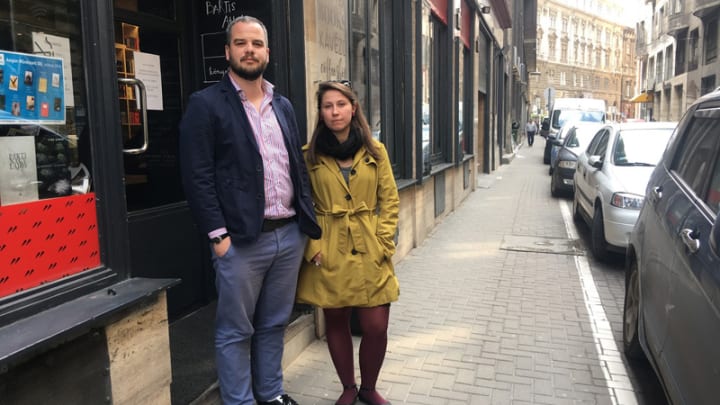
Zoltan Mester (left) and Vilja Arato, employees of the With the Power of Humanity Foundation. Michael Igoe/Devex
Among With the Power of Humanity’s staff, the debate over what is and is not an encroachment into party politics plays out constantly, Mester said. “Every day it’s a big fight … because especially in this time and especially in Hungary, everybody thinks that political is something bad … In Hungary if you say ‘political,’ you think about … party politicians.”…
“George Soros could have done many other things with his fortune, but that was the vision from the start — that those two were going to be the pillars of the ways in which he would then seek to define open society,” Vaquer said. “If you look at our budget 30 years later, that’s still what we are doing overwhelmingly. We’re still supporting civil society organizations and individuals. We haven’t changed that.”
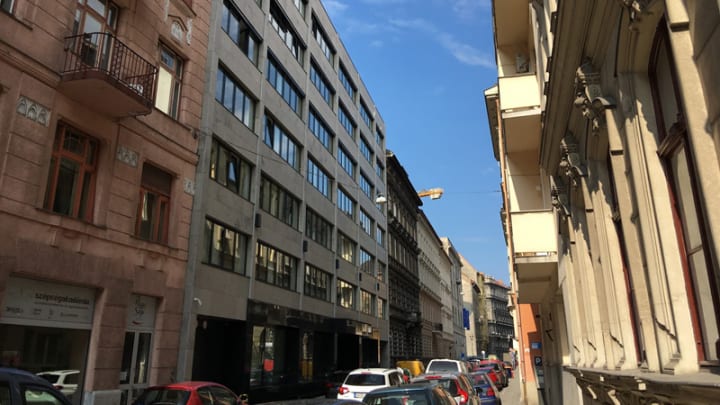
The Open Society Foundations office in Budapest, Hungary. Devex/Michael Igoe
Faced with a constant barrage of accusations that they are part of George Soros’ secret plan to meddle in national politics, some of Open Society’s grantees find themselves responding to the obligatory questions that follow…..In accusing the foundation of orchestrating a global campaign to transform Europe and erode countries’ national sovereignty, OSF’s enemies ascribe much more power and reach to the organization than its employees and grantees would ever claim to have. It is tempting to do the same thing when asking if Open Society has been successful in achieving its goals. The declines in democratic freedom currently underway in many countries where Open Society operates might raise questions about whether the foundation and its benefactor have been operating with the right theory of change.
….
With the erosion of the values and norms it promotes, Open Society is not necessarily thinking differently about how the foundation measures its impact, but its leaders are coming to terms with a more realistic view of what is possible. “I think it has made us extremely aware of the limitations of what can be achieved with cross-border philanthropic activity,” Vaquer said. “It was perhaps a product of the exceptional time that was the 1990s that OSF had such a disproportionate impact on some places, in terms of being part of their political transformation, but that was probably exceptional.”
[Michael Igoe is a Senior Reporter with Devex, based in Washington, D.C. He covers U.S. foreign aid, global health, climate change, and development finance. Prior to joining Devex, Michael researched water management and climate change adaptation in post-Soviet Central Asia, where he also wrote for EurasiaNet. Michael earned his bachelor’s degree from Bowdoin College, where he majored in Russian, and his master’s degree from the University of Montana, where he studied international conservation and development.]
On 18 May 2018 several newspapers – such as The Guardian and Scoop (NZ) – carried a piece by Andrew Gilmour, UN Assistant Secretary-General for Human Rights based in New York, which describes with great frankness how human rights defenders in Asia are under attack. To quote liberally:
In February, hundreds of Filipino participants in the peace process, environmental activists and human rights defenders were labeled “terrorists” by their own government. The security of the individuals on this list is at stake, and some have fled the Philippines. The UN independent expert on the rights of indigenous peoples – Victoria Tauli-Corpuz – was on this list. This followed the vilification only months before of another UN independent expert – Agnès Callamard – who deals with extra-judicial executions. Philippine President Rodrigo Duterte declared that he wanted to slap her, and later announced that he would like to throw other UN human rights officials to the crocodiles. The national Commission on Human Rights in the Philippines was threatened with a zero budget and its former chair, Senator Leila de Lima, is in detention for her advocacy. [see also: https://humanrightsdefenders.blog/2018/03/10/there-seems-to-be-no-limit-to-what-duterte-is-willing-to-say-and-may-get-away-with/]
…..If governments in the region can target high profile human rights defenders and those associated with the UN with impunity, what is the message to others at community level who are not afforded the same visibility? ..
In the run up to the 2018 national elections in Cambodia, the Government has cracked down on the opposition, independent media and civil society. ..
In Myanmar, there were reports of violent reprisals by Tatmadaw, the armed forces, against civilians who met with Yanghee Lee, UN independent expert on Myanmar, following her visit to Rakhine State. …..
Bogus accusations of abetting terrorism are a common justification that we hear from governments to defend the targeting of the UN’s important civil society partners. We have countless cases of advocates charged with terrorism, blamed for cooperation with foreign entities, or accused of damaging the reputation or security of the state.
I recently met with a group of human rights defenders from across South-East and South Asia about their experiences, which in some cases have been made worse by speaking out or if they share information with the UN. The stories about these reprisals were common – they have been charged with defamation, blasphemy and disinformation. They are increasingly threatened and targeted for their work, indeed some have been labeled as terrorists. There were also accusations of activists being drug addicts or mentally unwell.
Some governments feel threatened by any dissent. They label human rights concerns as “illegal outside interference” in their internal affairs; or as an attempt to overthrow regimes; or as an attempt to impose alien “Western” values.
Opposition to economic development and investment projects seems to incite particular ire. Agribusiness, extractive industries, and large-scale energy initiatives, including those that involve indigenous peoples’ land, often bear the brunt of the backlash.
Women’s rights activists and advocates of the rights of lesbian, gay, bisexual, transgender and intersex persons seem to be particularly targeted. Many are ostracized by their communities, labelled as outcasts, or branded as immoral. Sexual violence is part of this backlash, including rape threats.
Those working for religious freedom have been called ‘anti-Islam’, they and their families threatened or harassed. When advocacy for religious tolerance intersects with that of women’s rights and sexual freedom, the stakes can be even higher.
……
We are taking these allegations seriously, and addressing particular incidents of reprisals with governments. Civil society has to be heard – for the sake of us all.
Activists in Pakistan are under threat from a targeted campaign of digital attacks, which has seen social media accounts hacked and computers and mobile phones infected with spyware, a four-month investigation by Amnesty International reveals.
In a report titled ‘Human Rights Under Surveillance: Digital Threats against Human Rights Defenders in Pakistan’, released on Tuesday, 15 May 2018, Amnestyreveals how attackers are using fake online identities and social media profiles to ensnare Pakistani human rights defenders online and mark them out for surveillance and cyber crime.
“We uncovered an elaborate network of attackers who are using sophisticated and sinister methods to target human rights activists. Attackers use cleverly designed fake profiles to lure activists and then attack their electronic devices with spyware, exposing them to surveillance and fraud and even compromising their physical safety, Sherif Elsayed-Ali, Director of Global Issues at Amnesty International, said. “Our investigation shows how attackers have used fake Facebook and Google login pages to trick their victims into revealing their passwords. It is already extremely dangerous to be a human rights defender in Pakistan and it is alarming to see how attacks on their work are moving online,” he said.
RightsCon, held this year in Toronto from 16 – 18 May 2018, brings together an international audience to discusses all topics related to human rights in the digital age, such as surveillance, AI, censorship, access to the internet, etc. Citizen Lab researchers, fellows, and associates will be participating in panels and events throughout the week.Citizen Lab is the organization that helped Ahmed Mansoor with his iPone spyware in 2016: https://humanrightsdefenders.blog/2016/08/29/apple-tackles-iphone-one-tap-spyware-flaws-after-mea-laureate-discovers-hacking-attempt/.
Miles Kenyon on 11 a run-down of topics and where you can find them:
For those who think that muzzling human rights defenders is an exclusively non-western affair, look at these examples: Poland and Israel.
On 9 May 2018 Katharina Rall, environment researcher at Human Rights Watch, critically looks at Poland‘s efforts to hamper the freedom of expression and demonstration by human rights defenders at the forthcoming climate summit, known as the COP24. It will bring together state parties to the UN Framework Convention on Climate Change (UNFCCC), and thousands of experts, journalists, businesses and nongovernmental groups. UN experts cite concerns about the ban on spontaneous assemblies in Katowice during the talks, which will make it difficult for groups to respond to developments at the negotiations. In a letter sent to the Polish government last month they said that by “curtail[ing] the possibility of spontaneously expressing views about the unfolding of the climate talks and organizing peaceful assemblies to this effect”, the new law appears to go beyond the rights restrictions necessary to ensure security and safety at the conference. The UN experts also noted that the law “appears to give sweeping surveillance powers to the police and secret services to collect and process personal data about all COP24 participants”. This is a serious issue for the safety of climate activists at the summit. [The Polish government has yet to respond to the UN rights experts. But a reply from the Polish environment minister to similar concerns raised by the Bureau of the Aarhus Convention, a regional human rights and environmental body, has done little to dispel them.]
Just the day before, 8 May 2018, AP reported that Israel’s Interior Minister, Arieh Deri, has ordered the head of the local office of Human Rights Watch to leave the country within 14 days for allegedly supporting boycotts of Israel. HRW responded that it stands by Omar Shakir, a U.S. citizen of Iraqi descent, and accused Israel of trying to muzzle criticism of its human rights record. It says neither it nor Shakir support boycotts, and that it will challenge the decision in court. Iain Levine, a Human Rights Watch official, says Israel’s actions, such as compiling a dossier on Shakir, and “deporting human rights defenders is a page out of the Russian or Egyptian security services’ playbook.” [In April last year his appointment had already let to controversy, see: https://humanrightsdefenders.blog/2017/04/27/human-rights-watch-granted-israeli-work-permit-in-the-end/]
I reported already on the creation of a new award in Mexico [https://humanrightsdefenders.blog/2018/03/24/new-national-award-to-honor-slain-mexican-journalists/]. On 3 May 2018, the Mexican journalist Daniela Rea, known for her chronicles of the violence gripping her native country, was awarded the first edition of the Breach-Valdez Prize in Journalism and Human Rights. “We are gathered here today for them, for a prize born out of pain,” Rea said on accepting the award from Valdez’s widow. “But we are also here for all those other colleagues, many of them anonymous, who continue going out into the street, notebooks in hand, to ask questions, to write, to try to understand the workings of this machinery of death… despite our narco-government.”
(Rea, 35, was born in Guanajuato, in central Mexico, but launched her journalism career in the eastern state of Veracruz, one of the most violent in the country because of turf wars between rival drug cartels. From 2005 to 2012 she worked in Mexico City for respected newspaper Reforma, focusing on the consequences of the Mexican government’s decision in 2006 to deploy the military to fight drug trafficking. “I didn’t make a conscious choice and say ‘I’m going to write about human rights.’ It was the natural result of writing about Mexican life,” Rea told AFP.)

 Zoltan Mester (left) and Vilja Arato, employees of the With the Power of Humanity Foundation. Michael Igoe/Devex
 The Open Society Foundations office in Budapest, Hungary. Devex/Michael Igoe
 Hans Thoolen on Human Rights Defenders and their awards