Archive for the 'Front Line' Category
April 8, 2016

reports that on 8 April 2016 that human rights defender He Xiaobo (not to be confused with Nobel Laureate Liu Xiaobo) was released on bail after over four months in custody in Guangzhou, Guangdong province. The workers’ rights campaigner had been detained on 3 December 2015 along with a number of colleagues and on 8 January he was formally charged with ’embezzlement’. Two other human rights defenders detained at that time, Zeng Feiyang and Meng Han remain in detention and are facing charges of “gathering a crowd to disrupt social order”. He Xiaobo runs Nanfeiyan Social Work Service Centre, an NGO campaigning for compensation on behalf of workers who have been injured during the course of their work. The centre’s registration was rescinded in 2015. https://www.frontlinedefenders.org/en/case/case-history-he-xiaobo.
It is not a breakthrough in the treatment of human rights defenders in China (https://thoolen.wordpress.com/2015/01/19/the-plight-of-chinas-human-rights-lawyers-worsened/) but even small good news is welcome. On the other hand, also today Chinese Human Rights Defenders (CHRD人权捍卫者@CHRDnet) reports that 6 human rights defenders collectively received 20.5 years in prison for exercising their rights to free speech, assembly and association
Posted in awards, Front Line, human rights, Human Rights Defenders | Leave a Comment »
Tags: China, Chinese Human Rights Defenders, freedom of association, Front Line (NGO), He Xiaobo, Human Rights Defenders, human rights lawyers, labour activists, Liu Xiaobo, Meng Han, Nanfeiyan Social Work Service Centre, release on bail, Zeng Feiyang
March 18, 2016
During the adoption of the Universal Periodic Review (UPR) report of Rwanda at the UN Human Eights Council, Laurent Munyandilikirwa, former President of the Ligue Rwandaise pour la Promotion et la Défense des Droits de l’homme, delivered on 16 March 2016 a statement (on behalf of CIVICUS: World Alliance for Citizen Participation and East and Horn of Africa Human Rights Defenders Project):.
Mr President, for the vast majority of my professional and personal life, I have proudly dedicated myself to protecting and promoting fundamental human rights in Rwanda. As the former President of LIPRODHOR, one of Rwanda’s only independent human rights monitoring organisations, I had the great privilege of supporting my fellow citizens to secure and claim their rights. However, despite the severe human rights deficits which continue to undermine Rwanda’s democratic consolidation, the important work LIPRODHOR and other human rights groups undertook in Rwanda is now largely untenable and fraught with danger.
Since Rwanda’s last UPR examination in 2011, the government has strengthened its long-term and systematic campaign to completely stifle freedom of association, by replacing the leadership of human rights organisations with those sympathetic to the government. As a result, there are now very few freely functioning and entirely independent human rights organisations left that can meaningfully challenge government policies and advocate for reforms, without well-founded fear of reprisals. In addition, since Rwanda’s last examination, independent civil society organisations, NGOs, and individual human rights defenders have continued to face escalating intimidation and reprisals in the course of their work. A number of defenders, including myself, have either been imprisoned or forced into exile. Increasingly, human rights defenders and the NGOs for which they work have been subjected to administrative harassment smear campaigns and public denouncement in pro-government media.
We therefore strongly urge the Government of Rwanda to take effective and meaningful steps to operationalize the important recommendations put forward during this examination in support of the creation of a safe and enabling environment for civil society and human rights defenders.
This is line with e.g. Front Line Defenders’ report of 10 September 2015 about the Rwandan police disrupting the general assembly organised by LIPRODHOR . [On 5 September 2015, Rwandan police officers disrupted a general assembly that had gathered several dozen members of the League for the Promotion and Defence of Human Rights in Rwanda. The purpose of the general assembly was to elect a new independent board of directors.[LIPRODHOR is one of the few human rights organisations in Rwanda, which has continuously endeavoured to hold the government accountable for a wide range of human rights abuses. After numerous human rights groups based in Rwanda were either co-opted or forced into silence, LIPRODHOR stood out as the sole Rwandan organisation committed to being independent. In 2004, the government targeted its leaders and accused them on fabricated charges of “propagating genocide ideology.” The outgoing members of the board of directors of LIPRODHOR have allegedly been acting on behalf of the government. The general assembly which took place on 5 September 2015 had been convened by the outgoing board, whose term ended in July 2015, in order for a new board to be elected. During the assembly, participants elected three board members, namely the chair, the vice-chair and the secretary general. Following this, a number of participants, led by the chair of the outgoing board, reportedly stood up and caused a commotion as they claimed that the vote had been rigged. Soon after the incident, these participants reportedly called the police, who intervened and disrupted the assembly. A senior police officer informed the participants who had remained inside that he had to put an end to the meeting as it was “causing insecurity”. Members of the organisation have contacted the authorities about the incident, but, to date, no measures have been taken to assure the organisation’s rights to conduct its activities. It remains unclear whether LIPRODHOR’s members will be allowed to convene again and complete the election of the new board which will allow them to carry out their legitimate human rights work without restriction.
In November 2014, several members of LIPRODHOR attempted to convene a similar assembly in order to address the ongoing problem. However, local authorities thwarted the initiative, informing them that the gathering would be deemed illegal. Thereafter, Messrs Evariste Nsabayezu and Daniel Uwimana, respectively LIPRODHOR’s vice chair and provincial representative at the time, were arrested and detained over allegations that they were involved in organising the assembly using what the police claimed were “falsified documents.” They were later released without trial. Several other members of LIPRODHOR were also reportedly threatened with arrest.]
Posted in Front Line, Human Rights Council, Human Rights Defenders | Leave a Comment »
Tags: CIVICUS, Civil society, East and Horn of Africa Human Rights Defenders Project, Front Line (NGO), intimidation, Laurent Munyandilikirwa, LIPRODHOR, reprisals, Rwanda, UPR
March 17, 2016
An update on the situation human rights defenders in Russia is unfortunately needed too frequently. Recently the Martin Ennals Foundation condemned the attacks on its 2013 Laureate, the Joint Mobile Group (JMG) which is known for its courageous work in opening legal cases on behalf of victims of torture in Chechnya. On March 9th, they were travelling together with journalists and the group was physically attacked, their confidential notes stolen, and the vehicles they were in burned. Their offices in Ingushetia were also attacked. The international and local media have reported (see list at bottom of the post). This is part of an ongoing pattern of threats and intimidation directed against JMG.
Now, Human Rights Watch and others report that yesterday (16 March) Igor Kalyapin, head of the Committee for the Prevention of Torture, one of the founders and participants of the Joint Mobile Group, was attacked as he was leaving his hotel in Grozny. They also pelted him with eggs, and threw flour and bright antiseptic liquid on him, which stained his face and clothes. “The attack on Igor Kalyapin shows again that it’s open season on human rights defenders in Chechnya,” said Hugh Williamson, of Human Rights Watch. “The authorities’ utter failure to hold anyone to account for a series of vicious attacks in recent years is like a bright green light for further attacks.”
Read the rest of this entry »
Posted in AI, FIDH, Front Line, HRW, human rights, Human Rights Defenders, MEA, Observatory for the Protection of Human Rights Defenders, OHCHR, OMCT | 4 Comments »
Tags: attack, Chechnya, closing, Committee against Torture, Elena Shakhova, foreign agent law, Human Rights Defenders, Igor Kalyapin, Joint Mobile Group, Maria Razumovskaya, Martin Ennals Award, MEA Laureate 2013, Observatory for the Protection of Human Rights Defenders, Olga Nikolaenko, Russia, Vladimir Putin
March 16, 2016
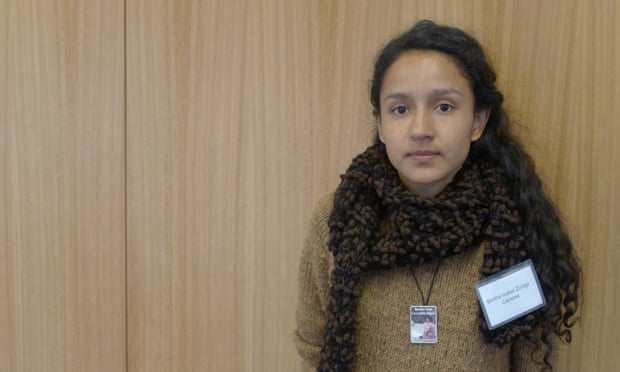
Bertha Cáceres, daughter of murdered Honduran environmental activist Berta Cáceres. Photograph: Liz Ford for the Guardian
This week, Bertha, who is studying for a masters degree in Latin American studies in Mexico, was in New York to speak at side events during the annual Commission on the Status of Women. Here she said “… I will talk about the situation in Honduras. This is not the first assassination, but one of a series of assassinations of human rights defenders … I don’t want another human rights defender to be assassinated”. Even while she spoke with the Guardian journalist a call came through from COPINH’s lawyer (the NGO her mother worked for) to say another member of the organisation had been shot dead ….
According to a statement by Front Line Defenders today, this human rights defender, Nelson Garcia, was returning home following a violent eviction conducted by the Public Order Military Police and the Cobras Special Force in the municipality of Río Lindo when he was intercepted by unidentified men who shot him in the face four times. Read the rest of this entry »
Posted in Front Line, Human Rights Defenders | Leave a Comment »
Tags: Agua Zarca, assassination, Berta Cáceres, COPINH, Development Cooperation, environmental issues, FMO, Front Line (NGO), Honduras, killing, land rights defender, Ministry of Foreign Affairs Netherlands, Nelson Garcia, the Guardian
March 16, 2016
reports on the use of fabricated charges against human rights defender Joel Ogata in Kenya. The story serves as a perfect illustration of how extractive industries (or the States on their behalf) keep human rights defenders tied up in court proceedings through judicial harassment and even manage to get them detained. Read the rest of this entry »
Posted in Front Line, Human Rights Defenders | Leave a Comment »
Tags: environmental issues, fabricated charges, Front Line (NGO), Human rights defender, illegal detention, Joel Ogata, judicial harassment, Kenya, Kurawa Salt Mining Company, land rights defender, Malindi Rights Forum (MRF), profiles
March 15, 2016
Yesterday, 14 March 2016 was the second anniversary of the death of Cao Shunli, a Chinese human rights defender who was detained and denied adequate medical treatment in police custody for five months, before dying in a military hospital in Beijing in 2014. This happened shortly after she was shortlisted for the Martin Ennals Award in that year. [see also https://thoolen.wordpress.com/2016/02/12/cao-shunli-a-profile-and-new-award-in-her-name/]. Has the situation improved…? Read the rest of this entry »
Posted in Front Line, human rights, Human Rights Defenders, THF | 1 Comment »
Tags: Cao Shunli, China, detention, Documentary film, Front Line Defenders, Guo Feixiong, Human Rights Defenders, human rights lawyers, remembrance, reprisals, THF, UPR, video, Wang Yu, woman human rights defender
March 3, 2016
A sad day for Honduras and all human rights defenders: today, 3 March 2016, Berta Cáceres was murdered by as yet unknown assailants who broke into her home in the city of La Esperanza in the early hours of the morning. One week prior to her assassination, the defender had denounced the killing of 4 leaders of her community as well as threats against her and other human rights defenders, at a press conference.

Berta Cáceres was one of the most prominent human rights defenders in Honduras and a Lenca indigenous woman who, for the past 20 years, had been defending the territory and rights of the Lenca people. In 1993, she co-founded the Consejo Civico de Organizaciones Populares e Indígenas de Honduras – COPINH (http://www.copinh.org/) (Civic Council of Popular and Indigenous Organisations of Honduras), which led fierce campaigns against illegal logging and mega-projects for their detrimental effects on the rights of indigenous peoples in the country. She faced off – and often won – against illegal loggers, plantation owners, multinational corporations, and dam projects that would cut off food and water supplies to indigenous communities. (e.g. https://thoolen.wordpress.com/2014/01/28/berta-caceres-in-honduras-continues-to-be-harassed-in-spite-of-court-order).
The human rights defender was a finalist for the 2014 Front Line Defenders Award [https://www.frontlinedefenders.org/es/programme/fld-award] and in 2015 she received the Goldman Environmental Prize. She had been a beneficiary of precautionary measures granted by the Inter-American Commission on Human Rights (IACHR) since 2009. Her harassment was followed closely by Front Line and others.
Other human rights defenders (including members of COPINH) have been targeted in the past. The killing of human rights defenders and impunity for the perpetrators have been documented by many organizations. In this blog alone:
https://thoolen.wordpress.com/2016/01/29/assassination-of-human-rights-defenders-proceed-in-honduras-venezuela-peru-colombia-and-the-philippines/
https://thoolen.wordpress.com/2016/02/27/alarming-criminalisation-of-human-rights-defenders-in-latin-america/
“the most dangerous place to be an environmental activist was actually Honduras, according to Global Witness” [https://thoolen.wordpress.com/2015/04/24/killings-of-environmental-human-rights-defenders-up-again-compared-to-last-year/]
Honduras: Berta Caceres, human rights defender & indigenous leader who opposed Agua Zarca dam, assassinated | Business & Human Rights Resource Centre
Posted in awards, Front Line, human rights, Human Rights Defenders | 3 Comments »
Tags: assassination, Berta Cáceres, COPINH, Front Line (NGO), Global Witness, Goldman Environmental Prize, Honduras, indigenous groups, judicial harassment, killing, land rights defender, woman human rights defender
February 23, 2016
The article starts by mentioning the attack on Soni Sori (see more below on her). Reports suggest that oil paint mixed with chemicals was thrown on her face by unknown assailants. This attack, … and other reports of intimidation of persons such as lawyers and journalists working in the Jagdalpur area raises the question of the safety of human rights defenders and shows that there isn’t enough being done by the State machinery to defend the defenders….
Srishti Agnihotri then makes the interesting point that “it is not necessary to be correct to qualify as a human rights defender”. E.g. the criticism of Human Rights Defenders on a particular development project may not be legally correct. However, this does not and should not disentitle them to the protection of the State against violence and reprisals. The reason for this will become clear when we examine the role human rights defenders play in a society.
These Defenders face problems, in many parts of the world, and India is not an exception. Often the work being done by human rights defenders brings them in conflict with vested interests such as the land mafia, the mining lobby, or other corporations. A case in point is the story of Satyendra Dubey, an officer in the Indian Engineering Service, who lost his life due to exposing corruption in a highway construction project. At other times, the advocacy done by them requires them to be critical of the State action including in areas where there is considerable unrest….
This gives room for propaganda that human rights defenders or NGOs are ‘anti-development’ or even ‘anti-national’. It leads to them facing the wrath of more draconian security legislations, or attacks on them by vested interests. It is very easy to make the mistake of thinking ‘Why should we use state resources to protect those who are critical of the State? The obvious answer, is that the State may not always be correct. Given the great power state and corporate entities enjoy, their ability to make mistakes if unchecked is also correspondingly large. A hard reckoning of the work done by human rights defenders shows that they act as an essential check and balance on the State, and throw light on existing state-industry nexus, to protect the rights of people. The State derives its legitimacy from an implicit contract with its citizens, which necessitates a mechanism to check that the State adheres to this contract, and this is a function carried out by the human rights defenders. In this sense, human rights defenders are necessary for a healthy functioning democracy.
………
While there are general laws that can be (and are) used to protect these defenders, but those working for the enactment of a special law argue that the role of the law is also to play a certain ‘normative, expressive and educative’ function. By this, they mean that a special law to protect human rights defenders will also confer legitimacy on the work that they are doing, and create an enabling environment where they may do so peacefully.
Of course, the enactment of a special law is not adequate to ensure the protection of human rights defenders. It has to go hand in hand with better law and order, better legal services in areas where these defenders work, transparency in governance, toleration of dissent by the State machinery, and continued proactive action by the Focal Point for the protection of Human Rights Defenders, at the National Human Rights Commission.
This focal point is involved in providing assistance to such Rights defenders, and following alleged violations of their rights. Although there has been greater collaboration between the NHRC and Human Rights defenders, much needs to be done to ensure that defenders can work in a safe and enabling environment.
The Times of India of 10 February 2016 takes to task the State of Chhattisgarh – echoing Amnesty India – that it should do more to protect a woman journalist, Malini Subramaniam, in Bastar. “This attack is another indicator of the increasingly hostile atmosphere in which journalists and human rights defenders operate in Chhattisgarh,” said Makepeace Sitlhou, Campaigner at Amnesty International India. Malini herself said: “This is not an attack on me as a person but as a journalist reporting incidents on the ground, something that they don’t want“. [The statement said, a group of over 20 people gathered outside the home of journalist Malini Subramaniam on February 7. They urged her neighbours to stone her house and chanted slogans suggesting that she was an agent for Maoist armed groups. Later that day, an anti-Maoist group released a public statement accusing her of presenting a distorted picture of Bastar and promoting Maoist ideology.]
On 21 February 2016 Saurav Datta in Catchnews poses the question “Why is Chhattisgarh govt scared of human rights defenders?“. Isha Khandelwal, Shalini Gera and Nikita Agarwal, all in their late 20s, keep looking furtively behind their backs while packing her bags from Jagdalpur in western India’s Chhattisgarh district. They are afraid that a posse of policemen may descend upon them and subject them to custodial torture. They also fear that that they would be implicated under various provisions of the Chhattisgarh Special Security Act, a law roundly criticised by civil liberties activists as being dangerously oversweeping in its scope and ambit. The moot question here is – why should be a ragtag coalition of lawyers, operating on a shoestring budget, be subjected to state repression? The piece then goes into the background of the Indian system of legal aid and how the state administration undercuts all this in practice.
has covered a lot cases in India including in the State of Chhattisgarh such as those of Malini Subramaniam and the members of the Jagdalpur Legal Aid Group mentioned above (https://www.frontlinedefenders.org/node/29909 and https://www.frontlinedefenders.org/node/306160).
Front Line – on 22 February 2016 – also reported the attack on human rights defender Soni Sori who was assaulted on 20 February by three unidentified men as she travelled from Jagdalpur to her home. The perpetrators halted the vehicle and threw a black substance on her face, resulting in intense burning and her hospitalization. She is a human rights defender who advocates for the rights of indigenous peoples in India, with a focus on women’s rights. She works in Chhattisgarh, where the long-term conflict between Maoists and government security forces has greatly affected the indigenous people in the area. During the attack, the perpetrators threatened to carry out a similar assault on the daughter of Soni Sori, lest the human rights defender halt the efforts she had undertaken to bring justice against a high-ranking police official from the Bastar district of Chhattisgarh. Soni Sori had recently been attempting to file a complaint against the police official in relation to their involvement in an alleged extra-judicial killing in the Mardum area of Bashar. In July 2015, the police official in question allegedly called for the “social exclusion” of the human rights defender and members of her family. [Soni Sori has previously been targeted by the authorities on several occasions https://www.frontlinedefenders.org/taxonomy/term/18892 and https://www.frontlinedefenders.org/node/29351]
On 8 January 2016, the Observatory for the Protection of Human Rights Defenders (a joint programme of the World Organisation Against Torture (OMCT) and the International Federation for Human Rights (FIDH), called on the Indian government to release on bail and stop the ongoing judicial harassment of Mr. Ajimuddin Sarkar. Mr. Sarkar is a renowned human rights defender who has investigated cases of human rights violations perpetrated by the police and Border Security Forces (BSF), and who has been instrumental in denouncing several other human rights violations in Murshidabad district. He was arbitrarily arrested on 22 September 22 and only on 8 December, 2015 released on bail, since the de facto complainant filed an affidavit stating that she did not bring any allegation of rape against Mr. Sarkar and she had no knowledge of the related criminal case against him. Mr. Sarkar is currently receiving medical treatment, both physical and psychological, as his mental and physical health conditions deteriorated significantly during the past months in detention.[The Observatory recalls that it is not the first time Mr. Sarkar has been intimidated, judicially harassed and ill-treated by the police – see background information].
See also my earlier: https://thoolen.wordpress.com/2016/01/17/india-human-rights-defenders-being-silenced-by-the-court/
Sources:
http://www.newsgram.com/who-is-defending-the-defenders-in-india-human-rights/ (first published at Kafila.org.)
Why is Chhattisgarh govt scared of human rights defenders?
http://timesofindia.indiatimes.com/city/raipur/Chhattisgarh-must-act-against-intimidation-of-woman-journalist-in-Bastar-Amnesty-says/articleshow/50934124.cms
http://www.omct.org/human-rights-defenders/urgent-interventions/india/2016/01/d23556/
Posted in AI, FIDH, Front Line, human rights, Human Rights Defenders, Observatory for the Protection of Human Rights Defenders, OMCT | Leave a Comment »
Tags: Ajimuddin Sarkar, Chhattisgarh State, enabling environment, Front Line, Human Rights Defenders, India, Indigenous rights, Jagdalpur Legal Aid Group, journalists, Malini Subramaniam, National security, Observatory for the Protection of Human Rights Defenders, Satyendra Dubey, Soni Sori, Srishti Agnihotri, state protection, woman human rights defender
February 15, 2016
While human rights organizations and the media around the world were remembering Egypt‘s Tahrir Square [https://thoolen.wordpress.com/2016/01/28/five-years-after-tahrir-square-there-is-stability-in-egypt-but-do-not-ask-at-what-price/] the space for demonstrations in Egypt itself was minimal. But a huge exception was made on 13 February 2016 when some 10.000 people gathered at noon in front of the Doctors Syndicate in Cairo. Heartening to see that the doctors have the courage to take up the case against police brutality. But you are unlikely to hear about this from an Egyptian human rights defender in person as they are systematically banned from traveling. Read the rest of this entry »
Posted in AI, FIDH, Front Line, HRW, human rights, Human Rights Defenders, OMCT | Leave a Comment »
Tags: demonstration, Esraa Abdel Fattah, Gamal Eid, Heba Morayef, Human Rights Defenders, Kareem Hamdy, medical profession, Mohamed Lotfy, NGOs, Omar Hazek, police brutality, Tahrir Square, torture, travel ban
February 13, 2016
Israel has used excessive force against Palestinians, Makarim Wibisono, the outgoing UN Special Rapporteur on Human Rights in Gaza and the West Bank said, calling for an investigation. He demanded that all Palestinian prisoners, including children, be charged or released. “The upsurge in violence is a grim reminder of the unsustainable human rights situation in the Occupied Palestinian Territory and the volatile environment it engenders”. Makarim Wibisono has announced he is resigning in protest at the Israeli government’s response to his concerns (his term would have expired on 31 March). The special investigator quoted statistics by the Israeli human rights group B’Tselem, which say that about 5,680 Palestinians, including children, were detained by Israel as of the end of October 2015. Detaining these people “often under secret evidence, and for up to six-month terms that can be renewed indefinitely, is not consistent with international human rights standards,” Wibisono said, adding that the Israeli government “should promptly charge or release all administrative detainees.” Israeli Foreign Ministry spokesman Emmanuel Nahshon branded Wibisono’s report as biased. “The report reflects the one-sidedness of the mandate and its flagrant anti-Israel bias. It is this one-sidedness which has made the rapporteur’s mission impossible to fulfill, hence his resignation,” he said.
Front Line reports that on 3 February 2016, human rights defender Mr Awni Abu Shamsiyya, son of human rights defender Mr Emad Abu Shamsiyya, was arrested alongside youth activist Mr Nizar Silhab Al-tamimi. The arrest took place after a raid on the Shamsiyya family home in Tel-Rumeida, Hebron. Awni Abu Shamsiyya and Nizar Silhab Al-tamimi were accused of throwing a Molotov cocktail at Israeli soldiers and of posting inflammatory statements on Facebook. [Awni Abu Shamsiyya is a 16 year old, known for his participation in the Palestinian non-violent popular resistance movement in Hebron. He is also an active member of the Human Rights Defenders Group, a non-partisan group that aims to document and expose violations of international law and injustice against families in areas of conflict under Israeli occupation. His father, Emad Abu Shamsiyya, is a long-standing activist in Palestine and volunteer at B’Tselem, the Israeli Information Center for Human Rights in the Occupied Territories, where he is involved in documenting the occupation of Tel-Rumeida. He is also a deputy coordinator of the Human Rights Defenders Group.In May 2015, Emad Abu Shamsiyya’s family home was subjected to an attempted arson attack by settlers in the middle of the night. In March 2015, a group of soldiers invaded his family home, searched the house and confiscated the family’s computer hard disk and a memory card containing footage filmed by B’Tselem volunteers. http://www.btselem.org/hebron/20150402_night_search_and_confiscation]
On 4 February 2016, Awni Abu Shamsiyya and Nizar Silhab Al-tamimi were interrogated by Israeli police and intelligence services before being brought before the military court of Ofer, where the accusations against the young activists of throwing a Molotov cocktail at Israeli soldiers and posting inflammatory statements on social media were presented, and a fine of appr €460 was requested by the military prosecutor. The court ordered Awni Abu Shamsiyya’s release after holding that the accusations against him had not been proven, however, the trial of Nizar Silhab Al-tamimi was postponed to 7 February 2016 after it was claimed by the military prosecutor that his confession had been obtained.
As an illustration of the context in which the violence and arrests occur see the report of Tuesday, 9 February 2016, by the International Solidarity Movement, al-Khalil team (Hebron), which published graphic pictures of Israeli forces patrolling the Palestinian market in occupied al-Khalil (Hebron), harassing and intimidating residents.

Israeli forces on their patrol through the Palestinian market
Any male adult or youth was stopped on their way to work and forced by the Israeli soldiers to lift up their shirts and trouser-pants, as well as throw their IDs on the ground. After throwing their IDs on the ground Israeli soldiers ordered the men to move back, so they could pick up the IDs from a ‘safe distance’. Most Palestinians were dismissed after this humiliating procedure, whereas some of them were detained for minutes or violently body-searched.
Also interesting to note here the protest by Palestinian human rights defenders who are condemning the killing by Hamas of one of the resistance organization’s own members in Gaza. On Sunday, the Qassam Brigades, the military wing of Hamas, announced it had executed Mahmoud Rushdi Ishteiwi. Qassam said that the slaying of Ishteiwi implemented a death sentence issued by “the military and Sharia judiciaries of Qassam Brigades for behavioral and moral excesses that he confessed.”
“Killing Ishteiwi in such a way constitutes an assault on the rule of law and might institutionalize a serious case of extrajudicial execution,” said the Palestinian Centre for Human Rights (PCHR). “Prosecuting collaborators with the Israeli forces is necessary, and the Palestinian armed groups play an important role in such prosecution,” PCHR stated. “However, only official authorities should open investigations and hold the perpetrators to account.” Following news of Mahmoud Ishteiwi’s execution, Buthaina Ishteiwi told the Wattan news outlet that she believed her brother had been killed due to a dispute with his superiors.
[Under the laws of the Palestinian Authority, death sentences issued by courts can only be carried out after ratification by the PA president. The West Bank-based PA leader Mahmoud Abbas has not ratified any death sentences in a decade. Hamas has however continued the use of the death penalty in Gaza. According to PCHR, a total of 172 death sentences have been issued since the PA was established in 1994, of which 30 were in the West Bank and 142 in Gaza. Eighty-four death sentences were issued since Hamas took over in Gaza in 2007. But however serious the threat from informants, Palestinian human rights defenders have been adamant that even wartime collaboration must be dealt with according to the rule of law. Both PCHR and Al Mezan have moreover long advocated the total abolition of the death penalty in all cases. In a short film entitled “Against the Death Penalty” and released in December, PCHR highlights its campaign to end the practice once and for all.]
https://www.rt.com/news/332245-israel-excessive-force-palestine/
Source: Palestinian human rights defenders condemn execution by Hamas | The Electronic Intifada
http://palsolidarity.org/2016/02/intimidating-military-patrol-of-palestinian-market/
Posted in films, Front Line, human rights, Human Rights Defenders, UN | Leave a Comment »
Tags: Against the Death Penalty, al-Khalil, arbitrary execution, Awni Abu Shamsiyya, B’Tselem, death penalty, Emad Abu Shamsiyya, film, Front Line (NGO), harassment, Hebron, Israel, Israeli-occupied territories, Mahmoud Rushdi Ishteiwi, Makarim Wibisono, military, Palestinian Centre for Human Rights, Special Rapporteur, violence


 Hans Thoolen on Human Rights Defenders and their awards