Anna Neistat, Senior Director of Research at Amnesty International, writes in the Huffington Postof 23 February 2017 about 4 Human Rights Defenders who deserve a “Lifetime Achievements” Oscar. Since it’s awards season, Amnesty International is paying tribute to four human rights heroes whose dramatic stories could – and should – be made into movies:
Itai Peace Dzamara
It’s been almost two years since Zimbabwean journalist and activist Itai Peace Dzamarawas dragged from a barbers’ chair by five armed men while he was getting a haircut. Dzamara, the leader of a pro-democracy movement called “Occupy Africa Unity Square”, had long been considered an enemy of the state by the Zimbabwean government. Just two days before his abduction he had delivered a speech at an opposition rally in Harare, calling for mass action against the deteriorating economic conditions in Zimbabwe. If this were a movie, justice would have been done long ago. Dzamara would have been returned to his wife and children, and the men who abducted him held accountable. But this isn’t Hollywood. This is Zimbabwe, where basic rights and freedoms have been trampled on throughout the long years of Robert Mugabe’s reign. As Itai Peace Dzamara and his family know, anyone who dares to speak out is a target for intimidation, harassment and arrest, and there’s no happy ending in sight. Despite a court ruling ordering state security agents to investigate Dzamara’s disappearance, there were gaps in the investigation and his whereabouts remains a mystery. [https://humanrightsdefenders.blog/2015/05/05/itai-dzamaras-disappearance-worrying-for-all-human-rights-defenders-in-zimbabwe/]
Berta Cáceres
GOLDMAN ENVIRONMENTAL FOUNDATION
Like the audience of a horror movie, the people around Berta could see that terrible danger was coming her way – but they were powerless to stop it. Honduras has the highest number of killings per capita of environmental and land activists in the world. The vast majority of these killings go unsolved and unpunished. One story that really stands out in this deadly context is that of Berta Cáceres. Berta was the leader and co-founder of an organisation that was campaigning against the construction of a hydroelectric project on the ancestral lands of indigenous communities in Honduras. In the early hours of 2 March 2016, she was murdered in her own home. Berta knew that she was putting her life in danger, but she was willing to take the risk to stand up for indigenous communities. Like the audience of a horror movie, the people around Berta could see that terrible danger was coming her way – but they were powerless to stop it. Despite the stark warning that her death served, environmental activists in Honduras say that stopping their work is not an option – no-one else will defend their communities and rights. They continue Berta’s work every day, reminding us that we should never take freedom for granted. It is essential that Berta’s assassination is solved, to show that there is a price to pay for attacking and killing environmental activists. Berta’s story ended in tragedy, but we will not stop fighting until we are sure that other activists will not meet the same fate. [https://humanrightsdefenders.blog/2016/03/07/exceptional-response-from-ngo-world-on-killing-of-berta-caceres/]
Sirikan Charoensiri
Sirikan Charoensiri, also known as “June”, is a young lawyer who has bravely stood up for human rights during a dark period of military rule in Thailand. In June 2015, she was on hand at a peaceful protest by pro-democracy student activists in Bangkok to monitor the situation and provide legal representation, if necessary. She now finds herself facing sedition charges and a potential trial in a military court alongside her clients. She also faces charges in two additional cases relating to her defence of the student activists and could be imprisoned for up to 15 years. As the Thai authorities have escalated their crackdown in the name of security, people who stand up for human rights in the country are increasingly falling foul of a government intent on silencing dissent. As June herself put it: “There is now an environment where risk is visible and imminent.” [https://humanrightsdefenders.blog/2016/12/01/international-day-of-women-human-rights-defenders-agents-of-change-under-pressure/]
Narges Mohammadi
Narges is a prisoner of conscience who should be lauded, not locked up, for her human rights work. In Iran, human rights defenders and other peaceful critics are subject to relentless harassment. Over the past year, those jailed after shockingly unfair trials before Revolutionary Courts including lawyers, bloggers, students, women’s rights activists, filmmakers and even musicians. Human rights defender Narges Mohammadi knows better than most how vengeful the Iranian authorities can be towards anyone who dissents. She is currently serving a total of 22 years in prison for speaking out against issues such as Iran’s prolific use of the death penalty and acid attacks on women. What makes her situation even worse is that she is critically ill and cannot receive proper medical care in prison. Just as cruelly, the authorities have at times denied her access to her young children, who had to leave Iran to live with their father in France after she was jailed. Narges is a prisoner of conscience who should be lauded, not locked up, for her human rights work. We will continue to fight until she is free.[https://humanrightsdefenders.blog/2014/06/12/retaliation-against-iranian-human-rights-defender-for-meeting-with-ashton/]
Itai, Berta, Sirikan and Narges are just a handful of the outstanding human rights defenders around the world who deserve recognition, but have instead been silenced by forces of cruelty, injustice and repression.
In 2013 I reported on human rights defender, Lena Hendry, in Malaysia who was charged with showing the film “No Fire Zone: The Killing Fields of Sri Lanka”, a film on human rights violations in Sri Lanka. [see: https://humanrightsdefenders.blog/2013/09/18/human-rights-worker-in-malaysia-to-appear-in-court-tomorrow-for-screening-the-film-no-fire-zone/#more-3469]. Now Front Line reports on 21 February 2017, that the human rights defender was convicted by the Magistrate’s Court in Kuala Lumpur [https://www.frontlinedefenders.org/en/profile/lena-hendry]. On 21 February 2017, Lena Hendry was found guilty by a magistrate’s court in Kuala Lumpur for screening “No Fire Zone: The Killing Fields of Sri Lanka” under Section 6 of the Film Censorship Act 2002. She is currently on bail and intends to appeal the court’s decision. Her sentencing is scheduled for 22 March 2017.
Lena Hendry is the former Programme Coordinator for Pusat KOMAS, a human rights organisation established in 1993 in Malaysia. This organisation works to empower indigenous peoples, poor people in urban areas, workers, and civil society organisations through the use of popular media. [On 10 March 2016, The Magistrates’ Court of Kuala Lumpur acquitted Lena Hendry of the charges but on 21 September 2016, the High Court in Kuala Lumpur reversed Lena Hendry’s aquittal following an appeal issued by the prosecution.
Front Line Defenders condemns the conviction of Lena Hendry, as it believes that the charges brought against the human rights defender are directly linked to her legitimate and peaceful work in the defence of human rights, in particular in exposing human rights violations in Sri Lanka. Front Line Defenders urges the Malaysian government to repeal provisions of the Film Censorship Act 2002 that allow unnecessary and arbitrary government interference in the showing of films in Malaysia.
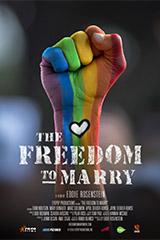
This documentary provides an insight into marriage equality movement in the USA. THE FREEDOM TO MARRYis an inspiring insiders’ look at the one the recent civil rights battles.
The historic Obergefell v. Hodges case represents the culmination of a decades-long struggle to guarantee the right of same-sex couples to marry. Among those leading the fight for justice is attorney and gay rights defender Evan Wolfson, who is considered by many the architect of LGBT marriage equality. Also profiled is human rights lawyer Mary Bonauto. In tracking the climactic countdown to the landmark Supreme Court decision, filmmaker Eddie Rosenstein manages to create a thrilling ambience.
THE FREEDOM TO MARRY was the Best Documentary and Best Editing winner at the Savannah Film Festival and recently picked up the Human Rights Prize at the Atlanta Jewish Film Festival 2017.
The International Film Festival and Forum on Human Rights (FIFDH) is an international event dedicated to film and human rights. For the past 15 years, the festival has taken place in the heart of Geneva, the human rights capital, parallel to the main session of the UN Human Rights Council in March. Each evening, the FIFDH provides high-level debates in which human rights violations are denounced and debated, wherever they occur, including those overlooked by the United Nations and not attract international attention. Diplomats, NGOs, victims, artists, philanthropists, activists, journalists, decision makers, and the general public are invited to debate their views in this unique setting. All the discussions are transmitted live online and have their own dedicated hashtags : you can submit questions and engage with the debate directly, wherever you are.
Prominent personalities who have participated in these debates include : Nobel Prize laureates Shirin Ebadi and Joseph Stiglitz, High Commissioners Navi Pillay and Zeid Ra’ad al Hussein, whistleblowers Edward Snowden, Julian Assange and Jesselyn Radack, doctor Denis Mukwege, activists Pussy Riot and the Yes Men, artists JR and Ai Weiwei, lawyers Fatou Bensouda, Carla del Ponte and Baltasar Garzon, diplomats Leila Shahid and Samantha Power, journalist Anna Politkovskaïa, as well as leading human rights thinkers Edgar Morin and Stéphane Hessel.
The FILM FESTIVAL runs two international competitions – fiction and documentary – offering a world class selection of films that challenge the ways in which we see the world, in the presence of filmmakers and artists turned protagonists. Two prestigious Juries award Le Grand Prix de Genève (10’000 €), Le Grand Prix Fiction (10’000 €) and the Prix Sergio Vieira de Mello (5000€).
The FIFDH reaches out to young people: more than half of its audience is younger than 35! We offer an ambitious and exciting programme of films and debates for school students. The Festival also schedules special screenings for students of the University of Geneva, the Graduate Institute and film schools, complete with workshops and dedicated Masterclasses.
Source: International Film Festival and Forum on Human Rights, Geneva
Andrea Ixchíu Hernandez is an indigenous rights defender working for several organisations in Guatemala. She talks – in English – to ISHR (International Service for Human Rights) about her work to build up community media so the voices of indigenous people are heard and the violations they face are publicly unveiled.
The weekly video service of Just Asia of 26 January 2017 is a special focus on the regional meeting of Asian Parliamentarians & Human Rights Defenders Against Torture, held in Hong Kong in December. During the meeting focusing on modernizing criminal institutions, Just Asiainterviewed several parliamentarians and human rights defenders.
Just Asia speaks to Dr. P. M. Nair, Chair Professor at the TATA Social Sciences Institute. According to Dr. Nair, institutions need to work together in India to combat torture, and he is confident that once this occurs, things will improve quickly. Dr. Nair also noted the importance of persons implementing laws and regulations to have a human rights perspective, which would particularly help vulnerable and marginalized sections of society.
Just Asia interviews Pakistani Member of National Assembly Imran Zafar Laghari, to learn his views on the rising incidents of torture and corruption in the policing and judicial systems.
In Nepal, the February 2017 deadline for the transitional justice commissions to complete their work is fast approaching. However, other than collecting over 60,000 complaints and starting preliminary investigations, the Truth and Reconciliation Commission (TRC) and the Commission of Investigation on Enforced Disappeared Persons (CIEDP) have not succeeded in anything meaningful. Meanwhile, Nepal’s Anti-torture legislation is pending in the Parliament. With Colonel Kumar Lama being released by the UK court, there are nominal chances for the Parliament to pass the anti-torture legislation and put it into practice. Just Asia speaks to Mr. Dipendra Jha, a practicing lawyer at the Supreme Court of Nepal, for his views.
Indonesia also faces a rise in executions and the use of the death penalty. At the same time, the revision of the country’s penal code has been ongoing for over a decade. Member of the drafting committee and parliamentarian Mr. Arsul Sani speaks about his views on the penal code revision process and rule of law in Indonesia.
Bangladesh has seen considerable violence and political manipulation in the last year. Dr. Badiul Alam Majumdar, secretary of Citizens for Good Governance shares with Just Asia his views on free and fair elections and the Bangladesh electoral system.
There is a lot of attention on current and feared loss of human rights attention in Trump-led USA. It is no reason to overlook positive events that continue. E.g. Robert F. Kennedy Human Rights, in partnership with the American Federation of Teachers and the Tribeca Film Institute, has launched on 25 January 2017 the 6th Annual Speak Truth to Power Video Contest. The short-video contest invites middle and high school students from around the country to create a three-minute video examining a human rights issue or violation while profiling human rights defenders fighting to restore justice. The deadline for entries is March 6, 2017. Participants must be in grades 6 through 12. No prior filmmaking experience is required.
“The lesson that we all have a responsibility to stand up and speak out against inequality and injustice is so important. This video contest will engage students in what it means to be a defender of human rights.”, said Randi Weingarten, president of the American Federation of Teachers (which is also producing an online webinar to share how teachers can use the contest to help students demonstrate independence, judgment and creativity about key human rights issues).
“Past winners demonstrated the transformative impact this contest has on those who participate,” said John Heffernan, Director of the Speak Truth To Power program. “We are thrilled to be able to expand our reach by partnering with the AFT in key cities throughout the US—inspiring even more students to identify with some of the most courageous people on the planet.”
Last year’s grand prize went to a filmmaker from Farmingdale, NJ whose satire “How to Be an American Muslim” asks the audience to reflect on the challenges of being a Muslim in America today, and highlights the work of human rights defender Dalia Mogahed. (http://www.ted.com/talks/dalia_mogahed_what_do_you_think_when_you_look_at_me)
Additional details can be found at http://www.speaktruthvideo.com. Winning videos will be featured on the Speak Truth To Power website and the grand prize video will be shown at the 2017 Tribeca Film Festival.
Cuban blogger Yoani Sánchez explains how technology is helping to break the information monopoly the Castro dictatorship has maintained for more than fifty years. In a country where purchasing internet access costs up to a third of the average salary, Sanchez says thumb-drives loaded with information are a vital tool of progress. Cuba is the last dictatorship in the Americas, but change is coming, and Sánchez is convinced that—aided by more information and education—the next revolution will lead to the democracy the Cuban people desire and deserve. This video is a bit older (Oslo Freedom Forum 2014) but still relevant.
KIOS is perhaps not the best-known human rights foundation in the world but that is surely mostly due to the fact that it operates from a small base: Finland. KIOS was founded by 11 Finnish human rights and development NGOs. The representatives of the founding NGOs form the Board of KIOS. In Finland, KIOS raises awareness on the significance of human rights and the work of human rights defenders in developing countries. It also advocates for the development of good practices in Finnish foreign and development policy in support ofHRDs. KIOS focuses its external support on 3 countries in East Africa (Kenya, Rwanda and Uganda) and 3 in South Asia (Nepal, Sri Lanka and to Tibetan civil society organizations in exile). Some long-term partner organizations of KIOS are also supported in Bangladesh, Burundi, Ethiopia and Pakistan. Ulla Anttila is the Executive Director.
On 17 December 2016 KIOS published four video links of interviews with human rights defenders from Asia and Africa (video links), available on You Tube: