Author Archive

UN Secretary-General’s Report 2022/23 on Reprisals : lack of progress

September 29, 2023

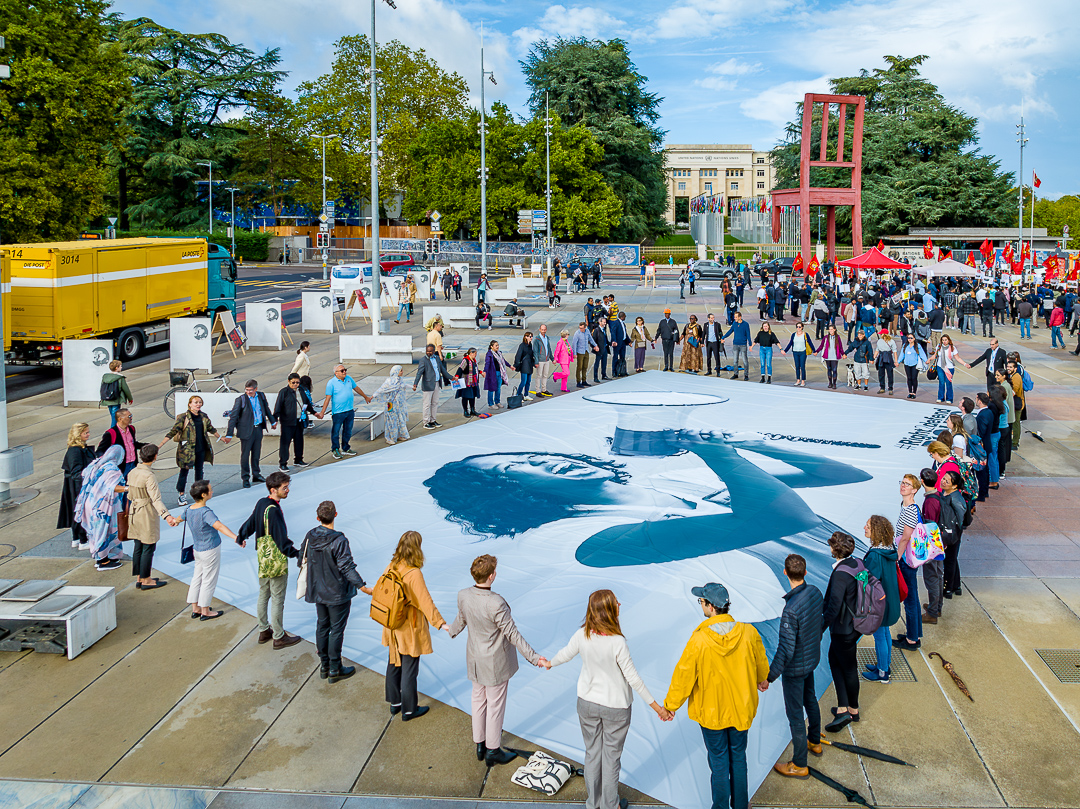
On Monday 18 September, over 50 activists, members of civil society organisations and diplomatic partners gathered on Geneva’s Place des Nations, unfurling a giant banner celebrating the right to defend human rights, as enshrined in the foundational UN Declaration on Human Rights Defenders.

The banner and gathering were meant to mark the 25th anniversary of the Declaration, which was adopted by the UN General Assembly in 1998. The document explicitly laid out the rights of human rights defenders and the protection owed to them by governments and businesses, emphasising that everyone has the right to advocate and defend rights and fundamental freedoms.

On 28 September 2023, the UN Secretary-General’s report on reprisals was presented, which covers the period from 1 May 2022 to 30 April 2023. Over 220 individuals and 25 organizations in 40 countries across the world faced threats and retaliation from State and non-State actors for cooperating with the UN on human rights.

Human rights defenders and other civil society actors are increasingly under surveillance and continued to face legal proceedings, travel bans and threats, and be given prison sentences for cooperating with the UN and the UN’s human mechanisms.

A global context of shrinking civic space is making it increasingly difficult to properly document, report and respond to cases of reprisals, which means that the number is likely much higher,” said Assistant Secretary-General for Human Rights Ilze Brands Kehris in her presentation to the Human Rights Council in Geneva. [see also: https://humanrightsdefenders.blog/2020/11/16/new-assistant-secretary-general-wants-to-improve-civil-society-participation-in-the-general-assembly/]

Among the growing trends noted in the report is the increase in people either choosing not to cooperate with the UN due to concerns for their safety, or only doing so if kept anonymous. 

Victims and witnesses in two-thirds of the States listed in the report requested anonymous reporting of reprisals, compared with one-third in last year’s report.  And most people who reported facing reprisals for their cooperation with the Security Council and its peace operations, as well as with the UN Permanent Forum on Indigenous Issues did so on the condition of anonymity.

A second trend was the increasing surveillance of those who cooperate or attempt to cooperate with the UN, being reported in half of the countries named in the report.  An increase in physical surveillance by State actors was also noted, likely linked to the return to in-person forms of engagement with the UN.

Third, almost forty-five per cent of the in the report continued to apply or enact new laws and regulations concerning civil society, counter-terrorism and national security, which punish, deter or hinder cooperation with the UN and its human rights mechanisms. 
These legislative frameworks represent severe obstacles to long-standing human rights partners of the UN worldwide, and were used to outlaw some of them, raid their offices, and question, threaten or try their staff.

Finally, the specificity and severity of acts of reprisals against women and girls, which constitute half of the victims in this year’s report, was once again identified with concern.

Most of them are human rights defenders and civil society representatives targeted for their cooperation with UN human rights mechanisms and peace operations, but there is also a significant number of judicial officers and lawyers subjected to reprisals for their cooperation with the UN in search of accountability and remedy.

We have a duty to those who put their trust in us,” said Brands Kehris. “That is why at the UN, we are determined to live up to our collective responsibility to prevent and address intimidation and reprisals against those who cooperate with the organization and its human rights mechanisms.” 

The 40 States referred to in the report are: Algeria, Afghanistan, Andorra, Bahrain, Bangladesh, Belarus, Burundi, Cameroon, China, Colombia, Cuba, Democratic Republic of the Congo, Djibouti, Egypt, France, Guatemala, India, Indonesia, Iran (Islamic Republic of), Iraq, Israel, Saudi Arabia, Libya, Maldives, Mali, Mexico, Myanmar, Nicaragua, Pakistan, the Philippines, Qatar, the Russian Federation, South Sudan, United Republic of Tanzania, United Arab Emirates, Uzbekistan, Viet Nam, Venezuela (Bolivarian Republic of), Yemen, and the State of Palestine.

The full report at A/HRC/54/61

https://ishr.ch/latest-updates/defenders-gather-before-the-un-headquarters-to-call-for-better-protection-of-their-work/

https://genevasolutions.news/human-rights/punished-for-speaking-up-at-the-un

Front Line Defenders Award winners go on US advocacy trip

September 29, 2023

Three human rights defenders (from Democratic Republic of the Congo (DRC), the Philippines and Ukraine) will visit New York and Washington, D.C. as part of an advocacy tour after being awarded the prestigious Front Line Defenders Award for Human Rights Defenders at Risk. [see: https://www.trueheroesfilms.org/thedigest/awards/2E90A0F4-6DFE-497B-8C08-56F4E831B47D]

Apart from engaging in high-level advocacy meetings with U.S. lawmakers and the State Department, the human rights defenders will speak at the Columbia Law School Human Rights Institute, participate in Climate Week NYC and take part in the Global Citizen Festival in New York, among other events.

From defending environmental rights to supporting civil society during armed conflict, to fighting for the right to education, these courageous human rights defenders represent some of the most at-risk communities of activists around the world today,” said Ana Cutter Patel, U.S. Representative at Front Line Defenders. “We hope this advocacy tour will bring them much-needed additional support and recognition, to energize them in their struggle to ensure human rights are respected in their respective countries.

Those taking part in the advocacy tour are:

Africa laureate: Olivier Bahemuke Ndoole (Democratic Republic of the Congo) is a leader among environmental and land defenders in DRC [https://www.trueheroesfilms.org/thedigest/laureates/4bdd9da9-740f-41b6-b6a1-bcad15e2e0a0]

Asia and the Pacific laureate, Jeany ‘Rose’ Hayahay (Philippines) is a woman human rights defender based in Mindanao, the Philippines. [https://www.trueheroesfilms.org/thedigest/laureates/ab448b53-297d-4ebc-8608-4baa29c1c161]

Europe and Central Asia laureate, Digital Security Lab Ukraine (Ukraine) – represented by Executive Director Vita Volodovska – is a team of specialists in the field of digital security and internet freedom. [https://www.trueheroesfilms.org/thedigest/laureates/70e5e379-d671-42c8-9d56-40b9a879cac2]

https://www.frontlinedefenders.org/en/statement-report/front-line-defenders-award-winners-launch-us-advocacy-trip

Right Livelihood awards 2023

September 29, 2023

The 2023 laureates face off against social taboos around abortion in African countries, Cambodia’s authoritarian regime and corrupt businesses, a growing humanitarian crisis in the Mediterranean Sea, and unsafe industrial practices in Kenya to demand a liveable future for all. For more on the Right Livelihood Award and its laureates, see: https://www.trueheroesfilms.org/thedigest/awards/97238E26-A05A-4A7C-8A98-0D267FDDAD59

The 2023 Right Livelihood Award goes to:

Eunice Brookman-Amissah, who is a Ghanaian physician whose leadership has been instrumental in advancing safe abortion access across Africa. For three decades, she has spearheaded high-level advocacy, sensitisation programmes and training on women’s reproductive rights. Her efforts have successfully united healthcare providers, government officials, lawyers and activists in support of abortion law reforms in Mozambique, Sierra Leone, Benin, Eswatini and Kenya, and abortion law implementation in Ghana, Zambia, Malawi, Senegal and Mauritius, among others.

When Brookman-Amissah began her advocacy, the term abortion was too taboo to mention, let alone champion at high-level forums. Nonetheless, she tirelessly raised the issue to empower women, enhance their autonomy, improve their health, and ultimately, create an environment where they can thrive personally and professionally. Brookman-Amissah is a pioneer in the field of sexual and reproductive health and rights (SRHR).

Mother Nature Cambodia is the country’s pre-eminent youth-led environmental rights organisation, working on the frontlines with local communities to preserve nature and livelihoods even in the face of a growing government crackdown on civil society activism. Using innovative techniques such as viral videos, training and the mobilisation of young Cambodians nationally and locally, Mother Nature Cambodia has helped highlight and stop environmental violations. Successful campaigns include stopping the Chinese-led construction of a hydroelectric dam threatening an Indigenous community and helping end the largely corrupted business of sand export from the coastal estuaries of Koh Kong, which was destroying the local ecosystem and fishing grounds.

Founded in 2012, Mother Nature Cambodia’s small and agile core team works to mobilise against destructive and corrupt construction projects. Indicative of the government’s hostile stance against the organisation, 11 of their activists have been jailed and dozens arrested since 2015, while one staffer and the founder, Alejandro Gonzalez-Davidson, have been forced to leave the country. Local community members campaigning with Mother Nature Cambodia have also been subject to intimidation, legal harassment and surveillance by the police.

Despite the harassment and constant threat of arrest, the organisation has stayed the course and continued to campaign fearlessly. Highlighting the connection between democracy, human rights and environmental activism, Mother Nature Cambodia has emerged as a beacon of hope for future generations, fighting for the preservation of nature and human rights in Cambodia. [see: https://www.trueheroesfilms.org/thedigest/laureates/d41428d8-4b96-4370-975e-f11b36778f51]

SOS MEDITERRANEE is a European maritime-humanitarian organisation saving people’s lives in the Mediterranean, the world’s deadliest migration route. Carrying out search and rescue operations, the organisation has brought more than 38,500 people to safety since operations began in 2016. SOS MEDITERRANEE follows a strict legal framework based on maritime law, setting high standards for search and rescue operations, and showing that assisting people in distress at sea is a legal obligation.

The organisation, which is an association of four offices located in France, Italy, Germany and Switzerland, was founded by civilians in May 2015, in response to the tragic loss of lives in the Mediterranean and the European Union’s inability to effectively address this issue. Pooling resources, the association finances and operates the Ocean Viking rescue ship with a professional crew. Once brought aboard, survivors are provided with medical and psycho-social care. SOS MEDITERRANEE also aims to amplify the voices of survivors by sharing their stories.

The organisation’s unwavering commitment to humanity has not only saved lives but kept the public, European institutions and national governments acutely aware of the realities of the humanitarian crisis in the Mediterranean Sea. [see: https://www.trueheroesfilms.org/thedigest/laureates/0700f14f-dbb5-4350-8e3f-5e7027294404]

Phyllis Omido is a Kenyan environmental activist leading the battle for the justice and health of the Owino Uhuru community that has suffered from lead poisoning ever since a battery smelting plant began operating in their village. Omido’s use of litigation, advocacy and media engagement has set vital legal precedents, affirming people’s right to a clean and healthy environment and the state’s responsibility to safeguard it.

Omido, dubbed the “Erin Brockovich of East Africa,” initially worked at the battery smelting plant that poisoned her, her son and thousands of Owino Uhuru community members. When the plant owners and government officials refused to act on the environmental impact report she conducted, Omido mobilised the community in protest. Following a 2012 demonstration, Omido was attacked by two men at her home and arrested on unfounded charges of terrorism and inciting violence.

Thanks to Omido’s activism, 17 toxic sites have been closed across Kenya. She has also used her experience to consult the United Nations, leading to a resolution on lead-acid battery recycling in Africa. Determined to spread knowledge on environmental rights far beyond Owino Uhuru, Omido has established a network of 120 grassroots land and environmental defenders (LEDs) across Kenya, Uganda and Tanzania, empowering and mentoring others to protect their communities. [see: https://www.trueheroesfilms.org/thedigest/laureates/79079c38-3ac4-4324-9e93-2cfb3f03fb28]

https://rightlivelihood.org/

https://www.aljazeera.com/news/2023/9/28/4-environmental-human-rights-activists-awarded-alternative-nobel-prizes

Global Witness annual report 2022: a land rights defender killed every other day

September 25, 2023

Over the last decade, nearly 2,000 land and environment defenders have been killed around the world, and in 2022, a land defender was killed every other day, according to a report. [for last year’s see: https://humanrightsdefenders.blog/2022/10/05/global-witness-report-2021-continued-disaster/]

The study from Global Witness, a non-profit human rights environmental watchdog, shows that the killings of Indigenous peoples defending their territories and resources represented nearly 34 percent of all lethal attacks despite making up about 5 percent of the world’s population.

Governments where these violations are happening are not acting properly to create a safe environment for defenders and a civic space proper for them to thrive,” said Gabriella Bianchini, senior advisor for the land and environmental defenders team at Global Witness. “They are not reporting or investigating and seeking accountability for reprisals against defenders. And most importantly, they are not promoting legal accountability in the proper manner.”

Latin America has consistently ranked as the deadliest region for land defenders overall and saw almost 9 in every 10 recorded killings in 2022. More than a third of those fatal attacks took place in Colombia. In 2021, Brazil was named the deadliest country for land defenders by Global Witness and now sits at second; In July, activist Bruno Pereira and journalist Dom Phillips were murdered in the Brazilian Amazon.

Growing tensions from agribusiness, mining, and logging have led to consistent lethal attacks in the region. Between 2011 and 2021, for instance, more than 10,000 conflicts related to land rights and territories were recorded in Latin America alone. 

The worsening climate crisis and the ever-increasing demand for agricultural commodities, fuel, and minerals will only intensify the pressure on the environment — and those who risk their lives to defend it,” wrote the authors.

Earlier this year, Frontline Defenders, an international human rights organization, released a similar report to Global Witness’ with corresponding findings — including that Colombia was the most dangerous country for land defenders. [see: https://humanrightsdefenders.blog/2023/04/04/front-line-defenders-just-published-its-global-analysis-2022-new-record-of-over-400-killings-in-one-year/ . While Frontline Defenders reported that there were 186 land defender deaths in Colombia and Global Witness reported 60, Bianchini said differences in statistics are the result of different methodologies, which vary by organization. However, both organizations’ reports were united in findings: Indigenous people make up a disproportionate amount of the deaths among land and environment defenders, Latin America sees the highest rates of violence, and the number of killings is likely underreported.

“I am incredibly grateful and impressed to see the fight of all of these communities who are there living in these areas and who have been acting for thousands of years to protect the array of life,” said Bianchini. “I cannot believe that humanity right now is living in a moment where we are killing those who are protecting their own lands and civil rights.”

https://grist.org/indigenous/in-2022-a-land-defender-was-killed-every-two-days/

https://www.globalwitness.org/en/campaigns/environmental-activists/standing-firm/

China continues to imprison whoever disagrees

September 24, 2023

The New York Times of 22 September 2023 and other outlets report on the increasing crackdown on dissent: Huang Xueqin, the journalist who gave #MeToo Victims a voice, and Wang Jianbing, a labor activist, have been accused of inciting subversion.

A casually dressed woman in a broad-brimmed black hat stands against a green wall, holding a sign that reads “Me Too.”
The Chinese journalist Huang Xueqin in Singapore in 2017. She has been in detention in China for two years.Credit…#FreeXueBing, via Associated Press

On 22 September saw the start of their trial after two years of arbitrary detention. A large number of civil society organisations, including the FIDH and the World Organisation Against Torture (OMCT) expressed their deep concern about their conditions of detention and called for their immediate and unconditional release.

Huang Xueqin, an independent journalist who was once a prominent voice in China’s #MeToo movement, and her friend Wang Jianbing, the activist, were taken away by the police in September 2021 and later charged with inciting subversion of state power. Their trial was held at the Guangzhou Intermediate People’s Court in southern China.

Little is known about the government’s case, but the vaguely worded offence with which the two were charged has long been seen as a tool for muzzling dissent. Since China’s top leader, Xi Jinping, came to power in 2012, the ruling Communist Party has sought to essentially silence people who have fought for free speech and political rights. A steady stream of activists, lawyers, tycoons and intellectuals have been put on trial and sentenced.

In Ms. Huang and Mr. Wang’s cases, the authorities questioned dozens of their friends in the months after their detentions and pressured them to sign testimonies against the two, according to Chinese Human Rights Defenders, an advocacy group that is in close contact with many activists.

In the meantime the Washington Post of 22 September reports that Rahile Dawut, a prominent Uyghur academic who disappeared six years ago at the height of the Chinese government’s crackdown in Xinjiang, has been given a life sentence in prison, according to a human rights group that has worked for years to locate her..

Dui Hua, a California-based group that advocates for political prisoners in China, said in a statement Thursday that the 57-year-old professor — who was convicted in 2018 on charges of endangering state security by promoting “splittism” — had lost an appeal of her sentence in the Xinjiang Uyghur Autonomous Region High People’s Court.

At a regular press briefing, Ministry of Foreign Affairs spokesperson Mao Ning said she was “unaware” of Dawut’s case. “What I can tell you is that China is a law-based country and handles relevant cases in strict accordance with the law.”

A former professor at Xinjiang University and leading scholar on Uyghur folklore, she is among more than 300 intellectuals, artists and writers believed to be detained in Xinjiang, amid a government campaign ostensibly aimed at better assimilating China’s Muslim minority and promoting ethnic harmony. Rights groups have accused the Chinese government of committing “cultural genocide” by wiping out previously vibrant local Uyghur culture. See also: https://humanrightsdefenders.blog/2020/11/11/rahile-dawut-recipient-of-courage-to-think-award-2020/

The sentencing of Professor Rahile Dawut to life in prison is a cruel tragedy, a great loss for the Uyghur people, and for all who treasure academic freedom,” said John Kamm, executive director of the Dui Hua Foundation.

https://www.fidh.org/en/region/asia/china/china-call-for-the-release-of-human-rights-defenders-huang-xueqin-and

https://edition.cnn.com/2023/09/21/china/china-metoo-activist-huang-xueqin-trial-intl-hnk/index.html

https://www.washingtonpost.com/world/2023/09/22/rahile-dawut-life-sentence-uyghur-china/

https://www.theguardian.com/world/2023/sep/24/chinese-authorities-uyghur-professor-rahile-dawut

Defense for Children – Palestine, winner of the 2023 Rafto Prize

September 21, 2023

Defense for Children International – Palestine is the 2023 recipient of the Rafto Prize, the Rafto Foundation for Human Rights announced today. 

For more on the Rafto Prize and its laureates, see: https://www.trueheroesfilms.org/thedigest/awards/A5043D5E-68F5-43DF-B84D-C9EF21976B18

The Rafto Prize 2023 is awarded to Defence for Children International-Palestine (DCIP) for their persistent work to defend and promote the rights of children living in the Occupied Palestinian Territory (OPT). For over 30 years, DCIP has investigated, documented and pursued accountability for grave human rights violations against children; held Israeli and Palestinian authorities accountable to universal human rights principles; and advocated at the international and national levels to advance access to justice and protection for children.

By awarding the Rafto Prize to DCIP, the Rafto Foundation wants to shine a spotlight on their work to promote and defend children’s rights,” said Jostein Hole Kobbeltvedt, executive director of Rafto Foundation. “With this award, we want to support DCIP by putting pressure on international organizations, including the UN, to investigate violations of children’s rights in the OPT and other armed conflicts around the world and demand that these be stopped.”

Our human rights documentation and evidence-based advocacy exposing Israeli forces’ grave violations against Palestinian children have made us a target of the Israeli government for years,” said Khaled Quzmar, General Director at DCIP. “But we will not back down. We are grateful for the Rafto Foundation’s recognition of the necessary human rights work my colleagues and I carry out to defend and protect Palestinian children.

DCIP is an independent, local Palestinian child rights organization dedicated to defending and promoting the rights of children living in the West Bank, including East Jerusalem, and the Gaza Strip. Since 1991, DCIP has investigated, documented, and exposed grave human rights violations against children; provided legal services to Palestinian children in urgent need; held Israeli and Palestinian authorities accountable to universal human rights principles; and advocated at the international and national levels to advance access to justice and protection for children.

Israeli Minister of Defense, Benny Gantz, designated DCIP and five other Palestinian human rights and civil society groups as “terrorist organizations” on October 19, 2021, pursuant to a 2016 Israeli law. The designation effectively criminalized the activities of these organizations and authorized Israeli authorities to close their offices, seize their assets, and arrest and jail their staff members.[see also: https://humanrightsdefenders.blog/2021/10/23/assault-by-israel-on-palestinian-human-rights-ngos/]

https://www.rafto.no/en/news/the-rafto-prize-2023-to

https://www.dci-palestine.org/dcip_awarded_international_prize_for_its_impact_on_palestinian_children_s_lives

Far-right EU lawmakers nominate Elon Musk for European Sakharov award

September 21, 2023

Eddy Wax in Politico of 14 September 2023 reported that the far-right political group in the European Parliament nominated tech billionaire Elon Musk for the EU’s top human rights award. The Identity and Democracy (ID) grouping, which includes members of European Parliament tied to France’s Marine Le Pen and Italy’s Matteo Salvini, put Musk’s name forward, according to a document sent to MEPs on September 14 and seen by POLITICO. An ID official confirmed to POLITICO its decision to nominate Musk.

ID cited Musk’s decision to release the so-called Twitter Files, which consisted of selected internal documents over how the social media platform handled requests to remove political posts. This amounts to a defense of the principle of freedom of expression, ID argued.

Musk is highly unlikely to receive the accolade as the President of the Parliament Roberta Metsola and the leaders of all political groups will select the winner together later this year.

The three largest groups — the center-right EPP, center-left S&D and liberal Renew — have all agreed to propose Mahsa Amini, a young Iranian woman whose death at the hands of police sparked a movement for women’s rights across Iran. [see also: https://humanrightsdefenders.blog/2023/05/11/now-it-is-the-turn-of-the-iranian-journalists-who-reported-on-mahsa-amini/]

The Greens have nominated Ugandan climate activist Vanessa Nakate, while the right-wing ECR group put forward Nino Lomjaria, a public defender in Georgia who stood up to Russian interference. The Left proposed three women’s rights activists.

https://www.politico.eu/article/identity-and-democracy-nominate-elon-musk-eu-human-rights-award-sakharov-prize/

https://pen.org/x-must-ensure-safety-of-users/

see also: https://www.fidh.org/en/region/americas/nicaragua/nicaragua-vilma-nunez-and-bishop-alvarez-nominated-for-european

British Airways ends solidarity trip for al-Khawaya

September 18, 2023

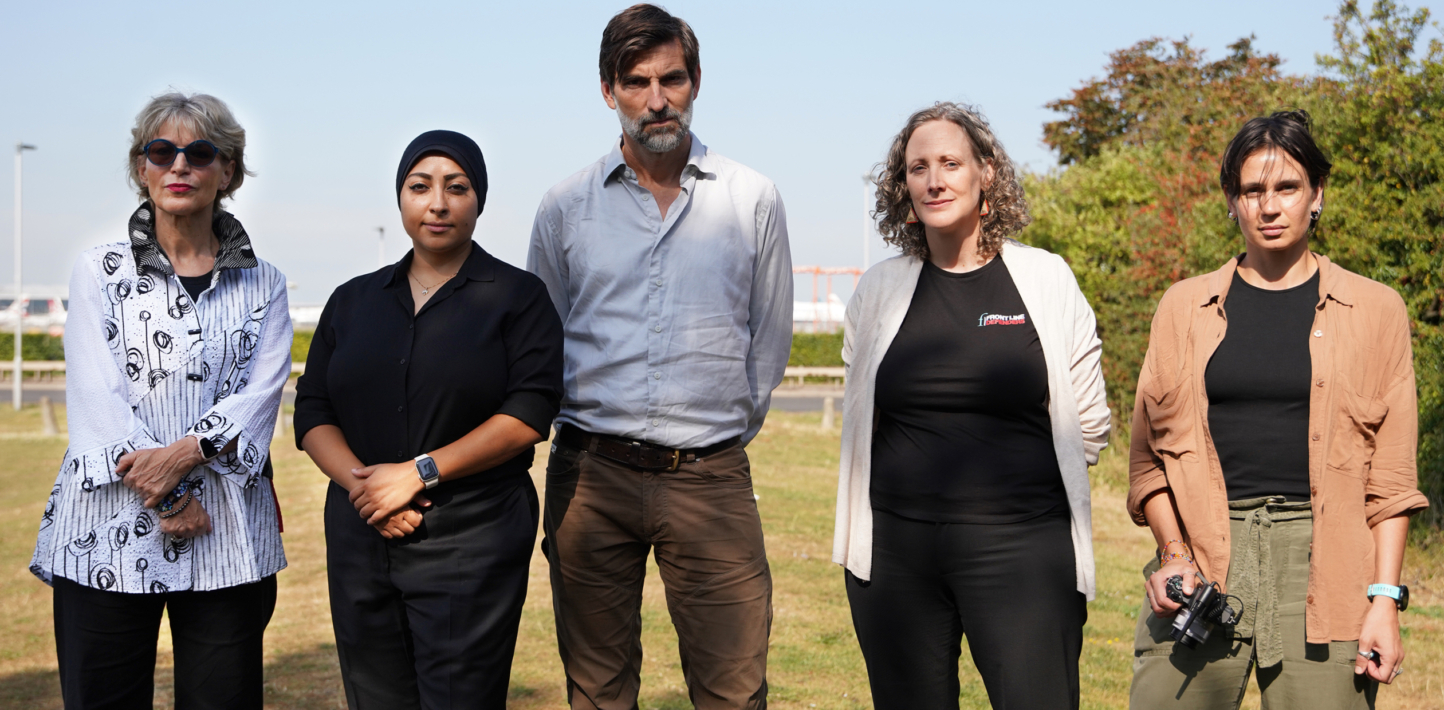
Maryam Al-Khawaja (second right) with members of the human rights delegation who were denied boarding a flight to Bahrain. (c) AI

Bahrani activist Maryam al-Khawaja said on Friday she was denied boarding on a flight to Bahrain by British Airways as she tried to return home to raise awareness of the condition of her imprisoned father. [see: https://humanrightsdefenders.blog/2023/09/14/more-join-maryam-al-khawajas-solidarity-trip-to-bahrain-to-be-continued/]

In a video message posted on X, Khawaja said she was not allowed to board a flight at London’s Heathrow Airport “despite being a Bahraini citizen”.

I was told I have to speak to Bahraini immigration if I want to get a boarding pass to Bahrain. So effectively we are being denied boarding by British Airways on behalf of the Bahraini government,” she said.

Agnes Callamard, the secretary-general of Amnesty International, was among those accompanying Khawaja and said on X that she had also been denied boarding. “Our human rights delegation members are all denied a boarding pass. We are told that British Airways has been instructed by the Bahrain immigration authorities not to give us a boarding pass,” she posted.

A spokesperson for the British Airways Press Office said: “All airlines are legally obliged to comply with immigration control laws and entry requirements for customers as set by individual countries,” he told Middle East Eye in a statement and a government spokesperson in Bahrain added: “…as with other countries, Bahrain reserves the right to refuse entry, if deemed necessary.”

Sayed Alwadaei, a Bahraini activist, and the director of advocacy at the UK-based Bahrain Institute for Rights and Democracy (BIRD), raised concern over al-Khawaja being denied boarding the flight.

“If a Bahraini citizen gets their rights denied at Heathrow airport, in London, in front of international observers and in front of heads of international rights organisations, then imagine what happens to prisoners behind bars, what is happening to Maryam’s father and other political prisoners who are suffering torture and systematic medical denial and slow death without anyone monitoring,” he told MEE. See: https://www.adhrb.org/2023/10/adhrb-at-hrc54-al-singace-al-khawaja-and-naji-fateel-face-reprisals-including-medical-neglect-2/#utm_source=rss&utm_medium=rss

Campaigners and the heads of human rights organisations informed MEE that they are planning to peacefully protest outside the Bahraini embassy in London later today in response to not being allowed to travel to Bahrain. 

Responding to the news, Olive Moore, the Executive Director of Frontline Defenders said that the decision not to let her board the flight was “unjustifiable“.

See also: https://www.ohchr.org/en/press-releases/2023/09/bahrain-un-expert-alarmed-health-human-rights-defenders-prison

https://www.theguardian.com/law/2023/sep/15/bahraini-human-rights-defender-stopped-from-travelling-to-kingdom-to-visit-imprisoned-father

https://www.middleeasteye.net/news/bahrain-activist-denied-boarding-british-airways-manama

Protest follows sentencing of Adilur Rahman Khan and Nasiruddin Elan in Bangladesh

September 15, 2023

On 14 September 2023 the Cyber Tribunal, Dhaka sentenced to two years imprisonment Odhikar’s Secretary Adilur Rahman Khan and Director ASM Nasiruddin Elan for allegedly breaching Section 57 of the Information and Communication Technology Act 2006. They were charged for releasing a report on extrajudicial killings committed on 5 and 6 May 2013, centering around the Hefazat-e-Islam protests.

Immediately, 39 organizations in a joint call said that Bangladesh should quash their convictions, and end all reprisals against them and other human rights defenders for their legitimate human rights work. The Bangladesh Government has persistently targeted and launched a smear campaign against Khan and Elan, the secretary and director, respectively, of prominent Bangladesh human rights organization Odhikar. Following the 2013 publication of Odhikar’s fact-finding report documenting extrajudicial killings during a protest, both defenders were arbitrarily detained; Khan for 62 and Elan for 25 days. After being released on bail, they continued to face prosecution and judicial harassment on trumped-up allegations that their 2013 report was “fake, distorted, and defamatory.”

After years of stalling, Bangladeshi judicial authorities accelerated the hearings in their case following the designation of US sanctions against the country’s notoriously abusive paramilitary Rapid Action Battalion (RAB) and its officials in December 2021, blaming human rights organizations like Odhikar for this outcome. Their case has been marred with due process violations, such as the failure to provide the defense with advance information on the prosecution witnesses or a copy of the Criminal Investigation Department’s further investigation report until the day before a hearing. See also: https://humanrightsdefenders.blog/2021/12/21/harassment-of-adilur-rahman-khan-and-other-human-rights-defenders-in-bangladesh/

After the Government reopened the examination of witnesses and presented additional prosecution witnesses in July and August 2023, the judge convicted Khan and Elan to two years in prison and a fine of 10,000 Bangladeshi Taka (equivalent of USD$91.17).

In addition to targeting Odhikar’s leaders, the Government interfered with the organization’s ability to conduct its human rights work by blocking their access to funds and leaving its registration renewal application pending since 2014. Following the US sanction designations, the Government increased surveillance and harassment against those affiliated with Odhikar and ordered the organization to provide sources and proof for its findings of enforced disappearances and extrajudicial killings. On June 5, 2022, the Government’s NGO Affairs Bureau officially denied Odhikar’s application for renewal, stating that the organization’s publications have “seriously tarnished the image of the state to the world.” See also: https://humanrightsdefenders.blog/2023/09/06/ohchr-says-nobel-laureate-yunus-and-other-human-rights-defenders-being-harassed-through-legal-proceedings/

The Government then continued to besmirch the organization publicly, even criticizing and questioning the credibility of the US Department of State’s 2022 Country Report on Human Rights Practices: Bangladesh for relying on Odhikar’s documentation. United Nations human rights experts have expressed their concerns over the Government’s actions, stating that “the defamation of Bangladeshi-based human rights organisations by high-profile public figures is a clear attempt to undermine their credibility, reputation and human rights work in the country.” [see also: https://www.dhakatribune.com/bangladesh/foreign-affairs/325311/us-embassy-voices-concern-over-verdict-against]

Human rights defenders should be allowed to conduct their necessary and important work without fear of harassment, intimidation, and reprisals. Instead of prosecuting and punishing those who document and expose human rights violations, the Government should investigate and hold the perpetrators of these violations accountable.

List of signatories: 

  1. Advocacy Forum Nepal 
  2. Amnesty International
  3. Anti-Death Penalty Asian Network (ADPAN)
  4. Asian Federation Against Involuntary Disappearances (AFAD)
  5. Asian Forum for Human Rights and Development (FORUM-ASIA)
  6. Asian Network for Free Elections (ANFREL)
  7. Association of Family Members of the Disappeared, Sri Lanka
  8. Capital Punishment Justice Project, Australia 
  9. Citizens’ Alliance for North Korean Human Rights (NKHR)
  10. CIVICUS: World Alliance for Citizen Participation
  11. Defence for Human Rights Pakistan (DHR)
  12. Desaparecidos – Philippines
  13. Eleos Justice, Monash University, Australia 
  14. Families of Victims of Involuntary Disappearance (FIND)
  15. FIDH (International Federation for Human Rights), within the framework of the Observatory for the Protection of Human Rights Defenders
  16. Forum ONG Timor-leste
  17. Free Jonas Burgos Movement
  18. HAK Association, Timor-leste
  19. Human Rights First
  20. Human Rights Hub
  21. Human Rights Watch 
  22. Indonesian Association of Families of the Disappeared Families (IKOHI)
  23. International Coalition Against Enforced Disappearances (ICAED)
  24. International Federation of ACATs (FIACAT)
  25. International Service for Human Rights (ISHR)
  26. Karapatan Alliance Philippines (KARAPATAN) 
  27. KontraS (the Commission of the Disappeared and Victims of Violence) 
  28. Latin American Federation of Associations of Relatives of Disappeared-Detainees (FEDEFAM)
  29. Legal Literacy – Nepal
  30. Liga Guatemalteca de Higiene Mental
  31. Madres de Plaza de Mayo – Linea Fundadora, Argentina
  32. Martin Ennals Foundation
  33. Nonviolence International Canada
  34. Robert F. Kennedy Human Rights 
  35. Sindhi Foundation
  36. The Asian Alliance Against Torture (A3T) 
  37. Torture Abolition and Survivors Support Coalition, Washington DC
  38. We Remember-Belarus
  39. World Organisation Against Torture (OMCT), within the framework of the Observatory for the Protection of Human Rights Defenders

Odhikar itself denounces the arrest, trial and imprisonment of these two human rights defenders and added that “It believes that justice has not been served. As an organisation Odhikar has drawn the sustained wrath of the establishment for becoming the voice of the victims of human rights violations, including those of enforced disappearances, extrajudicial killings, torture, arbitrary detention and against the suppression of free expression and assembly; and for its engagement with the United Nations Human Rights Mechanisms. Earlier the government arbitrarily deregistered the organisation. Today’s judgement is likely to have a chilling effect on human rights defenders and civil society organisations around the country.

Also: https://www.thedailystar.net/news/bangladesh/news/human-rights-bangladesh-european-parliament-moves-resolution-expressing-concern-3418651

https://www.hrw.org/news/2023/09/14/bangladesh-quash-conviction-and-release-rights-defenders

https://www.newagebd.net/article/212570/switzerland-canada-27-rights-groups-condemn-jailing-adilur-elan

but then on 16 October “Bangladesh rights activists Adilur Rahman Khan and ASM Nasiruddin Elan were released on bail Sunday evening after being in prison since Sept. 14 in a cybercrime case.”: https://www.voanews.com/a/top-bangladesh-rights-activists-released-on-bail-/7313942.html

Iran: One year after uprising in Iran the international community must combat impunity says Amnesty

September 15, 2023

The international community must pursue pathways for justice at the international level to address systemic impunity for Iranian officials responsible for hundreds of unlawful killings of protesters and widespread torture, Amnesty International said on 13 September 2023, as Iran marks the one-year anniversary of the “Woman Life Freedom” uprising.

Over the past year, Iranian authorities have committed a litany of crimes under international law to eradicate any challenge to their iron grip on power. These include hundreds of unlawful killings; the arbitrary execution of seven protesters; tens of thousands of arbitrary arrests; widespread torture, including rape of detainees; widespread harassment of victims’ families who call for truth and justice; and reprisals against women and girls who defy discriminatory compulsory veiling laws.

The anniversary of the ‘Woman Life Freedom’ protests offers a stark reminder for countries around the world of the need to initiate criminal investigations into the heinous crimes committed by the Iranian authorities under universal jurisdiction. Government statements calling on the Iranian authorities to halt the unlawful use of firearms against protesters, stop torturing detainees, and release all individuals detained for peacefully exercising their human rights remain as crucial as ever. These actions show victims they are not alone in their darkest hour.

The anniversary of the ‘Woman Life Freedom’ protests offers a stark reminder for countries around the world of the need to initiate criminal investigations into the heinous crimes committed by the Iranian authorities under universal jurisdiction. Diana Eltahawy, Amnesty International’s Deputy Regional Director for the Middle East and North Africa

The Iranian authorities have waged an all-out assault on the human rights of women and girls over the past year. Despite months of protests against Iran’s compulsory veiling laws, triggered by the arbitrary arrest and death in custody of Mahsa/Zhina Amini, the authorities have reinstated “morality” policing and introduced a raft of other measures that deprive women and girls who defy compulsory veiling of their rights.

These include the confiscation of cars and denial of access to employment, education, healthcare, banking services and public transport. Simultaneously, they have prosecuted and sentenced women to imprisonment, fines and degrading punishments, such as washing corpses.

This assault on women’s rights is taking place amid a spate of hateful official statements referring to unveiling as a “virus”, “social illness” or “disorder” as well as equating the choice to appear without a headscarf to “sexual depravity.”

The authorities are also working on new legislation that will introduce even more severe penalties for defying compulsory veiling.

Mass arbitrary detentions and summons

During the uprising and in the months that followed, the authorities arbitrarily arrested tens of thousands of men, women and children, including protesters, human rights defenders and minority rights activists.  Those arrested include at least 90 journalists and other media workers and 60 lawyers, including those representing families of individuals unlawfully killed. Scores of other lawyers were summoned for interrogations. [see e.g. https://humanrightsdefenders.blog/2023/05/11/now-it-is-the-turn-of-the-iranian-journalists-who-reported-on-mahsa-amini/]

Ahead of the anniversary, the authorities have intensified their campaign of arbitrary arrests targeting, among others, family members of those unlawfully killed, and forcing thousands of university students to sign undertakings not to participate in anniversary protests.

Execution of protesters

Over the past year, the authorities have increasingly used the death penalty as a tool of political repression to instil fear among the public, arbitrarily executing seven men in relation to the uprising following grossly unfair sham trials. Some were executed for alleged crimes such as damage to public property and others in relation to the deaths of security forces during the protests. All were executed after Iran’s Supreme Court rubber stamped their unjust convictions and sentences despite a lack of evidence and without carrying out investigations into their allegations of torture. Dozens remain at risk of execution or being sentenced to death in connection with the protests.

A crisis of impunity

The authorities have refused to conduct any thorough, independent and impartial investigations into the human rights violations committed during and in the aftermath of the “Woman Life Freedom” uprising and have failed to take any steps to hold those suspected of criminal responsibility to account.

Instead, authorities have applauded the security forces for suppressing the unrest and shielded officials from accountability, including two officials who admitted raping women protesters in Tehran. They have also dismissed complaints from victims and/or their families, threatening them with death or other harm if they pursued their complaints.

Amnesty International welcomed the establishment of a Fact-Finding Mission on Iran by the UN Human Rights Council in November 2022, yet much more is needed to combat the crisis of impunity for serious crimes in Iran – and to deter further cycles of bloodshed.

Amnesty International urges all states to consider exercising universal and other extraterritorial jurisdiction in relation to crimes under international law and other serious human rights violations committed by Iranian authorities, irrespective of the absence or presence of the accused in their territory. This includes initiating adequately resourced criminal investigations aimed at disclosing the truth about the crimes, identifying those suspected of responsibility, including commanders and other superiors and issuing, when there is sufficient admissible evidence, international arrest warrants. States should also contribute to achieving reparations for the victims.

https://www.amnesty.org/en/latest/news/

https://www.hrw.org/news/2023/09/15/iran-crackdown-dissent-ahead-protest-anniversary

see also:

https://www.fidh.org/en/region/asia/iran/iran-statement-on-the-un-fact-finding-mission-s-oral-upda

https://news.un.org/en/story/2023/09/1141017

https://www.ohchr.org/en/press-releases/2023/09/iran-un-experts-denounce-crackdown-public-commemoration-jina-mahsa-aminis