Author Archive

Strategy 2030: ISHR’s new Strategic Framework

March 9, 2026

For over 40 years ISHR has worked with human rights defenders to promote freedom, dignity, equality and justice. We have partnered with them to strengthen human rights laws, systems, networks and narratives. Over the next decade the work of defenders, supported by ISHR, will be critical to reverse rising authoritarianism, combat the accelerating climate crisis, prevent regress in the areas of women’s rights and the rights of LGBTIQ+ people, address systemic racism and discrimination, adequately regulate new and emerging technologies, and promote accountability for widespread atrocity crimes, among other challenges.

This Strategic Framework is designed to ensure that human rights defenders and the international human rights movement and system are equipped to respond to these challenges. It will ensure that ISHR’s work is relevant, responsive, effective, efficient, impactful and sustainable, and that our partnerships are equitable, powerful and influential.

In developing this Framework, we consulted more than 800 human rights defenders working in diverse contexts and on diverse issues. The strategy is also informed by key intelligence and insights gathered over the period 2021-25 from 5 staff strategy retreats, 9 Board and expert panel discussions, over 10 programme and campaign evaluations, a 40th anniversary survey with key stakeholders, and an intensive 3-month process of internal and external reflection on 12 key strategic questions.

https://ishr.ch/defenders-toolbox/resources/ishr-strategy-2030

Launch of the 2025 Freedom of Thought Report

March 8, 2026

On 25 February 2026 Humanists International launched its flagship publication, the 2025 Freedom of Thought Report

The Freedom of Thought Report by Humanists International assesses every country in the world on the basis of human rights and the legal status with regard to humanists, atheists, and the non-religious.

Systemic, legal discrimination can include such things as established state churches (resulting in religious privilege), religious instruction provided without secular ethical alternative classes in schools, through to severe punishments such as prison for crimes of “insulting” religion, or death merely for expressing your atheism.

This landmark report is the only worldwide index dedicated to monitoring how laws and state authorities treat humanists, atheists, and the non-religious. At a time of shrinking civic space and growing threats to democracy, this work is more urgent than ever. The report analyzes human rights in every country in the world and documents discriminatory national laws ranging from religious instruction without secular alternatives in schools to death sentences for renouncing religion. This year, the Key Countries edition assesses the right to freedom of religion or belief in a world of rising authoritarianism.

Focus on Bangladesh, El Salvador, Georgia, Kenya, Lebanon, Malaysia, Malta, Myanmar, Sudan, and the USA, the report captures positive developments while highlighting instances of democratic backsliding and religious nationalism. 

Checklist with criteria for candidates Special Rapporteur on freedom of expression

March 7, 2026

UN: Vacancy for Special Rapporteur on freedom of expression - Civic Space

In June 2026, the President of the UN Human Rights Council (the Council) will appoint a new UN Special Rapporteur on the promotion and protection of the right to freedom of opinion and expression.

Candidates must have the required expertise and experience in the field of the mandate, be independent and impartial, and show a high level of personal integrity and objectivity.

Alongside partners, we have developed a document including a checklist with criteria for candidates for the position. Its intention is to support all stakeholders in the identification of, and outreach to, highly qualified and independent candidates. It is also intended as a checklist that can be used by the President and Consultative Group of the Human Rights Council to ensure that only highly qualified and independent candidates are considered and appointed as the mandate holder.

It is part of a series of documents developed for vacant positions of Special Procedures mandate holders.

The signatory organisations call on governments, civil society, and other stakeholders, including relevant professional networks, to use this checklist to identify eligible candidates for the upcoming vacancy for the UN Special Rapporteur on the promotion and protection of the right to freedom of opinion and expression.

Read the document

Signatories:

  • ARTICLE 19
  • Amnesty International
  • Access Now
  • Asian Forum for Human Rights and Development (FORUM-ASIA)
  • DefendDefenders (East and Horn of Africa Human Rights Defenders Project)
  • IFEX
  • International Bar Association’s Human Rights Institute (IBAHRI)
  • International Federation for Human Rights (FIDH)
  • International Service for Human Rights (ISHR)

UN experts warn of extreme M23 violence targeting human rights defenders in DRC

March 7, 2026

UN experts on 26 February 2026 condemned the extreme violence committed against human rights defenders by the M23 armed group in the North and South Kivu provinces, in eastern DRC.

“We are horrified by the gravity and brutality of the abuse committed against human rights defenders and their families,” the experts said.

“There are allegations of attempted killings, repeated kidnappings, torture, sexual violence and death threats at the hands of M23, targeting those peacefully documenting abuses, supporting their communities and speaking out against violations.”

Between November 2025 and February 2026, several human rights defenders in North and South Kivu were reportedly targeted by members of M23 and their collaborators, in direct connection with their human rights work.

Two women human rights defenders protesting forced expulsions of civilians in Uvira, South Kivu, were reportedly abducted and tortured by M23 elements. Their fate and whereabouts remain unknown. One woman human rights defender working on LGBT rights was abducted multiple times, severely tortured and continues to be aggressively pursued.

In another case, a human rights defender was subjected to death threats and forced into hiding. Armed men allegedly raided his home, abducted and violently assaulted his spouse in an effort to force her to reveal his whereabouts. A young human rights defender from Goma, in North Kivu, was also reportedly threatened and forced into hiding following his public writings about killings of civilians in M23-controlled areas.

“Human rights defenders operating in the Kivu provinces are paying an unbearable price,” the experts said. “Those who dare to denounce abuses by M23 are being deliberately targeted. Women human rights defenders and LGBT rights defenders, who already face stigma and discrimination, are at acute risk of sexual violence and torture.”

“M23 must immediately stop targeting human rights defenders and civilians. The ceasefire must be fully respected and not undermined by ongoing intimidation and persecution,” they added.

The experts stressed that while the reported violations are attributed to M23 members, the State retains the obligation under international human rights law to protect individuals within its jurisdiction.

“Even where violations are committed by non-State armed groups, the State has a clear obligation to exercise due diligence to prevent, investigate, punish and redress such acts,” the experts said.

“We call on the authorities to ensure prompt and impartial investigations into all allegations, to provide protection and adequate medical and psychosocial support to survivors and their families and to take meaningful steps to guarantee that human rights defenders in eastern DRC can carry out their work safely and without fear.”

“Human rights defenders are not combatants. They are not enemies, but vital actors for justice, accountability and peace,” the experts said. “When they are silenced through fear and brutality, the prospects for lasting peace in eastern DRC grow ever more distant.”

*The experts:

https://www.ohchr.org/en/press-releases/2026/02/drc-un-experts-warn-extreme-m23-violence-targeting-human-rights-defenders

https://www.devdiscourse.com/article/other/3819548-un-experts-condemn-m23-attacks-on-rights-defenders-in-dr-congo

Amnesty Reports Attacks on Indonesian Human Rights Defenders in 2024 – four acquitted in 2026

March 6, 2026

On 29 April 2025 (last year) Amnesty International Indonesia raised concerns over the persistent violence and intimidation targeting human rights defenders in the country, recording at least 123 cases involving physical assaults, digital attacks, threats, and other retaliatory actions against 288 individuals throughout 2024.

Usman Hamid, Executive Director of Amnesty International Indonesia, attributed the frequency of such incidents to a lack of strong legal safeguards. “This makes human rights defenders vulnerable to threats and intimidation,” Usman said.

He added that the absence of robust legal frameworks also results in weak law enforcement, with only a few perpetrators of violence against human rights defenders in 2024 being brought to justice. Among the cases highlighted was the shooting of lawyer and human rights advocate Yan Christian Warinussy in Manokwari, West Papua, on July 17, 2024, after attending a corruption trial. [see https://www.hrw.org/news/2024/07/25/prominent-rights-lawyer-shot-west-papua-indonesia] “As of the end of the year, there has been no progress known in the police investigation,” Usman stated.

It was not until February 2025 that police arrested a suspect, ZT, in connection with the shooting. The arrest took place at a residence in Manokwari Regency and was carried out by the Manokwari City Police Special Team. ZT’s testimony led investigators to identify four additional suspects, including the alleged mastermind, OU, who is still at large. According to Manokwari City Police Chief Commissioner Rivadin B. Simangunsong, the attack on Yan was linked to a separate legal case: the murder of Yahya Sayori, for which Yan had been providing legal assistance. “It is motivated by another issue currently being processed in court, namely the murder case of the late Yahya Sayori, who was accompanied by lawyer Yan Christian Warinussy,” said Rivadin.

Then on 6 March 2026 came the good news that an Indonesian court acquitted four other activists after judges find no link to protest violence, prompting renewed scrutiny of policing and restrictions on civic space.

Responding to the acquittal of four activists – Delpedro Marhaen, Muzaffar Salim, Syahdan Husein and dan Khariq Anhar – accused by the authorities of inciting people to commit violent acts during the August 2025 protests, Usman Hamid, Amnesty International Indonesia’s Executive Director, said: “This brings new hope amid an creasingly shrinking civic space in Indonesia. The acquittal sends a clear message to law enforcement authorities that they should stop criminalising human rights defenders and anyone who peacefully exercises their right to protest. This is a significant victory for justice and human rights in Indonesia. 

So maybe there will be progress also on the case of Yan Christian Warinussy ?

https://www.amnesty.org.uk/latest/indonesia-acquittal-of-activists-brings-new-hope-for-right-to-protest/

https://en.tempo.co/read/2001740/amnesty-reports-attacks-on-288-indonesian-human-rights-defenders-in-2024

After 16 years of outstanding leadership, Gerald Staberock is stepping down as Secretary General of the OMCT

March 6, 2026

OMCT Gerald Staberock Headshot

After 16 years of leadership, Gerald Staberock is stepping down from his role as Secretary General of the OMCT. The Executive Council has accepted his resignation and will oversee a smooth transition to new leadership to continue advancing the organization’s mission to combat torture and support human rights defenders worldwide.

A good friend and colleague has taken the thoughtful decision to start a managed transition of his own position at the helm of a key international NGO. Forgive me for being biased but he is a remarkable and exceptional person.

Under his leadership, OMCT gained renewed energy, reinforcing its footprint across regions through dynamic regional offices and in country-presence and further expanding the reach and impact of its global network. This was no small accomplishment. With staff, members and partners around the globe, Gerald also aided in “opening roads, working through landslides and filling gaps” so that OMCT could respond more effectively to the needs of people who were subject to torture and serious human rights violations or abuse. He has fostered a model of work that is lean and fitting for purpose in some of the toughest places in the world and has put our network of human rights defenders at the heart of our identity. He has maintained time after time that our true reserves are human – the trust, commitment and courage of our members, partners and staff.

The Executive Council of the OMCT extends special thanks to Gerald for his unwavering commitment to OMCT’s values and philosophy. After 16 years of dedicated service, Gerald has made the personal decision to step down to embrace new challenges and devote more time to his family, and the Executive Council fully supports and respects this decision, sharing his conviction that a leadership transition can be healthy for both him and the organization. We are committed to ensuring that this transition is safe, orderly and well-timed, and that OMCT remains firmly anchored in its values and strategic vision. Gerald has promised in the past that he’s committed to OMCT and the challenge of torture and, in any case, a smooth handover to the next Secretary General.

In this vein, the Executive Council is eager to start the recruitment process for the OMCT’s next Secretary General. You can access here the call for applications. Timing of the new Secretary General will depend on the availability of the candidate selected, and a dedicated transition process will be co-defined between the Executive Council working group, the incoming Secretary General and Gerald.

Gerald’s own Message to the SOS Torture Network and partners is a demonstration of his modesty and foresightedness:

I am writing you today to tell you that I informed our executive board early this year that it is time for leadership transition after 16 years at the OMCT. I can assure you that we will ensure that this is a safe, orderly and well-timed transition so that there will be no gaps. I am also addressing this to all our supporters; this is the time we need you to stay course with us more than ever. The relationship with many of you has been enriching, marked by a shared commitment that has helped us shape our vision. I would particularly like to thank our support committee in Geneva for their support. 

For the past years, every time I came back from one of the many trips that are part of this job, I was intrigued by a watch making advertisement at the Geneva Airport. It basically says, ‘you never own this watch, your task is to keep it safe to hand over to a next generation’. Not being the owner of any luxury watches the advert always touched me, and each time I would think about OMCT.  And when my decision nourished that after 16 years of leadership, it is time to accept that change is good, I had to look back at this advert.

My task was to take on an incredible gift from the founding fathers (yes, they were male) and a charismatic preceding director whom I call a friend. An organization built around a network, built around people that work in their countries to make them better places, more just, safer – and who sadly often don’t get the recognition for the good they do. 

I cannot tell you how much I enjoyed and continue to enjoy working with amazing staff and members in our network. Human rights are really about people, people we help, serve, support, torture survivors and human rights defenders that make the difference. Our reserves are not financial but these relationships – they are our most important currency. In this, OMCT being able to provide tangible support is a is a meaningful achievement. Human rights work is also collective, it is about a movement, an eco-system. I appreciate our joint work in the Human Rights Defenders mechanism – Protect Defenders – stimulating and effective. I believe that our collective work within United Against Torture Consortium will be crucially important for the future. OMCT will remain about being united because it makes us better and stronger.

…I feel after 16 years it is the right moment to making sure that this incredible gift – not a watch – but an organization called OMCT – is given into the safe hands of a new generation…..

We can only hope that he will continue to be active on one capacity or another in the human rights movement, if only through social media: see: https://www.linkedin.com/in/gerald-staberock-65a63146/

https://www.omct.org/en/resources/statements/message-from-the-omct-president-on-the-secretary-generals-transition
Human rights defender’s story: Nathalia Bonilla from Ecuador

March 6, 2026

Nathalia Bonilla is an environmental human rights defender from Ecuador who works in the protection of the rights of Nature. She told ISHR about her country’s sharp policy turn in favour of extractive activities and spoke about the ‘utopia’ she and her peers would like to see in its place. ‘A revolution where you can’t dance is not my revolution,’ Nathalia said, in arguing for an ‘environmentalism for the people’.

Meet other defenders liker her: https://ishr.ch/defender-stories/

On 2 March 2026 woman human rights defender Yanar Mohammed was killed in Baghdad.

March 6, 2026

On 2 March 2026, woman human rights defender and feminist Yanar Mohammed was killed in an armed attack in front of her residence in northern Baghdad.

Yanar Mohammed was a prominent Iraqi woman human rights defender and feminist, and the co-founder and director of the Organisation of Women’s Freedom in Iraq (OWFI). Since 2003, she had worked to protect women facing gender-based violence, including domestic abuse, trafficking, and so-called ‘honour killings.’ Under her leadership, OWFI established a network of safe houses across several Iraqi cities, providing protection and support to hundreds of women. Yanar Mohammed led these efforts despite all the ongoing impediments and risks. She was a strong advocate for secularism and women’s equality. Throughout her activism, Yanar Mohammed faced death threats and, at times, was forced to restrict her movement. {see also: https://humanrightsdefenders.blog/2019/01/07/women-human-rights-defenders-in-iraq-have-to-live-dangerously/]

According to an offical statement from OWFI, on 2 March 2026 at 9:00, two unidentified gunmen on motorcycles opened fire on Yanar Mohammed as she stood outside her home. She was quickly transported to the hospital, however, despite the effort of medical personnel, she succumbed to her injuries.

Reportedly, Yanar Mohammed had returned to Baghdad from Canada just a few days prior to her assassination, raising concerns about the potential surveillance and monitoring of her movements.


Read more about Yanar: vday.link/yanarmohammed

Download the urgent appeal

https://www.frontlinedefenders.org/en/case/iraq-killing-woman-human-rights-defender-and-feminist-yanar-mohammed

https://amnesty.ca/human-rights-news/ensure-accountability-yanar-mohammed-iraq/

https://civicus.org/index.php/media-resources/news/8143-iraq-assassination-of-whrd-yanar-mohammed-emblematic-figure-of-the-feminist-movement-condemned

https://jinhaagency.com/en/actual/un-calls-on-iraq-to-hold-killers-of-yanar-mohammed-accountable-and-end-impunity-38702

9 March 2026: important Geneva event on transnational repression of human rights defenders

March 4, 2026

The event “Tackling the protection gap: Host States’ responsibility to prevent and respond to transnational repression” will bring together defenders and UN experts to discuss the international human rights law obligations of States in respect of transnational repression against individuals and groups within their territory, as well as the strengthening of international standards, and gaps arising from shortcomings in their implementation domestically.

Location: Geneva, Switzerland. Date: 09 March 2026. Palais des Nations, Room VIII. Time: 2:00PM – 3:00PM CET and livestreamed on ISHR’s YouTube channel.!

Research from international organisations, NGOs and academics shows that transnational repression (TNR) – acts by States and their proxies to deter, silence or punish dissent, criticism or advocacy outside their territory – is affecting a growing array of individuals and groups worldwide.[1] With the emergence of new surveillance and communication technologies, many actors have found new avenues to silence and punish critics and opponents. The most common targets have been exiled human rights defenders and political activists, but today broader groups such as journalists, lawyers, artists, academics and ordinary members of diaspora communities are frequently targeted. See e.g.

https://humanrightsdefenders.blog/2024/03/19/transnational-repression-human-rights-watch-and-other-reports/ and

https://humanrightsdefenders.blog/2024/03/19/transnational-repression-human-rights-watch-and-other-reports/

Freedom House Transnational Repression dataset: https://freedomhouse.org/report/transnational-repression

Human Rights Watch, “We Will Find You” A Global Look at How Governments Repress Nationals Abroad, 2024, https://www.hrw.org/report/2024/02/22/we-will-find-you/global-look-how-governments-repress-nationals-abroad;

The immediate effect of TNR is the violation of, or constraint on the exercise of, fundamental human rights. States have obligations towards those subject to such violations taking effect within their territory. These obligations have long been recognised, but have not yet been the subject of focused discussion in relation to TNR, leaving the scope and nature of the duties of host States unclear.

This event will bring together defenders and UN experts to discuss the international human rights law obligations of States in respect of transnational repression against individuals and groups within their territory, as well as the strengthening of international standards, and gaps arising from shortcomings in their implementation domestically.

Speakers: 

  • Sayed Ahmed al-Wadaei, Director of Advocacy, Bahrain Institute for Rights and Democracy (BIRD)
  • Birgit Kainz-Labbe, Coordinator of Civic Space Unit, Office of the UN High Commissioner for Human Rights
  • Ben Saul, UN Special Rapporteur on counter-terrorism and human rights
  • Hélène Tigroudja, Human Rights Committee, Vice-Chair

Moderator: Raphael Viana David, International Service for Human Rights 

This event is organised by ISHR and co-hosted with Human Rights Watch, Human Rights House Foundation and the International Federation for Human Rights (FIDH).


https://ishr.ch/events/tackling-the-protection-gap-host-states-responsibility-to-prevent-and-respond-to-transnational-repression

Tunisian authorities should immediately drop the unfounded charges and release Ahmed Souab

March 3, 2026
e465df4f-5702-47d7-81db-742d13799bef
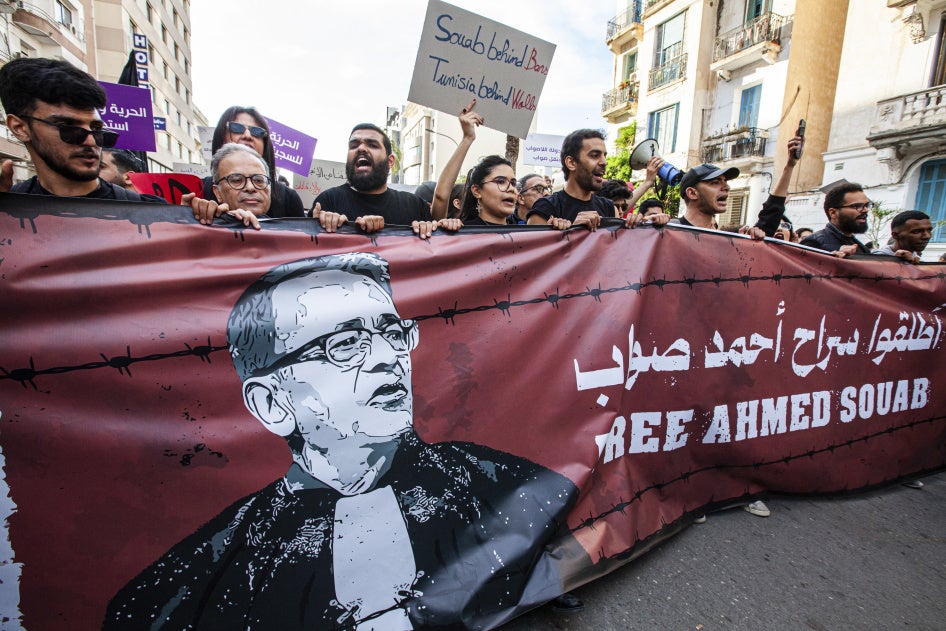
Supporters show support for the lawyer and human rights defender, Ahmed Souab, who was arrested on terrorism-related charges, in Tunis, Tunisia, April 25, 2025. © 2025 Ons Abid/AP Photo

A Tunisian lawyer and human rights defender, Ahmed Souab, who was sentenced to prison on terrorism-related charges, will face a new trial on appeal on February 12, 2026, Human Rights Watch said. The Tunisian authorities should immediately drop the unfounded charges and release him, and stop retaliating against critics and the lawyers defending them.

Tunisian authorities prosecuted Souab, 69, for statements he made outside of court while representing defendants in a notorious case of “conspiracy against state security.” On October 31, 2025, a Tunis anti-terrorism court sentenced him to five years in prison and three years of administrative supervision. His trial lasted just minutes; Souab was not present, and journalists were reportedly barred from attending.

“Ahmed Souab, a lawyer, former administrative judge, and fierce advocate for judicial independence, is behind bars simply for his defense work and outspoken views,” said Bassam Khawaja, deputy Middle East and North Africa director at Human Rights Watch. “His abusive prosecution for defending others from abusive prosecution shows the sheer extent of the Tunisian authorities’ crackdown on any dissent.”

Anti-terrorism agents arrested Souab in his home on April 21, following comments he made after the “conspiracy case” verdict on April 19. That day, 37 people, including lawyers, activists, and opponents, were sentenced after a sham trial for terrorism and security-related offenses to prison terms ranging from 4 to 66 years.

Standing outside the headquarters of Tunis Bar Association, Souab reportedly said: “It seems that it is not the detainees who have a knife turned on them, but rather, it’s the president of the chamber who has a knife [at his throat].” Video excerpts of his statement circulated widely on social media. Souab’s defense committee explained that he was referring to pressure exerted on judges.

Human Rights Watch has documented the authorities’ repeated attacks on the judiciary in Tunisia, including President Kais Saied’s dismantling of the High Judicial Council in February 2022. The attacks have severely undermined the rule of law, allowed the executive to weaponize the judiciary for political ends, and jeopardized Tunisians’ right to a fair trial, Human Rights Watch said. 

The Tunisian authorities are increasingly relying on remote trials for terrorism cases, especially for politically motivated trials against dissidents. The practice of remote trial by video is inherently abusive, including by undermining detainees’ right to be brought physically before a judge to assess their well-being and the legality and conditions of their detention.

On October 31, Souab was convicted of “endangering the lives of people entitled to protection by deliberately disclosing information that could reveal their identities” and of “making threats in connection with a terrorist offense,” his family told Human Rights Watch. 

Souab’s family said he has a history of cardiac conditions and experienced a deterioration in his health in prison. He has suffered several nosebleeds, the cause of which was not determined, they said.

Over the past three years, the authorities have increasingly relied on an aggressive legal toolbox, including unfounded security and terrorism charges under the penal code and 2015 Counterterrorism Law, to target critics and lawyers with judicial harassment, abusive criminal prosecution, arbitrary detention, and travel bans for the legitimate exercise of their profession. see also: https://humanrightsdefenders.blog/tag/tunisia/

https://www.hrw.org/news/2026/02/10/tunisia-prominent-lawyer-arbitrarily-detained