As the main author of a book on “Indonesia and the Rule of Law” published as far back as 1987 (Pinter Publishers ISBN 0-86187-919-8; International Commission of Jurists) I cannot be but very interested in the way the Indonesian government deals with the mass atrocities that took place in 1965. It had promised in the elections (Nawacita) to investigate and this is also laid down in its National Medium Term Development Plan (RPJMN) 2015-2019. Under the title “Indonesia: What next after symposium on 1965 massacre, Mr. President?” the Asian Human Rights Commission on 21 April comments on the half hearted start the Government made with a symposium held on 18 and 19 April 2016 in Jakarta. The government, represented by the President’s advisory body, the National Commission on Human Rights (Komnas HAM), the Press Council, and also representatives from other government institutions attended the symposium. Read the rest of this entry »
Author Archive
Azerbaijani human rights defenders Leyla and Arif Yunus allowed to leave for the Netherlands
April 19, 2016Two of Azerbaijan‘s most prominent human rights defenders have arrived in the Netherlands after the authorities in Baku suddenly granted them permission to leave.
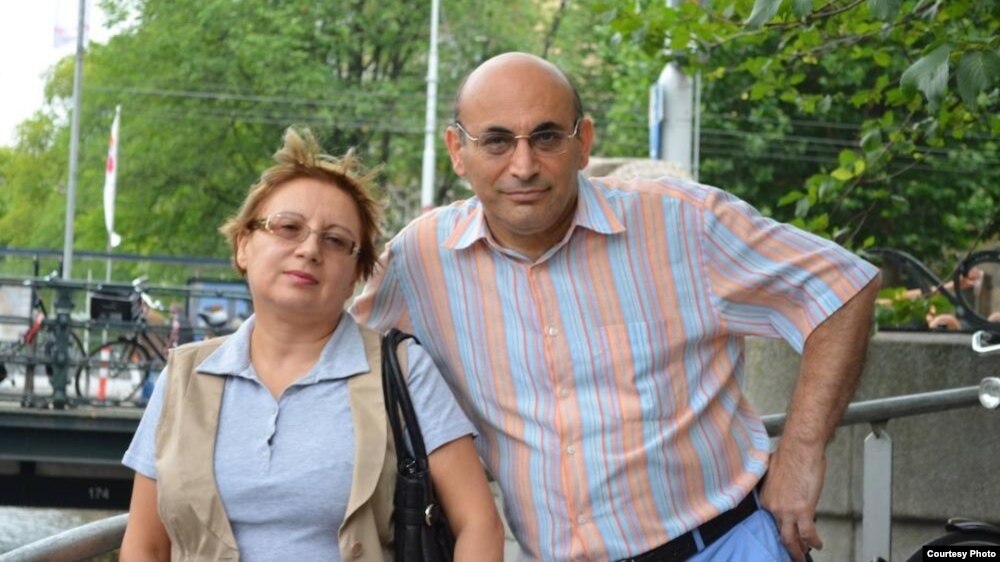
Leyla and Arif Yunus
Goldman Environmental Prizes 2016 awarded to six activists
April 19, 2016Six environmental activists from around the world received the prestigious Goldman Environmental Prize at a ceremony in San Francisco on 18 April 2016. This prize does not always go to human rights defenders in the traditional sense of the word, but several well-known ones are among the recipients such as the recently killed Berta Carceres [https://thoolen.wordpress.com/2016/03/07/exceptional-response-from-ngo-world-on-killing-of-berta-caceres/]. This year’s winners are: Read the rest of this entry »
Next Secretary General of the UN: human rights NGOs know what they want but candidates still vague
April 19, 2016Who will be the next secretary-general? The field is still wide open but thanks in part to the 1 for 7 Billion campaign, campaigning for the job is – for the first time in UN history – mostly public, even if the decision is ultimately made by General Assembly upon the recommendation of the Security Council. There are strong arguments in favor of a woman (first time ever, see link below) and someone from Eastern Europe (‘their turn’ in the informally agreed regional rotation). Of the nine candidates currently in the running, UN insiders and others close to the process see UNESCO head Irina Bokova, UNDP Administrator Helen Clark, former High Commissioner for Refugees António Guterres and former Slovenian President Danilo Türk as the frontrunners (if the bookmakers are right).
Last week, for the first time ever, nine candidates presented their visions for the UN to the General Assembly in New York Read the rest of this entry »
UNHCR extends Nansen Refugee Award nominations until 25 April 2016
April 18, 2016The UN Refugee Agency is inviting further nominations for the Nansen Refugee Award 2016 until 25 April 2016. For more information on this humanitarian award for an individual or group who has gone beyond the call of duty to assist refugees, internally displaced or stateless persons, see: http://www.brandsaviors.com/thedigest/award/nansen-medal.
Nominations made during this additional period will join nominations from the previous round which closed on 8 February 2016. The winner will be announced in September 2016. Anyone can submit a candidate for the Nansen Refugee Award at www.unhcr.org/nansen.
Source: UNHCR – UNHCR reopens Nansen Refugee Award nominations for 2016
for last year see: https://thoolen.wordpress.com/2015/10/06/nansen-refugee-award-to-afghan-refugee-teacher/
Images and military-style precision characterize violations-recording group
April 16, 2016
Videre Est Credere founder, Oren Yakobovich, holds a miniature camera with which he equips human rights defenders to expose abuses on the ground. Videre Photo
Astrid Zweynert of the Thomson Reuters Foundation published a very interesting interview on 15 April 2016 with Oren Yakobovich, founder of Videre Est Cruder:
Videre Est Credere, founded by Yakobovich, equips human rights defenders with cameras – some of them almost as small as a shirt button – and training to expose violence and human rights abuses around the world. “Our vision is that no human rights violation anywhere should go unnoticed, no matter how remote and dangerous a place is,” Yakobovich, a former Israeli army officer, told the Thomson Reuters Foundation before being awarded the $1.25 million Skoll Award for Social Entrepreneurship at a conference in Oxford this week.
Videre’s mission is to reveal abuses of armies, security forces, militia groups or officials through a network of activists who film and record abuses and violations of human rights, often at enormous personal risk. Since Videre was founded in 2008 it has distributed more than 500 videos to more than 140 media outlets, including major broadcasters such as the BBC and CNN. “It’s great to get something broadcast by a big TV channel but it’s most effective when it goes out on local stations – it makes it very clear to the perpetrators that they are being watched – and that’s powerful,” Yakobovich said. Footage has also been used in court cases to prosecute corruption and incitement to political violence.Yakobovich said his own journey to becoming a human rights activist started after he joined the Israeli Defense Forces at the age of 18.
“I spent a lot of the time in the West Bank and it shocked me what we were doing there – checkpoints in crowded areas in the city, raids on Palestinian homes in the middle of the night, scaring small children,” the 45-year-old said. Eventually, he refused to serve in the West Bank, a decision that landed him in jail. “It gave me time to think and it struck me how powerful information is, but also how little voice those have who are suffering – and how little accurate information we are getting from those places.”
He became a documentary filmmaker but said he was not happy spending more time at film festivals than helping people. “I realised that people who are suffering need to tell their own stories, not the journalists or the filmmakers.” In 2005 Yakobovich joined the Israeli human rights group B’Tselem and set up a video unit. Three years later he co-founded Videre Est Credere – which means “to see is to believe” – with Israeli filmmaker Uri Fruchtmann.
Videre has deployed some 600 people across Africa, the Middle East and Asia and has partnered with organisations such as Human Rights Watch and Amnesty International. In-depth research, solid on-the-ground contacts and thorough verification are key for Videre, which is highly secretive about its work to avoid putting human rights activists at risk. No one has been killed as a result of its work but some activists have been arrested. “The safety of the people we work with is paramount,” Yakobovich said, adding that Videre applies a “military-style” precision and security to its operations. “I’m still a soldier, just not in the army anymore,” he said.
(Visit news.trust.org to see more stories)
Source: INTERVIEW-Secretive human rights group fights abuses with military-style precision
Navi Pillay reflects on 50 years as a defender of human rights
April 14, 2016I have had quite a few post on Navi Pillay as UN High Commissioner for Human Rights [https://thoolen.wordpress.com/tag/navi-pillay/] before and after her term [https://thoolen.wordpress.com/2014/07/09/navanethem-pillay-finishes-her-term-as-un-high-commissioner-for-human-rights-a-great-lady/]. So when the Toronto Star (Nicholas Keung Immigration reporter) did an interview with this remarkable woman on 12 April 2016, I am happy to bring it to your attention. She was the recipient of the 2003 Gruber Prize for Women’s Rights and the 2010 Stockhom Human Rights Award.
“Navi Pillay reflects on 50 years as a champion for human rights”

Navi Pillay, who grew up under apartheid in South Africa, is the former United Nations High Commissioner for Human Rights.
Applications for scholarships for ECCHR’s Legal Training Program now open
April 14, 2016The European Center for Constitutional and Human Rights (ECCHR) and the Kreuzberger Kinderstiftung, the scholarship sponsor, recognize that there continue to be barriers to entry into the human rights profession that go against the spirit of our work, i.e. when economic or social considerations prevent potential participants from taking part. Therefore they offer young people with limited financial means and/or from underrepresented geographic and social backgrounds the chance to gain professional experience in human rights work.
The call for applications is aimed at students and young professionals (max one year after graduation) who wish to apply for ECCHR’s Legal Training Program but whose personal and financial situation would make it impossible to participate on an unpaid basis. Candidates from the Global South as well as refugees and others with a migration background are especially encouraged to apply.
The deadline for applications is 15 May 2016
More info: http://www.ecchr.eu/en/our_work/education-program/legal-training-program/scholarships.html
Showing of the film The Opposition about land rights in Papua New Guinea cancelled until further notice
April 14, 2016As feared (see https://thoolen.wordpress.com/2016/04/12/controversial-film-opposition-geneva-australian-court-papua-new-guinea-joe-moses/) the showing of the documentary film
 ,which was planned for 19 April in Geneva, had to be cancelled until further notice due to the controversy it has created including a court case.
 Hans Thoolen on Human Rights Defenders and their awards