Author Archive
April 3, 2018
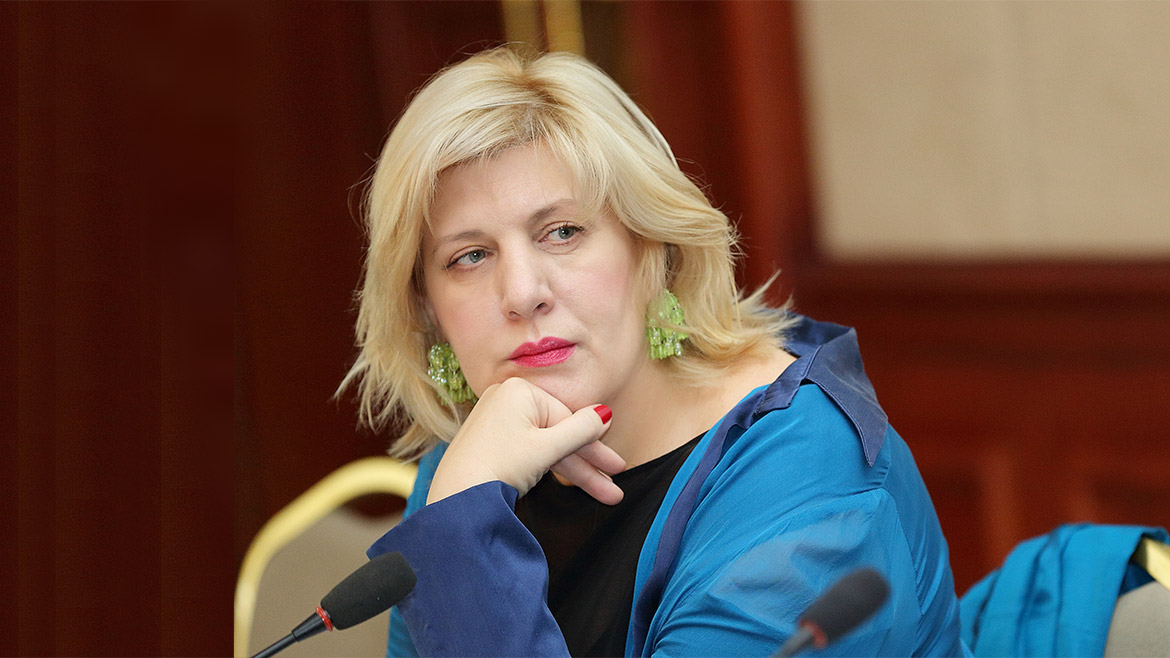
On 3 April, 2018, Dunja Mijatović has taken up the post of Council of Europe Commissioner for Human Rights.
She was elected last January [https://humanrightsdefenders.blog/2018/01/25/dunja-mijatovic-new-council-of-europe-commissioner-for-human-rights/] as the first woman to hold this post, succeeding Nils Muižnieks (2012-2018).
“I intend to keep the legacy of the previous Commissioners’ work and maintain the ability of this institution to react rapidly and effectively to protect people’s human rights. My view is that human rights are indeed universal and that no country is beyond scrutiny.
In terms of priorities, my vision is simple. In a word, it is: implementation. Norms, resolutions, treaties are there to guide us. Yes, we do need political will to make sure they are realised. But this is not a matter only for governments. We must engage our societies at large in their implementation and involve everyone in a dialogue on human rights. It is paramount that we achieve a recommitment to and a reaffirmation of human rights for all, and bring back trust in their importance for the well-being of each and every person.
I look forward to cooperating with governments, national authorities, international organisations, human rights defenders, journalists, NGOs, and human rights structures.”
https://www.coe.int/en/web/commissioner
Posted in human rights | 1 Comment »
Tags: appointment, Bosnia and Herzegovina, Council of Europe, Dunja Mijatović, Office of the Commissioner for Human Rights of the Council of Europe
April 3, 2018
An Egyptian lawyer, Samir Sabry, has requested the Attorney General to bring human right defender Asmaa Mahfouz to court. The reason? Winning the Sakharov Prize in 2011! If Egypt Today had reported it a day earlier (on 1 April), I would have credited it as a good April 1st spoof, but unfortunately it is not. In his complaint, Sabry called for the Attorney General to transfer Mahfouz to a Criminal Court trial and ban her from travelling outside the country. He stated that the prize, worth €50,000 was given to her suddenly, and he did not know why. He asked whether it is funding, a reward, or for certain service, and what the reason is for this award. The complaint from Sabry also claimed that this is a Jewish award [SIC} and questions the award’s links to Zionism. According to Sabry, the answer is that Mahfouz received the prize money, and accepted the award, in return for betraying Egypt.
Asmaa Mahfouz was one of the founding members of the April 6 Youth Movement, which sparked nation-wide demonstrations in April 2008 and was indeed awarded the Sakharov prize in 2011 (sharing it with four other Arab figures).
The prize in question is the Sakharov Prize for Freedom of Thought [http://trueheroesfilms.org/thedigest/awards/sakharov-prize-for-freedom-of-thought], which is of course is not granted by Israeli but by the European Parliament!
However, the issue of foreign funding is a major one in the Egyptian context as demonstrated by the case of two Egyptian woman human rights defenders in the ‘NGO foreign-funding case” (as ISHR reminds us on 29 March 2018): harassed and targeted Egyptian woman defenders Azza Soliman and Mozn Hassan [https://humanrightsdefenders.blog/2017/02/02/right-livelihood-has-to-go-to-egypt-to-hand-mozn-hassan-her-2016-award/] face life imprisonment if their cases are brought to trial simply for conducting legitimate human rights work.
Read the rest of this entry »
Posted in CIHRS, human rights, Human Rights Defenders, ISHR | 2 Comments »
Tags: Asmaa Mahfouz, Azza Soliman, Cairo Institute for Human Rights Studies, digest of human rights awards, Egypt, foreign funding, human rights award, human rights awards, ISHR, Israel, Mozn Hassan, NGO foreign-funding case, Sakharov Prize for Freedom of Thought, Samir Sabry, travel ban, woman human rights defenders
April 1, 2018
The funding of the office of the high commissioner for human rights in Geneva has also been cut. The current high commissioner, Zeid Ra’ad Hussein, has announced that he will be stepping down this year and not seeking another term in the post, explaining to his staff that the lack of global support for protecting human rights made his job untenable. [https://humanrightsdefenders.blog/2017/12/22/bound-to-happen-but-still-high-commissioner-zeid-announces-he-will-not-seek-second-term/]
Last week, Zeid was due to address the UN security council on plight of civilians in Syria but before he began, Russia called a procedural vote to stop him speaking on the grounds that the council was not the proper forum for discussing human rights. “The fifth committee has become a battleground for human rights,” Louis Charbonneau, the UN director for Human Rights Watch, was quoted in the Guardian. “Russia and China and others have launched a war on things that have human rights in their name.”
“China has real political momentum at the UN now,” Richard Gowan, a UN expert at the European Council for Foreign Relations, said. “It is now the second biggest contributor the UN budget after the US, and is increasingly confident in its efforts to roll back UN human rights activities. It is also pushing its own agenda – with an emphasis on ‘harmony’ rather than individual rights in UN forums. And a lot of countries like what they hear.”
A western diplomat at the UN conceded that human rights were losing ground at the UN, in part because China had become a more assertive voice, prepared to lead lobbying campaigns, and because Beijing is increasingly leveraging its vast and growing investments in the developing world to win votes for its agenda at the UN.
https://www.theguardian.com/world/2018/mar/27/china-and-russia-accused-of-waging-war-on-human-rights-at-un
https://www.amnesty.org/en/latest/news/2018/03/a-new-low-for-the-un-security-council-as-russia-takes-syrian-human-rights-off-the-table/
Posted in Amnesty international, HRW, human rights, Human Rights Council, OHCHR, UN | Leave a Comment »
Tags: AI, ‘win-win’ resolution, budget, China, funding, HRW, international human rights mechanisms, Julian Borger, Russia, the Guardian, UN, UN High Commissioner for Human Rights Zeid, UN Human Rights Council
March 30, 2018
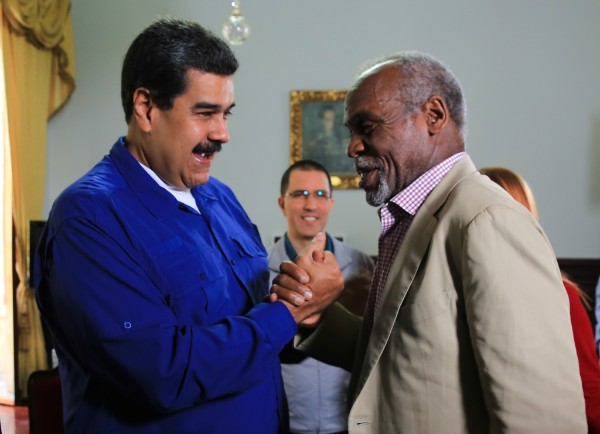
The way celebrities involve themselves in human rights (positively or negatively) has been a topic in this blog several times [see e.g. https://humanrightsdefenders.blog/2014/02/28/and-the-nominees-are-oscars-for-human-rights/ and recently https://humanrightsdefenders.blog/2017/11/10/helen-hunt-joins-list-of-celebrities-that-show-insensitivity-on-human-rights/]. Venezuela has played the game getting star power on its side, but the president of the New York based Human Rights Foundation, Thor Halvorssen, is quite right that when it concerns a UNICEF goodwill ambassador matters become more serious: “…the moment Danny Glover travels to Venezuela using the seal of the United Nations’ highest office that deals with children, then Glover’s statements deserve higher scrutiny,” Thus HRF’s demand that UNICEF should strip Danny Glover from its honorary Ambassadorship.
This Saturday in Caracas, Glover praised Maduro’s government for “advancing humanity through education, health, and other aspects that honor humankind.” Meanwhile, the dictatorship’s economic policies have brought over 30 million Venezuelans into the worst humanitarian crisis in the 200-year history of the country. In 2017, Venezuelans lost 24 pounds in average due to hunger and undernourishment and, according to NGO Caritas, 33% of Venezuela’s 10 million child population has stunted growth.
[HRF adds: “Danny Glover has behaved unspeakably in his support for the Venezuelan regime and his motivation is unbridled greed. Eleven years ago, Glover received close to 20 million dollars from the Venezuelan regime to produce a film that was never made, and the funds have yet to be returned to the Venezuelan people. The payment was a crude payoff, masked as a production budget, in order to ensure that Glover was a permanent public relations agent for the Venezuelan government. In doing so, Glover violated American laws regarding registration as a foreign agent. But most of all, he lost all credibility as a spokesperson for human rights,”]
(Early this year, the International Criminal Court in The Hague (ICC), Netherlands, opened an investigation against the Venezuelan regime for crimes against humanity, while the Organization of American States (OAS) has created a commission to investigate gross human rights violations committed by the regime and refer their results to the ICC.)
https://mailchi.mp/e97c4e3f959c/hrf-to-un-fire-danny-glover-from-unicef-ambassadorship?e=f80cec329e
Posted in films, Human Rights Foundation | Leave a Comment »
Tags: celebrities, Danny Glover, film star, goodwill ambassador, Human Rights Foundation, Maduro, star power, UNICEF, Venezuela
March 29, 2018
In response IHEU’s Director of Advocacy, Elizabeth O’Casey, corrected the Holy See listing the established rights which constitute freedom from religion, and highlighted why freedom from religion is so necessary for those professing no religious beliefs around the world: “freedom from coercion to adopt a religion is protected by law; freedom to have no religion is protected by law; freedom to leave a religion is protected by law; and freedom to criticise a religion is protected by law.”
She also noted that in his own comments to the Council, the UN Special Rapporteur on Freedom of Religion of Belief, Dr Ahmed Shaheed, also corrected the Holy See. Shaheed stated categorically that freedom from religion is protected by the right to freedom of religion or belief. Dr Shaheed mentioned specifically how humanist, atheist and secular bloggers are under attack, and that the right to freedom of religion or belief protects the individual, not the religion or belief itself.
In her statement, O’Casey went on to highlight just why statements such as those made by the Holy See are so objectionable and dangerous; especially in the context of state-based hate and a culture of impunity allowing for violence against those who have no religious beliefs. O’casey reminded the Council that 85 countries severely discriminate against non-religious individuals whilst seven countries were found to actively persecute the non-religious during last year. She also reminded the Council of the situation of those jailed in states such as Pakistan, Saudi Arabia and Iran for being atheist or humanist, and the brutal murder of so many secularists and rationalists with impunity in Bangladesh, India and the Maldives. O’Casey also mentioned Saudi Arabia, Egypt, Malaysia and Cyprus in their promoting state hatred against atheists and humanists.
In the light of this situation, O’Casey asked how many more humanists, atheists and secularists need to be killed, imprisoned, persecuted and disproportionately targeted for the international community to begin to understand the absolute importance of freedom of religion or belief for those with no religion? She concluded, “so long as the rest of the international community stay silent, the rights of the invisible minority of non-believers across the world will continue to be trampled upon, including by members of this Council.” The full text of O’Casey’s statement can be seen through the link below.
In this context it was interesting to see that in the UK a Burnley vicar, who has campaigned to expose sexual abuse and its cover-up in the Church of England, has been named Secularist of the Year! The Rev Graham Sawyer, who is the vicar of St James’ Church, was one of two joint winners presented with a £5,000 prize at a lunch hosted by the National Secular Society. Human rights campaigner Peter Tatchell, who won the award in 2012, presented the prize at the event in central London.
Posted in awards, Human Rights Council, Human Rights Defenders | Leave a Comment »
Tags: Ahmed Shaheed, atheism, awards, Elizabeth O’Casey, freedom from religion, Graham Sawyer, Holy See, International Humanist and Ethical Union (IHEU), religious freedom, UN Human Rights Council, UN Special Rapporteur on Freedom of Religion of Belief, Vatican
March 29, 2018
 The Frank Jennings Fellowship was set up to give an opportunity for dedicated and talented individuals to gain experience working for the protection of human rights defenders in an international NGO and at the Office of the UN High Commissioner for Human Rights. It is named after Front Line Defenders’ former Head of Research who died after a long illness in 2005. Frank made a huge contribution to the development of human rights activism in Ireland and candidates who have some experience of human rights work in Ireland will be given priority.
The Frank Jennings Fellow spends 3 months at Front Line Defenders where they will be trained in relation to Human Rights Defenders; the UN Declaration on Human Rights Defenders; the Mandate of the UN Special Rapporteur; the procedures and methodology of the mandate; the role of Front Line Defenders and other national and international organisations in the support and protection of Human Rights Defenders. The Fellow will then move to Geneva for a period 6 months before returning to Front Line Defenders for a further 3 months.
The Fellow will be able to draft well and have good analytical skills. They will have some knowledge of the UN system and international and human rights law. They must be able to work in both English and Spanish (required!). They will be able to work on own initiative and as a member of a team. They will have good oral and written communication skills and be computer literate. They will be flexible and co-operative. Previous work experience with organisations working in the field of Human Rights would be desirable.
Basic Terms of reference – Front Line Defenders Dublin
- Provide support to Front Line Defenders’ Protection Coordinators including dealing with routine queries and correspondence with human rights defenders;
- Cooperate closely with the Regional Fellows and Protection Coordinators in drafting urgent appeals on behalf of human rights defenders at risk around the world
- Input HRD-related information on the Front Line Defenders database;
- Undertake clerical tasks such as faxing, photocopying, word processing, sending press releases, data entry, collating, emailing
- Support follow-up on cases taken up by Front Line Defenders or other specific projects relating to Human Rights Defenders as requested;
- Draft as requested, minutes, briefings, reports, appeals;
Basic Terms of Reference – Geneva SR
- Gather information on the situation of human rights defenders around the world (with a particular focus on themes of concern identified by the SR);
- In coordination with other thematic mechanisms and with geographic desk officers, and under the supervision of the HRD assistant to the SR, draft urgent appeals and communications to Governments concerning human rights violations against human rights defenders;
- Support follow-up of cases;
- Analyse replies received from Governments and prepare summaries for inclusion in the annual Human Rights Council (HRC) report;
- Assist in the drafting of annual reports to the HRC and the General Assembly;
- Assist in the preparation of background materials for official missions by the Special Rapporteur;
- Assist in liasing with non-governmental organizations for the smooth implementation of the mandate, as needed.
Honorarium: €1200 per month Dublin and €1400 per month Geneva.
The next Frank Jennings Fellowship will start on 1 April 2018.
Applications comprising a cover letter and CV should be sent to Ed O’Donovan, Head of Protection, at recruit@frontlinedefenders.org by 30 November 2017.
Important: please indicate the FULL title of the position you are applying for in the subject heading of email: ‘Frank Jennings Internship’ or the application may be missed.
https://www.frontlinedefenders.org/en/frank-jennings-fellowship-dublin-and-geneva
Posted in Front Line, human rights, Human Rights Defenders | 1 Comment »
Tags: call for applications, Dublin, fellowship, Frank Jennings Fellowship, Front Line (NGO), Geneva, internship, job opportunity, vacancy, youth
March 26, 2018
Diplomats gathered on Friday to vote on resolutions presented at the UN Human Rights Council in Geneva (swissinfo.ch)
The Chinese resolution calling for “mutually beneficial cooperation” on human rights issues was adopted at the United Nations Human Rights Council last week, but human rights defenders and several countries say it actually weakens human rights principles.
“The Chinese resolution is the first stage of a major step backwards,” Geneva-based human rights specialist Adrien Claude Zoller told swissinfo.ch, calling it “THE major event” of the Human Rights Council’s 37th sessionexternal link.
At first glance, Beijing’s resolution at the Human Rights Council – only its second-ever in nearly a dozen years ! – seems relatively innocent. The text, full of diplomatic language such as “universality” and “international constructive dialogue”, was adopted on Friday evening by 28 votes to one, with 17 abstentions.
But it nonetheless upset many diplomats and human rights campaigners in Geneva. Australia, Britain, Japan, and Switzerland were among those abstaining, though many envoys spoke out against the text. Ahead of Friday’s vote, Switzerland said the resolution contained “vague and ambiguous language that weakens fundamental human rights principles”. [see also in this context: https://humanrightsdefenders.blog/2018/03/22/unfortunately-europe-is-not-stepping-up-its-human-rights-policy-in-us-absence/]
While welcoming “constructive international cooperation as a means of promoting and protecting human rights”, Switzerland’s ambassador to the UN in Geneva, Valentin Zellweger, stressed that human rights-related mandates need to be able to act quickly and work efficiently to prevent crises. Civil society, he added, must be able to play a crucial role in protecting against and addressing violations.
Zoller said the resolution recalled certain language and concepts heard during the Cold War when the Soviet Union also invoked the idea of “mutually beneficial cooperation”. “The procedure put in place by the Chinese resolution involves putting an extra layer around the system of special procedures [such as independent investigations] and increasing pressure on them,” Zoller declared. It amounts, he said, to an attempt to “kill the messenger” and complicate the work of the special rapporteurs who carry it. “It attempts to do this by ignoring the monitoring bodies of human rights conventions [and returning] to the principle of non-interference.”
John Fisher, the Geneva-based director of Human Rights Watch, also criticised China’s strategy. His organisation last year issued a reportexternal link warning of Chinese interference in UN human rights mechanisms.
The United States cast the only “no” vote on the resolution, co-sponsored by states including Pakistan and Egypt. US diplomat Jason Mack said China was using its resolution to try to weaken the UN human rights system and norms. “The ‘feel-good’ language about mutually beneficial cooperation is intended to benefit autocratic states at the expense of people whose human rights and fundamental freedoms we are all obligated as states to respect,” he said.
He added that Chinese spokespeople had clearly been trying to “glorify their head of state by inserting his thoughts into the international human rights lexicon”.
On Monday, China accused the Americans of arrogance for rejecting the Chinese resolution. “I think the comments by this US official in Geneva…were extremely unreasonable, and also reflect the consistent ignorance and haughtiness of the US side,” Chinese Foreign Ministry spokeswoman Hua Chunying told a daily news briefing.
Many countries expressed at the meeting that the Chinese resolution reflected the common wishes of the international community and helped raise the ability of developing nations to speak for themselves on human rights issues, Hua added.
https://www.swissinfo.ch/eng/un-human-rights-council-_china-s–win-win–rights-initiative-makes-waves-in-geneva/44000588?&ns_mchannel=rss&srg_evsource=gn
Posted in Human Rights Council, UN | 2 Comments »
Tags: Adrien Claude Zoller, ‘win-win’ resolution, China, diplomacy, human rights mechanisms, non-interference, Resolution, Swissinfo, Switzerland, UN Human Rights Council, US
March 26, 2018

British labor rights activist Andy Hall (Associated Press)
The Washington Post and many others reported on this development. The Monday ruling involves four defamation suits filed by pineapple canning company Natural Fruit, which employed migrant Myanmar workers who claimed the company had abused them and broke labor regulations.Hall’s legal troubles stem from a 2013 report he researched for the Finnish consumer organization Finnwatch that alleged labor abuses at Natural Fruit’s facilities. They also concern an interview that he gave to Al-Jazeera on the subject, which was the focus of Monday’s ruling. Natural Fruit claimed that the report Hall helped research and his interview comments both hurt their business.
(Hall left Thailand in 2016, citing intolerable legal harassment after another company, poultry producer Thammakaset Farm, sued him in another case, but still works on labor rights issues concerning migrants in Thailand.)
“This verdict is a major setback for rights of human rights defenders, migrant workers, labour/migration activists and researchers everywhere and casts a dark shadow over recent positive progress the Thai government and Thai industry has made to improve migrant worker conditions,” Hall commented Monday on his Twitter account.
https://www.washingtonpost.com/world/asia_pacific/thai-court-finds-british-labor-activist-defamed-fruit-firm/2018/03/26/3c0094f4-30d4-11e8-b6bd-0084a1666987_story.html?utm_term=.fa9fba4f63b6
Posted in Human Rights Defenders | Leave a Comment »
Tags: Andy Hall, defamation, Finnwatch, Human rights defender, judicial harasment, labour rights, migrant workers, Natural Fruit Company Ltd, Thailand
March 24, 2018
Journalists take part in a protest outside the State Government building in Ciudad Juarez, Mexico to mark one year since the murder of journalist Miroslava Breach (AFP Photo/HERIKA MARTINEZ)
The UN and AFP launched an award Thursday 22 March 2018 to honor journalists who risk their lives to cover human rights abuses in Mexico, in tribute to two celebrated reporters murdered last year. The Breach-Valdez Prize will honor journalists who follow in the footsteps of their slain colleagues Miroslava Breach and Javier Valdez, two of the more than 100 reporters murdered since 2000 in one of the world’s most dangerous countries for the press. (see also: https://humanrightsdefenders.blog/2018/01/05/front-lines-2017-report-confirms-worst-expectation-over-300-hrds-killed/)
Its aim is “to recognize the careers of Mexican journalists who have distinguished themselves in defending human rights,” said Giancarlo Summa, director of the United Nations Information Center in Mexico.
Valdez, an award-winning journalist who covered Mexico’s powerful drug cartels, was gunned down last May in broad daylight outside the offices of Riodoce, the newspaper he co-founded in Culiacan, the capital of his native Sinaloa state. He was also a long-time AFP collaborator.
Miroslava Breach, a correspondent for Mexican daily La Jornada in the state of Chihuahua, on the US border, was a celebrated investigative journalist known for hard-hitting reports on links between politicians and organized crime. She was shot dead in broad daylight last March as she drove her son to school.
The annual prize is also co-sponsored by UNESCO, the Ibero-American University and the French embassy in Mexico. The first edition will be awarded on May 3 in Mexico City. The winner will receive a grant and a trip to France to take part in a series of events on free speech.
(Breach and Valdez were among at least 11 journalists murdered in Mexico last year, making it the deadliest country in the world for the press after Syria, according to watchdog group Reporters Without Borders. The latest murder came just Wednesday, when journalist Leobardo Vazquez was gunned down outside his house in Veracruz state — the second killed in 2018.)
“There is no indication these crimes are going to stop. Let’s hope this prize will help all the country’s brave journalists keep up the fight,” Valdez’s widow, Griselda Triana, said at the launch of the award.
This is a national award. There are many awards for journalists and for freedom of expression at the international level, see: http://trueheroesfilms.org/thedigest/
https://www.yahoo.com/news/un-afp-launch-prize-honor-slain-mexican-journalists-034757524.html
Posted in awards, Human Rights Defenders, UN | 4 Comments »
Tags: AFP, awards, Breach-Valdez Prize, digest of human rights awards, freedom of expression, Javier Valdez, journalists, killings, Leobardo Vazquez, Mexico, Miroslava Breach, national award
March 24, 2018
I Defend Rights: Shifting the Narrative about Human Rights Defenders and Civil Society Globally is a project of the Norwegian Human Rights Fund and Memria.org, in collaboration with numerous partners around the world (see the list of partners below).
It is about collecting audio accounts from human rights defenders to create a global archive of recordings of their experiences working on the front lines defending the rights of others. We will then develop multiple ways to share many of these audio recordings with much broader audiences, such as through exhibits and using social media platforms. Any defender (including you!) can participate and easily:
- It only takes a few minutes.
- You can re-record as many times as you want.
- We will ask you a few simple questions.
- You can remain anonymous.
- We will not ask you to reveal sensitive information.
The “I Defend Rights” project will make audible the voices of hundreds of Human Rights Defenders from every part of the world. By collecting these recordings, the project team will build a massive public audio archive. They are then committed to working with defenders and other partners to disseminate and share these narratives through creative communications strategies. This project will contribute to our shared goal of shifting the global narrative about the thousands of ordinary women and men who promote human rights.
This project helps show how diverse and multiple the human rights community is and how courageous and valuable human rights defenders are in securing rights for all of us, sometimes at great risk. Human rights activists are not enemies of the societies they live in, they are not anti-development or threats to national security as many governments try to depict them. On the contrary, they actively contribute to peace, democracy, and sustainable development. They are agents of positive change. The project will also help us understand why we need to collectively recognize and protect them.
If you peacefully defend human rights, I urge you to take a few moments to sign up at the top of this website. You will then receive an email and be able to respond to a few questions and add your audio recording to this archive and project. It only takes a few minutes.
With thanks.
https://www.idefendrights.org
Posted in human rights, Human Rights Defenders | 1 Comment »
Tags: "I Defend Rights", 20th anniversary UN Declaration on HRDs, audio, documentation, MEMRIA, Michel Forst, Narrative, Norwegian Human Rights Fund, voice recording


 Hans Thoolen on Human Rights Defenders and their awards