Author Archive

Refugee defender Barbara Harrell-Bond died on 18 July 2018

July 25, 2018

Laura Hammond – Professor of Development Studies at the School of Oriental and African Studies, University of London – wrote in IRIN the following obituary of Barbara Harrell-Bond who died on 18 july 2018. She was one of the most  prolific advocates of the rights of refugees all over the world. Tireless is often used but in her case an understatement. 

In the current international climate, refugees can use all the supporters they can get. But last week, refugees around the world lost an irreplaceable champion with the passing of Dr. Barbara Harrell-Bond.

Barbara worked tirelessly for more than 35 years to improve protections for refugees, to ensure that their voices were heard not only in academic research but in real-world policy debates.

Barbara was never short of outrage at how badly refugees were being treated throughout the world. To her, fighting that injustice was the most important thing – it was all-consuming. Her research and teaching were inspirational to generations of scholars and practitioners of refugee and forced migration studies. Most memorably, she never shied away from speaking truth to power, taking on donor governments, UN bodies, large non-governmental organisations, and host governments alike. Indeed, her bold criticisms, backed by robust evidence, have inspired generations of scholars to follow her example and hold to account officials charged with assisting refugees.

I first met Barbara in 1988 while studying anthropology at the University of Oxford. I had spent the whole year studying subjects like witchcraft and totemism – things that can make people seem more exotic than understood – and I wanted to use my training in a more useful way. My tutor sent me along to meet Barbara. I stepped into her office and found a wonderful, diverse world of people who were doing exactly what I wanted to be doing – using academic research to try to make a positive difference in the world.

Trained as a legal anthropologist, she studied at Oxford under the supervision of eminent anthropologist Edward Evan Evans-Pritchard.

Her engagement with refugees and African studies came later, but her commitment to social justice was clear even from her 1967 dissertation, an ethnography of a deprived housing estate in the Oxford suburbs, Blackbird Leys. She went on to research law and dispute resolution in traditional courts in Sierra Leone.

Barbara’s work on refugees began in the early 1980s. She established the Refugee Studies Programme at Oxford (now known as the Refugee Studies Centre). Run by a tiny but dedicated team, this institution quickly became a crucial resource and meeting point for academics, practitioners, and refugees themselves. Barbara led the way in establishing refugee studies as an interdisciplinary academic field. At its centre: an agenda for influencing policy and bringing a refugee-centred focus to debates about asylum policy, social integration, and refugee assistance.

Barbara’s seminal 1986 book Imposing Aid: Emergency Assistance to Refugeeswas based on research she and a band of Oxford students and local researchers conducted in what is now South Sudan. In it, she makes the very simple argument – she was the first to agree it should not have to be made – that refugees are not helpless victims, but always and everywhere have agency, resilience, and dignity, and that this must be the starting point for any assistance. Showing how badly wrong things can go when they fail to keep this basic truth in mind, this book – as well as Rights in Exile: Janus-Faced Humanitarianism (which she co-authored) – called to account those acting to aid and protect refugees. Her criticisms were always sharp, direct, and – most embarrassingly for their targets – meticulously substantiated with evidence. She did not suffer fools or egos gladly.

I worked for Barbara in 1989-1990, helping to put together material for training courses for people working with refugees. She had me working late into the night and on weekends. I remember working on New Year’s Day, stepping outside the office only to buy bread, salami, and Barbara’s cigarettes. When my work permit expired after a year, she somehow managed to get it extended through a connection in the British government’s Home Office – much to my surprise, as that was a regular target (along with the UN’s refugee agency, UNHCR) of her strident criticism.

These days I am less surprised; these organisations are sprinkled with people who were influenced by her, who carry with them a streak of critical boldness even as they work inside the belly of the beast.

Many years later, when we started a master’s degree in ‘Migration, Mobility and Development’ at SOAS, she told me that she was sorry we had focused on migrants of all kinds rather than focus exclusively on refugees, as she thought that the latter needed greater protection. She picked fights over this issue with many people, and she was not easy to get along with. At the same time, she was fiercely loyal to her friends, and we remained in regular contact over three decades, up to just a few weeks ago.

Barbara’s research and teaching were inspirational to generations of scholars and practitioners of refugee and forced migration studies. She was crucial in the founding of the Journal of Refugee Studies and the Forced Migration Review – respectively the world’s leading academic and practitioner publications on refugees and displacement. She also set up the Rights in Exile web portal that provides essential information and a network of experts who provide pro bono legal assistance to asylum seekers.

Barbara was also a founder of the International Association for the Study of Forced Migration, the leading professional association for scholarship on forced migration. The association will meet next week in Thessaloniki, Greece, where she was to have received yet another lifetime achievement award, and seen the launch of a new film about her life, Barbara Harrell-Bond: A Life Not Ordinary.

Barbara’s vision of refugee studies demanded being close to the regions and people with whom it is engaged. Disturbed by the idea of a refugee studies centre isolated in the ivory tower of Oxford, she worked with colleagues to establish the Refugee Law Project at the University of Makerere, Uganda, and refugee studies centres at Moi University in Kenya, the American University in Cairo, and others. Out of these centres have come many of the strongest and most interesting voices in refugee studies today, including academics who are or have been refugees themselves.

Her home in north Oxford was a hive of activity – every guest was pressed into voluntary service to contribute to scholarship or advocacy on refugee issues. Refugees found safe haven there. Stray academics found purpose in her fierce commitment to social justice.

When I now think about Barbara’s legacy, I realise that almost everyone I have collaborated with or respected in the field of refugee studies has a Barbara connection. In some cases she introduced us to each other. In other cases I feel a connection to someone and only find out much later that Barbara touched their lives in some way, in some part of the world – Uganda, South Africa, Kenya, Egypt, India… Whether she introduced us to each other or not, having been in her orbit changed all of us and made us into a strong, subversive, passionate clan.

A few years ago I went to visit her again. She sat in her living room, which continued to be a cottage industry for refugee protection. Three student interns sat at computers. A fourth was cheerfully preparing lunch for everyone. They had all, like me all those years before, been seduced by Barbara’s passion.

http://www.irinnews.org/feature/2018/07/18/appreciation-barbara-harrell-bond-refugee-advocate-and-researcher-1932-2018?utm_source=IRIN+-+the+inside+story+on+emergencies&utm_campaign=194a685f7e-RSS_EMAIL_CAMPAIGN_WEEKLY_ENGLISH&utm_medium=email&utm_term=0_d842d98289-194a685f7e-75444053

https://www.rsc.ox.ac.uk/news/barbara-harrell-bond-obe-1932-2018

Announcement of the Human Rights Defenders World Summit in Paris, October 2018

July 24, 2018

ProtectDefenders.eu, the EU Human Rights Defenders mechanism, is organising the HUMAN RIGHTS DEFENDERS WORLD SUMMIT 2018 – to be held in Paris, October 29-31 2018 at Palais de Chaillot (Espace Niemeyer). The event is organised with a coalition of international NGOs and human rights defenders networks – including Amnesty International, AWID, the International Service for Human Rights, and ProtectDefenders.eu’ board members FIDH, Front Line Defenders, OMCT, and RSF -, with the support of the European Union.

On the occasion of the 20th Anniversary of the UN Declaration on Human Rights Defenders, the Human Rights Defenders World Summit 2018 will constitute an opportunity to review the progress made in the defence of human rights and in the protection of all those that defend these rights in all their diversity since the adoption of the Declaration. By creating a unique platform for the human rights defenders’ voices to be heard, this Summit will also call for the international community to reinforce its commitments to protect human rights defenders, celebrate the essential work HRDs carry out in the most difficult environments, and raise awareness about the threats, obstacles and restrictions HRD are constantly confronted with. The Summit intends to shape the upcoming human rights defenders’ agenda, showing the way forward to the international community engaged in the protection of human rights defenders and the promotion of a safer and more enabling environment.

To learn more about the Human Rights Defenders World Summit 2018, and meet the HRDs who are confirming their participation, check for updates at the Summit’s website.

Open call for human rights defenders

The  Human  Rights  Defenders  World  Summit  2018 will bring together a diverse group of over 150 HRDs, from around the world, for three days of meetings, panel discussions, networking and workshopping. These HRDS who are at the forefront of the struggles for social, political and environmental changes will have the opportunity to connect, work and debate together and engage with regional and international human rights organisations, global leaders from governments, the United  Nations, and the private sector. In addition to a focus on those HRDs who are most vulnerable and at risk, the Summit will be a unique space to convene marginalised groups, including ethnic and religious minorities, diverse gender identity activists, indigenous peoples and other defenders who are geographically remote from centres of power, media and international attention.

For achieving this goal, the World Summit is launching an open call for human rights defenders to present their candidacies. The aim of this call is to reach out to the most isolated and less connected defenders, traditionally underrepresented, members of less visible categories and groups or profiles of special concern. This call is, thus, very important to ensure and reinforce the representativeness, inclusiveness and diversity of the Summit’s participants.

This call will be open until 1st September, and is available in the HRD World Summit website, in English, French, Spanish, Arabic, and Russian. Please, share it widely within your network!

Communication and coordination

Louise Levayer – llevayer@amnesty.fr

Javier Roura – jroura@protectdefenders.eu

Website

https://hrdworldsummit.org

Facebook

https://www.facebook.com/hrdworldsummit2018

Twitter

https://twitter.com/HRDWorldSummit

Nominations for the 2019 Dodd human rights prize open

July 23, 2018

The public is being invited to submit nominations for the human rights prize awarded biennially by the University of Connecticut. For more on the Thomas Dodd Human Rights Award see: http://trueheroesfilms.org/thedigest/awards/thomas-j-dodd-prize-in-international-justice-and-human-rights.

Nominations are being accepted online through 1 October.

See also: https://humanrightsdefenders.blog/2017/02/04/physicians-for-human-rights-gets-dodd-human-rights-award/

https://www.theday.com/statenortheast-news/20180721/public-invited-to-submit-nominations-for-dodd-human-rights-prize

Farewell message from Amnesty’s Salil Shetty

July 17, 2018

I announced Salil’s successor on 22 December [https://humanrightsdefenders.blog/2017/12/22/amnesty-announces-kumi-naidoo-as-next-secretary-general-effective-august-2018/]. The farewell message by the departing Secretary General, Salil Shetty, is worth sharing as it contains some general thoughts on the state of the human rights movement:

..

As some of you would know, after eight great years with Amnesty International, I am moving on. My time as Secretary General formally drew to a close on 8 July after the annual gathering of our global leadership in Poland. I wanted to take this opportunity to thank you for your important and generous support through this period – a turbulent time in the world at large, and a crucial transformation process internally.
 
It is difficult to sum up eight years in a pithy way, but as we look back on the so-called Arab Spring, the Syrian conflict, spiralling refugee numbers, the social impact of government policies in the aftermath of the 2008 financial crisis, and the rise of popular authoritarians in many countries, it is clear that we have lived – and continue to live – through very challenging times. The voices of those who stand up against oppression and the abuse of power are more isolated but more important than ever. And Amnesty has played a vital role in supporting these voices.
 
We have seen much fruit from the work in virtually every region of the world we have done together during this period – from the adoption of the Arms Trade Treaty to some important breakthroughs on corporate accountability, from another 10 countries abolishing the death penalty to the release of innumerable prisoners unjustly detained. We have built a new body of work on technology and human rights, ready to confront important new challenges ahead. We have also seen some crucial steps forward on women’s rights and have good reason to hope for much more progress in the coming months and years. Above all, it has been a privilege to work with so many extraordinary people from every part of the world. I will treasure the memories of so many courageous activists I have met during my time with Amnesty.
 
For me, the biggest source of hope has always been people at the local level who refuse to accept injustice. During the past eight years we have had a strong focus on building a truly global human rights movement, particularly by rebalancing the centre of gravity from our traditional strongholds in the richer countries of the world towards a more distributed centre with a much stronger voice for the global south. The growth of Amnesty’s membership in key southern powerhouses such as Brazil, India, Indonesia, Egypt and Nigeria, has been very encouraging, and gives us stronger foundations for the future.
 
……..
I am delighted to hand over to my successor, Kumi Naidoo from South Africa, who will take up the reins on 15 August. Kumi is a well-respected activist and leader in the international NGO sector, having previously led Greenpeace International and CIVICUS. …


Best,

Salil Shetty

China, Russia and Pakistan in UN fail at attempt to muzzle human rights defenders (for now)

July 7, 2018

On 6 July 2018 Stephanie Nebehay reported for Reuters that China, Russia and Pakistan lost their bid on Friday to weaken a U.N. resolution upholding the crucial rule of human rights defenders. The United Nations Human Rights Council adopted a resolution calling on all states to protect civil society groups from threats and intimidation, and prosecute reprisals against them. Chile presented the resolution text on behalf of more than 50 countries on the final day of a three-week session. Amendments proposed by China, Pakistan and Russia – declaring that civil society groups must respect “the sovereignty and territorial integrity of states” and that their funding must be “legal and transparent” – were soundly defeated. So, in spite of increasing retaliation against human right defenders and pressure on civil society in many countries [see recently: https://humanrightsdefenders.blog/2018/06/08/ishr-new-report-on-reprisals-and-restrictions-against-ngo-participation-in-the-un/ ], the UN is still able to resist some of the more blatant attempt to silence critics.

China and Russia are often the least tolerant of civil society at home. They are now seeking to introduce similar restrictions at the international level,” John Fisher of Human Rights Watch told Reuters. Their attempts to place national sovereignty above international human rights law “would turn guarantees of peaceful assembly and association on their heads”.

“These amendments were a swing and a miss for China and its allies on the Council,” Sarah Brooks of the International Service for Human Rights told Reuters, using an American baseball term. “Their efforts to limit civil society’s independence and shut down civil society voices were rebuffed by a strong message – from member states across the globe – about the importance of keeping defenders’ voices at the table”.

[At the current session, China tried unsuccessfully to block the accreditation of Uighur activist Dolkun Isa, U.N. sources said. China’s delegation publicly challenged activists speaking on behalf of Uighur and Tibetan ethnic minorities. Council president Vojislav Suc, Slovenia’s ambassador, said allegations of intimidation and reprisals had emerged during the session and urged “all necessary measures” to prevent such acts.]

https://www.reuters.com/article/us-un-rights/china-russia-fail-to-curb-activists-role-at-u-n-rights-forum-campaigners-idUSKBN1JW2EM

Human Rights Defender Profile: Iván Madero from Colombia

June 30, 2018
2018 is the year of the Human Rights Defenders! The Norwegian Human Rights Fund (NHRF) celebrates its 30th anniversary by showcasing some of the brave human rights defenders it supports through out the year. Iván Madero is a human rights defender from Colombia. Iván Madero Vergel is the director of CREDHOS, an organization that documents violations and accompanies human rights defenders. For him becoming a human rights defender was a natural response to the difficult circumstances in his hometown Barrancabermjea. For more than three decades he has been a leader that stands up for the rights of others. In this video, he tells  how it is to work in a country where people who stand up for human rights are risking their lives:

Azerbaijan: example of ‘sophisticated’ harassment of human rights lawyers

June 29, 2018

Om 29 June 2018 Front Line Defenders reported on the case of disbarment of human rights lawyer Irada Javadova in Azerbaijan. It shows how seemingly ‘neutral’ procedures within the Bar Association are used to silence human rights defenders.

Irada Javadova <https://www.frontlinedefenders.org/en/profile/irada-javadova> is a human rights lawyer who was involved in many resonant cases, including working on numerous violations of citizens’ property rights and violations against political activists and human rights defenders. She is the former head of NGO “Human Rights Education”. The procedure was initiated upon the complaint of an anonymous citizen, who stated that Irada Javadova wrote a letter to the Interior Ministry about her illegal detention in the Directorate for Combating Organized Crime and reported the incident to the press, without the citizen’s consent. According to reports, the citizen stated that Irada Javadova spread false information, defamed her, and requested that the Bar Association take action against the human rights defender. On 11 June 2018, the Presidium of the Bar Association announced the termination of her authority.

Irada Javadova denied the allegations, stating that she had an agreement with her client and that she had legitimately defended her and acted within the law. She had submitted the agreement with the complainant to the Bar Association, but her colleagues expressed doubts about the authenticity of the client’s signature. She was disbarred on 11 June 2018. On 12 June, she met with the chairman of the Presidium of the Bar Association and presented additional evidence, but she was told that there will be an appeal to Baku Administrative Economic Court No. 1, where she will have the opportunity to defend her rights. Irada Javadova believes that the disciplinary commission was biased and erroneous.  On 14 June 2018, human rights lawyer Irada Javadova appealed the Presidium of the Bar Association’s decision to disbar her.

[In recent years, Azeri authorities have been pursuing those lawyers who defend political activists and who speak before the European Court of Human Rights. Officials have dismissed such well-known and active lawyers as Namizad Safarov, Khalid Baghirov <https://www.frontlinedefenders.org/en/profile/khalid-bagirov> , Aslan Ismayilov, Alaif Hasanov, Elchin Namazov, Yalchin Imanov <https://www.frontlinedefenders.org/en/profile/yalchin-imanov> , Farhad Mehdiyev, Muzaffar Bakhshaliyev, Annaghi Hajibeyli, and Intigam Aliyev <https://www.frontlinedefenders.org/en/profile/intigam-aliyev>.  For some earlier posts on Azerbaijan: https://humanrightsdefenders.blog/tag/azerbaijan/page/4/

PS In 2018, Irada Javadova was the only member of Presidium of the Bar Association to vote against the disbarment of human rights lawyer Yalchin Imanov. It is believed that she lost her place in the Presidium following her defence of Yalchin Imanov.


Inventivity of evil: how states restrict HRDs access to the UN in 10 case studies

June 27, 2018

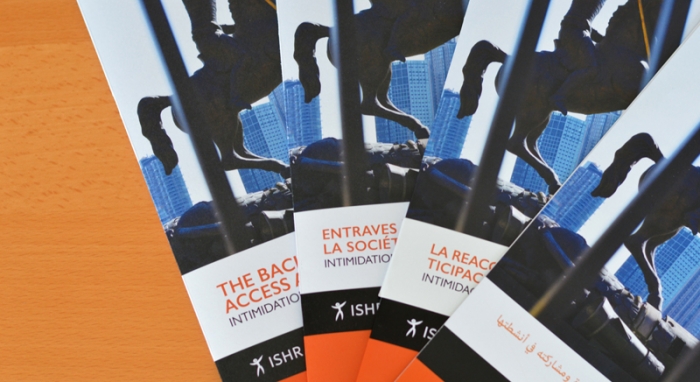
In a new report entitled “The Backlash Against Civil Society Access and Participation at the United Nations” the ISHR outlines the many different ways States employ to keep critical voices out of multilateral spaces. ISHR’s new report provides a road map for States and UN representatives to prevent and counter restrictions on civil society participation in UN processes.

Civil society has the right to ‘unhindered access to and communication with international bodies. However, that right is not being respected.  ISHR’s new report documents a broad range of obstacles faced by human rights defenders, from opaque bureaucracies and procedures to reprisals, physical threats and attacks. ‘States decide who gets through the door,’ said ISHR’s Eleanor Openshaw.  ‘States that fear calls for accountability and justice do what they can to prevent civil society access to and participation in UN spaces’.

Click on the video below to get an insight into the report:

Opaque practices and procedures provide covers for States seeking to block NGO entry.  An NGO seeking to participate in a UN high-level event can be a victim of the ‘no-objection’ procedure.  This is the means by which any State can veto their participation without being named or providing any justification. ‘The no-objection procedure is poorly defined, and provides no formal criteria for objections to NGO participation,’ said ISHR’s John Indergaard. ‘It’s carte blanche to exclude legitimate NGOs for illegitimate reasons.’

Even when civil society representatives make it into an actual UN building, they have been thrown out without explanation or asked to leave while events were ongoing. At some high-level events and committee meetings, NGO representatives have been barred from giving statements or bringing in documents related to their work. Physical attacks and intimidation against those seeking to cooperate with the UN are well documented.  ‘These restrictions and reprisals are all aimed at dissuading civil society participation,’ said Openshaw. ‘They need to be challenged in each and every case.’

For some of my earlier posts on reprisals: https://humanrightsdefenders.blog/tag/reprisals/

To say it again clearly: assaults on human rights defenders are incompatible with international human rights treaties

June 27, 2018
In a ground-breaking joint statement on 23 May 2018, the UN Special Rapporteur on human rights defenders and representatives from all of the UN human rights treaty bodies have affirmed that all forms of abuse or undue restrictions against human rights defenders constitute violations of States’ parties obligations towards the realisation of rights set out in the Treaties. The statement was adopted on the eve of the 30th annual meeting of Treaty Body chairs on the occasion of a consultation initiated by the UN Special Rapporteur on human rights defenders and ISHR in New York.

This pronouncement constitutes a major step forward in the protection of human rights defenders and lays the ground for substantial enhancement of treaty body recommendations and jurisprudence in that area” says ISHR head of treaty body advocacy Vincent Ploton.

The statement reiterates the vital and central role played by human rights defenders to promote and support the application of the fundamental rights enshrined in the core international human rights treaties. It further contextualises the importance and relevance of the UN Declaration on human rights defenders which “reaffirms, is underpinned by, and elaborates binding human rights obligations, including rights set out in the Treaties, and is relevant to the interpretation and implementation of the Treaties”.

The Committee on economic, social and cultural rights (CESCR) was the first to adopt in 2016 a statement affirming that threats and violence against human rights defenders amount to violations of the Covenant. “We are delighted that fellow Treaty Bodies are now following suit with the adoption of this new joint statement”, says ISHR’s New York Director Madeleine Sinclair.

Marking the 20th anniversary of the UN Declaration on human rights defenders, the statement confirms that the core international human rights treaties and the Declaration prohibit discrimination against individuals and groups who champion such human rights norms and standards. It reaffirms that all individuals should be able to engage with treaty bodies free from all forms of interference, intimidation, abuse, threat, violence, reprisal, or undue restriction. It concludes with a series of practical measures that States ought to take to guarantee the protection of human rights defenders, including the adoption of specific legislation to protect and recognise defenders, and the revocation of legislation which restricts or hinders their work.

Read the full statement: http://www.ohchr.org/EN/NewsEvents/Pages/DisplayNews.aspx?NewsID=23154&LangID=E

[The statement was endorsed by the Committee on Enforced Disappearances, the Special Rapporteur on Human Rights Defenders, and the following Treaty Body members in their individual capacity: Virginia Brás-Gomes, CESCR Chair; Dalia Leinarte, CEDAW Chair; Noureddine Amir, CERD Chair; Ahmadou Tall, CMW Chair; Danlami Basharu, CRPD Vice-Chair; Felice Gaer, CAT Vice-Chair; Marcia Kran, HRCttee member; Olga Khazova, CRC Vice-Chair and Satyabhooshun Gut Domah, SPT member.]

https://www.ishr.ch/news/treaty-bodies-threats-and-assaults-human-rights-defenders-incompatible-core-international-human

New Global Center for Sport and Human Rights created to address abuses

June 27, 2018