Author Archive

Anaïs Marin – UN Expert on Belarus: “Full-scale assault” ongoing against civil society

July 6, 2021
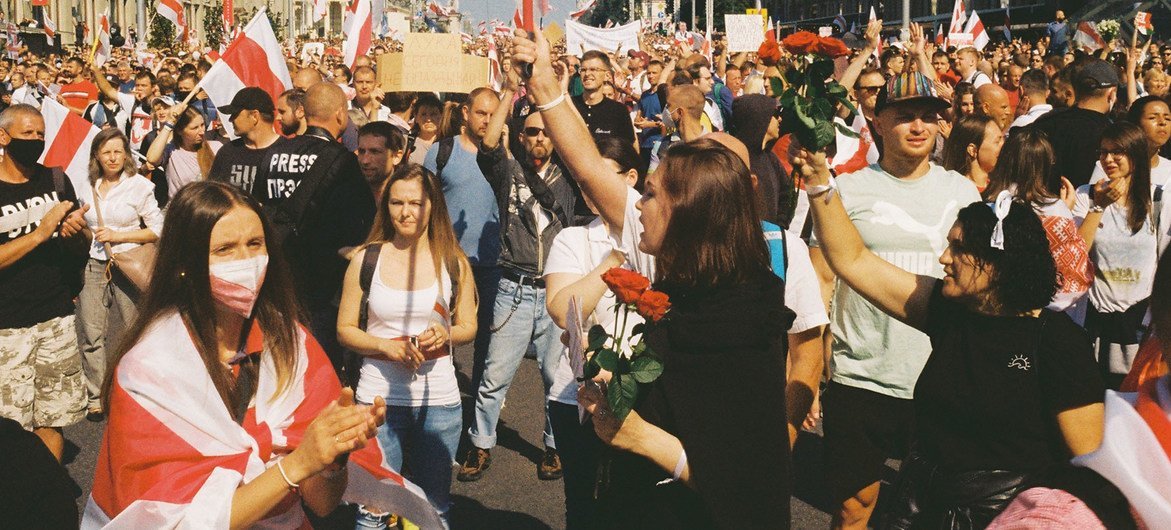
Protestors at the March of Peace and Independence in Minsk, Belarus (file photo).

Unsplash/Andrew KeymasterProtestors at the March of Peace and Independence in Minsk, Belarus (file photo). 5 July 2021

Belarus has witnessed an unprecedented human rights crisis over the past year, the independent expert appointed to monitor the country said on Monday 5 July 2021, calling on authorities to immediately end their policy of repression and fully respect the legitimate aspirations of their people.

Belarus has witnessed an unprecedented human rights crisis over the past year, the independent expert appointed to monitor the country said on Monday, calling on authorities to immediately end their policy of repression and fully respect the legitimate aspirations of their people.

In her annual report to the Human Rights CouncilAnaïs Marin said she had received reports of massive police violence used against protesters – since last August’s disputed presidential election brought millions onto the streets to contest the result – cases of enforced disappearance, allegations of torture and ill-treatment and the continuous intimidation and harassment of civil society actors.

Broad spectrum of abuses

“The Belarusian authorities have launched a full-scale assault against civil society, curtailing a broad spectrum of rights and freedoms, targeting people from all walks of life, while systematically persecuting human rights defenders, journalists, media workers and lawyers in particular,” Ms. Marin told the Council.

“The crackdown is such that thousands of Belarusians have been forced or otherwise compelled to leave their homeland and seek safety abroad; yet the downing of a civilian plane in Minsk on 23 May, for the apparent sole purpose of arresting a dissident who was on board, signaled that no opponent to the current Government is safe anywhere”, the expert added.

She noted that the significant deterioration of the human rights situation in Belarus started in late spring 2020 and climaxed in the aftermath of the presidential election of 9 August, the results of which were widely contested.

Malpractices were reported during the election campaign, as most opposition candidates were forced out of the race, while the vote count was marred by allegations of fraud.

Unjustified and disproportionate

“Distrust in the legitimacy of the electoral outcome triggered spontaneous and largely peaceful popular protests to which the authorities responded with unjustified, disproportionate and often arbitrary force”, said the Special Rapporteur, who reminded that over 35,000 people have been detained since then for trying to exert their right to freedom of peaceful assembly, including women and children arrested for peacefully demonstrating solidarity with victims of police violence.

“Since August 2020 I received innumerable allegations of beatings and ill-treatment, including torture in detention, but also allegations of rapes, enforced disappearances and even killings – all remain to be investigated.”

She said she was also alarmed by the hundreds of cases of criminal prosecution of human rights defenders and lawyers, journalists and medical staff, which have taken place, simply for doing their job.

Abusers protected

“As the legal and judicial systems in Belarus protect the perpetrators of grave human rights violations, continuing impunity means that there is no guarantee of non-reoccurrence,” Ms. Marin said. “Hence the international community should keep on demanding the release and rehabilitation of all those still detained on political grounds, and support initiatives aiming at bringing perpetrators of the most serious crimes to account”.

The UN expert also expressed concerns about the impact the ongoing crackdown has had on the right to education, pointing to discriminatory measures that persist in Belarus against people with disabilities, ethno-linguistic minorities, people living in rural areas and those deprived of liberty.

‘Disastrous consequences’

I call on the Belarusian authorities to put an end to their policy of repression, to immediately and unconditionally release those arbitrarily detained, and to ensure full respect for the human rights and legitimate democratic aspirations of people in Belarus”, the UN expert said, warning that a further aggravation of the human rights crisis and international self-isolation could have disastrous consequences for the whole country.

See also: https://humanrightsdefenders.blog/2021/06/28/fidh-launches-website-tracking-systematic-human-rights-violations-in-belarus/

https://news.un.org/en/story/2021/07/1095302
China in the 47th session of the UN Human Rights Council: Uyghurs and jailed human rights defenders

July 6, 2021

In a statement 22 June 2021, the ISHR on behalf of over 20 civil society organisations called for unequivocal action by the High Commissioner to monitor and report on the human rights situation in China. The violations targeting Uyghurs and other Turkic Muslims, the groups underlined, have been determined by Amnesty International and Human Rights Watch to constitute crimes against humanity.

‘The Special Procedures and treaty bodies have repeatedly, for the last five years, raised serious concerns about the human rights situation in China,’ said Sarah M Brooks, ISHR programme director. ‘But despite these efforts, little has changed. More is needed.’

The gravity of the situation was underlined also by a joint statement delivered by Canada, on behalf of more than 40 states, earlier today. Listing a range of concerns about treatment of Uyghurs, those governments pressed China to allow ‘immediate, meaningful and unfettered’ access to the region for the High Commissioner.

The weight of evidence and the gravity of allegations of crimes against humanity against Uyghurs demands that the High Commissioner commence remote monitoring and public reporting immediately. The full statement can be accessed here

Anadolu on 29 June 2021 reported that Mary Lawlor, the UN special rapporteur on human rights defenders, says she has countless reports about mistreatment of activists in China.

The UN’s independent expert on human rights defenders said that she feared activists in China were arbitrarily sentenced to long prison terms, house arrest and tortured and also denied access to medical treatment, their lawyers and families.

Condemning human rights defenders…to long terms in prison for their peaceful human rights work, abusing them in custody and failing to provide them with adequate medical care…cannot continue,” Mary Lawlor, the UN special rapporteur on human rights defenders, said in a statement.

She said she had “countless reports” pointing to the mistreatment of human rights defenders in Chinese custody, which is “endemic.”

Geneva’s Chinese mission spokesman Liu Yuyin later refuted Lawlor’s criticism, accusing the UN expert of having “deliberately smeared China, spread disinformation and interfered in China’s judicial sovereignty under the pretext of human rights.”

“The individuals that Ms. Lawlor and other special procedure mandate holders mentioned have committed a series of crimes such as inciting subversion of state power and splitting the state. The facts are clear and the evidence is solid,” he added.

Lawlor said the treatment meted out to those jailed may amount to torture and other cruel and inhuman treatment, despite a plethora of recommendations from the UN mechanisms over the years, including from the Committee Against Torture.

Some defenders, such as Gao Zhisheng, have been “forcibly disappeared,” while others such as Guo Hongwei have died in prison, she said. Lawlor said she knew of at least 13 human rights defenders sentenced on “spurious charges” such as “picking quarrels” or “provoking trouble” to 10 years or more in prison for peacefully defending the rights of others. Among them is Qin Yongmin, sentenced to 35 years in prison for work that included promoting engagement with the UN, and Ilham Tohti, a “moderate scholar” serving a life sentence.

“Tohti was arbitrarily arrested, allegedly tortured and sentenced to life after a closed-door trial. He was not allowed any family visits and no information has been provided by Chinese authorities since,” said Lawlor. He is a much-recognised defender: https://www.trueheroesfilms.org/thedigest/laureates/37AE7DC4-16DB-51E9-4CF8-AB0828AEF491

Human rights defender Chen Xi, serving 10 years in prison, has chronic enteritis, which causes dehydration and fever. In winter, he contracts severe frostbite on his hands, ears and abdomen, and in his lifetime, he has been sentenced to 23 years in prison, said the expert.

https://www.ishr.ch/news/hrc47-governments-ngos-call-high-commissioner-step-work-protect-uyghurs

https://www.globalvillagespace.com/un-expert-raises-concern-on-jailed-activist-in-china/

Profile of Barun Ghimire, human rights defender from Nepal

July 5, 2021

The rights of migrant workers is a global problem, and actors in different jurisdictions have to come together to make a difference in this particular area,” says Barun Ghimire, a human rights lawyer based in Kathmandu, Nepal. “And we need to create a collective narrative that is based on a rights-based approach of migrant workers”.

Barun Ghimire is a human rights lawyer and programme manager at the Law and Policy Forum for Social Justice. Barun works for the protection and defence of the rights of migrant workers in Kathmandu, Nepal. 

In this video, Barun explains his work in relation to the rights of migrants, as well as how Covid-19 has affected this group, which is facing even stronger vulnerability. He also calls the international community and other actors to come together and help improve the situation of migrants workers as well as their families.  To achieve this goal, it is necessary to create a new narrative and defend and promote the rights of migrant people in vulnerable situations, especially during and after Covid-19.

Barun was also a participant in ISHR’s Human Rights Defender Advocacy Programme (HRDAP) in 2020.

https://www.ishr.ch/news/human-rights-defenders-story-barun-ghimire-nepal

Father Stan’s death: callousness that amounts to murder

July 5, 2021

What many feared has happened, jailed Indian tribal rights activist Stan Swamy has died of a cardiac arrest in Mumbai city. He was 84. He was jailed last year under draconian anti-terror law UAPA in connection with the Elgar Parishad case – his death has triggered a flood of messages on social media from political leaders, intellectuals and other activists. Swamy, the oldest person to be accused of terrorism in India, was arrested in October 2020.

Members of the civil society on Sunday 4 July 2021 had urged the chief justice of the Bombay High Court to intervene and provide relief to ailing activist Stan Swamy. They demanded that the 84-year-old, who suffers from Parkinson’s disease and had been put on ventilator support, should be granted bail immediately and allowed to return to Jharkhand.

Mary Lawlor, Special Rapporteur on Human Rights Defenders shared a similar Tweet, saying it was “horrible news” that Swamy was put on a ventilator: “He’s spent 9 months in jail on unfounded charges. I’m deeply saddened and expect that every possible specialist treatment will be provided to him.”

Mr Gilmore – the European Union’s Special Representative for Human Rights, – re-tweeted Ms Lawlor’s post and added: “India: I am very saddened to hear that Father Stan Swamy has passed away. A defender of indigenous peoples’ rights. He was held in detention for the past 9 months. The EU had been raising his case repeatedly with authorities.”

The Jesuit priest, who suffered from Parkinson’s disease, was moved to a private hospital in May after he tested positive for Covid. As he was very belatedly released on bail into hospital and was denied critical treatment in detention, he should be considered a death in the custody of the state.

Jharkhand Chief Minister Hemant Soren stated on Monday: Shocked to learn about the demise of Father Stan Swamy. He dedicated his life working for tribal rights. I had strongly opposed his arrest & incarceration. The Union Govt should be answerable for absolute apathy & non provision of timely medical services, leading to his death.

See also: https://humanrightsdefenders.blog/2020/10/11/the-indomitable-father-stan-swamy-defending-the-adivasis-and-the-dalits-a-cause-of-arrest/

I understand there will be likely a virtual memorial tomorrow, but no details known yet.

A joint statement by important international NGOs (Amnesty International, CIVICUS: World Alliance for Citizen Participation, CSW, FIDH, in the framework of the Observatory for the Protection of Human Rights Defenders, Front Line Defenders, International Commission of Jurists, International Dalit Solidarity Network, World Organisation Against Torture (OMCT), in the framework of the Observatory for the Protection of Human Rights Defenders)) was issued on 5 July: https://www.fidh.org/en/region/asia/india/india-joint-statement-on-the-death-of-human-rights-defender-father

The Government keeps insisting that all was ‘legal’: https://www.mangalorean.com/govt-rebuts-un-says-stan-swamys-detention-was-lawful/

On 25 November 2021 this: https://thewire.in/rights/bombay-hc-asks-jesuit-group-to-file-new-plea-if-they-want-stan-swamys-name-cleared

https://www.bbc.com/news/world-asia-india-57718356

https://scroll.in/latest/999322/as-activist-stan-swamys-heath-worsens-civil-society-members-call-for-bail-specialised-treatment

https://www.outlookindia.com/website/story/india-news-stan-swamys-death-marks-a-tragic-moment-for-indian-democracy-akhil-gogoi/387163

https://www.ndtv.com/india-news/elgar-parishad-case-stan-swamys-death-devastating-eu-un-human-rights-reps-on-stan-swamys-death-2479792

https://www.hindustantimes.com/india-news/activists-opposition-call-out-custodial-murder-of-stan-swamy-101625494111357-amp.html

https://www.fidh.org/en/region/asia/india/india-joint-statement-on-the-death-of-human-rights-defender-father

https://www.indialegallive.com/column-news/stan-swamy-uapa-unlawful-activities-prevention-act-kanchan-nanaware-varavara-rao-binayak-sen/

https://www.miragenews.com/death-in-custody-of-priest-stan-swamy-is-596431/

https://www.ucanews.com/news/book-tells-story-of-indian-jesuit-who-died-in-custody/94104#

New investigation shows global reach of NSO Group’s spyware

July 5, 2021

On 3 July 2021, a new interactive online platform by Forensic Architecture, supported by Amnesty International and the Citizen Lab, maps for the first time the global spread of the notorious spyware Pegasus, made by cyber-surveillance company NSO Group.

‘Digital Violence: How the NSO Group Enables State Terror’ documents digital attacks against human rights defenders around the world, and shows the connections between the ‘digital violence’ of Pegasus spyware and the real-world harms lawyers, activists, and other civil society figures face.   NSO Group is the worst of the worst in selling digital burglary tools to players who they are fully aware actively and aggressively violate the human rights of dissidents, opposition figures, and journalists. Edward Snowden, President of Freedom of the Press Foundation.

NSO Group is a major player in the shadowy surveillance industry. The company’s Pegasus spyware has been used in some of the most insidious digital attacks on human rights defenders. When Pegasus is surreptitiously installed on a person’s phone, an attacker has complete access to a phone’s messages, emails, media, microphone, camera, calls and contacts. For my earlier posts on NSO see: https://humanrightsdefenders.blog/tag/nso-group/

“The investigation reveals the extent to which the digital domain we inhabit has become the new frontier of human rights violations, a site of state surveillance and intimidation that enables physical violations in real space,” said Shourideh C. Molavi, Forensic Architecture’s Researcher-in-Charge. 

Edward Snowden narrates an accompanying video series which tell the stories of human rights activists and journalists targeted by Pegasus. The interactive platform also includes sound design by composer Brian Eno. A film about the project by award-winning director Laura Poitras will premiere at the 2021 Cannes Film Festival later this month.

The online platform is one of the most comprehensive databases on NSO-related activities, with information about export licenses, alleged purchases, digital infections, and the physical targeting of activists after being targeted with spyware, including intimidation, harassment, and detention. The platform also sheds light on the complex corporate structure of NSO Group, based on new research by Amnesty International and partners.

For years, NSO Group has shrouded its operations in secrecy and profited from working in the shadows. This platform brings to light the important connections between the use of its spyware and the devastating human rights abuses inflicted upon activists and civil society,” said Danna Ingleton, Deputy Director of Amnesty Tech.

Amnesty International’s Security Lab and Citizen Lab have repeatedly exposed the use of NSO Group’s Pegasus spyware to target hundreds of human rights defenders across the globe. Amnesty International is calling on NSO Group to urgently take steps to ensure that it does not cause or contribute to human rights abuses, and to respond when they do occur. The cyber-surveillance must carry out adequate human rights due diligence and take steps to ensure that human rights defenders and journalists do not continue to become targets of unlawful surveillance.

In October 2019, Amnesty International revealed that Moroccan academic and activist, Maati Monjib’s phone had been infected with Pegasus spyware. He continues to face harassment by the Moroccan authorities for his human rights work. In December 2020, Maati Monjib was arbitrarily detained before being released on parole on 23 March 2021.

Maati Monjib, tells his story in one of the short films, and spoke of the personal toll following the surveillance, “The authorities knew everything I said. I was in danger. Surveillance is very harming for the psychological wellbeing of the victim. My life has changed a lot because of all these pressures.”

Amnesty International is calling for all charges against Maati to be dropped, and the harassment against him and his family by the Moroccan authorities to end.

To find out more visit digitalviolence.org

https://www.amnesty.org/en/latest/news/2021/07/investigation-maps-human-rights-harm-of-nso-group-spyware/

https://www.techradar.com/news/spyware-toolkit-used-by-governments-hackers-to-break-into-windows-machines

Goldman Prize laureates express concern about colleague Alberto Curamil in Chile

July 3, 2021
Alberto Curamil. (Vicente Franco/Water For Life)

In the Washington Post of 1 July 2021, Craig Williams and Alfred Brownell (winners of the Goldman Prize in 2006 and 2019 respectively) wrote: He has worked to protect the Earth. Now we must protect him.”

As environmental activists and human rights defenders, we are alarmed by a spike in violent attacks on and killings of land rights activists across the globe and, most recently, in Latin America. The latest in this disturbing trend is a violent assault on Alberto Curamil, a leader of the Indigenous Mapuche people in southern Chile and an activist working to protect his people’s land, water and other resources. As we write, we fear Alberto could become the latest casualty in a global war against Earth’s front-line protectors. [see: https://www.trueheroesfilms.org/thedigest/laureates/4f845ff0-86d2-4b12-97af-1590f6ba8602]

On April 29, Alberto was attending a protest along with his son andnephew, both teenagers. They were there to show support for Elena Paine, another Mapuche leader, and her community a day after her house and crops in Koyam Montre were burned to the ground. Alberto, Paine and members of the Machupe community believe that the threat may have come from far-right-wing groups in the area.

As Alberto and his teenage relatives were driving away from the protest, the back window of their truck was shattered by a tear-gas canister. When they got out of the vehicle, police shot Alberto at point-blank range three times with buckshot, which lodged in his back, side, arm and the back of his leg. Then, police beat the teens with batons while yelling “Pinche Mapuche” (“Lousy Mapuche”). The three were arrested and charged with disorderly conduct at a public event and breach of sanitary provisions. Alberto was taken to a hospital three hours after being brought into custody, bleeding and in excruciating pain. The teens were bruised, battered and traumatized.

This was not the first time Alberto had been a target of the Chilean government. In 2018, he was arrested and jailed for 15 months on false charges of armed robbery based entirely on hearsay evidence. He was acquitted of all charges and released in December 2019. Due to his imprisonment, he had been unable to receive the Goldman Prize — known as the “green Nobel” — at ceremonies in April and May 2019 in D.C. and San Francisco. He was previously arrested after being violently beaten by police in 2014.

Our alarm has led us, along with several dozen of our fellow Goldman Prize winners from across the globe, to demand assurances from Chilean President Sebastián Piñera that Alberto’s safety will be given the highest priority. We are also seeking support through appeals to the U.S. Congress, the European Union and the United Nations.

We believe time is of the essence, especially given the broader context of violence against those who stand up to protect the Earth. In 2016, the internationally celebrated Honduran Indigenous activist and Goldman Prize winner Berta Cáceres was murdered by operatives for the power company Desarrollos Energéticos (Desa) for her opposition to a hydroelectric project on the Rio Gualcarque. Seven men accused of plotting Cáceres’s murder were convicted and sentenced to between 30 and 50 years in prison. An eighth suspect, Roberto David Castillo Mejía, president and chief executive of Desa, is currently on trial, accused of masterminding the murder-conspiracy plot.

In its latest report, Global Witness recorded the highest number of environmental defenders killed in a single year — more than 212 people killed in 2019, a rate of four a week. More than two-thirds of the killings took place in Latin America. [see also: Global]

The killings of and assaults on Earth’s defenders worldwide have accelerated in some of the most fragile pristine landscapes and biodiverse countries, jeopardizing the fight against climate change and species extinction. In Mexico, police are investigating the suspicious killings of two employees at a butterfly reserve in 2020. That same month, six members of an Indigenous community were killed at a nature reserve in Nicaragua. And in South Africa, environmental activist Fikile Ntshangase was killed last year in an attack local activists fear was related to her opposition to disruptive local mining operations.

In Chile, Indigenous communities’ push for human rights go hand in hand with their struggle for land and water rights, as government-backed companies try to run them off their land with threats, harassment and violence.

Attacks on environmental defenders in Latin America and worldwide are not only an affront to human rights, but also a cause for deep alarm at a time when the world must fight climate change and bring about a sustainable future. We are demanding that the Chilean government take immediate steps to stop these aggressive and often deadly attacks on the Mapuche community. There should also be a thorough, independent investigation into the destruction of Paine’s home.

We must act against this brutality, or we threaten the fight for a planet in crisis.

https://www.washingtonpost.com/opinions/2021/07/01/alberto-curamil-chile-environmental-defender-safety/

Germain Rukuki, Burundi human rights defender, out of jail

July 3, 2021
Pic

Burundian human rights activist Germain Rukuki was freed on Wednesday afternoon after spending four years in prison, his lawyer told the BBC Great Lakes.

Mr Rukuki was sentenced in 2018 to 32 years in jail on charges that included threatening state security and being part of an insurrection during protests in 2015 against former President Pierre Nkurunziza. He denied the charges.

See also: https://humanrightsdefenders.blog/2019/03/29/ngo-statement-condemns-new-irregularities-in-the-case-of-germain-rukuki-burundi/

Last week, a court of appeal in the city of Bujumbura reduced the sentence to one year – opening the path to his release.

Last December, President Evariste Ndayishimiye pardoned four journalists who had spent a year in prison for ‘undermining state security’ under his predecessor, charges that they denied.

After a year in power, President Ndayishimiye has been praised for positive moves toward human rights, freedom of press and reviving the country’s international relations.

But opposition in the country and international rights defenders deplore ongoing rights violations and political intolerance.

http://www.businessghana.com/site/news/politics/241505/Burundi-human-rights-activist-freed-from-jail

s://ishr.ch/latest-updates/burundi-germain-rukuki-is-free-at-last/

Joint statement by U.N. rapporteurs emphasizes digital rights as “top priority” to rebuild civic space

June 29, 2021

A bit belatedly, I refer to the statement made by Access Now welcoming on Tuesday, 8 June 2021, the timely new statement from U.N. Special Procedures emphasizing that digital rights are “a top priority” to rebuild civic space amid recovery from the COVID-19 pandemic. The nine experts are taking part in RightsCon 2021 (June 7-11), marking the third consecutive year that Special Rapporteurs have issued a statement in light of thematic discussions to be held at the global summit on human rights in the digital age.

The experts pointed to recent instances of digital repression including non-transparent content takedowns and manipulation — as the world is witnessing in Palestine, India, and Colombia — and called upon businesses to uphold their responsibility to respect human rights. They stressed that “the opacity that prevails in the ways content is moderated by Governments and companies reinforces global perceptions of discrimination, inefficiency and censorship. There is an urgent need for transparency.”

The diversity and scope of issues addressed within the mandates of the nine U.N. experts speaks to the heightened role of technology — and the need to center digital rights — in the pandemic recovery. We are thrilled to have such a robust presence of U.N. Special Rapporteurs and members of the Working Group on Business and Human Rights in this year’s RightsCon program,” said Peter Micek, U.N. Policy Manager at Access Now. “The statement decries patterns of abuse accelerating digital inequalities and discrimination against users most at risk, reminding states and the tech sector to undertake systemic efforts to reach those most affected.”

“We look forward to continuing to engage with the U.N. experts at RightsCon and beyond to address the intersection of technology within their mandates through a human rights-centered and intersectional lens,” said Laura O’Brien, U.N. Advocacy Officer at Access Now. “As we recover from the pandemic, we cannot understate the value of civil society engagement with U.N. experts.”

The experts warned particularly “against using the pandemic as an excuse to rush forward ‘digital transformation,’ as exemplified in digital vaccine certificates, without prioritising foundational digital rights safeguards” — a call that Access Now emphasizes.

The nine Special Procedures and their mandates include: Fionnuala Ní Aoláin, fundamental freedoms while countering terrorism; Clément Voule, the right to peaceful assembly and association; Olivier De Schutter, extreme poverty and human rights; David R. Boyd, human rights and environment; Gerard Quinn, the rights of persons with disabilities; Tlaleng Mofokeng, the right to physical and mental health; Irene Khan, freedom of expression; Mary Lawlor, the situation of human rights defenders; and the Working Group on Business and Human Rights — Dante Pesce, Surya Deva, Elżbieta Karska, Githu Muigai, and Anita Ramasastry.

https://www.scoop.co.nz/stories/WO2106/S00090/un-joint-statement-experts-call-for-centering-digital-rights-in-pandemic-recovery-on-eve-of-rightscon-2021.htm

https://www.manilatimes.net/2021/06/20/business/sunday-business-it/access-nows-digital-security-helpline/1803849

Forensic Architecture and similar in Berlin are building Investigative Commons, a kind of super-hub for human rights activism

June 28, 2021

The Guardian of 27 June 2021 carries a fascinating article entitled “Berlin’s No 1 digital detective agency is on the trail of human rights abusers” about investigators in Germany who are using Google Earth, YouTube clips and social media posts to bring political crimes to the courts

Projecting images across a 3D model can help determine real-world distances between objects.

Projecting images across a 3D model can help determine real-world distances between objects. Photograph: Forensic ArchitecturePhilip Oltermann in Berlin@philipoltermann

…..this second-floor space inside a beige brick former soap factory is something closer to a newsroom or a detective agency, tripling up as a lawyers’ chambers. Next month it will formally be launched as the home of the Investigative Commons, a kind of super-hub for organisations whose work has revolutionised the field of human rights activism.

Most of the desks will be taken up by Forensic Architecture, a team of architects, archaeologists and journalists whose digital models of crime scenes have been cited as evidence at the international criminal court, contributed to the sentencing of the neo-Nazi leaders of Greece’s Golden Dawn party, and led to an unprecedented apology from Benjamin Netanyahu over the accidental killing of a Bedouin teacher.

Then there is the European Center for Constitutional and Human Rights (ECCHR), a human rights NGO headquartered on the floor below, which last year brought to court the first worldwide case against Syrian state torture.

Bellingcat – the organisation started by British blogger Eliot Higgins that revealed the perpetrators behind the poisonings of MI6 double agent Sergei Skripal and Russian opposition activist Alexei Navalny – will have its name on a desk in the hub as well as Mnemonic, a Berlin-based group of Syrian exiles who build databases to archive evidence of war crimes in their homeland, and Laura Poitras, the US film-maker who worked with whistleblower Edward Snowden to expose the National Security Agency’s (NSA) global surveillance programme.

They all share, says Poitras, “a commitment to primary evidence”: each group works on the cutting edge of what has come to be known as “open-source intelligence”, the mass-harvesting, modelling and examination of publicly available material from Google Earth, social media posts or YouTube videos. In the post-truth era, they excel at the painstaking task of corroborating the facts behind disputed events. “The traditional model for human rights work is that you have a big NGO that sends experts to the frontline of a conflict, speaks to sources and then writes up a report on their return,” says Forensic Architecture’s British-Israeli founder Eyal Weizman. “Nowadays, evidence is produced by people on the frontline of the struggle. You no longer have one trusted source but dozens of sources, from satellite images to smartphone data. Our challenge lies in assembling these sources.”

Eliot Higgins, founder of the investigative journalism website Bellingcat.

Eliot Higgins, founder of the investigative journalism website Bellingcat. Photograph: Fabio De Paola/The Observer

These groups have occasionally collaborated, but have broadly followed their own paths for over a decade. The decision to pool their investigative tools, with the added legal heft of ECCHR, is a sign that open-source investigations could be coming of age, moving one step further away from art and academia towards a world where the ultimate judge of their work will be a sober, bewigged individual in a courtroom.

“Facts need good litigators,” says Weizman. “Human rights work is transforming: you used to have these big clearing-house-style NGOs that did everything. Now it’s more like an ecosystem of investigators and litigators. Rather than one person writing up a report, there is a constant workshop, with people being brought in all the time as long as confidentiality allows.”

As with any all-star team, there is a risk of key players stepping on each other’s toes as they jockey for the same position on the field.

“Of course there’s a certain tension,” says ECCHR’s founder, Wolfgang Kaleck. “You have to be aware which pitch you are playing on at any given stage, and what the rules of the game are.”

The first showcase of the physical collaboration is a joint investigation documenting human rights abuses in Yemen. Syrian journalist Hadi al-Khatib’s Mnemonic has amassed and verified thousands of videos of airstrikes in the multisided civil war on the southern end of the Arabian peninsula.

Forensic Architecture applied its own mapping software to tell the story of these incidents through time and space. Evidence from the scenes of these attacks, such as fragments of munition found on site, then provided clues as to the identity of the western manufacturers of the weapons used – which is where ECCHR’s lawyers have come in.

The fact that this assembly line for investigations into human rights abuses will be physically located in Berlin has much to do with the German capital’s history and social environment – but also the conditions for investigative work in post-Brexit Britain.

Both Bellingcat and Forensic Architecture were once British success stories. The former was started in 2014 from the front room of Leicester-based Higgins, then still an office worker-cum-blogger going by the Frank Zappa-inspired alias Brown Moses. The latter grew out of, and continues to be affiliated with, Goldsmiths, University of London, and was nominated for the Turner prize in 2018.

But as these groups have grown on the back of their successes, Britain’s departure from the EU has made the task of bringing in new researchers with international backgrounds more cumbersome, with EU nationals now required to show proof of settled status or a skilled-worker visa. Goldsmiths announced a hiring freeze last May.

Traditional human rights NGOs have started using Berlin as the place to launch their own open-source investigations. Amnesty International’s Citizen Evidence Lab, which has used satellite technology and 3D modelling to uncover human rights abuses in Ethiopia and Myanmar, has been led for the last five years from the city. Human Rights Watch’s Digital Investigations Lab has key staff in Berlin, as well as a project with the German space agency.

Bellingcat, which made its name with an investigation into the 2014 crash of the Kuala Lumpur-bound Malaysia Airlines flight 17 from Amsterdam, moved its main offices to the Dutch capital in 2018. “Brexit created uncertainties on the horizon,” says Higgins. “We didn’t want to be a in a position where our international staff couldn’t stay in the UK. We needed something that gave us more flexibility.”

Another factor behind the move was that investigative journalism per se is not a recognised charitable purpose in the UK, and consequently has limited access to the funding opportunities and tax advantages of charities. In the Netherlands, Bellingcat is now set up as a stichting, or foundation.

As well being a founding member of the Investigative Commons, Forensic Architecture is moving a quarter of its staff to Germany to set up Forensis, an NGO that will be a registered association or eingetragener Verein under German law, allowing it to access funding that would not be available in the UK. It will focus its work on human rights issues with a European dimension, from cybersurveillance and rightwing extremism to immigration.

The University of London will continue to be a home for the group of digital detectives but could eventually become more of an “incubator” for new research methods, says Weizman.

Berlin has been in a similar situation before. In around 2014 the city looked briefly as if it had become the world’s ultimate safe harbour, from where hackers, human rights groups and artists would expose humanitarian abuses globally.

WikiLeaks staffers were marooned in Berlin’s counterculture scene, fearful of being detained upon return to the US or the UK. Poitras edited her Snowden film, Citizenfour, in the city, concerned her source material could be seized by the government in America. Chinese dissidents such as Liu Xia, Liao Yiwu and Ai Weiwei also found new homes here.

For multiple reasons, that promise was not fulfilled. …

“Perhaps then the expectation of what Berlin could become was simply too great,” says Kaleck, who is Snowden’s lawyer. Nowadays, Berlin may be less of a city for dreaming of digital revolutions, and more of a place to get work done. “We’re on an even keel now – that’s a good starting point.”

https://www.theguardian.com/law/2021/jun/27/berlins-no-1-digital-detective-agency-is-on-the-trail-of-human-rights-abusers

Samar Badawi and Nassima al-Sadah released in Saudi Arabia

June 28, 2021

Samar Badawi and Nassima al-Sadah were arrested in August 2018 as part of a government crackdown against dissent.

Nassima al-Sadah, left, and Samar Badawi were held in detention for nearly three years [AFP & EPA]

“Human rights defenders Samar Badawi and Nassima al-Sadah have been released following the expiry of the 3-year sentences against them,” ALQST for Human Rights said in a tweet on 27 June 2021. See also: https://humanrightsdefenders.blog/2020/10/23/saudi-arabia-uses-women-to-spruce-up-its-image-2-efforts/

See also: https://www.trueheroesfilms.org/thedigest/laureates/eaed8641-4056-4130-a5ff-fb7bf289cece

https://www.aljazeera.com/news/2021/6/27/saudi-arabia-releases-two-prominent-womens-rights-activists