On 4 May 2024, during World Press Freedom Day, the European Parliament launched a call for the submission of entries for the Daphne Caruana Galizia Prize 2024. The award is for all journalists who work in newspapers registered in one of the 27 member countries. The purpose of the award is to recognize outstanding work that promotes and defends the fundamental principles and values of the European Union, such as human dignity, freedom, democracy, equality, rule of law, and human rights. [see: https://www.trueheroesfilms.org/thedigest/awards/ea7f958d-a957-4495-9ab4-9550741a8a58]
An independent jury, comprising representatives of the press and civil society from EU countries and members of leading European journalists’ associations, will award the 20,000 europrize. The award ceremony will be around October 16, the anniversary of Daphne Caruana Galizia’s murder. Journalists have until 12 on July 31 to submit their entries.
The award aims at remembering Daphne Caruana Galizia, a Maltese journalist active against corruption, who was killed in 2017 by an explosive device planted in her car. The president of the European Parliament, Roberta Metsola, in presenting the 2024 edition, was keen to remember Daphne Caruana Galizia: “She was murdered, but her spirit endures in the work of journalists who, like her, defend truth, pluralism, and justice. This prize is for them.”
On World Press Freedom Day, May 3, the Freedom Cartoonists Foundation recognized the talent and courage of cartoonists working under difficult circumstances. The Kofi Annan Courage in Cartooning Award 2024 was presented by Nobel Peace Prize laureate Dr. Shirin Ebadi of Iran, during a public ceremony at the Geneva Graduate Institute, in presence of CNN’s international chief anchor Christiane Amanpour. For more on this award see: https://www.trueheroesfilms.org/thedigest/awards/f60cb3d4-c79a-43aa-9b5c-351c56c02ae1. This award is presented every two years in alternance with a prize presented by the allied organization Cartoonists Rights in the United States. The accompanying international exhibition Cartooning for Freedom, visible on the shores of Lake Geneva until June 2, 2024, features nearly 60 press cartoons selected by Freedom Cartoonists, in partnership with Cartooning for Peace in Paris. Chaired by Kenneth Roth, former Executive Director of Human Rights Watch, the international jury shares the 2024 Prize between two winners: Rachita Taneja (India) and Zunzi (Hong Kong).
For Chappatte, president of the Foundation, “Both brilliantly embody the fundamental values of editorial cartooning: talent, freedom of spirit, and courage. With a bit of mischief.”
On 3 May, 2024 at 5.30 pm in the Maison de la Paix, Geneva Graduate Institute, and to mark World Press Freedom Day, the Freedom Cartoonists Foundation and the City of Geneva will be awarding its 2024 international editorial cartoon prize [City of Geneva’s International Press Cartoon Award]. See: https://www.trueheroesfilms.org/thedigest/awards/EBEE0ECF-565B-6614-9B67-A6938EB46155
The public event is fully booked, but a livestream will be available on this page.
Keynote by the 2003 Nobel Peace Prize laureate Shirin Ebadi from Iran, (mentor of Narges Mohammadi, current Nobel Peace Prize winner imprisoned in Teheran), in discussion with Christiane Amanpour, CNN chief international anchor and member of the Foundation’s advisory board.
Followed by a debate on women cartoonists around the world, with Ann Telnaes (USA), Rachita Taneja (India) and Willis from Tunis (Tunisia), moderated by Christiane Amanpour. Presentation of the “Kofi Annan Courage in Cartooning Award 2024” by the City of Geneva and the Freedom Cartoonists Foundation.
Introductions by Chappatte and Marie Heuzé (Chair and Vice-Chair of the Foundation), Sami Kanaan (Administrative Councillor of the City of Geneva) and Volker Türk (UN High Commissioner for Human Rights).
Film made by True Heroes Films.
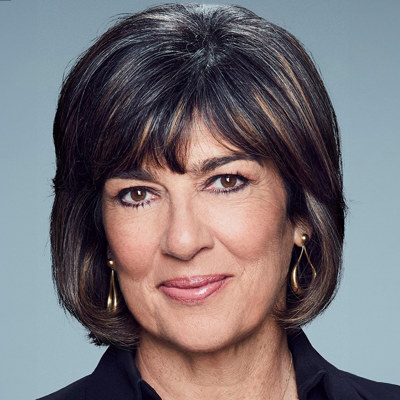
Christiane Amanpour, CNN anchorwoman, member of the foundation’s advisory board
The conflict in Ukraine with all these absurd symbols (Vladimir Kazanevsky for Nebelspalter)
Ukrainian Vladimir Kazanevsky and Hungarian Gabor Papai were announced as the winners of the Kofi Annan Courage in Cartooning Award at a ceremony at the Maison de la Paix in Geneva and presented by the Freedom Cartoonists Foundation. Jury : Kenneth Roth, Human Rights Watch (president), Sami Kanaan, City of Geneva and cartoonists Ann Telnaes (USA), Kak (France) and Chappatte (Switzerland). The portraits below were done by True Heroes Films (THF)
Vladimir Kazanevsky
Vladimir Kazanevsky, Ukraine’s leading cartoonist, was working in his studio early in the morning of 24 February when he heard loud explosions near the airport in Kyiv. He and his wife fled to western Ukraine, along with a huge wave of families fleeing the bombings. From there they went to Presov, a town in Slovakia with a community of artists.
Deprived of his drawing materials, catalogues and books, which he had to leave behind in Kyiv, Kazanevsky continues to draw relentlessly: Putin in action, on a tank or on the bow of the Titanic. “Autocrats and dictators are afraid of our cartoons, and they are right, because our drawings are powerful weapons,” he says.
Fiercely determined to continue the fight against Russian aggression, the 71-year-old sees his work as an act of resistance. An act of defence of freedom of expression against war propaganda.
Gábor Pápai
For several years, Hungarian cartoonist Gàbor Pàpai and his newspaper Népszava – the only opposition daily still alive in Budapest – have been the subject of attacks and legal proceedings by the authorities – even though Hungary is part of the European Union.
This cartoon, “The Chronicle” by Gábor Pápai, published in Hungary’s daily newspaper Népszava on 28 April shows the Hungarian National Public Health Centre’s chief doctor looking at Jesus on the cross and suggesting that many people who had deceased from the coronavirus had already been likely to die because they had suffered from pre-existing conditions.
It was intended to ridicule Hungary’s chief health figure for having tried to minimise the number of deaths solely attributable to the coronavirus in Hungary and, by extension, to mock the government’s handling of the crisis.
“Its depiction and use of Jesus on a cross sparked an outcry from the representatives of the Christian Democrat Party, an ally of the ruling Fidesz, to the point that the Secretary of State for persecuted Christian communities, Tristan Azbej, accused Gábor Pápai of blasphemy and threatened to sue him or Népszava,” as Reporters Without Borders, who came to the defense of Papai, explains.
The Catholic religion, the fight against Covid or simply Hungarian history are all pretexts for prosecution in a country ranked 92nd in the world press freedom index by Reporters Without Borders (RSF). This shameful ranking has been deteriorating ever since Viktor Orbán became Prime Minister, putting all independent media in great difficulty. Some, like Népszava, are directly threatened with extinction. Gàbor Pàpai, far from being intimidated, continues to critically observe and draw all political actors in Hungary.
This day is one on which the world stands still to think about press freedom and journalists who are persecuted. I want to start with some quotes from an excellent piece in the Economist on 2 May by Indian reporter Rana Ayyub who wonders whether plaudits such as “brave” normalise their persecution:
“When a journalist is killed or incarcerated or assassinated, obituaries scream bravado, editorials claim courage. Have such plaudits normalised the persecution of journalists? Why does a journalist have to be brave to report facts as they are? Why does she need to be persecuted for her story to reach the world? Consider Gauri Lankesh, Daphne Caruana Galizia and Jamal Khashoggi—all journalists with a profile, all brazenly killed in broad daylight. Their murders dominated the front pages of international publications. But their killers, men in power, remain unquestioned not just by the authorities but often by publishers and editors who develop a comfortable amnesia when meeting those in power. They do not want to lose access to them.“
“Journalists are the new enemy of the state; we are going through one of the toughest phases in the history of the profession. We document the truth at a time marked both by a voracious demand for news and by the persecution of minorities, genocide and war crimes. We witness savage attacks on minorities in India, Myanmar, China, Palestine or Ukraine even as bumbling editors still frame arguments and narratives through the prism of “‘both sides”. For example attacks on Palestinians, even during Ramadan, are often referred to as “clashes”. Despite one side having grenades thrown at them, and pelting stones in defence, the lens of the mainstream media remains firmly aligned with the oppressor. In India attacks on Muslims by Hindu nationalists often are reported as “riots” or “clashes”, too. The distinction between oppressor and oppressed can be blurred as convenient“….
“Journalism was never a nine-to-five profession. We knew it was an unconventional calling, and one where we might not leave the office for days, or where our families might have no communication from us as we report on crucial investigations, wars and undercover operations. Journalism schools taught us the ethics of our profession, but they did not warn us about nervous breakdowns, or about spending more time in courtrooms than newsrooms. We owe it to the next generation of journalists to create a safer environment in which to work. They should fear only the distortion of truth, never reporting the truth itself.“
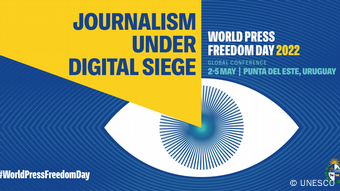
At the Global Conference for World Press Freedom Day, May 2-5 in Uruguay, DW Akademie hosted a panel on digital authoritarianism. International media experts (Nanjala Nyabola, Laís Martins, Vladimir Cortés Roshdestvensky and Annie Zaman) discussed fighting disinformation and censorship.
Digital authoritarianism – when governments assert power and control information using digital tools and the internet – disrupts journalism and can endanger reporters and human rights defenders.
Regardless of recognition of press freedom under international legislations and under state constitutional provisions, the attack on journalists and ultimately on access to information remains a growing concern. According to the UN, 55 journalists were killed in 2021, while 62 of them were killed in 2020. A number of global networks of journalists have led the work of advocating press freedom and provide a platform for journalists to fight such state and non-state actors in unison.
The NWMI is a network of over 600 women journalists across India providing a space or a forum for women in Indian media to come together and share information, exchange ideas, discuss media ethics and promote gender equality in media. The collective aims to provide a holistic system to support women journalists in terms of space, resources and access to justice in case of rights violations. It also works for getting recognition, fair pay and decent working conditions for women independent journalists in the country. https://nwmindia.org/
International Federation of Journalists (IFJ)
IFJ is a Paris-based organisation representing as many as 6,00,000 media professionals across 140 countries. The collective works to strengthen labour rights of journalists and advocates for their fair pay, decent working conditions and gender equality in media recruitment at a global level. One can access records and data documented by IFJ through their campaigns focusing on violence against journalists, impunity to the perpetrators and countries where media freedom is curbed through state laws or private entities.
Reporters Sans Frontiers or Reporters without Borders (RSF)
With 115 correspondents across the world, RWB is a non-profit organisation started by four journalists and headquartered in Paris. RWB is known for its annual Press Freedom Index, one of the most credible indicators of the status of media freedom in over 180 countries of the world. In addition to this, RWB also tracks censorship activities and various kinds of abuse that journalists are subjected to and communicates the information in five different languages. RWB works in cooperation with international rights based organisations to further recommendations to the state in order to provide legal and material resources for journalists and advocate their safety as media personnel.
CPJ is known for its Global Impunity Index analysing the state impunity provided to murderers of journalists in democracies as well as in war-torn countries. As an independent and non-profit organisation based in New York City, CPJ documents attacks on journalists and the subsequent press freedom violations and works with the state actors to provide rapid response assistance, legal support and other resources to journalists in danger.
Article 19 mainly works to improve access to information, protect the civic spaces to discuss and dissent and strengthen human rights in the digital space too. Its key areas of work include information, censorship, gender and sexuality, freedom of religion and belief, equality and hate speech and media freedom among others. In line with its objectives to create a safe space for free flow of information, the organisation channelises its resources for the protection of journalists and human rights defenders. Article 19’s annual Global Expression Report and GxR metric provides a detailed picture of the condition of freedom of expression across the world. https://www.article19.org/about-us/
Media Defence
Media Defence’s focus lies on providing legal advice, support and resources to journalists, independent journalists and citizen journalists, who are under threat for their reportage and enable them to carry out reporting on issues of larger public interest. An international human rights organisation, in addition to documenting cases, it also intervenes to provide legal recourse to the journalists undergoing trial. https://www.mediadefence.org/legal-resources/
And of course – marking World Press Freedom Day, Reporters Without Borders (RSF) published their 2022 World Press Freedom Index that indicates a two-fold increase in polarization exacerbated by information disorder — that is, media polarization fuelling divisions within countries, as well as polarization between countries at the international level. See: https://rsf.org/en/index
“Within democratic societies, divisions are growing as a result of the spread of opinion media following the ‘Fox News model’ and the spread of disinformation circuits that are amplified by the way social media functions,” the watchdog said in a statement.
At the same time, the disparity between open societies and autocratic governments that dominate their media and online platforms while waging propaganda campaigns against democracies is eroding democratic institutions around the world. Therefore, the polarization on different levels is fuelling increased tensions, according to RSF.
Assessing the state of journalism in 180 countries and territories worldwide, the World Press Freedom Index showed how the crisis in the world reflects on the media.
Oiwan Lam on 26 April 2022 reported that Hong Kong’s Foreign Correspondents’ Club has canceled its Human Rights Awards for fear of “legal risks”
Image created by Oiwan Lam.
The Foreign Correspondents’ Club, Hong Kong (FCC HK), a press freedom watchdog, announced they would cancel their 2022 Human Rights Press Awards (HRPA) on April 25. Eight members of the Club’s Press Freedom Committee have resigned in protest over the decision.
Many foreign correspondents were shocked by the decision. Launched in 1995, the HRPA has been one of the most important platforms to celebrate and honour human rights journalism from around Asia. The Club normally announces the winners on May 3, World Press Freedom Day.
Hong Kong Free Press (HKFP) quoted sources from FCC HK that the cancellation was related to the legal risks in presenting awards to the now-defunct Stand News. Two former senior staff members of the independent news outlet have been charged with conspiring to publish “seditious publications” pending trial.
Stand News was forced to shut down last December after security police raided its office. The police authorities accused the news site of publishing “seditious materials” with the intent to cause hatred towards the government and the judiciary.
An FCC member told the HKFP that Stand News would receive four awards and five merits in this year’s award, but “certain items” would pose a legal risk.
In a letter to the Club’s members, the president of FCC HK Keith Richburg said the decision was made in the organization’s board meeting on April 23:
Over the last two years, journalists in Hong Kong have been operating under new “red lines” on what is and is not permissible, but there remain significant areas of uncertainty and we do not wish unintentionally to violate the law. This is the context in which we decided to suspend the Awards.
The letter also says that “recent developments might also require changes to our [FCC HK’s] approach” in the promotion of press freedom.
As the city’s incoming Chief Executive John Lee has vowed to apply the “strictest measures” to clamp down on “anyone who tries to use journalistic work as a shield to engage in crimes endangering national security” in response to the crackdown on Apple Daily, FCC HK’s anticipation of legal risks is valid.
Yet, as a press freedom watchdog, many see the choice to ax the awards as an act of self-censorship antithetical to the organization’s purpose, as independent journalist Ilaria Maria Sala wrote on Twitter:
Differenceday.com of 5 May 2021 reports on how World Press Freedom Day was celebrated in Brussels as Difference Day
At a time when independent and free media reporting is more essential than ever, press freedom continues to be under threat. In a declaration ahead of World Press Freedom Day on Monday, EU High Representative Josep Borrell states that journalists continue to experience harsh working conditions with increasing financial and political pressure, surveillance, arbitrary prison sentences or violence for doing their work.
According to the UNESCO Observatory, 76 journalists were killed since 2020, while many more were arrested, harassed or threatened worldwide. Of particular concern is gender-based violence targeting women journalists.
“Press freedom is a fundamental value for the European Union underpinned by many recent initiatives. Media freedom and the safety of journalists are key priorities of the new Human Rights and Democracy Action Plan and of the European Democracy Action Plan.”
In 2020, more than 400 journalists benefited from the EU mechanism for protection of Human Rights Defenders, while the EU took important actions to support journalists, independent media and the fight against disinformation in the context of the pandemic in many regions.
The EU is determined to do more, in Europe and abroad, the declaration continues. The EU will continue coordinating with international organisations and mechanisms and pioneer new approaches. One example is the European Commission’s proposal for a Digital Services Act aimed at holding the major platforms accountable to make their systems fairer, safer and more transparent.
EU will also continue its action to counter disinformation and seek with all partners effective means to support sustainable business models for independent media.
“Press freedom means security for all,” the declaration concludes.
The World Press Freedom Day on 3 May was declared by United Nations General Assembly in 1993. The day raises awareness of the importance of freedom of the press and reminds governments of their duty to respect and uphold the right to freedom of expression enshrined under Article 19 of the 1948 Universal Declaration of Human Rights.
Freedom of expression implies the respect for opinions of others. In Brussels the day is commemorated annually as Difference Day because it recognises the difference in people and their convictions.
“To celebrate freedom of expression is to celebrate diversity,” the Free University of Brussels and other organisers of Difference Day in Brussels stated. In the past, investigative journalism has been in the focus of the event. This year the attention is drawn to women journalists behind the news and on the front line.
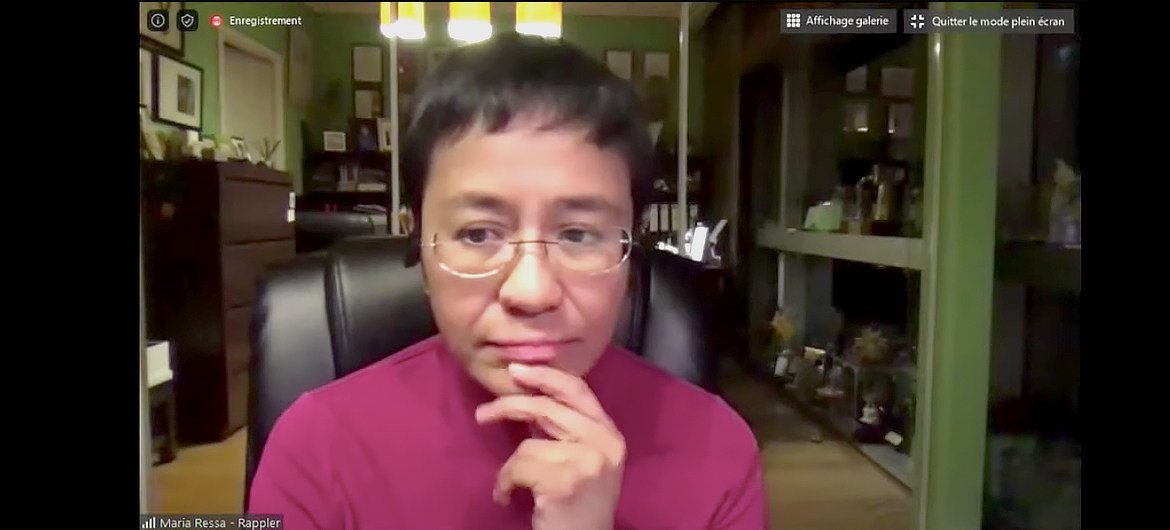
For over three decades, Ms. Ressa has been involved in many initiatives to promote press freedom and currently manages the online outlet, Rappler. Her work however, also made her a target for attacks and abuse, UNESCO – the UN agency tasked with defending press freedom – said in a news release.
Ms. Ressa was chosen for the UNESCO/Guillermo Cano World Press Freedom Prize following the recommendation of an international jury of media professionals.
“Maria Ressa’s unerring fight for freedom of expression is an example for many journalists around the world. Her case is emblematic of global trends that represent a real threat to press freedom, and therefore to democracy”, Marilu Mastrogiovanni, Chair of the Prize’s international jury and an investigative journalist from Italy, said.
The award ceremony will take place on 2 May in Windhoek, Namibia, during the World Press Freedom Day Global Conference. It will be streamed online.
Hosted by UNESCO and the Government of Namibia, the 2021 World Press Freedom Day Global Conference will be held from 29 April to 3 May under the theme of information as a public good, and will focus on topics such as transparency of online platforms and the importance of media and information literacy.
On 30 April 2020 at the occasion of World Press Freedom Day the Graduate Institute in Geneva organised a lecture by Shalini Randeria Professor, Anthropology and Sociology and Director of the Albert Hirschman Centre on Democracy, on “Defending Press Freedom in the Time of Coronavirus“. Even after 6 weeks it is still valid, here in full:
The coronavirus crisis has provided a welcome pretext for soft authoritarian regimes the world over to strengthen their hold on power, with their declared states of exception potentially becoming the new normal. Curbing press freedom was among illiberal rule’s casualties even prior to the pandemic; attacks against independent newspapers and TV channels have not been limited to the Trump Presidency, which is notorious for its charge of “fake news” against critical reporters. But neutrality of the press can be a risky principle in the face of “alternative facts” such as Trump’s recent home remedies for the coronavirus.
The USA was ranked 45th out of 180 countries for its hostility towards news media in Reporters without Borders’ recently published World Press Freedom Index, with China (ranked 117th), Iraq and Iran among the countries mentioned for censoring coverage of the COVID-19 outbreak.
Instead of suppressing the spread of COVID-19, placing limits on press freedom could backfire, not only by reducing public awareness about the grave risks of the virus, but also preventing public debate about steps needed to mitigate the risks.
Moreover, this gag on press freedom compounds an unprecedented lockdown in which parliaments – even in liberal democracies – are hardly functioning, courts are not in regular session, street protests are impossible due to restrictions on the right to assembly, elections have been cancelled (for the most part), and universities are closed.
Under these circumstances, a free press is the only institution of countervailing power that could hold a government to account.
A widespread anti-press sentiment along with the detention, intimidation and jailing of activists and journalists, has become the order of the day in Turkey and India, to name but a few of the countries witnessing systematic assaults on press freedom in recent years, assaults that have escalated under the conditions created by the curtailment of civil liberties due to the threat of coronavirus.
Hungary suspended its parliament and further curbed freedom of expression, giving Prime Minister Orban unfettered emergency powers to rule by decree. China expelled American journalists for reporting on the dangers of the virus, while Iraq temporarily withdrew Reuter’s license after it published a story on the government’s under-reporting of COVID-19 cases.
On 10 April 2020, The New York Times reported that 28,000 workers at news companies in the USA had lost their jobs since the start of the pandemic. It is unlikely that the news industry will receive the federal aid that it is pleading for to prevent further job losses and closures.
What Buzzfeed has called “media extinction” comes in the wake of decades of layoffs and the shutting down of small local and regional newspapers, but also of large, progressive news sites, such as ThinkProgress in 2019. Fox News, however, continues to gather strength, posting record ratings in the first quarter of this year.
The commercialisation of the public sphere, along with the enormous concentration of power in the hands of very few media companies, which are closely linked to politicians in many a liberal democracy, spells danger for press freedom, as does repression by authoritarian governments. Both trends result in a near monopoly over information.
The WHO’s Director-General alerted us recently that the pandemic is also an “infodemic”, one that has given a fillip to spurious conspiracy theories circulating widely in various social media: “fake news” spread not only by ill-informed private individuals or ill-intentioned groups but also by governments.
But it has drawn attention once again to the dangers of “dead” or “buried” news suppressed by those in authority along with the deployment of all kinds of strategies to control information and mute public debate.
The rhetoric of the pandemic as “war” against an invisible enemy employed in France, as much as in China and the US, serves the same function.
Liberal democracies need strong civil society organisations that can mobilise public opinion and foster public debate, monitor the functioning of institutions, and hold politicians and public officials responsible.
In the absence of the freedom of the press, neither protest nor dissent can be voiced. The COVID-19 crisis may have accelerated the speed of the movement towards the slippery slope of dismantling democracy and human rights in many parts of the world.
Reporters Without Borders (RSF) published exclusive interviews by Philippine journalist Maria Ressa with Washington Post columnist Rana Ayyub, whistleblower Edward Snowden, Nobel economy laureate Joseph Stiglitz and RSF secretary-general Christophe Deloire on the subject of “Journalism in crisis: a decisive decade.”
“At a moment of a global health emergency, journalism serves a crucial function, and each journalist bears great responsibility,” DW Director General Peter Limbourg said while announcing the award winners in Berlin. “Citizens of any country have the right of access to fact-based information and critical findings,” he said. “Any form of censorship may result in casualties and any attempts to criminalize coverage of the current situation clearly violate the freedom of expression.” For a list of this year’s laureates, see: https://www.dw.com/en/deutsche-welle-freedom-of-speech-award-17-laureates-from-14-countries/a-53306033
Michelle Bachelet, the UN high commissioner for human rights, said in a video message to the journalists honored that the general public needs “full and accurate information about the pandemic, and to be involved in the decisions that are being made on our behalf.” The International Press Institute documented more than 150 violations of press freedom worldwide through the end of April. The IPI has tracked cases of censorship and restrictions on access to information — but the greatest number of violations of press freedom have been arrests of journalists and verbal or physical attacks on them. (https://www.dw.com/en/un-commissioner-michelle-bachelet-honors-journalists/av-53297637)
——
On the occasion of World Press Day, the Syrian Network for Human Rights (SNHR) issued a report demanding the release of 422 citizen journalists in Syria, most of whom are detained by the Syrian regime, and are now threatened by the COVID-19 pandemic. The report notes that 707 citizen journalists have been killed since March 2011 to date, 78% of them by Syrian Regime forces. The 20-page report shows how the Syrian regime has been well aware of the danger posed by press freedom to its tyrannical rule for decades, abolishing all independent newspapers, and allowing only three official newspapers to be published, which are simply Syrian regime mouthpieces, dedicated to promoting, defending and justifying the regime’s actions. As the report further notes, it’s no exaggeration but simply a statement of fact to say that there is no such thing as a free press under the Syrian regime…..The report distributes the total death toll according to the main parties to the conflict, with the Syrian regime being responsible for the deaths of 551 citizen journalists, including five children, one woman, five foreign journalists, and 47 other citizen journalists due to torture in detention centers, while Russian forces were responsible for the deaths of 22 citizen journalists, and ISIS killed 64, including one child, two women, three foreign journalists, and three under torture. Hay’at Tahrir al Sham also killed eight, including two who died due to torture. Factions of the Armed Opposition were responsible for the deaths of 25 citizen journalists, including one child and three women.




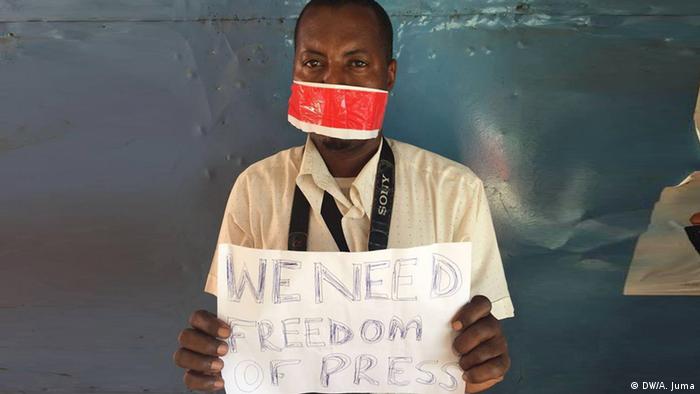
 On the occasion of World Press Day, the Syrian Network for Human Rights (SNHR) issued a report demanding the release of 422 citizen journalists in Syria, most of whom are detained by the Syrian regime, and are now threatened by the COVID-19 pandemic. The report notes that 707 citizen journalists have been killed since March 2011 to date, 78% of them by Syrian Regime forces. The 20-page report shows how the Syrian regime has been well aware of the danger posed by press freedom to its tyrannical rule for decades, abolishing all independent newspapers, and allowing only three official newspapers to be published, which are simply Syrian regime mouthpieces, dedicated to promoting, defending and justifying the regime’s actions. As the report further notes, it’s no exaggeration but simply a statement of fact to say that there is no such thing as a free press under the Syrian regime…..The report distributes the total death toll according to the main parties to the conflict, with the Syrian regime being responsible for the deaths of 551 citizen journalists, including five children, one woman, five foreign journalists, and 47 other citizen journalists due to torture in detention centers, while Russian forces were responsible for the deaths of 22 citizen journalists, and ISIS killed 64, including one child, two women, three foreign journalists, and three under torture. Hay’at Tahrir al Sham also killed eight, including two who died due to torture. Factions of the Armed Opposition were responsible for the deaths of 25 citizen journalists, including one child and three women.
 Hans Thoolen on Human Rights Defenders and their awards