Human Rights First published this on 24 February 2025
Human Rights Defender & architect Olga Kleitman from Ukraine turned an empty building into a safe haven for those displaced by war in Kharkiv.
share information on human rights defenders, with special focus on human rights awards and laureates
Human Rights First published this on 24 February 2025
Human Rights Defender & architect Olga Kleitman from Ukraine turned an empty building into a safe haven for those displaced by war in Kharkiv.
On 29 November 2024, OHCHR published this interview in the context of the International Day for Women Human Rights Defenders.

© Kirsty Teichert
Nonhlanhla Dlamini heads SWAGAA – the Swatini Action Group Against Abuse, a local Eswatini organisation whose primary focus is on ending gender-based violence in the country. Since 1990, SWAGAA has provided care, support, prevention, and access to justice for victims and survivors of gender-based violence, by working with community leaders, community members, and the Government, as well as providing counselling for GBV victims. For the International Day for Women Human Rights Defenders, Dlamini answers questions about GBV, her inspirations and why it was necessary for her to become one of the first women elected as a member of parliament in Eswatini.
What actually motivated me was an incident where a relative of mine was raped at the age of six by a stranger. We didn’t find the person. SWAGAA already existed, but I didn’t know anything about them. Then in 1997, I saw an advertisement [for SWAGAA] in the newspaper. And when I learned about what they were doing, I asked myself why I didn’t know about the organization when I had this problem because I had no one to talk to. I had no one to support me. We reported the matter to the police, but nothing ever happened. We’re so frustrated. So, when I saw the position, I just knew this was my job. And my objective was, I want people to know about SWAGAA. I wanted SWAGAA to be a household name.
I have several times, particularly when I get hurt, because, you know, sometimes this world can be very cruel. And I ask myself, how could people do such an evil thing? I do get depressed. And when I’m very depressed, I’m like, you know, out of all the jobs that I could be doing, why am I even doing this job? Then I get some motivation with some of the success stories. If I quit, who else is going to do it? I kind of feel I’m compelled to do it because there’s a whole lot of people that are looking up to me for help. So, I continue.
… The mistake that we make as advocates and women’s rights activists is that we’re always pushing for others to go and make the change that we want to see. So, I made a decision; I was going to stand for the next elections, which were in 2008. I realized that for years, I’ve been part of a vote for a woman campaign, pushing women to stand for elections. But I’ve never thought of myself one day running for elections. I ran the race to Parliament. I was nominated. I was widely supported. I won the primary elections. It was easy for the primary elections, but the secondary elections were not easy. And I was the only woman against seven men. It was very rough. It was very testing. But I pushed with everything that I had. And I won the elections, and I became a member of Parliament. And the first motion that I moved in Parliament, was that the Minister of Justice bring the sexual offenses and domestic violence bill within 30 days. And his response was no. I kept asking, and that is how the bill was finally seen by Parliament.
The most critical thing is prevention. Prevention, prevention, because once it happens, it’s difficult to pick up the pieces. …
Of course I do, 100 percent. I consider myself a human rights defender because due to the nature of the work that I’m doing, I am continuously standing up for the rights of women and girls in Eswatini. And I have advocated for better legislation in the country. I have advocated for better services in the country, be it in the police, be it in the hospitals, be it in the justice system. I have done everything that I think needs to be done under the sun to make sure that I stand for the rights of the citizens of this country. And I’m saying this because I also know people believe in me. I’ve done all I possibly can to advocate for the rights of women and children in the country.
On 27 November 2024 ISHR shared this profile:
‘The Egyptian authorities must open the civic space for civil society to play its role. They must stop persecuting human rights defenders, political opponents, and journalists simply for doing their jobs. The UN and the international community must maintain pressure on them to comply with human rights standards.’
Basma Mostafa is an Egyptian investigative journalist and co-founder of the Law and Democracy Support Foundation. She began her journalism career amid the Egyptian revolution, focusing on sensitive issues such as torture, enforced disappearances, and extrajudicial killings.
Basma’s commitment to exposing human rights violations in Egypt came at a high personal cost. Over the years, she faced numerous threats and severe reprisals for her work, including being detained three times, forcibly disappeared, and accused of ‘affiliation with a terrorist organisation’ and of ‘spreading false information’. Following a sustained campaign of intimidation, Basma was forced to leave Egypt in 2020.
What happened during the Egyptian revolution strengthened my commitment to the principles of human rights and to defending them.
https://ishr.ch/defender-stories/human-rights-defenders-story-basma-mostafa-from-egypt

human rights defender Mercedes Bulnes.
The lawyer and independent legislator for the Maule region died at the age of 74, a victim of cancer. “She left attentive, fighting until the end, and her life leaves these marks that will not be erased,” wrote X Boric on her account, who highlighted her fight for citizen prerogatives in the country’s dark times.
Despite being pregnant, Bulnes, along with her husband Roberto Celedón, were arrested after the 1973 coup d’état and subjected to torture, after being accused of having links with the Revolutionary Left Movement. After living in exile in the Netherlands, they returned to the country and opened a law firm in the 1990s to help those who did not have access to justice due to their lack of financial resources.
“Our Mercedes Bulnes has passed away, but she leaves behind in all of us who knew her a beautiful memory of life and struggle. Always a loving and fierce defender of human rights,” said the government spokesperson, Camila Vallejo.
The Frente Amplio party expressed its sorrow for the death of its colleague, whom it described as an “example of commitment and work for justice.”
Felice Gaer Baran, an internationally renowned human rights expert who for more than four decades brought life and practical significance to the Universal Declaration of Human Rights and international commitments to prevent grave human rights abuses around the world, died on November 9, 2024 in New York City, following a lengthy battle with metastatic breast cancer. She was 78. At the time of her death, she was the director of the American Jewish Committee’s Jacob Blaustein Institute for the Advancement of Human Rights (JBI)
Longtime UN official and Acting High Commissioner for Human Rights from 2003-2004 Bertrand Ramcharan characterized Gaer as a “pillar of the human rights movement.”
Throughout her career, in myriad roles, Gaer insisted that governments and the United Nations should consistently condemn the practices of tyrants and authoritarians and recognize that many forms of harm and inequality once considered ‘internal affairs’ of states as human rights abuses. Gaer’s influence established more protective interpretations of human rights norms from within and outside the United Nations human rights system. She effectively advocated for the creation and evolution of numerous international institutions and processes that play a critical role today in monitoring states’ human rights practices and holding violators to account.
Gaer achieved international recognition among human rights advocates as a force multiplier capable of overcoming the obstacles within government bureaucracies and multilateral institutions that often allow perpetrators of egregious abuses to avoid scrutiny and condemnation. Dr. Ahmed Shaheed, who served as the UN’s independent monitor on human rights in Iran and on the right to freedom of religion or belief, praised Gaer’s “exemplary track record” in 2021, stating that “You and JBI have made exemplary contributions to advancing human rights through the UN, especially in strengthening the effectiveness of the UN’s human rights mechanisms. Your own personal contribution, not just through the JBI, but in your own capacity as a member of the UN Committee against Torture and other roles, are not only legendary, but are a source of inspiration for everyone.” Elena Bonner, a one-time Soviet political prisoner, founder of the Moscow Helsinki Group, relentless advocate for democratic change in Russia, and wife of famed Soviet physicist, dissident, and Nobel Laureate Andrei Sakharov, with whom Gaer worked closely, recounted in 1997 that Gaer’s fierce approach to advocacy had helped a nascent international human rights movement find its voice. Said Bonner, “it was thanks to individuals like…Felice…who had the courage to be impertinent, that today it is more and more difficult for the rights-violating governments to challenge the universality of human rights and to ignore human rights concerns.”
Gaer began her career at the Ford Foundation as a program officer in 1974, focusing on the Soviet Union and Eastern Europe; subsequently, her areas also included arms control and human rights. At Ford, she became heavily involved in advocacy for the rights of Soviet Jewish refuseniks and encouraging broader internal changes that would catalyze greater respect for human rights for all in the Soviet Union. She maintained a passion for championing individual rights defenders while expanding her geographical focus. As the Executive Director of the International League for Human Rights from 1982 to 1991, Gaer championed human rights defenders throughout Latin America, particularly in Chile and Venezuela. She then served as Director of European Programs for the United Nations Association of the USA from 1992 to 1993, before becoming director at the Jacob Blaustein Institute in 1993–where she remained for the following three decades.
Gaer served for nine terms as an appointed “public member” of official U.S. government delegations to United Nations meetings between 1993 and 1999, including six U.S. delegations to meetings of the U.N. Commission on Human Rights. As a public member of the U.S. delegation to the 1993 World Conference on Human Rights in Vienna, Gaer’s advocacy was instrumental in the creation of the position of UN High Commissioner for Human Rights. Gaer also played a critical role in bringing about the conceptual and political victory that the U.S. government achieved for women’s rights at the 1995 World Conference on Women in Beijing – at which the UN explicitly recognized for the first time that women’s rights are human rights – working closely with US Ambassador to the UN Commission on Human Rights Geraldine Ferraro and First Lady Hillary Clinton.
In 1999, Gaer became the first American and first woman to serve on the 10-person United Nations Committee against Torture, an expert body that monitors implementation of the Convention against Torture. Over her 20 years on the United Nations Committee against Torture, Gaer insisted that the Committee and all other UN treaty bodies should affirmatively and publicly press governments to address allegations of wrongdoing, rather than accepting States’ assertions of compliance at face value. She led the Committee to develop practices that made it far more accessible to non-governmental organizations and human rights defenders seeking to share evidence of human rights violations. She also devoted extraordinary effort to ensuring that the Committee acted on information it received from third parties and conveyed accurate appreciation of the key human rights challenges occurring in every country it reviewed. Her rigorous and unsparing critiques – and her practice of inquiring about alleged victims of torture and arbitrarily imprisoned lawyers and advocates by name in public meetings – occasionally provoked angry outbursts by government officials accustomed to deferential, non-adversarial treatment in UN settings. However, Gaer’s approach turned what might otherwise have been pro-forma exercises into valuable opportunities for advocates to secure formal UN recognition of their claims.
Gaer’s efforts also led to a transformation in the Committee’s against Torture’s approach to the issue of violence against women, which previously was seen only as often a private matter rather than a form of torture or ill treatment for which perpetrators should be punished and victims of which are entitled to redress. The Committee became an important avenue for women’s rights advocates seeking to compel governments to develop more effective national capacities to protect women from violence, as well as members of vulnerable groups such as religious minorities and LGBTQI persons. These efforts brought significant public attention to previously overlooked issues in several countries. In one particularly noted case, Gaer’s insistence at public Committee meetings that Ireland had failed to address the abuses of the church-run ‘Magdalene Laundries’ – which had imprisoned and punished women the church had deemed ‘morally irresponsible’ – galvanized local advocates’ efforts for an official government inquiry to redress this longstanding historical injustice and acknowledge the State’s enduring obligations to survivors of the Laundries.
Gaer also championed the rights of religious minorities and victims of violence justified in the name of religion in countries around the world. Gaer was appointed and served five terms as an independent expert member of the bipartisan federal U.S. Commission on International Religious Freedom from 2001-2012, including as its chair. In that capacity, Gaer traveled to countries ranging from Sudan and Egypt to China to Afghanistan, directly pressing government officials to change policies and practices. She testified frequently before Congress and organizations including the Organization for Security and Cooperation in Europe on religious freedom issues.
Gaer’s commitment to universality also inspired her to work for decades to correct the persistent failure of the United Nations to recognize antisemitism as a serious human rights concern and to recognize the Holocaust as its most violent manifestation. Her engagement with public delegations to the UN Commission on Human Rights encouraged the U.S. to secure the inclusion of the first reference to antisemitism as an evil that UN efforts should seek to eradicate, in a resolution of the UN General Assembly, in a 1998 text condemning racism, using language previously negotiated by the U.S. at the Commission.
Gaer not only shared her wisdom and practical experience with colleagues but also convened numerous strategy discussions and facilitated the work of hundreds of human rights defenders, advocates, and other independent UN experts through JBI grants that empowered and encouraged their efforts to advance human rights norms and protections on a wide range of subjects and countries. For many colleagues and beneficiaries of her supports, Gaer was an invaluable resource, strategist, collaborator, mentor, and friend…
A prolific author of over 40 published articles and book chapters and editor of the volume “The United Nations High Commissioner for Human Rights: Conscience for the World,” Gaer received the American Society of International Law’s Honorary Member Award in 2023, an Honorary Doctorate from the Jewish Theological Seminary in 2018, and the First Freedom Center’s prestigious National First Freedom Award for her religious freedom advocacy in 2010. Gaer’s JBI was also named a “Champion of Prevention” by the UN Office on the Prevention of Genocide in 2023. [https://humanrightsdefenders.blog/2013/12/21/jacob-blaustein-institute-for-human-rights-publishes-book-on-un-high-commissioner-for-human-rights/]
One of three children of Abraham Gaer, a businessman who owned a toy shop, and his wife Beatrice Etish Gaer, Felice was born on June 16, 1946 in Englewood, New Jersey. She was raised in Teaneck, New Jersey and graduated from Teaneck High School. She received a Bachelor of Arts degree from Wellesley College and pursued her graduate studies in political science at Columbia University’s Russian Institute (now Harriman Institute), where she received a Master of Arts degree in 1971 and a Master of Philosophy degree in Political Science in 1975. In 1975, she married Dr. Henryk Baran, a professor at the State University of New York-Albany; Dr. Baran has a long and distinguished career specializing in Russian literature and culture of the Russian Silver Age and avant garde. The couple’s two sons – Adam, a queer filmmaker and curator, and Hugh, a workers’ rights attorney who litigates wage theft, discrimination, and forced labor cases – survive her, as do her brother Arthur Gaer, sister Wendy Philipps, son-in-law Jacob Rozenberg, five nephews, and ten cousins. Gaer’s wisdom, support, conviction, and passionate concern for all humanity made her truly exceptional, and she will be deeply missed.
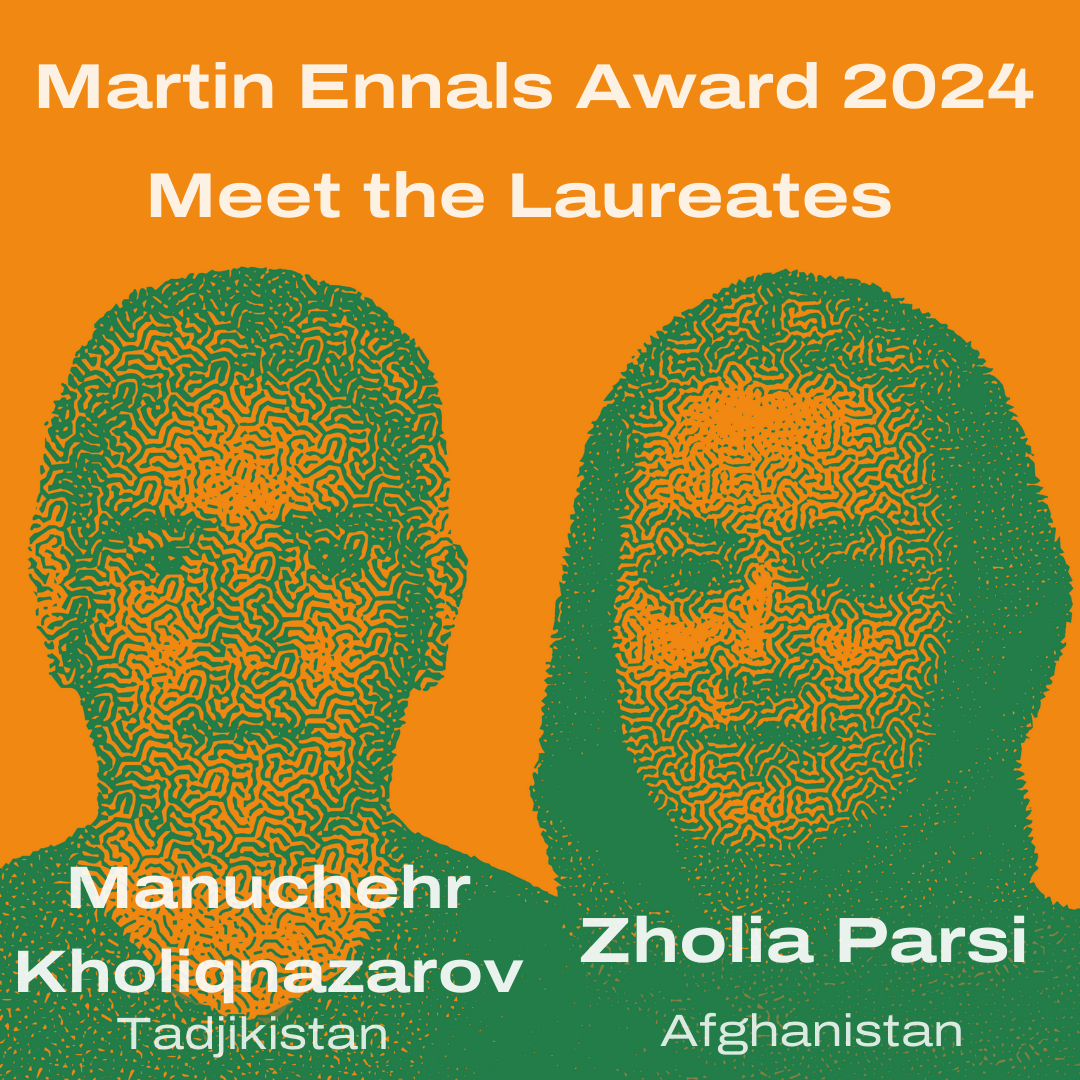
Two outstanding human rights defenders who have made it their life mission to protect human rights in Afghanistan and in Tajikistan will receive the Martin Ennals Award 2024 on November 21th, 2024, in Geneva, Switzerland, on the occasion of the 30th anniversary of the Martin Ennals Award.
The Jury of ten of the world’s leading human rights NGOs – Amnesty International, Human Rights Watch, FIDH, HURIDOCS, Bread for the World, Human Rights First, World Organisation Against Torture, International Commission of Jurists (ICJ), International Service for Human Rights (ISHR), and Front Line Defenders – has selected, after much deliberation, the two human rights defenders whom it strongly believes deserve to be recognized and honored in 2024, on the 30th anniversary of the Martin Ennals Award. [see also: https://www.trueheroesfilms.org/thedigest/awards/043F9D13-640A-412C-90E8-99952CA56DCE]
The two 2024 Laureates, Zholia Parsi (Afghanistan) and Manuchehr Kholiqnazarov (Tadjikistan) have shown exceptional courage and determination to bring human rights at the forefront despite evolving in deeply repressive environments.
“We are very proud to honor these two exceptional Laureates. They have paid too big a price for justice and equality to be respected in Afghanistan and Tajikistan and the international community must support their efforts instead of battling geostrategic interests in the region“.
– Hans Thoolen, Chair of the Martin Ennals Award Jury
The two Laureates 2024:

Zholia Parsi: is a teacher from Kabul, Afghanistan. Having lost her career and seeing her daughters deprived of their education with Taliban takeover in August 2021, she founded the Spontaneous Movement of Afghan Women (SMAW) to protest the return of policies and practices against women rights and fundamental freedoms. She displayed remarkable leadership and resilience in organizing numerous public protests despite the risks involved. The grassroots movement that is the SMAW quickly grew momentum in Kabul and other provinces, now counting 180 members and having mobilized communities to resist the Taliban’s policies and practices.
She was arrested in the street by armed Taliban in September 2023, and detained along with her son. She was released after three months of torture and ill-treatment under their custody, which further strengthened her resolve to resist Taliban oppression and repression.

Manuchehr Kholiqnazarov: is a Pamiri human rights lawyer from the Gorno-Badakhshan Autonomous Oblast (GBAO), Tajikistan. He is serving a 16 year-long prison sentence after what is widely considered an unfair trial in retaliation for his human rights work.
As Director of the Lawyers’ Association of Pamir (LAP), he led strategic advocacy efforts in the GBAO, a region marked by its ethnic minority and historical tensions with the central government, including by lobbying for the incorporation of international human rights standards into domestic law and practice, and by providing legal support to residents of the GBAO.
Through the human rights initiatives Commission 44 and Group 6, he played a key role in investigating the death of youth leader Gulbiddin Ziyobekov in November 2021, and the violent repression of subsequent mass protest in the regional capital Khorog. The investigation resulted in critical evidence of an unlawful killing, possibly an extrajudicial execution of the young man, and the unlawful use of force of security forces against protesters, resulting in two deaths, seventeen injured and hundreds detained.
He was arrested on 28 May 2022 together with two other members of Commission 44 amid a widespread crackdown on local informal leadership and residents of the GBAO.
The Martin Ennals Award (MEA): 30 years alongside human rights defenders
The Martin Ennals Award (MEA) was given for the first time in 1994 to recognize, promote and protect human rights defenders at risk or from under-reported contexts. Over the years, the MEA has offered defenders a platform to issues that are of global concern and the means to steer the movement for human rights and larger freedoms.
The MEA culminates every year in a public ceremony in Geneva, co-hosted with the City of Geneva (Ville de Genève). The 2024 MEA Ceremony will take place on November 21th, 2024 at the Salle communale de Plainpalais. The Ceremony, which is also livestreamed, draws many local and international human rights supporters to an inspiring event which celebrates the achievements and commitment of exceptional human rights defenders.
“Geneva has a long tradition of hosting international diplomacy and promoting human rights and fundamental freedoms. The City of Geneva is proud to co-host the Martin Ennals Award and shed light, on this 30th anniversary, on the impressive resilience of two human rights defenders and the hope they bring for peace and equality” concludes Alfonso Gomez, Administrative Counselor of the City of Geneva.
https://www.frontlinedefenders.org/en/statement-report/martin-ennals-award-2024-laureates-announced
https://hawarnews.com/en/afghan-feminist-wins-martin-ennals-human-rights-award
In June 2017, Indigenous Ñomndaa’ journalist Marcela de Jesus Natalia found herself fighting for her life. A gunman waited for her outside the radio station where she worked and shot her three times.
“I didn’t think he wanted to kill me,” she said. “I turned around. The first bullet went to my forehead. I put my hand up, [and] the bullet went in and came out. The second one shattered my jaw. Then this guy held me, dragged me, gave me a final shot in my head and laid me on the pavement.”
Though at first presumed dead, Marcela de Jesús survived the attack and, with the support of lawyers and advocates, as well as of UN Human Rights, continues to fight for justice for the crime perpetrated against her. Marcela de Jesús was attacked because she angered powerful people by informing Indigenous Peoples about their rights, such as the importance of education, justice, and in particular, violence against women, thus empowering them to fight against historical discrimination against them.
“Journalists who expose wrongdoing and show us the horrific reality of conflict are human rights defenders,” said Volker Türk, UN Human Rights Chief, in a statement commemorating the International Day to End Impunity for Crimes against Journalists, observed every year on November 2. “Attacks against them affect everyone’s right to freedom of expression and access to information, leaving us all less well informed.”
In 2023, 71 journalists and media workers were killed and over 300 imprisoned around the globe, Türk said.
Marcela de Jesús is an Indigenous Ñomndaa’ woman born in Xochistlahuaca, in the state of Guerrero, on Mexico’s Pacific coast. From a young age, Marcela de Jesús witnessed violence and attacks by men in positions of power and even the military. It was there that her desire to defend her people was born and she realised that to confront abusers she needed to learn Spanish.
Marcela de Jesús migrated to the state of Oaxaca, and by her own efforts, she managed to continue studying and encountered a radio station that was looking for an Indigenous person from Guerrero who spoke Ñomndaa’ and Spanish and had completed middle school.
“I went behind my husband’s back, took the exam and passed,” she said. “I remember that the director [of the radio station] said to me, ‘Why do you want to be an announcer?’ ‘I always wanted to be the voice of my people,’ I answered.” Later, she returned to the state of Guerrero and got a precarious job as a radio announcer, but with patience and hard work she managed to become the radio manager.
It was after her return to her home state that she began to encounter opposition to her “voice.” Marcela de Jesús was told by powerful people in her town that she was not supposed to inform Indigenous Peoples; that the only thing they were interested in was whether a goat or a cow was lost, and not to get into trouble. She fought against and won lawsuits filed against her for giving Indigenous Peoples news.
It is my conviction that my people should be guaranteed the right that is enshrined in the Constitution and in international treaties, that we have the right to information.
“They couldn’t [silence me] because what is legal is legal. What is morally good is morally good. And that is the reason for the attack against me,” said Marcela de Jesús.
According to UN Human Rights in Mexico, at least five journalists and one media worker have been killed and one more media worker was disappeared this year because of their work. This continuous danger in which journalists have had to operate for years, led universal and regional human rights mechanisms to recommend to the Mexican State the creation of a Mechanism for the Protection of Human Rights Defenders and Journalists.
…The gunman who shot Marcela de Jesus has been arrested and sentenced for his crime, but the ones who called for her shooting are still out there. She is hopeful for them to be brought to justice.
“I have a lot of faith that the alleged intellectual author will forget about me. I have faith that nothing is forever,” said Marcela de Jesús. She added: “Nothing and no one, not jail, not this attack with three bullets, takes away my desire to continue being the voice of my people, to continue with my activism, my defence of human rights. I am fulfilling my dream of being the voice of my people at the national and international level.”
https://www.ohchr.org/en/stories/2024/11/i-always-wanted-be-voice-my-people
 We have been busy on multiple fronts. As Memria continues to attract new users such as libraries, historical societies, and museums, we have also been developing new ways to tell stories and make people and communities more visible. At the Visibility Initiative, for example, we highlight changemakers of all genders and sexual identities, with a primary focus on women. This was an editorial choice; women’s contributions are often overlooked more frequently than men’s. By centering women’s stories, we discover new approaches to leadership that challenge common perceptions. Leadership is often imagined as an individual pursuit of a singular vision yet the women featured in this edition of Squeaky Wheel bring about change through deep integration with their communities, not by standing above them. Consider Filipino-American nurses Luisa Blue and Zenei Triunfo-Cortez. They brought their nursing skills—compassion, resilience, and patience—into union activism to push for better working conditions. Rather than pursuing personal ambition, they lead by collaborating, caring for fellow advocates, and prioritizing collective well-being. We also share the stories of three remarkable Senegalese women transforming their communities through the arts and public policy. Christiane Agboton Johnson, for example, has shown that women bring unique strengths to peace negotiations, bridging divides and conveying messages in ways that men often can’t. This edition also includes the work of a Viva Voz fellow from our Colombian program, who navigated the Pacific rivers to explore the connection between these waterways and Black communities—preserved by midwives, elder women, and healers. In these communities, women safeguard essential knowledge. These women’s stories offer new models of leadership and ways to address today’s most pressing issues. – Miguel BoteroEditor in Chief, The Visibility Initiative  Photo: RN Luisa Bluo in front of a picket line. Positively Filipino.Healing and Advocacy: How Filipino-American Nurses Transformed Healthcare Through ActivismAs Filipino-American History Month wraps up, we looked into an overlooked story: the activism of Filipino-American nurses in the U.S. We may have heard about their essential role in healthcare, but their impact goes much deeper. Leaders like Zenei Triunfo-Cortez and Luisa Blue have fought tirelessly for fair wages, better working conditions, and equal rights, challenging discrimination head-on. Their journey from patient care to union leadership shows how their compassion and resilience extend beyond the bedside and into the fight for systemic change. Their inspiring work is part of Filipino Americans’ long legacy of social justice.Read More Photo: RN Luisa Bluo in front of a picket line. Positively Filipino.Healing and Advocacy: How Filipino-American Nurses Transformed Healthcare Through ActivismAs Filipino-American History Month wraps up, we looked into an overlooked story: the activism of Filipino-American nurses in the U.S. We may have heard about their essential role in healthcare, but their impact goes much deeper. Leaders like Zenei Triunfo-Cortez and Luisa Blue have fought tirelessly for fair wages, better working conditions, and equal rights, challenging discrimination head-on. Their journey from patient care to union leadership shows how their compassion and resilience extend beyond the bedside and into the fight for systemic change. Their inspiring work is part of Filipino Americans’ long legacy of social justice.Read More  Oshúm and the shades of water in the COP16 Oshúm and the shades of water in the COP16COP16 will take place from October 21 to November 1, 2024, in Cali, Colombia. This biodiversity summit gathered representatives from 196 countries to discuss global efforts to protect nature and stop biodiversity loss. The International Forum on Women and Biodiversity featured clips from Oshúm and the Shades of Water, a project Memria co-produced through the Viva Voz Fellowship, our program with the Ford Foundation’s Bogota office and other partners to support Colombian storytellers. For this project, fellow Lyann Cuartas and her team from the Las Jaibas Collective navigated three rivers on Colombia’s Pacific coast. There, they interviewed women and queer individuals who hold deep spiritual connections to the rivers. Their stories blend childhood memories, songs, and firsthand accounts of environmental crimes against one of the most biodiverse places on earth. This photo and audio project offers an intimate look at communities that have lived by these rivers and jungles for centuries.You can read more about the project on Global Voices WEDO will celebrate the 11th Anniversary of Women’s Entrepreneurship Day on November 15th at the United Nations Delegate Dining Room in New York City. The event will be live-streamed Among the event’s remarkable changemakers is Angeline Zimbwani Mikiri, a pioneering African publisher dedicated to making storytelling across the continent more accessible and diverse. She founded Zimbabwe’s award-winning publishing house Tariro Books, which has become known for amplifying African voices and perspectives in children’s literature, educational materials, and adult fiction. Committed to fostering a culture of reading in Africa, Mikiri has emphasized stories that reflect the unique experiences, traditions, and challenges African communities face.Join the event to hear from her and other inspiring entrepeneurs who have transformed their communities.Follow this link for more information  Read about some of the most remarkable women in SenegalStarting in September, we began translating and republishing stories from our partner, Géantes Invisibles, on The Visibility Initiative. These stories mark our origins, as the initiative grew from our alliance with Coumba Toure, Senegalese feminist activist and Géantes Invisibles founder. She started this storytelling project to honor the women of Africa and its diaspora who have transformed their communities—often silently, without much recognition from governments, media, or philanthropic organizations. We joined forces because we share a mission: to shine a light on changemakers whose impactful stories deserve more attention. These stories are rich with lessons on how leaders develop, think, and make things happen in their communities against great odds. These stories highlight well-known figures, like Germaine Acogny, the mother of modern African dance, and Madeleine Devès Senghor, a key architect of Senegal’s post-independence state. They also feature lesser-known giants like Christiane Agboton Johnson, an advocate for disarmament, who emphasizes women’s critical role in peacebuilding. These stories create a vibrant mosaic of West African women’s activism. |

‘Indigenous communities must have better political representations to ensure our rights are protected both constitutionally and in practice,‘ says Victoria Maladaeva, and Indigenous peoples’ rights defender from Russia. Victoria was also a participant in ISHR’s Women Rights Advocacy Week this year. She spoke to ISHR about her work and goals.
Hello Victoria, thanks for accepting to tell us your story. Can you briefly introduce yourself and your work?
Sure! I’m a Buryat anti-war decolonial activist, co-founder of the Indigenous of Russia Foundation.
What inspired you to become involved in the defence of human rights?
Since the full-scale Russian invasion of Ukraine, Indigenous peoples, particularly Buryat, have been hit the hardest. I wanted to help my people, fight the Russian propaganda and raise awareness about systemic colonial oppression and discrimination faced by Indigenous people and ethnic minorities in the Russian Federation.
What would Russia and your community look like in the future if you achieved your goals, if the future you are fighting for became a reality?
The country needs a large-scale transformation— political, economic, and cultural. Indigenous communities must have better political representations to ensure our rights are protected both constitutionally and in practice. Genuine democratic reforms involve fundamental rights for self-determination and autonomy where Indigenous peoples gain control of their land and resources. Putin’s constitution’s amendments to national Republics must be reversed, our languages must be mandatory in all schools, universities, and institutions where Indigenous communities live.
How do you think your work is helping make that future come true?
I’m advocating for the rights of Indigenous peoples with international stakeholders and institutions to raise awareness about issues faced by our communities and spreading awareness, producing documentaries, and mobilising diasporas.
Have you been the target of threats or attempts at reprisals because of your work?
Unfortunately, yes. There have been threats because of my anti-war activism and for shedding light on the disproportionate mobilisation in the Republic of Buryatia. For some reason, my colleagues and I were denied participation in the UN Permanent Forum on Indigenous Issues. I would like to believe this was a mistake and that there was no influence from the Russian delegation at the UN.
Do you have a message for the UN and the international community?
Russia needs decolonisation and de-imperialisation. Without revising the past and acknowledging colonial wars (not only in Ukraine) and discrimination, there can be no bright future for Russia—free and democratic. The international and anti-imperialist community should acknowledge that the Russian government is not for any anti-colonial movement. Stand in solidarity with independent Indigenous activists!
https://ishr.ch/defender-stories/human-rights-defenders-story-victoria-maladaeva-from-russia
GORDON OSEN on 24 October 2024 in the Star of Kenya published a warm portrait of Rachael Mwikali who, born and bred in Mathare slums, has come face to face with discrimination and abuse.
When you watch Rachael Mwikali do her activism, you may dismiss her as an antagonistic feminist and a rebel without a cause. Not so. At proximity, the globally recognised champion of sexual and reproductive health rights and women is a warm and compassionate personality whose work is fired up by empathy.
She told the Star during an interview on the sidelines of the annual meeting of the African Commission on Human and People’s Rights in Banjul, The Gambia, that at the age of 13, a man 10 years older than her sexually abused her. “The saddest part is the community did not protect me. In fact, they blamed me for engaging in sex at a young age,” she said.
“I learnt to speak up for myself and others who may not have the courage.” Her reward, she says, is when the marginalised get justice. At the heart of her campaign is turning women’s perceived vulnerability and weaknesses into strengths.
Through her organisation Coalition for Grassroots Human Rights Defenders, she champions for intersectionality as well. When El Nino ravaged Mathare slums this year, Mwikali started a community kitchen that would make up to 500 hot meals per day.
She is also part of the #EndFemicideKE. Her agitation has seen her count her losses and keep some wins. In 2016, aged 24, Mwikali was named the Lobbyist for Change by a Swedish non-governmental organisation known as We Effect. She also sits on the Amnesty International board, the Royal Denish Embassy Youth Sounding board and the Youth Advisory board of the Kingdom of Netherlands. She is also the chairperson of the Human Rights Defenders Awards in Kenya which recognises activists at the frontline of human rights protection. The awards are given annually by the Defenders Coalition.
[https://trueheroesfilms.org/thedigest/awards/8D7E476D-A61A-4912-8CFE-97707A3C1A73]
Asked about what motivates her and what she considers a win, Mwikali says she dreams of having many more passionate women standing up for their rights, and championing for an equal society
 Hans Thoolen on Human Rights Defenders and their awards