Michael Ineichen of the International Service for Human Rights [ISHR] in its Monitor of 27 September 2013 welcomes the adoption of a Resolution by the UN Human Rights Council which condemns the global crackdown on civil society and calls on all  governments to protect and support the work of non-governmental organisations and human rights defenders. In a resolution adopted that day, entitled ‘Civil society space’, Read the rest of this entry »
Posts Tagged ‘United Nations’
UN Human Rights Council 2013 condemns crackdown on Human Rights Defenders
September 28, 2013Criteria to ensure quality successor as Rapporteur on Human Rights Defenders
September 28, 2013As this is a weekend post I have chosen one that requires a bit of reflection: Several UN Rapporteurs are coming to the end of their term in 2014, including – unfortunately – also the mandate of the Rapporteur on Human Rights Defenders Margaret Sekaggya. A number of NGOs – in this case Amnesty International and the International Service for Human Rights – have given thought to the kind of kind of criteria that should ensure that a good successor in chosen, or at least that high-quality and independent candidates to come forward for nomination.
What follows are the key parts of the “Proposed criteria for selection & appointment of a new mandate holder on the situation of human rights defenders: Amnesty International, International Service for Human Rights and others; joint written statement to the 24th session of the UN Human Rights Council (9 – 27 September 2013)”
In March 2014, the President of the UN Human Rights Council (the Council) will appoint a new Special Rapporteur on the situation of human rights defenders.
This UN expert on the situation of human rights defenders will serve two terms of three years each.
Candidates and nominating entities shall submit an application with personal data and a motivation letter no longer than 600 words. OHCHR will prepare a public list of candidates.
Applications open in early September, and the deadline now set for 31 October 2013.
Background
The signatory organisations call on Governments, NGOs and others, including relevant professional networks, to use this checklist to identify eligible candidates for the upcoming vacancy for the Special Rapporteur on the situation of human rights defenders. We urge Governments to consult civil society and to disseminate the vacancy widely, eg. through media advertisement, so as to encourage candidates to apply for this vacancy. Prospective mandate holders should be aware that this is a voluntary, unpaid role. They would not receive salary or other financial compensation, except for travel expenses and daily subsistence allowance of ‘experts on mission’. It will require a substantial time commitment from the individual, including readiness to travel and respond to urgent situations, as explained in the checklist.
Checklist for selection of candidates for mandate of Special Rapporteur on the situation of human rights defenders:
FORMAL CRITERIA
According to Human Rights Council resolution 5/1, Annex, the following general criteria will be of paramount importance while nominating, selecting and appointing mandate-holders: (a) Expertise; (b) Experience in the field of the mandate; (c) Independence; (d) Impartiality; (e) Personal integrity; (f) Objectivity. Due consideration should be given to gender balance and equitable geographic representation, and to an appropriate representation of different legal systems. Eligible candidates should be highly qualified individuals who possess established competence, relevant expertise and extensive professional experience in the field of human rights (paras. 39-41).
INDEPENDENCE
According to Council Resolution 5/1, ‘individuals holding decision-making positions in Government or in any other organization or entity which may give rise to a conflict of interest with the responsibilities inherent to the mandate shall be excluded.’ At a minimum, this requires independence of prospective mandate holders from the executive of governments or from intergovernmental organisations, which may be the subject of a communication or mission within the terms of the mandate. The conflict of interest provision has also been interpreted to mean that candidates are expected to clarify how, if appointed, they would deal with any perceived or actual conflict of interest in relation to governments, inter-governmental organisations, or non-governmental organisations.
QUALIFICATIONS & EXPERTISE
In its Decision 6/102 of 27 September 2007, the Council approved technical and objective requirements for candidates eligible for special procedures mandates. The following checklist is intended as an interpretive aid for those requirements:
1. Qualifications (and skills): relevant educational qualifications or equivalent professional experience in the field of human rights.
[Checklist: A post-graduate university degree or equivalent in law, social sciences or in a discipline directly related to the mandate, preferably with a focus on international human rights law, would be highly desirable; Academic publications or other published material (articles, studies, reports, research papers or any similar written material demonstrating in-depth knowledge) addressing issues relevant to the mandate, from a human rights perspective; Excellent oral and written communication skills in at least one of the UN working languages (English, French and Spanish – knowledge of other widely-used or official UN languages, such as Arabic, Chinese or Russian, would be an asset); Extensive experience in public speaking (for example in expert seminars) and in communicating at senior levels with governments, UN officials, the business community, the media and other relevant stakeholders.]
2. Relevant expertise: knowledge of international human rights instruments and standards; knowledge of institutional mandates related to the United Nations or other international or regional organisations’ work in the area of human rights; proven work experience in the field of human rights.
[Checklist: Extensive knowledge of international human rights law and standards; Several years of progressively responsible work experience in the field of human rights or as a human rights defender, including in human rights research, monitoring, reporting, investigating and advocacy; Excellent knowledge of the international and regional legal frameworks and case law relevant to the promotion and protection of the rights of human rights defenders, including on freedom of expression, freedom of peaceful assembly and association, torture, extrajudicial, summary or arbitrary executions, and enforced or involuntary disappearances; Excellent knowledge of institutional mandates of the United Nations or other international or regional organisations in the area of human rights.]
3. Established competence: nationally, regionally or internationally recognised competence related to human rights.
[Checklist: A demonstrated commitment to universal human rights law, standards and values; Excellent knowledge and expertise of the work of human rights defenders, and the recent trends, developments and challenges they face; Experience at national, regional and/or international level in developing legislation and policy for the protection of human rights defenders and in creating an enabling environment for their work; Extensive experience with and proven commitment to working and/or interacting with civil society and in interacting with individuals whose human rights may have been violated or restricted as a result of their work of defending rights; Proven awareness of the particular risks faced by and particular protection needs of specific groups of human rights defenders, such as women human rights defenders, defenders working on sexual orientation and gender identity issues, ethnic and religious minorities, non-nationals, members of political opposition groups, people in a disadvantaged socio-economic situation, journalists and media workers and youth/children human rights defenders; Experience in interacting with actors impacting the work of human rights defenders, such as: Security forces Armed groups; and Transnational corporations and other business enterprises; Experience in the development and delivery of human rights and rule of law assistance/capacity building, including the training of law enforcement and legal professionals and other officials responsible for the protection of human rights defenders; the ability to conduct both academic and field research required, and experience in carrying out fact-finding missions.
4. Flexibility/readiness and availability of time to perform effectively the functions of the mandate and to respond to its requirements, including conducting visits, preparing reports and attending Human Rights Council and General Assembly sessions.
[Checklist: Willingness and ability to conduct in-country investigations, in all regions of the world, into government policies, legislation and practices affecting human rights defenders and their work; Energy, determination and vision to promote the effective and comprehensive implementation of the Declaration on human rights defenders; A commitment to uphold the integrity, independence and impartiality of the Special Rapporteur’s mandate and the special procedures system as a whole; Willingness and ability to devote a substantial proportion of working hours to fulfilling the mandate, which includes undertaking two to three country missions per year, preparing and presenting reports to the Human Rights Council and the General Assembly (such as the annual thematic report, and country mission and follow-up reports), attending seminars and other UN meetings and acting on individual cases of violations of the rights of human rights defenders; Willingness and ability to act urgently when cases or situations so require.
APPOINTMENT PROCEDURE
Details and formalities about the nomination, selection and appointment of mandate holders are explained on the OHCHR Web site at http://www.ohchr.org/EN/HRBodies/SP/Pages/Nominations.aspx. Applications have to be submitted through an online system.
First ministerial UN meeting on protection of gay rights held
September 27, 2013On 26 September 2013 many countries attended the first ministerial meeting held at the United Nations on the rights of lesbian, gay, bisexual and transgender (LGBT) individuals.

(UN Photo/Amanda Voisard)
Foreign ministers attending the meeting, held on the margins of the General Assembly’s annual high-level debate, adopted a declaration pledging not just to protect LGBT rights but also to counter homophobic and transphobic attitudes. UN High Commissioner for Human Rights Navi Pillay commended
Controversy surrounding the death of LGBT activist Eric Ohena Lembembe; Cameroon blames the victims and continues persecution
September 25, 2013
On 23 September Amy Bergquist of the Advocates for Human Rights writes in her blog: The International Justice Program doesn’t get to travel to Geneva very often, but thanks to the United Nations’ live webcasts, we can usually see and hear all the U.N.’s human rights action as it happens. On Friday morning, I was eager to watch the U.N. Human Rights Council’s consideration of the Universal Periodic Review of Cameroon. I was especially moved when one of our colleagues from the Cameroonian Foundation for AIDS (CAMFAIDS) took the floor to speak on behalf of the International Lesbian, Gay, Bisexual, Trans, and Intersex Association and recounted his July 15 discovery of his tortured and murdered colleague, Eric Ohena Lembembe, Read the rest of this entry »
First mission of the new UN independent expert Gustavo Gallon to Haiti
September 22, 2013
 |
Haiti Libre on 22 September welcomes the visit by Gustavo Gallón, the new Independent Expert on the situation of human rights in Haiti, appointed by the UN Council of Human Rights in June 2013 [replacing Michel Forst, who had completed his term], will visit Haiti from 23 September to 1October 2013.
“During this first visit, I will monitor the reality for the Haitian both in Port-au-Prince and outside of the capital and for that I will be traveling to at least one of the other departments […] Read the rest of this entry »
Protecting Human Rights Defenders from Reprisals: crucial issue with timely article and side event on 24 September
September 20, 2013Philip Alston, John Norton Pomeroy Professor of Law at New York University School of Law, and former UN Special Rapporteur on Extrajudicial, Summary or Arbitrary Executions wrote a piece on one of the most crucial topics facing human rights defenders at the moment and which has figured regularly in this blog: the issue of retaliation or reprisals against those HRDs who cooperate with the Un and their Rapporteurs. Read the rest of this entry »
Challenges for Human Rights Education at side event Council on 25 September
September 19, 2013The World association for the School as an Instrument of Peace & the International Training Centre for Human Rights and Peace Teaching organise on 25 SEPTEMBER, from 10.00 – 12.00 in ROOM XXIV – PALAIS DES NATIONS, Geneva a side event:
“Making Human Rights a Reality : Challenges for Human Rights Education“.
Speakers include:
Ms Rebiya Kadeer, President of the World Uyghur Congress [who is the laureate of the HRW “Human Rights Defenders Award” in 2000 as well as the Norwegian Rafto Award in 2004. Former member of the Political Consultative Congress of China (1992 -1997).
Mr. Emmanuel Decaux, Professor, University of Paris II, Member of the UN Committee on Forced Disappearances
Ms. Amina Lemrini, President of the High Council for Audiovisual Communication, Morocco
Ms. Nadira Eshmatova, Youth Human Rights Group, Kyrgyzstan
Ms. Géraldine Puig, Education program on citizenship and human rights, Ministry of public education, Republic and Canton of Geneva.
Moderator : Ms. Stefanie Rinaldi, University of Teacher Education, Lucerne
if you are interested contact: Cifedhop cifedhopATmail-box.ch.
NGOs give cautious welcome to UK Government’s Action plan on human rights & business, but want better enforcement
September 11, 2013The UK government recently launched an Action Plan on Business and Human Rights by Vince Cable and William Hague.
On 5 September the CORE Coalition, whose members include Amnesty International, Oxfam, CAFOD and War on Want, supported by the Trades Union Congress, share the plan’s clear expectation that UK companies respect human rights throughout their global operations and supply chains, but question whether the governments proposals will be sufficient to reduce corporate abuses. CORE calls on the government to take effective steps to ensure companies respect human rights. The plan builds on the government’s commitment to implement the UN Guiding Principles on Business and Human Rights, agreed by the UN Human Rights Council in 2011. The principles set out what states need to do to protect people from corporate human rights abuses and the actions that businesses should take to respect human rights. “While it’s positive that the plan sets out clear expectations for UK companies to respect human rights wherever they operate and explicitly applies to businesses’ supply chains in the UK and overseas, there’s little clarity on how the government’s approach will require companies with the worst human rights records to change their behaviour. Sharing good practice and offering guidance for businesses are important but are not enough on their own,” said Marilyn Croser, Coordinator of the CORE Coalition. Anne Lindsay, CAFOD’s Lead Analyst on the Private Sector said: “For local communities in countries such as Colombia, Peru and the Philippines, the key question is, will this action plan prevent abuses of human rights by companies or just maintain the status quo? We welcome the references to protection of human rights defenders and investment agreements for example, but these principles need to be linked to a much more comprehensive set of follow up actions.” Oxfam’s Robert Nash, Private Sector Policy Adviser added: “This is a welcome signal to businesses that corporate abuses must be tackled. However, plans must go further to strengthen protection for vulnerable communities and the means for them to seek redress. This includes identifying and addressing failures on vital issues like the governance of land, transparency and accountability of investments, human rights requirements and empowering women, who are often the most at risk yet the most likely to be excluded from having their voices heard.” The absence of clear commitments to improve access to justice for victims of corporate human rights abuse overseas and the reliance on voluntary corporate self-governance to ensure businesses respect for human rights is of particular concern to CORE and its member organisations. Murray Worthy, Senior Economic Justice Campaigner at War on Want commented: “This plan places the burden of responsibility for businesses’ respect for human rights in the hands of the companies responsible for violations of human rights. Such voluntary self-regulation has been found wanting for years. It failed to prevent the deaths through negligence of over 1,100 Bangladeshi garment workers in the Rana Plaza disaster earlier this year. Now the government wants to extend this model so that even private military and security companies become self-regulating. The government needs to be more rigorous in preventing human rights abuses by UK companies.” Meanwhile, Owen Tudor, Head of the TUC’s European Union and International Relations Department, said: “Global businesses mustn’t be allowed to avoid their ethical duties, and governments must work with unions and campaigners to hold them to account… The UN and the ILO have set international standards for corporate behaviour and this action plan is a key element in making sure multi-nationals meet those standards. Globalisation has let too many businesses undercut livelihoods at home by exploiting people abroad. Unions will seek to build on this action plan but won’t hesitate to demand stronger action if it is needed.”
via UK action plan on human rights urged to go beyond business as usual | Ekklesia.
SAVE THE DATE: MARTIN ENNALS AWARD CEREMONY IN GENEVA ON 8 OCTOBER
September 8, 2013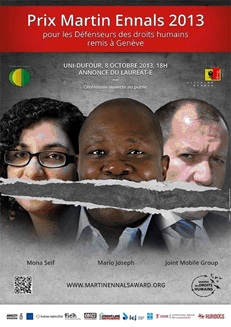
2013 Martin Ennals Award ceremony
October 8th, 2013, 6 pm
Please subscribe online: http://www.martinennalsaward.org
The Martin Ennals Foundation and the City of Geneva announce the 20th ceremony of Martin Ennals Award for human rights defenders. This event is integrated within Human Rights Week, a four-day event organized at the University of Geneva. This ceremony is open to the public. All who are interested in human rights are welcome to come and pay tribute to these men and women who are engaged in the defense of human rights, often risking their lives. It is crucial that the public knows the work of these individuals, not only in Geneva but also at the international level, in order to ensure that they can benefit from a certain degree of protection.
The following 3 nominees were carefully selected by the Jury of the Martin Ennals Award, made up of ten of the world’s leading human rights organisations:
- Ms Mona Seif (Egypt) who is one of the core founders of the ”No To Military Trials for Civilians”, a grassroots initiative that aims to stop military trials for civilians in Egypt.
- The Joint Mobile Group (Russia) seeks accountability for human rights abuses in Chechnya, notably enforced disappearances, torture in custody, and extra-judicial executions.
- Mr Mario Joseph (Haïti) has been referred to as Haiti’s most prominent human rights lawyer, and has worked on some of the most important cases including the one against former dictator Jean-Claude “Baby Doc” Duvalier.
Ms Navanethem Pillay, United Nations High Commissioner for Human Rights, will present the award to one of these nominees. The ceremony will be held in French and in English at Uni-Dufour, Jean-Piaget auditorium, U-600 at 6 pm. A live broadcast will be given in the Charles-Rouiller auditorium, U-300, located in the same building and it should also be streamed on the internet.

