The International Civil Society Week 2019 has finished. During the this meeting in Belgrade, that brought together over 850 civil society leaders, activists and concerned citizens from across the world, a large number of contribution were made and I will make reference to some of them in separate posts. Here one of the results:
A World Citizens’ Initiative as an instrument of citizen participation at the United Nations was promoted on 11th April 2019 at a plenary session of the International Civil Society Week 2019 (ICSW). Presenting the idea of a UN World Citizens’ Initiative (UNWCI), Caroline Vernaillen of Democracy International stressed that addressing the UN’s democratic deficit needs to be on the agenda, too. “The UN is a club of representatives of member states. There are no means for ordinary citizens to take influence and this has to change,” she said. The activist from Belgium stated that a UNWCI would help “create a citizen-based global political sphere.”
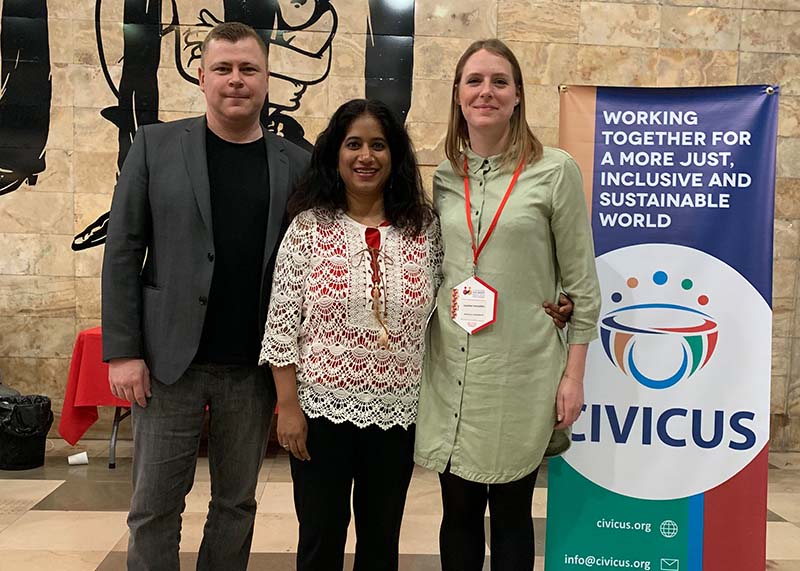
Caroline Vernaillen and Andreas Bummel with CIVICUS’ Secretary-General Lysa John (middle)
According to Vernaillen, the instrument of a UNWCI would allow global citizens to gather support for specific proposals which then would have to be considered and acted upon by the UN General Assembly. She emphasized that a similar instrument already exists in the European Union, the European Citizens Initiative.
CIVICUS, Democracy International and Democracy Without Borders have started preparing an international campaign to promote a UNWCI and participants of the civil society week were invited to join their efforts. The UNWCI campaign is planned to be launched in September or October 2019 when the next session of the UN General Assembly begins.
Joe Mathews, a board member of Democracy International and Co-President of the Global Forum for Direct Democracy, commented on Twitter that a World Citizens’ Initiative was a “powerful new idea” in direct democracy, “open to people everywhere, to attack big problems and check global power.”
The UNWCI campaign will be launched with a view of the 75th anniversary of the UN in 2020. On 11th April 2019, one of the numerous sessions of the civil society week dealt with this topic. Jeffery Huffines of CIVICUS gave an overview of the UN’s preparations of a UN2020 summit (see also this recent article). He urged civil society representatives to engage with this process and proposed that NGOs should think about whether there should be a global civil society forum on the occasion of UN2020.
The new initiative Together First was represented at this session by Giovanna Marques Kuele. She said that the UN needed to become “more democratic, more representative and more transparent.” Together First plans to identify the most important reform proposals and push for them ahead of a UN summit in 2020.
Speaking at the ICSW, the UN’s Assistant Secretary-General for Strategic Coordination, Fabrizio Hochschild, stated that on the occasion of 2020 UN Secretary-General Antonio Guterres “will call for a global youth driven conversation on what kind of world we want 25 years from now, in 2045.
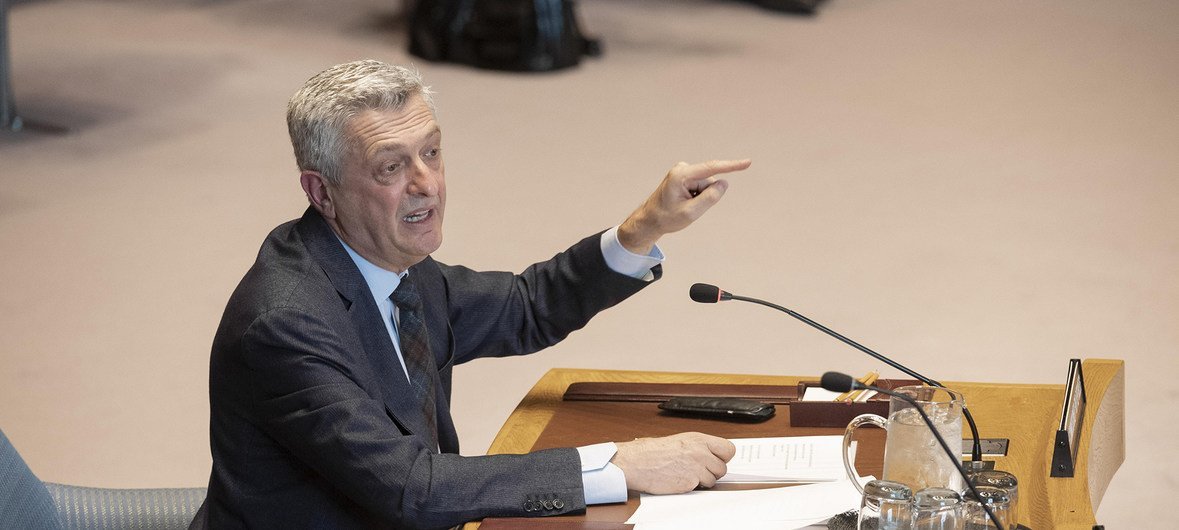
On 9 April 2019 UN News reports that in briefing to the Security Council on Tuesday, Filippo Grandi, United Nations High Commissioner for Refugees, said that, during his three and a half decades as an international civil servant, he has “never seen such toxicity, such poisonous language in politics, media and social media,” directed towards refugees, migrants and foreigners. At times – pointing his finger at Security Council members for emphasis – Mr. Grandi said that the stigmatization of refugees and migrants is “unprecedented,” and that traditional responses to refugee crises appear increasingly inadequate.
Dissecting the term “refugee crisis” itself, Mr. Grandi asked the Security Council to consider to whom, exactly, that applied: “It is a crisis for a mother with her children fleeing gang violence; it is a crisis for a teenager who wants to flee from war, human rights violations, forced conscription; it is crisis for governments in countries with few resources that, every day, open their borders to thousands. For them, it is a crisis.”
UN Photo/Evan Schneider. The United Nations High Commissioner for Refugees, Filippo Grandi, briefs the Security Council. (9 April 2019)
But it is wrong, he continued, to portray the situation as an unmanageable global crisis: with political will and improved responses, as enshrined by the Global Compact for Refugees, adopted last December, it can be addressed, and the Security Council has a critical role to play, particularly in terms of solving peace and security crises, supporting countries that are hosting refugees, and working to remove obstacles to solutions.
Conflicts, Mr. Grandi pointed out, are the main drivers of refugee flows: of the nearly 70 million people that are displaced, most are escaping deadly fighting. However, from the point of view of the UN High Commission for Refugees, approaches to peace-building are fragmented; addressing the symptoms, rather than the causes.
..[he goes into more detail on the Libyan situation]…
The UN refugee chief went on to exhort the Security council to step up support for the developing countries that host 85 per cent of the world’s refugees, to avoid leaving governments politically exposed, and refugees destitute. With regards to the return of refugees and migrants to their countries of origin, Mr. Grandi countered the misconception that UNHCR blocks returns: refugees have both a right to return, and also a right to not return, he said, in the absence of security and basic support. The informed choice of refugees must be respected, and returns must be dignified.
Mr. Grandi concluded by returning to the consequences of the toxic language surrounding refugees and migration, citing the example of the recent mosque shootings in Christchurch, New Zealand in March, which left 49 dead. The response of the New Zealand Government should, he said, be seen as an good example of effective leadership and how to respond to such toxicity, in a firm and organized manner, restating solidarity with refugees, and reaffirming the principle that our societies cannot be truly prosperous, stable and peaceful, if they do not include everyone.
Do UN Communications Make a Difference for Human Rights Defenders? asked Janika Spannagel in her new study on the “The Effectiveness of Individual Casework on Human Rights Defenders: An Empirical Study of the UN Special Procedure Cases 2004-2015“
After her first study [see: https://humanrightsdefenders.blog/2018/01/26/first-quantitative-analysis-of-16-years-outgoing-communications-by-special-rapporteurs-on-human-rights-defenders/], the University of York has now made public this follow up, which makes fascinating reading for anyone with serious interest in the protection of human rights defenders. Thew full paper is downloadable (see link below) and clarifies many of the tricky issues that this study has to cover. While the highest impact for intervention is always desirable, there remains the ethical and ‘political’ question of intervening even when there is little hope of improvement because the offending regime does not seem to care..’crime should not pay after all’ [On 3 June 2014, that question became the motivation for continuing my blog: https://gr.linkedin.com/in/hans-thoolen-b6648b7]
Despite a growing body of literature on the UN special procedures, we still know very little about the effectiveness of one of its core instruments, namely the use of communications to raise individual cases of human rights abuse with the government concerned. Focusing on the mandate of the UN Special Rapporteur on the situation of human rights defenders, this working paper explores new data to answer the controversially discussed question of whether or not communications generally make a difference in the situations of individual defenders.
The first part of this paper analyses data obtained from a survey of involved advocates, assessing the UN mandate’s impact on a random sample of cases among the Special Rapporteur’s communications between 2004 and 2015. The second part is concerned with external factors that may impact the further development of a case, suggesting alternative explanations of – but also possible conditions for – the medium term effectiveness of communications. For this purpose, the author uses a logistic regression to analyse a sample of almost 500 cases in order to investigate possible explanations for improvement or deterioration among cases addressed by the Special Rapporteur.
The systematic analysis of impact assessments provided by involved advocates convincingly suggests that individual casework is very often effective in providing protection to defenders whose cases are raised. However, the study of predictors of positive case developments also shows that the effectiveness of individual casework is highly contextual and therefore requires strategic adaptation and creative responses.
Implications for Practice
In considering only direct impact, the finding that the Special Rapporteur’s individual casework very often positively influences defenders’ situations provides an important argument for continued, or even increased, support for the special procedures’ communications activity.
Based on the sample cases, it can be concluded that international attention paid to cases with business involvement did not result in any substantial improvements in the medium term. The recently increased efforts by the Special Rapporteur to raise cases with companies directly, rather than only through the government concerned, may prove more effective.
Regime type matters with regard to case development, although only as an indirect effect on the predictive value of certain variables. This includes the previous violations, a country’s aid dependency, and a forthcoming UPR process. Such variables should be taken into account when considering the potential impact of a communication on a certain case.
The Special Rapporteur often refers to ‘follow-up’ on cases, however, rarely if ever does this reflect repeat communications regarding the same violation against a given defender. In reality, further communications serve instead to highlight new violations against the individual involved. The data suggests that these – often ‘high profile’ – defenders have a very low chance of seeing their situation improved. This finding makes the case for a more detailed assessment of the likely added value that repeated mentions by the Special Rapporteur can or cannot provide.
The main leverage in terms of possible impact relies on the selection of cases. However, both the ethical implications and multiple purposes of casework should be acknowledged and respected. While a focus on increased impact can be useful, the documentation function and more indirect protection effects should also be taken into account during case selection.
What remains unclear in the dataset is the extent to which ‘improvements’ in a defender’s situation following a communication also reflect a restored ability to carry out their work, and to what extent the experience of violations, or the continued threat thereof, inhibits this. Further research into the effects of case-specific improvement on defenders’ ability to effect change is needed.
Nishita, JhaBuzzFeed, reports on 20 March 2019 that many women who were slated to participate in the UN Commission on the Status of Women have been denied visas, especially lawyers, activists, and women who deliver reproductive health care services from African and Middle Eastern countries that fell under Donald Trump’s travel ban.
The International Service for Human Rights said it was aware of at least 41 women who have been denied visas to attend the conference this year — but this figure is said to be only “the tip of the iceberg” and likely to increase.
Women who wanted to attend CSW this year from countries like Iran, Sudan, Zimbabwe, and Syria were asked to provide supporting documents like marriage certificates, proof of property ownership, letters stating employment status, proof of finances, and even proof of birth certificates or proof showing that they have children, according to the petition.
Lyndal Rowlands, advocacy officer with the UN-accredited organization CIVICUS, told BuzzFeed News that among all the people that were denied visas, women from countries that fell under the Trump administration’s travel ban were disproportionately affected. “Last year and this year we have also heard of women from Pakistan and Nepal who were denied visas,” she said. …Most of the women applying for visas, Rowlands said, had not traveled to the US before — a deliberate decision by organizers who wanted a diverse range of women present at the United Nations, not just pundits and experts who travel all the time but women who work at the grassroots.
“It’s essential that women who are at the front lines working on women’s rights are present when their rights and the rights of the women they serve are being discussed,” she said. “Governments and UN officials that attend the conference can make better policies when they are informed by the experiences of women who face some of the biggest uphill battles when it comes to fighting for gender equality — for example, delegates who were unable to attend include lawyers and advocates who represent women who have been imprisoned for their activism, [and] women who deliver reproductive health care services.”
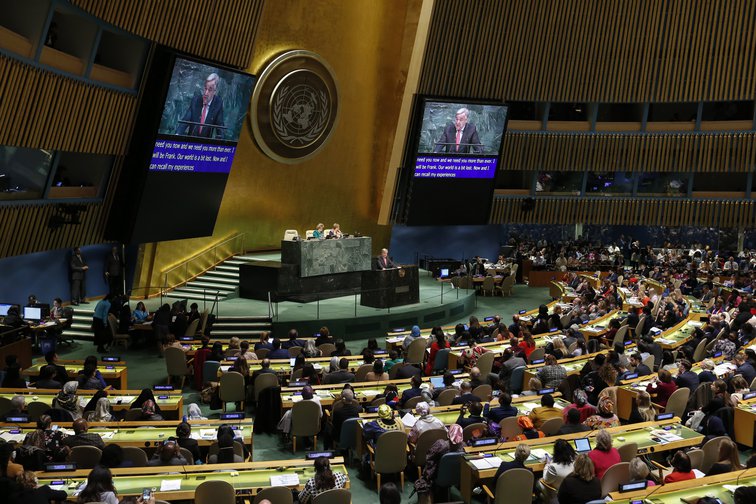
UN Commission on the Status of Women opening session, March 2019. Photo: Li Muzi/Xinhua News Agency/PA Images. All rights reserved.
Several news outlets have noticed the rather ironic selection of Iran to a United Nations’ body dedicated to “gender equality and the advancement of women”. Especially as this happened on the same day as an Iranian court sentenced Nasrin Sotoudeh, a lawyer who represented women charged for protesting the mandatory wearing of the hijab [ see: https://humanrightsdefenders.blog/2019/03/12/iran-cracks-down-on-nasrin-sotoudeh-and-other-human-rights-defenders/]. No Commission on the Status of Women (CSW) member-state raised an objection or called for a recorded vote, and Iran got the post. There is perhaps not much substantive meaning in this position and other ‘contradictory appointments’ have occurred in the UN, but it remains a public relations disaster for the UN.
Anne Marie Goetz in Open Democracy of 13 March 2019 goes in more depth on what the UN’s Commission on the Status of Women (CSW) in New York can do and points our that “Never before has social protection – pensions, health insurance, social security, child benefit, parental leave – been addressed by the CSW. Achieving progress on these issues is threatened by both religious and market fundamentalisms – though a number of states including Lebanon, Namibia, and Uruguay are resisting this backlash.“…
The US, Bahrain and Malaysia have reiterated during this week’s CSW discussions that the family – not the state – is the main source of social protection for many women. This is what I’d call a ‘family fallback’ approach which, combined with cuts to public services, requires women to expand their mothering roles to pick up the slack. Some countries, including Russia and Saudi Arabia, defend this maternal focus as a national cultural preference. The US is now among those supporting this view, arguing that any proposals on women’s rights should only be applied ‘as nationally appropriate’. This allows the notion of ‘national sovereignty’ to trump global standards on gender equality.
But the US position is so extreme that Shannon Kowalski, advocacy and policy director at the International Women’s Health Coalition, told me it’s expected that “major fractures will emerge” even with its conservative friends. Few developing countries can stomach the Trump government’s drift towards abstinence as the foundation of family planning.
Moreover, the US’s refusal to participate in the 2018 Global Compact for Immigration discussions has alienated countries such as the Philippines, Mexico and Indonesia, which have proposed, for instance, that social security benefits earned by immigrant women should be portable and redeemable when they return home.
A diverse counter-movement against the current global ‘illiberal drift’ is also visible at this year’s CSW. The ‘Buenos Aires Group’, consisting of many South American states (notably Argentina, Chile and Uruguay), has emerged as a defender of LGBTIQ rights and a skeptic about privatisation of public services. This year Tunisia and Lebanon, in the Arab states group, and South Africa, Namibia, Liberia and Cape Verde in the ‘Africa Group’ of countries, are championing progressive positions on women’s rights as well. This support from the Global South vitally shows that the gender equality agenda is not just the concern of the usual suspects in the North – Canada, New Zealand, Australia, Iceland, Norway, Liechtenstein and the EU.
In a blog post in Foreign Policy of 28 February JACOB MCHANGAMA (Executive director of Justitia, a Copenhagen based think tank) tackles the thorny issue of hate speech versus freedom of speech: “The U.N. Hates Hate Speech More Than It Loves Free Speech – The U.N. Secretary General is going soft on one of the most fundamental human rights“. It is an excellent read! Read the rest of this entry »
In UN Dispatch of 20 February 2019 Mark Leon Goldberg described “..How the UN Is Impacted By The Budget Deal Between President Trump and Congress”.
The United States averted another government shutdown last week .. the budget also has big implications for US foreign policy in general — and for the United Nations in particular. The United States is the single largest funder of the United Nations, so decisions in Congress have outsized influence over how the United Nations and its many agencies operate.
Here is what you need to know about how the budget deal between President Trump and Congress will impact the United Nations.
UN Peacekeeping is underfunded.
The budget deal includes$1.551 billion for the “Contributions to International Peacekeeping Activities” account. This is the budget line that funds most of America’s contributions to United Nations peacekeeping operations, including key missions in Mali, the Democratic Republic of Congo, Lebanon and more. The $1.551 billion appropriated by Congress falls short of this rate by nearly 3%. At issue is an arbitrary “cap” of 25% that Congress imposes on US dues to UN peacekeeping, despite the fact that at the UN, the US had agreed to pay 27.9%. The gap between what is assessed and what is paid by the United States results in an underfunding of UN peacekeeping operations and the accumulation of arrears by the United States, now to the tune of $750 million.
This underfunding of UN peacekeeping is contributing to a major cash crisis for UN Peacekeeping operations. Last month, the UN Secretary General sent a letter to every UN ambassador, warning them that a $2 billion shortfall means the UN only has a few months of cash on hand to sustain its peacekeeping operations. This budget passed by congress only adds to the these uncertainties facing UN Peacekeeping.
The UN regular budget is properly funded
The “Contributions to International Organizations” account funds the regular budget of the United Nations and also the core budgets of some UN agencies, like the International Atomic Energy Agency and the World Health Organization. The Congressional deal includes over $1.3 billion for this account, which represents a funding level commensurate with the rates the United States is assessed as a dues paying member of the UN. In other words, it is the proper funding level.
The caveat here is that the Trump administration may still try to withhold, or slow walk, the disbursement of these funds in an attempt to punish the Office of the High Commissioner for Human Rights. Last year, the White House sought to withhold $27 million in payments to the UN, which it calculated was roughly the amount that the UN would spend to fund the Office of the High Commissioner for Human Rights and also the UN Human Rights Council. ..
The Budget Deal Thwarts the Trump Administration’s Attempt to Kill UNICEF
In its budget request last year, the White House sought to completely eliminate an account known as “International Organizations and Programs.” (UNICEF is also funded through this account)…
Congress did not agree to these gratuitous cuts, and maintained a funding level for this account consistent with previous budgets, to the tune of $340 million. The budget also includes consistent funding levels for global health programs like the Global Alliance for Vaccines and Immunizations and the Global Fund to Fight AIDS, Tuberculosis and Malaria. Additionally, the budget includes consistent levels of funding for refugee related programs, including the UN Refugee Agency and the UN Relief and Works Agency, which supports Palestinian refugees. (Alas, it is likely that the administration will nonetheless withhold the disbursement for UNRWA for political reasons.)
In sum, with the exception of UN Peacekeeping, American commitments to the United Nations remained consistent with America’s traditional role as the indispensable member state of the UN.
The United Nations’ human rights office in Geneva confirmed on Friday a Reuters report that three-member team of international experts would conduct an inquiry into the murder of Saudi journalist Jamal Khashoggi. [https://humanrightsdefenders.blog/2019/01/26/u-n-rapporteur-agnes-callamard-to-investigate-kashoggi-murder/]. The other two panel members – in addition to Agnes Callamard – are British barrister Helena Kennedy and Duarte Nuno Vieira, a pathology expert and professor at the department of legal and forensic medicine and ethics and medical law at Coimbra University, Portugal.
The trio will visit Turkey from Jan 28-Feb 3 and plan to report to the U.N. Human Rights Council in June, it said.
There was no word on whether the panel would seek access to Saudi Arabia or whether the kingdom would cooperate. The Saudi diplomatic mission in Geneva did not respond to inquiries. On 29 January Human Rights Watch stated that the team has in fact requested to visit Saudi Arabia. HRW added that” Once Callamard presents her findings to the Human Rights Council, UN member states should explore avenues for holding to account everyone responsible for Khashoggi’s murder, from the operatives who dismembered him with a bone saw to any officials who ordered or organized the killing.”
Today, on the occasion of the presentation of the Action Plan at the plenary session of the General Assembly of the United Nations in New York, the NGOs who organized the World Summit 2018 (Paris October 2018) make public a powerful 8-mn video that summarizes The Human Rights Defenders World Summit 2018 and the highlights of this historic event in Paris. Click on play and meet the defenders, inspiring and courageous individuals and representatives of communities that advance and protect human rights, every day, in the most difficult places around the world. Film made by True Heroes Films (THF – www.trueheroesfilms.org).



 Hans Thoolen on Human Rights Defenders and their awards