Posts Tagged ‘UN Human Rights Council’
June 23, 2014
In a recent piece published on LinkedIn on 3 June 2014, I argued that there is not enough attention given to enforcement [https://www.linkedin.com/today/post/article/20140603192912-22083774–crime-should-not-pay-in-the-area-of-international-human-rights]. This conviction was fortified by reading the ISHR Monitor of 20 June in which Heather Collister sums up recent cases of persistent non-cooperation by States with the Council’s special procedures and other mechanisms.
The Human Rights Council heard updates from the Special Rapporteurs on Belarus, the Democratic People’s Republic of Korea, and Eritrea, along with the latest update from the Commission of Inquiry into the situation in Syria. In all cases the countries in question have refused access to the mechanism created by the Council to monitor and report on the human rights situation.
Read the rest of this entry »
Posted in human rights, Human Rights Defenders, ISHR | 1 Comment »
Tags: Belarus, Democratic People’s Republic of Korea, DPRK, enforcement, Eritrea, Heather Collister, Human Rights Council, international commitments, ISHR, LinkedIn, non-cooperation, special rapporteurs, Syria, Thoolen, UN Human Rights Council, UPR
June 11, 2014
Defenders of the environment often face terrible consequences for their actions, suffering rights violations and violence, according to a new report by Friends of the Earth International to be released on June 26, during the 26th Session of the U.N. Human Rights Council . “A new case of violence against environmental rights defenders and violations of their rights is reported to us on average once a week, and this is just the tip of the iceberg,” said Lucia Ortiz, of Friends of the Earth International. “Environmental defenders who uphold the right of communities to determine their own development path in opposition to corporate-driven mega projects are subject to many types of human rights abuses, often committed by corporations or on their behalf”.
Friends of the Earth International recorded more than 100 incidents of violence against environmental rights defenders and violations of their rights in 27 countries around the world in the period November 2011 – October 2013. More than half of the killings recorded were targeted assassinations of peasant leaders and deaths of peasants during violent confrontations regarding land disputes, often involving the protection of peasant territories from polluting development projects such as hydroelectric dams, monoculture plantations or the extraction of oil, gas and minerals.
The new report calls on the UN Human Rights Council to create an international treaty to address corporate human rights violations. [On may 7, 2014, a global alliance of civil society organizations known as the Treaty Alliance representing more than 500 groups called on UN Human Rights Council members to support an initiative in June that would begin a process towards creating an international legally binding treaty to address corporate human rights violations. For more information read: www.foei.org/news/groups-call-for-un-treaty-to-tackle-corporate-human-rights-violations/ – A regulatory and enforcement framework that is legally binding for corporations has been proposed at the Council by a group of 84 nations since September 2013]
The following environmental defenders will be in Geneva on June 23-27:
1) Micaela Antonio Gonzalez from Guatemala and Victor Barro from Friends of the Earth Spain will expose the human rights violations by the Spanish company Hidralia in Guatemala.
2) Abeer Al Butmah from Friends of the Earth Palestine will expose the human rights violations by Israeli water company Mekorot in Palestine.
3) Godwin Ojo from Friends of the Earth Nigeria and Paul de Clerck from Friends of the Earth Europe will expose the human rights violations by Royal Dutch Shell in the Niger Delta.
4) Alberto Villarreal will expose the violations of the human right to health posed by the Philip Morris International challenge to the tobacco control legislation in Uruguay.
Friends of the Earth International is critical of ‘voluntary mechanisms’ such as the Global Compact and Ruggie’s UN Guiding Principles on Business and Human Rights and believes they have not reduced attacks on human rights defenders and are thus insufficient to protect human rights.
The report ‘We defend the environment, we defend human rights‘ is available at www.foei.org/resources/publications/publications-by-subject/human-rights-defenders-publications/we-defend-the-environment-we-defend-human-rights/
For some of my earlier posts on environmental issues and human rights defenders see: https://thoolen.wordpress.com/tag/environmental-issues/
Posted in human rights, Human Rights Council, Human Rights Defenders | 1 Comment »
Tags: binding international law, campesinos, corporate accountability, Environmental issue, Friends of the Earth, Guatemala, Human Rights Defenders, human rights violations, indigenous groups, legal protection, Nigeria, Palestine, resource extraction, treaty, UN Human Rights Council, Uruguay
June 6, 2014
The ISHR Monitor of June 2014 contains a good wrap-up of the situation regarding reprisals against Human Rights Defenders written by Eleanor Openshaw under the title: “Reprisals: States must reduce unacceptable human cost of cooperating with UN”.
‘Regrettably, reprisals against persons cooperating with the United Nations, its mechanisms and representatives in the field of human rights continue. ...’ said UN Secretary-General Ban Ki-moon in 2013. In response, the UN Human Rights Council adopted a landmark resolution in September 2013 calling on the Secretary-General to designate a UN-wide senior focal point to combat reprisals. Regrettably, Human Rights Council resolution 24/24 was blocked by the UN General Assembly in New York in December 2013, but NGOs are now calling again on States to revisit the issue as a matter of priority. “The disappearance, arbitrary detention, ill-treatment and death of human rights defender Cao Shunli in retaliation for her efforts to hold China to account for its human rights record at the UN is just one example among many of the unacceptable human cost of cooperating with the UN,’ said Ms Openshaw.
A number of positive recent developments (referred to in earlier blog posts [https://thoolen.wordpress.com/tag/reprisals/]) include a May 2014 decision by the African Commission on Human and Peoples’ Rights in Angola to appoint its own focal point, and a joint statement delivered by Botswana on behalf of 56 States in Geneva in March 2014 recognising that ‘the current response by the UN and the member States in addressing reprisals is inadequate’ and calling on them to ‘address cases of reprisals through a more effective and coordinated approach.‘
‘With the opportunity for the General Assembly to revisit the issue in September, NGOs are urging States to transfer the political will shown on this issue in Angola and Geneva to New York, and achieve an outcome that challenges impunity for the perpetrators of reprisals and increases protection for human rights defenders and others who engage with the UN human rights system,‘ Openshaw said (Program and Advocacy Manager, e.openshaw[at]ishr.ch).
The statement was signed by a coalition of 12 leading international and regional NGOs (of which 8 are members of the MEA Jury or Regional Panel):
- Amnesty International
- Association for the Prevention of Torture (APT)
- Asian Forum for Human Rights and Development (FORUM-ASIA)
- Cairo Institute for Human Rights Studies
- Commonwealth Human Rights Initiative
- Conectas Direitos Humanos
- Human Rights House Foundation
- Human Rights Watch
- International Commission of Jurists
- International Federation for Human Rights (FIDH)
- International Service for Human Rights
- World Organisation Against Torture (OMCT)
full article: Reprisals: States must reduce unacceptable human cost of cooperating with UN | ISHR.
Posted in human rights, Human Rights Defenders, MEA, UN | 1 Comment »
Tags: anti-reprisals focal point, Cao Shunli, coalition, human rights, Human Rights Council, Human Rights Defenders, MEA, reprisals, retaliation, UN, UN General Assembly, UN Human Rights Council, UN Resolution
May 30, 2014
The Geneva Academy of International Humanitarian Law and Human Rights, organised an expert meeting on The Right to Privacy in the Digital Age‘ (hosted by the Permanent Missions of Austria, Brazil, Germany, Liechtenstein, Mexico, Norway, and Switzerland) in Geneva on 24-25 February 2014. The right to privacy is of great practical importance to human rights defenders who are often in the firing line of (mass) surveillance. The report is short and very readable and makes an excellent long read for the weekend. To help those pressed for time, here is the Summary of conclusions:
Read the rest of this entry »
Posted in books, Human Rights Defenders, UN | 1 Comment »
Tags: big data, communication, corporate accountability, digital security, freedom of expression, Geneva, Geneva Academy of International Humanitarian Law and Human Rights, Human Rights Committee, internet, mass surveillance, meta data, privacy, self censorship, Special Rapporteur, Surveillance, the right to privacy, UN Human Rights Council
April 30, 2014
Saudi Arabia has criticised Norway’s human rights record, accusing the country of failing to protect its Muslim citizens and not doing enough to counter criticism of the prophet Mohammed. The gulf state and other islamic countries called for all criticism of religions and of prophet Mohammed to be made illegal in Norway. It also expressed concern at “increasing cases of domestic violence, rape crimes and inequality in riches” and noted a continuation of hate crimes against Muslims in the country. Russia also called for Norway to clamp down on expressions of religious intolerance and and criticised the country’s child welfare system. They also recommended that Norway improve its correctional facilities for those applying for asylum status. All this happened when Norway submitted itself to scrutiny during the current session of the United Nations’ Universal Periodic Review.
The criticism may sound incongruent for those who know how often Russia and Saudi Arabia figure in reports from human rights defenders, including ib this blog, but – as the Norwegian Foreign Minister, Børge Brende, in Geneva told Norway’s NTB newswire prior to the hearing – “… that is the United Nations”.
Saudi Arabia criticises Norway over human rights record – News – The Independent.
Posted in human rights, Human Rights Defenders | Leave a Comment »
Tags: asylum seekers, Børge Brende, freedom from religion, freedom of religion, Geneve, islamic law, Norway, Russia, Saudi Arabia, The Independent, UN Human Rights Council, United Nations, UPR
April 29, 2014
In a post dated 13 March 2014, I suggested the possibility of suspending the membership of countries in the Human Rights Council in case of serious reprisals against human rights defenders who coöperate with the UN. [https://thoolen.wordpress.com/2014/03/13/zero-tolerance-for-states-that-take-reprisals-against-hrds-lets-up-the-ante/]. The backdrop to this admittedly far-reaching proposal Read the rest of this entry »
Posted in human rights, Human Rights Defenders, ISHR | Leave a Comment »
Tags: ADC Memorial, annual Report of the Secretary General on Reprisals, Cao Shunli, China, General Assembly, gross and systematic violations, Human Rights Defenders, human rights violations, ISHR, membership UN human rights council, Phil Lynch, reprisals, retaliation, Russia, Sri Lanka, UN Human Rights Council
April 12, 2014
Mandeep Tiwana posted on 10 April in the Mail & Guardian a piece that – sadly – needed to be written. On how South Africa and India increasingly find themselves siding with Russia, China in votes concerning human rights in the UN Human Rights Council. Mandeep recalls that “Mandela was acutely aware of the role that international solidarity played in supporting anti-apartheid activists as they mobilised on the streets. As president, he made a compelling speech at the Southern African Development Community’s periodic conference in 1997 in Blantyre, Malawi. He urged that national sovereignty and non-interference in the affairs of other countries could not blunt the common concern for democracy, human rights and good governance in the regional grouping. Mandela called upon his fellow leaders to recognise the right of citizens to “participate unhindered in political activities”. Under title : “India, SA risk forsaking their proud histories on human rights” the piece makes good reading for your weekend: Read the rest of this entry »
Posted in human rights, Human Rights Council, Human Rights Defenders, UN | 1 Comment »
Tags: Brazil, BRICS, diplomacy, freedom to demonstrate, Geneva, Human Rights Council, Human Rights Defenders, India, Mail & Guardian, Mandeep Tiwana, moment of silence, Nelson Mandela, retaliation, South Africa, UN Human Rights Council
March 31, 2014
Contrary to what I hoped in my post of last week, there are still problems with the appointment of the slate of special rapporteurs of the UN Human Rights Council. The session that just finished SHOULD have seen the appointment of 19 special procedure mandate holders, including the Special Rapporteur on human rights defenders. The appointments were, however, postponed until April at the request of Peru. It seems that Peru argued that the President had not justified the few instances in which he had chosen to select another candidate than the one recommended by the consultative group based on the interviews they had carried out; and that the final group of selected candidates did not adhere to requirements of gender or regional balance. Peru was specifically unhappy at a lower representation of experts from Latin America amongst the special procedures. So, we wait a bit longer!
https://thoolen.wordpress.com/2014/03/28/new-un-special-rapporteur-on-human-rights-defenders-indeed-michel-forst/
Posted in Human Rights Council, Human Rights Defenders, UN | Leave a Comment »
Tags: diplomacy, Human Rights Defenders, Margaret Sekaggya, Michel Forst, Peru, Special Procedures, Special Rapporteur, special rapporteurs, the appointment, UN Human Rights Council, UN Special Rapporteur on Human Rights Defenders
March 29, 2014
This week, the UN Human Rights Council adopted its annual resolution on human rights defenders. The resolution, led by Norway and Ireland, was co-sponsored by 74 nation-states and adopted by consensus. The new emphasis – in line with the latest report by the departing Rapporteur, Margaret Sekaggya – is on the importance of domestic law and administrative provisions which protect human rights defenders from criminalization, stigmatization, impediments, and obstructions contrary to international human rights law. The misuse of national security and counterterrorism legislation to crackdown on human rights defenders is also explicitly warned against. The resolution explicitly refers to the impact of how a country’s laws can be used by a government to further or impede the work of human rights defenders within the country.
for the full text see: http://www.ishr.ch/sites/default/files/article/files/140328-res-council-25-hrds-l24-as-adopted.pdf
Posted in human rights, Human Rights Council, ISHR, UN | Leave a Comment »
Tags: Human Rights Defenders, international human rights law, international protection, ISHR, Margaret Sekaggya, national level, Resolution, UN Human Rights Council, women human rights defenders
March 28, 2014
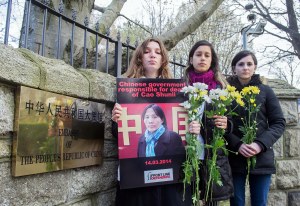
Vigil for Cao Shunli in March 2014 in Dublin – (c) Front Line
Didi Kirsten Tatlow reports in The New York Times of 28 March how the issue of Cao Shunli’s death in detention in China has not ended. A lawyer for Cao Shunli said her family wants an independent autopsy by pathologists from outside China, saying they do not trust local pathologists or the police to make an accurate report. “If we can we would like to invite an international expert or an international expert organization to come here to do an autopsy,” said the lawyer, Ms Wang Yu. “’The family has not requested an autopsy yet, though they want one, because they don’t trust anyone here to do a fair job,” [The Beijing Lawyers Association and the Beijing Municipal Justice Bureau seem to be putting pressure on the lawyer] Read the rest of this entry »
Posted in Front Line, human rights, Human Rights Defenders, ISHR | Leave a Comment »
Tags: autopsy, Beijing Lawyers Association, Beijing Municipal Justice Bureau, Cao Shunli, China, death, detention center, Front Line (NGO), Hans Thoolen, Human Rights Defenders, human rights lawyers, illegal detention, impunity, ISHR, Liu, medical care, New York Times, reprisals, UN Human Rights Council, UPR, Wang Yu, woman human rights defender


