Posts Tagged ‘Ukraine’

Ukrainian human rights defender Maksym Butkevych wins CoE’s 2025 Václav Havel Prize

September 30, 2025
2025 Václav Havel Prize awarded to Ukrainian journalist and human rights defender Maksym Butkevych

The thirteenth Václav Havel Human Rights Prize – which honours outstanding civil society action in defence of human rights – has been awarded to Ukrainian journalist and human rights defender Maksym Butkevych. The prize was presented at a special ceremony on the opening day of the autumn plenary session of the Parliamentary Assembly of the Council of Europe (PACE) in Strasbourg on 29 September 2025

Mr Butkevych is a co-founder of the Zmina Human Rights Centre and of Hromadske Radio. Despite his lifelong pacifism, he volunteered for the Ukrainian Armed Forces at the start of the 2022 Russian invasion and became a platoon commander. Captured and sentenced to 13 years in prison by Russian forces, he endured over two years of harsh imprisonment before being released in a prisoner exchange in October 2024. He remains a powerful symbol of courage and resilience in defence of justice and freedom.

The two runners-up for the 2025 Prize are Georgian journalist Mzia Amaghlobeli and Azerbaijani journalist Ulvi Hasanli. Both of them are currently detained in their home countries.

Opening the ceremony, PACE President Theodoros Rousopoulos said it was no coincidence that all three shortlisted candidates this year were journalists. Urging the immediate release of Ms Amaghlobeli and Mr Hasanli, he said: “Your voice may be silenced, but your testimony is heard loud and clear.” The President – himself a former journalist – also thanked all three candidates for their courage in opposing authoritarianism and for acting as role-models for a whole generation of journalists and human rights defenders: “Governments should not be afraid of the truth,” he declared.

For more on the Václav Havel Human Rights Prize, and its laureates, see: https://www.trueheroesfilms.org/thedigest/awards/7A8B4A4A-0521-AA58-2BF0-DD1B71A25C8D.

IPS at this occasion published a post critical of the lack of follow up to free the laureates:

The Václav Havel Prize is an important international recognition for those who stand up for human rights and against autocracy, but while recognition through such awards and solidarity matters deeply, it is not enough. The Council of Europe must match its willingness to recognise the courage of human rights defenders with efforts to stand courageously up to autocrats and dictators, even and especially those within its own membership ranks.

For PACE leadership and members, the recognition given to human rights defenders through the Václav Havel Prize must be matched with tireless, persistent and coordinated action to put pressure on the other political bodies of the Council of Europe. This includes adopting resolutions demanding the release of imprisoned laureates; organising visibility campaigns within PACE through side events, exhibitions and public initiatives; building stronger connections and networks with families of prisoners; and consistently deploying all available diplomatic tools to keep political prisoners at the forefront of European media and diplomacy.

At the same time, CoE leaders, including the Secretary General and Commissioner for Human Rights (currently Alain Berset and Michael O’Flaherty, respectively), must put the release of political prisoners at the top of the organisation’s priority list. These leaders have important public platforms that must consistently and relentlessly raise the profile of human rights defenders at risk. Leaders must work to mobilise member states to apply pressure for the release of political prisoners.

Finally, Council of Europe member states – signatories to the European Convention on Human Rights – need to recognise that the continued detention of human rights defenders poses a great risk to the long-term credibility of the institutions. Member states – on their own and through the organisation’s powerful Committee of Ministers – have to use all tools at their disposal to address the rising cases of political prisoners and crackdowns against civil society across the broader region. The Committee of Ministers needs to put enhanced enforcement pressure on member states regarding the judgments of the European Court of Human Rights on fundamental freedoms. These judgements, after all, often affect the fate of political prisoners.[https://www.ips-journal.eu/topics/democracy-and-society/prizes-without-freedom-risk-becoming-trophies-of-hypocrisy-8573/]


 Last year’s winner 

 Václav Havel Prize film

https://www.coe.int/en/web/portal/-/2025-v%C3%A1clav-havel-prize-awarded-to-ukrainian-journalist-and-human-rights-defender-maksym-butkevych-1

https://www.kyivpost.com/post/61106

The History of Writers Defending Human Rights in the USSR, e.g. the poet Lina Kostenko

September 16, 2025

On 14 September 2025 Ilya V Ganpantsura wrote in Countercurrents:

In the USSR, writers often became defenders of human rights. They were people of various ages and backgrounds, yet their works exposed injustice and reflected personal courage to speak the truth — for which many paid with exile and labor camps. Why did the authorities fear writers so much? And why should they be honored today?

One such figure was the Soviet-Ukrainian writer and poet Lina Kostenko, who, through her works and personal stance, inspired resistance, standing proudly for freedom and against the oppressive system, despite multiple attempts to push her out of cultural and literary life. Her novel Notes of a Ukrainian Madman, written in the 1970s, was long banned and circulated only through underground self-publishing (samizdat). Through this work, Kostenko protested the totalitarian regime and shed light on the lives of those who could not live in good conscience under Soviet rule. The novel symbolized the fight for the right to be oneself.

Lina Kostenko was part of the “Sixtiers” (Shistdesyatnyky) movement, a generation that opposed Soviet propaganda stereotypes, aimed to restore historical memory, protect national culture, and resist ideological control in Ukraine. As a writer and poet, Kostenko not only used her works to critique the totalitarian regime but also supported the core values of the movement: personal freedom, the right to cultural expression, and the condemnation of repression.

“We are warriors. Not idlers. Not slackers.
And our cause is righteous and holy.
For while others fight for whatever,
We fight for independence.
That’s why it’s so hard for us.”
“A human seemingly cannot fly…
But has wings.
Has wings!”

Her contribution to the cultural revival of Ukraine and the preservation of free speech values is immeasurable. Today, Lina Kostenko still resides in Ukraine. In 1987, she was awarded the Shevchenko National Prize for her novel Marusia Churai.

One of Lina Kostenko’s close friends and fellow Sixtiers was the poet, translator, and dissident Vasyl Stus. They actively supported each other in their fight against censorship during the most difficult times of repression.

Stus openly criticized the Soviet regime for human rights violations, which led to his repeated persecution. In 1972, he was arrested and sentenced for “anti-Soviet agitation and propaganda.” Despite the harsh conditions of his imprisonment, he continued to write, and his works were distributed through samizdat, inspiring many to resist oppression.

After five years in a Mordovian labor camp and two years in exile in the Magadan region, Stus returned to Kyiv in September 1979. There, he resumed his human rights activities, supporting “prisoners of conscience” with the help of Western organizations. In 1978, he was made an honorary member of the English PEN Club. However, in early 1980, he was arrested again. Vasyl Stus died in a maximum-security labor camp in 1985. His life and works became symbols of the relentless struggle for freedom and human dignity under totalitarianism.

The stories of Lina Kostenko and Vasyl Stus remind us that words can be powerful weapons in the fight for truth and dignity. Their courage, dedication to the ideals of freedom, and love for Ukrainian culture prove that even under the harshest conditions, there is always room for bravery and resistance. Today, as issues of freedom of speech and cultural identity remain pressing, their legacy continues to inspire us to remember that truth is a value worth fighting for.

https://countercurrents.org/2025/09/the-historical-tragedy-of-writers-defending-human-rights-in-the-ussr/

EU’s Annual Report on Human Rights and Democracy in the World 2024 is out

May 28, 2025
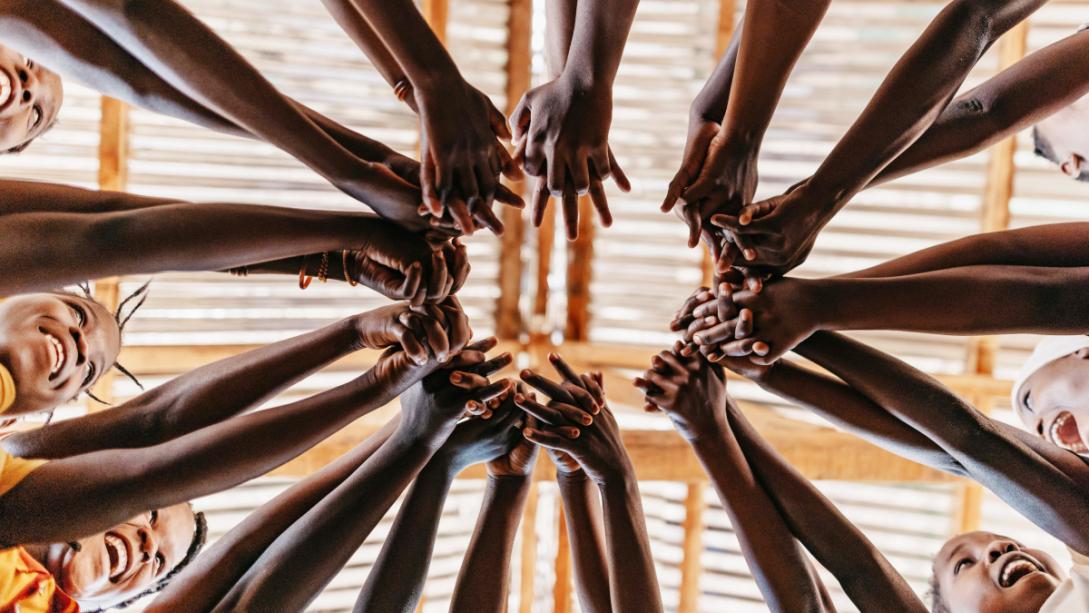
Low angle of children standing in a circle reaching out to join hands.

© UNFPA

In 2024, we have witnessed extraordinary levels of hostility towards democracy, from rampant disinformation and information manipulation by foreign actors, to the silencing of media and human rights defenders, and a strong pushback against gender equality and diversity, undoing years of progress in many countries across the globe. Today, only 29% of the world’s population live in liberal democracies. At the heart of these challenges lies peace. Peace is not simply the absence of war. It is the active cultivation of justice, the protection of the most vulnerable, the realisation of all human rights and the commitment to dialogue and reconciliation.’ 
– High Representative, Kaja Kallas 

The publication of the EU’s Annual Human Rights Report takes place in the context of multiple and cascading crises, including war on the European continent and the resurgence of conflict in many other areas of the world. These developments underscore the strong links between peace, human rights and democracy. Climate change, digital transformation, and rising inequalities add to the growing human rights challenges worldwide.

The report follows the structure of the EU’s Action Plan on Human Rights and Democracy, particularly the EU’s work on protecting and empowering individuals, building resilient, inclusive and democratic societies, promoting a global system for human rights and democracy, harnessing opportunities and addressing challenges, and ensuring that the EU delivers by working with our partners.

The EU continues to support the strengthening of inclusive, representative and accountable institutions, and promoted a collaborative approach to democracy through the Team Europe Democracy initiative. The fight against information manipulation and interference also continues to be a priority through initiatives such as EUvsDisinfo. Over the past year, the European Endowment for Democracy has kept up its work on fostering democracy and working with free media and civil society in challenging circumstances in Belarus, and Ukraine among others. The EU has carried on supporting and empowering people on the frontlines of human rights advocacy.

While the global outlook is challenging, the EU is steadfastly pursuing deeper international cooperation and stronger early warning and prevention mechanisms. Efforts to ensure accountability for violations and abuses of human rights continue to be a key priority. Together with its partners, the EU is determined to protect the multilateral human rights system and uphold the central role of human rights and democracy in fostering peace, security and sustainable development.

Russian and Ukrainian human rights defenders focus on end to the war in Ukraine.

May 14, 2025

In the past weeks and months, Russian and Ukrainian human rights activists have been focusing on negotiations to end the war in Ukraine. Back in January, human rights activists and the People First campaign raised several issues to parties involved in ongoing negotiations in the hopes that the negotiations would prioritise those affected by the conflict, particularly prisoners of war, detained Ukrainian citizens, Ukrainian children which have been taken to Russia, and Russian political prisoners.

The invasion of Ukraine was only possible thanks to a system of political repression Russia has inflicted on its own people for decades.

In February, on the third anniversary of Russia’s full-scale invasion of Ukraine, a group of UN special rapporteurs and experts called for parties involved in negotiations to put legal and humanitarian issues at the forefront of discussions. They stressed that the Russian government must be held accountable for its aggression and war crimes in Ukraine committed, and its repressive policies towards its own citizens.

The invasion of Ukraine was only possible thanks to a system of political repression Russia has inflicted on its own people for decades. According to experts, over 3,000 individuals have been persecuted by Russian authorities for political reasons. Despite recent efforts by human rights activists to advocate for person-centred negotiations, it seems more and more doubtful that the focus will be on human rights

Russia’s aggression against Ukraine has challenged the established system of international relations, which has now proven to be woefully fragile. Most countries see Putin’s decision to unleash outright war on Ukraine as unacceptable. While many democratic countries have continued to provide Ukraine with assistance, this has at times proven insufficient in the face of Russian violence.

Since January, the rejection by the US of legal norms in place since the two world wars has unleashed a new crisis in international politics.

US tactics to repeal basic human rights seem eerily familiar for Russian activists, who have been fighting similar state tactics for the past 25 years.

The new American administration’s policy is increasingly similar to Putin’s own tactics. Both favour the “right of the strong”, whereby great powers can decide the fate of others and dictate conditions. The US has shown itself to be less interested in international law, making it increasingly easy for norms to be overlooked.

US tactics to repeal basic human rights seem eerily familiar for Russian activists, who have been fighting similar state tactics for the past 25 years. Russians knew a world without regard for international human rights or legal norms long before 2025, or the invasion of Ukraine in 2022.

For 25 years, Putin’s government has created a country which prioritises the interests of the state and denies basic human rights.

What is happening in the US is recognisable to many Russians.

By wanting to end the war in Ukraine and find a quick solution, the US president is effectively equating the aggressor with the victim of aggression.

Negotiations thus far suggest Trump is more likely to ensure Russian interests that are detrimental both to the safety of the Ukrainian people, who have been subjected to aggression and occupation, and to justice and a sustainable peace.

Russia’s full-scale invasion of Ukraine was the result of years of human rights violations within Russia and the lack of a response from the international community to these violations.

An unfair peace — a “deal” that contradicts the norms of international law — sets a dangerous precedent. It normalises the war against Ukraine, thereby giving Russia the green light to repeat its aggression and to enact even harsher repressive policies inside Russia.

Such a “deal” is a signal to the whole world, a move towards dangerous instability, reminiscent of the brink of the outbreak of the world wars. Departing from the principles of human rights and international law in peacekeeping practices encourages impunity and will inevitably lead to new wars of aggression. Democracy in many countries will also be at risk, as the new rules of the game will open up opportunities for autocrats and dictators to violate human rights in their countries without regard for international institutions and their international obligations.

No peace without rights 

We call on the leaders of all democratic countries, all politicians for whom human rights are not merely empty words, and civil society to take a stand and bring human rights back into international politics.

This is the only way to create reliable conditions for long-term peace in Europe and prevent the emergence of new-large scale military conflicts globally. Otherwise, the world will find itself in a situation where the fate of countries and the people living in them will be decided through wars unleashed by imperialist predators.

We call on all parties taking part in peace negotiations in Ukraine to prioritise the human aspect: the fate of prisoners of war and the protection needed for civilians, including in Russian-occupied areas of Ukraine.

We insist that negotiations be based on the fundamental norms of international legal agreements, including the UN Charter and the Helsinki Final Act, as they define aggression, protect the principle of territorial integrity and sovereignty, and link military and political security with human rights. Without this, it will be impossible to achieve a just and sustainable peace.

The appeal was drafted and signed by members of the the Council of Russian Human Rights Defenders: Galina Arapova, Sergey Davidis, Yury Dzhibladze, Leonid Drabkin, Sergey Krivenko, Sergey Lukashevsky, Karinna Moskalenko, Oleg Orlov, Lev Ponomarev, Alexander Cherkasov, and Yelena Shakhova.

The names of the other Council members who signed the appeal are not given for security reasons.

https://novayagazeta.eu/articles/2025/05/11/no-peace-without-human-rights-en

https://www.osce.org/odihr/elections/590898

Interview with Human Rights Defender Olga Kleitman

February 28, 2025

Human Rights First published this on 24 February 2025

Human Rights Defender & architect Olga Kleitman from Ukraine turned an empty building into a safe haven for those displaced by war in Kharkiv.

William Collins to publish two books by late Ukrainian author Victoria Amelina

July 2, 2024

A book of first-hand accounts of the war in Ukraine by Victoria Amelina is to be published posthumously by William Collins. Publication for Looking at Women Looking at War: A War and Justice Diary is scheduled for February 2025. It will be followed by a novel in 2026.

Amelina, who died exactly a year ago as a result of a missile strike in Kramatorsk, was a well-known novelist and children’s author in Ukraine. Rights to her unfinished non-fiction book were pre-empted by Arabella Pike at Williams Collins from Emma Shercliff at Laxfield Literary Associates. It will be published in the US by St Martin’s Press and translation rights have been sold in France (Gallimard), Italy (Guanda), Korea and Georgia.

Amelina’s book follows 11 female journalists, human rights defenders, lawyers, and volunteers documenting war crimes in Ukraine while the war is still ongoing. It includes Nobel Peace Prize Laureate Oleksandra Matviichuk, and chronicles Amelina’s own transformation from novelist and mother into a war crimes researcher.

Pike said: “After hearing the cruel news of Victoria’s death, it was a small consolation to us that she knew her vitally important book would be published in English. We at William Collins are so proud to publish her account of the hideous war crimes happening daily in Ukraine and regret deeply that this must be posthumous.

Arabella Tetyana Teren, head of PEN Ukraine, said: “This book is the voice of Ukraine fighting for its freedom and future. This book is the voice of a writer who, in the most difficult time for her country, chose the role of testifying about the war crimes of the Russians and seeking punishment for the perpetrators. This book was born from love—the author’s love for her country and her heroines, and our love for the talented Ukrainian writer, brave woman, and our dear friend, whose life was taken by Russia.”.”

Amelina, who was 37 when she died, worked in the high-tech industry for ten years before becoming a writer and lived in the US in 2019/20. She travelled extensively to talk about her work with Truth Hounds, and her poetry, essays and prose have appeared in publications including the Irish Times, the Dublin Review of Books, The Guardian and the New Yorker. Victoria was the founder of a literary festival in a city named New York in the Donetsk region, Ukraine. [see also: https://humanrightsdefenders.blog/2023/10/12/5th-dublin-arts-and-human-rights-festival-in-october-2023/]

https://www.thebookseller.com/rights/william-collins-to-publish-two-books-by-late-ukrainian-author-victoria-amelina

Human rights defenders working in war zones such as Ukraine and Israel

July 1, 2024

On 20 June 2024 Swissinfo spoke with human rights defenders from Ukraine and Israel about how they operate in tough contexts. The main tasks of human rights defenders include investigating, collecting information about, and reporting rights violations. They raise public awareness to ensure that human rights are respected. But how do they work in a war zone or in an environment where a large part of public opinion is against them? SWI swissinfo met activists from Ukraine and Israel in Geneva’s Palais des Nations, where they had come to meet delegations and attend side-events during a session of the Human Rights CouncilExternal link .

We are documenting testimonies from victims of the war in Ukraine,” says Lyubov Smachylo, an analyst with the Ukrainian organisation Media Initiative for Human Rights (MIHR).

MIHR’s main office is in Kyiv. It has direct access to victims and witnesses of rights violations, such as Ukrainians living in the north of the country – formerly under Russian occupation and now back under Ukrainian rule – or former prisoners in Russian jails. Smachylo, who lives between Kyiv and Paris, analyses documented testimonies of human rights violations committed by Russia. These include Russian armed forces acting with generalised impunity, the arbitrary detention of civilians – often accompanied by torture and ill-treatment – and in some cases enforced disappearances.
Lyubov Smachylo from the Ukrainian Media Initiative for Human Rights. Courtesy of Lyubov Smachlyo

MIHR is one of the few NGOs able to gather information on the ground. Virtually no international organisation can go into the occupied Ukrainian regions, not even the Office of the UN High Commissioner for Human Rights (OHCHR). The International Committee of the Red Cross (ICRC), for example, has only limited access to Ukrainian prisoners of war. This absence of accountability and the underreporting of abuses mean there is an increased risk of mistreatment and of perpetrators going unpunished.

Among other things, the MIHR deals with prisoners of war and civilians who have been arrested in the Russian-occupied regions of Ukraine or who are being detained in unknown places. Beatings and torture are rife, and some have died because of the poor detention conditions, says Smachylo.

“We know of 55 places of detention in the occupied regions of Ukraine and 40 in Russia, where a total of at least 1,550 Ukrainian civilians are being held,” says Smachylo. Contacted by SWI, the ICRC did not comment on whether it has access to the occupied regions. More More Human Rights Council: Fundamental or fundamentally flawed?

This content was published on Jun 30, 2021 The Human Rights Council, convening in Geneva, is mired in US-China rivalry, while the Council also faces criticism from developing countries. Read more: Human Rights Council: Fundamental or fundamentally flawed Increasingly hostile environment

Tal Steiner is meanwhile a human rights lawyer and director of the Public Committee Against Torture in Israel (PCATI). The NGO holds Israel accountable on its use of torture, which is not illegal in the country, although there is an absolute prohibition on torture enshrined in international human rights instruments such as the Universal Declaration of Human Rights. Steiner says her NGO’s work has become particularly difficult since the Hamas attacks of October 7 and the Israeli-Palestinian war. Israel has restricted access to political prisoners, while rights defenders find themselves in an increasingly hostile environment where they are regularly branded as“defending terrorists”.

The political prisoners to which Steiner has access include Palestinians living in Israel and in the West Bank as well as Jewish Israeli citizens.

“Working on the issue of torture – or on any issue in Israel that affects human rights in terms of security – has never been easy,” she says.
Tal Steiner, right, pictured with Miriam Azem, advocacy associate at the Legal Center for Arab Minority Rights in Israel (ADALAH). Keystone/AFP/Coffrini

Compassion for Palestinian prisoners and the view that human rights apply to everyone have been greatly diminished since the war, Steiner explains.“This means that the circle that supports our work has become smaller.”

According to her, many Israelis have opted for security above human rights. Many also harbour feelings of vengeance towards Palestinians.“We saw this, for example, at the Israeli Prison Service (IPS),” Steiner says. There, extreme overcrowding since October 7 has led to a severe deterioration in conditions, including limited access to basic needs like water, electricity, food, and medical care. Human rights groups have also noted cases of severe beating of detainees and prisoners, sexual harassment and intimidation.

Miriam Azem also took part in the SWI interview with Steiner. The international advocacy expert works for Palestinian organisation Adalah, which defends Palestinians living in Israel and the occupied territories in Israeli courts. “Since October 7, the attitude towards our lawyers has changed a lot,” she says. This has become apparent in disciplinary committees, which handle disputes in universities.“Since the beginning of the war, over 120 disciplinary proceedings have been initiated against Palestinian students – citizens of Israel – for statements made on their private social media accounts” she says.

She cites the example of Palestinian students with Israeli citizenship who have been accused of inciting terrorism on the basis of unfounded arguments. Adalah attorneys, who have represented 95 Palestinian students facing this charge,“were questioned regarding their loyalty to Israel”, Azem says.

According to Azem, there has been an increase in arrests and interrogations due to posts on social media. “The vast majority of these posts do not meet any criminal threshold. Nevertheless, the accusations against activists were grounded in Israel’s Counter-Terror Law, which carries severe imprisonment penalties,” she says. More More Is Geneva still the capital of peace?

In February, PCATI and Adalah, together with two other Israeli organisations, sent an urgent appeal to the UN Special Rapporteur on Torture, Alice Jill Edwards. They called on Edwards to intervene immediately to stop torture and the systematic mistreatment of Palestinian prisoners in Israeli detention facilities. Apart from private lawyers, these are the only four organisations that can currently visit Israeli prisons – Israel has denied the ICRC access.

“We are therefore the only ones who can report what we have seen there,” says Steiner. Around 10,000 Palestinian prisoners are currently in Israeli custody, many of them detained without trial. However, no one is allowed to visit the Israeli military camps for prisoners from the Gaza Strip. PCATI fears a“new Guantanamo” is being established there, in reference to the US facility in Cuba where prisoners were held indefinitely without trial in the aftermath of the terrorist attacks on September 11, 2001.

In their appeal to the UN rapporteur, the four organisations also expressed concern about the dehumanising rhetoric being used by some members of the Israeli government. The Minister of National Security, Itamar Ben-Gvir, in charge of the IPS, has repeatedly spoken out in favour of subjecting Palestinians to degrading and inhumane treatment.

In the meantime, UN rapporteur Edwards has called on Israel to investigate the numerous allegations of torture against detained Palestinians. Since the attacks of October 7, it is estimated that thousands of Palestinians including children have been detained, she has written. Edwards says she received allegations of individuals being beaten, kept blindfolded in cells, handcuffed for excessive periods, deprived of sleep, and threatened with physical and sexual violence. Burnouts and death threats

Burnout and death threats are also part of the job. Smachylo says the war which stretches through the whole of Ukraine is an added strain on a very stressful job. Activists and staff members of her organisation spend hours writing reports detailing torture and mistreatment of Ukrainian citizens by the Russian authorities. She particularly highlights the risk of burnout for those who regularly carry out missions in the field.

The Geneva-based World Organization against Torture (OMCT), which cooperates with the NGO, provides financial support for their psychological and therapeutic retreats.

Steiner, for her part, draws particular attention to the huge amount of work involved.“In view of the grief over the tragedies of October 7 and the war in the Gaza Strip, cooperation between Israelis and Palestinians is proving to be a challenge right now,” she says. For her, it is fundamental that every detainee has the right to defense.

Smear campaigns have also targeted her work. For example, the Israeli TV station Channel14, the equivalent of the rightwing US station Fox News, made a derogatory programme about PCATI and other organisations campaigning for Palestinian rights. The title:“Disgrace: the Israeli activists who take care of the treatment of Hamas terrorists”. The program led to harassment and threatening phone calls. Some of the emails Steiner received were about rape and death threats, others targeted her family.

“We are aware that we are operating in an environment that is very hostile to our work,” says Azem.“As an NGO registered in Israel, we are extremely cautious.” Steiner adds that the persecution of NGOs in Israel and Palestine has a long history. Six Palestinian human rights organisations have been classified as terrorist by Israel. And several bills currently envisage a higher taxation rate for Israeli NGOs in order to block their work.

https://menafn.com/1108388272/Silence-Threats-Burnout-Challenges-For-Human-Rights-Defenders-In-Times-Of-War

Ukrainian woman human rights defender and writer Viktoria Amelina killed in Russian missile strike on Kramatorsk

July 20, 2023

On 1 July 2023, woman human rights defender and author Viktoria Amelina died in hospital in Dnipro, Ukraine after sustaining fatal injuries during the Russian missile attack on Kramatorsk, Ukraine on 27 June 2023. PEN Ukraine reported the death of the woman human rights defender on 3 July 2023 with the consent of her relatives. Viktoria is survived by her husband and 10-year old son.

Viktoria Amelina was a woman human rights defender and writer. In June 2022, after the beginning of Russia’s full-scale invasion of Ukraine on 24 February 2022, she joined the Ukrainian human rights organisation Truth Hounds to document war crimes. She had been documenting apparent Russian war crimes in the liberated territories of eastern, southern and northern Ukraine, and particularly the village of Kapytolivka in Kharkiv region. During one of her missions, Viktoria Amelina discovered a diary of Volodymyr Vakulenko, a Ukrainian writer who was abducted and killed by the Russian military. She was also working on a non-fiction project “War and Justice Diary: Looking at Women Looking at War”, a research project about the Ukrainian women human rights defenders documenting and investigating war crimes committed by the Russian military. Before joining Truth Hounds, Viktoria Amelina actively campaigned for the liberation of Oleh Sentsov, a Ukrainian film director from Crimea who was a political prisoner of the Russian authorities from 2014 to 2019.

Viktoria Amelina won the Joseph Conrad Literature Prize for her prose works, including the novels Dom’s Dream Kingdom and Fall Syndrome, and was a finalist for the European Union Prize for Literature. In 2021, she founded the New York book festival in the Donetsk region of Ukraine, where New York refers to a village in Donetsk that is very close to the military frontline.

On 27 June 2023, the woman human rights defender Viktoria Amelina was in Kramatorsk, in the Donetsk region of Ukraine, accompanying a delegation of Colombian writers and journalists who represented #AguantaUcrania, a group that raises awareness about Russia’s full-scale invasion of Ukraine in Latin America. Before coming to Kramatorsk, the group took part in a prominent Ukraninan literary fair “Book Arsenal.” They all arrived to Kramatorsk to document the situation in Ukrainian cities in the Donetsk region to support the visibility work of #AguantaUcrania.

On the evening of 27 June 2023, the group was having dinner in the Ria Lounge restaurant in Kramatorsk, when a Russian missile hit the building in which the restaurant was located. This missile killed 13 civilians and injured a further 60. As a result of the missile strike, Viktoria Amelina suffered a severe head injury and was hospitalised in Kramatorsk, before being transferred to the hospital in Dnipro. The woman human rights defender died in the hospital in Dnipro three days later, on 1 June 2023.

Truth Hounds and PEN Ukraine reported that, in the aftermath of the attack, Russian state propaganda media falsely claimed that the target of the missile was the temporary headquarters of one of the Ukrainian Armed Forces brigades. In reality, the Ria Lounge restaurant in Kramatorsk was one of the most popular restaurants in the city and was frequented by Ukrainian and international human rights and civil society actors, humanitarian volunteers, and media and film crews. Truth Hounds and PEN Ukraine’s report stated that there were no military objectives that the Russian military could have have been targetting with a missile attack that day. Together, the human rights organisations made a public statement concerning the strike, stating that the precision of the Iskander missiles leads them to believe that the missile strike was an attack against the civilian population.

In light of the death of the woman human rights defender Viktoria Amelina, Front Line Defenders once again reiterates its grave concern about the killings of Ukrainian human rights defenders, civil society activists, humanitarian volunteers and other community leaders as a result of Russia’s full-scale invasion in Ukraine. According to Front Line Defenders’ HRD Memorial, at least 50 human rights defenders were killed in Ukraine in 2022, including humanitarian actors and human rights journalists, as a result of the activities of the Russian military forces.

Front Line Defenders strongly condemns the killing of the woman human rights defender Viktoria Amelina and urges the authorities of the Russian Federation to cease targeting civilian objects in accordance with Russia’s international humanitarian and human rights law obligations, recalling that the deliberate targeting of civilians is prohibited under the Fourth Geneva Convention. The attack on the Ria Lounge restaurant may qualify as a war crime pursuant to Article 8(2)(b)(ii) of the Rome Statute of the International Criminal Court (ICC) – “intentionally directing attacks against civilian objects.” Alternatively, such an attack may be qualified under Article 8(2)(b)(i) – “intentionally directing attacks against the civilian population”; or Article 8(2)(b)(iii) – “intentionally directing attacks against personnel, installations, material, units or vehicles involved in a humanitarian assistance […] mission.” Front Line Defenders calls for an impartial and independent investigation into the killing of human rights defender Viktoria Amelina while she was on mission conducting her human rights work. All those involved in the commission of this crime must be brought to justice.

https://www.frontlinedefenders.org/en/statement-report/ukrainian-woman-human-rights-defender-and-writer-viktoria-amelina-killed-russian

Winners of the Václav Havel International Prize for Creative Dissent 2023

June 12, 2023

The Human Rights Foundation announced as recipients of the 2023 Václav Havel International Prize for Creative Dissent: Nicaraguan political cartoonist Pedro X. Molina; Ugandan novelist Kakwenza Rukirabashaija; and the third prize to be shared by four Ukrainian artists: the late conductor Yuriy Kerpatenko; the “Art Residency in Occupation” project; the illustrator Mariia Loniuk; and the “Stand Up for Ukraine” performance project.

In the face of oppression and stifling silence, this year’s laureates have chosen to speak the unspoken, echoing Václav Havel’s creativity and courageous spirit,” said HRF Chief Executive Officer Thor Halvorssen.

This year’s laureates will be recognized during a ceremony on Wednesday, June 14, at the 2023 Oslo Freedom Forum (OFF) in Oslo, Norway. The Havel Prize ceremony will also be broadcast live at oslofreedomforum.com.

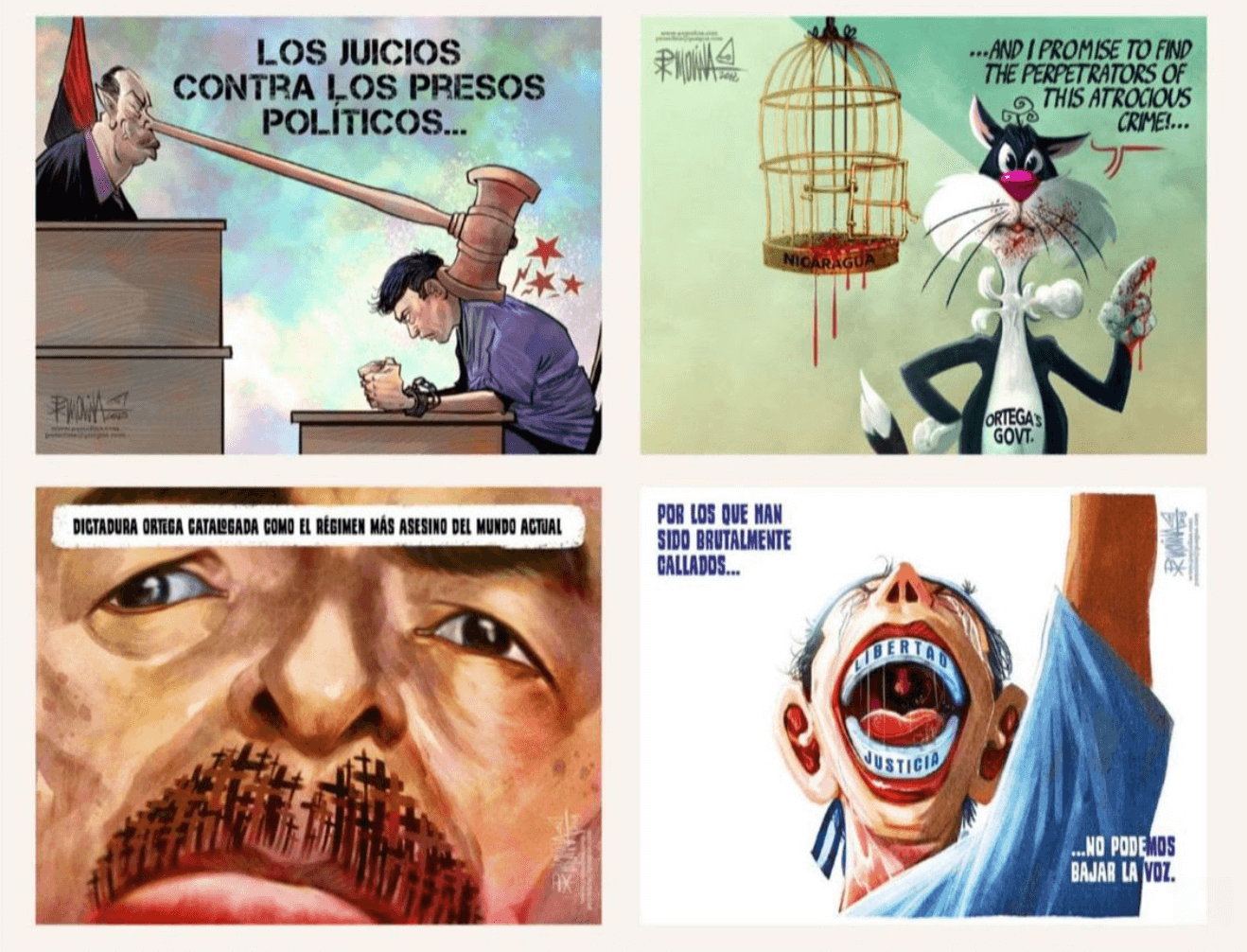
Pedro X Molina is a Nicaraguan political cartoonist who was forced into exile on Christmas Day 2018 after Nicaraguan dictator Daniel Ortega’s political police killed a journalist, jailed two others, and ransacked the offices of El Confidencial — the digital newspaper that featured Molina’s biting caricatures of Ortega and his tyranny. Molina published his first two cartoons in Barricada in 1995, later becoming a cartoonist for the digital outlet El Confidencial. In 2019, he received the Maria Moors Cabot Prize, awarded by Columbia University. The same year he was recognized by Americas Quarterly as one of its Top 5 Latin American political humorists.

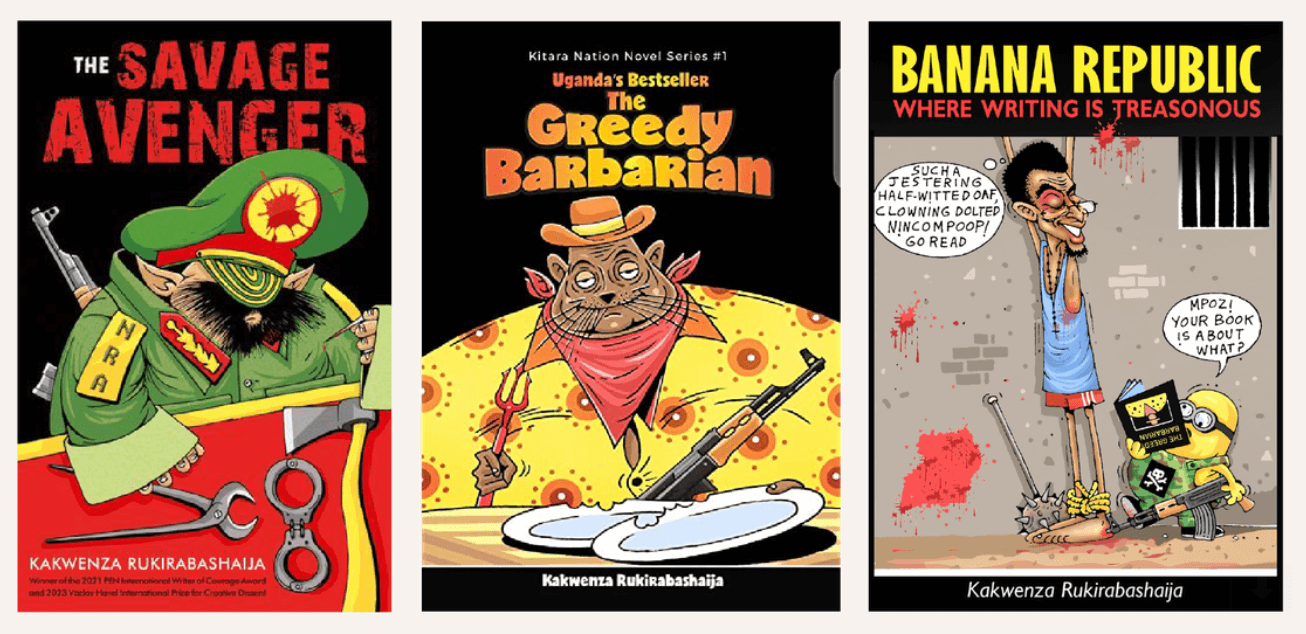
Kakwenza Rukirabashaija is a prominent Ugandan novelist recognized by English PEN in 2021 as a Writer of Courage and a fierce critic of the dictatorship of Yoweri Museveni. He has shown exceptional courage and defiance despite being imprisoned and tortured three times since 2020 for his irreverent writing and books, including “The Greedy Barbarian,” a satirical political fiction novel about corruption and dictatorship in a fictitious African country, and “Banana Republic: Where Writing is Treasonous,” an account of the torture he was subjected to while in detention in 2020 for the publication of his first book. In late December 2021, Rukirabashaija was kidnapped from his home and taken to an army base, where he was illegally detained for one month because of his tweets criticizing Museveni and his son.  Rukirabashaija was so severely tortured that he was released only on medical grounds. He was charged with “offensive communication” under Uganda’s repressive Computer Misuse Act. In February 2022, Rukirabashaija managed to flee to Germany for medical treatment, and he vowed to return to Uganda to face trial after his medical treatment.

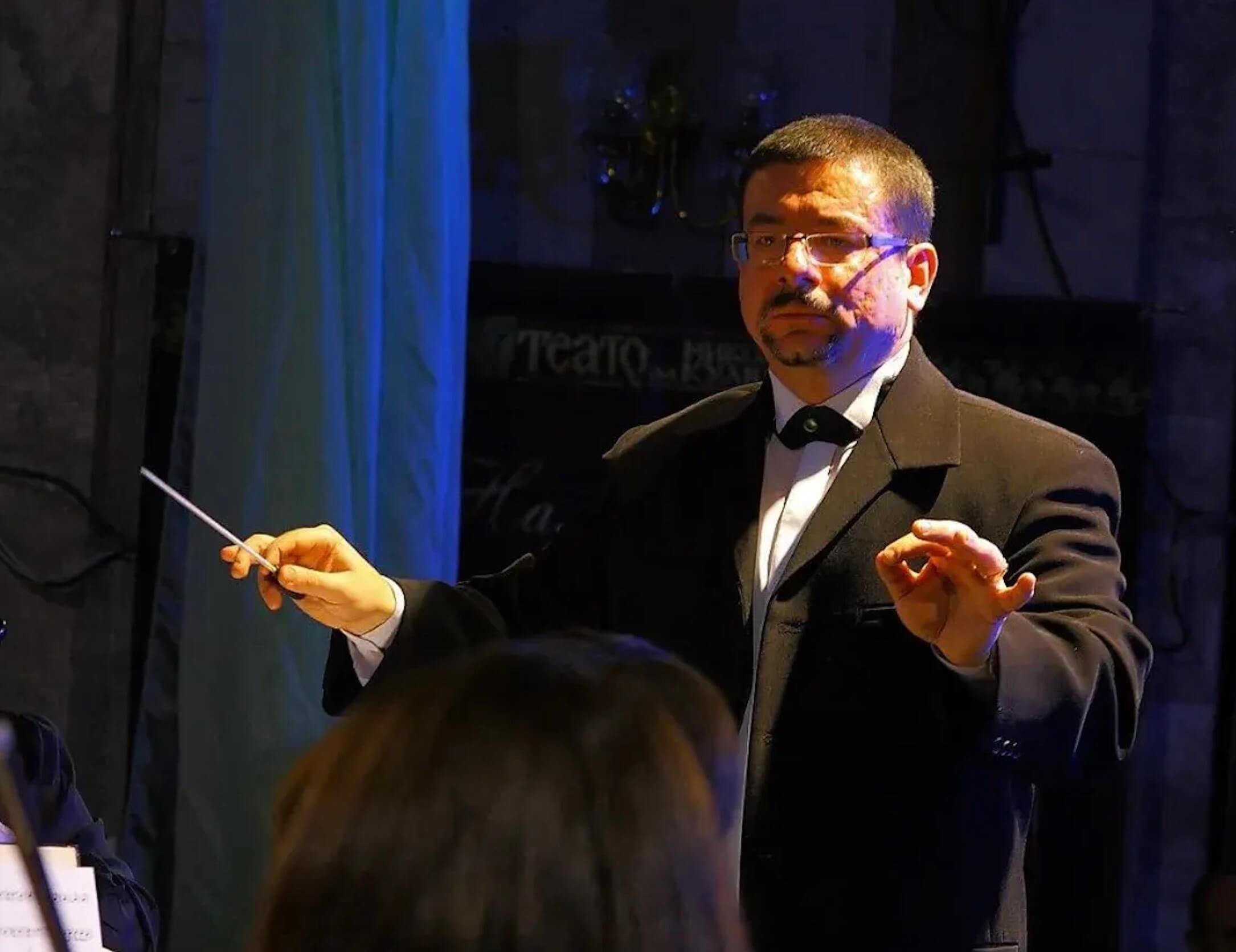
Kerpatenko was a renowned Ukrainian musician and principal conductor of the Kherson Regional Philharmonic. In October 2022, Russian troops assassinated Kerpatenko in his home at point-blank range after he refused to conduct a concert under the rule of Russian invading forces in Kherson, Ukraine. The concert was meant to portray an “improvement of peaceful life” in the occupied city, but Kerpatenko “categorically refused to cooperate with the occupants,” the Ukrainian Ministry of Culture and Information Policy later confirmed. Kerpatenko led his hometown’s orchestra for more than  20 years before he was murdered. The Havel Prize will be presented posthumously to Kerpatenko for his courageous stance against the Russian forces’ repeated attempts at “artwashing” their illegal occupation of Ukraine.

Art Residency in Occupation is an underground art society created by curator Yuliia Manukian. During the occupation of Kherson, Ukraine, six resident artists secretly met in a basement studio at the initiative of Manukian to produce works that showcase the death and destruction in the southern city of Kherson, offering viewers an opportunity to understand the scope of the war. Through this residency, Manukian sought to provide shelter for artists and gave them the opportunity to tell stories of war through the language of art. While written journalism can distance an outsider from the reality of current life in Ukraine, Manukian believes that the group’s collection of drawings, paintings, photographs, diary entries, and videos convey the raw truth.

The Havel Prize will be presented to Manukian on behalf of the collective of artists who bravely united in wartime to create dozens of works that creatively document the horrors endured by millions of Ukrainians living under the Russian invasion.

Manukian is a curator, art critic, and journalist based in Odessa, Ukraine. She was shortlisted in the British Journalism Awards’ foreign affairs category for her vital, courageous, and deeply moving Kherson diaries for The Observer.

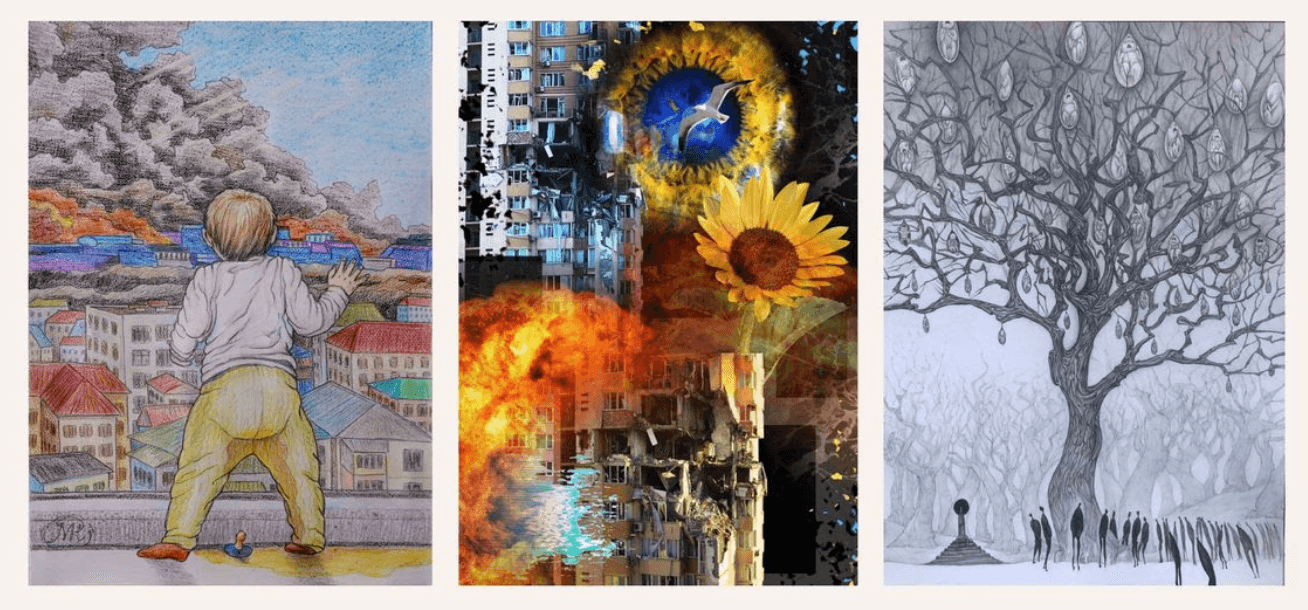
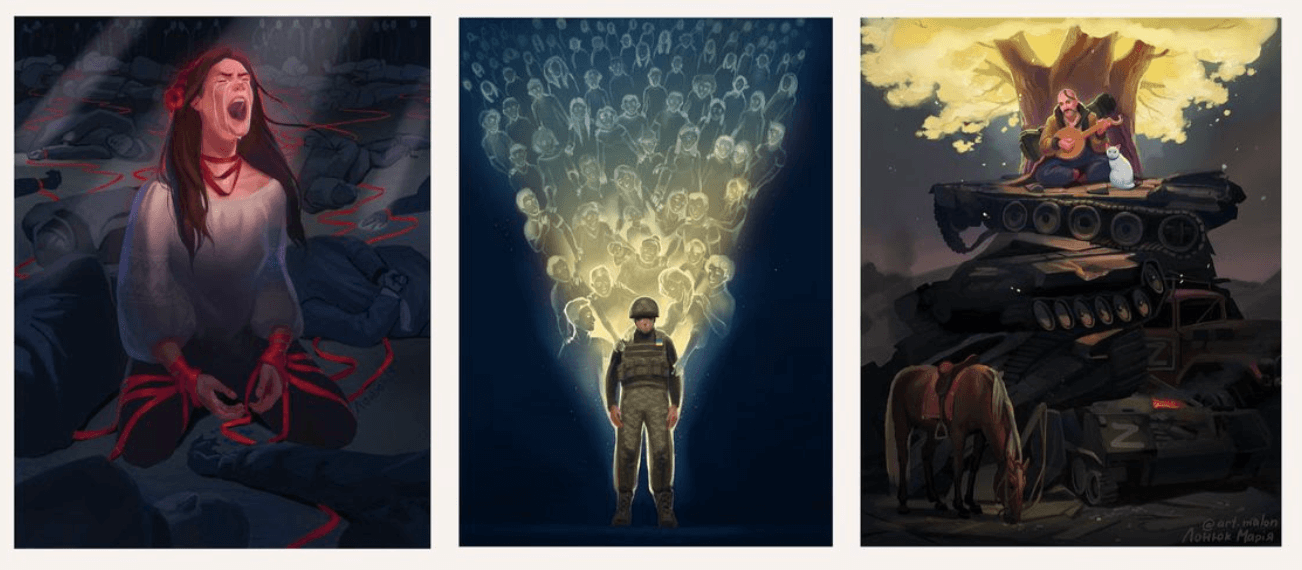
Mariia Loniuk is a Ukrainian freelance artist specializing in digital art. Since Vladimir Putin’s 2022 invasion of Ukraine, Loniuk has created vivid and touching illustrations about the war, conveying the feelings and images Ukrainians face. Her drawings capture the devastation of cities, homes, and human lives, the ubiquity of death and suffering, and the war’s destruction. Despite this, her illustrations also highlight the tremendous bravery and determination of the Ukrainian army and the courage and solidarity of the Ukrainian people as they defend their freedom.

Stand Up for Ukraine is a project that brings people together through the universal language of music, reminding us that art has the ability to transcend boundaries, challenge oppressive ideologies, and ignite a collective spirit of solidarity. The performance project, curated by Neringa Rekašiūtė, Eglė Plytnikaitė, and Elvina Nevardauskaitė, seeks to spark hope and empowerment and encourage people to stand united against a totalitarian regime that undermines human dignity. It consists of a live performance where the 22-year-old Ukrainian singer, Elizaveta Izmalkova, is joined by passersby singing along to the folk song, “Chervona Kalyna” — a symbol of Ukrainian resilience and freedom. Stand Up For Ukraine took the internet by storm, capturing the attention of more than five million viewers worldwide. The project serves as a call to action, urging people to set aside differences and come together in support of Ukraine.

Izmalkova is a 22-year-old Ukrainian singer based in Vilnius, Lithuania. She was born in the city of Pervomaisk in the Luhansk region. In her lifetime, Izmalkova’s family home in Ukraine was destroyed twice by Russian forces, first when Russia invaded Ukraine in 2014 and once again in early 2023.

For more on the Havel Prize and its many laureates, see: https://www.trueheroesfilms.org/thedigest/awards/438F3F5D-2CC8-914C-E104-CE20A25F0726

Front Line Defenders just published its global analysis 2022: new record of over 400 killings in one year

April 4, 2023

Front Line Defenders launched its Global Analysis 2022 on the situation of human rights defenders (HRDs) at risk around the world, an in-depth annual publication detailing the variety of risks, threats and attacks faced by HRDs around the world. Front Line Defenders’ Global Analysis 2022 gives a panorama of the threats faced by HRDs in all regions of the world. Despite an assault on human rights and the rule of law in many countries, human rights defenders (HRDs) showed remarkable courage and persistence in advocating for more democratic, just and inclusive societies in 2022. [see also https://humanrightsdefenders.blog/2022/01/17/at-least-78-human-rights-defenders-killed-in-colombia-in-2021/]

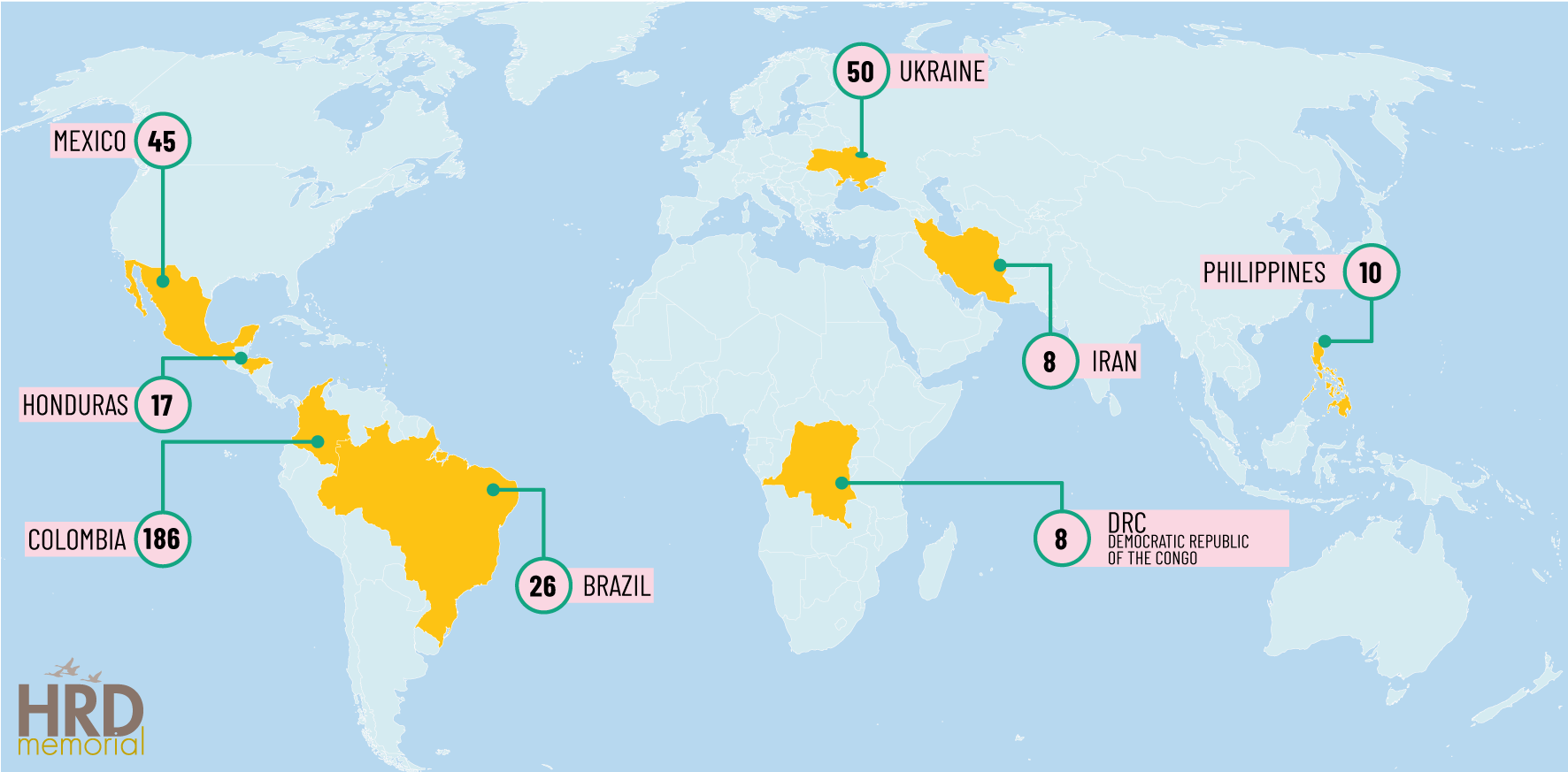
The report also names 401 HRDs killed in 26 countries in 2022 compared to 358 HRDs killed in 35 countries in 2021 – based on statistics by the HRD Memorial, a collective initiative of human rights organisations working to collect and verify data on the killings of HRDs each year.

“In a grim milestone, for the first time we saw more than 400 targeted killings of human rights defenders in 2022. While Latin America remained the deadliest region in the world for human rights defenders, we also saw a more dangerous landscape for defenders in the context of Russia’s full-scale invasion of Ukraine,” said Olive Moore, Interim Director of Front Line Defenders. ”These human rights defenders were deliberately targeted and killed because of their human rights work. Because they choose to speak out and challenge injustice, they paid for it with their lives.”

Five countries – Colombia, Ukraine, Mexico, Brazil and Honduras – accounted for over 80% of killings, according to HRD Memorial data. Colombia alone accounted for 46% of the total, with at least 186 killings documented and verified by HRD Memorial partner Somos Defensores to date. Defenders working on land, indigenous peoples’ and environmental rights were the most frequently targeted sector, accounting for almost half (48%) of the total killings.

In the context of Russia’s full-scale invasion of Ukraine, defenders engaged on humanitarian response and human rights journalists were also specifically targeted, with at least 50 documented killings by Russian military forces.

Wide array of threats

Global Analysis 2022 data is based on more than 1,500 threats and violations reported to Front Line Defenders, and is disaggregated by region, type of threat, sector of human rights work and gender.

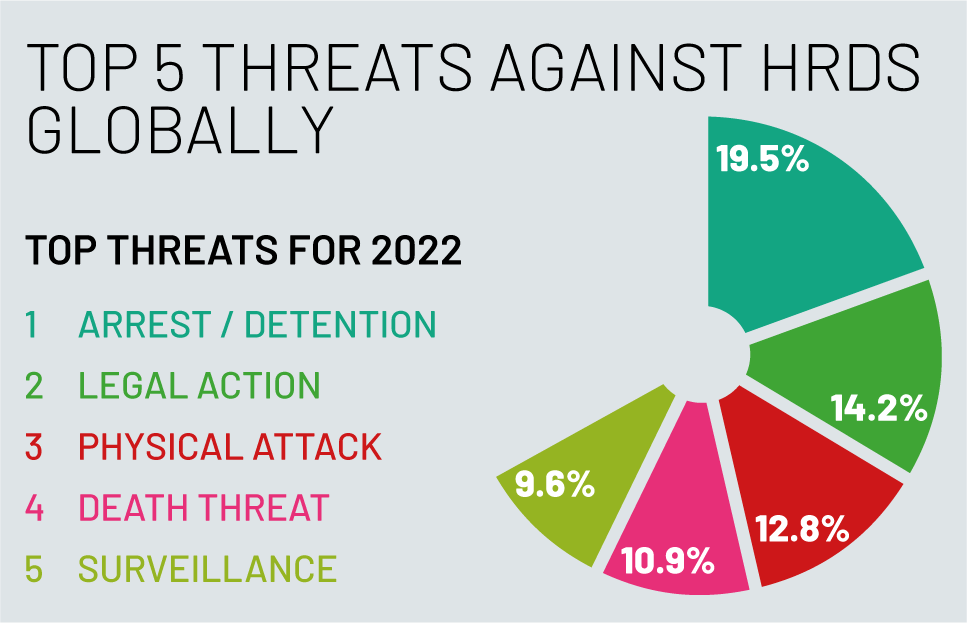
The main threats HRDs reported to Front Line Defenders in 2022 included: arrest or detention (19.5%); legal action (14.2%); physical attack (12.8%); death threats (10.9%); and surveillance (9.6%). In Asia and the Americas, death threats were the most frequent violation against defenders; in Africa it was arrest and detention; while in ECA and MENA it was legal action against HRDs.

Women HRDs (WHRDs) were frequently targeted with death threats, which accounted for the third most common violation against them. Physical violence was the most prevalent violation reported by trans and gender variant/gender nonconforming HRDs.

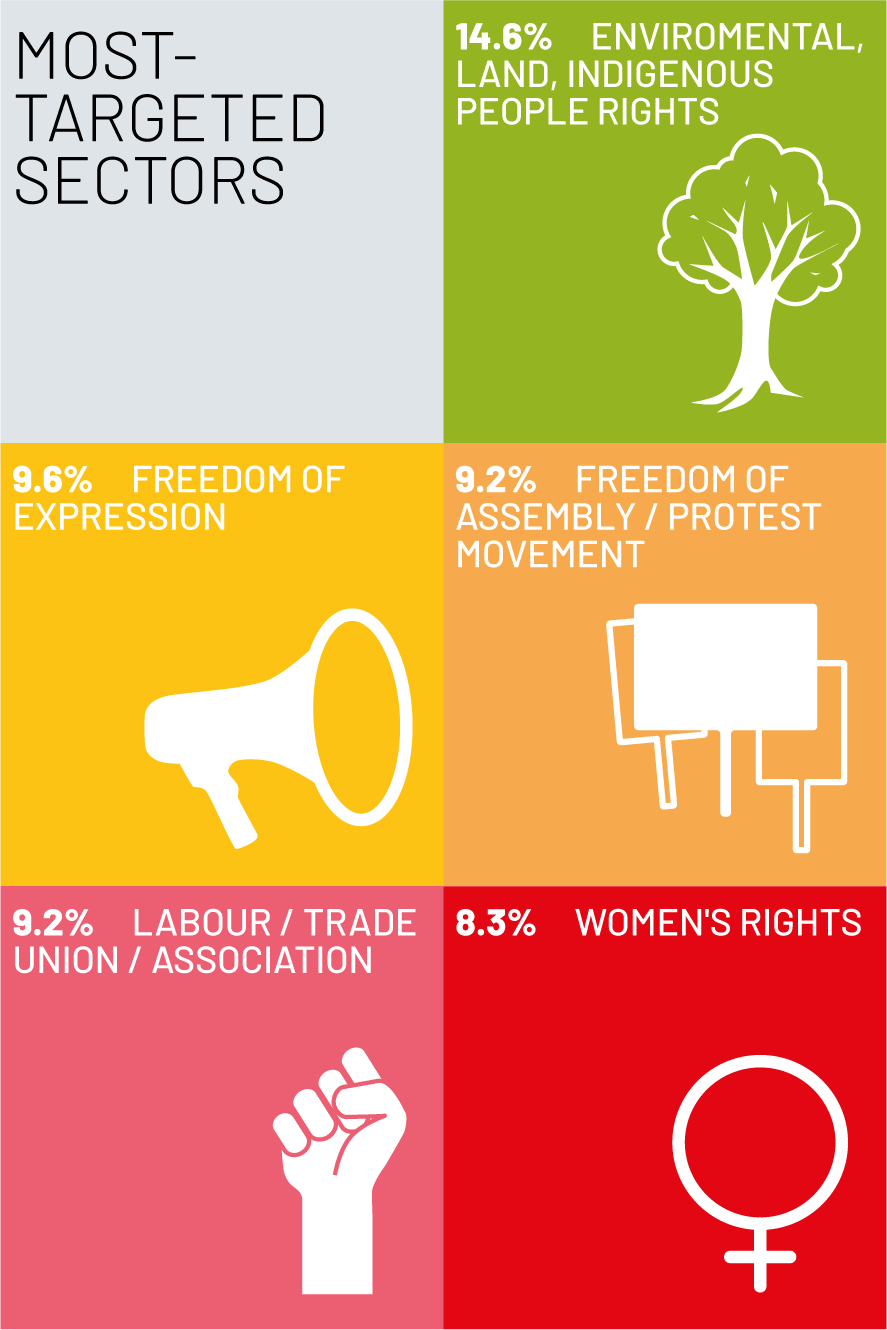
The five most targeted sectors of human rights defence were: environmental, land and indigenous peoples’ rights (11%); freedom of expression (10%); protest movement/ freedom of assembly (9%); women’s rights (7%); and impunity and access to justice (6%).

________________________________________________________________________________________________________________________________

About the data on killings: Front Line Defenders manages the collection of partner-verified data-sets under the HRD Memorial umbrella. The partners in the HRD Memorial are: ACI-Participa (Honduras); Amnesty International; Comité Cerezo (Mexico); FIDH; Front Line Defenders; Global Witness; Human Rights Defenders’ Alert – India; Karapatan (the Philippines); OMCT; El Programa Somos Defensores (Colombia); Red TDT (Mexico); and UDEFEGUA (Guatemala).

About the data on other violations against HRDs: This is derived from 1,583 reported threats and violations, based on Front Line Defenders’ urgent actions and approved grants between 1 January and 31 December 2022. For more details, see the Methodology section of the report.

for last year’s report, see: https://www.frontlinedefenders.org/en/resource-publication/global-analysis-2021-0

Download the Global Analysis 2022

https://www.theguardian.com/world/2023/apr/04/colombia-human-rights-defenders-killings-2022