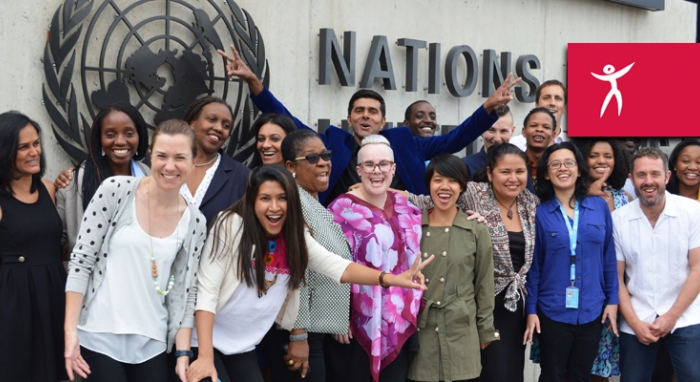
The International Service for Human Rights (ISHR) is calling for applications for its flagship Human Rights Defenders Advocacy Program in 2017 – the extensive training programme for human rights defenders. The training will take place in Geneva between 29 May and 9 June 2017 and provides defenders with opportunities to put their advocacy skills directly into action at the 35th session of the UN Human Rights Council.
ISHR’s Human Rights Defender Advocacy Programme (HRDAP) equips defenders with the knowledge and skills to make strategic use of the international human rights system. It also provides an opportunity for participants to directly engage in lobbying and advocacy activities at the UN level to effect change on the ground back home. As well as receiving training modules on all the UN human rights mechanisms from a range of experts, participants will also have the opportunity to build networks in Geneva and around the world, carry out lobbying of UN member States and UN staff, and learn from peers from a range of regions working on a range of human rights issues.
Participants will take part in:
A short online learning component, prior to face-to-face training, to enable you to consolidate your existing knowledge and develop your advocacy objectives;
Intensive training in Geneva during June, to coincide with the 35th session of the Human Rights Council. The training will focus on ways to effectively use international human rights mechanisms and to influence outcomes;
Specific advocacy at Human Rights Council sessions and other relevant meetings, with regular feedback and peer education to learn from the experiences, including expert input from leading human rights advocates.
This programme is directed at experienced human rights defenders in non governmental organisations and national human rights institutions, with existing advocacy experience at the national level and some prior knowledge of the international human rights system. If you are interested in applying for ISHR’s training programme, please read the call for applications to check that you comply with the requirements. The link to the online application form can be found under point 5 of the call for applications.
The call for applicants can be found here. For more information, write to hrdap2017@ishr.ch.
The Leuven Centre for Global Governance Studies is an interdisciplinary research centre of the Humanities and Social Sciences at the University of Leuven, Belgium, led by prof. Jan Wouters. It carries out and supports interdisciplinary research on topics related to globalisation, global governance processes and multilateralism, and has been recognised as a KU Leuven Centre of Excellence [http://ghum.kuleuven.be/ggs/].
It has just announced a new MOOC (Massive Open Online Course). The previous edition on ‘EU and Human Rights’ reached more than 8,000 students worldwide. Starting on 21 June 2016 and running for 6 weeks, the MOOC provides a basic course on human rights using FRAME research results, targeting undergraduate students and other people interested in the topic, such as international organizations and NGO staff. It will be offered free of charge and will include a collection of videos of lectures and teaching materials.
I am sharing with you an important new report on the protection and security of human rights defenders entitled, “Keeping Defenders Safe: A Call to Donor Action”. The report was released this summer but did not get the attention it deserves. The report reviews existing responses to the security challenges that human rights defenders face, with a focus on the grant-makers who support work aimed at strengthening HRD protection and security. The author, Borislav Petranov, conducted more than 150 interviews with defenders and related stakeholders around the world, seeking to capture the viewpoints of activists on the ground. Monette Zard prepared it for publication. The report’s conclusions suggest changes in focus and approach with recommendations that donors can implement individually as well as collectively to enhance the protection and security of HRDs. While it is not a roadmap or comprehensive analysis of protection mechanisms, it does recommend considered reflection on current policies and practices in the field: Read the rest of this entry »
What every human rights defender should know about video, images etc.
Instruction video published on 15 October 2014 by Witness.What is a video format? A codec? What do 1080 and 720 refer to? What about “i” and “p”? In this video, archivist and writer of WITNESS’ award winning guide, Yvonne Ng, provides an overview of the key technical characteristics of video for everyday users with visual examples. Comment on Witness blog: http://wp.me/p4j1y7-5J2
New Tactics is going to have a on-line conversation on the safe & effective use of documentation tools from 9 to 13 June 2014. They are looking to recruit 10 to 12 human rights practitioners to join Daniel D’Esposito of HURIDOCSand Enrique Piracés of Benetech to help lead the upcoming conversation on Working Safely and Effectively with Documentation Tools Documentation is a crucial aspect of the quest for justice, accountability and transparency.
On 14 May the blogger APaper Bird posted an interesting set of slides that can be used in training human rights defenders. The author also sets a good example by letting them be shared freely:
“One thing I do with some frequency is trainings. These powerpoints reflect a session I worked on recently with the Egyptian LGBT group Bedayaa. The first (download the English version here) deals with issues in human rights documentation in general terms. The second (download English here) deals more specifically with strategies for interviews. I’m posting them here in the hope that they may be useful to activists who weren’t able to attend the workshop, and to people elsewhere as well. Some of the material is specific to Egypt, some is not….. [the slides also exist in Arabic – see original post)
These aren’t copyrighted; I’m not sure how you would copyright a basic skills set. (Actually, late capitalism can copyright anything. What I mean is, I don’t want to know.) However, if you find them interesting enough to adapt or reuse, I ask that you let me know, and cite me as the author.”
There are many international NGOs doing excellent work for human rights defenders, but I want to highlight one here in particular: the International Service for Human Rights. It has a clear mandate and niche, based in Geneva for 30 years (with a small office in New York) is the main advocate for human rights defenders in the UN. The Director, Phil Lynch, sent out an overview in April 2014 of its activities covering the recent months, especially the latest session of the UN Human Rights Council. Please read the statement in full and – if you want regular updates – subscribe to the ISHR Newsletter: Read the rest of this entry »
“Like other people, journalists have personal interest in the rights that allow them to live in freedom and to be free from fear or oppression…” said Onesmo Olengurumwa, National Coordinator of Tanzania Human Rights Defenders – Coalition (THRD-C). He was speaking recently in Dar es Salaam at a 3-day seminar for journalists meant to train them in Security Management and Risk Assessment. Similar trainings will be conducted periodically to ensure journalists are equipped with the knowledge on how to best respond and tackle volatile and potentially dangerous situations. “Media owners, editors, journalists, human rights NGOs, community and the government should take security and protection issues for journalists much more seriously,” said Olengurumwa. He also reminded journalists that their personal behaviour, lifestyle and how they approach their work may place them at risk. “Investing on security management and protection for journalists should be undertaken by all media owners,”
group photo of training on Human rights in NBGS. [Gurtong| Abraham Agoth]
On 28 March 2014 Abraham Agoth in “Oye! News from Africa” reported that Journalists and Civil Society Organisations (CSOs) has completed a Human Rights Defenders training course organised by the Human Rights Protection and Civil Affairs Departments of the United Nations Mission in South Sudan (UNMISS). Speaking at the closing ceremony, the acting UNMISS state coordinator, Numa Shams urged the participants to apply what they learnt during the training in their daily work so that human rights abuses are minimized. “We hope this work will be incorporated into your daily activities of monitoring human right in your respective working locations and within your communities,” he said. “I have seen your participation and commitments in this training. It clearly shows that you have learnt something and are eager to learn more,” said Mary Makelele, the director general in the state ministry of Information, “My appeal to everyone is that; do not take these skills for granted but instead use them to educate others.” During the training, it was generally observed that human rights have been mostly violated due to negligence and ignorance.
On 8 April 2014 Sarah Cortes posted a short report on Cambridge Community Television about how Cambridge internet freedom advocates trained human rights defenders at the recent Civil Rights Defenders Conference in Stockholm.
Civil Rights Defenders [CRD] brought 121 human rights defenders from over 30 countries together last weekend to share their stories and participate in training by legal, security and technology specialists. One of them is Andrew Lewman from Cambridge-based Tor who provided training in internet and digital security to help activists who may be under surveillance from governments whose policies and activities they protest. “Activists may not realize the extent to which their governments may monitor their computers, cellphones and other devices,” said Lewman. “Learning to improve digital security may save their life, in some cases“. CRD itself has not yet published a general report.





![Journalists, CSOs, Human Rights and CBOs representatives posing for a group photo during the two-day training on Human rights in NBGS. [Gurtong| Abraham Agoth]](http://www.gurtong.net/Portals/0/GlobalResources/EN/images/Editorial2/journalists%20and%20Human%20Rights%20Defenders.jpg)
 Hans Thoolen on Human Rights Defenders and their awards