Posts Tagged ‘South Africa’
Prosecutor Thuli Madonsela in film Whispering Truth to Power
August 12, 2019Report of the Nelson Mandela Human Rights Lecture 2019
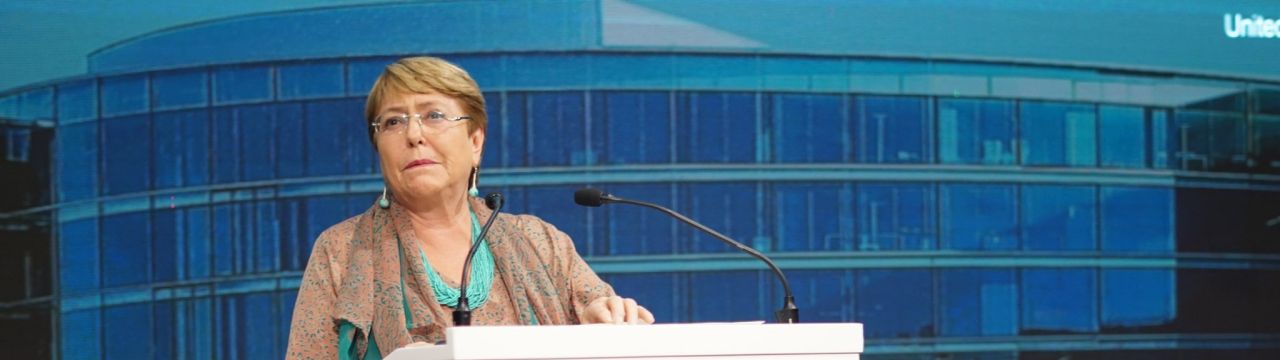
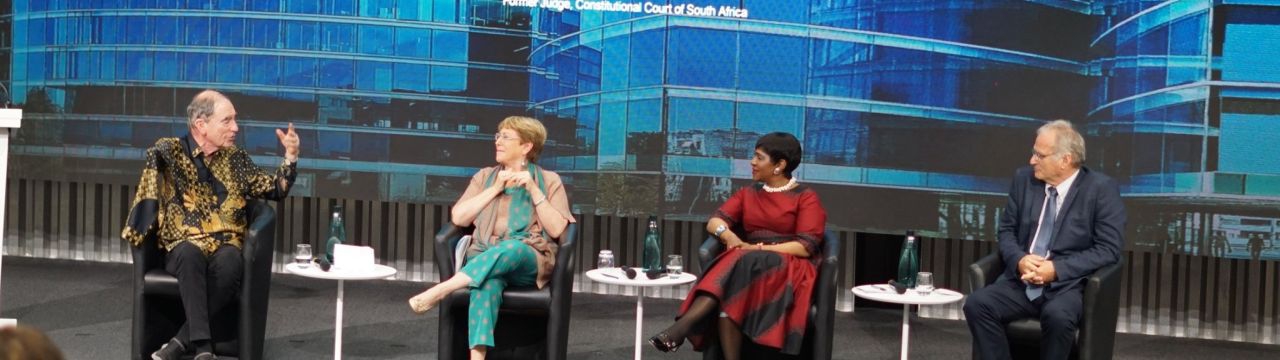
July 24, 2019The Nelson Mandela Human Rights Lecture was held at the Graduate Institute 18 July 2019 [see: https://humanrightsdefenders.blog/2019/07/12/nelson-mandela-human-rights-lecture-in-geneva-on-18-july-2019/]. For the lecture, Michelle Bachelet, United Nations (UN) High Commissioner for Human Rights, and Albie Sachs, Former Judge of the South African Constitutional Court, were present to share their incredible personal experiences of fighting for human rights.
Establishing the Rule of Law in South Africa as a form of ‘Soft Vengeance’ against Apartheid
‘A piece of paper, a body, a voice and the dreams of millions of people, including our hope; for those of you in the audience, that’s my text for today’, began Mr Sachs, who had fought against apartheid since age 17, was appointed by Nelson Mandela to the Constitutional Court of South Africa in 1994 and played a critical role in the creation of the first draft of South Africa’s Bill of Rights, adopted in 1996 by the South African parliament as an integral part of the South African Constitution. Mr Sachs explained that his efforts to establish a rule of law in South Africa were a form of ‘soft vengeance’ against apartheid, exemplified through his own, personal tribulation. On 7 April 1988 in Mozambique, as a result of a car bomb, he lost his right arm. …Commenting on the trial of one of the accused car bombers, Mr Sachs said, ‘My vengeance will be if the person receives a fair trial, and if his guilt is not beyond doubt, will be acquitted, because this will prove that we will have established the rule of law’.
Standing Up and Acting for Change
Michelle Bachelet recounted her own experience as a human rights defender. She told of dictatorship in Chile, the torture and killing of her father and her mother’s detention. In defiance of the anger she felt at her family’s situation, she found the perseverance to stand up and act for change, becoming the first woman President of Chile (dually elected), then Executive Director of UN Women, and eventually replacing Zeid Raad Al Hussein in 2018 as the UN High Commissioner for Human Rights.
‘[…] the world today faces complex challenges, challenges too big for one country, challenges that do not respect borders’, she said. ‘[…] And we see a pushback on human rights. And I say, let’s pushback the pushback’.

Video of the Lecture. You can watch here the Nelson Mandela Human Rights Lecture in its entirety.
The human rights defenders in AI’s 2018 Write For Rights Campaign
November 25, 2018
These are cases of human rights defenders featuring in the 2018 Write for Rights campaign that I referred to yesterday [https://humanrightsdefenders.blog/2018/11/24/amnesty-starts-again-its-write-for-rights-campaign/]:
Marielle Franco, Brazil
Killed for defending the people of Rio [see also: https://humanrightsdefenders.blog/2018/03/16/marielle-franco-38-year-old-human-rights-defender-and-city-councilor-of-rio-assassinated/]
Geraldine Chacón, Venezuela
Atena Daemi, Iran
Jailed for opposing the death penalty
#NowForNI campaigners, UK
Seyi Akiwowo, UK
Abused online for defending women’s rights
Nonhle Mbuthuma, South Africa [see also: https://humanrightsdefenders.blog/tag/nonhle-mbuthuma/]
Death threats for protecting her community
Gulzar Duishenova, Kyrgyzstan
Speaking up for disability rights
The Sengwer People, Kenya
Forced from their ancestral land
Pavitri Manjhi, India
Threatened for standing up to big business
Vitalina Koval, Ukraine
LGBTI rights activist attacked by the far right
Nawal Benaissa, Morocco
BRICS leaders should have addressed human rights at their recent summit
July 30, 2018
Russian President Vladimir Putin (L) Indian Prime Minister Narendra Modi (C) and Turkish President Recep Erdogan (R) interact during a family photo during the BRICS summit meeting in Johannesburg, South Africa, 27 July 2018. EPA-EFE/GIANLUIGI GUERCIA / POO
As they met in Johannesburg last week, BRICS leaders focused on the economy, development, peacekeeping, health and industrialisation issues within the bloc (accounting for 40% of the world’s population). However, equally important issues such as the protection and realisation of human rights in the respective countries remained off the agenda. Jennifer Wells, an intern with AI South Africa, on 30 July 2018, gave a useful reminder of what could and should have been also addressed:
Brazil
Brazil has one of the highest murder rates in the world, with around 60,000 people murdered each year…Brazil’s failure to protect black Brazilians from police violence remains critical as this year marks the 25th anniversary of the Candelaria killings. The tragedy, in which eight young black boys were killed by off-duty police officers in Rio de Janeiro in 1993, represents the endemic racism within the Brazilian security forces. The situation was aggravated by the murder of Rio de Janeiro human rights defender and councilwoman Marielle Franco on 14 March 2018. [https://humanrightsdefenders.blog/2018/03/16/marielle-franco-38-year-old-human-rights-defender-and-city-councilor-of-rio-assassinated/]
Russia
…human rights defenders and civil society activists continued to face harassment, intimidation and arbitrary arrests across the country. The trial of human rights defender Oyub Titiev started in Chechnya. He, like several other human rights defenders, is being prosecuted on trumped-up criminal charges. Law enforcement agencies continue to launch cases on fabricated “extremism” and “terrorism” charges. [https://humanrightsdefenders.blog/2018/01/15/chechen-human-rights-defender-oyub-titiev-arrested-on-trumped-up-charges/] The Ukrainian film director Oleg Sentsov, serving 20 years on “terrorism” charges, is on day 75 of a hunger strike demanding the release of “64 political prisoners from Ukraine”. The right to freedom of peaceful assembly has been increasingly restricted in Russia since 2012 and remains under severe clampdown. …. The rights of LGBTI people are trampled upon daily and the authorities continue to refuse to investigate the horrific gay purge in Chechnya. The World Cup has come and gone, but the suppression of freedoms and shrinking of civil liberties continues unabated.
India
It’s a similar story in India where human rights defenders are consistently under threat, attacked and threatened, often from security forces. India has witnessed horrific instances of alleged extrajudicial executions by security forces for years as police and federal forces have effective immunity from prosecution. In the North-Eastern state of Manipur, human rights defenders who have lost their loved ones in alleged extrajudicial executions and are now campaigning for justice, face unprecedented attacks. Salima Memcha, a widow who lost her husband to an alleged extrajudicial execution, was verbally threatened by security personnel. Her house was also vandalised by them. Three other human rights defenders in Manipur have faced similar reprisals for campaigning for justice for their loved ones.
China
In China, the government continues to enact repressive laws under the guise of “national security” that present serious threats to human rights. Nobel Peace Prize laureate Liu Xiaobodied in custody whilst other human rights defenders are detained, prosecuted and sentenced on vague charges such as “subverting state power”, “separatism” and “picking quarrels and provoking trouble”. Controls on the internet have been strengthened and freedom of expression and freedom of association are under attack.[see also:https://humanrightsdefenders.blog/2018/04/12/how-china-extracts-televised-confessions-from-human-rights-defenders/]
South Africa
In the host nation, nearly a quarter of century after adopting arguably one of the most progressive constitutions in the world, the country is bedevilled by profound inequalities, which persistently undermine economic, social and cultural rights. Failures in the criminal justice system continue to present barriers to justice for victims of human rights abuses and violations, including the state’s failure to hold perpetrators accountable for the killing of 34 striking mineworkers in Marikana in 2012 by the South African Police Service. Access to sexual and reproductive health services remain a human rights issue as does the provision of quality education.
https://www.dailymaverick.co.za/article/2018-07-30-what-brics-leaders-should-have-talked-about/
Goldman environmental prizes in 2018 go to women human rights defenders
April 23, 2018
Goldman environment prize winners 2018: (clockwise from top left) Manny Calonzo, Francia Márquez, Nguy Thi Khanh, LeAnne Walters, Makoma Lekalakala and Liz McDaid, Claire Nouvian. Photograph: 2018 Goldman Environmental Prize
This year’s Goldman environmental prizes celebrate six remarkable success stories, five of them driven by women.
In Latin America, the winner is Francia Márquez, an Afro-Colombian community leader who led a 10-day, 350-mile march of 80 women from the Amazon to Bogotá that prompted the government to send troops to remove illegal miners who were polluting rivers with cyanide and mercury. [The dangers of environmental activism have been evident in the murder of two Goldman-prize recipients in the past two years: the 2015 winner Berta Cáceres and the 2005 winner Mexican activist Isidro Baldenegro López] “The first thing we need is to be more aware of the historical moment in which we find ourselves: the planet is being destroyed, it’s that simple, and if we do nothing to avoid it we will we will be part of that destruction,” Francia Márquez said. “Our time has come, we must act, we have a responsibility to future generations to leave a better world, in which taking care of life is more important than producing cumulative wealth.”
South African anti-nuclear activists Makoma Lekalakala and Liz McDaid, [see: anti-nuclear court ruling against former South African president Jacob Zuma]
Vietnamese clean-energy advocate Nguy Thi Khanh,
USA clean-water defender LeeAnne Walters, and
French marine-life champion Claire Nouvian.
Philippines anti-lead campaigner Manny Calonzo.
– see also: https://humanrightsdefenders.blog/2016/04/19/goldman-environmental-prizes-awarded-san-francisco-activists/
South African human rights defender turned teacher among the last ten nominees for the Teacher Prize
February 16, 2018Now in its fourth year, the US$1 million award is the largest prize of its kind. In a special video message announcing the top ten finalists, Bill Gates paid a glowing tribute to the work of teachers around the world. “When you think about what drives progress and improvement in the world, education is like a master switch—one that opens up all sorts of opportunities for individuals and societies….and research has shown that having a great teacher can be the most important factor that determines whether students get a great education,” he said.
Marjorie Brown is a former human rights defender who teaches history to female students at Roedean School, Johannesburg, whilst encouraging critical thinking and global citizenship. Her students have gone on to represent South Africa at youth forums, the Paris Climate Talks and various Ivy League universities.
Italian tenor Andrea Bocelli (L) performs during the Global Teacher Prize ceremony in Dubai on March 19, 2017. Photo credit should read KARIM SAHIB/AFP/Getty Images)
She is widely credited with bringing the New Zealand originated Kids Lit Quiz programme, devoted to improving children’s literacy, to South Africa. This global quiz programme now has more than 100 South African schools participating, which has boosted the stocks of books in libraries throughout the land and mobilized teachers to act as coaches and reading champions with students. Marjorie also founded the Phendulani literacy quiz, which will have spread to over 100 schools this year, while the South African Department of Education plans to introduce it to 45 reading clubs involving over 225 pupils, with publishers Pan Macmillan aiming to start a Phendulani quiz in a poor area near Johannesburg.
Marjorie Brown and the other finalists were selected from over 30,000 nominations and applications from 173 countries around the world. The top ten were subsequently narrowed down from a top 50 shortlist that was announced in December 2017… The other nine finalists for the Global Teacher Prize 2018 come from turkey, Brazil Norway, Belgium and the United States among other countries.
Oslo Freedom Forum now also in Johannesburg (26 March 2018)
February 3, 2018HRF and Nelson Mandela Foundation Will Produce OFF in Johannesburg this March
On 26 March, 2018, the Human Rights Foundation (HRF) will bring the Oslo Freedom Forum experience and community together for the first-ever Oslo Freedom Forum in Johannesburg (OFFinJoburg). In 2017, HRF established a collaboration with the Nelson Mandela Foundation to bring the Oslo Freedom Forum to South Africa in 2018, the 100th anniversary of Mandela’s birth. OFFinJoburg will be held in Bryanston, Johannesburg, and live-streamed. You can register for the event here.
Speakers at OFFinJoburg will include Zimbabwean civil rights activist and #ThisFlag movement leader Evan Mawarire, former Maldivian president Mohamed Nasheed, Moroccan-born French free expression advocate and journalist Zineb El Rhazoui, Arab Spring writer and journalist Iyad el-Baghdadi, Chinese-Canadian actress and human rights activist Anastasia Lin, Angolan investigative journalist Rafael Marques de Morais, and Eritrean information activist and refugee rescuer Meron Estefanos, among others.
In memoriam human rights lawyer Rudolph Jansen in South Africa
November 27, 2017Human rights lawyer Rudolph Jansen has died.
Jansen, who leaves his wife Mariana, and two sons Rudolph and Gustav, died on Saturday in Limpopo, 53 years old. He completed his law studies at the University of Pretoria, and as a young advocate with the Pretoria Bar, quickly turned his attention to combating issues of inequality and injustice that were a hallmark of the apartheid state. His early and extensive pro bono work for Lawyers for Human Rights was representative of his commitment to the realisation of human rights in South Africa, which defined his career.
During the late 1980s and early 1990s Jansen joined other Lawyers for Human Rights to prevent the execution of political activists who were facing the death penalty. In those days Lawyers for Human Rights aimed at delaying executions, hopefully for long enough until the death penalty was eventually abolished. With its abolition in 1995, Jansen assisted Lawyers for Human Rights to expand its focus to unaddressed issues, including the awful conditions in prisons. With fellow human rights lawyers, Jansen challenged overcrowding, abusive practices like indefinite solitary confinement and other violations.
In 2003, Jansen took over as national director of Lawyers for Human Rights. He led the organisation for five years through a challenging period of transition and growth. Throughout, he remained a tireless champion of under-served communities in South Africa, inspiring the same commitment from his colleagues. When his tenure ended, Jansen resumed his practice at the Pretoria Bar, achieving senior status in 2014.
He developed a wide-ranging practice centred on human rights and public interest law, representing landless communities, unlawfully evicted people, and human rights defenders, among many others. Jansen’s work in recent years focused increasingly on the furtherance of South African land reform and restitution, to which he made an immeasurable contribution. His commitment to the successful implementation and achievement of this constitutional project saw him involved in ground-breaking cases addressing issues like post-settlement support and market-related pricing within the government’s willing-seller, willing-buyer policies.
Jansen’s advocacy in many of South Africa’s ground-breaking housing cases helped to ensure fair process and entrenched the right of dignity for many of the country’s marginalised. His latest involvement in legal challenges seeking to ensure the equitable distribution of the country’s mining benefits to affected communities represented the next step in his personal and professional quest for justice on behalf of those whose voices have historically been muted. He was an inspiration to many activists and human rights lawyers over the course of his life, and leaves behind a legion of individuals committed to taking forward his work and vision for a just and equal society.
The legacy of his work to quietly push for a more just society will continue to the next generation of human rights lawyers. Hamba kahle, Comrade Jansen.
https://www.iol.co.za/pretoria-news/top-city-human-rights-lawyer-dies-12164274
Supporting film festivals on human rights in 2018
November 19, 2017
Movies that Matter presented the ten festivals that it recently decided to support. This month, it offered grants to a new round of projects. Among others, two debuting festivals that will receive the start-up grant: for the first time a human rights film festival will take place in Timor-Leste in 2018. To bring the cinema to the people, the Timor-Leste Human Rights Film Festival will use a portable set-up to screen their selection of films at multiple sites. A new film festival will also arrive in South Africa: Shining Lights onto Langa. The festival introduces people to the Sunshine Cinema, a solar powered mobile cinema that converts solar energy into social impact. It brings people together with the intent to uplift grassroots movements and create networks of social change.
Additionally, the support goes to three film festivals that pay direct attention to LGTBQI+ rights in Turkey, Pakistan and Myanmar. Other supported cinema projects include those in Kyrgyzstan, Moldova, Palestine, Turkey and Peru.
Read more about all projects that were supported this year 
https://www.moviesthatmatter.nl/nieuwsbrief_internationaal/18/international-support-november-2017