Posts Tagged ‘Russia’

2017 was a grim year for imprisoned technologists

December 29, 2017
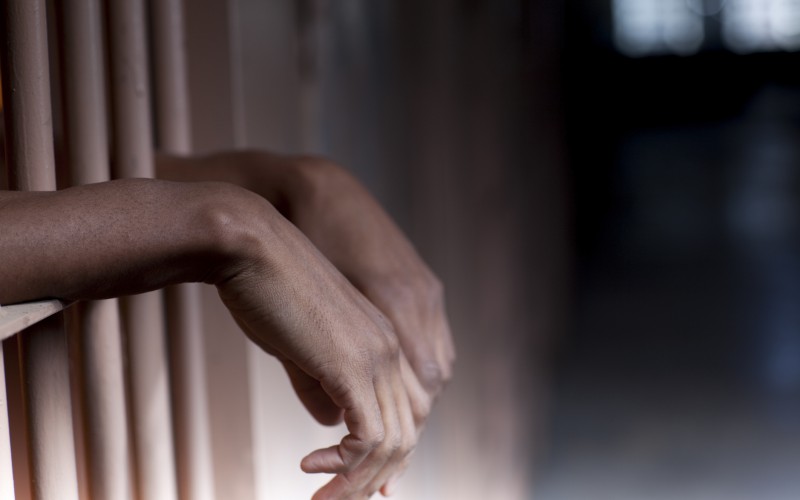
Prison Hands

Since its founding, EFF has highlighted and defended cases of injustice and fearmongering perpetrated against innocent technologists. We advocate for unjustly imprisoned technologists and bloggers with our Offline project. In 2017, we continue to see fear being whipped up against those who oppose oppression with modern tools—as well as those who have done nothing more than teach and share technology so that we can all use and understand it better:

Dmitry Bogatov, software developer and math lecturer at Moscow’s Finance and Law University. Bogatov ran a volunteer Tor relay, allowing people around the world to protect their identities as they used the Internet. It was one part of his numerous acts of high-tech public service, which include co-maintaining Xmonad and other Haskell software for the Debian project. For his generosity, Bogatov has now spent over a hundred days in pretrial detention, wrongfully accused of posting extremist materials that were allegedly sent via through Tor server. Law enforcement officials around the world understand that data that appears to originate from a particular Tor machine is, in fact, traffic from its anonymised users. But that didn’t stop Bogatov’s prosecutors in Russia from accusing him of sending the data himself, under a pseudonym, to foment riots—and added new charges of “inciting terrorism” when a judge suggested the earlier charge was too weak to hold Bogatov in pre-trial detention.

Ahmed Mansoor, of the United Arab Emirates. Mansoor has been a tireless voice for victims of human rights abuses in the United Arab Emirates. In 2011, amidst the Arab uprisings, he was one of five Emirati citizens to be sentenced to prison for his social media postings. That case provoked international condemnation, and the group was soon pardoned. Mansoor was subsequently targeted with sophisticated government spyware on his iPhone; he recognised and passed on the malware link to experts, which led to the discovery of three previously unknown vulnerabilities in Apple’s iOS. In April, Mansoor was seized by the UAE authorities again. On the day of his arrest, the UAE’s official news agency saying that he had been arrested on the orders of the Public Prosecution for Cybercrimes and accused of using social media to promote sectarianism and hate, among other charges. Mansoor’s family did not hear from him for two weeks, and he has been denied access to a lawyer. Just a year ago, Apple was able to roll out a security fix to their users because of Mansoor’s swift, transparent, and selfless actions. Millions of people are safer because of Ahmed’s actions, even as his family fears for his own physical and mental safety. [https://humanrightsdefenders.blog/2017/03/28/ahmed-mansoor-under-arrest-emirates-under-pressure/]

Alaa abd el-Fattah ran Linux installfests across the Middle-East and was a key online voice in the Egyptian uprising. Since then he has been jailed, in turn, by the democratically elected Islamist President Mohammed Morsi, and then when Morsi was overthrown in a coup, by incoming President Abdel Fattah El-Sisi. Alaa’s appeal against a five year prison sentence for protesting—widely seen as a means to silence him on social media—was refused in November of this yearAmnesty and the UN Working Group on Arbitrary Detention have both condemned Alaa’s continuing imprisonment.

Another long-term case is that of Saeed Malekpour, who has been in jail in Iran since 2008. Malekpour returned from Canada to visit his sick Iranian father in October of that year, at a time when the Iranian Revolutionary Guard was starting to target technologists and Internet experts. As an open source coder, Malekpour had written a free front-end image management utility for websites. The Guard found this software on a Farsi pornography site, and used it to as a pretext to seize Malekpour from the streets of Tehran, charge him with running the web site, and sentencing him to death. Malekpour’s death sentence has been anulled twice following international pressure, but a change of government in his home country of Canada risked reducing the level of support for Malekpour. A campaign to encourage the new Trudeau administration to continue to advocate for Malekpour, even as Canada seeks to normalize relations with Iran, seems to be working. One of Malekpour’s advocates, former Liberal MP Irwin Cotler, has said that the Canadian government is now working on the case. The continuing monitoring of Malekpour’s life sentence is a small consolation, but better than the alternative.

Peter Steudtner and Ali Gharavi travel the world, teaching and advising Internet users on how to improve their privacy and digital security online (Ali was an advisor for EFF’s Surveillance Self-Defence project). The two were arrested in a raid by Turkish police on a digital security workshop in July in Istanbul, along with Amnesty Turkeys’ director, Idil Eser, and eight other human rights defenders. The two technology consultants have been accused of aiding terrorists, despite the long history of both as peaceful advocates for secure online practices. After months of detention, concentrated diplomatic and public pressure led to both being released to join their families in Germany and Sweden. We’re delighted that they are free, but their unjust prosecution—and that of their Turkish colleagues—continues in the Turkish courts. 

Bassel Khartabil, the Syrian free culture advocate. Before his arrest and torture in 2012, Bassel was the driving force behind countless projects to turn technology for the public good in his country. He founded a hackerspace in Damascus, translated Creative Commons into a Middle Eastern context, and built out Wikipedia and Mozilla for his fellow Syrians. Bassel’s generosity brought him notability and respect. His prominence and visibility as a voice outside the divided political power-bases of Syria made him an early target when the Syrian civil war became violent. Bassel was killed by the Syrian government in 2015, shortly after he was removed from a civilian prison and sent into the invisibility of Syria’s hidden security complexes.


https://personalliberty.com/grim-year-imprisoned-technologists-2017-review/

Russia before the European Court for limiting NGOs communication with international bodies

August 8, 2017
In an intervention to the European Court of Human Rights in a case against Russia, the International Service for Human Rights (ISHR) has called on the Court to explicitly rule that that the rights to freedom of expression and association include the right to unhindered access and communication with international human rights bodies.

A law in Russia requires that an NGO receiving foreign funding and engaging in ‘political activity’ register as a ‘foreign agent‘. ‘Foreign agents’ not only have to comply with cumbersome financial and reporting requirements, but the negative stigma associated with this label have been described as debilitating. [https://humanrightsdefenders.blog/2013/12/16/russian-court-declares-adc-memorial-formally-as-foreign-agent-others-to-follow/]

After submitting a report to the UN Committee Against Torture, Anti-Discrimination Centre (ADC) Memorial – an NGO at that time operating in Russia – was required to register as a foreign agent on the basis that submitting the report constituted ‘political activity’. Following this, ADC Memorial brought a case against Russia in the European Court of Human Rights alleging that the administrative consequences associated with being labeled a foreign agent violate the rights to freedom of expression and association protected by the European Convention of Human Rights. ‘This case raises issues regarding meaningful protection the European Convention on Human Rights provides individuals exercising their right to freedom of expression and association with international human rights bodies and mechanisms’, says ISHR’s Legal Counsel Tess McEvoy. ‘It also demonstrates a serious and systematic human rights problem of reprisals and intimidation against those cooperating with the UN.’

ISHR submitted a third party intervention in the case of ADC Memorial. ‘The intervention is designed to assist the Court by providing an extended analysis of the scope of the rights to freedom of expression and association in international law to inform the interpretation of the European Convention on Human Rights’, McEvoy states. The analysis concluded that accessing and communicating with the UN is protected under the rights to freedom of expression and association enshrined in the European Convention on Human Rights, and that reprisals and intimidation against those cooperating with the UN would violate those rights. ‘It is vital that human rights defenders have the ability to communicate, publish and disseminate information to international human rights institutions to effectively promote and protect human rights. We call on the European Court to ensure that right is protected’.

For more information contact: Tess McEvoy, t.mcevoy@ishr.ch.

Source: Reprisals | ISHR calls on European Court to protect the right to communicate with international bodies | ISHR

Lawyer wins Front Line’s 2017 human rights award for helping Crimean Tartars

May 26, 2017

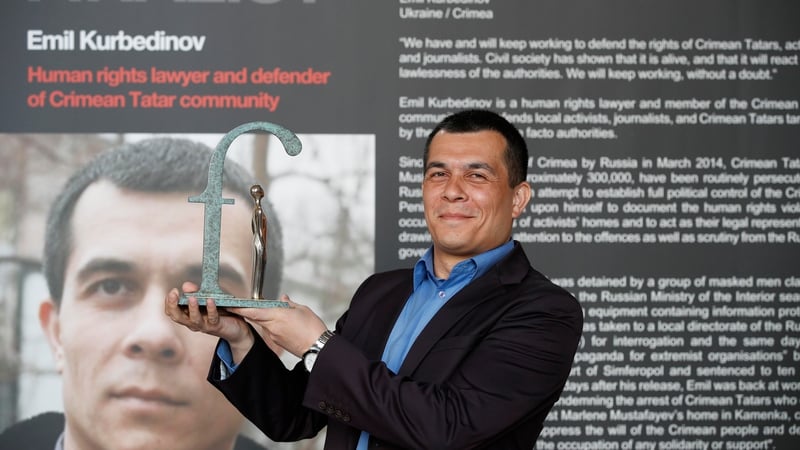
On 31 March this year  I announced the 5 nominees for Front Line’s human rights award [https://humanrightsdefenders.blog/2017/03/31/finalists-for-the-2017-front-line-defenders-award-come-from-ukraine-nicaragua-vietnam-south-africa-and-kuwait/] and today the organization announced that the winner is Emil Kurbedinov, a lawyer who is helping ethnic Tartars in Crimea.

Emil Kurbedinov said 'Winning an acquittal for my clients is almost impossible - but what I can do is show them that, despite the risks, I will not abandon them'

Emil Kurbedinov was at the ceremony in Dublin’s City Hall this morning to receive the Human Rights Defender At Risk award for 2017. According to Front Line Defenders, which has its global headquarters in Blackrock in Dublin, defending human rights activists and political prisoners in Crimea is some of the most dangerous work that any lawyer can undertake. Despite those risks, Mr Kurbedinov has spent years providing emergency legal response for the Crimean Tartar minority, which it maintains has been persecuted by Russian authorities.

In January of this year, Mr Kurbedinov was detained by representatives of Crimea’s Centre for Counteracting Extremism while on his way to represent a client whose house had been raided by police. A district court later sentenced him to ten days in detention on a charge of “propagandising for extremist organisations“.

The Executive Director, Andrew Anderson, said: “In the midst of a global crackdown on human rights defenders, the five finalists demonstrate the will to persist in the face of severe, often life-threatening risks.

Source: Lawyer wins human rights award for helping Tartars

Interpol headed by Chinese police official, human rights defenders fearsome

April 20, 2017
meng-hongwei.jpg
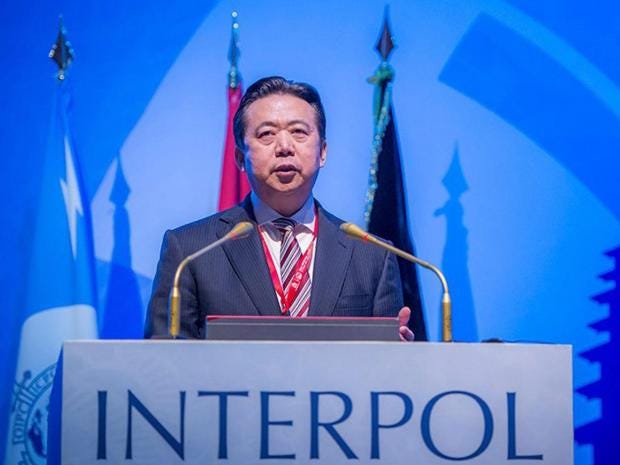
Meng Hongwei takes charge of Interpol

‘Old’ but underreported news is that Meng Hongwei – a top Chinese police official – has been elected president of Interpol, which worries some human rights NGOs. The Independent had an article on 10 November 2016.

Chinese President Xi Jinping has waged a four-year campaign against corruption, which includes a push to return former officials and other suspects who fled abroad. China filed a list of 100 of its most-wanted suspects with Interpol in April 2014, about one third of which have since been repatriated. The country’s police and judicial systems have been routinely criticised for abuses, including eliciting confessions under torture and the disappearance and detention without charges of political dissidents and their family members.  Many Western nations have been reluctant to sign extradition treaties with China or return suspects wanted for non-violent crimes.

Given those circumstances, Mr Meng’s election is an “alarming prospect“, said Maya Wang, Hong Kong-based researcher at Human Rights Watch. “While we think it’s important to fight corruption, the campaign has been politicised and undermines judicial independence,” Ms Wang added. Mr Meng’s election “will probably embolden and encourage abuses in the system,” she said, citing recent reports of close Chinese ally Russia’s use of Interpol to attack President Vladimir Putin’s political opponents.

This is extraordinarily worrying given China’s longstanding practice of trying to use Interpol to arrest dissidents and refugees abroad,” Nicholas Bequelin, east Asia director at Amnesty International wrote on Twitter.

Recently, 5 April 2017, Wei Jingsheng, a well-known human rights defender in exile, said while visiting Lyon (the HQ of Interpol) that the election of Meng Hongwei as chief of the global police organisation could give Beijing new leverage over its critics. “The Chinese government’s message to all political opponents like me or party officials who have fled the country is: ‘Wherever you are, the international police work with us and we will find you’,” “That’s frightening,” he said, adding that Meng “is still vice-minister of public security in China. He has led the secret police.”

While Interpol’s charter officially bars it from undertaking “any intervention or activities of a political, military, religious or racial character,” critics say some governments, primarily Russia and Iran, have abused the system to harass and detain opponents of their regime.

Sources:

Chinese state official named head of Interpol, raising fears for political opponents | The Independent

http://www.france24.com/en/20170405-china-dissident-sees-threat-new-interpol-chief

Women human rights defenders and their films at Movies That Matter 2017

April 10, 2017

Beth Murphy (Filmmaker/Journalist) wrote in the Huffington Post of 31 March 2017 under the title “The world’s human rights movement would look very different ‘if it weren’t for women’” a piece that highlights women human rights defenders in the context of the Movies That Matter Film Festival which took place in the Netherlands earlier this year [https://humanrightsdefenders.blog/2017/03/15/movies-that-matter-film-festival-in-the-hague-from-24-march-to-1-april-2017/]. Movies that Matter, the Amnesty International film festival celebrated nine human rights defenders and screened films that share their powerful stories. Here some of these defenders: Read the rest of this entry »

Human Rights Council extends mandate on human rights defenders – after considerable wrangling

March 24, 2017

On Thursday 23 March 2017 the UN Human Rights Council adopted a resolution in which it extended, for a period of three years, the mandate of the Special Rapporteurs on human rights defenders. [https://humanrightsdefenders.blog/2017/02/22/un-special-rapporteur-on-human-rights-defenders-wraps-up-his-first-mandate/]

The press statement by the UN (see below) explains that there was quite a bit of wrangling on wording, but in the end the draft resolution (A/HRC/34/L.5) on the mandate of the Special Rapporteur on the situation of human rights defenders, Michael Forst, was adopted without a vote as orally revised, in the same terms as provided for by the Human Rights Council in its resolution 16/5. It urges again all States to cooperate with and assist the Special Rapporteur in the performance of his tasks, to provide all information and to respond to the communications transmitted to them by the Special Rapporteur without undue delay; and calls upon States to give serious consideration to responding favourably to the requests of the Special Rapporteur to visit their countries.

(here the detailed report on the failed efforts – mainly by Russia and China – to weaken the text:) Read the rest of this entry »

Vladimir Kara-Murza, Russian democracy defender, speaks at Oslo Freedom Forum 2016

January 29, 2017

On 24 May 2016  Vladimir Kara-Murza spoke at the Oslo Freedom Forum. As the Human Rights Foundation states: “The Russian government doesn’t love activist Vladimir Kara-Murza, but he loves Russia. That’s why he is devoting his life to the fight for democracy in Russia, even though it might get him killed.

2016 Oslo Freedom Forum

2017 (5): With Trump US president, Sweden must stand up for human rights

January 24, 2017

On 24 January 2017, thelocal.se published the English version of an opinion piece originally written in Swedish by Civil Rights Defenders executive director Robert Hårdh for newspaper Dagens Nyheter. Like my post published yesterday about the call for Canada to ‘compensate’ for Trumps election [https://humanrightsdefenders.blog/2017/01/23/2017-4-canadas-year-of-real-human-rights-action/], this piece argues that Sweden, also as a member of the EU and with its current place on the UN Security council, must step forward and take a greater responsibility to protect human rights on a global level: Read the rest of this entry »

Surprise: Russia loses seat on UN Human Rights Council by 2 votes

October 29, 2016
Russia was defeated in its bid to be re-elected as a member of the UN’s Human Rights Council. But only just: Russia lost to Croatia by just two votes with Hungary claiming the Eastern Europe region’s other remaining seat. Many human rights groups had campaigned against the membership of Russia, China and others such as Saudi Arabia, but the problem is that the UN General Assembly only has a choice when the regional allotment has more candidates than seats. Saudi Arabia was re-elected as one of the four Asia-Pacific region countries to run for that region’s four allocated slots. Human Rights Watch’s UN director, Louis Charbonneau said that the vote “also shows how important it is to have competitive slates in UN elections. Countries should have a chance to reject those whose candidacies are so severely compromised, as they did today.

Read the rest of this entry »

Right Livelihood Awards 2016 to Syrian, Egyptian, Russian and Turkish human rights defenders

September 22, 2016


Right Livelihood logoThe Laureates of this year’s Right Livelihood Award have been announced today – 22 September 2016 – in Stockholm, Sweden:

SYRIA CIVIL DEFENCE (Syria)

Syria Civil Defence (The White Helmets), ‘for their outstanding bravery, compassion and humanitarian engagement in rescuing civilians from the destruction of the Syrian civil war’. It is the first time that a Right Livelihood Award goes to a Laureate from Syria.…for their outstanding bravery, compassion and humanitarian engagement in rescuing civilians from the destruction of the Syrian civil war.

Read the rest of this entry »