Posts Tagged ‘NGO’
January 10, 2017
After giving itself a new Secretary General [https://humanrightsdefenders.blog/2016/11/04/sam-zarifi-new-sg-of-the-international-commission-of-jurists/] the International Commission of Jurists (ICJ) in Geneva has now announced new additions to its main body: the Commission:
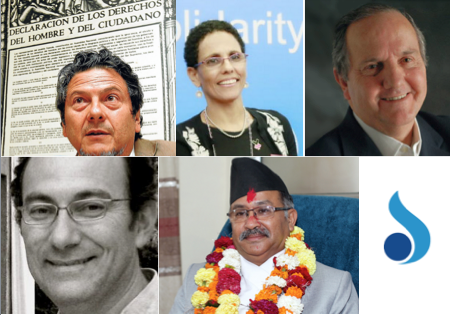
The following five new Commissioners have recently been elected: Mr Reed Brody (United States), Ms Roberta Clarke (Barbados/Canada), Professor Juan Mendez (Argentina), Mr Alejandro Salinas Rivera (Chile) and Justice Kalyan Shrestha (Nepal). It is an impressive list: Read the rest of this entry »
Posted in human rights, Human Rights Defenders, ICJ | 1 Comment »
Tags: Alejandro Salinas Rivera, appointment, Board of Directors, Geneva, human rights lawyers, ICJ, International Commission of Jurists, Juan Mendez, Kalyan Shrestha, NGO, Reed Brody, Roberta Clarke
October 8, 2016
Dublin-based NGO Front Line Defenders announced on 6 October 2016 that Andrew Anderson has been appointed as the organisation’s new Executive Director. Andrew has worked for the international protection of human rights defenders for more than twenty years, and has played a key leadership role in building Front Line Defenders into an effective force fighting for those most at risk. He will begin his new role on 1 November 2016.
The Front Line Defenders Board of Trustees selected Andrew due to his extensive management, fundraising and human rights experience. In its announcement, the Board of Trustees noted that it “unanimously agreed that Andrew is the candidate with the experience and skills best placed to lead Front Line Defenders into the next stage of our development.”
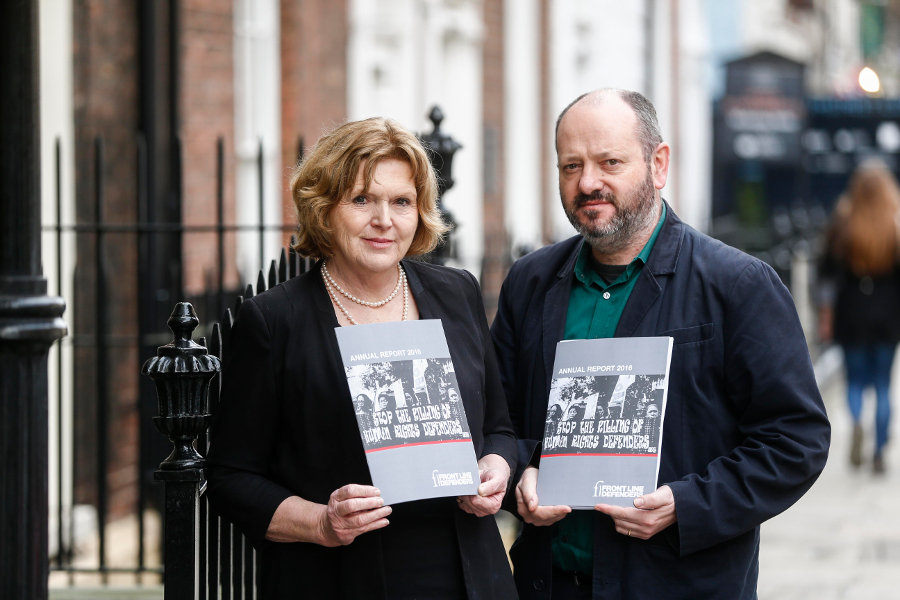
The choice is a good one in my view as Andrew has 27 years experience of working for human rights at the international level and has served as Deputy Director of Front Line Defenders since March 2003. As Deputy Director, he led the development of an international civil society consortium to implement the EU human rights defenders mechanism (www.ProtectDefenders.eu), and is a member of the Advisory Board of the Centre for Applied Human Rights at the University of York. Before joining Front Line Defenders, Andrew worked for thirteen years at the International Secretariat of Amnesty International where he served as Director of the Campaigning and Crisis Response Programme and as Director of the Africa Programme. For an earlier video statement by Andrew see: https://thoolen.wordpress.com/2011/12/09/andrew-anderson-speaks-and-speaks-well-on-the-anniversary-of-un-declaration-on-hrds-youtube/.
“It is an honour and a challenge to take on this role at a time when human rights defenders are facing increasing attacks in all regions of the world,” said Andrew. “We must sustain the drive and energy which made Front Line Defenders so effective under Mary’s inspirational leadership and build on that legacy to deliver rapid and practical support for those who risk their lives to build a better future.”
Andrew will succeed Front Line Defenders’ current Executive Director Mary Lawlor, who founded the organisation in 2001. See: https://thoolen.wordpress.com/2016/07/11/mary-lawlor-leaves-as-executive-director-of-front-line-defenders-job-search-for-successor-started/
Source: Front Line Defenders Announces New Executive Director, Andrew Anderson | Front Line Defenders
Posted in Front Line, human rights | 2 Comments »
Tags: Andrew Anderson, appointment, Front Line (NGO), Front Line Defenders, Ireland, Mary Lawlor, NGO
September 6, 2016
 (Human Rights Information and Documentation Systems, International) has started its search for a new Executive Director as envisaged in my post of 5 August: https://thoolen.wordpress.com/2016/08/05/daniel-desposito-huridocs-executive-director-announces-his-departure/.
HURIDOCS expects:
- A willingness to embrace new challenges with HURIDOCS’ partners while ensuring continuity and quality in our work and products.
- Some travelling will be required, but Geneva will be the base for the most part of the working time.
- An open management style, with regular contact and ongoing communication and dialogue with all staff members regardless of their physical location. [HURIDOCS employs 17 staff members with a total of 13 full time positions with many staff members operating remotely]
General Duties include:
- Lead strategic planning and implementation of strategy
- Fundraising
- General management of HURIDOCS resources, including financial and human resource
- Representing HURIDOCS to the human rights community, and to the public at large
- Maintaining knowledge of the needs in relation to information and documentation of organisations in the human rights space, as well as an understanding of technology trends and directions from a management perspective
Specific Duties:
- Overall supervision and guidance of the software development process
- Identifying and understanding the needs of the organisations HURIDOCS serves, and available opportunities
- Cultivating the ground for HURIDOCS‘ powerhouses’ – organisations in different regions to serve as focal points for HURIDOCS’ human rights solutions in different regions of the world
Qualifications:
- University education: Preferably at least a master’s degree in a discipline relating to the work of HURIDOCS, or its equivalent in a relevant field
- A background in the Human Rights environment and knowledge of how legal systems operate is highly desirable
- An ability to communicate about complex topics in engaging ways
Skills include:
- Proven ability to raise funds and to secure strategic relationships with key actors (Required)
- Fluency in both written and spoken English and proficiency in another language (Required)
- Familiarity with different types of technology and their application in a human rights context (Required)
- Strong interpersonal skills and the ability to manage a diverse international and multicultural workplace (Required)
- Ability to lead negotiations (Required)
Experience:
- Experience in the successful management of a non-profit organisation (Required)
- At least 5 years experience in the human rights field (Strongly desired)
The new Executive Director should be in place in Geneva in January 2017. Visit www.huridocs.org for more information. If you have any specific questions you may contact HURIDOCS Board Member Douglas Arellanes at douglas.arellanes@huridocs.org. Your application and CV should be sent to edrecruitment@huridocs.org no later than 15 October 2016.
Posted in Human Rights Defenders, HURIDOCS | 1 Comment »
Tags: Douglas Arellanes, Executive Director, Geneva, human rights documentation, HURIDOCS, information technology, job opportunity, NGO, recruitment, vacancy
June 13, 2016
 The NGO TRIAL came into being on 6 June 2002. That day, its members met for their first General Assembly, laying out the organization’s mission which still constitute its cornerstones today: fighting impunity, supporting victims in their quest for justice and redress, building an international network of committed lawyers, advocating for fairer laws and policies.
Since then, TRIAL has never stopped expanding: it is now present on three continents and recognized as a key actor in the worldwide fight against impunity. It was therefore time for TRIAL’s identity to evolve and reflect this broader scope of action. For the past three years the staff has worked on an important makeover.
TRIAL’s new identity includes a new name, a new visual identity and a new website:
TRIAL International will from now on be the organization’s official name. [“We have outgrown the names ‘Swiss association against impunity’ and ‘Track Impunity Always’, which will no longer be used”, explained Director Philip Grant. “We believe that TRIAL International will better reflect our international scope, while remaining faithful to who we are”]
The new logo combines a spunky orange with a powerful black & white doors symbol.
The main facelift is TRIAL International’s new website. [“We wanted the navigation to be very intuitive, hence the simplified sitemap, the shorter texts and the refined search function. We also wished to bring to light the human aspect of our work, with victims’ stories at the forefront”, said Kevin Karlen, the organization’s Web Project Officer.]
Source: TRIAL turns fourteen and change is in the air – TRIAL
see also: https://thoolen.wordpress.com/2015/05/07/more-on-impunity-guatemalas-ex-police-chief-jailed-for-life-in-appeal-before-swiss-court/
Posted in human rights, Human Rights Defenders | 1 Comment »
Tags: documenting, Geneva, human rights violations, impunity, NGO, perpetrators, Philip Grant, TRIAL (NGO), website
May 15, 2016
Today the International Service for Human Rights (ISHR) announced the publication of its annual report which highlights key developments during 2015 and its vision for 2016 and the years ahead.
Source: Our vision and achievements: ISHR’s 2016 Annual Report | ISHR
for more posts on the ISHR, see: https://thoolen.wordpress.com/tag/ishr/
Posted in books, human rights, Human Rights Defenders, ISHR | Leave a Comment »
Tags: accredited NGOs, annual report 2016, Geneva, Human Rights Defenders, International Service for Human Rights, ISHR, NGO, UN
December 26, 2015
Erik-Aimé Semien is a lawyer and human rights defender at Observatoire Ivoirien des Droits de l’Homme, a non-governmental organisation that aims to achieve human rights progress through capacity building and constructive dialogue with the authorities. On 9 July 2015 he talked with the Intern national Service for Human Rights about his work. ‘
What we want’, Eric explains, ‘
is to make them understand why human rights are important for the progress of our nation’.

Eric was first drawn to human rights when Cote d’Ivoire plunged into civil war in 1999, following a military-led coup d’etat. What followed were ten years of violence and sectarian strife. ‘We are a country coming out of ten years of civil war, but the main problems are not yet solved. It was widespread frustration and a lack of democratic institutions that caused the war; and it is for overcoming frustration and the creation of democratic institutions that we continue to struggle.’
Eric explains that frustration is caused when there is a lack of transparency in government work, when the president favours his regional or ethnic group over others, when there is impunity for war crimes, and when voices critical of the government are excluded from debate.
‘Take the national TV, a public service paid for by public taxes. If you watch TV in Cote d’Ivoire, you will receive the impression that the perspective of the president of the republic is the only perspective there is. It was the same for the former president. This means that if you disagree with government policy, National TV will no longer interest you, for you will find no expression of your opinion. This begs the question, if you disagree, where can you go? To whom can you speak? The result is frustration. The media outlets need to be open to everybody, to civil society, to the opposition, to everybody.’
In addition to advocating for more inclusive democratic institutions, Observatoire Ivoirien des Droits de l’Homme works to combat impunity. The war lasted ten years, but today, not only do many people on the winning side who committed human rights violations walk free, but they also enjoy appointments in the army and the administration.
‘After the war I think we should have a fair and equitable justice. What a victim wants is to see those who committed human rights violations behind bars. We organise victims and take their cases to court. We say to the judge, find out who did this and send them to prison. If they do this, it will release tension. The government recently set up a trust fund that provides financial compensation for victims. This is a positive step. But it needs to be accompanied by a clear message: whoever you are, in whatever position, you are not above the rule of law.’
One of the challenges Eric faces is a lack of awareness in the government of what human rights defenders are and what they do.
‘In Cote d’Ivoire certain authorities don’t have a clear idea of the role of civil society. They think we are causing a disturbance when all we want is the progress of our nation. But I have to admit that the situation is improving. Previously the authorities were closed but now they are much more open. They listen to us more and we are allowed to participate in meetings.’
One remarkable result of this increased openness on the government’s part is the adoption in June 2014 of a law that protects human rights defenders. ‘In the build up to the drafting of this law, we clearly explained why protecting human rights defenders was important. Many human rights NGOs were involved in the process. We had several meetings with parliament representatives and even at the national assembly. We had to explain who human rights defenders were and why protecting them is important. I am proud of Cote d’Ivoire that we have adopted this law, which is the only law of its kind on the African continent.’
The law, although still largely unknown, has already had a positive impact. In 2014 the leaders of a public assembly protesting the high costs of grocery goods were arrested. But the Observatioire Ivoirienne intervened and showed the prosecutor the law. The protesters were subsequently freed. ‘Now, whenever we have a problem with authorities, we can show them this law, and they will see that we are protected. This will make our work much easier and less dangerous. In a democracy, in a rule of law state, the government should engage with civil society. The role of civil society is that of counter balance. We don’t want to antagonise the authorities needlessly nor do we seek power. We would like to see change coming from the inside and genuinely inclusive democratic institutions and not just superficial engagement. I am proud of Cote d’Ivoire for the progress we have made, of which this new law is tangible proof, but we still have some way to go. The frustration that causes war needs to be eliminated for good.
Source: Erik-Aimé Semien: Human rights defender from Côte d’Ivoire | ISHR
Posted in human rights, Human Rights Defenders, ISHR | Leave a Comment »
Tags: Côte d'Ivoire, civil war, enabling environment, Erik-Aimé Semien, Human Rights Defenders, impunity, ISHR, Ivory Coast, NGO, Observatoire Ivoirien des Droits de l’Homme, profiles
December 2, 2015
Yesterday I announced the “10 December, 10 Defenders” Campaign by OMCT. One the first profiles concerns Russian human rights defender Olga Sadovskaya.
Olga Sadovskaya does not shout, or carry banners in the streets; nor does she complain about the threats and insulting graffiti she regularly finds painted on the fence around her house. This sober 36-year-old lawyer, who practices yoga in her spare time, has put her legal skills and intellectual rigor in the service of the cause of fighting torture. As Deputy Director of the Committee Against Torture, theNGO that won the 2011 Council of Europe Human Rights Prize, she focuses on winning legal victories in torture cases by thorough investigative groundwork, sophisticated medical reports and legal expertise.
“Everyone should care about torture because anyone could be the next victim,” Olga says. “If torture is condoned or indeed widespread, it means that the State’s legal system is not working properly, not only when torture is involved, but at all levels.” Torture works like a litmus test. If it is accompanied by impunity, the legal system is dysfunctional. “There is no guarantee that the law will work properly in ordinary, day-to-day situations, as when someone asks for a bank loan, sues for damages, needs her child to be protected from abuse or her mother to be provided with anaesthesia”, she explains.
The work pays off. In the 13 years she has been with the Committee, she and her colleagues have filed 84 complaints at the European Court of Human Rights, managed to put more than 100 police officers in jail for torture, with clients receiving almost 46 million roubles (700,000 USD) in compensation, and several lives being saved by evacuation from Chechnya.
Olga describes her work as a constant challenge given the Russian Government’s attempts to close down independent human rights organizations. For lack of substantive arguments, the Government accuses the Committee – partially funded by international donors, as most NGOs – of being a foreign agent, in order to prevent it from accessing funds that allow it to function. This is a commonly used tactic against human rights activists. Rather than simply banning an NGO, some States block its access to external funding by a variety of restrictive measures – legal, administrative or practical – which being, less obvious, are less likely to draw international condemnation. Although, as a result, the Committee might run out of money within three months, Olga keeps ploughing through her cases with unwavering faith that her work is about restoring trust in the State. [for more on foreign agent, see: https://thoolen.wordpress.com/tag/foreign-agent/]
Story by Lori Brumat in Geneva.

Source: Russian Federation: Olga and the paradox of fighting torture: Revealing legal dysfunctionality, building trust / November 1, 2015 / Links / Human rights defenders / OMCT
Posted in human rights, Human Rights Defenders, OMCT | 1 Comment »
Tags: 10 December - 10 Defenders, Committee against Torture, Council of Europe human Rights Prize, Foreign agent, human rights lawyer, NGO, Olga Sadovskaya, profiles, Russia, torture, woman human rights defender
October 21, 2015
On 7 October, Robert F. Kennedy Human Rights announced that Ms. Natalia Taubina, a leading human rights defender from Russia, has been selected as the laureate of the 2015 Robert F. Kennedy Human Rights Award, now in its 32nd year. “..I know my father would be proud of her work” said Kerry Kennedy, President of Robert F. Kennedy Human Rights. “This award is not just a recognition, it is an opportunity to work hand in hand with human rights defenders to protect the rights and freedoms of the Russian people.”
Natalia is the Director of the Public Verdict Foundation in Russia and is being recognized for her work to hold law enforcement agents accountable for human rights violations and support victims of torture in Russia. The Public Verdict Foundation litigates on behalf of citizens wrongfully arrested, beaten, tortured, and illegally detained by police. In 2014, the Russian government categorized the foundation as a “foreign agent”to publicly invalidate, shame, and render inoperable organizations with international ties. Natalia’s organization has resolutely fought this label in court and is committed to protecting human rights despite the government’s attempt to shut down civil society groups.
“This recognition of our work is especially important today when civil society in Russia is under unprecedented pressure. The climate in which we now operate is hostile like never before. But victims of abuse in Russia need us, and we are not going to abandon them” said Natalia Taubina.
Mrs. Robert F. Kennedy will present Natalia with the 2015 Robert F. Kennedy Human Rights Award in Washington, D.C., in a ceremony on 19 November.
About the Robert F. Kennedy Human Rights Award see their website or http://www.brandsaviors.com/thedigest/award/robert-f-kennedy-human-rights-award
For more info: cronin@rfkhumanrights.org
Source: | Robert F. Kennedy Center for Justice & Human Rights
Posted in awards, human rights, Human Rights Defenders | 1 Comment »
Tags: digest of human rights awards, fair trial, foreign agent law, human rights award, Natalia Taubina, NGO, Public Verdict Foundation, Robert F. Kennedy Human Rights Award, Russia, torture, USA, woman human rights defender
September 17, 2015
On 15 September 2015, the Turin Court of Appeal ruled to release Algerian human rights defender Mr Rachid Mesli, who has been under house arrest since 22 August 2015, and to allow him to leave the country, as reported by Front Line Defenders.
The human rights defender was released before the end of the 40 day period during which the Algerian government could submit a formal request for extradition. The Court recognised Rachid Mesli’s important and peaceful work in the defence of human rights, as well as the high risk of torture he would face if returned to Algeria. While the court is yet to make its final decision on the extradition warrant, the release order highlighted that, according to the information received, Rachid Mesli’s human rights activities were not in any way related to terrorism.
On 22 August, the Italian court placed the human rights defender under house arrest following three days in detention in Aosta prison. Rachid Mesli was arrested on 19 August 2015 (https://www.frontlinedefenders.org/node/29390) as he travelled to Italy on holiday with his wife and son. The arrest occurred as a result of an arrest warrant issued by the Algerian authorities in April 2002 on terrorism-related charges.
[Rachid Mesli is the Legal Director of Alkarama, an independent human rights organisation based in Geneva that works to assist victims of extra-judicial executions, disappearances, torture and arbitrary detention in Arab states. And this is not first effort by the Algerian government see: https://thoolen.wordpress.com/2012/01/20/mourad-dhina-algerian-head-of-the-human-rights-organization-alkarama-detained-in-france/]
Interesting tot note Front Line Defenders’ call on Interpol to ensure the legitimacy of all warrants issued by its members and to put in place safeguards so that the system cannot be abused in order to target human rights defenders.
Posted in Front Line, Human Rights Defenders | Leave a Comment »
Tags: al-karama, Algeria, Alkarama, Arab region, arrest, France, Front Line (NGO), Human rights defender, Mourad Dhina, NGO, Rachid Mesli, Switzerland, terrorism
May 20, 2015
 is recruiting a Communications Manager, based in Geneva or Stockholm. The successful applicant will be shaping its international communications strategy and working closely with its Laureates. She/he will lead the Right Livelihood Award Foundation’s communications team and be responsible for the conceptualisation, implementation and the daily running of all communications of the foundation. Read the rest of this entry »
Posted in awards, human rights, Human Rights Defenders | Leave a Comment »
Tags: awards, communication officer, communications, Geneva, international communications strategy, job opportunity, NGO, position, Right Livelihood Award, Right Livelihood Award Foundation, Stockholm, vacancy


 Hans Thoolen on Human Rights Defenders and their awards