In an opinion adopted on 20 November 2013, the United Nations UN Working Group on Arbitrary Detention [WGAD] requested the release of Iranian human rights defenders Khosro Kordpour and Massoud Kordpour from arbitrary detention. The WGAD carried out its investigation pursuant to an appeal by the Observatory for the Protection of Human Rights Defenders and informed the Observatory (an FIDH-OMCT joint program me) of its decision on 4 February, 2014.
 Read the rest of this entry »
Posts Tagged ‘media’
UN Working Group concludes that detention of human rights defenders in Iran is arbitrary
February 6, 2014Media can help uphold human rights, says meeting in Dhaka
December 22, 2013Lawyers, former diplomats and rights activists at a dialogue on 16 November 2013 in Dhaka, Bangladesh, stressed that media should use national and international mechanisms in reporting on human rights issues. They also pointed out that pressuring the government by international mechanism and pressure groups, such as diplomats and international media, could help improve the human rights situation in the country. Former ambassador Harun Ur Rashid, Dhaka Tribune editor Zafar Sobhan, Sayeed Ahmad of Forum Asia, Tahmina Rahman of Article 19, lawyer Jyotirmoy Barua, Nur Khan of Ain o Salish Kendra were the panelists at this dialogue entitled “Journalists as human rights defenders working together for the promotion and protection of human rights” organised by the human rights group Ain O Salish Kendra. Ambassador Harun ur Rashid said the media played an important role in creating awareness as well as acting as a pressure group to uphold human rights.“Individuals are now recognised not only in the national law but also in the international laws, so when his/her rights are violated, both state and the UN can intervene to protect the individual,” Harun ur Rashid added. Dhaka Tribune Editor Zafar Sobhan said the government had a tendency to act unresponsively on human rights violations until the issue was being picked up by international media or watchdogs. “Still, the media is playing a great role here. Ultimately the international watchdogs and media mostly gather information from news published in local media,” he said, adding that media persons also have the duty to respect victim’s privacy and rights. Sayeed Ahmad of Forum Asia observed that accountability was much more needed than creating awareness on human rights among the government institutions and law enforcement agencies such as Rapid Action Battalion, police and armed forces to ensure human rights. Echoing Sayeed, Tahmina of Article 19 said if such groups always enjoy exemption from the laws in the country, a culture of impunity is hard to eliminate.
via Media can help uphold human rights: Dialogue | Dhaka Tribune.
New laws are being introduced in Kenya to restrict Human Rights Defenders
November 19, 2013The Information and Communications Amendment Bill of 2013 was passed in Kenya by parliament on October 31, 2013, but has not yet been signed by the president. Another problematic draft law, the Media Council Bill, is due to
 be debated in parliament in the coming weeks. Moreover, on October 30 the attorney general also proposed controversial new provisions regulating the work of nongovernmental organizations (NGOs), including a proposed cap at 15 percent of foreign funding. “These new laws are an attempt to undermine freedoms of expression and association in Kenya,” said Daniel Bekele, Africa director of Human Rights Watch on 12 November. “Kenya’s leaders should act swiftly to prevent these bills from becoming law and focus on the country’s real challenges, like police reform and accountability.”
The new idea of restricting (foreign) funding follows similar efforts by an increasing number of other countries, signaling a dangerous trend:
On October 30, the office of the attorney published in the official gazette – the mandatory first step before a bill is introduced to parliament – the Miscellaneous Amendment Bill of 2013. This bill includes provisions that would grant broad discretionary powers to a new government body to regulate nonprofit organizations and would limit access to foreign funding for these groups. The amendment would empower a new government body, the Public Benefits Organizations Authority, to “impose terms and conditions for the grant of certificates of registration, permits of operation, and public benefit organization status.” The chairperson would be appointed by the president, increasing executive powers over nongovernmental groups. Critics of the law fear that the wide powers vested in the executive branch could be used to restrict nongovernmental organizations or even penalize organizations that fall out of favor with the Kenyan authorities.
The amendment would also introduce new limits on funding for nongovernmental organizations. It states that “a public benefit organization shall not receive more than 15 percent of its total funding from external donors,” unless otherwise approved by the minister for finance. Funding to nonprofits would be channeled through a new Public Benefits Organizations Federation rather than directly from donors – which could create new operational difficulties for nongovernmental organizations and delays in their projects.
“This new law requiring nongovernmental organizations to raise 85 percent of their funding locally may well have the effect of weakening independent voices,” Bekele said. “As we have seen elsewhere in the region, including in Ethiopia, these laws are an assault on basic freedoms and Kenya’s citizens and leadership should soundly reject them.”
Kenya: New Laws Would Undermine Basic Rights | Human Rights Watch.
Related articles
- India should end funding restraints on Human Rights Defenders, Says HRW (thoolen.wordpress.com)
Human rights defenders describe lack of freedom of expression in Africa
November 2, 2013A three-day Forum on the participation of African NGOs at the 54th Ordinary Session of the African Commission on Human and People’s Rights [ACHPR] and also the 28th African Human Rights Book Fair concluded on Sunday, 20th October, 2013 in Kololi. The forum brought together stakeholders dealing with various human rights issues from different parts of Africa. Various reports were presented that touched on media freedom and freedom of expression as well as on laws and principles governing media practice such as defamation, sedition and other draconian laws that prevail in many African countries. Kebba Jeffang reports in the Foroyaa newspaper of 21 October on the results:
Terrorist charges against journalists and human rights defenders in Morocco
October 31, 2013In the last three days Morocco has been seen using Anti-Terrorism laws against human rights defenders and journalists exercising their freedom of expression. The following two cases come from Frontline: Read the rest of this entry »
20th MEA ceremony broadcast live on 8 October 18h00
October 5, 2013The 20th Ceremony of the Martin Ennals Award for Human Rights Defenders will take place on Tuesday 8 October and can be followed live on www.martinennalsaward.org as from 18h00 Central European (Geneva) time. The moment of the announcement of the laureate will be approximately 18:30.
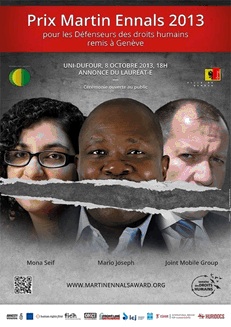
As a reminder, the 3 Final Nominees are: Read the rest of this entry »
Job opportunity in Beirut for Communication Officer, deadline 7 October
October 2, 2013Justice without Frontiers (JWF) a secular, nonprofit, NGO in Lebanon seeks a (part-time) Communication Officer whose key responsibilities are:
● To develop and implement an integrated media strategy
● To document the process of preparation of JWF activities
● Deliver high quality local, national (and in some instances international) media coverage for JWF projects.
● Responsible for delivering accurate, timely and compelling information and stories that illustrate and raise the profile of projects implemented by JWF.
● Write & produce content – for the website and external media outlets such as Facebook sub-pages, e-actions, emails, and web pages.
● Monitor and evaluate media coverage generated and to draw lessons to improve coverage.
● Build and maintain excellent relationships with key media players, journalists and broadcasters in Lebanon and regionally and internationally.
● Develop and regularly maintain a national database of media contacts.
● Coordinate the production of IEC materials related to the project: billboard-posters-pamphlets-newsletter-song&hellipetc
● Review and assist in the development of proposals, progress reports, and final reports as per donor requirements
Among the Qualifications and Competencies:
● A Bachelor’s degree in journalism or related field.
● Knowledge of local, national and international media (including press, internet, print)
● Native Arabic and excellent English skills (writing, reading, and correspondence).
● IT skills (Word, Excel, power point&hellip)
To Apply: submit a cover letter describing your experience what you would bring to the organization, and your salary requirements; along with a CV and contact information for three professional references; and send to: jwficc@yahoo.com; jwf@jwf.org.lb by October 7, 2013.
Right Livelihood Awards 2013 announced today
September 26, 2013Today were announced as the 2013 Right Livelihood Laureates:

Paul Walker (USA),
Raji Sourani (Palestine),
Denis Mukwege (Democratic Republic of Congo) and
Hans Herren/Biovision Foundation (Switzerland).
for more information see: http://www.rightlivelihood.org/
Follow on YouTube very interesting debate on Syria and media organised by International Alert
September 20, 2013While not directly dealing with Human Rights Defenders, I want to share with you this fascinating debate organised by International Alert.
As Syria stays in the news, Read the rest of this entry »
 Hans Thoolen on Human Rights Defenders and their awards