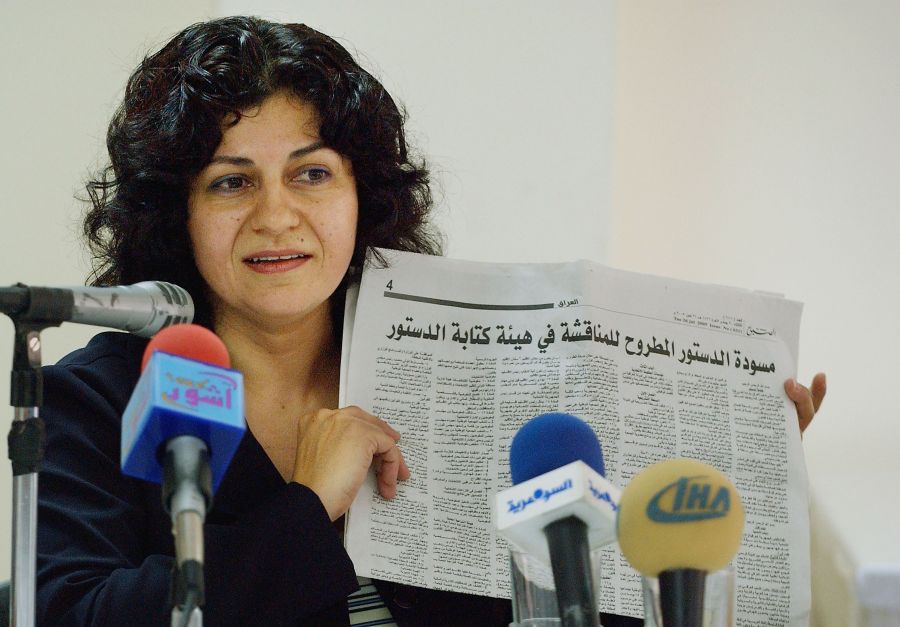
On 2 March 2026, woman human rights defender and feminist Yanar Mohammed was killed in an armed attack in front of her residence in northern Baghdad.
Yanar Mohammed was a prominent Iraqi woman human rights defender and feminist, and the co-founder and director of the Organisation of Women’s Freedom in Iraq (OWFI). Since 2003, she had worked to protect women facing gender-based violence, including domestic abuse, trafficking, and so-called ‘honour killings.’ Under her leadership, OWFI established a network of safe houses across several Iraqi cities, providing protection and support to hundreds of women. Yanar Mohammed led these efforts despite all the ongoing impediments and risks. She was a strong advocate for secularism and women’s equality. Throughout her activism, Yanar Mohammed faced death threats and, at times, was forced to restrict her movement. {see also: https://humanrightsdefenders.blog/2019/01/07/women-human-rights-defenders-in-iraq-have-to-live-dangerously/]
According to an offical statement from OWFI, on 2 March 2026 at 9:00, two unidentified gunmen on motorcycles opened fire on Yanar Mohammed as she stood outside her home. She was quickly transported to the hospital, however, despite the effort of medical personnel, she succumbed to her injuries.
Reportedly, Yanar Mohammed had returned to Baghdad from Canada just a few days prior to her assassination, raising concerns about the potential surveillance and monitoring of her movements.
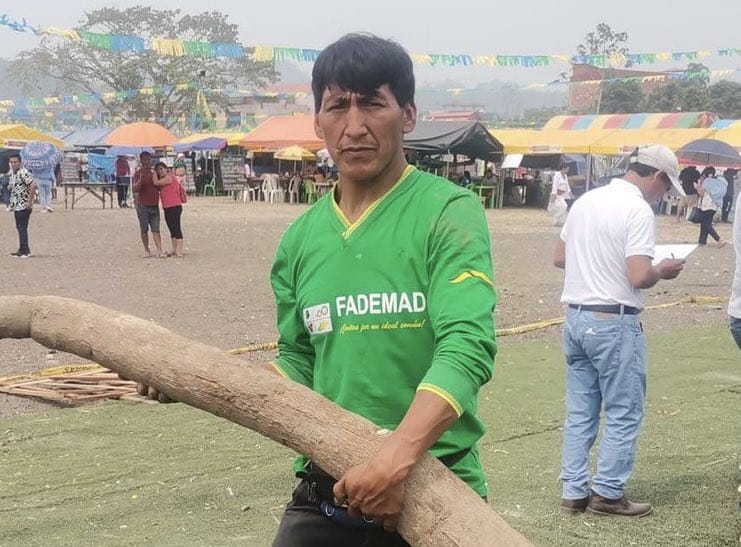
Environmental activist Hipólito Quispe Huamán was shot and killed Saturday night in the Madre de Dios region of southeastern Peru, in what authorities suspect was a targeted attack linked to his work defending the Amazon rainforest, AFP reported on 29 July 2025.
Quispe Huamán was driving along the Interoceanic Highway when he was gunned down, according to local prosecutors. Karen Torres, a regional prosecutor, told reporters that investigators are considering his environmental advocacy as the likely motive.
“This is a murder with a firearm of yet another defender of the Madre de Dios region,” she was quoted as saying by AFP.
Quispe Huamán had served as an active member of the Tambopata National Reserve Management Committee and was a vocal opponent of deforestation and illegal land use in the Peruvian Amazon. His killing has sparked outrage from human rights and environmental organizations, which say the attack reflects a growing pattern of violence against Indigenous leaders and environmental defenders in the region.
“We condemn the murder of environmental defender Hipólito Quispe Huamán in Madre de Dios, another victim of the growing violence against those who protect our territories and ecosystems,” said the National Coordinator for Human Rights (CNDDHH) in a statement posted on social media. “Not one more death!”
Hipólito Quispe Huamán. Photo courtesy of CNDDHH (on X).
Quispe Huamán’s brother, Ángel, called for accountability. “I demand justice for my brother’s death. This kind of thing cannot happen,” he told local media.
The Ministry of Justice has pledged to support the legal defense of Quispe Huamán’s family and ensure the perpetrators are brought to justice. However, critics say the government’s response mechanisms remain under-resourced. The Intersectoral Mechanism for the Protection of Human Rights Defenders, led by the Ministry of Justice, has faced ongoing criticism for lacking the budget and personnel needed to respond effectively to threats.
Attacks against environmental defenders have increased across Peru’s Amazonian regions, where extractive industries, drug trafficking, and illegal land grabs often operate with impunity. In July 2024, the Interethnic Association for the Development of the Peruvian Rainforest (AIDESEP) declared a state of emergency after an Indigenous leader was tortured and killed in central Peru, citing escalating threats from coca growers and criminal networks.
According to Global Witness, at least 54 land and environmental defenders have been murdered in Peru since 2012—more than half of them Indigenous. Many of these killings remain unsolved.
Quispe Huamán’s death has reignited calls for stronger protections for those who safeguard the rainforest and Indigenous territories. As investigations continue, activists and family members are demanding not only justice—but a systemic response to end the violence.
“Despite it all, I hold onto a small hope—that the future might bring justice, that our voices will eventually be heard, and that one day I can celebrate my birthday again, in peace, with the people I love, free from fear and loss.” – Awdah Hathaleen, April 2025 Photo by: Emily Glick
An Israeli settler shot dead a Palestinian teacher who helped film Oscar-winning documentary No Other Land, according to the Palestinian education ministry and an Israeli-American activist who was at the scene of the shooting.
No Other Land co-director Yuval Abraham said on X that a settler shot Odeh (also Awdah) Hathaleen in the lungs in Umm Al-Khair village in the occupied West Bank. Residents allege the shooter was Yinon Levy, who is sanctioned by the UK.
Attorney Avichai Hajbi said he was representing a resident “who felt his life was in danger, was forced to fire his weapon into the air” after residents were “attacked by an Arab mob, along with foreign activists, with stones and violence”. Mattan Berner-Kadish, an Israeli-American activist at the scene, told the BBC that at about 17:20 local time (15:20 BST) on Monday, a bulldozer from a nearby Israeli settlement was driven through private Palestinian land, crushing a sewage pipe, multiple olive trees and two fences.
Berner-Kadish and other activists, including Hathaleen’s cousin Ahmad, ran to block the bulldozer. The activist said the driver hit Ahmad in the neck and shoulder with a drill that extended from the bulldozer, with his footage capturing Ahmad falling to the ground. Berner-Kadish did not believe Levy was driving.
While attending to Ahmad’s injuries, Berner-Kadish heard a pop. Running back to the village to get water, he saw Hathaleen lying bleeding from a gunshot wound and Levy, the only settler he saw, holding a gun.
In a video believed to be filmed by a relative of Hathaleen and posted on social media, a man identified as Levy is seen holding a pistol with a bulldozer behind him, as men yell at him. Levy pushes at one man, who pushes back. Levy then raises his pistol and shoots ahead of him, then again into the air.
The clip cuts off when the person filming turns around to run away as women are heard screaming. The footage does not show what or who the shots hit, if anything, and whether anyone else was shooting. There are no other settlers visible. Israeli police said it was investigating the incident in the area of Carmel, an Israeli settlement near Umm Al-Khair.
“As a result of the incident, a Palestinian man was pronounced deceased. His exact involvement is under investigation,” police told the BBC. Police said on Tuesday morning they had detained an Israeli citizen for questioning. Israeli media later reported Levy was released on house arrest.
The Israel Defense Forces (IDF) also detained five Palestinians on suspicion of involvement in the incident, along with two foreign tourists who were present. Berner-Kadish said on Tuesday evening they were still detained. The activist, who began visiting the village in 2021, said Hathaleen was “one of my best friends in the world” and the two were days away from constructing a football field in the village. He added that Hathaleen was a “warm and loving” father of three young children.
The Palestinian education ministry said Hathaleen was a teacher at a local secondary school. US congresswoman Lateefah Simon, a Democrat from California, said she was “heartbroken” over the killing of Hathaleen. He and his cousin, “both holding valid visas”, were detained and deported from San Francisco airport last month while travelling for a multicultural faith dialogue, she said.
Abraham said Hathaleen had helped film No Other Land, the 2025 Oscar winner for best documentary feature that follows the legal fight between the Israeli government and Palestinians over Masafer Yatta, a West Bank community of about 20 villages.
..Levy, a leader of an outpost farm, was sanctioned by the UK in 2024, along with others, because he “used physical aggression, threatened families at gunpoint, and destroyed property as part of a targeted and calculated effort to displace Palestinian communities”.
He was also sanctioned by the US under the Biden administration, along with others, last year, but President Donald Trump lifted those sanctions.
Gilad Kariv, a member of Israel’s Knesset from the Democrats party, said on X in response to the video that “in the territories, armed Jewish militias operate unchecked”.
Settler violence, which has also been on the rise for years, has surged since the outbreak of the war in Gaza. The UN documented at least 27 attacks by settlers against Palestinians that resulted in property damage, casualties or both, between 15 and 21 July, in the West Bank.
ISHR and the Colectivo 46/2 condemn the assassination of opposition leader Samcam Ruìz by the Nicaraguan Government.
In the joint letter published on 23 June 2025 The 46/2 Collective denounces to the international community the assassination of retired Nicaraguan Army Major Roberto Samcam Ruíz, which took place on 19 June in his home in San José, Costa Rica.
Samcam Ruíz was a strong voice of denunciation against the Ortega-Murillo dictatorship, denouncing the Nicaraguan army and pointing it out as a participant in the repression and extrajudicial executions committed since 2018. He had also denounced an espionage network against opposition refugees in Costa Rica.
The retired major was one of the 94 Nicaraguans denationalised in February 2023 by the dictatorship and since 11 July 2018 had been a refugee in Costa Rica due to persecution and criminalisation by the dictatorship of Daniel Ortega and Rosario Murillo. He obtained Spanish nationality on 26 July 2023.
The assassination of the former retired military officer is not the first attack against opponents on Costa Rican soil. In 2023, opposition member Joao Maldonado and his wife were shot at with the clear intention of killing them. Maldonado had already suffered another attack in 2021, also in San José, Costa Rica. In 2022, the Nicaraguan opposition leader Rodolfo Rojas was found dead in Honduras. According to relatives, he had been lured to Honduras from Costa Rica, where he had gone into exile. To the list must be added the murder of another refugee, Jaime Luis Ortega, in 2024, in Upala, a canton on the border with Nicaragua. Following these events, Roberto Samcam had spoken to the press, pointing out the direct involvement of the Ortega Murillo regime and indicating that he knew that his life was at risk.
Although the investigations into Samcam’s murder are ongoing, the circumstances of the murder and the profile of the victim raise strong suspicions that it may be a political crime with possible transnational links. This murder takes place in a context in which various human rights organisations have been documenting a sustained pattern of surveillance, threats, harassment and acts of intimidation directed against Nicaraguans in exile in the region, especially in Costa Rica.
We consider that this crime should be analysed and investigated as part of a broader strategy of transnational repression promoted by the Nicaraguan regime to persecute and silence dissent outside its borders, in open violation of the human rights of refugees and exiles. This transnational repression has been documented by the Group of Experts on Human Rights in Nicaragua (GHREN), who have pointed out that ‘The Government’s repressive actions transcend the country’s borders and affect people who are opponents or perceived as such abroad. The government has also continued to target family members of opponents inside Nicaragua, including children, by mere association, as a way of punishing opponents and/or deterring them from speaking out wherever they are’.
Given the gravity of this crime and the sustained pattern of transnational repression against exiled Nicaraguans, we urgently call on the international community to demand that the Nicaraguan State immediately cease all forms of persecution, surveillance and violence against dissidents in exile. We also request that the international community strengthen political, technical and financial support for the protection mechanisms for human rights defenders in exile. We also urge the establishment of bilateral or multilateral channels of communication with the host countries of Nicaraguans in order to assess the security situation and articulate preventive responses to possible acts of transnational persecution. Finally, we call on international human rights bodies to urgently follow up on these cases as part of a systematic pattern of cross-border repression, and to ensure justice and truth for the victims.
Signatories:
Collective Nicaragua Never Again
Centre for International Law and Justice – CEJIL
International Federation for Human Rights – FIDH
International Institute on Race, Equality and Human Rights
Autonomous Women’s Movement – MAM
World Organisation Against Torture (OMCT)
Peace Brigades International – PBI
International Network on Human Rights Europe – RIDHE
Legal Defence, Registry and Memory Unit – UDJUDR
Open ballot boxes
International Service for Human Rights – ISHR
Additional information:
The 46/2 Collective is a coalition of 19 international, regional and Nicaraguan human rights organisations that regularly informs the international community about the lack of action by the Nicaraguan regime to meet its international human rights obligations.
Catholic aid agency CAFOD has called for justice, after the murder of a prominent environmentalist that CAFOD supported.
Following the news of the murder of Juan Lopez – anti-mining, environmentalist, community leader and Municipal Councillor of Tocoa, northern Honduras – who was shot dead by several men as he headed home in his car from church, Paz Redondo, CAFOD’s Country Representative for Central America said: “The assassination of Juan Lopez clearly shows once again the complicity between the authorities, international companies, and organised crime in Tocoa, and the inability of the government to protect environmental and human rights defenders in the emblematic case of the Guapinol river – despite the fact that precautionary measures had been ordered by the Interamerican Court of Human Rights – IACHR.“
Juan Lopez denounced the corruption within local and central governments in Honduras during a public press conference just before he was killed.
Paz Redondo continues: “Justice needs to be more than words for the state of Honduras, a state that shows once again its fragility and inability to combat corruption within its ranks, as it continues to serve the interests of extractives and organised crime. Juan publicly denounced this corruption within local and central governments and was killed days after his and his fellow activists’ latest public press conference.”
For over a decade, the communities of Guapinol, San Pedro and other areas in the vicinity of Tocoa have been denouncing the illegal granting of mining concessions in the “Carlos Escaleras National Park” in Honduras. Their advocacy efforts were fruitful in February, when the Honduran government approved Decree 18-2024 to protect the core zone of the national park, a key achievement to safeguard the environment against mining and energy projects in the area.
The murder of Juan Lopez is not the first killing in the Guapinol case. Over 160 community members in Tocoa have been killed protecting their land and natural resources since 2010 (Amnesty, 2024). In 2023, three community leaders were killed in what the community saw as retaliation, following the release of defenders who had been criminalised. Later in the year, in October 2023, 30 members of the Municipal Committee for the Defense of Common and Public Goods of Tocoa and of the Bufete Justicia para los Pueblos, were granted precautionary measures by the Human Rights Interamerican Court (IACHR).
Juan Lopez was killed despite precautionary measures which were ordered by the IACHR last October. The community of Tocoa believes his death could have been prevented if the Honduran authorities had implemented the precautionary measures granted to Juan Lopez. CAFOD, alongside ERIC has accompanied the Guapinol community in their fight to protect the land and natural resources essential for their survival, and we will continue supporting them as they defend their environmental rights.
In El Salvador, the suspects in the murder of four Dutch journalists will finally stand trial 42 years after the fact. The former Salvadorian Minister of Defense and two army officers will appear in court, NOS reports. See
On 6 July 2023 Oxfam issued a statement that it stands in solidarity with the Bangladesh Garment and Industrial Workers Federation (BGIWF), trade union leaders and all human rights defenders who stand up for workers’ rights and protect human rights.
Oxfam learned of the horrific news of the brutal murder of Shahidul Islam, a union leader who was beaten to death on June 25th for his labour rights activism in Gazipur, a major garment industry hub on the outskirts of Dhaka, Bangladesh. He was an organizer of the BGIWF for 25 years advocating for workers’ rights as a trade union organizer, and was attacked and killed for standing up for basic human rights. We mourn not only the loss of an individual but also the loss of a powerful voice that championed the rights and well-being of workers, including the right to a living wage. We extend our sincere condolences to the grieving family, friends, colleagues and allies mourning his loss.
Kalpona Akter, the president of BGIWF, said: “Shahidul mobilised thousands of workers to join unions, empowering them to become solid factory-level trade union leaders. Throughout his life, he assisted thousands of workers in receiving arrears and severance pay wrongfully denied by their employers. With workers’ needs always in mind, Shahidul and three other union leaders met on the evening of his death to discuss a peaceful resolution to a wage dispute and the Eid-ul-Azha festival bonus. He met his fate due to the industry’s ill practice to promote yellow unionism for years and the neglect of workers’ voices. This needs to stop. Let our workers be free to organize and join unions. Shahid’s contributions to the labour movement were remarkable and will be sorely missed.”
Ahmed Sharif, a union organizer who was wounded in the attack, told the Guardian “As soon as we came out of the gate, a group of assailants grabbed Islam and separated him from us. They started cursing and randomly beating us, particularly Islam, some of them were kicking him mercilessly.”
As an organisation dedicated to the fight to end poverty and injustice, we are deeply concerned by the murder of Shahidul Islam. This tragic incident highlights the vulnerability of union leaders and activists fighting for workers’ rights. Oxfam joins BGIWF in demanding a thorough investigation and ensure justice is served for the death of Islam. We further call on all brands and stakeholders to conduct ethical purchasing practices upholding human rights within their supply chain and paying a living wage. We call on the government of Bangladesh to step up their protection of trade unionists who are exercising their fundamental human rights to freedom of association and collective bargaining.
Oxfam stands in solidarity with BGIWF, raising a resounding call for justice in the case of Shahidul Islam and demanding the unwavering safety of workers, union members and human rights defenders. We stand united in their relentless struggle to defend workers’ rights at Prince Jacquard Sweaters Ltd factory and in workplaces across Bangladesh. Together we demand accountability and an end to the systemic violations that perpetuate injustice.
Background
Shahidul and his colleagues were attacked after leaving the meeting with the management of a factory named Price Jacquard Sweaters Ltd to help the workers collect their due bonuses and wages. The factory management refused to comply despite being directed by the Deputy Commissioner’s (DC) office of Gazipur District to pay the workers’ salaries.
This is not the first time BGIWF has been the victim of such a fatal attack. Eleven years ago, in April 2012, another worker leader, Aminul Islam was tortured and murdered. Aminul was also an organizer with BGIWF, a vital contributor to the nation’s striving movement to advance workers’ rights. The murders of human rights defenders exemplify the extreme measures employed to suppress freedom of association in Bangladesh.
The tragic death of Shahidul, along with countless incidents of other workers being silenced by violence and fear, highlight the urgent need for change. Brands are responsible for ethical business practices and need to ensure that their purchasing practices are not leading to exploitation and deprivation of human rights. Brands must guarantee the right to a living wage and just, safe and healthy working conditions for garment workers.
Despite legal provisions, union leaders and activists face many challenges and restrictions such as anti-union discrimination, harassment, and retaliation against union leaders and members. Additionally, labour activists have raised concerns about the composition and independence of worker participation committees in factories. Labour activists argue that these ‘yellow unions’ are established by factory owners to exert control on workers raising concerns of workers’ rights to collective bargaining and discriminatory power dynamics.
Oxfam Canada, Oxfam Australia and Oxfam Aotearoa’s What She Makes campaign aims to transform the fashion industry into a more just and equitable space by holding brands accountable for their purchasing practices and advocating for a living wage. A living wage is the minimum amount that a worker should earn in a 48-hour work week and adequately covers workers’ and their family’s basic needs, including food, water, housing, energy, healthcare, clothing, childcare, education, transportation and savings for unexpected events. We stand united with the women who make our clothes, advocating for their right to living wages, freedom of association and labour rights.
On 22 January 2023 Freedom Under Law (FUL) said that the news that eSwatini human rights lawyer Thulani Maseko has been gunned down in cold blood comes as no surprise. The eSwatini government said Maseko was brutally shot and killed by unknown criminals at his home in Mbabane on Saturday night. See: https://www.trueheroesfilms.org/thedigest/laureates/03464020-c1e6-11ea-a3f7-933e766692a6
“A ceaseless and fearless human rights lawyer, an outspoken critic of the regime in his beloved eSwatini, Thulani had all too long suffered at the hands of a heedless regime. But he lived by the motto: ‘My head is bloody, but unbowed … I am the master of my fate: I am the captain of my soul’.
“Sadly, and to the shame of those engaged in the administration of justice in his country, all too often he was a lone beacon of light,” FUL chair judge Johann Kriegler said. He said no-one could be misled by the cynical message of condolence put out on behalf of the eSwatini government.
“His passing has not only left his family bereft of a loved one; his country has been left the poorer, its human rights conscience brutally stifled.”
FUL said in paying tribute to Maseko that it respectfully suggested it would be fitting if the Law Society of eSwatini were to mark his passing by observing January 21 every year as a day of mourning his death and rededication to the rule of law. “To his widow and family we express our grateful condolences. They have paid a bitter price on behalf of all who try to serve the principles for which their dear one lived.”
According to the eSwatini government, Maseko was shot by “unknown criminals”. “[His] demise is a loss to the nation, and his footprints as a human rights lawyer are there as proof of his contributions to the country. He will be surely missed,” it said in a statement. Spokesperson Alpheous Nxumalo said the country’s security forces had assured the government that they were already at work looking for the killers and would not rest until they have been brought to book. “Government also wants to warn against speculations and insinuations, peddled particularly on social media platforms in instances like these. Again, government distinctively disassociates… and the country’s authorities from these heinous acts.”
Maseko chaired the Multi-Stakeholders Forum, a collaboration of political parties and civil society groups working to amplify calls for democratic reforms.
In 2018, Maseko took Swaziland’s King Mswati III to court for changing the country’s name. He had argued that the resources to be channelled to the name change should rather go towards improving living standards of the poor, according to reports by City Press. In 2014, Maseko was sentenced to two years in prison, with the editor of news magazine The Nation, Bheki Makhubu, for contempt of court over articles critical of the government and judiciary. The Nation published articles co-authored by the two men which were critical of the chief justice and suggested that he may have abused his powers. See also: https://lawyersforlawyers.org/en/lawyers/thulani-maseko/
Reuters on 28 December 2020 reported that masked men armed with guns and machetes killed Felix Vasquez, a Honduran environmental rights defender, in front of his family, police said, the latest in a string of such attacks in the Central American country. [see: https://humanrightsdefenders.blog/2020/10/16/two-more-defenders-killed-in-honduras/]
“Police authorities immediately decided to initiate a corresponding investigation… we hope to have an answer soon,” police official Kevin Hernandez told journalists.
Vasquez, a member of the indigenous Lenca community which lives in the mountainous region near the border with El Salvador, had intended to run for Congress as a member of the opposition LIBRE party in 2021 elections.
Carla Gomez and Nestor P. Burgos Jr. wrote for the Philippine Daily Inquirer of 24 December, 2020 “Goodbye, ‘people’s doctor” about the burial of Guihulngan City health officer Mary Rose Sancelan and her husband, Edwin. White balloons were released during the couple’s burial.
“Our people’s doctor (Mary Rose) dedicated her life to end both the COVID-19 pandemic and the pandemic of injustice. [But] our beloved martyr took eight bullets on our behalf; and her husband, Edwin, took five. Sadly, their son, Red Emmanuel, bears all the pain of the violent demise of his parents. Together, we accompany him in his quest for justice,” San Carlos Bishop Gerardo Alminaza said during the funeral Mass at the Our Lady of Buensuceso Parish Church.
Mary Rose, Guihulngan’s health officer and chief of the city’s Inter-Agency Task Force Against Emerging Infectious Diseases, and her husband were on board a motorcycle on their way home to Carmeville on 15 Decemeer when they were shot by two men on board another motorcycle that drove alongside them.
The attack came about a year after Mary Rose expressed fears over her safety after she was red-tagged by a group called Kawsa Guihulnganon Batok Komunista (or “Kagubak,” loosely translated as Concerned Guihulnganons against Communists). She was the first on the list of Guihulngan residents whom the anti-communist vigilante group Kagubak accused of being supporters of the Communist Party of the Philippines and the New People’s Army (NPA).
The list, which was released in 2018, identified her as Ka JB Regalado, then spokesperson for the Apolinario Gatmaitan Command of the NPA.
Bishop Alminaza appealed to the faithful to wear white on Christmas Eve and Christmas Day and on New Year’s Eve and New Year’s Day “to express our desire for and commitment to peace, sanctity of life, human dignity and human rights, and our collective call to end the killings, the COVID-19 pandemic and the abuse of our common home.”
Alminaza said the International Criminal Court, the Office of the United Nations High Commissioner for Human Rights, Amnesty International, Human Rights Watch and other agencies have more reasons to demand from the Philippine government accountability for the rampant human rights violations and the absence of the rule of law.
“We can never speak of peace when the bloodbath continues. We are not Christians at all if we use violence in the name of enforced peace. Peace is real when we stop firing our guns, when we refuse to pull the trigger on a person’s life, and when we stop becoming enablers of injustice,” the bishop said. “It is sad that militarization defines our peace and order, not the security of our citizens. We call on our city to seriously work for justice among the citizens living in Guihulngan. We call upon our mayor and city officials to take to heart their utmost duty to protect the people in this city. We challenge our local government to not become a political hostage of this oppressive killing policy,” he added. The Sancelans’ relatives declined to issue any statement, saying they wanted to keep their mourning private.
In a pastoral message, Alminaza reiterated the need to end the killings in Negros. “Our island awaits the day when the blood from the pandemic of violence stops flowing. When will our priests in the diocese end burying victims of these orchestrated acts of terrorism?” he said. The killing of the Sancelan couple is among the 106 cases of extrajudicial killings recorded on Negros Island under the Duterte administration. [see also: https://humanrightsdefenders.blog/2020/08/22/the-killing-of-randy-echanis-and-zara-alvarez-put-the-philippines-under-more-pressure/]
“As your pastor, I am taking the mantle of the cause of their martyrdom. We stress that merely speaking about this senseless violence in our midst is not enough. Our collective outrage should move us to collectively act against it,” Alminaza said.



 Hans Thoolen on Human Rights Defenders and their awards