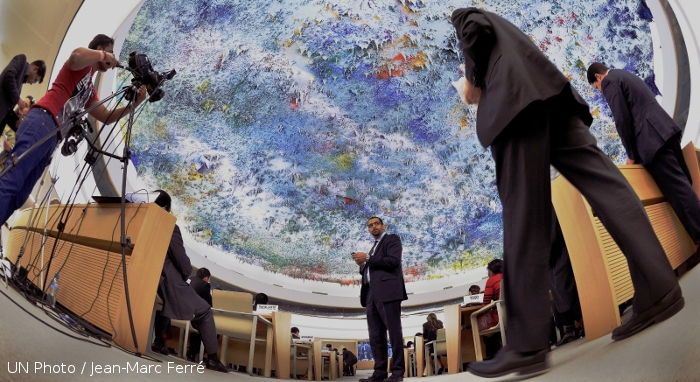
On 6 March the ISHR reported on that first week during which several dignitaries emphasised the key role that a vibrant civil society plays in promoting and protecting human rights.
The President of the General Assembly, Peter Thomson, highlighted the importance of civil society by calling States, the UN and civil society to work shoulder to shoulder and advance with common purpose. Other high-level speakers expressed concern regarding increasing restrictions to civil society space, particularly against HRDs and journalists.
Delegates from Botswana, the Czech Republic, Costa Rica, the European Union, France, Malta, Liechtenstein and Luxembourg, among others, reiterated their support to the work of HRDs and journalists and stressed the importance of guaranteeing their protection.
Delegates from Germany, Norway, Poland, Slovenia, Sweden and the United Kingdom, among others, condemned acts of reprisals against HRDs and emphasised that HRDs must be able to participate and engage with the Council without fear of intimidation or reprisals.
The pivotal role defenders play in promoting sustainable development was also recognised. Georgia underscored the importance of strengthening the role of NGOs and safeguarding civil society’s space to ensure they are heard. ‘Without close cooperation with all stakeholders, it is impossible to secure the sustainable development of the country.’
So, there is no shortage of good statements in Geneva, but the what matters most is the upcoming renewal of the mandate of the Special Rapporteur on Human Rights Defenders and any real action on reprisals!
The number of ‘side events’ in Geneva during the UN Human Rights Council is mind boggling. A full (provisional) list of 7 pages can be found at: http://www.files.ishr.ch/public/hrc34/Draft-HRC34-NGO.pdf. Some days have from 15 to 20 (parallel) events a day! I will from time to time draw attention to some that are specifically relevant to human rights defenders such as the one mentioned below:
The ISHR, together with the permanent mission of Finland, will organise and event on Ensuring sustainable development: the role and protection of defenders. On Thursday 2 March 2017, 10:30-11:45 in room 25. Palais des Nations. This event will explore the role and challenges faced by human rights defenders in contributing to sustainable development, and the interests and obligations of States and business should play in that regard. It will feature the participation of Joe Moses, the protagonist of the award-winning documentary “The Opposition” (extracts of which will be shown) about his activism in protecting the Paga Hill community from forced eviction in the wake of a real-estate project in Papua New Guinea, as well as experts from the UN and business community. see: https://humanrightsdefenders.blog/2016/04/14/showing-of-the-film-the-opposition-about-land-rights-in-papua-new-guinea-cancelled-until-further-notice/
A preview of what to look out for at the upcoming session of the UN Human Rights Council from 27 February – 24 March 2017. This selection of what is most relevant to human rights defenders is based on the excellent overview provided by the International Service for Human Rights (ISHR): Read the rest of this entry »
Camara Salimata SY, is the vice-president of Association des Femmes Chefs de Famille (AFCF – Association of female family heads). She talked to ISHR about her work on women’s rights and political participation in Mauritania. She also highlights the risks and challenges facing her and calls for more respect from the African Commission and African States for their human rights obligations.
Victor Nanklan Touré is the president of NGO ‘Club Union Africaine Côte d’Ivoire’ which is mainly working on statelessness and land issues. A human rights advocate for over 15 years he participated in the civil society training organised in Banjul from 15 to 16 October 2016 by ISHR, the Office of the High Commissioner for Human Rights and the African Centre for Democracy and Human Rights Studies. On this occasion he presented his work to ISHR and shared a message towards African political leaders.
The interview mentioned above is unfortunately only available in French.
Andrea Ixchíu Hernandez is an indigenous rights defender working for several organisations in Guatemala. She talks – in English – to ISHR (International Service for Human Rights) about her work to build up community media so the voices of indigenous people are heard and the violations they face are publicly unveiled.
Surendra Pratap works for the Centre for Workers’ Education in India. He talked to ISHR about his activities promoting workers’ rights and trade unions. This video clip was published in the ISHR Monitor of December 2016.
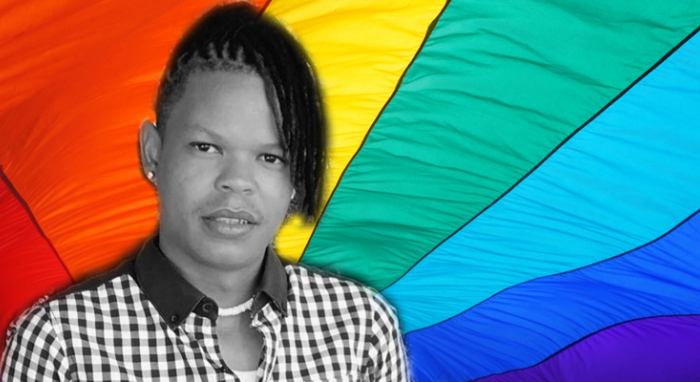
Jacobus was a human rights defender from Namibia who proudly defended and promoted the rights of of lesbian, gay, bisexual, trans and intersex people via Pan Africa ILGA. ISHR reported this in their ISHR Monitor of December 2016.
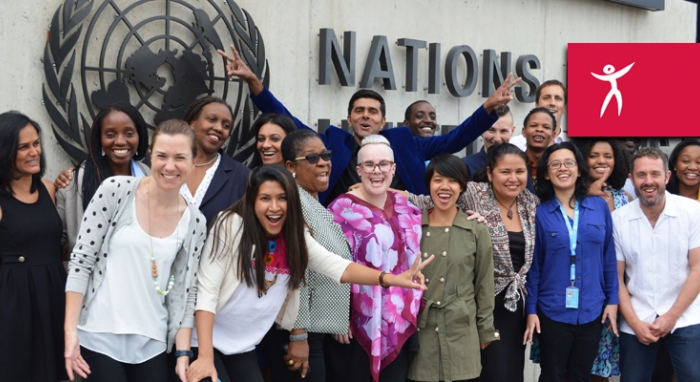
The International Service for Human Rights (ISHR) is calling for applications for its flagship Human Rights Defenders Advocacy Program in 2017 – the extensive training programme for human rights defenders. The training will take place in Geneva between 29 May and 9 June 2017 and provides defenders with opportunities to put their advocacy skills directly into action at the 35th session of the UN Human Rights Council.
ISHR’s Human Rights Defender Advocacy Programme (HRDAP) equips defenders with the knowledge and skills to make strategic use of the international human rights system. It also provides an opportunity for participants to directly engage in lobbying and advocacy activities at the UN level to effect change on the ground back home. As well as receiving training modules on all the UN human rights mechanisms from a range of experts, participants will also have the opportunity to build networks in Geneva and around the world, carry out lobbying of UN member States and UN staff, and learn from peers from a range of regions working on a range of human rights issues.
Participants will take part in:
A short online learning component, prior to face-to-face training, to enable you to consolidate your existing knowledge and develop your advocacy objectives;
Intensive training in Geneva during June, to coincide with the 35th session of the Human Rights Council. The training will focus on ways to effectively use international human rights mechanisms and to influence outcomes;
Specific advocacy at Human Rights Council sessions and other relevant meetings, with regular feedback and peer education to learn from the experiences, including expert input from leading human rights advocates.
This programme is directed at experienced human rights defenders in non governmental organisations and national human rights institutions, with existing advocacy experience at the national level and some prior knowledge of the international human rights system. If you are interested in applying for ISHR’s training programme, please read the call for applications to check that you comply with the requirements. The link to the online application form can be found under point 5 of the call for applications.
The call for applicants can be found here. For more information, write to hrdap2017@ishr.ch.
As the Geneva-based International Service for Human Rights (ISHR) is one of the most important sources of information on HRDs and the UN, I hope that many of you will be able to give them feedback on their various communications and digital publications by filling our the on-line survey in the link below. It indeed takes not more than 5 minutes to complete.



 Hans Thoolen on Human Rights Defenders and their awards