Blognovic’s post on this topic worth reading Turkey and the Internet.
Posts Tagged ‘internet’
Turkey and the Internet: restrictions increasing
February 8, 2014Committee to Protect Journalists publishes New Risk List: Where Press Freedom is going down
February 8, 2014The Committee to Protect Journalists [CPJ] has published its Risk List, indicating where press freedom is in decline. In determining the list, CPJ staff examined six press freedom indicators: fatalities, imprisonments, restrictive legislation, state censorship, impunity in anti-press attacks, and journalists driven into exile. Countries named to the Risk List are not necessarily the world’s worst places for journalists; such a list would include nations like North Korea and Eritrea, where free expression has long been suffocated. Instead, the Risk List identifies the 10 places where CPJ documented the most significant downward trends during 2012. Those trends included:
- High murder rates and entrenched impunity in Pakistan, Somalia, and Brazil.
- The use of restrictive laws to silence dissent in Ecuador, Turkey, and Russia.
- The imprisonment of large numbers of journalists, typically on anti-state charges, to thwart critical reporting in Ethiopia, Turkey, Vietnam, Iran, and Syria.
- An exceedingly high fatality rate in Syria, where journalists faced multiple risks from all sides in the conflict.
CPJ, which is publishing its Risk List for the first time, identified Syria and Somalia, which are racked by conflict, along with Iran, Vietnam, and Ethiopia, nations that are ruled with an authoritarian grip. But half of the nations on the Risk List– Brazil, Turkey, Pakistan, and Russia, along with Ecuador–practice some form of democracy and exert significant influence on a regional or international stage.
Threats to press freedom were not confined within the borders of these nations. Four Risk List countries sought to undermine international or regional press freedom initiatives during the year. Russia pushed for centralized control of the Internet ahead of the World Conference on International Telecommunications. Ecuador led an effort, supported by Brazil, to weaken the ability of the Inter-American Commission on Human Rights to intervene in cases of systemic or grave press freedom abuses. Brazil and Pakistan were among a handful of countries that tried to derail a U.N. plan to improve journalist security and combat impunity worldwide.
Setbacks in Brazil are particularly alarming given its status as a regional leader and home to a diverse array of news media. But a spike in journalist murders, a failure to address impunity, and a pattern of judicial censorship have put Brazil’s press freedom at risk, CPJ found. Turkey, too, has projected an image as a regional model for freedom and democracy. But while Prime Minister Recep Tayyip Erdoğan has expressed a commitment to press freedom, his administration has wielded an anti-terror law as a club to jail and intimidate journalists.
Less surprising, but no less worrisome are setbacks in Vietnam, Ethiopia, and Iran. Though Ethiopia and Vietnam have been applauded for economic strides, both countries have lagged in terms of openness and freedom of the press. Conditions worsened in 2012, as Ethiopian and Vietnamese authorities ramped up efforts to stifle dissent by imprisoning journalists on anti-state charges. Iran, ignoring international criticism of its press record, has intensified an assault on critical voices that began after the disputed 2009 presidential election.
In Syria and Somalia, where journalists faced risks from multiple sides, the death tolls have mounted. Crossfire was the leading cause of death for journalists in Syria, although at least three journalists were assassinated, CPJ research shows. Both rebels and forces loyal to President Bashar al-Assad have been implicated in acts of violence against the press. All 12 journalists killed in Somalia in 2012, the country’s bloodiest year for the press, were targeted in direct reprisal for their reporting. Both insurgents and government officials were suspected of involvement. In both countries, the ranks of young journalists, many with little training and experience, have been particularly hard hit.
In the full report below you can find capsule reports on the 10 nations named to the CPJ Risk List:
Dutch Advisory Council broadly endorses Government’s human rights policy
January 10, 2014On 24 September 2013 the Dutch Advisory Council on International Affairs [AIV] published its advice on the Government’s policy letter (a kind of white paper) on human rights (“Respect and Justice for All”) of June 2013. The Council, which can be quite critical, has broadly endorsed the proposed policy. The link to the full document is below but the highlights are as follows: Read the rest of this entry »
NEW TACTICS in Human Rights: 2013 accomplishments and plans for 2014
January 3, 2014We start the year with a little survey of what New Tactics in Human Rights accomplished in 2013: they trained 114 human rights defenders from the Middle East and North Africa [MENA region] on Strategic Effectiveness method and expanded their capacity in the MENA region for training and mentorship for human rights defenders. New material, including 20 new human rights tactics, were added to the website and there is now a French-language landing page. New Tactics also launched an Arabic version of its website and online community. In the Arabic-language community, it hosted 6 online conversations that engaged 60 human rights defenders from around the MENA region. In its English-language community, it hosted 10 online conversation that engaged 153 human rights defenders. Summaries of all of these conversations can be found on its website. In 2014 it will launch its New Tactics Strategy Toolkit, an online collection of tools to help defenders create effective strategies.
My post number 1000: Human Rights Awards finally made accessible for and by True Heroes
November 27, 2013To mark my post number 1000, I have chosen the subject of human rights awards, timely as today, 27 November, is also the LAUNCH OF THE TRUE HEROES AWARDS DIGEST on www.trueheroesfilms.org. The number of human rights awards has exploded with over 50 new awards created in just the last decade, bringing the total number to well over 100. Most of the research was done when I was writing an article on Human Rights Awards for the Special Issue of the OUP Journal of Human Rights Practice on ‘The Protection of Human Rights Defenders” which comes out on 29 November (for more info go to: http://jhrp.oxfordjournals.org/). Doing the research I found that the information on awards is scattered all over the internet and that human rights defenders would greatly benefit if the dat were put all together in a searchable way in a single Digest.
The double face of technology for Human Rights Defenders
November 13, 2013 Technology is becoming increasingly important in documenting and preventing human rights abuses. But emerging technologies can also pose a threat to human rights defenders. Two pieces on AI’s blog demonstrate that:
On 11 November Tanya O’Carroll, Technology & Human Rights Project Officer, and Danna Ingleton, Individuals & Communities at Risk Research & Policy Advisor, blogged under the title: “An Invisible Threat: How Technology Can Hurt Human Rights Defenders“while Sami Goswami used the headline: “How Technology Is Helping Us Better Protect Human Rights”.
The piece focusing on the negative aspects says inter alia Read the rest of this entry »
Amnesty criticizes Vietnam with regard to HRDs, especially those using the internet
November 11, 2013Authoritarian Vietnam has stepped up an alarming crackdown on domestic dissent even as it seeks a seat on the UN Human Rights Council, Amnesty International says on 7 November. Vietnam is using a raft of draconian legislation to clamp down on a growing number of citizens who seek to question the party’s stranglehold on power. “Vietnam is fast turning into one of Southeast Asias largest prisons for human rights defenders and other activists” said Amnesty researcher Rupert Abbott to AFP. Read the rest of this entry »
Join on-line Conversation on the power of narrative for HRDs as from today
October 14, 2013
You can Join the Center for Story-based Strategy CSS and the New Tactics community for an online conversation on Change the Story: Harnessing the power of narrative for social change from October 14 to 18.
People and communities use stories to understand the world and our place in it. These stories are embedded with power – the power to explain and justify the status quo as well as the power to make change imaginable and urgent. …This conversation is an opportunity for human rights defenders to learn more about story-based strategy and how to integrate it into campaign planning. This is also an opportunity for those practitioners using story-based strategy to share their experiences, questions, and ideas with each other. Practitioners to lead this conversation are:
Danielle Coates-Connor, Conversation Facilitator of the Center for Story-based Strategy
Nathan Schneider of Waging Nonviolence
Soriano of Lionswrite Communications
Kathleen Pequeño of the Progressive Communicators Network
Nadia Khastaqir of the Design Action Collective
Kristi Rendahl of the Center for Victims of Torture
Lama Sangye and Justin Von Bujdoss of the New York Tsurphu Goshir Dharma Center
Chris Cavanagh of the Catalyst Centre
Dr. Cara Lisa Berg Powers of Press Pass TV
Laura Revels, Digital Storytelling Trainer
Shreya Atrey, practitioner.
September’s Conversation on Media Tactics for Social Change now has a summary posted and in November there will be a Conversation on Visualizing Information for Advocacy, in partnership with Tactical Technology Collective.
via Join our conversation on the power of narrative, this week!.
20th MEA ceremony broadcast live on 8 October 18h00
October 5, 2013The 20th Ceremony of the Martin Ennals Award for Human Rights Defenders will take place on Tuesday 8 October and can be followed live on www.martinennalsaward.org as from 18h00 Central European (Geneva) time. The moment of the announcement of the laureate will be approximately 18:30.
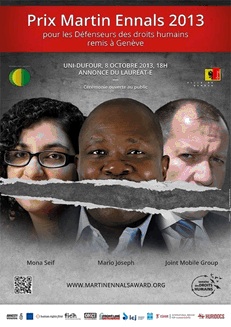
As a reminder, the 3 Final Nominees are: Read the rest of this entry »
 Hans Thoolen on Human Rights Defenders and their awards