ISHR, Amnesty International and Human Rights Watch organise a meeting on STRENGTHENING AND LEVERAGING HUMAN RIGHTS COUNCIL MEMBERSHIP on Monday 1 July 2019, 13h00-14h30 Restaurant des Délégués, 8th Floor, Palais des Nations, Geneva.The composition of the HRC has captured significant public attention over the past year – with people around the world rightly asking: how can States accused of gross and systematic human rights violations become members of the United Nations’ Human Rights Council? And what does that mean for the credibility and effectiveness of this body? Clearly, for the HRC to be effective, and to be credible and relevant to the wider human rights community, and the wider public, it needs members committed to the promotion and protection of human rights at home and abroad in its 47 seats, as foreseen by UNGA resolution 60/251. Of course, no State has a perfect human rights record, and a wide and diverse range of States should be encouraged to address their shortcomings and enhance their commitment to human rights through HRC participation and engagement. While the argument does not apply to candidates that are in clear breach of the membership criteria, HRC membership may be an important incentive for national-level change, particularly where States, as candidates, make voluntary pledges and commitments, and are willing and able to implement them. The framing and implementation of those pledges and commitments is, however, rarely discussed at national or international level. Against this backdrop, in February 2019, Amnesty International, Human Rights Watch, the International Service for Human Rights (ISHR) and HRC-net convened a one-day dialogue bringing together national and regional actors – including human rights defenders and NHRIs – with a cross-regional group of State representatives, OHCHR officials and international civil society, to address two important and interlinked questions regarding HRC membership: 1) how can we encourage greater respect and application of the membership criteria clearly set out in GA resolution 60/251; and 2) how can a State’s membership of the HRC be leveraged for positive change on human rights at national level? Drawing on good practices and lessons learned, participants identified a range of challenges, opportunities and practical recommendations. A report of the one-day dialogue will be presented during a lunch time reception at the Restaurant des Délégués on 1 July, in the side-lines of the 41st session of the Human Rights Council. The reception will provide an opportunity for the presentation of some of the key challenges, opportunities and practical recommendations identified in the report, including with regards to good practice relating to candidacy and membership of the HRC.
Speakers:
- Ambassador Nazhat Shameem Khan, Permanent Representative of Fiji to the UN
- Salma El Hosseiny, ISHR’s Human Rights Council Advocate
- Hilary Power, Amnesty International’s Senior UN Advocate
Please RSVP by clicking here <https://crm.ishr.ch/sites/all/modules/civicrm/extern/url.php?u=884&qid=111418> by 19 June 2019 to confirm your participation at this event.

Standing at 6 foot 3, with freckled features and a low-key leadership style, Mr. Bernstein began his career as a junior office boy at Simon & Schuster and rose to become the president, chief executive and chairman of America’s most renowned publishing house…

Mr. Bernstein’s memoir, “Speaking Freely: My Life in Publishing and Human Rights,” was published in 2016. (Courtesy of the New Press)
For decades, he spent what few free hours he had promoting human rights, a passion that deepened in the 1970s when he visited Moscow with a delegation of American publishers. His meetings with dissidents such as Andrei Sakharov, the nuclear physicist and Nobel Peace Prize laureate, led him to create the Fund for Free Expression, a group of writers, editors and other literary figures concerned with rights abuses around the world. In the aftermath of the 1975 Helsinki Accords, he also formed Helsinki Watch to monitor the protection of basic freedoms behind the Iron Curtain. It was followed by similar organizations centered on the Americas, Africa, Asia and the Middle East, which merged in 1988 to form Human Rights Watch.
Mr. Bernstein sometimes held board meetings for the organization out of Random House’s headquarters in Manhattan and participated in its research activities firsthand. In 1985 he flew to Nicaragua and drove “to within 20 miles of the Honduran border,” according to a Times report, “to investigate charges that acts of terrorism were being waged by the contras against unarmed civilians.”
Combining his interests, Mr. Bernstein published works by dissidents around the world, including Sakharov and his wife, Yelena Bonner; Natan Sharansky, a former Soviet political prisoner; Jacobo Timerman, who was tortured by Argentina’s military government in the 1970s; and Vaclav Havel, the Czech statesman and playwright.
Mr. Bernstein shifted his focus to Human Rights Watch, which was active in 70 countries by the time he stepped down as chairman in 1998. That same year, President Bill Clinton honored him as one of the first recipients of the Eleanor Roosevelt Award for Human Rights, calling Mr. Bernstein “a pathbreaker for freedom of expression and the protection of rights at home and abroad.”..
In 2009, he took the unusual step of criticizing the organization he had founded, writing in an op-ed column for the Times that Human Rights Watch had issued reports “on the Israeli-Arab conflict that are helping those who wish to turn Israel into a pariah state.”
The group, he argued, was better served focusing on closed authoritarian states such as Iran than condemning violations of international law in Israel. (Two chairs of the organization disagreed with his reasoning, writing in a letter to the Times that “it is essential to hold Israel to the same international human rights standards as other countries.”)


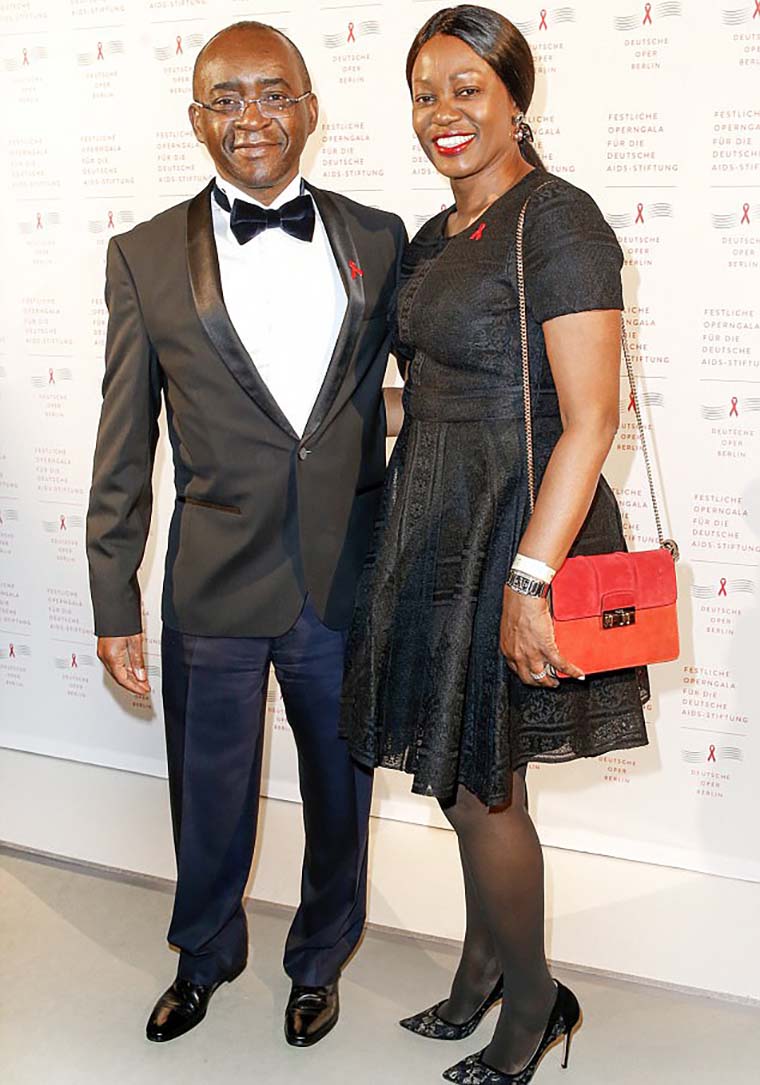 Strive Masiyiwa and his wife
 Hans Thoolen on Human Rights Defenders and their awards