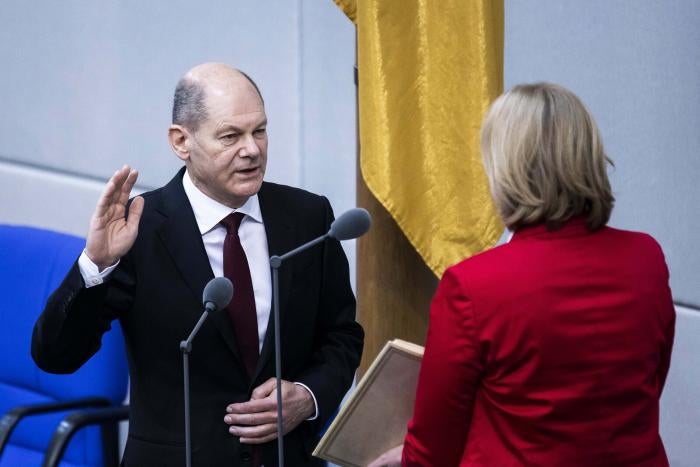
On 10 December 2021, David Fischer, HRW’s Media Coordinator, Germany published “A Human Rights Roadmap for Germany’s New Government“
…The climate crisis threatens catastrophic impacts on human rights, and ambitious climate action by the government to reduce greenhouse gas emissions is critical if Germany – the European Union’s biggest greenhouse gas emitter – is to help prevent the worst of those impacts. The new government’s coalition agreement, a non-binding roadmap for legislative action, calls for elimination of coal energy “ideally” by 2030, promises a roll-back of subsidies for fossil fuels and legislation to deal with climate change adaptation planning. These are positive steps but insufficient to reach Germany’s contribution toward the global goal in the Paris Agreement of limiting global warming to 1.5°C above pre-industrial levels.
In addition to the climate crisis, the new coalition between the Social Democrat Party (SPD), the Free Democrats (FDP) and the Greens (Die Grünen) will have to tackle challenges to the rule of law within the EU, stand up for human rights against autocrats in China and Russia, and address the many challenges arising from the pandemic.
The coalition agreement makes promising commitments to advance the rights of lesbian, gay, bisexual, and transgender (LGBT) people, including to change the law on legal gender recognition for transgender people so that it is based on self-determination. The coalition also commits to protecting human rights in supply chains in line with the UN Guiding Principles on Business and Human Rights that include the right to a remedy for victims. It proposes to increase the capacity of German courts to prosecute universal jurisdiction cases such as the trial on state-sponsored torture in Syria.
Within Europe, the new government intends to push for judgements of the European Court of Human Rights to have greater impact and “be implemented in all member states”. It supports the use of mechanisms and sanctions to enforce the rule of law in European Union member states. It also calls for shared responsibility for migrants and refugees among member states, an end to pushbacks at EU borders and for the border agency Frontex to respect human rights.
Scholz’s new government will now need to live up to expectations on human rights and prove that what the coalition dubbed “Germany’s responsibility for Europe and the World” is expressed in actions and not just words.
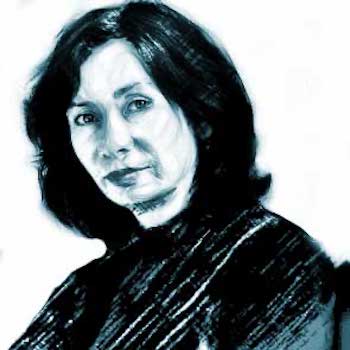
Natalia – Natasha to me and many others – was a colleague and very close friend. I last saw her 36 hours before the murder, while staying at her place in Grozny, as I always did when in Chechnya. We’d spent a week interviewing people whose homes police had torched because of their alleged involvement with militants, and whose relatives had been rounded up, disappeared, or killed by security officials.
We said goodbye just past midnight on July 14. When I woke up later that morning, Natasha had already left for an early meeting, so I went to the airport without getting to see her again. The next day, armed men pushed her into a car as she was running to catch a bus to the city center. They drove her into neighboring Ingushetia and shot her near the forest.
In 2011, having lost hope for an effective investigation by Russian authorities, Natasha’s family filed a complaint with the European Court, alleging a violation of her right to life because Russian authorities failed to protect human rights defenders in Chechnya, Chechnya’s leadership repeatedly threatened Natasha, and her abduction was apparently carried out by security officials.
Ten years later, the court ruled today that Russia had failed to investigate but also held that there wasn’t sufficient evidence to conclude that state agents had murdered Natasha.
The ECHR noted that Russian authorities promptly opened a probe into Estemirova’s killing and identified a suspect, but emphasized that Moscow’s failure to provide full materials of the case made the court “unable to conclude that the investigation had been carried out thoroughly.” It noted some contradictions in the expert evidence led it to doubt that the investigation had been effective.
The victim’s sister, Svetlana Estemirova, alleged in her appeal that state agents were behind the killing but the Strasbourg-based court ruled that the evidence didn’t support the claim.
The court required Russia to pay 20,000 euros ($23,600) to Estemirova’s sister and urged Russian authorities to track down and punish the perpetrators of her murder.
“I had very high hopes and it would be an understatement to say that I’m disappointed,” Natasha’s daughter Lana, who was 15 when she lost her mother, told me today.
The lack of sufficient evidence the court cited is a direct result of Russia’s brazen determination to protect the perpetrators of this outrageous murder. Natasha was killed for fearlessly exposing abuses by Chechen authorities. An effective investigation would leave no doubt about official involvement in her murder.
In December 2016, Russia designated the Southern Human Rights Center (SHRC) as a foreign agent, considering it to be engaging in political activity. The SHRC is an organization providing pro bono legal services on human rights issues in Russia. Given this status, Russian law required the SHRC to register as a foreign agent. According to Human Rights Watch (HRW), “foreign agent” connotes being a traitor or spy. [see: https://humanrightsdefenders.blog/2019/11/19/russias-foreign-agents-bill-goes-in-overdrive/]
In February of 2017, Russia fined the SHRC for its failure to register. A Russian court determined Simonov, the President of the SHRC, would be held liable to pay the fine in July of 2019 following the SHRC’s non-payment. Sunday’s ruling imposed a sentence of 250 hours of community service onto Simonov for failure to pay the fine.
Simonov has a long history of championing for human rights. He has documented the human rights violations endured by migrant workers preparing for the 2018 FIFA World Cup and the 2014 Winter Olympics.
Simonov’s criminal case has been heavily criticized by the human rights community. HRW’s Russia Researcher, Damelya Aitkhozhina, said “The criminal case against Semyon Simonov has been a sham from start to finish. It’s shocking and abhorrent that the authorities wasted so much time and resources on a case in which the accused did nothing but help people protect their rights.”
Similarly, the country’s foreign agents law itself has faced calls for repeal. It has been criticized for quashing dissent and undermining the United Nations’ Declaration on Human Rights Defenders which provides in article one that everyone has the right “to promote and to strive for the protection and realization of human rights”.
Radio Free Europe/Radio Liberty filed a lawsuit challenging the country’s foreign agents law, citing concerns about the controversial law’s “profound chilling effect”.
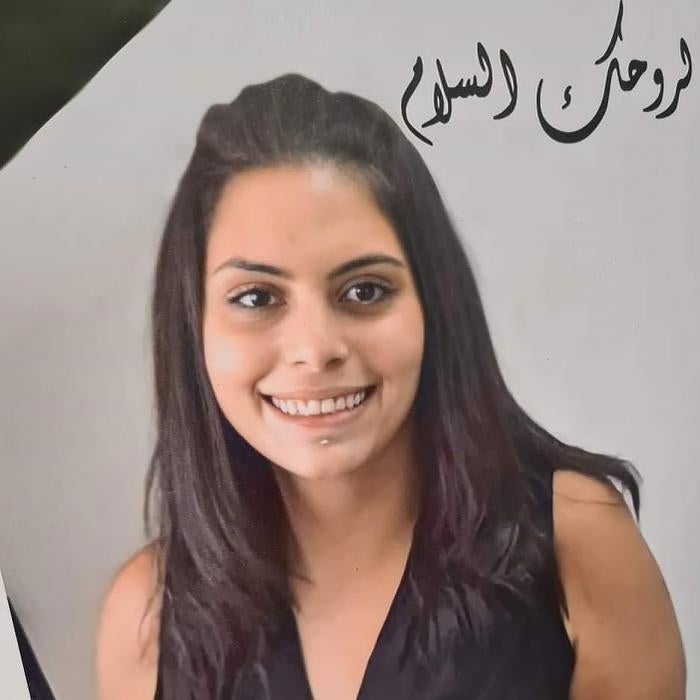
Omar Shakir wrote an obituary for Suha Jarrar, research and advocacy officer at Palestinian human rights organization al-Haq, who died at her home in Ramallah in the Israeli-occupied West Bank. Over her 31 years, Suha made an indelible impact on human rights advocacy in Palestine. He added that the Israeli Authorities should allow the detained mother, Parliamentarian Khalida Jarrar, to attend the funeral
Suha conducted innovative research on the environmental impacts of the Israeli occupation, including a 2019 report arguing that discriminatory Israeli policies and practices impede the ability of Palestinians in the occupied West Bank to adapt to climate change. As point person on gender issues for al-Haq, she represented the organization when the United Nations Committee on the Elimination of Discrimination against Women deliberated on the situation of women in Palestine. She researched, advocated, and fearlessly pushed to mainstream within Palestinian civil society the full range of rights issues related to gender and sexuality, even where perilous and proscribed.
Suha died without her mother nearby, since Khalida Jarrar sits in an Israeli jail. For most of the last six years, Israeli authorities have detained Khalida, a 58-year-old elected member of the Palestine Legislative Council, over her political activism with the Popular Front for the Liberation of Palestine (PFLP). One of the more than 400 organizations that Israeli authorities have outlawed, the PFLP includes both a political party and an armed wing. The armed wing has attacked Israeli soldiers and civilians. Israeli authorities have never charged Khalida with involvement in armed activities.
Khalida spent long stretches, including between July 2017 and February 2019, in administrative detention without trial and charge. In March 2021, an Israeli military court sentenced her to two years in prison for “membership in an unlawful association,” based on a plea deal, with Israeli military authorities acknowledging that she “did not deal with the organizational or military aspects of the organization.” Detaining Khalida over her political activism violates her freedom of association, as Human Rights Watch has documented. The suspension of civil rights to the millions of Palestinians living in the Occupied Palestinian Territory is a central part of the Israeli government’s crimes against humanity of apartheid and persecution.
Suha’s infectious smile never faded, even though for much of her adult life, her mother was unjustly behind bars. Israeli authorities have reportedly denied a request for Khalida to attend Suha’s funeral. Having repeatedly detained Khalida in violation of her rights, Israeli authorities should at minimum allow her to say goodbye to her daughter.
EJIL Talk!, the Blog of the European Journal of International Law, last week had a symposium (see: https://www.ejiltalk.org/), which has addressed a number of legal issues arising from HRW’s report released in late April 2021 “A Threshold Crossed: Israeli Authorities and the Crimes of Apartheid and Persecution.” This report has received significant media attention.
On 9 july 2021 Clive Baldwin, Senior Legal Adviser of HRW, uses the opportunity to contribute to a substantive discussion focusing primarily on the implications of the report for the broader international legal discourse.
After detailed discussion of the international LEGAL aspects, he concludes:
The discussion demonstrates the importance of considering the term “apartheid” under international criminal law as a specific crime against humanity, together with the closely related crime against humanity of persecution. This requires a legal understanding of its definition and constitutive elements, as well as of ways to apply it. To even begin the process of criminal justice, prosecutors – and in particular those at the ICC – will first need to understand and investigate these crimes. Legal discussions like this symposium can, we hope, help advance this objective. These are crimes against humanity that have been neglected for too long.
Alan Macleod in Mint-press News of 7 May 2021 studies in quite some detail the way in which the recently released Human Rights Watch (HRW) report has made waves around the world and the organised backlash that followed.
The 213-page study goes into detail about a range of racist laws and policies carried out by successive administrations, concluding that there is an “overarching Israeli government policy to maintain the domination by Jewish Israelis over Palestinians and grave abuses committed against Palestinians living in the occupied territory, including East Jerusalem.” The report accuses the state of Israel of widespread “institutional discrimination” and of “denying millions of Palestinians their fundamental rights…solely because they are Palestinian and not Jewish.” It further notes that, across Israel and the Occupied Palestinian Territories, it has “sought to maximize the land available for Jewish communities and to concentrate most Palestinians in dense population centers.”
“Prominent voices have warned for years that apartheid lurks just around the corner if the trajectory of Israel’s rule over Palestinians does not change,” said the organization’s executive director, Kenneth Roth. “This detailed study shows that Israeli authorities have already turned that corner and today are committing the crimes against humanity of apartheid and persecution.
Perhaps most importantly, Human Rights Watch is now openly calling for global action to end the repression. The report asks the International Criminal Court to investigate and prosecute those involved in Palestinian persecution. While not explicitly endorsing the Boycott, Divestment and Sactions (BDS) movement, Human Rights Watch directly advocates that “[s]tates should impose individual sanctions, including travel bans and asset freezes, against officials and individuals responsible for the continued commission of these serious crimes,” and for businesses to “cease business activities that directly contribute to the crimes of apartheid and persecution.”
A big splash
The report was widely covered across the world and has been heralded by Palestine solidarity activists, with experts seeing it as a potential turning point in the struggle for Palestinian sovereignty. “It was inevitable that Human Rights Watch would have to declare Israel an Apartheid state and, from what I hear, Amnesty International is going to be next to say it,” Asa Winstanley of the Electronic Intifada told MintPress. “It puts Israel’s backers in a difficult spot because Human Rights Watch is really part of the establishment so they cannot just dismiss it and it makes it impossible to ignore… It is harder for them to say Human Rights Watch is anti-Semitic, but they’re trying it anyway,” he added.
Trying indeed. Michigan Congresswoman Lisa McClain tweeted that “Human Rights Watch has shown again how they have an anti-Israel agenda,” suggesting they instead focus their attention on China or Iran’s repressive governments. “Hostility and hypocrisy are HRW’s hallmarks when it comes to Israel,” wrote the American Jewish Committee. The Jerusalem Post’s editorial board was equally condemnatory, denouncing what they saw as the “cynical appropriation of the suffering of the victims of the actual apartheid regime.” Other Israeli journalists described the report as “a disgrace to the memory of the millions who suffered under that policy [apartheid] in South Africa.” The news even made enough waves to force a response from the White House. Press Secretary Jen Psaki replied that “[a]s to the question of whether Israel’s actions constitute apartheid, that is not the view of this administration.”
Organized spontaneity
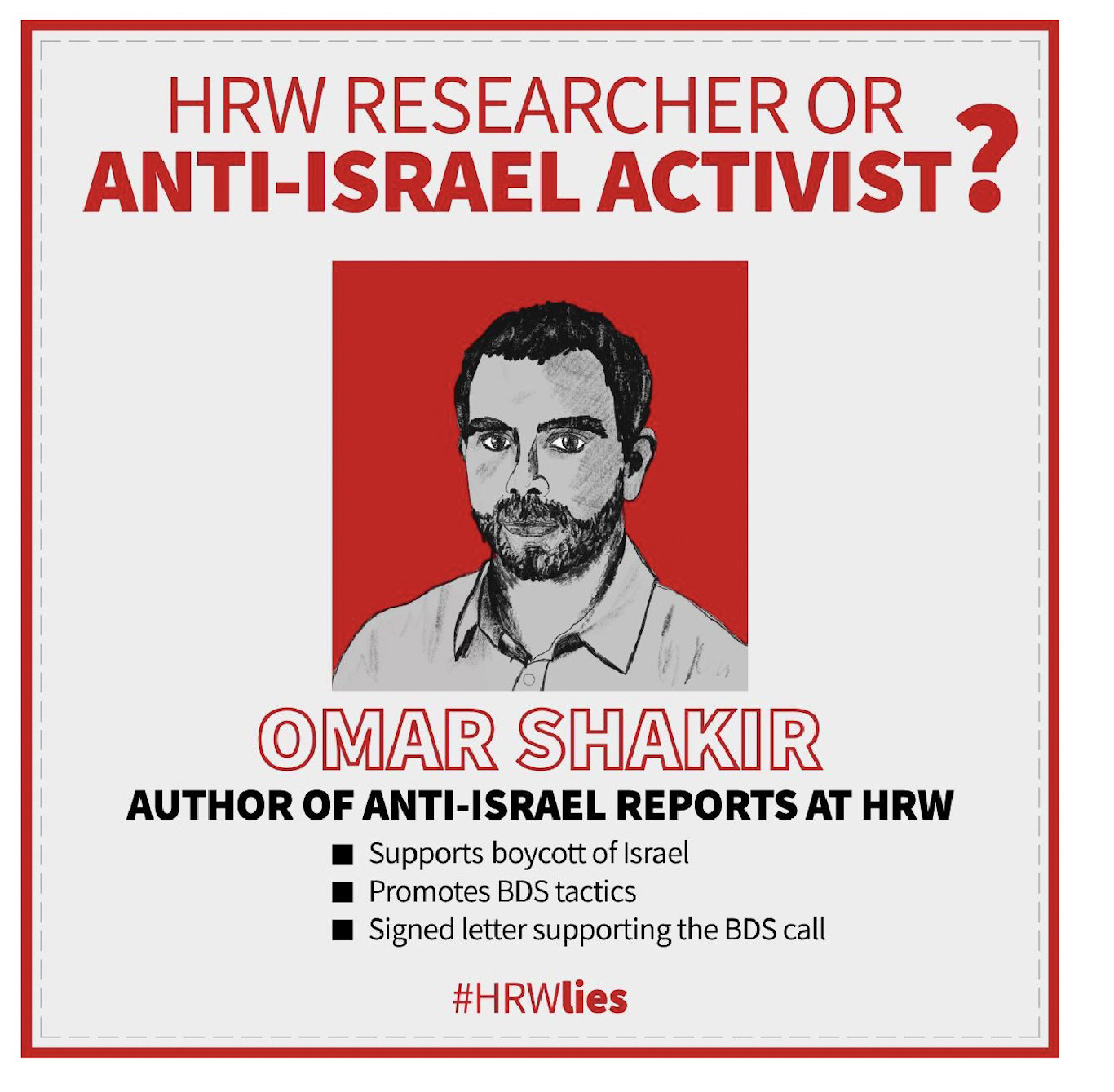
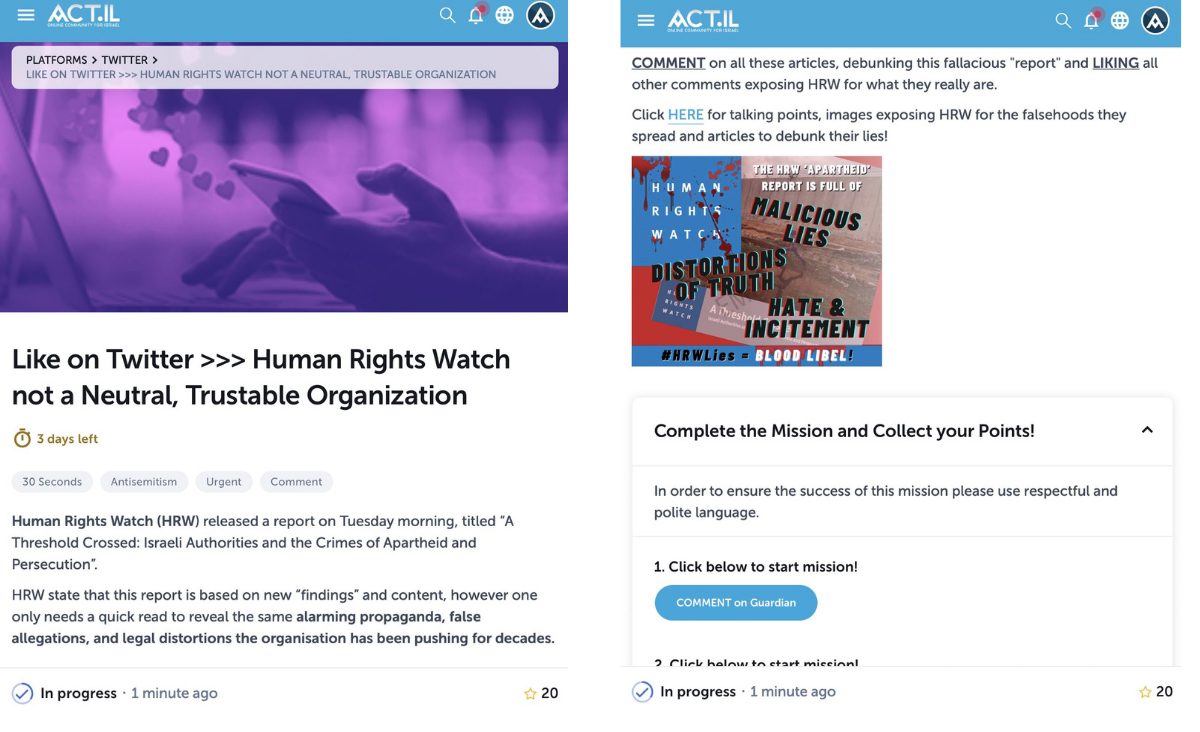
Yet much of the online anger at the report was actually manufactured by an Israeli government-sponsored app, Act.IL, which organized supporters of the Jewish state to act in sync to create an artificial groundswell of opposition to it. The app, which reportedly has a budget of over $1 million per year, instructed users to leave combative comments on Facebook, Twitter, and popular news outlets, and to like and promote others who did the same.
Human Rights Watch’s Facebook post announcing the report’s release has received over 1,400 comments, hundreds of them written in a similar, scathingly negative tone. One that the app directly told users to signal boost, for instance, described Palestinians as a people “indoctrinated with hate for Israel and Jews for over 100 years,” and claimed they were paid salaries to murder Israelis. It also presented the 1967 war and occupation as a humanitarian effort to bring electricity and other infrastructure to Arabs.
Another “mission” Act.IL gave its users was to promote a Facebook comment attacking the report as “nothing more than hate speech” and calling its lead author a “rabid anti-Zionist and Israel hater.”
One of the many images provided to Act.IL users for their astroturfing campaign against HRW
Act.IL is one of the chief tools in Israel’s online public relations enterprise. The app debuted in 2017 and is part of what Israeli Minister of Strategic Affairs Gilad Erdan called an “Iron Dome of Truth.” “Our cell phones are the number one weapon against us,” he explained, noting that public opinion in the U.S. was beginning to turn against them. While most of the app’s nearly 20,000 users are volunteers, a core of them are paid operatives, with many students receiving scholarships as a reward for their work.
The app has been designed to feel like a game, with points assigned for completing “missions” such as sharing pro-Israel videos, reporting anti-Israel content, signing petitions, or attending online seminars. Users can track their progress on leaderboards, earn badges and prizes, and chat with other members of the community. While it might feel like Animal Crossing or World of Warcraft for some, its creators see this very much as a new front in the war against Palestine. Israeli Justice Minister Ayelet Shaked categorizes BDS as “another branch of terrorism in the modern age,” and has been an important voice in taking the fight to a new front.
An Act.IL mission encouraging astroturfing of online discussions. Source | @AntiBDSApp
There is also an online toolkit full of folders of responses to typical questions and issues that arise. Users can, for instance, go to the BDS folder to find stock replies to their arguments. Or they can go to a specific folder to find articles, images and videos they can use to demonize Hamas.
The missions are organized by outlet, so users can, for instance, target only Facebook, Telegram, or other platforms they are most familiar with. At the time of writing, there are 10 missions each to complete on Facebook and YouTube, 30 on Instagram, 25 on Twitter.
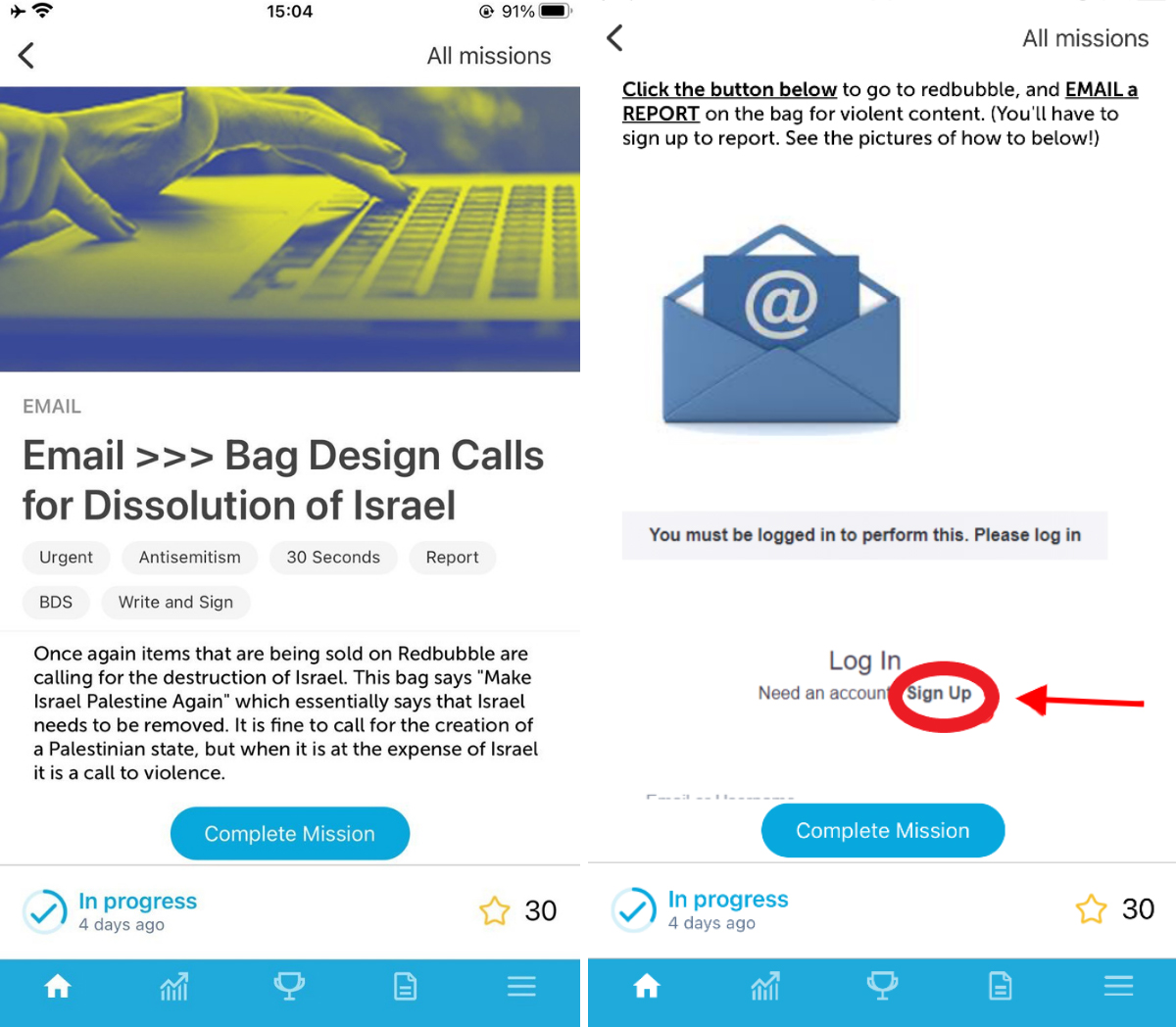
One current challenge is to upvote an answer to a question on Quora that asks about the validity and purpose of checkpoints in the West Bank. The answer claims they are purely about protection from terror attacks, and claims that Red Crescent ambulances are used to ferry bombs around the area. Other missions include pressuring an online store to remove a bag with a message stating “Make Israel Palestine Again.”
An Act.IL “mission” encouraging users to demand the removal of products with pro-Palestinian messaging
“It is quite astounding how openly they do it. But, of course, when you see a comment online, you wouldn’t necessarily think that it was coming from the Israeli government, but this is essentially what is happening,” Winstanley said. “Israel is not the only state to do this, but they do it fairly successfully.”
For all this, however, it is clear that Act.IL has a serious problem with user retention and lacks the volunteer numbers for it to be truly game changing.
Controlling the message
In a time of heightened awareness about foreign government interference online, it is particularly surprising that these operations can be openly carried out across virtually every major platform. Big tech companies like Twitter, YouTube and Facebook are constantly deleting tens of thousands of Russian, Chinese, Iranian and Cuban accounts belonging to what they claim are organized, state-sponsored disinformation campaigns.
In an effort to gauge the legality of its operations, MintPress reached out to Facebook, YouTube, Quora, and other big platforms used by Act.IL. We received no response from any of them. While this is particularly noteworthy — as these companies have teams of public relations representatives and are extremely forthright and timely with responses on other issues — it is perhaps not surprising. Facebook especially has long been working closely with the Israeli government in deciding which voices to censor. As far back as 2016, Ayelet Shaked boasted that Facebook removed 95% of the posts her office asked them to. Yet when Shaked herself called for a genocidal war against Palestine and its women, who give birth to “little snakes,” not only did the post remain online, it received thousands of likes and was widely circulated.
“The concern is that Facebook is adopting Israeli policy and terminology when it comes to defining what incitement is,” said Nadim Nashif, co-founder of 7amleh, the Arab Centre for the Advancement of Social Media. 7amleh was therefore dismayed when last year, Facebook appointed former Israeli Minister of Justice Emi Palmor to its Oversight Board, the council having the final say in the moderation of content on the platform used by 2.6 billion people worldwide. In her role as justice minister, Palmor was directly implicated in the persecution and subjugation of Palestinians.
Earlier this year, an Israeli Defense Forces soldier attempted to sue a Palestinian-American activist living in California over an allegedly slanderous Facebook post condemning her for participating in ethnic cleansing. Remarkably, the plaintiff attempted to convince a California judge to apply Israeli law to the incident, despite the fact that both she and the defendant are American citizens. https://cdn.iframe.ly/r7H7ueP?iframe=card-small&v=1&app=1
Inside the world of academia, professors critical of Israel have found themselves pushed out of the profession. In 2007, prominent critic of Israel Norman Finkelstein was denied tenure at DePaul University for political reasons. Seven years later, the University of Illinois “unhired” Steven Sailata for his comments denouncing Operation Protective Edge, the 2014 Israeli attack on Gaza. Emails showed that wealthy donors put significant pressure on the university to pull the plug on him. More recently, Cornel West was blocked from a tenured job at Harvard this year, despite having previously held tenure at Harvard, Princeton, and Yale. “Being the faculty advisor for the Palestinian student group was the one that probably went outside of the line for many Harvard staff,” West told Krystal Ball and Kyle Kulinski. “It’s a joke. It’s ridiculous. It’s ludicrous. It’s preposterous that it wouldn’t have something to do with politics.”
Top media figures have also paid the price for their support of BDS. CNN fired commentator Marc Lamont Hill after he made a speech at the United Nations calling for a free Palestine. Meanwhile, journalist Abby Martin was blocked from speaking at a conference at Georgia Southern University last year after she refused to sign a contract promising to renounce BDS. Georgia is one of dozens of U.S. states to have anti-BDS legislation, essentially forcing any would-be recipient of public contracts or funds, including government employees, to sign a pledge not to boycott Israel. Martin is currently suing the state of Georgia. MintCast Interviews Abby Martin About Her Anti-BDS Lawsuit & The Israel Lobby…
While Human Rights Watch’s report is new, the charge of apartheid is not. In 2017, a United Nations report “clearly and frankly concludes” that Israel is “a racist state that has established an apartheid system that persecutes the Palestinian people.” Earlier this year, Israeli human rights organization B’TSelem also used the word “apartheid,” claiming that Israel had established “a regime of Jewish supremacy from the Jordan River to the Mediterranean Sea.”…
Advocates for Palestine hailed Human Rights Watch’s study. Phyllis Bennis of the Institute for Policy Studies wrote:
There can be little doubt that much of HRW’s decision to issue this report now was based on the recognition that not only is it no longer political suicide to call Israeli apartheid what it is, but that we are now at a tipping point whereby failing to call out apartheid risks losing credibility for a human rights organization. It’s a huge victory for our movement.”
The battle, however, is far from won, and it is clear that the Israel lobby will continue to fight to hold back the tide until it is insurmountable.
Human rights groups called on the Philippine government to investigate what they said was the use of “lethal force” during police raids on Sunday that left at least nine activists dead. The raids in four provinces south of Manila resulted in the death of an environmental activist as well as a coordinator of left-wing group Bagong Alyansang Makabayan, among others, and resulted in the arrest of four others, activist groups said.
“These raids appear to be part of a coordinated plan by the authorities to raid, arrest, and even kill activists in their homes and offices,” Human Rights Watch Deputy Asia Director Phil Robertson said in a statement.
These incidents, he said, were “clearly part of the government’s increasingly brutal counter-insurgency campaign“. “The fundamental problem is (that) this campaign no longer makes any distinction between armed rebels and noncombatant activists, labour leaders, and rights defenders.” The United Nations has warned in a report that “red-tagging”, or labelling people and groups as communists or terrorists, and incitement to violence have been rife in the Southeast Asian nation.
“The Philippines government should act now to investigate the use of lethal force in these raids, stop the mayhem and killings that has gone hand in hand with the practice of red-tagging,” Robertson said.
Sunday’s raids, which human rights group Karapatan condemned, came two days after President Rodrigo Duterte ordered the police and military to “kill” communist rebels and “ignore human rights”.
“Nothing could be more apt than calling this day a ‘Bloody Sunday,’” Karapatan’s Cristina Palabay said.
Lieutenant General Antonio Parlade, head of an anti-rebel task force, told Reuters the raids were “legitimate law enforcement operations”, and authorities acted on the basis of search warrants for possession of firearms and explosives.
“As usual these groups are so quick in assuming that the subjects were activists and that they were killed. If (the) motive was to kill them they should all be dead but there were those who did not resist arrest so they were collared,” Parlade told Reuters in a phone message. — Reuters
In the meantime on 7 March 2021 Rappler.com reported that UK lawmakers called for release of jailed Duterte critic De Lima
Signatories include Rt Hon Dame Diana Johnson, MP (chair, All Party Parliamentary Human Rights Group), Tonia Antoniazzi MP, Harriett Baldwin MP, Paul Blomfield MP, Tracy Brabin MP, Lyn Brown MP, and Dawn Butler MP, according to the Office of Senator Leila de Lima.
“President Duterte’s self-styled ‘war on drugs’ has seen an estimated 30,000 extra-judicial killings – along with increased targeting of journalists and human rights defenders, and the undermining of judicial independence,” they added.
A Muntinlupa court on Friday, March 5, dismissed her second drug case appeal, even as she was earlier acquitted in another case. A third case against her is pending before another court.
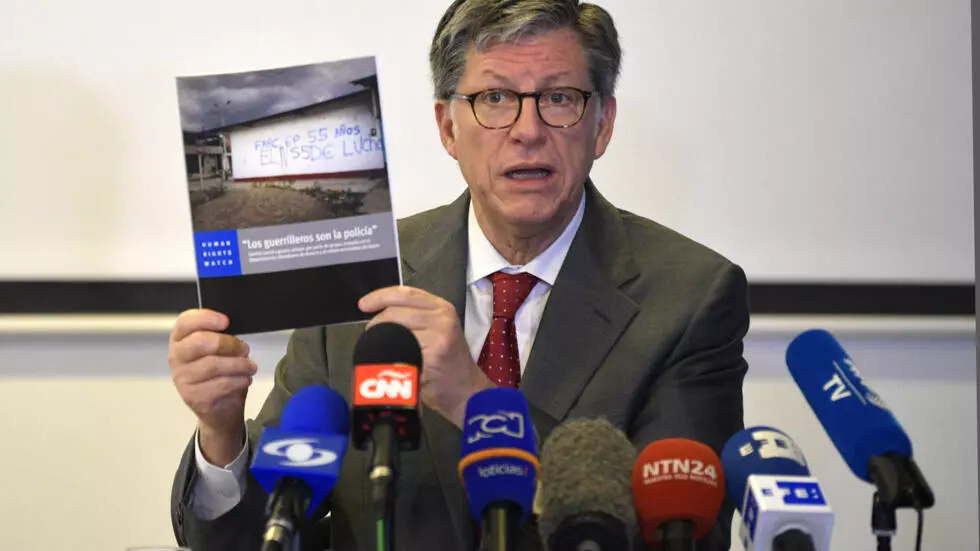
Jose Miguel Vivanco, HRW director for the Americas, accuses the Colombian government of failing to act on the murders of rights activists Raul ARBOLEDA AFP
Human Rights Watch on Wednesday 10 Febuary 2021 hit out at Colombia’s government over the rising number of human rights defenders and activists being murdered in the South American country.
Since the 2016 peace accord that ended half a century of fighting between government forces and the Revolutionary Armed Forces of Colombia (FARC), an increasing number of civil society leaders have been killed each year. But “the government has acted slowly and weakly in the implementation of policies to prevent these murders,” HRW said in a statement.
Despite Colombia suffering the largest number of such murders on the continent, “the government’s response has been more focussed on making speeches and announcements than adopting measures that will have an impact in the territories” affected by the violence, said Jose Miguel Vivanco, HRW director for the Americas.
Behind the wave of violence targeting advocates are National Liberation Army Marxist rebels, dissident FARC guerrillas and right-wing paramilitaries, as well as armed drug-trafficking groups. They are fighting each other over access to lucrative cocaine and illegal mining markets.
HRW says most victims were murdered as reprisals for opposing drug-trafficking in their territories, allegedly collaborating with the army or supporting the replacement of illegal coca plantations with legal ones. The digest of Human Rights Laureates lists 50 HRDs in Colombia. See: https://www.trueheroesfilms.org/thedigest
World Report 2021, Human Rights Watch’s 31st annual review of human rights practices and trends around the globe, reviews developments in more than 100 countries.
In his introductory essay, Executive Director Kenneth Roth calls on the incoming US administration to more deeply embed respect for human rights as an element of domestic and foreign policy to counter the “wild oscillations in human rights policy” that in recent decades have come with each new resident of the White House. Roth emphasizes that even as the Trump administration mostly abandoned the protection of human rights, joined by China, Russia and others, other governments—typically working in coalition and some new to the cause—stepped forward to champion rights. As it works to entrench rights protections, the Biden administration should seek to join, not supplant, this new collective effort.
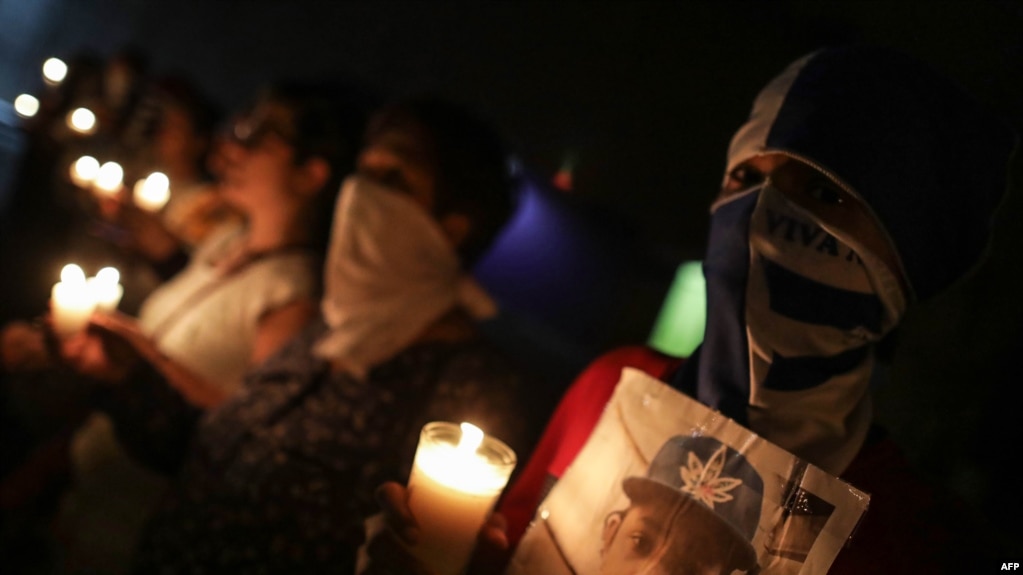
On 25 October 2020 Mariana Castro published on Polygraph.info an overview article showing that despite official denials torture does occur in Nicaragua’s Prisons.
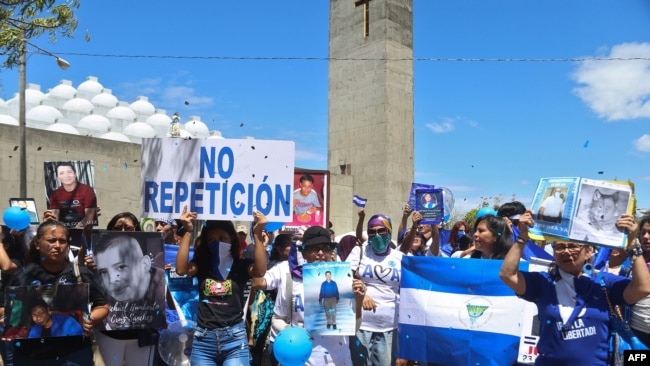
NICARAGUA – Anti-government demonstrators take part in a vigil to demand the release of political prisoners and justice for the victims of protests against President Daniel Ortega, outside the Metropolitan Cathedral of Managua on October 3, 2019.
“There are always prisoners who make up that they’re being tortured. …They invent things simply to create a negative image on Nicaragua before international organizations run by the yanquis…”
On October 15, the General Secretariat of the Organization of American States (OAS) publicly denounced persistent human rights violations in Nicaragua and urged the government to release political prisoners, restore fundamental freedoms and respect the separation of powers and rule of law: “The government’s has refused to comply with the recommendations of the Inter-American Commission on Human Rights, the Interdisciplinary Group of Independent Experts (GIEI), and the office of the United Nations High Commissioner for Human Rights and to fulfill its duties under the Inter-American Democratic Charter.”
Four days later, Nicaragua’s president, Daniel Ortega, dismissed allegations that political prisoners made of being tortured, calling them “lies” and an attempt to taint the country’s image.
“There are always prisoners who make up that they’re being tortured … they invent things simply to create a negative image on Nicaragua before international organizations run by the yanquis [referring to the United States], like the OAS,” Ortega said during a speech. (Source: El 19 Digital, October 19, 2020)
Based on multiple published reports, Ortega’s claim that torture accusations are invented is false.
Nicaragua under Ortega has faced extensive international scrutiny for violations of human rights. These include “targeting civil society, human rights defenders, including women human rights defenders, community and religious leaders, journalists and other media workers, students, victims and their family members, and individuals expressing critical views of the Government,” according to the United Nations Human Rights Council (HRC).
In April 2018, protests broke out in Nicaragua as fiscal reforms slashed social security. Protestors were met with a violent and lethal response from the government, fueling a civil uprising demanding Ortega’s resignation. More than 100,000 Nicaraguans have since fled the country.
Between the start of the protests and September 2019, 651 people died, nearly 5,000 were injured, 516 were kidnapped and 853 have gone missing, according to the Nicaraguan Association for Human Rights (ANPDH). Twenty-two police officers died, as stated by the U.N.
According to Human Rights Watch, many of those detained during the protests were subjected torture, including electric shocks, asphyxiation and rape. Detainees were also reportedly denied care in public hospitals.
The organization interviewed 12 former detainees, 11 of whom described suffering one of more forms of abuse, and seven who said they witnessed 39 detainees suffering abuses. It also interviewed three doctors and a psychologist who treated some detainees. They reported that many “showed signs of physical harm consistent with physical abuse and torture similar to that described by the 12 detainees.”
This week, Monitoreo Azul y Blanco (Blue and White Monitoring), a group that since 2018 registers and consolidates complaints of human rights violations in Nicaragua, published a video by Expediente Publico (an investigative journalism magazine in Honduras and Nicaragua) with testimonies from former political prisoners about their experiences of ill treatments and torture while incarcerated.
The testimonies mentioned the details of the event that resulted in the death of Eddy Montes, a Nicaraguan-American and U.S. Navy veteran who was shot dead in La Modelo prison in May 2019 after “a serious disturbance” inside of the prison, according to Nicaragua’s interior ministry.
The magazine also published an article on October 20 detailing testimonies of victims of abuse by the Nicaraguan police. They tell the story of J, an opposition protestor who between May 6 and May 13, 2019, was subjected to “constant questioning” and abuse by the police. Her complaint is one of dozens of cases.
Between April 2018 and June 2020, the Nicaraguan Human Rights Collective Never Again (Colectivo de Derechos Humanos Nicaragua Nunca+) registered complaints of five rapes, eight sexual abuses, seven threats of rape to detainees or their family members and three witnesses of rape to one or more fellow inmates, the article reported.
NICARAGUA – Members of the organization Mothers of April (AMA) hold portraits of their late loved ones outside the Cathedral in Managua on February 23, 2020.
On June 19, the Office of the United Nations High Commissioner for Human Rights issued a resolution to promote and protect human rights in Venezuela, and requesting the U.N.’s High Commissioner for Human Rights, Michelle Bachelet, to “enhance monitoring” and “continue to report on the situation of human rights in Nicaragua.”
Amid increased international pressure, Ortega’s government has released some political prisoners, including 91 people whose sentences were converted to house arrest in December 2019. But some 100 political prisoners (estimates vary slightly) remain in jails.
On September 30, more than 50 political prisoners went on a hunger strike as part of protests demanding their freedom. At least three of them sewed their mouths as part of protests and were then transferred to maximum security cells at the Jorge Navarro prison complex known as La Modelo. Amnesty International has described the complex as “one of the main destinations for those detained and punished for reporting human rights violations in the country.”
During his October 19 speech, Ortega said prison doors were open to those calling out the government, including relatives of prisoners, for them “to visit them when they say they’re being tortured, they are saying, they have sown their lips.”
But on the following day, representatives from the Permanent Commission on Human Rights (CPDH), one of Nicaragua’s oldest rights groups, went to visit the prison and were not allowed in, as La Prensa reported.
Allan Gomez, a member of the Union of Political Prisoners (UPPN), told Nicaragua Investiga that the denial of abuses is nothing new, “but human rights violations are fully visible.”
Earlier this month, the U.S. imposed its latest round of sanctions on top Nicaraguan officials, including the attorney general. According to The Associated Press, about two dozen people close to Ortega and his wife, Vice President Rosario Murillo, have been sanctioned – including Murillo and three of the couple’s children – since late 2017.
The European Union also recently renewed sanctions on Nicaragua – introduced in October 2019 – for another year, citing the “deteriorating political and social situation in Nicaragua.”
 Hans Thoolen on Human Rights Defenders and their awards