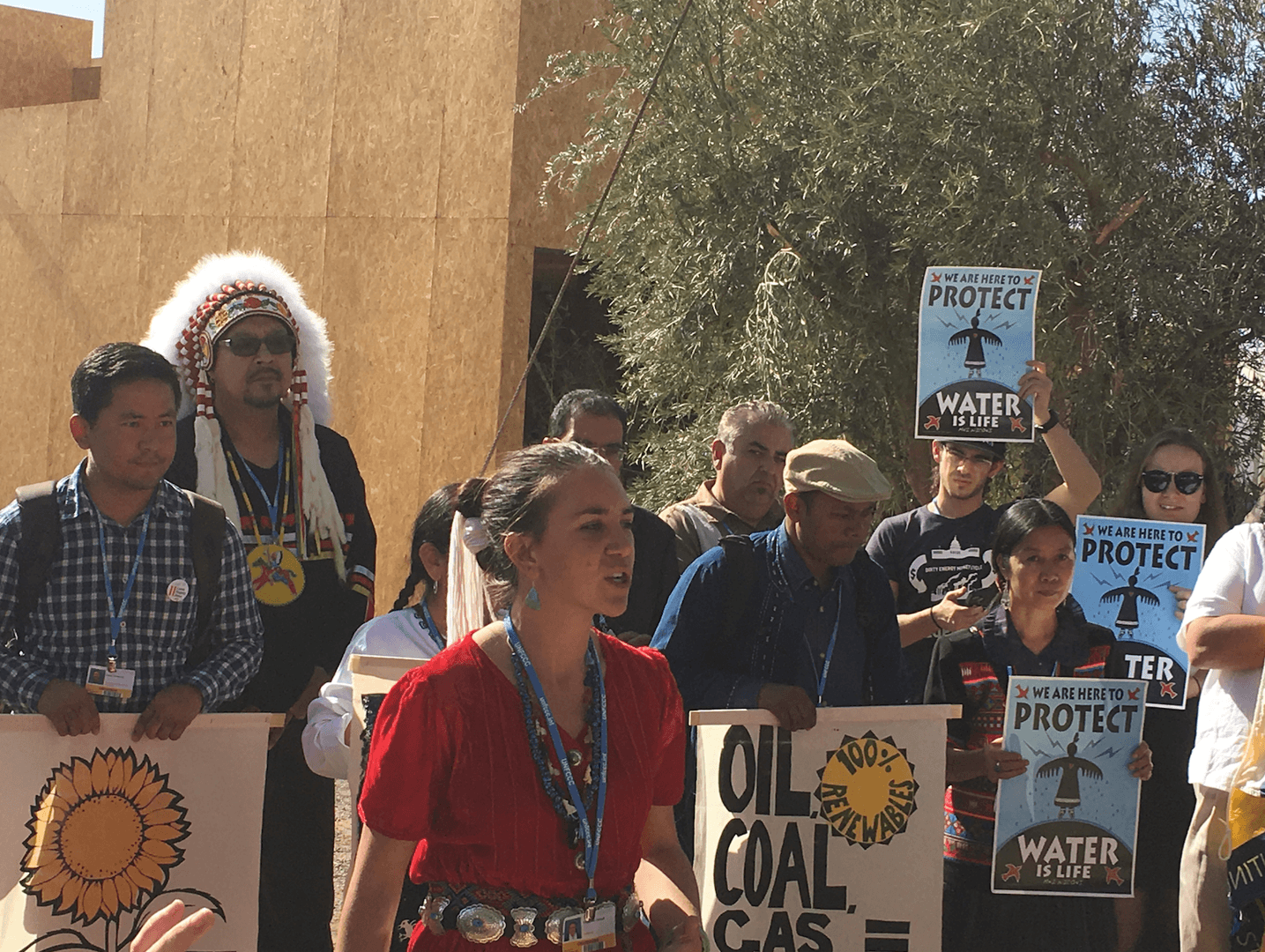
The talks wrapped up on Friday, and during the last two weeks, advocates for gender equality and indigenous peoples made their voices heard and won hard-fought battles to better respect their rights. Notably, governments agreed to create a platform to promote the participation of indigenous peoples in United Nations climate responses, and adopted a Gender Action Plan that aims to better integrate gender equality in climate change policies.
Just when the talks were nearing their end, human rights were pushed to the fore when Fijian prime minister and president of the climate talks, Frank Bainimarama, convened a high-level event about the importance of rights in climate negotiations. Why was this such a big deal? Because never before has any government presiding over the talks hosted an official event on human rights.
Bainimarama has also long been among those who have been silent on human rights issues. But on Thursday, he announced that integrating human rights in the implementation of the Paris Agreement was an important element of Fiji’s presidency, which will continue through the coming year. Costa Rica’s environment minister, Edgar Gutiérrez-Espelata, also proposed concrete ways to integrate rights into the current negotiations about the so-called Paris Rulebook. For example, governments could reference human rights obligations in climate change action plans and climate negotiators could agree to build capacity among states on promoting human rights in climate action.
The authors realize that of course, “such commitments are worth little unless governments are willing to turn rhetoric into reality. If they are serious about fighting climate change, governments should also do more to integrate the protection of human rights in climate policies, while defending the rights of people working to protect the environment.”
Similar ideas are to be found in the “Opening speech at seminar on human rights defenders” given the the Norwegian State Secretary Audun Halvorsen in Oslo, on 30 October for a seminar on “Environmental human rights defenders under threat from business operations“. The seminar was organised by Amnesty International Norway and Rainforest Foundation Norway.
The NOW! campaign, founded by 14 human rights organizations, calls for the immediate release of 165 prisoners of conscience in Vietnam. The campaign has established a comprehensive online database containing information about Vietnam’s prisoners of conscience. According to the database, Vietnam’s prisoners of conscience included bloggers, journalists, environmentalists, students, farmers, and workers who were arrested for their peaceful activism. Together, these men and women are serving 955 years and one month in prison, followed by 204 years under house arrest. Most of them were charged with violating article 79 of the criminal law, “plotting to overthrow the government”, and article 88, “conducting propaganda against the state”. But Civil Rights Defenders, one of the members of the NOW! campaign, said that the number of prisoners of conscience could be higher. [see also earlier post: https://humanrightsdefenders.blog/2016/01/14/assaults-on-human-rights-defenders-on-the-rise-in-vietnam/]
A lettersigned by 17 civil society organizations urged leaders who attended the 2017 summit of the Asia-Pacific Economic Cooperation (APEC) in Vietnam to raise the issue of human rights violations committed by state forces. The letter informed APEC leaders that Vietnam has detained at least 25 peaceful activists and bloggers since last year. “This crackdown is contrary to the goal of “Creating New Dynamism, Fostering a Shared Future” which is the stated theme of this year’s APEC gathering. Arbitrary detention, censorship, and state-sponsored violence against activists and human rights defenders are not only an affront to our common humanity but a grave violation of international human rights laws and standards. We believe it is in the strong interest of APEC and of the international community to speak out against the widespread and systematic violations of human rights violations in Vietnam.”
Nine human rights groups launched the #StopTheCrackdownVNcampaign decrying the crackdown of bloggers and activists in recent months and the harsh prison terms handed out to critics of the state. Don Le, a writer and member of Viet Tan political party, explained how the notorious articles 79 and 88 of the law are used by authorities to silence citizens: The law also allows authorities to filter, block or temporarily shutdown networks on the basis of any information that may be seen to “incite” mass gatherings that disturb national security and order. Given the Vietnamese government’s broad interpretation of national security, we might expect to see more attacks and shutdowns aimed at independent media and bloggers and arrests of peaceful community mobilisers.
But Vietnam is not easily impressed as the recent case of reprisals shows: Front Line Defenders reports that three human rights defenders were briefly arrested after meeting the EU Delegation in Hanoi. [On 16 November 2017, human rights defenders Pham Doan Trang, Bui Thi Minh Hang and Nguyen Quang were arrested by police after attending a meeting with the European Union Delegation in Hanoi to discuss human rights issues ahead of the EU – Vietnam Human Rights Dialogue, scheduled for 1 December 2017. After being kept incommunicado without access to legal representation, the human rights defenders were released. They remain under surveillance.] From Line adds that: Authorities in Vietnam have a habit of tightening the grip over human rights defenders and civil society ahead of international meetings. During the APEC Summit in Danang between 6 and 10 November 2017, and afterwards, during the state visits of U.S. President Donald Trump and Chinese President Xi Jinping, several human rights defenders and activists were kept under house arrest and heavy surveillance. Reports also state that human rights defenders were harassed by policemen in plainclothes to prevent them from meeting with international officials or organising demonstrations.
The Office of the UN High Commissioner for Human Rights issued a statement in July 2017 expressing concern about the detention and persecution of citizen journalists: We urge the Vietnamese authorities to immediately release all those detained in connection with their exercise of their rights to freedom of expression, and to amend the overly broad ill-defined laws that are used – under the pretext of national security – to crack down on dissent.
Four UN human rights experts*(including Michel Forst, the Rapporteur on Human Rights Defenders) have called on states to address pressing human rights issues during the 31st ASEAN Summit being held from 10-14 November in the Philippines. Recognising the important work of the many active civil society organisations across the region, the experts expressed concern about “a worrying deterioration in the environment in which they operate.”
“Human rights defenders, social activists, lawyers, journalists, independent media and even parliamentarians trying to speak out and protect the rights of others, increasingly face a multitude of risks ranging from judicial harassment and prosecution to threats, disappearances and killings,” said the experts. They observed rising numbers of cases of serious human rights violations affecting among others, people working on women’s rights, environmental and land issues and lawyers dealing with drug cases.
The experts called on the 10 ASEAN Member States to amend or repeal existing legislation and to reconsider draft laws that are being or could be applied to criminalize or restrict the vital work of civil society. “We condemn the public vilification, harassment, arrests and killings of members of civil society, and call on Member States to rigorously uphold their duty to ensure the freedom and protection of those exercising their fundamental rights to freedom of expression, association and peaceful assembly,” the experts said. “Independent media, members of civil society and human rights defenders should be viewed as partners and as an essential element of democracy.”
“This summit should be seen as an opportunity to make real progress on these issues and to show the world that the Member States of ASEAN are fully committed to securing the human rights of all in the region,” the group said.
The 2017 Human Rights Tulip has been awarded to Mexican human rights defender Graciela Pérez Rodriguez. Foreign minister Halbe Zijlstra will present her with the prize on Friday 8 December in The Hague, two days ahead of Human Rights Day. The Human Rights Tulip is an annual prize awarded by the Dutch government to human rights defenders who take an innovative approach to promoting human rights. The prize consists of a bronze sculpture and €100,000, which is intended to enable recipients to further develop their work. See: http://trueheroesfilms.org/thedigest/awards/tulip-award
Graciela Pérez Rodriguez defends the rights of family members of disappeared persons in Mexico. Through her work she attempts to break through the taboos surrounding this issue. The human rights defender is herself searching for her disappeared daughter, brother and three nephews. Graciela Pérez Rodriguez, a non-professional who has immersed herself in forensic science, is a founding member of the Forensic Citizen Science project. This national collective of disappeared persons’ family members in various Mexican states helped establish the Mexican National Citizen Registry of Disappeared Persons and a DNA database run by and for citizens, which facilitates the identification of victims’ remains at a late stage.
‘Despite the difficult circumstances in which she works, Graciela remains committed to searching for disappeared persons in Mexico,’ Mr Zijlstra said. ‘Human rights defenders like Graciela are indispensable in the fight for a better world. It takes pressure from the inside to achieve real change.’ Disappearances are a serious problem in Mexico. Between January and August this year over 2,400 people were reported missing. In mid-October the Mexican Congress passed a new law to combat disappearances, which provides for longer prison sentences and a committee tasked with finding disappeared persons. The Dutch government sees this law as an important step forward in dealing with this problem.
Human rights defenders from across Africa were in The Gambia undergoing a three-day training to consolidate their knowledge and skills on relevant human rights instruments for effective monitoring at the continental and international levels. The training on international and regional human rights mechanisms, was held from 25 – 29 October 2017, was organised by the African Commission on Human and People’s Rights, CIVICUS, ISHR, ACHPR and the United Nations Human Rights Council. The training was held on the margins of the Forum on the Participation of NGOs in the 61st Ordinary Session of the African Commission on Human and Peoples’ Rights and 36th African Human Rights Book Fair.
The training was designed to sharpen the knowledge and skills on the procedures for the promotion and protection of human rights in Africa. It was divided into three main parts: the international and the regional systems and mechanisms for the two days, and freedom of association and assembly, the SDGs, and human rights monitoring. Hannah Forster of the African Centre for Democracy and Human Rights Studies (ACDHRS – http://www.acdhrs.org) said: “This, we believe, will enable us to better understand opportunities available as we engage governments in the fulfillment of their mandates to promote and protect human rights and it will equip us with the knowledge and skills to lobby our governments to domesticate and implement their commitments while assisting participants to frame a strategy as they seek redress for violations of human rights”.
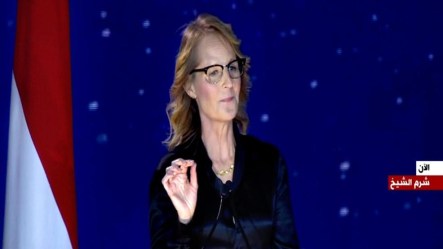
Celebrity support for human rights can do much good but there are still too many who simply do not study the issue before accepting. [see: https://humanrightsdefenders.blog/2014/02/28/and-the-nominees-are-oscars-for-human-rights/]. Two days ago Brian Rohan of Associated Press, reported that actress Helen Hunt just added her name to the list of ignoramuses (“Egyptian activists pan US actress Helen Hunt in open letter” – 7 November, 2017).
5 November 2017: image taken from video, showing actress Helen Hunt speaking during a government-organized youth conference in the Red Sea resort of Sharm el-Sheikh, Egypt. (AP Photo /CAPITAL BROADCAST CENTER)
Egyptian activists condemned American actress Helen Hunton Tuesday for her participation in a government-organized youth conference they say is whitewashing authorities’ appalling human rights record and suppression of free speech. The open letter by Mona Seif and other well-known human rights advocates gained nearly 300 signatures by Tuesday afternoon. They included Mohamed Zaree, who last month won the Martin Ennals Award, and Aida Seif el-Dawla, whose Nadeem Center treats victims of torture and trauma and was shuttered by the government earlier this year.
The letter follows a flurry of online criticism against this week’s “World Youth Forum,” hosted under the patronage of President Abdel-Fattah el-Sissi, 62, in the Red Sea resort of Sharm el-Sheikh. Hunt, 54, was a keynote speaker at the opening ceremony. The event’s official Twitter hashtag #WeNeedToTalk has become a battleground for opposing viewpoints, with critics overwhelming the thread with images of Egyptian police beating and chasing down youths during el-Sissi’s rule alongside portraits of young jailed activists.
“This isn’t just any forum that you chose to endorse,” the letter to Hunt read. “This is a youth forum with the slogan ‘We Need To Talk’ called for by a dictator who cannot stand any form of opposition or real criticism. He jails journalists for doing their jobs, youth for expressing their opinions, writers for writing fiction that violates ‘public morality,’ gays for coming out, supporters of LGBTQ for daring to support diversity, and he has blocked more than 400 different websites and media platforms.
Human rights defenders and their organizations such as Human Rights Watch and Amnesty International have documented enforced disappearances, widespread torture and a recent arrest campaign targeting people authorities believe are gay. The authorities have blocked hundreds of independent news and critical websites.[see also: https://humanrightsdefenders.blog/tag/egypt/]
The forum, which lasts until Nov. 10, has been broadcast nearly all day long on state and private television since its opening ceremony Sunday night. It has been widely promoted with slick television ads in Egypt, where several major Western PR firms advise and work for the government. A giant billboard hovers over Cairo’s Tahrir Square, epicenter of the youth-led 2011 uprising.
Hunt, an Academy Award-winning actress who now directs films, delivered a speech Sunday in which she criticized the U.S. justice system for its high incarceration rates and voiced support for the online anti-sexual harassment movement #MeToo. That, however, did not deflect criticism from Seif and other Egyptian feminists. “Unbelievable Hypocrisy! @Helenhunt speaks of “Women Rights” in a PR circus for a general who justified forced virginity tests,” Seif tweeted, referring to the military’s “virginity tests” conducted on a group of women protesters detained in 2011. El-Sissi, who was the chief of military intelligence at the time, was quoted then as saying the tests were necessary to head off possible allegations that the women were sexually assaulted by soldiers.
Others accused Hunt, the most famous Western celebrity at the event, of selling out to el-Sissi, pointing out a string of websites that advertise her as a for-hire speaker with fees between $50,000 to $1 million. Hunt did not respond to a social media request to discuss her efforts in Egypt.
In a new report launched at the 61st session of the African Commission on Human and Peoples’ Rights, DefendDefenders (the East and Horn of Africa Human Rights Defenders Project) finds that amid growing restrictions on civic space in the sub-region, journalists play a critical role in exposing human rights violations and providing vital information and analysis of current events. Simply documenting and sharing information can simultaneously place them at risk and at the forefront of human rights defence.
In “Don’t Shoot the Messenger! Journalists as Human Rights Defenders in the East and Horn of Africa”, DefendDefenders examines the challenges journalists face, and provides an overview of the various strategies they have used to circumvent and continue their work amid these restrictions. Overall trends, legal frameworks, and case studies from 11 countries in the East and Horn of Africa provide an understanding of the capacity, risks, and needs of journalists reporting on human rights issues. Over 60 journalists, bloggers, and media professionals from the sub-region were interviewed, in addition to significant input from civil society organisations dedicated to free expression and the protection of journalists.
Central to the report is the question of whether journalists, by nature of their work, should be considered HRDs. Nearly all journalists interviewed for this report considered themselves to be HRDs, but many had doubts over whether this also applied to all their colleagues. Some interviewees claimed to actively seek out human rights stories, especially in conflict situations, while others also advocated for freedom of expression, often from exile.
…
Journalists are increasingly faced with new threats to their work and security, including harassment, arbitrary detentions, and imprisonments and prosecutions under spurious laws, both online and offline. These threats intensify amid violent conflicts and political crises, and often force journalists into exile, where they face new challenges. The report offers concrete solutions to online and offline challenges and makes key recommendations to governments and civil society to ensure that a free media environment in the region is protected and promoted.
On 4 November, 2017 Tony La Viña published a post in the Standard in the Philippines that is worth reading in full. It describes a quintessential non-governmental and balanced response to the on-going crisis of extra-judicial killings:
9 December 2018 will mark the 20th anniversary of the ‘UN Declaration on the Right and Responsibility of Individuals, Groups and Organs of Society to Promote and Protect Universally Recognized Human Rights and Fundamental Freedoms‘ (in short the UN Declaration on HRDs). The General Assembly and the Human Rights Council have over the years adopted annual resolutions, informed by reports by the Secretary-General and the Special Rapporteur on the situation of human rights defenders. However, as this blog and many others can testify, human rights defenders continue to face severe risks and are increasingly targets of actions taken by state and/or non-state actors in violation of the Declaration. As we approach the 20th anniversary of the Declaration, the Norwegian delegation has just now tabled a draft resolution at the 72nd session of the General Assembly. The text is not officially out yet but the main new elements in the draft resolution are:
a high level meeting on HRDs in the General Assembly in New York next year, and
a request to the UN Secretary General/OHCHR to put together a comprehensive report on what UN can do to assist States.
The UN Mission of Norway is as usual in the lead in getting this resolution adopted, while facing the danger of hostile amendments. [see e.g.: https://humanrightsdefenders.blog/2016/03/23/norwegian-resolution-un-human-rights-council-defenders-amendments/]. They have their work cut out and any help in lobbying for this new draft would be most welcome. The text of the draft resolution as tabled follows below (it should be issued soon as an “L” document) in which I have highlighted operative paragraphs 14-17.
If you are – or know – a human rights defender keen to increase interaction with the UN system, apply now for the 2018 edition of ISHR’s Human Rights Defenders Advocacy Programme!
The training will take place in Geneva between 11 and 22 June 2018 and provides defenders with opportunities to put their advocacy skills directly into action at the 38th session of the UN Human Rights Council. Get a taste of the programme here.
ISHR’s Human Rights Defender Advocacy Programme (HRDAP) equips defenders with the knowledge and skills to make strategic use of the international human rights system. It also provides an opportunity for participants to directly engage in lobbying and advocacy activities at the UN level to effect change on the ground back home.
As well as receiving training modules on all the UN human rights mechanisms from a range of experts, participants will also have the opportunity to build networks in Geneva and around the world, carry out lobbying of UN member States and UN staff, and learn from peers from a range of regions working on a range of human rights issues.
At the end of last year’s training, 100% of participants were either “very satisfied” or “satisfied” with the overall programme, and they all also felt that they would be able to apply what they learnt to their own day-to-day work. ISHR will look to build upon this success in 2018.
Participants will take part in:
A short online learning component, prior to face-to-face training, to enable you to consolidate your existing knowledge and develop your advocacy objectives;
Intensive training in Geneva during June, to coincide with the 38th session of the Human Rights Council. The training will focus on ways to effectively use international human rights mechanisms and to influence outcomes;
Specific advocacy at Human Rights Council sessions and other relevant meetings, with regular feedback and peer education to learn from the experiences, including expert input from leading human rights advocates.
This programme is directed at experienced human rights defenders in non-governmental organisations, with existing advocacy experience at the national level and some prior knowledge of the international human rights system.
If you are interested in applying for ISHR’s training programme, please read the call for applications to check that you comply with the requirements, and apply before midnight Geneva time on 11 December 2018. The link to the online application form can be found in the call for applications. For more information, write to hrdap2018@ishr.ch.



 Hans Thoolen on Human Rights Defenders and their awards