Posts Tagged ‘Human Rights Defenders’

Radio Prague: interesting interview with People In Need Director Simon Panek

March 28, 2014

Since its foundation in the early 1990s, Prague-based People in Need [Člověk v tísni] has become one of the biggest NGOs in Central Europe. Founding member Šimon Pánek has for many years been the organisation’s director, and Ian Willoughby of Radio Prague did an lengthy interview with him on 24 March 2014. The conversation touched on targeting of aid, politics, international perception and plans for the future. It has become a most interesting interview that shows how in two decades a NGO in Central Europe can develop into a serious and mature organisation, still mostly local but with international potential. The transcript of the interview follows below:

I first asked Pánek what for him had been its standout projects of the last 20 years-plus “What was important was one of the very first projects, SOS Sarajevo, a big fund-raising campaign in the Czech Republic and relatively massive humanitarian aid into the besieged city of Sarajevo during the war. That was a formative period for us, for sure.

“The second important period I regard as when we were approached by students from Belarus and Cuban immigrants in the second half of the 1990s with a simple question: did you forget that we are not free yet?

“They said, you got your freedom, you got rid of the Communist regime, but we still have Lukashenko, we still have Castro – it’s a bit unfair to forget that we are in a bad situation.

Šimon Pánek, photo: Štěpánka Budková

(Šimon Pánek, photo: Štěpánka Budková)

“At that time we basically established the second department of People in Need, dealing with human rights, or supporting human rights defenders.

“The third pillar was established again at the end of the 1990s when in the North Bohemian city of Ústí nad Labem the mayor started to build a wall between a Roma settlement and the majority…”

This was the notorious Matiční Street.

“Yes, Matiční Street. And we were shamed. We were sitting around the table – I still remember the day – and one of my colleagues said, if we are able to operate in Chechnya, if we are able to do illegal work and support dissidents in Cuba, Burma, Belarus, we should be able to try to do at least something in such a shameful situation in our own country.

“So we started with social work at that time, and now we are running 10 offices around the Czech Republic with almost 200 employees working in 60 localities, dealing with social exclusion and all other connected things.”

Could we get back to the political activities of People in Need? You were saying that you support the opposition in countries like Cuba, Burma – do you have a kind of neo-conservative approach, where you’re trying to in a sense export democracy to these countries? Neoconservativism has been largely discredited politically, I would say.

“Yes, I absolutely agree that the word democracy was discredited, mainly through the Bush era.

“The push for more democracy with a really very simple approach – the more money I pour on the one side, the more democracy will appear the other – we never shared. We’ve never tried to push or export things.

“What we do is we try to support the people who are there in their activities, their interests.

“We do basically the same thing that same things that were done from Sweden, Britain, France, Germany – to a certain extent from the US as well, but mainly from European countries – during communism for [Czechoslovak] writers, intellectuals, dissidents.

“And I think to say ‘opposition’, it means we are supporting the political opposition – in the vast majority of situations that’s not true. We are supporting student groups that want to discuss the economy…”

But they want regime change.

“Some of them. Or regime improvement. They want to get freedom to travel, they want free access to the internet.

“Of course from the point of view of dictatorships or authoritarian regimes we are breaking some of their laws. But is the law legitimate if it deprives people of free access to the internet in the 21st century? I don’t think so.

“We are basically helping people to get very basic things that you and I can have here on any corner.

“What’s important is that if any change is going to happen and to be sustainable, it’s the destiny of the people there. If they can’t read books by Václav Havel or about the economy, or get access to the internet or even publish what they write, I think it’s unfair.

“We are basically helping them to overcome the obstacles and oppression which, in our opinion, illegitimate, undemocratic regimes are imposing on their own people.”

You mentioned Václav Havel. He was a great supporter of People in Need and of you personally – at one point he said that you could follow him as president some day. What did his backing mean to People in Need, especially internationally in terms of creating your profile?

Václav Havel, photo: Filip Jandourek

Václav Havel, photo: Filip Jandourek

“Well, of course it was very important to have a person like Václav Havel here. We did not cooperate directly as much as it might appear – it was more of a convergence of the same principles, values and ideas.

“On the other hand, in some cases yes, we were carrying messages from Václav Havel to people in Burma, Cuba, East Timor, Chechnya.

“It was very important for the people to hear that we are coming from the Czech Republic and that Václav Havel is sending his greetings, whatever.

“Because his life was kind of a fairy tale for people living in unfree countries. And a big hope that if a powerless writer can win over a very strong regime, sooner or later freedom will come even to their countries.

“Internationally, yes it helped, probably. On the other hand, I think 20 years of work without any major mistakes or problems, high credibility among people, a few tens of thousands of stable supporters, I mean financial supporters which we have in the Czech Republic – these are important factors as well, of course.”

There are so many crises around the world and there are always fresh ones it seems – how do you decide which ones to target with aid?

“It’s a very good question, but of course it brings us back to the ultimate question – does this really make sense?

“We try to sit around the table and estimate critically if we are able to really make some change, if it’s reasonable in terms of the size of the crisis and in terms of the resources and capacities which we are able to generate here in the Czech Republic.

“If not, we often cooperate with our colleagues from Alliance 2015, which is eight organisations from Europe.

“If we are able to get together a few hundred thousand euros for a crisis, if it’s in one of the countries where the partner organisations are working, we just channel the money through them. Because there is no sense in spending the money on extra offices, cars, flight tickets.

“What we really don’t want to have is more flags on the map. Often less is more. To be focused and to really be able to achieve more and to go deeper in addressing the needs of the people and the causes of the crisis is more important than how many countries we are active in.”

Does the fact that People in Need comes from the Czech Republic influence how you are seen in different parts of the world?

“Absolutely. Coming from a small Central and Eastern European country has some advantages, but also some disadvantages. The disadvantages are that we really had to work hard to get on the mental map of big institutional international donors.

“The advantage is that we are not seen as having any other agenda. Still people coming from the US and strong Western European countries are… seen with greater suspicion.

“We come from a very small state without imperial ambitions, without really big influence. Basically people welcome us and I think they tend to trust us more quickly than NGOs coming from very strong countries with support from very strong governments.”

How would you like to see People in Need develop into the future?

“The last 20 years were interesting in one regard – we never made any plan as to how big we wanted People in Need to be, or how much money we wanted to turn over every year.

“We were always responding to needs which came from outside, humanitarian needs or the big floods in the Czech Republic, or issues connected with social exclusion, mainly of Roma people.

“It’s slightly changing, because we are too big to just respond. We are discussing more and more some new fields.

“The staff is getting older, including us in the management, which is probably good for the stability of the organisation.

“What I’ve seen during the last few years and what I think is extremely interesting and extremely important is that we are kind of materialising into systemic objectives our experience and cumulative knowledge from concrete work with beneficiaries in humanitarian development, social work, education.

“So while continuing with direct work we are more and more dealing with governments, inter-governmental bodies, coming with different suggestions, procedures.

“We are trying in different fields, like debt issues among the socially weak part of the population in the Czech Republic, to bring in education, some system improvements.

“This is a new ambition – not just to help people do concrete things which are making some change, but trying to address the causes, not just the symptoms but the causes of different problems.

“This is mainly in the Czech Republic, because you can hardly address the causes of the wars in Africa from our level. But in the Czech Republic our systemic work, policy work often, is more and more important. We are basically trying to improve how the state, how the system works.” 
Radio Prague – Work with human rights activists abroad like Western support for dissidents under communism, says PiN chief Pánek.

South Africa disappoints terribly in the Human Rights Council: support for China’s silencing the silence

March 27, 2014

A column in the South African City Press under the title “A chilling point of order for SA” written by Juliette De Rivero on 26 March 2014 makes a punchy statement about the disappointment felt all though the human rights movement when South Africa opted to support China’s point of order in the UN Council of Human Rights. In my post about this ‘court drama’ (reference below) I did not list all the countries coming out against allowing a moment of silence for the deceased Chinese human rights defender Cao Shunli and indeed the position of South Africa was in many way the most surprising, in de Rivero’s words: “…The South African delegate took the floor and warned that allowing the activists to proceed with the moment of silence would “create a dangerous precedent” that the council would not be able to sustain in the future.He noted that the action was “irregular and incompatible with the rules of procedure of this council”.South Africa’s choice to stand with the government that prevented Cao Shunli from participating in the UN came as a blow to the activist community – a community that was willing to stand up for Cao just as it had been willing to denounce the injustice of apartheid.South Africa’s concern that the moment of silence – not the death of the activist – was setting a bad precedent in the UN body sent such a chilling message to the human rights community that it should not be ignored…”

Let me add: That silence is a way of speaking should be clear to all, including South Africa, e.g. when on 6 December 2013 the General Assembly held a moment of silence to honour the memory of Nelson Mandela (“Madiba”).

full piece in:  A chilling point of order for SA – City Press.

background in: https://thoolen.wordpress.com/2014/03/20/china-in-the-un-human-rights-council-manages-to-silence-cao-shunli-as-well-as-ngos/

Protection international seeks French-speaking Regional Programme officer based in Nairobi

March 27, 2014

Brussels-based Protection International [PI] is looking for a Regional Programme officer based in Nairobi, Kenya – French-speaking.  PI is an international non-profit organization researching strategies and security management tools that protect human rights defenders and sharing its expertise in this area with people at risk for their human rights work all around the world. PI sees human rights defenders as agents of change who form a pillar of free and just societies. In many parts of the world, HRDs face threats from state and non-state actors for their human rights work. PI works with human rights defenders to develop strategies tailored to their profile and context.

The Role
PI Regional Programme officer is responsible for implementing PIs work in the region of the East and Horn of Africa and the wider African continent (except DRC) under supervision of the Representative. The RPO will have a focus (but not work exclusively) on French-speaking African countries. The PI RPO is part of a team of four, based in Nairobi. (S)he travels regularly in the region and occasionally beyond.

Key responsibilities:

Capacity Building

1. To accompany partners in building their capacity to manage their security and protect their sources and the people whose rights they defend;
2. to propose improvement of PI’s capacity building approach and tools with an eye for the specific requirements of local, national and regional context;
3. To actively monitor and evaluate change, positive or negative.

Research
1. Undertake research on issues related to the way HRDs protect themselves, the State and its duty to protect and the ways of other actors with a stake in the protection of HRD;
2. To capture lessons learnt and best practices in HRD protection in suitable formats and share within PI for internal learning and strategic use with external stakeholders.

Lobby and advocacy
1. To contribute to the development of advocacy activities and documents in coordination with the PI Representative;
2. To liaise with other regional, national and/or local HRDs organisations with a view to establishing or reinforcing relationships and possibly developing partnerships;
3. To undertake advocacy activities before national, regional and international authorities;
4. To liaise with NGOs, international organisations and bodies working in the region on the protection of human rights defenders.

Monitoring and evaluation
1. To analyse the situation of HRDs and HROs at risk in EHA and other sub regional countries covered by the project and provide security advice;
2. To collaborate and prepare reports for the PI Representative on programmatic and thematic topics;
3. Monitor and evaluate PI projects and partners with a view to document and learn from the process.

General responsibilities
1. To contribute to the timely update of the organisation security plan and abide by it;
2. To keep abreast of the political situation in the country and contribute to the organizational political analysis.

Skills and experience (selection)

  • University degree in law, human rights, political science, social sciences or related field;
  • Experience in human rights work of at least 3 years;
  • Experience in the practical delivery of training preferably adult learning;
  • Experience with local human rights organisations and human rights issues;
  • Field mission experience;

Location: The position is based in Nairobi, Kenya with frequent travels in the sub-region of the East and Horn of Africa.
Languages: Fluency in spoken and written French and English are a precondition. Kiswahili will be positively valued.
The offer: One-year, renewable contract with six month probation period. Contract conform Kenyan labour law. Competitive remuneration

To apply for the position please send your resume, cover letter and names and contact details of 3 references before 4 April 2014 to the following email: ikihara[at]protectioninternational.org. Include your name in the file name of your application documents, e.g. John_Smith_CV.doc. Do not attach any certificates or references at this stage of the recruitment process. Include the following subject line in your email: Application for PI Regional Programme Officer EHA.

Further information about the activities of Protection International can be obtained from http://www.protectioninternational.org. Female candidates are especially encouraged to apply.

http://protectioninternational.org/2014/03/20/call-for-applications-pi-is-looking-for-french-speaking-regional-programme-officer/

Ban Ki-Moon calls civil society “an indispensable part of the United Nations”

March 27, 2014

Civil society actors must be able to do their work freely, independently, safe from fear, retaliation or intimidation. This requires collective action to denounce reprisals and defend free voices and protect those targeted,” said the UN Secretary-General Ban Ki-Moon, referring to civil society as “an indispensable part of the United Nations”. “We must expand the space for civil society to meaningfully participate and contribute,” he added in a video statement screened at a discussion on the promotion and protection of civil society space, in the context of the Human Rights Council’s 25th session.humanrightslogo_Goodies_14_LogoVorlagen

Civil society actors around the world face risks ranging from threats and intimidation to horrible reprisals, even killings”, said UN Human Rights Deputy, Flavia Pansieri at a discussion on the promotion and protection of civil society space. “From the NGO who is prohibited from receiving funding to the whistle-blower who is imprisoned for revealing corruption… we must work to protect civil society from such practices,” she said.

Hina Jilani, Read the rest of this entry »

Another human rights defender shot dead in Philippines

March 27, 2014

According to ucanews.com of 26 March 2014, unidentified gunmen shot and killed a human rights defender, whose name had appeared on a military hit list, in the northern Philippine province of Ifugao on Tuesday. Cristina Palabay, secretary general of human rights group Karapatan identified the victim as William Bugatti of the Cordillera Human Rights Alliance. She said that Bugatti’s name had appeared on an army list of targeted persons, obtained from undisclosed sources, which included activists and individuals working with farmers’ organizations. Bugatti was described on the list as the “brains” of the New Peoples Army” the military arm of the underground Communist Party of the Philippines. According to Piya Macliing Malayao of the Alliance of Indigenous People of the Philippines, Bugatti was on his way home from the office when he was gunned down. He sustained three gunshot wounds. Malayao said other members of human rights groups in the Cordillera region have also become targets of the military. “Bugatti’s killing sends a gravely disturbing message to members of peoples organizations and human rights defenders in the region,” she said. Last week, Malayao raised concerns about posters that appeared in Ifugao province, bearing the names of tribal leaders and human rights activists who have been tagged as communist rebels. “We now fear for the lives of the others listed on the military’s target catalog,” she said, adding that the list “proves that there are precision strikes being made on unarmed civilians” under the governments anti-insurgency program. Malayao said that during the first 10 weeks of 2014 alone, four indigenous people were killed by government security forces.

via Another activist shot dead in Philippines ucanews.com.

Ganji: Human rights in Iran improved, but still short of expectations

March 26, 2014


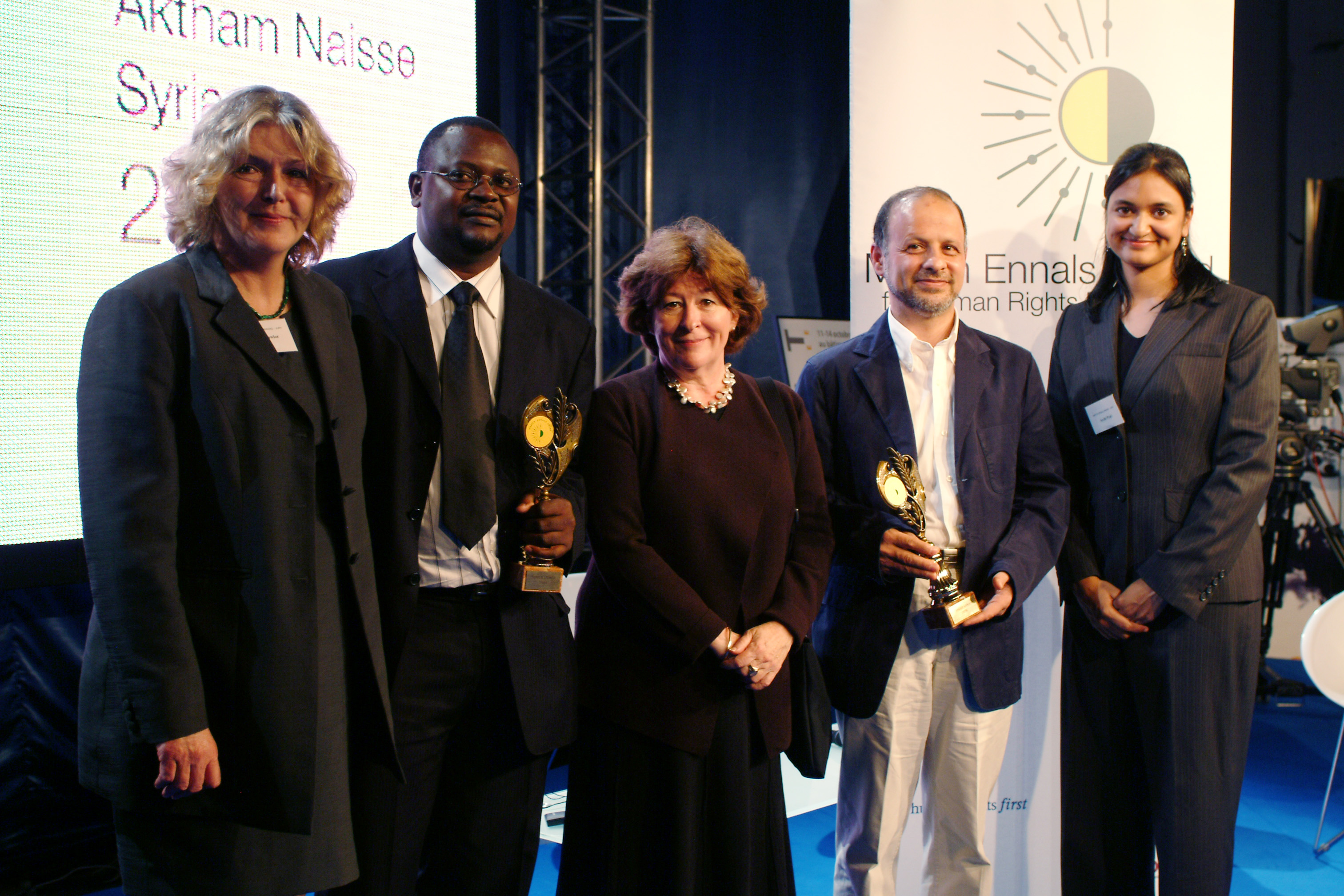
Remise du Prix Martin Ennals 2006

(Ganji – second from the right – at the MEA ceremony of 2006, where he received the award from UN High Commissioner Louise Arbour)

Al-Monitor of 25 March carries a lengthy interview with MEA Laureate Akbar Ganji in which Jahandad Memarian records many interesting insights, especially on the issue of sanctions and support to human rights defenders. The whole interview is certainly worth reading; here follow some long excerpts:

It is not an exaggeration to say that Akbar Ganji is the most celebrated dissident within the ranks of Iranian journalists since the inception of the Islamic Republic of Iran in 1979. A former supporter of the revolution, Ganji became disenchanted and turned into one of its most vocal critics. He is best known for his work as a journalist covering the 1998 murders of Iranian dissidents in Reformist newspapers, a series which came to be known as “the chain murders” that implicated top governmental officials. For his work revealing the murders of dissidents and attending a conference in Berlin that was condemned by hard-liners who were reeling after a Reformist victory in parliament, Ganji was arrested and served time in Tehran’s Evin Prison from 2001 to 2006. During his final year in prison, he went on a hunger strike that doctors urged him to end for concerns he would suffer permanent brain damage.

Ganji has won several international awards, including the World Association of Newspapers’ Golden Pen of Freedom Award, the Canadian Journalists for Free Expression’s International Press Freedom Award, the Martin Ennals Award for Human Rights Defenders and the Cato Institute Milton Friedman Prize for Advancing Liberty. In an exclusive interview via email with Al-Monitor, Ganji, based in New York, shared his thoughts about human rights and democracy in the context of President Hassan Rouhani’s administration.

Al-Monitor:  The UN secretary-general, Ban Ki-moon, has sharply criticized the Iranian president, Hassan Rouhani, saying, “He has not made any significant improvement” in ending human rights abuses since taking office. Nevertheless, Mahmoud Sadri — Iranian professor of sociology at the Federation of North Texas Area Universities — is optimistic about the new administration and has asked Iranian dissidents and intellectuals to take advantage of this historic opportunity. How do you evaluate the Rouhani administration?

Ganji:  The situation has improved from various aspects compared with the [Mahmoud] Ahmadinejad administration. However, it falls short of the expectations of democracy advocates and human rights activists. The Rouhani administration truly seeks to improve the state of human rights, but it has faced obstacles in Iran’s power hierarchy, including organizations that [Supreme Leader] Ayatollah [Ali] Khamenei oversees, such as the judiciary, law enforcement, etc., in addition to the Majles [parliament] that is controlled by the conservatives and some radical reactionaries.

…….Since his administration came to power, Rouhani has spoken with the supreme leader about freeing the Green Movement’s leaders (former Prime Minister Mir-Hossein Mousavi and former Majles speaker Mehdi Karoubi) and political prisoners, guaranteeing that nothing would happen, if they were freed.

Al-Monitor:  In January, you wrote a Huffington Post article titled “The Iran Nuclear Accord Is Good for Human Rights.” It seems to me whenever international pressure on the Iranian government increased, Iran improved its record. For example, Tehran released political prisoners ahead of Hassan Rouhani’s UN speech, including prominent human rights lawyer Nasrin Sotoudeh. Don’t you think such actions stem from international pressure? In the absence of this leverage — i.e., international pressure — Iran would continue human rights violations.

Ganji:  With regard to “external pressure on an undemocratic regime and improvement of human rights or increased oppression,” there is no law/rule that would address the cause-reaction relationships. At most, one can speak of “correlation.”[…] we need to know the following:

First, economic sanctions represent the collective punishment of a country’s people and do not necessarily lead to dictatorships’ downfall.

Second, long-term sanctions destroy the internal infrastructure of societies. ..Consequently, trust that is the basis of social capital is destroyed. Because of the sanctions, the oppressive regime’s increasing level of oppression, the internal destruction of society, is not visible. It is only in the aftermath of the dictatorship’s downfall that we will witness the visible spread of a wave of hatred, revenge and violence.

Third, in a life and death situation, the state of human rights, democracy and freedom completely falls by the wayside.

Fourth, consider Iraq’s example again. Before, the invasion al-Qaeda forces did not exist in Iraq, but they were born and bred as a result of the US sanctions and the US attack on Iraq. This story has been repeated in Libya and Syria. …..Iranian, US and European officials have professed that economic sanctions against Iran have affected Iran’s economy negatively. Last year, the economic growth rate fell to -5.8%. The inflation rate rose to 40%. The corruption rate climbed, and other negative outcomes followed. We should ask ourselves, what is the impact of recession on ordinary people’s lives?

The middle class, as a vehicle of democracy, has been transformed to the impoverished class, and its democratic movement may lose its agents. Democracy is the product of the balance of power between the government and civil society.

The transformation of the nuclear agreement from temporary to permanent, improvement of Iran’s relationship with Western governments, rekindling of ties between Iran and the United States, lifting of all the economic sanctions and alleviation of foreign threats can help empower the people through their mobilization and expansion of civil society. In that sense, the regime’s focus and its supporters will not be on discovering conspiracies of foreign governments and military attacks to destroy the regime. Let’s not forget that democracy and human rights have a direct relationship with economic development.

Al-Monitor:  You have opposed US aid to Iranian dissidents and human rights activists. What are your key criticisms against such aid? What actions should foreign countries.. take or avoid ?

Ganji:  The opposition that I have spoken about consists of groups and people that advocate regime change in Iran, so they can come to power. It is not possible for the leaders of a country to be indebted to other foreign governments, including the United States, Israel, Saudi Arabia, Russia and China. In that case, they will become the greater powers’ pawns. Look at the groups that have received financial aid from foreign governments in the past 35 years. What have they done? Do their terrorist and espionage activities constitute human rights activism, or are such activities considered criminal in all countries, including the United States and Israel, and are they strongly punished?

However, I support educational financial aid, including student scholarships and research fellowships for scholars. Just think about what would have happened if the $1.5 trillion that was spent on the wars in Afghanistan and Iraq would have been used toward education and development of the Middle East, and how that would have changed the region. Why do Western governments, the United States included, not grant scholarships to tens of thousands of talented and smart Iranian youth as students in social sciences?

Western governments should protest all human rights violations; they should give ethical and spiritual support to pro-democracy and human rights activists; they should file complaints at the UN Human Rights Council and ease the process of bringing perpetrators to justice. Moreover, Western powers should stop selling weapons of torture and oppression to dictatorial regimes. Ultimately, they should allocate financial resources to form independent labor unions and improve the state of human rights.

Ganji: Human rights improved, still short of expectations in Iran – Al-Monitor: the Pulse of the Middle East.

Read more:

https://thoolen.wordpress.com/tag/iran/

http://www.al-monitor.com/pulse/originals/2014/03/rouhani-reform-nuclear-iran-politics-student-human-rights.html#ixzz2x3K4G8RK

Human rights defender Mohamed Salah Mohamed disappeared in Sudan

March 25, 2014

On 20 March 2014, human rights defender  Mohamed Salah Mohamed was forcibly disappeared at Khartoum International Airport as he was traveling to a workshop in Tunisia. His family have not been provided with any information to his whereabouts.

Mohamed Salah Mohamed is actively involved in the mobilisation of Sudanese citizens to demand human rights and democracy. The human rights defender had attended the funeral of Ali Akabar, a student protester who was killed during a demonstration on 11 March 2014. During the memorial he had given a speech in which he named National Intelligence and Security Service (NISS) officials who he claimed were directly responsible for  the killing. According to sources, this is very likely to be the reason for his disappearance.

On 20 March 2014, Mohamed Salah Mohamed, for reasons of security, was accompanied by family and friends to the departures hall of Khartoum International Airport. They left the airport after receiving a message from his phone stating that he had boarded the aircraft. However, other individuals on the same flight later informed them that the human rights defender never boarded the plane. Later, the airline confirmed that he had never checked in. After spending four hours seeking information as to his whereabouts, Mohamed Salah Mohamed’s family were informed by an unofficial source that he had been arrested before he checked in. According to the source, he was kept at the airport for some time and was then taken to an unknown location.

On the morning of 21 March 2014, members of Mohamed Salah Mohamed’s family went to NISS headquarters in Khartoum to deliver clothes and personal items to the human rights defender, however they were told by a source in the political section that he was not in their custody and that they should “look for him elsewhere”. They were further advised to search in other NISS centres in Khartoum to obtain information regarding the human rights defender’s whereabouts.

Since the events of 11 March 2014, Mohamed Salah Mohamed’s family home in Khartoum has been monitored, with at least ten security guards spending the night in front of the house every night. On 15 March, the human rights defender’s brother was kidnapped by plain-clothed NISS agents metres from their home. The agents took him to a deserted location of the Alshagara neighbourhood in Khartoum, and there assaulted and robbed him. He was told that this was a message for his brother, Mohamed Salah Mohamed, and that both brothers “should be careful from the consequences of their actions” [sic].

viaFrontline NEWlogo-2 full version - cropped


Sri Lankan court order silences two human rights defenders

March 24, 2014

Two human rights defenders in Sri Lanka – on whose arrest and release I reported last week – were banned from speaking to international media and ordered to give their sim cards and computers to police. Police told media personnel that this was because they were under investigation regarding an incident in Killinochi, the details of which cannot be made public [allegedly something to do with terrorism, a commonly used tactic by the Sri Lankan authorities]. https://thoolen.wordpress.com/tag/ruki-fernando/

via SRI LANKA: Court orders to silence two human rights activists — Asian Human Rights Commission.

see also http://www.frontlinedefenders.org/node/25400  and the subsequent  http://www.frontlinedefenders.org/node/25435.

Mourning “Ndinga Man” – Cameroon’s famous musical dissident

March 24, 2014

In Foreign Policy magazine of 19 March, Alex Gladstein has written a very complete and moving story about the great Cameroonian musician, political prisoner and human rights defender,  Lapiro de Mbanga. He died of cancer this past Sunday, 16 March 2014, in Buffalo, New York. Known as “Ndinga Man” to millions of Cameroonians, Lapiro escaped President Paul Biya’s regime in 2012, after three years of political imprisonment. He received asylum in the United States.

Mourning a Musical Dissident.

How China cut short Cao Shunli’s remembrance in the UN

March 24, 2014

This is the UN footage from the dramatic session in the UN Human Rights Council of 20 March 2014 where the ISHR asked for a moment of silence to remember Cao Shunli the Chinese HRD who recently died in detention. What happened next I described in my post: https://thoolen.wordpress.com/2014/03/20/china-in-the-un-human-rights-council-manages-to-silence-cao-shunli-as-well-as-ngos/ followed by recalling the precedent setting: https://thoolen.wordpress.com/2014/03/21/who-can-speak-for-ngos-in-the-un-a-precedent-set-in-1982/