 Bahrain’s crackdown on human rights defenders continued today with the arrest of another prominent figure, Naji Fateel. The arrest is the latest in a string of recent events calling into question the Kingdom’s claims of reform and progress. On 2 May 2013 at dawn, police arrested human rights defender Naji Fateel at his home in the village in north-west Bahrain. He is being held without formal charges at a location which is still unknown. Naji Fateel is a board member of the Bahrain Youth Society for Human Rights and a blogger who has been active in reporting human rights violations in Bahrain. The human rights defender gives daily speeches during marches in villages in which he discusses the importance of documenting violations and calls for people to form monitoring committees. Read the rest of this entry »
Posts Tagged ‘Human right’
Another prominent Bahraini Human Rights Defender, Naji Fateel, arrested
May 3, 2013Bahrain’s crackdown on human rights defenders continued today with the arrest of another prominent figure, Naji Fateel. The arrest is the latest in a string of recent events calling into question the Kingdom’s claims of reform and progress. On 2 May 2013 at dawn, police arrested human rights defender Naji Fateel at his home in the village in north-west Bahrain. He is being held without formal charges at a location which is still unknown. Naji Fateel is a board member of the Bahrain Youth Society for Human Rights and a blogger who has been active in reporting human rights violations in Bahrain. The human rights defender gives daily speeches during marches in villages in which he discusses the importance of documenting violations and calls for people to form monitoring committees. Read the rest of this entry »Yoga and Human Rights: stretching for human rights defenders
May 2, 2013Sometimes my eyes fall on more esoteric contributions to the protection of human rights defenders. Let me share with you Mark Laham’s blog post for the Huffington Times of the 1st of May 2013 which calls for a “borderless” one-hour live online yoga class in honour of Nasrin Sotoudeh, the Iranian lawyer in jail, recipient of the Sakharov Award and Nominee of the MEA 2012. Mark got inspired – through AI – by what he read about Nasrin’s struggle and other brave human rights defenders around the world. “How does Nasrin’s story make you feel?” he asks, ” Me, I…I feel the need to do something that will create positive change for this woman and countless others like her.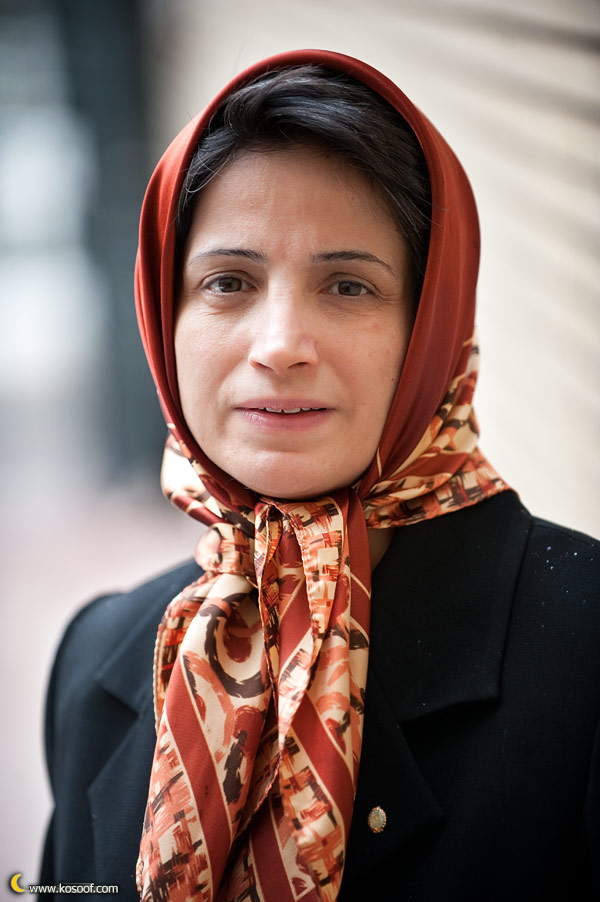 Read the rest of this entry »
York University’s Protective Fellowship Scheme for Human Rights Defenders at Risk.
April 30, 2013
(Professor Paul Gready at York University with Nagi Musa, a human rights activist from Sudan)
Sheena Hastings reports in the Yorkshire Post of 30 April 2013 on the programme offered by York University that lets human rights defenders stay on a fellowship that provides a safe haven and adds to their skills .
“In the few months that Nagi Musa has lived in York, he has not lost the learned panicky response to the odd creaking noise in the night, and he does still find himself scanning any group of people in case there’s someone who looks like a threat. He tends to position himself where he can see the nearest exit, too. Read the rest of this entry »
Human Rights Watch video on Russian civil society under Putin
April 29, 2013This video accompanies a new 78-page report, “Laws of Attrition: Crackdown on Russia’s Civil Society after Putin’s Return to the Presidency, which describes some of the changes since Putin returned to the presidency in May 2012. The authorities have introduced a series of restrictive laws, begun a nationwide campaign of invasive inspections of nongovernmental organizations, harassed, intimidated, and – in a number of cases – imprisoned political activists, and sought to cast government critics as clandestine enemies. The report analyzes the new laws, including the so-called “foreign agents” law, the treason law, and the assembly law, and documents how they have been used. Many of the new laws and the treatment of civil society violate Russia’s international human rights commitments, Human Rights Watch said.
Frequently asked question: how do I become an international human rights lawyer?
April 27, 2013How do I become an international human rights lawyer? is the topic of an article by Hannah Gannagé-Stewart in the Guardian of Friday 26 April 2013. She rightly starts by stating that “the life of an international human rights lawyer is not all jet setting glamour”. Still, it is one of the most frequent questions put to me at the end of a lecture, often during the reception afterwards under 4 eyes: “I would like to work for human rights – what do you advise me?” is the usual opening line. My half-serious standard reply: “if your really want to work FOR human rights, I advise you to get very rich and donate half your wealth to the human rights movement“, is not always appreciated, but correct at the macro level as the shortage of funds is much more problematic than that of talent and devotion in the human rights movement. The question asked was of course situated at the micro level as in: “I want to work IN human rights (even if the pay is not very good)“.
The Guardian piece (although focusing on the UK) contains good, practical advice and most of it would be valid in other countries:
“Jet-setting round the globe, setting the worlds highest courts alight with spectacular oratory performances, radically changing the lives of the most vulnerable. Hell, theres probably a Nobel peace prize in there somewhere too right? Think again. There are actually very few lawyers who would describe themselves as international human rights lawyers, Read the rest of this entry »
Losing faith in justice system in Thailand – good editorial in Bangkok Post
April 27, 2013I am re-publishing this excellent editorial that appeared in the Bangkok Post of 25 Apr 2013 about the lack of protection for environmental human rights defenders in Thailand. If only more newspapers carried such succinct and clear opinions:
“The rally in front of the Appeal Court on Tuesday by 300 residents from Prachuap Khiri Khan to demand transparency in the murder case of environment defender Charoen Wat-aksorn attracted scant media attention.That is not surprising at all as most mainstream media have lost interest in the case, which has dragged on for almost a decade since the victim’s murder on June 21, 2004, regrettably with justice yet to be served _ at least in the mind of Charoen’s widow, his friends and supporters. It is understandable why these rural residents had to travel from their hometown more than 200 kilometres away to gather in front of the court, albeit in a peaceful and civilised manner, to demonstrate their “reaction” against the courts recent acquittal of the last suspect in Charoen’s murder case, 51-year-old Thanu Hinkaew. Their presence in Bangkok was not meant to protest against the Appeal Courts acquittal but merely to seek an explanation from the court and to ensure the case would be treated with transparency when prosecutors appeal against the verdict to the Supreme Court. Read the rest of this entry »
Human Rights Watch urges EU to stand up for human rights in China during Ashton’s visit today
April 25, 2013(EU) High Representative Catherine Ashton should publicly raise concerns over ongoing and persistent human rights violations in China when she visits Beijing, said Human Rights Watch. “As EU’s top foreign policy official, Ashton cannot ignore the deteriorating human rights environment in China,” said Lotte Leicht, European Union advocacy director. “She needs to make it a central part of her agenda in Beijing.” Ashton should also urge top Chinese officials to stop obstructing Security Council action on Syria, including humanitarian access to all civilians in need, and referring jurisdiction over war crimes and crimes against humanity to the International Criminal Court.
In recent months the EU has issued strong statements, including ones at the United Nations Human Rights Council, on China’s use of the death penalty and the crisis of self-immolations in Tibet, among other issues.
The EU also provides some support to human rights defenders in China…..Yet, the EU’s engagement on human rights in China has been extremely weak since Ashton was nominated as the EU’s first foreign policy chief. The more than thirty rounds of the official EU-China dialogue on human rights have had little discernible positive effect for those standing up for human rights in China, and at other levels of political dialogue the EU has failed to give human rights and the rule of law a degree of public attention commensurate with the importance of these issues in China…
…Although the new Chinese leadership has expressed rhetorical support for reform on some key human rights concerns, such as re-education through labor, abuses remain rampant throughout the country. The Chinese government denies people the full exercise of basic rights such as freedom of expression, association, and religion, and systematically suppresses dissidents and human rights activists…
“Ashton should be prepared to tell her Chinese government interlocutors who speak of the need for reform that a good start would be freeing Liu Xiaobo and lifting the appalling and abusive house arrest imposed on Liu Xia,” said Leicht.
Even the new leadership’s commitment to robustly grappling with rampant corruption – identified as a high priority – is already being called into question. In early April, eight activists were arrested for their involvement in a grass-roots anti-corruption campaign.
China: EU Commitments Demand Tough Response | Human Rights Watch.
Freedom House celebrates EU Human Rights Defender Award for Ugandan journalist but with some exaggeration
April 25, 2013
(Photo credit: HRNJ-Uganda website)
Freedom House got carried away a bit when it published the following:
Freedom House would like to congratulate Ugandan human rights activist Geoffrey Wokulira Ssebaggala, on being awarded the European Union Human Rights Defender Award for the year 2012. Ssebaggala is one of the founding members of the Human Rights Network for Journalists-Uganda (HRNJ-Uganda) and has been its National Coordinator since 2009. He was honored for his efforts in defending media rights, recording and highlighting restrictions on freedom of expression and access to information, as well as attacks on journalists. Ssebaggala is certainly a most deserved winner, but when Freedom House states: “The European Union established the award to raise awareness about the work of individual human rights defenders (HRDs) around the world. [emphasis added]” it exaggerates quite a bit as is made clear by the EU delegation in Kampala in 2011 when it created the purely national award http://www.deluga.ec.europa.eu/index.php/delegation-activities-in-uganda/political-press-information/press-and-info/news-releases/182-new-new-new-eu-local-hrd-awards-nominations.
IFEX at the end of its congratulatory piece at least recognises the local character of the award. http://www.ifex.org/uganda/2013/04/24/award_freedom/
Freedom House Grantee Receives the European Union Human Rights Defender Award | Freedom House.


Annual Report 2013 of the Observatory focuses on the issue of funding of NGOs
April 24, 2013

In its 2013 Annual Report, the Observatory for the Protection of Human Rights Defenders focuses on a new setback impeding the work of human rights defenders. Access to funding, in particular foreign funding, is increasingly being hindered by governments, whose primary intentions are to silence human rights defenders. The Report of the Observatory, a joint programme of the World Organisation Against Torture (OMCT) and the International Federation for Human Rights (FIDH), provides a global review of the violations of NGOs’ right to funding via various forms of restrictions imposed by States. It provides a detailed picture of this as yet insufficiently studied problem. This analysis is illustrated by concrete cases in 35 countries.
As also highlighted by Maina Kiai, United Nations Special Rapporteur on the Rights to Freedom of Peaceful Assembly and of Association, in the Foreword to the Report, “The topic of this year’s Report is most pertinent as lately we have witnessed increased stigmatization and undue restrictions in relation to access to funding and resources for civil society organizations, in an attempt to stifle any forms of criticism […]”.
Based on the legal framework surrounding the right to access to funding and the embryonic jurisprudence on this subject, the Report seeks to foster an in-depth analysis of the negative impacts of these restrictive measures, and addresses recommendations to all stakeholders – beneficiaries, donors, governments and intergovernmental organisations.
As also highlighted by Maina Kiai, United Nations Special Rapporteur on the Rights to Freedom of Peaceful Assembly and of Association, in the Foreword to the Report, “The topic of this year’s Report is most pertinent as lately we have witnessed increased stigmatization and undue restrictions in relation to access to funding and resources for civil society organizations, in an attempt to stifle any forms of criticism […]”.
Based on the legal framework surrounding the right to access to funding and the embryonic jurisprudence on this subject, the Report seeks to foster an in-depth analysis of the negative impacts of these restrictive measures, and addresses recommendations to all stakeholders – beneficiaries, donors, governments and intergovernmental organisations.
Two of the three Final Nominees of the MEA this year (in Egypt and Russia) have to deal with these kind of restrictions.
For those who missed the publication when announced in February: Annual Reports : OBS Annual Report 2013: Violations of the right … – FIDH.
 Hans Thoolen on Human Rights Defenders and their awards