Posts Tagged ‘HRW’

Human rights defenders in Greece, my adopted country: not doing well

July 28, 2022
OHCHR | Ms Mary Lawlor

Special Rapporteur on the situation of human rights defenders, Mary Lawlor, conducted an official visit to Greece from 13 to 22 June 2022, to assess the government’s efforts towards creating an enabling environment for those seeking to protect and promote human rights.

Human rights defenders in Greece, particularly those working on migration, operate in an environment of pervasive fear and insecurity, concluded Mary Lawlor. “I am concerned about the increasing criminalization of humanitarian assistance in Greece. Solidarity should never be punished and compassion should never be put on trial,” she said while presenting her preliminary findings at the end of a 10-day mission in the country.

With Greece facing intense international criticism over unlawful pushbacks of migrants at its borders and wider human rights concerns related to migration and asylum, the Greek government has moved to silence groups and individuals documenting these abuses. While acknowledging Greece’s migration challenges and government efforts to address them, Lawlor criticized burdensome rules for the registration of nongovernmental organizations working on migration, introduced in 2019, calling them discriminatory and in violation of Greece’s international human rights obligations. See my earlier: https://humanrightsdefenders.blog/2021/11/17/greeces-mistaken-deterrence-migrants-and-aid-workers-facing-heavy-prison-sentences/

The UN expert noted that human rights defenders not only face criminal sanctions for their activities, but are operating in an increasingly hostile environment where the general public is influenced by negative rhetoric from high-ranking officials and their unfavorable portrayal in the media, which often conflates their activities with traffickers and criminal networks.

Greece fell 38 positions within a year in Reporters Without Borders’ 2022 report on the Press Freedom Index, with the organization marking it the lowest-ranked European Union country for press freedom. “Journalists who counter the government’s narrative on the management of migration flows are often under pressure and lack access to mainstream media outlets.… Journalists reporting on corruption are sometimes facing threats and even charges,” Lawlor said. She noted that journalists have very limited or no access to facilities where migrants, refugees, and asylum seekers are being held, further contributing to a general lack of transparency regarding the government’s policies in this area.

See also: https://humanrightsdefenders.blog/2022/02/18/greek-court-fails-human-rights-defenders-on-antisemitism/

Lawlor will present a detailed report with her findings at the March 2023 session of the UN Human Rights Council. The government should listen to what the UN expert has to say and champion human rights defenders. The European Commission, which noted in July last year the narrowing space in Greece for groups working with migrants and asylum seekers, should step up its engagement on the issue and press Greece to stop harassing civil society groups and activists.

https://www.ohchr.org/en/media-advisories/2022/06/un-human-rights-expert-visit-greece-assess-situation-human-rights

https://www.ohchr.org/en/press-releases/2022/06/greece-migration-policy-having-suffocating-effect-human-rights-defenders

https://www.amnesty.org/en/location/europe-and-central-asia/greece/report-greece/

see also later:

https://www.theguardian.com/world/2022/aug/31/greece-should-face-more-checks-over-asylum-seeker-treatment-eu-official

https://www.theguardian.com/world/2022/aug/31/i-was-close-to-death-syrian-man-tells-how-greek-officials-pushed-refugees-back-out-to-sea

And on 7 November : https://www.hrw.org/news/2022/11/07/greeces-surveillance-scandal-puts-rights-risk

and then: https://www.hrw.org/news/2023/03/16/un-expert-slams-greece-over-civil-society-curbs

Kavala ruling of European Court of Human Rights – infringement procedure against Turkey

July 27, 2022
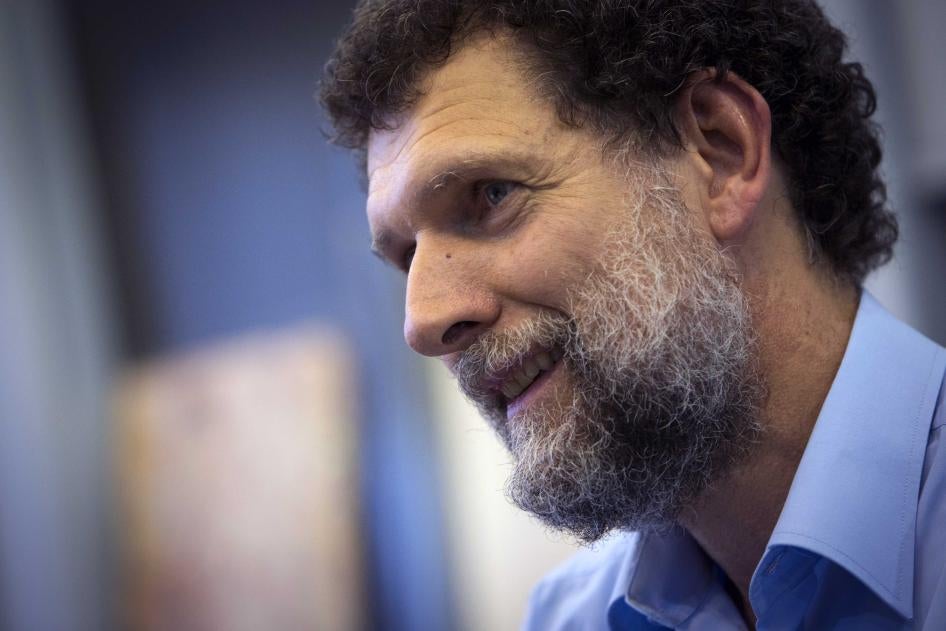
Osman Kavala © 2017 Private

Several sources (here HRW) reported on the European Court of Human Rights (ECtHR) handing down a landmark judgment (announced on July 11, 2022) against Turkey for its failure to carry out the court’s order to free the imprisoned human rights defender Osman Kavala. See: https://humanrightsdefenders.blog/2022/04/27/unexpected-in-its-harshness-kavala-gets-life-sentence-without-parole/

The court found in Kavala v. Türkiye, a case brought by the Council of Europe’s Committee of Ministers, that Turkey failed to fulfil its obligation under Article 46(1) of the European Convention on Human Rights to comply with its judgment issued on  December 10, 2019.  The judgment is an important step toward accountability for Turkey’s systemic disregard for the convention system and as recognition of the urgency of implementing the court’s order to release Kavala.

This is the only second time, after Mammadov v. Azerbaijan, that the ECtHR has ever conducted infringement proceedings and determined that a member state has not complied with a European Court judgment,” said Helen Duffy of the Turkey Litigation Support Project.

It is an acknowledgement of Turkey’s ever-deepening rule of law crisis, which has involved seriously undermining the Convention system and the escalating use of criminal law for political purposes.”

In its new judgment, the court held that “Türkiye has failed to fulfil its obligation under article 46§1 to abide by the Kavala v. Türkiye judgment of 10 December 2019.”

The European Court underlined that:

Its finding of a violation of Article 18 taken together with Article 5 in the Kavala judgment had vitiated any action resulting from the charges related to the Gezi Park events and the attempted coup. It is nonetheless clear that the domestic proceedings subsequent to the above judgment, which resulted first in an acquittal and then a conviction, have not made it possible to remedy the problems identified in the Kavala judgment (para. 172).

The Grand Chamber judgment addresses these practices of the Turkish authorities by stating that “the measures indicated by Türkiye do not permit it to conclude that the State Party acted in good faith,’ in a manner compatible with the ‘conclusions and spirit’ of the Kavala judgment, or in a way that would make practical and effective the protection of the Convention rights which the Court found to have been violated in that judgment” (para. 173).

Aisling Reidy, senior legal adviser at Human Rights Watch said: “As the European Court has now confirmed Turkey’s failure to execute the 2019 Kavala judgment, the Committee of Ministers needs urgently to take all feasible measures to ensure the judgement is respected and Kavala released“.

The Committee of Ministers is expected to resume its supervision process and take more robust steps to discharge its mandate of ensuring the necessary individual and general measures are taken by Turkey to implement the court’s ruling.

Now, it is up to the Committee of Ministers, which oversees the implementation of the ECtHR rulings, what measures to take against Turkey after the country failed to comply with the court’s ruling. This could lead to Turkey’s suspension from the Council of Europe. In anticipation, the Foreign Ministry of Turkey said they expected the Committee of Ministers “to act without bias and with common sense” in a statement.

However, see: https://stockholmcf.org/coe-fails-to-sanction-turkey-over-jailed-philanthropist-opts-for-dialogue-instead/

https://www.hrw.org/news/2022/07/12/landmark-judgment-against-turkey-ignoring-european-ruling

Cambodia: Quash Convictions of ‘ADHOC 5’

June 22, 2022
201808asia_cambodia_adhoc
© 2018 ADHOC

The Cambodian authorities should quash the baseless criminal convictions of four members and one former member of the Cambodian Human Rights and Development Association (ADHOC), Human Rights Watch said on 22 June 2022. On June 21, 2022, four of the defendants, Yi Soksan, Lim Mony, Ny Sokha, and Ny Chakrya appealed a May 23 appeals court ruling upholding their convictions to the Cambodian Supreme Court.

From the very beginning, the Cambodian authorities have sought to unjustly punish the ADHOC 5 as a way to intimidate all civil society activists from criticizing Prime Minister Hun Sen’s government,” said Phil Robertson, deputy Asia director at Human Rights Watch. “Foreign governments, the United Nations country team, and international donor agencies should urge the authorities to drop these cases and end all repression of human rights defenders.” See also: https://humanrightsdefenders.blog/2017/03/11/even-landmark-un-decision-does-not-change-cambodias-treatment-of-human-rights-defenders/

In April 2016 the government’s Anti-Corruption Unit arrested ADHOC members Ny Sokha, Nay Vanda, Yi Soksan, and Lim Mony, along with the former ADHOC member Ny Chakrya, who was then deputy secretary-general of the National Election Committee, and accused them of making false statements regarding a criminal case against the then-opposition leader Kem Sokha.

The five activists spent 14 months in pretrial detention. During their criminal trial, the prosecution failed to present any of the witnesses mentioned in the case or provide any credible evidence to substantiate the charges.

On September 26, 2018, the Phnom Penh municipal court convicted Vanda, Sokha, Soksan, and Mony of “bribery of a witness” (article 548 of Cambodia’s criminal code) and Chakrya of being an accomplice (articles 28 and 548). All five received suspended five-year prison terms, minus 14 months of time served.

On October 24, 2018, the defendants appealed the guilty verdicts to the Court of Appeal. The prosecutor’s office also filed an appeal, seeking to have the defendants serve the remainder of their suspended sentence in prison. The Court of Appeal denied both appeals on May 23, 2022.

The ADHOC 5 case arose during a broader government crackdown on civil society and the political opposition, specifically on the Cambodia National Rescue Party (CNRP), which the government-dominated Supreme Court later dissolved in a politically motivated ruling.

The former CNRP leader, Kem Sokha, continues to face unsubstantiated, politically motivated treason charges brought in September 2017. While he is no longer detained, his trial only recommenced in January, after being suspended for two years ostensibly because of the Covid-19 pandemic and the government deemed his case to not be a “priority”. The allegations against Sokha are based on the government’s groundless claim that the CNRP fomented a “color revolution” to overthrow the government.

Human Rights Watch has documented the situations of more than 50 current political prisoners in Cambodia, including both those in pretrial detention and those serving prison sentences following politically motivated convictions. They include political opposition members, human rights defenders, land and environmental rights activists, and journalists.

“The Cambodian authorities should recognize that every day the ADHOC 5 case persists, the greater this travesty of justice inflicts harm to the government’s reputation,” Robertson said. “The only way for justice to be served is for the prosecutor to quash the convictions and provide the defendants with an appropriate remedy for the years of hardship the case caused them.”

see also: https://www.martinennalsaward.org/hrd/the-khmer-5/

https://www.hrw.org/news/2022/06/22/cambodia-quash-convictions-adhoc-5

Emirates’ claim to improve its legal system are nonsense

June 7, 2022

Human Rights Watch on 5 June 2022 published a detailed piece showing that wide-ranging legal changes introduced by the United Arab Emirates (UAE) in late 2021 fail to address the long-standing and systematic restrictions on citizens’ and residents’ civil and political rights. The new laws maintain previous provisions and include new ones that pose grave threats to fundamental human rights.

As reported by the state news agency WAM in November, the legal changes include amendments to over 40 laws including on crime and punishment, cybercrimes, and drugs, aiming “to strengthen economic, investment and commercial opportunities, in addition to maximizing social stability, security and ensuring the rights of both individuals and institutions.” While the changes allow for a moderate broadening of personal freedoms, the new legal framework retains severe restrictions on the rights to free expression, association, and assembly.

While the UAE government and its state-controlled media outlets trumpeted these new legislative changes as a massive step forward for economic and social freedoms, they will further entrench government-imposed repression,” said Michael Page, deputy Middle East director at Human Rights Watch. “The UAE government has chosen to squander an opportunity to improve freedoms across the board and instead has doubled down on repression.”

Human Rights Watch conducted a comprehensive legal analysis of two of the new laws, the crime and punishment law and the cybercrimes law, to identify any changes related to the rights to free expression and free assembly. Both laws went into effect in January 2022.

The laws continue to prohibit criticism of rulers and speech that is deemed to create or encourage social unrest, imposing severe penalties for vaguely defined charges. They maintain provisions that criminalize defamation and both verbal and written insults, whether published or made in private, as prosecutable offences. New provisions criminalize “false” and “misleading” information, sharing information with foreign groups or countries, and “offending foreign states.” Protests and demonstrations would still be prohibited.

UAE authorities have also spied on international journalists, activists, and even world leaders using sophisticated Israeli and EU-produced spyware, or with the help of former US intelligence officials. Some of those whose communications and devices were targeted by the government surveillance and who are residents of the UAE, were subsequently arrested and abused in detention. Among them is the prominent Emirati human rights activist Ahmed Mansoor [see: https://humanrightsdefenders.blog/2016/08/29/apple-tackles-iphone-one-tap-spyware-flaws-after-mea-laureate-discovers-hacking-attempt/]. A UAE court sentenced Mansoor to 10 years in prison in May 2018 following a grossly unfair trial, partly based on private email exchanges and WhatsApp conversations. See also: https://humanrightsdefenders.blog/2019/11/05/massive-call-in-support-of-ahmed-mansoor-at-his-50th-birthday-how-can-emirates-remain-deaf/ and https://www.trueheroesfilms.org/thedigest/laureates/074ACCD4-A327-4A21-B056-440C4C378A1A

The UAE authorities should take immediate steps to bring the penal code and cybercrime law into line with international and regional standards on free speech and individual freedoms, Human Rights Watch said. The UAE has not ratified the ICCPR, article 19 of which outlines the right to freedom of opinion and expression. But it is a state party to the Arab Charter on Human Rights. Article 32 of the Arab Charter ensures the right to information, freedom of opinion and freedom of expression, and article 24 guarantees the right to freedom of political activity, the right to form and join associations, and the right to freedom of assembly and association.

The UAE cannot market itself as a reformist and tolerant state while introducing new laws that increase its already alarming levels of repression and censorship,” Page said….

The piece further provides a detailed analysis of penal and Cybercrimes Law.

https://www.hrw.org/news/2022/06/05/uae-sweeping-legal-reforms-deepen-repression

NGOs condemn arbitrary arrest of pro-democracy activists in Hong Kong

May 15, 2022

NOGs (such as Human Rights Watch and the Human Rights Foundation) have condemned the arrest of Cardinal Joseph Zen, as well as the lawyer Joseph Zen, the singer Denise Ho and the scholar Hui Po-Keung, for having maintained contacts with foreign forces in Hong Kong.

HRW Senior China researcher Maya Wang, said that “the arrest of a 90-year-old cardinal is the latest example of the city’s human rights freefall in recent years.

The four, along with former lawmaker Cyd Ho, who is already in jail, were part of the 612 Humanitarian Aid Fund, which provided medical, legal and psychological help to protesters arrested during the 2019 pro-democracy protests in Hong Kong. Kong.

Denise Ho, Margaret Ng, and others affiliated with Stand News, an independent pro-democracy online publication, were previously arrested by national security police in December 2021 under allegations of publishing “seditious” and “inflammatory” materials. Denise Ho formerly served on the board of Stand News, but stepped down in November 2021. Meanwhile, the 612 Humanitarian Support Fund ceased operations in October 2021 after national security police and Chinese state-backed media requested information on its beneficiaries and donors.

Maya Wang has specified that Hong Kong has “long been a regional leader in openness and respect for the rule of law, but now competes for the first places in Asia for repression and political prisoners.”

The people of Hong Kong have been unequivocal in their demand for human rights, and governments around the world should be unequivocal in their response to that call,” concluded the HRW researcher.

https://mailchi.mp/hrf.org/hong-kong-hrf-condemns-arbitrary-arrest-of-denise-ho-and-colleagues?e=f80cec329e

New program director of Human Rights Watch generates interest

May 7, 2022

In 1 May 2022 the Times of Israel reported that “Sari Bashi, a longtime activist with the organization who is married to a Palestinian, to head up programming at HRW amid search for successor to departing director Kenneth Roth” {see also: https://humanrightsdefenders.blog/2022/04/27/after-almost-30-years-kenneth-roth-will-leave-human-rights-watch/]

I’m thrilled, honored, humbled and grateful to announce that next month, I will begin my appointment as @hrw’s new Program Director, supervising our research and investigations as we reorient ourselves to strengthen the broader human rights ecosystem and meet today’s challenges,” Bashi tweeted on Friday.

In the past, Bashi, a lawyer by training, co-founded and directed Gisha, an organization that pushes for freedom of movement for Palestinians in Gaza. From 2015 to 2018 she served as the director of Israel-Palestine for HRW, and returned to the organization last year as a special adviser.

A year ago, HRW issued a sweeping 213-page report accusing Israel of apartheid. Israel rejected the report, calling its “fictional claims… both preposterous and false,” and accusing HRW of having “a long-standing anti-Israel agenda.” [see also: https://humanrightsdefenders.blog/2021/05/10/israeli-government-sponsored-app-goes-after-hrw-for-apartheid-categorisation/]

HRW’s Israel and Palestine director, Omar Shakir, was expelled by Israel in 2019 over allegations that he supported the Boycott, Divestment and Sanctions movement, which seeks to isolate Israel over its alleged mistreatment of Palestinians. [See also: https://humanrightsdefenders.blog/2019/11/06/human-rights-watch-omar-shakir-loses-his-appeal-in-israeli-supreme-court/]

In recent years, Bashi, a US native, has been open about her relationship with a Palestinian man originally from Gaza, and the struggles they have faced to live in the same place. They lived together for a few years in the United States as well as in South Africa, and have based their lives in Ramallah, she said, since they are unable to live together in Israel.

The reaction was quick in coming. On 2 May Just the News stated: “A powerful nongovernmental organization with a massive budget and an alleged ideological bias against Israel will continue targeting the Jewish state after it completes a major leadership change now underway, according to experts and lawmakers who spoke to Just the News.” “Unfortunately, the extremely biased attitude toward Israel which Kenneth Roth represented in Human Rights Watch will, most probably, be cemented with the appointment of Sari Bashi,” said Sarah Stern, president of the Endowment for Middle East Truth, a think tank. “Throughout her career, Ms. Bashi has constantly demonstrated her lack of objectivity and overwhelming animus towards the state of Israel.”

https://www.timesofisrael.com/jewish-israeli-to-become-new-programs-director-of-human-rights-watch/

https://justthenews.com/accountability/whistleblowers/experts-human-rights-watch-continue-targeting-israel-after-leadership

EU – China Summit on 1 April should not be a joke

March 30, 2022

European Union leaders should announce specific policy responses to the Chinese government’s atrocity crimes, Human Rights Watch said today, 30 March 2022. A virtual summit between the EU and China is scheduled for April 1, 2022.

The summit takes place at a time of heightened tensions between the EU and the Chinese government, which retaliated against Lithuania for its relations with Taiwan, baselessly sanctioned EU bodies and European research institutions, and has not condemned Russian war crimes in Ukraine. The Chinese government’s disregard for international human rights norms mirrors its domestic track record of grave abuses without accountability.

The EU’s foreign policy chief has pointed with alarm to the Chinese government’s ‘revisionist campaign’ against universal human rights and institutions,” said Sophie Richardson, China director at Human Rights Watch. “Brussels should revise its approach to match the magnitude of that threat.”

In a March 18 joint letter from 10 nongovernmental organizations to Ursula von der Leyen, president of the European Commission, and Charles Michel, president of the European Council, Human Rights Watch cited Chinese authorities’ deepening assault on human rights, including crimes against humanity targeting Uyghurs and other Turkic communities in Xinjiang, and heightened repression in Tibet and Hong Kong. Human rights defenders across the country – including the citizen journalist Zhang Zhan, the Uyghur intellectual and Sakharov Prize laureate Ilham Tohti, the Swedish publisher Gui Minhai, and many others – remain arbitrarily detained. {see https://www.trueheroesfilms.org/thedigest/laureates/37AE7DC4-16DB-51E9-4CF8-AB0828AEF491, and https://humanrightsdefenders.blog/2020/02/25/gui-minhai-10-years-jail-sentence-in-china/

While the EU has taken important steps in reaction to these developments, including some targeted sanctions and strong condemnations of Beijing’s abuses at the United Nations, these efforts lack the consequences to bring significant change. The rights groups urged Michel and von der Leyen to use their time with the Chinese leaders to announce further steps to counter Beijing’s abuses, and cautioned them against calling for yet another round of the bilateral human rights dialogue, which after 37 rounds has proven unable to secure concrete progress.

Stronger, better coordinated action is also supported by the European Parliament, which has remained a staunch critic of the Chinese government’s crackdown and has repeatedly denounced its abuses. Beijing responded by sanctioning several members of the European Parliament. In response, the European Parliament froze consideration of a bilateral trade deal and called for a new, and more assertive, EU strategy on China, including further targeted sanctions and closer coordination with like-minded partners. [see: https://humanrightsdefenders.blog/2021/05/21/china-eu-investment-deal-off-the-rail/]

Presidents Michel and von der Leyen should go beyond words of condemnation at the summit if they want to deter Chinese government violations now and in the future,” said Claudio Francavilla, EU advocate at Human Rights Watch. “Bolder steps are needed to counter Beijing’s crimes against humanity and anti-rights agenda, and EU leaders should announce their determination to pursue them.”

https://www.hrw.org/news/2022/03/18/joint-ngo-letter-ahead-eu-china-summit

https://www.hrw.org/news/2022/03/30/eu-no-business-usual-china-summit

UN experts urge Bangladesh to end reprisals against human rights defenders

March 17, 2022

On 14 March 2022 a group of UN human rights experts today called on Bangladesh to immediately cease reprisals against human rights defenders and relatives of forcibly disappeared persons for their activism and co-operation with international human rights bodies and UN mechanisms.

Following the announcement of sanctions imposed by the United States of America against top Rapid Action Battalion (RAB) officials on 10 December 2021, Bangladeshi authorities have reportedly launched a campaign of threats, intimidation and harassment against relatives of forcibly disappeared persons, human rights defenders, and civil society actors. See also: https://humanrightsdefenders.blog/2014/05/12/bangladesh-chains-of-corruption-strangle-nation-asian-human-rights-commission/

In the period between December 2021 and February 2022, the homes of at least 10 relatives of forcibly disappeared individuals were reported to have been raided late at night.

During the raids, relatives were intimidated, threatened and forced to either sign blank sheets of paper or pre-written statements indicating that their family member was not forcibly disappeared and that they had deliberately misled the police. This is unacceptable,” the experts observed.

The experts noted with concern the increasingly challenging situation relatives, human rights defenders and civil society are facing in Bangladesh. Repeated accusations by senior Government officials against some civil society organizations of providing “false information” to the UN mechanisms risk undermining the civil society’s key role.

Bangladesh must ensure that relatives and human rights defenders are able to carry out their legitimate work in a safe and enabling environment without fear of threats, intimidation or reprisals of any kind,” the experts stressed. They expressed their concern that the reported reprisals may have a chilling effect and deter others from reporting on issues of public interest, including human rights, and from cooperating with the UN, its representatives and mechanisms.

Since 2009, the RAB has reportedly been involved in the perpetration of the majority of cases of enforced disappearance in the country, as noted in several reports by the UN Working Group on Enforced or Involuntary Disappearances.**

“Bangladeshi authorities are obliged under international law to promptly launch ex officio, independent, impartial and thorough investigations into these serious allegations, complemented by a thorough and comprehensive search for disappeared persons. At the same time, the RAB and other security agencies should not be shielded from scrutiny and criminal responsibility.”

The experts also reiterated their request to the Government of Bangladesh to take effective steps to protect and uphold the rights of victims and their families to truth, justice, reparation, and guarantees of non-recurrence.

On 17 March HRW stated that the Bangladesh government should meaningfully respond to United Nations concerns regarding grave allegations of torture, enforced disappearance, and extrajudicial killings in the country.

https://www.hrw.org/news/2022/03/17/bangladesh-stop-flouting-un-rights-concerns

Anti-war Human Rights Defenders in Russia

February 27, 2022
People attend an anti-war protest, in Saint Petersburg, Russia.
People attend an anti-war protest, in Saint Petersburg, Russia, February 24, 2022, after Russian President Vladimir Putin authorized a military operation in Ukraine. © 2022 REUTERS/Anton Vaganov

It is of course the worst for the direct victims of Russia’s aggression in Ukraine, but the very courageous people who stand up against the autocratic government and nationalistic media in Russia deserve all our attention. On 26 February 2022, Human Rights Watch wrote “Russia: Arbitrary Detentions of Anti-War Protesters“:

Police arbitrarily detained hundreds of peaceful protesters across Russia on February 24, 2022, at rallies in solidarity with Ukraine and against the war, Human Rights Watch said. The authorities also arrested at least two human rights defenders who spoke up against Russia’s full-scale invasion in Ukraine, threatened to block mass media outlets in case their reporting on the war differed from the official narrative, and demanded that foreign social media platforms stop restricting reports from Russian state media.   

For years, Russian authorities have been suppressing free speech and peaceful protests to stifle critical voices,” said Hugh Williamson, Europe and Central Asia director at Human Rights Watch. “Now the government is silencing all those who speak out against the war with Ukraine.”  

According to OVD-Info, an independent human rights project working to protect freedom of assembly in Russia, by the evening of February 25, police had detained at least 1,858 people for participation in anti-war protests in 57 cities, including Moscow, Saint Petersburg, Krasnodar, Ekaterinburg, Saratov, Nizhny Novgorod, and Voronezh. Some of detained protesters stood in single pickets and held posters saying “no to war, do not be silent,” “stop the war,” and other similar slogans.

At around 3 p.m. on February 24, the police detained Marina Litvinovich, a human rights activist, in Moscow after she had made a call over social media to “come out and say we are against war.” She was released several hours later, pending a court hearing and the next day was fined for violating the rules on public gatherings.   https://www.rferl.org/a/russia-litvinovich-fined-ukraine-invasion-protest/31723131.html

In response to calls for peaceful protests, Russia’s Investigative Committee published a news release with a warning that organizing unsanctioned gatherings is a prosecutable offense and threatening “harsh punishment” for organization of “mass riots.”

In the evening of February 24, protesters gathered in different cities across Russia to demonstrate against war. According to OVD-Info, more than 1,000 protesters were arbitrarily detained in Moscow and around 400 in Saint Petersburg where the biggest protests took place.

Human Rights Watch analyzed and verified 27 videos recorded north of the Gostinny Dvor metro station in Saint Petersburg and close to Pushkinskaya Square in Moscow that were published on social media on February 24. The vast majority document brutal arrests of peaceful activists by police officers. In at least four cases, videos show police officers beating protestors, pushing them to the ground, dragging them, grabbing them by the head, and choking them.

Mass media and OVD-Info also reported other cases of excessive use of force by the police, refusal of medical assistance, and denial of access to lawyers. At night, at least six police stations in Moscow, and some stations in Saint Petersburg, Saratov, Voronezh and Ekaterinburg refused access to outside visitors after initiating the “Fortress” protocol, authorized for  a situation of potential attack, which meant lawyers were denied access to their clients for hours. On February 25, OVD-info reported they could not get in touch with three of the detainees on their list.

Russian public figures, journalists, scientists, activists, and average social media users have been publicly expressing their shock and indignation at the full scale Russian military operations in Ukraine and calling for the hostilities to end. Thousands used the hashtag #нетвойне (#notowar).

Lev Ponomarev, a prominent human rights defender and the founder of the Movement for Human Rights, initiated a petition “against war,” calling on the Russian military to withdraw from Ukraine and inviting people to join the peaceful anti-war movement. The police detained Ponomarev on February 24 and charged him with organizing unsanctioned protests in connection with the petition, which had gathered over 550,000 signatures by the evening of February 25.

On February 24, the internet regulator Roskomnadzor published a warning to mass media disseminating “unverified” and “false” information, claiming that only information from official sources can be used when reporting on the “special operation” in Ukraine. The authorities also said that all “false” information would be instantly blocked and warned about fines for disseminating “fake” news.

Roskomnadzor also sent official letters to Facebook (Meta) demanding that it should lift restrictions imposed by the social media platform on official pages of state and government mass media. The authorities said that Facebook had marked them as “untrustworthy” and hid their publications from the platform’s search. Roskomnadzor also called on Russian users to switch to national internet resources and social networks due to “unfounded blockings by foreign platforms.”

On February 25, the Office of the Prosecutor General, in coordination with the Ministry of Foreign Affairs, accused Facebook of being “involved in violation of fundamental human rights and freedoms” and imposed restrictions on access to the platform in Russia.

The authorities’ actions to prevent people from participating in peaceful public protests and freely expressing their opinions violate fundamental rights, including those to freedom of expression and assembly and the prohibition on arbitrary detention, guaranteed by the European Convention on Human Rights (ECHR), the International Covenant on Civil and Political Rights (ICCPR), and Russia’s own Constitution.

The ability to express disagreement in a peaceful way is crucially important in any society that respects human rights and rule of law,” Williamson said. “This abusive crackdown on a peaceful anti-war movement is yet further proof, if more was needed, of the government’s intolerance of independent voices.

On the other hand, in a post of 25 February 2022, Brian Dooley of Human Rights First relates what human rights defenders in Ukraine are telling about the immediate impact on them of the Russian invasion.

https://www.hrw.org/news/2022/02/26/russia-arbitrary-detentions-anti-war-protesters

https://www.humanrightsfirst.org/blog/human-rights-activists-ukraine-call-swift-response

Prosecution of human rights defender Öztürk Türkdoğan in Turkey should be dropped

February 23, 2022

All charges against Öztürk Türkdoğan, the co-chair of Turkey’s most prominent human rights organisation and a respected lawyer, should be immediately dropped, Amnesty International said ahead of the start of his trial. Öztürk Türkdoğan, the co-chair of the Human Rights Association (IHD), faces baseless charges of “membership of a terrorist organization”, “insulting a public official” and “insulting the Turkish nation and the Turkish state” for public statements he made in relation to his association’s human rights work.
See also: https://humanrightsdefenders.blog/2021/03/22/turkey-arrests-and-backsliding-on-femicide/.


The prosecution of Öztürk Türkdoğan is an undisguised attack on this one human rights defender and also on all those who speak out for human rights in Turkey,” said Julia Hall, Amnesty International’s Deputy Director for Research for Europe. “With these spurious charges against the co-chair of Turkey’s longest-standing human rights organisation, the prosecuting authorities send a chilling message that increases the climate of intense fear among Turkey’s already beleaguered human rights community.

According to IHD’s records, over 200 separate criminal investigations and prosecutions of IHD members and elected representatives of the organization are ongoing across Turkey.

The criminalization of human rights defenders and of the Human Rights Association are the true insults here. The authorities’ unrelenting attack on Öztürk Türkdoğan and Turkey’s civil society movement has to end,” said Julia Hall. “Turkey must immediately drop all charges against Öztürk Türkdoğan and create an enabling, protective environment for civil society in line with its obligations under international human rights law.”

In December 2021, the Turkish authorities initiated three separate prosecutions against Öztürk Türkdoğan. He was tried under Article 125 of the Turkish Penal Code allegedly for “insulting” a public official in a statement published on the IHD website on 29 June 2018. The first hearing of this prosecution, in which the Minister of Interior is the alleged victim, was held on 18 February 2022. The next hearing will be held on 11 May.

He was also charged with “membership of a terrorist organization” under Article 314/2 of the penal code after the authorities detained him and searched his home on 19 March 2021. During the search, his phone and laptop were confiscated. The first hearing for this case will take place on 22 February 2022.

https://www.amnesty.org/en/latest/news/2022/02/turkey-baseless-prosecution-of-ozturk-turkdogan-an-attack-on-all-those-who-speak-out-for-human-rights/

https://www.arabnews.com/node/2029361/middle-east