On 27 January 2026, 1,025 (!!) organisations in the USA sent the following letter:
Dear Members of Congress,
We the undersigned 1,025 organizations write to express our horror, outrage and deep grief about the news that federal agents have executed a human being in broad daylight on the streets of Minneapolis. How many more people have to die, how many more lies have to be told, and how many more children must be used as bait and abducted, before Congress fulfills its responsibilities and stops these out-of-control agencies from continuing to violently attack our immigrant communities and communities of color, as well as their many allies and supporters?
We demand an immediate halt in all funding for these deadly operations until the violence, abuses, and deaths in American communities and in immigration detention centers stop. Congress must refuse to provide one dollar to Immigrations and Customs Enforcement (ICE) or Customs and Border Protection (CBP) Border Patrol through the appropriations process and immediately take action to revoke the tens of billions already given through last summer’s reconciliation bill.
We demand that you act decisively and show DHS and the communities you serve that this cruelty and lawlessness is unacceptable and must end now. When federal agents are patrolling the streets of American cities and gunning people down in broad daylight, the bare minimum response is to stop the funding that enables these violent agencies to carry out these atrocities. You have the power and responsibility to stop this. What you do now will be remembered for future generations – take a stand today while you still have the power to do so
The Abu Dhabi Federal Court of Appeal in the United Arab Emirates (UAE) sentenced 43 individuals to life in prison in a mass trial on Wednesday 3 July 2024, according to the UAE’s state-run news agency, WAM. The trial, which has been criticized by human rights organizations for allegedly targeting dissidents, involved charges linked to the Muslim Brotherhood, a group designated as a terrorist organization by the UAE government. WAM reported the verdicts shortly after human rights advocates released statements announcing the sentences. Alongside the life sentences, five defendants received 15-year prison terms and another five were sentenced to 10 years. The court dismissed the cases of 24 defendants.
According to WAM, the court ruled that those convicted “have worked to create and replicate violent events in the country, similar to what has occurred in other Arab states—including protests and clashes between the security forces and protesting crowds—that led to deaths and injuries and to the destruction of facilities, as well as the consequent spread of panic and terror among people.”
While WAM did not identify those sentenced by name, and specific details regarding the trial are not clear, Joey Shea, a researcher focusing on the UAE for Human Rights Watch, noted a few prominent figures involved in the case to the Associated Press (AP).
On 10 July 2024, Human Rights First condemned the secret trial and sentencing of dozens of activists in the United Arab Emirates:
“Washington’s ally has again today demonstrated its violent repression,” said Senior Advisor Brian Dooley. “The Biden administration has struck millions of dollars of arms deals with the UAE dictatorship, and failed to sanction its officials responsible for cracking down on peaceful dissent. The message from Washington to the UAE has been clear for many years: Do what you want, there will be no consequences.”
Among those reportedly sentenced to life in prison after a mass trial is prominent legal scholar Nasser bin Ghaith. He graduated with honors from Case Western Reserve University School of Law in Ohio with an LLM in U.S. and Global Legal Studies in 2001. Another of those in the mass sham trial — which included 84 defendants — was Ahmed Mansoor, who received his Bachelor’s Degree in Electrical, Computer, & Energy Engineering and his Master’s in Telecommunications for the University of Colorado, Boulder. Human Rights First is still waiting for confirmation on the outcome of his case in the trial. [see https://www.trueheroesfilms.org/thedigest/laureates/074ACCD4-A327-4A21-B056-440C4C378A1A]
Bin Ghaith, Mansoor, and other prominent activists in the trial were already in prison serving long sentences for their peaceful activism.
In 6 August, 2020 HRF’s President sent a letter to the American hip hop artist Tyga pointing out that his performance is part of a plan to distract from the electoral fraud in the imminent election and prevent protesters from gathering at opposition rallies. The concert is organized and funded by the Belarusian dictatorship, led by Alexander Lukashenko. Under this regime, there is no freedom of speech, no freedom of assembly, and no freedom of association.
“This performance, scheduled for the day before Belarus’ elections, is no coincidence. It is an excuse to cancel the opposition’s final electoral rally, and prevent ordinary Belarusians from showing their support for freedom and democracy,” said HRF president Thor Halvorssen. “It is also a deliberate attempt to turn attention away from the massive electoral fraud that is already taking place across the country.” Belarus’ elections, which haven’t been free or fair since 1994, have been met with extreme repression. As HRF recounted in its letter to the performer: “Protestors are grabbed off the street at random, and many are beaten bloody. The two most popular candidates in the upcoming presidential election, Viktor Babryka and Sergei Tikhanouvsky, were both arrested on trumped up charges. Many opposition activists have had to flee the country, along with their children, after receiving threats from the government.” “Tyga has been an outspoken advocate of the Black Lives Matter movement. He has urged followers to vote in local elections and take to the streets in protest. His support for Lukashenko’s regime will greatly undermine the activism he has encouraged in the United States,and provide the Belarusian dictator a useful propaganda stunt,” said Halvorssen. “We hope he will stand on the side of the people of Belarus as opposed to their oppressor. He must decline the invitation to perform for the dictator.” HRF requested that Tyga cancel his concert and use this media opportunity to send an urgent and categorical message of encouraging support to protestors in Belarus.
The Voice of America (3/3/17: Tillerson in Background as State Department Issues Human-Rights Report) and other media reported on the low-key way in which the US State Department launched the2016 Country Reports on Human Rights Practices.
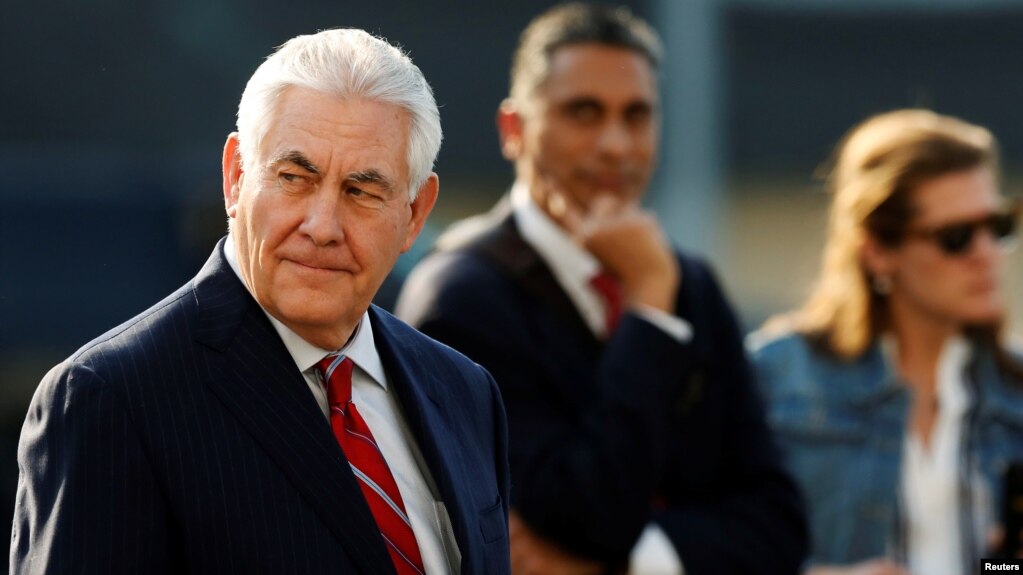
U.S. Secretary of State Rex Tillerson arrives in Mexico City, Mexico, Feb. 22, 2017.
A senior Trump administration official briefed reporters on the 2016 Country Reports on Human Rights Practices and rejected criticism from some human-rights groups and lawmakers that the briefing was not announced a day in advance, was not on camera and did not feature Tillerson. “The report speaks for itself. We’re very, very proud of it. The facts should really be the story here,” the senior official said Friday. “Secretary Tillerson spoke quite clearly in his confirmation hearing about his views of the impact of human rights on, and the importance to, U.S. interests.” When questioned by reporters, the senior administration official did not explain why Tillerson did not unveil the report, but did say that the State Department wanted to get it out without delay.
Human Rights Watch and Human Rights First both issued statements sharply criticizing the low-key rollout of the report, which reflects thousands of hours of painstaking work. The annual effort is read carefully by both governments and human-rights defenders around the world. Sarah Margon of Human Rights Watch noted in a statement that Tillerson’s absence “reinforces the message to governments, rights activists and at-risk minorities that the State Department might also be silent on repression, abuse, and exploitation.”
In an overview, the 2016 report did not specifically highlight any countries. As is customary, it does not rank or compare countries’ human-rights records. The report offers country-by-country analysis of 199 countries, and it paints a devastating picture of conditions in Syria:
Under the title “Dooley doodling”appeared a post in the Gulf Daily News of 18 May 2015. It is supposed to a pun on the name of Brian Dooley, the director of Human Rights First’s human rights defenders’ programme. The writer [Duri?] draws fortunately more attention to Dooley’s piece in the Huffington Post of 6 May: ‘How to Sound Like a Washington Expert on Bahrain’.
There is a rather-vaguely worded attack on his work for human rights defenders in Bahrain without ever substantiating any of the claims that he or his organization is receiving money from unnamed sources (“Guess who foots the bills?“) or going in any detail on the harassment of the human rights defenders (“Every time Mr Rajab or any of the players happen to be [SIC] behind bars, expect one piece from him attacking the Bahraini government and its institutions.“). Dooley is quite capable of defending himself, but the awards aspect below is worth a bit more attention: Read the rest of this entry »
organises on 9-10 December 2014 its annual Human Rights Forum. It takes place in the Newseum in Washington DC, USA. Several panels are of direct relevance to human rights defenders, such as:
Show Them the Money: What are the Lifelines for Civil Society in a Sea of Restrictions? More and more governments – and not only authoritarian ones – are finding ways to close the space for independent civil society groups, especially those critical of government policies. As part of this effort, governments have developed sophisticated methods to undermine the credibility of international –especially American – support for local human rights and democracy organizations. Russia and Egypt are leading the way; each has passed laws restricting access by independent civil society groups to foreign funding, which is essential to their existence. How should the U.S. government and other donors respond to these coordinated efforts to restrict human rights and democracy activists? Given the legal landscape, is foreign funding for NGOs even possible anymore?
Progress and Backlash in the Global Struggle for LGBT Equality Human rights advocates often describe achieving full equality for LGBT people as the next chapter in the struggle for universal human rights. For many years, this movement appeared to be one of steady gains, but we are now facing a moment of profound backlash. LGBT citizens of Russia, India, and Nigeria have seen a sharp curtailment of their rights. In many cases, this is part of a larger attack on civil society, marked by laws and policies aimed at limiting freedom of expression, freedom of association, and other basic rights. The countries in question may see themselves as in conflict with the West and its values; support for such laws is often driven by anti-Western sentiment. How can the United States respond to this development in ways that will improve the lives of LGBT people worldwide?
NGOs as the Enemy Within? Human rights defenders face particular challenges when their societies mobilize for war. In such circumstances, questioning government policies can be characterized as disloyalty or siding with the enemy. Human rights defenders become targets of defamation, persecution, and violence. The universal values they are seeking to uphold are themselves called into question and undermined. Does the U.S. government have a role in preserving the rights of activists espousing what may be deeply unpopular points of view in times of public fear and conflict?
will honor Ryan Boyette, a human rights advocate based in Sudan, with its 2014 Human Rights First Award. Boyette is recognized for his courageous work documenting and drawing international attention to the ongoing attacks against civilians by the Sudanese government in conflicts largely hidden from worldview. The organization will present the Award at its annual gala on 22 October in New York. Human Rights First’s CEO Elisa Massimino stated: “We are inspired by Ryan’s commitment to keep the eyes of the world on the human rights crisis in southern Sudan.” Read the rest of this entry »
today (1 September 2014) expressed fears for leading human rights defender Maryam Al Khawaja, who landed at Bahrain airport last night on a visit home and has been held by Bahraini authorities. Reports state that al Khawaja, a Danish citizen, was immediately detained and will be held at the airport until tomorrow. “Bahrain is consistently revealing itself as a place where voices on human rights are not welcome,” said Human Rights First’s Brian Dooley. “In the last two months, a U.S. diplomat, a member of Congress, and the NGO Human Rights First have either been kicked out of or not allowed into the country. Now Maryam has been taken into custody and will appear in court tomorrow after trying to visit her family, including her father who is on hunger strike in prison there. Lets hope the United States, United Kingdom, and other governments will respond to whats happening to her with more than just an awkward silence.”
For more information please contact Brenda Bowser Soder at bowsersoderb[at]humanrightsfirst.org.
New York based Human Rights First is now accepting nominations for the 2014 Roger N. Baldwin Medal of Liberty which recognizes an individual or organization who demonstrates exceptional commitment to advancing human rights. Named in honor of the principal founder of the American Civil Liberties Union and the International League for Human Rights, the Roger N. Baldwin Medal of Liberty Award was established in 1989. This year marks the 25th anniversary of the award and it will focus areas such ashuman trafficking, religious freedom, LGBT rights, refugee protection, and defense of civil society. The winner will be selected by a jury and will receive a $25,000 prize. The award will be presented at a ceremony during Human Rights First’s annual Human Rights Summit in Washington, D.C. in December 2014. Nominations are due on March 15, 2014.
More information on this award and past awardees can be found at: <http://www.humanrightsfirst.org/our-work/human-rights-defenders/baldwin-award> .
(Jennifer Lopez performing for the leader Turkmenistan. (c) Agence France-Presse/Igor Sasin)
In quite a few earlier posts in this blog I have drawn attention to stars and celebrities who either support dictators or simply do not care that their actions do. So, I was quite happy to see a thoughtful piece by Jo Biddle of Agence France-Presse on 9 February 2014 analyzing this issue a bit more in-depth, with actress Scarlett Johansson as the “poster girl of Israeli apartheid”, Dennis Rodman in North Korea, and Kim Kardashian expressing her love of Bahrain. I would add, Mariah Carey who thinks nothing of singing for Gaddafi or the Angolan President, while Jennifer Lopez (picture above) did the same in Turkmenistan.
The author rightly states that when celebrities wander into complex foreign policy issues, it can be a minefield, leaving diplomats and human rights campaigners scrambling for damage control. The article mentions exceptions such as Bob Geldof,Bono, George Clooney or Angelina JolieRead the rest of this entry »


 Hans Thoolen on Human Rights Defenders and their awards