Cândida Schaedler on 12 February 2025 asks whether anything can be done to protect them.
In 2023, 196 land and environmental defenders were murdered around the world – the vast majority of them in Latin America. In fact, just four countries – Brazil, Colombia, Honduras and Mexico – accounted for over 70 percent of those killings. Colombia was by far the deadliest country, with 79 murders, followed by Brazil, with 25.
We spoke with some of these brave activists to learn more about the threats they face, how they stay safe and how Colombia and Brazil are working to keep them alive.
Quilombolas in the Jequitinhonha Valley in Minas Gerais, Brazil. Photo: Mídia NINJA, Flickr
“When we recognized ourselves and declared ourselves a quilombo, our peace was over”, recalls Elza,* a Brazilian Quilombola leader in her late 50s.
In December 2008, she was shot and injured in an attack that killed her brother and sister. Since then, she hasn’t left her home alone – not even for a walk in her own territory, one of the 11 urban quilombos in Porto Alegre, the capital of Rio Grande do Sul in southern Brazil.
Quilombos are Afro-Brazilian communities that were originally founded by escaped slaves in colonial times.
Today, they are officially defined as “ethno-racial groups that, by self-definition, have their own historical trajectory, maintain specific territorial relations and are presumed to have Black ancestry related to resistance against historical oppression.” Brazil has recognized quilombos in its constitution since 1988, but the process of gaining legal recognition is time-consuming and often fraught with obstacles. Elza’s community was officially designated a quilombo in 2005, but only after its residents agreed to give up half their territory. Ever since, they’ve been battling gangs and real estate speculators who want control of the same 58 hectares of land they call home.
In 2022, they once again came under attack. Armed men showed up at their door in an attempt to take over a housing project under construction in the quilombo, which had been put on hold due to a dispute with the bank financing it….
Elza and her daughter, Carolina,* live under the protection of the Brazilian government, which has a program to safeguard human rights defenders, environmentalists and communicators.
Jesus Pinilla leads a workshop for the Network of Young Guardians of the Atrato. Photo courtesy of Jesus Pinilla
Jesus Pinilla is a 26-year-old Afro-Colombian activist from a small community in the Chocó Department in western Colombia. He is a member of the Network of Young Guardians of the Atrato, a group composed of 36 young people defending the Atrato River – considered the mightiest river in Colombia.
Back in 2016, the Atrato was the first Colombian river to be given legal rights. Enforcing those rights are a group of 10 guardians, along with the Young Guardians, who are embroiled in a constant battle against mining companies exploiting the river’s waters.
Pinilla works as an environmental educator. He first became an environmental activist at the age of 14, but he fears that the risks often drive young people away from climate and environmental movements in Colombia.
“My community is located by the river, so we are constantly dealing with it on a daily basis,” he says. “We depend on it for our basic needs.”
Policing is not enough to tackle the threats facing land and environmental defenders in Latin America. Photo: Agência Brasília, Flickr
“When combined with the interests of communities, the internal armed conflict becomes even more dangerous,” says Leonardo González Perafán, director of the Institute for Development and Peace Studies (Indepaz) in the capital, Bogotá.
“That’s when actions against environmental defenders and communities come into play,” he explains, adding that environmental conflicts often occur in countries with abundant mineral resources.
In most cases, communities are forced to self-organize to ensure their own safety due to the absence of the state.
“They provide self-protection through Indigenous or campesino [farmer] guards,” he explains.
The communities have also developed communication strategies to share information with each other, as well as with the authorities and other organizations.
But as long as the armed conflict persists, it will be very difficult for the government to tackle systemic threats against environmental defenders, especially in areas where it has little authority, says Franklin Castañeda, director of human rights at Colombia’s Ministry of the Interior.
Castañeda explains that more than 15,000 people are currently protected under the National Protection Unit (UNP), which aims to ensure the safety of members of Congress, mayors, journalists, human rights defenders, community leaders and other individuals facing threats due to their work.
The majority – around 9,000 – of these people are social leaders, including environmental defenders. The UNP provides them with security measures such as bulletproof vests, private escorts, armored vehicles or other measures as deemed necessary on a case-by-case basis.
Still, Castañeda emphasizes that individual measures are a last resort. The government has also invested in prevention, such as ensuring that the military and police are not involved in illegal activities.
Despite these efforts, Castañeda concedes that there is still plenty of work to be done to address the structural drivers of conflict, such as high levels of socioeconomic inequality.
“Most of the territories where social conflicts arise are the least developed ones that the government still cannot reach.”
He says these areas will need internet access, highways and other infrastructure to improve the government’s ability to ensure safety and the rule of law.
A quilombo in southern Brazil. Photo: Cândida Schaedler
In Brazil, the main drivers of conflict are deforestation, illegal mining, real estate speculation and the expansion of agriculture.
The program’s coordinator, Igo Martini, emphasizes the importance of listening to the communities to respond quickly to their protection needs. Last year, it carried out 54 public consultations to devise a National Plan to address threats to these communities. But Martini also points out the need to address the root causes rather than merely deploying the police.
“If we don’t solve the underlying causes, the program will continue for another 20 or 40 years just responding to emergencies,” he warns. “A movement from the states is also necessary, not just from the federal government.”
“We need to strengthen agencies, monitoring systems and prevention systems, like the Brazilian Institute of the Environment and Renewable Natural Resources (Ibama), for example.”
The PPDDH operates in three areas: state protection, justice protection and collective protection.
While state and justice protection are offered by the police and courts respectively, collective protection involves strengthening communities and providing them with the tools to communicate with each other and report threats to the authorities to safeguard their territory.
Catholic aid agency CAFOD has called for justice, after the murder of a prominent environmentalist that CAFOD supported.
Following the news of the murder of Juan Lopez – anti-mining, environmentalist, community leader and Municipal Councillor of Tocoa, northern Honduras – who was shot dead by several men as he headed home in his car from church, Paz Redondo, CAFOD’s Country Representative for Central America said: “The assassination of Juan Lopez clearly shows once again the complicity between the authorities, international companies, and organised crime in Tocoa, and the inability of the government to protect environmental and human rights defenders in the emblematic case of the Guapinol river – despite the fact that precautionary measures had been ordered by the Interamerican Court of Human Rights – IACHR.“
Juan Lopez denounced the corruption within local and central governments in Honduras during a public press conference just before he was killed.
Paz Redondo continues: “Justice needs to be more than words for the state of Honduras, a state that shows once again its fragility and inability to combat corruption within its ranks, as it continues to serve the interests of extractives and organised crime. Juan publicly denounced this corruption within local and central governments and was killed days after his and his fellow activists’ latest public press conference.”
For over a decade, the communities of Guapinol, San Pedro and other areas in the vicinity of Tocoa have been denouncing the illegal granting of mining concessions in the “Carlos Escaleras National Park” in Honduras. Their advocacy efforts were fruitful in February, when the Honduran government approved Decree 18-2024 to protect the core zone of the national park, a key achievement to safeguard the environment against mining and energy projects in the area.
The murder of Juan Lopez is not the first killing in the Guapinol case. Over 160 community members in Tocoa have been killed protecting their land and natural resources since 2010 (Amnesty, 2024). In 2023, three community leaders were killed in what the community saw as retaliation, following the release of defenders who had been criminalised. Later in the year, in October 2023, 30 members of the Municipal Committee for the Defense of Common and Public Goods of Tocoa and of the Bufete Justicia para los Pueblos, were granted precautionary measures by the Human Rights Interamerican Court (IACHR).
Juan Lopez was killed despite precautionary measures which were ordered by the IACHR last October. The community of Tocoa believes his death could have been prevented if the Honduran authorities had implemented the precautionary measures granted to Juan Lopez. CAFOD, alongside ERIC has accompanied the Guapinol community in their fight to protect the land and natural resources essential for their survival, and we will continue supporting them as they defend their environmental rights.
On 31 May 2024, Front Line Defenders announced the five winners of its top distinction, the 2024 Award for Human Rights Defenders at Risk, at a special ceremony in Dublin this morning. Laureates from each of the major global regions travelled to Ireland to accept the Award, including:
Africa: Gamito dos Santos Carlos of AJOPAZ, the Youth Association for Peace (Mozambique)
Americas: The Trans women collective Muñecas de Arcoíris (Honduras), represented by Jennifer Bexara Córdova
Asia and the Pacific: Sammi Deen Baloch of the Voice for Baloch Missing Persons (Balochistan, Pakistan)
Europe and Central Asia: Doros Polykarpou of KISA (Cyprus)
Middle East and North Africa: We Are Not Numbers (Gaza, Palestine), represented by Ahmed Alnaouq
“Given the immensity of the challenges we face and the adverse forces working against human rights in many parts of the world, it might seem tempting to lose hope that a better world is even possible,” said Alan Glasgow, Executive Director of Front Line Defenders. “But these courageous human rights defenders have defied that temptation and inspire us to keep hope alive. They say ‘no’ to the perpetrators and ‘yes’ to optimism – they know a fairer, more equal, rights-respecting world is worth fighting for.
Gamito dos Santos Carlos, a human rights defender from Nampula, northern Mozambique, is the executive director of AJOPAZ, the Youth Association for Peace. His human rights work centres around social, civil and political rights and accountability. Gamito has been advocating for the protection of human rights activists and engaging with young people to advocate for significant social change in his community, to foster justice and sustainable decision-making by authorities. He is also a member of the Friends of Amurane Association for a Better Mozambique -KÓXUKHURO, as well as an analyst and Provincial Coordinatorof the Mozambican Network of Human Rights Defenders (RMDDH). He has faced ongoing intimidation for his human rights work, including repeated raids on his home and the loss of his job, and in March 2023 he was kidnapped and tortured after he organised a demonstration.
Muñecas de Arcoíris (Rainbow Dolls) is a collective of trans women from the city of Tegucigalpa and Comayagüela in Honduras, founded in 2008. Muñecas works under the LGTBI+ Arcoíris Association of Honduras with the aim of creating a safe space for trans sex worker women. The members of Muñecas started as volunteers of the Arcoíris Association, where they became more aware of the situation that trans people were facing in Honduras. With the support of the Arcoíris Association, Muñecas members received training related to their rights as LGTBI+ people. They then started to document human rights violations specifically against trans women in 2006 and two years later, on 31 October 2008, the collective was formally created as a trans women organisation. Most of its members are sex workers, informal workers, stylists, and housekeepers,among others.
Sammi Deen Baloch is a Baloch woman human rights defender from Mashkai, Awaran District of Balochistan province,Pakistan. She is the General Secretary of the Voice for Baloch Missing Persons (VBMP), a non-governmental organisation that represents and supports victims and relatives of enforced disappearances in Balochistan. In June 2009, at the age of 10, Sammi’s father, Dr Deen Mohammed Baloch, was forcibly disappeared in Khuzdar, Balochistan. She began persistently campaigning for the release of her father, which further led to her deeper, collective involvement in advocating against enforced disappearances in Balochistan by state forces.
Doros Polykarpou is a leading human rights defender and founding member of KISA (the Movement for Equality, Support, and Anti-Racism). He is an expert on migration, asylum, discrimination, racism, and trafficking in Cyprus. For over 27 years, he has dedicated himself to defending and advocating for the rights of people on the move and tackling discrimination and xenophobia in Cyprus, navigating the unique socio-political environment of the small island nation with strong conservative elements. This has exposed him and the organisation to a backlash, and earlier this year KISA’s office was targeted by a bomb attack. [see also: https://humanrightsdefenders.blog/2024/01/19/attack-against-cypriot-anti-racism-ngo-kisa/]
We Are Not Numbers (WANN) is a youth-led Palestinian nonprofit project established in the Gaza Strip in 2014, with the aim of telling the everyday, human stories of thousands of Palestinians. Their vision is to spread Palestinian voices and narratives, based on respect for human rights through the work of peaceful, non-violent, youth led Palestinians. When co-founder Ahmed Alnaouq lost his 23-year-old brother, Ayman, during an Israeli military attack on Palestinians in the summer of 2014, he was devastated, and sunk into a depression from which he thought he would never escape. During this time, he met American journalist Pam Bailey, who encouraged him to celebrate his brother’s legacy by writing a story about him. Like many young people in Gaza, Ahmed was majoring in English literature to improve his language skills. Pam published the story on a Western news website, which was well-received beyond expectation. Ahmed and Pam realised that writing the story had brought some healing to him and that this could be done on a much bigger platform.
Mozilla is highlighting each year the work of 25 digital leaders using technology to amplify voices, effect change, and build new technologies globally through its Rise 25 Awards. On 13 May 2024 was the turn of Raphael Mimoun, a builder dedicated to making tools that empower journalists and human rights defenders. Aron Yohannes talked with Raphael about the launch of his app, Tella, combatting misinformation online, the future of social media platforms and more.
Raphael Mimoun: So I never worked in tech per se and only developed a passion for technology as I was working in human rights. It was really a time when, basically, the power of technology to support movements and to head movements around the world was kind of getting fully understood. You had the Arab Spring, you had Occupy Wall Street, you had all of these movements for social justice, for democracy, for human rights, that were very much kind of spread through technology, right? Technology played a very, very important role. But just after that, it was kind of like a hangover where we all realized, “OK, it’s not just all good and fine.” You also have the flip side, which is government spying on the citizens, identifying citizens through social media, through hacking, and so on and so forth — harassing them, repressing them online, but translating into offline violence, repression, and so on. And so I think that was the moment where I was like, “OK, there is something that needs to be done around technology,” specifically for those people who are on the front lines because if we just treat it as a tool — one of those neutral tools — we end up getting very vulnerable to violence, and it can be from the state, it can also be from online mobs, armed groups, all sort of things.
There’s so much misinformation out there now that it’s so much harder to tell the difference between what’s real and fake news. Twitter was such a reliable tool of information before, but that’s changed. Do you think that any of these other platforms can be able to help make up for so much of the misinformation that is out there?
I think we all feel the weight of that loss of losing Twitter. Twitter was always a large corporation, partially owned by a billionaire. It was never kind of a community tool, but there was still an ethos, right? Like a philosophy, or the values of the platform were still very much like community-oriented, right? It was that place for activists and human rights defenders and journalists and communities in general to voice their opinions. So I think that loss was very hard on all of us.
I see a lot of misinformation on Instagram as well. There is very little moderation there. It’s also all visual, so if you want traction, you’re going to try to put something that is very spectacular that is very eye catchy, and so I think that leads to even more misinformation.
I am pretty optimistic about some of the alternatives that have popped up since Twitter’s downfall. Mastodon actually blew up after Twitter, but it’s much older — I think it’s 10 years old by now. And there’s Bluesky. So I think those two are building up, and they offer spaces that are much more decentralized with much more autonomy and agency to users. You are more likely to be able to customize your feeds. You are more likely to have tools for your own safety online, right? All of those different things that I feel like you could never get on Threads, on Instagram or on Twitter, or anything like that. I’m hoping it’s actually going to be able to recreate the community that is very much what Twitter was. It’s never going to be exactly the same thing, but I’m hoping we will get there. And I think the fact that it is decentralized, open source and with very much a philosophy of agency and autonomy is going to lead us to a place where these social networks can’t actually be taken over by a power hungry billionaire.
What do you think is the biggest challenge that we face in the world this year on and offline, and then how do you think we can combat it?
I don’t know if that’s the biggest challenge, but one of the really big challenges that we’re seeing is how the digital is meeting real life and how people who are active online or on the phone on the computer are getting repressed for that work in real life. So we developed an app called Tella, which encrypts and hides files on your phone, right? So you take a photo or a video of a demonstration or police violence, or whatever it is, and then if the police tries to catch you and grab your phone to delete it, they won’t be able to find it, or at least it will be much more difficult to find it. Or it would be uploaded already. And things like that, I think is one of the big things that we’re seeing again. I don’t know if that the biggest challenge online at the moment, but one of the big things we’re seeing is just that it’s becoming completely normalized to grab someone’s phone or check someone’s computer at the airport, or at the border, in the street and go through it without any form of accountability. People have no idea what the regulations are, what the rules are, what’s allowed, what’s not allowed. And when they abuse those powers, is there any recourse? Most places in the world, at least, where we are working, there is definitely no recourse. And so I think that connection between thinking you’re just taking a photo for social media but actually the repercussion is so real because you’re going to have someone take your phone, and maybe they’re going to delete the photo, or maybe they’re going to detain you. Or maybe they’re going to beat you up — like all of those different things. I think this is one of the big challenges that we’re seeing at the moment, and something that isn’t traditionally thought of as an internet issue or an online digital rights issue because it’s someone taking a physical device and looking through it. It often gets overlooked, and then we don’t have much kind of advocacy around it, or anything like that.
What do you think is one action everybody can take to make the world and our lives online a little bit better?
I think social media has a lot of negative consequences for everyone’s mental health and many other things, but for people who are active and who want to be active, consider social networks that are open source, privacy-friendly and decentralized. Bluesky, the Fediverse —including Mastodon — are examples because I think it’s our responsibility to kind of build up a community there, so we can move away from those social media platforms that are owned by either billionaires or massive corporations, who only want to extract value from us and who spy on us and who censor us. And I feel like if everyone committed to being active on those social media platforms — one way of doing that is just having an account, and whatever you post on one, you just post on the other — I feel like that’s one thing that can make a big difference in the long run.
We started Rise25 to celebrate Mozilla’s 25th anniversary. What do you hope that people are celebrating in the next 25 years?
I was talking a little bit earlier about how we are building a culture that is more privacy-centric, like people are becoming aware, becoming wary about all these things happening to the data, the identity, and so on. And I do think we are at a turning point in terms of the technology that’s available to us, the practices and what we need as users to maintain our privacy and our security. I feel like in honestly not even 25, I think in 10 years, if things go well — which it’s hard to know in this field — and if we keep on building what we already are building, I can see how we will have an internet that is a lot more privacy-centric where communications are by default are private. Where end-to-end encryption is ubiquitous in our communication, in our emailing. Where social media isn’t extractive and people have actual ownership and agency in the social network networks they use. Where data mining is no longer a thing. I feel like overall, I can see how the infrastructure is now getting built, and that in 10,15 or 25 years, we will be in a place where we can use the internet without having to constantly watch over our shoulder to see if someone is spying on us or seeing who has access and all of those things.
Lastly, what gives you hope about the future of our world?
That people are not getting complacent and that it is always people who are standing up to fight back. We’re seeing it at. We saw it at Google with people standing up as part of No Tech for Apartheid coalition and people losing the jobs. We’re seeing it on university campuses around the country. We’re seeing it on the streets. People fight back. That’s where any change has ever come from: the bottom up. I think now, more than ever, people are willing to put something on the line to make sure that they defend their rights. So I think that really gives me hope.
Nikole Yanez is a computer scientist by training, and a human rights defender from Honduras. She is passionate about feminism, the impact of the internet and protecting activists. She was first drawn to human rights through her work as a reporter with a local community radio station. After surviving the coup d’état in Honduras in 2009, Nikole broadened her approach to focus her activism on technology. When she applied for the Digital Forensics Fellowship with the Amnesty Tech Security Lab in 2022, she was looking to learn more about cybersecurity and apply what she learnt with the organizations and collectives she works with regularly.
She highlighted her commitment to fostering a network of tech-savvy communities across Latin America in an interview with Elina Castillo, Amnesty Tech’s Advocacy and Policy Advisor:
I grew up in Honduras, where I lived through the coup d’état, which took place in 2009. It was a difficult time where rights were non-existent, and people were constantly afraid. I thought it was something you only read about in history books, but it was happening in front of my eyes. I felt myself just trying to survive, but as time went by it made me stronger and want to fight for justice. Despite the difficulties, people in my community remained hopeful and we created a community radio station, which broadcast stories about everyday people and their lives with the aim of informing people about their human rights. I was a reporter, developing stories about individual people and their fight for their rights. From there, I found a passion for working with technology and it inspired me to train to become a computer scientist.
I am always looking for ways to connect technology with activism, and specifically to support women and Indigenous people in their struggles. As much as technology presents risks for human rights defenders, it also offers opportunities for us to better protect ourselves and strengthen our movements. Technology can bring more visibility to our movements, and it can empower our work by allowing us to connect with other people and learn new strategies.
Is there one moment where you realized how to connect what you’ve been doing with feminism with technology?
In my work, my perspective as a feminist helps me centre the experiences and needs of marginalised people for trainings and outreach. It is important for me to publicly identify as an Afrofeminist in a society where there is impunity for gendered and racist violence that occurs every day. In Honduras we need to put our energy into supporting these communities whose rights are most violated, and whose stories are invisible.
For example, in 2006, I was working with a Union to install the Ubuntu operating system (an open-source operating system) on their computers. We realized that the unionists didn’t know how to use a computer, so we created a space for digital literacy and learning about how to use a computer at the same time. This became not just a teaching exercise, but an exercise for me to figure out how to connect these tools to what people are interested in. Something clicked for me in this moment, and this experience helped solidify my approach to working on technology and human rights.
There are not many women working in technology and human rights. I don’t want to be one of the only women, so my goal is to see more women colleagues working on technical issues. I want to make it possible for women to work in this field. I also want to motivate more women to create change within the intersection of technology and human rights. Using a feminist perspective and approach, we ask big questions about how we are doing the work, what our approach needs to be, and who we need to work with. Nikole Yanez Honduras Human Rights Defender
For me, building a feminist internet means building an internet for everyone. This means creating a space where we do not reproduce sexist violence, where we find a community that responds to the people, to the groups, and to the organizations that fight for human rights. This includes involving women and marginalised people in building the infrastructure, in the configuration of servers, and in the development of protocols for how we use all these tools.
In Honduras, there aren’t many people trained in digital forensics analysis, yet there are organizations that are always seeking me out to help check their phones. The fellowship helped me learn about forensic analysis on phones and computers and tied the learning to what I’m actually doing in my area with different organizations and women’s rights defenders. The fellowship was practical and rooted in the experience of civil society organizations.
How do you explain the importance of digital forensics? Well first, it’s incredibly relevant for women rights defenders. Everyone wants to know if their phone has been hacked. That’s the first thing they ask:, “Can you actually know whether your phone has been hacked?” and “How do I know? Can you do it for me? How?” Those are the things that come up in my trainings and conversations.
I like to help people to think about protection as a process, something ongoing, because we use technology all day long. There are organizations and people that take years to understand that. So, it’s not something that can be achieved in a single conversation. Sometimes a lot of things need to happen, including bad things, before people really take this topic seriously…
I try to use very basic tools when I’m doing digital security support, to say you can do this on whatever device you’re on, this is a prevention tool. It’s not just applying technical knowledge, it’s also a process of explaining, training, showing how this work is not just for hackers or people who know a lot about computers.
One of the challenges is to spread awareness about cybersecurity among Indigenous and grassroots organizations, which aren’t hyper-connected and don’t think that digital forensics work is relevant to them. Sometimes what we do is completely disconnected from their lives, and they ask us: “But what are you doing?” So, our job is to understand their questions and where they are coming from and ground our knowledge-sharing in what people are actually doing.
To someone reading this piece and saying, oh, this kind of resonates with me, where do I start, what would your recommendation be?
If you are a human rights defender, I would recommend that you share your knowledge with your collective. You can teach them the importance of knowing about them, practicing them, as well as encouraging training to prevent digital attacks, because, in the end, forensic analysis is a reaction to something that has happened.
We can take a lot of preventive measures to ensure the smallest possible impact. That’s the best way to start. And it’s crucial to stay informed, to keep reading, to stay up to date with the news and build community.
If there are girls or gender non-conforming people reading this who are interested in technical issues, it doesn’t matter if you don’t have a degree or a formal education, as long as you like it. Most hackers I’ve met become hackers because they dive into a subject, they like it and they’re passionate about it.Nikole Yanez Honduras Human Rights Defender.
On 25 July, 2023 – International Afro-Latina, Afro-Caribbean and Diaspora Women’s Day, – Amnesty International highlighted nine defenders and collectives who have devoted their lives to ending inequality and violence, advocating a dignified life for all people because their work deserves the recognition, visibility, protection and resources necessary for it to continue to spread.
Rede Vozes Negras pelo Clima, Brazil
Rede Vozes Negras pelo Clima is an initiative of 11 Black Brazilian women who are working in their respective territories to protect human rights, confront climate racism and promote anti-racist socio-environmental justice. They belong to traditional, riverine quilombola communities. They are also activists and leaders of communities that live on the margins of large urban centres, communities that are being directly affected by the consequences of the climate crisis and development projects that fail to take into account the rights of local populations.
They are thus fighting for anti-racist adaptation policies and an energy transition that will guarantee the promotion of human rights and nature. Mitigation initiatives need to incorporate the ancestral knowledge and wisdom of traditional peoples and communities and ensure the participation of those people affected by extreme weather events when decisions are being made as to the investments that need to be made to repair losses and damage.
Dayana Blanco Acendra, Colombia
Dayana Blanco is a renowned Colombian lawyer who heads ILEX Acción Jurídica, an Afro-Colombian and Afro-LGBTQI+ organization committed to racial justice in Colombia, Latin America and the Caribbean. According to Blanco, “Racial justice in Colombia requires all of society to commit to combatting the historical inequality that has affected the Afro-descendant population. This means actions to address social and economic inequality.”
With an outstanding academic background and experience in different sectors, Dayana has promoted innovative research on racist police violence, statistical invisibility in the systematization of violence against Afro-descendant leaders and economic and social rights. In addition, together with her team and in coordination with other civil society organizations, she has obtained notable rulings in defence of Afro-Colombian midwifery, overcoming the statistical invisibility of the Afro-descendant population, among others, and demonstrating her dedication to the struggle for equality and justice.
Under her leadership, ILEX has – through legal mobilization, research and strategic communications – become a reference for promoting the rights of the Afro-descendant population. Dayana and her team highlight the importance of addressing social and economic inequality as a fundamental element of racial justice in Colombia, calling on the whole of society to unite in the struggle and build a more equitable future for all.
Donaida Pérez Paseiro, Cuba
Donaida Pérez Paseiro is a Black activist, religious leader and president of the Asociación Yorubas Libres de Cuba. Yoruba is a religion of the African diaspora that is practised in many countries, including Cuba. Donaida was arrested on 16 July 2021 and sentenced in February 2022 to eight years’ imprisonment by the Santa Clara Municipal People’s Court for “public disorder”, “contempt” and “attacking” an official. According to the information available to Amnesty International, Donaida should never have been charged with these crimes.
The charges of “contempt” and “public disorder” are frequently used in Cuba to limit the right to freedom of expression and peaceful assembly. Both she and her husband, Loreto Hernández García, were tried along with 14 other protesters in what appears to have been an unfair trial.
Donaida is the wife of Yoruba leader and activist Loreto Hernandez Garcia who was unjustly sentenced to seven years in prison for demanding respect for human rights in Cuba during the 11 July 2021 demonstrations.
Donaida is an example of courage and perseverance in the resistance against repression in Cuba. Her commitment has manifested itself in numerous peaceful marches and protests. According to her family, she was a freelance journalist and founded the Laurel Express press agency, where she gave visibility to the injustices and challenges faced by her community in the city of Placetas. Her activism spans multiple spheres, having been a member of the Orlando Zapata Tamayo resistance front and the central opposition coalition. Donaida’s legacy transcends borders and leaves a profound inspiration for those who seek a Cuba without repression.
Guerline M. Jozef, Haiti
Guerline M. Jozef is the founder and executive director of the Haitian Bridge Alliance, the only Black and Haitian women-led organization serving migrants on both sides of the U.S.-Mexico border. Named one of the most influential people in 2021 on racial issues by Politico, she is also co-founder of the Black Immigrants Bail Fund and the Cameroon Advocacy Network.
The Haitian Bridge Alliance (HBA), also known as “the Bridge,” is a grassroots community-based organization that advocates for just and humane immigration policies and provides migrants and immigrants with humanitarian, legal and social services, with a special focus on Black migrants, the Haitian community, women and girls, LGBTQIA+ people, and survivors of torture and other human rights abuses. HBA also seeks to highlight issues specific to Black migrants and encourages solidarity and collective action to bring about policy changes. Through her work, Guerline reminds us that together, Anpil men, chay pa lou! Many hands lighten the load!
Miriam Miranda, Honduras
An Afro-indigenous Garífuna leader from Honduras, Miriam Miranda stands out as a courageous defender of human and environmental rights. As coordinator of the Organización Fraternal Negra Hondureña (OFRANEH), she has carried out invaluable work to protect and defend the rights of the Garífuna people in Honduras. Her tireless work, lucidity and commitment have earned her the recognition of prestigious awards, such as that of the Friedrich Ebert Foundation, as well as the Carlos Escaleras and Oscar Romero awards.
Miriam’s struggle is deeply rooted in the Garífuna territory of Honduras and is manifested through the history of OFRANEH, an organization through which these people are building their dignity and their future. The land and the sea, as an indispensable part of their identity, determine an essential struggle to preserve the natural assets of their territory.
Miriam is a highly respected thinker and leader within the social movement. She has an enormous capacity to devour books and mobilize energies from all sides to defend her people. She is one of those people who make life possible, whose words always point forward and who finds strength in the deep roots of her origin, where her future of freedom was born. As the daughter of Barauda (representing Garífuna female strength, Barauda is an historical character who pushed the Garífuna hero Sathuye to continue the struggle for the liberation of his people), Miriam has turned her critical eye to the source of it all: the predatory civilization of consumerism.
Her tireless work and courage inspire others to keep fighting. Her contribution and leadership have already left an indelible mark on the history of Honduras and global struggles for territory. [see also: https://humanrightsdefenders.blog/tag/miriam-miranda/]
Shackelia Jackson, Jamaica
The extrajudicial killing of her brother, Nakiea Jackson, in 2014 pushed Shackelia Jackson into a life of activism. Since then she has been healing, evolving, learning and gathering the tools with which to reconcile her conflicting realities. A political science scholar and communicator, Shackelia is the mother of an empathetic child, who longs with innocence to experience the world. Despite challenges and setbacks, Shackelia remains dedicated to the wider struggle, supporting causes that prevent the institutionalization and normalization of practices that violate human rights and erode the sanctity of life.
Through her grassroots organizing efforts in Jamaica, she has raised funds to support back-to-school initiatives and education programmes, recognizing the importance of empowering the younger generation. Shackelia’s work has gone far beyond her local community. She has become a global force, lending her voice and expertise to international platforms. As keynote speaker at an Amnesty International event in London, she captivated the audience with her powerful words, urging them to stand up and take action. In 2017, Shackelia also participated in roundtable discussions at Amnesty International events in Brazil and the United States, amplifying the voices of the oppressed and demanding accountability.
It was on this journey that Shackelia realized that change starts with each individual. She has encouraged others to join her in writing for rights, and to use their words as weapons against injustice. “Let us write until we are heard, let us write until justice is done,” she said.
Ivana C. Fred Millán, Puerto Rico
Ivana Fred is a prominent Black and transgender activist, writer and leader from Puerto Rico. She has dedicated her life to fighting for human rights and equality for transgender people in her country. Her passion for justice has made her an influential figure and a powerful voice in Puerto Rican society.
Since her first steps into activism in 1999, Ivana has formed part of pioneering projects aimed at trans people and has used her voice and pen to amplify the stories and needs of trans people.
As she says: “Life put me in a place where I could develop as a leader, the ‘Ponte el Sombrero’ project gave me the tools to empower and educate socially disadvantaged and discriminated populations. That was how I came to understand that to exist is to resist”.
Ivana has also made her mark in the media, writing for the Metro newspaper and participating in acclaimed documentaries and films such as “Mala Mala” and “Las Muchachas”. Her presence and perspective have helped generate greater visibility and understanding of transgender experiences in Puerto Rico.
Ivana Fred is currently one of the directors of the organization Trans Goofy Games, where she continues to lead and support initiatives that promote transgender inclusion and empowerment. With unwavering commitment, Ivana has remained a visible leader and loyal activist. From her early days of activism to the present day, her voice has been resolute in seeking dignity and respect for all transgender people.
With her courage and determination, Ivana has shown that to exist is to resist and has paved the way for a more inclusive and respectful future in Puerto Rico and beyond. Her legacy as a visible leader and her tireless activism inspire us all to continue fighting for a world where everyone can live with equality and dignity.
Elena Lorac, Dominican Republic
Elena Lorac is a prominent activist and advocate for human rights in the Dominican Republic, especially on the part of Dominicans of Haitian descent. As national coordinator of the Movimiento Reconoci.do, she has led the fight for the right to nationality and full integration of this community into Dominican society.
With more than 12 years’ experience, Elena has worked to strengthen community leadership and empower black women in the country’s bateyes [sugar mill settlements]. She also provides support to Haitian migrants and Venezuelan migrants and refugees, and is known for her community-based approach.
Elena is also a nationally and internationally renowned speaker, speaking on issues such as nationality, discrimination and racism, and raising awareness of policies that affect Dominicans of Haitian descent in the Dominican Republic. Her tireless work has been instrumental in promoting human rights and achieving the real inclusion of this community in Dominican society.
Aracelis Sánchez, Venezuela
Aracelis Sánchez, a human rights defender and the founder of Organización de Familiares de Víctimas de Violación de Derechos Humanos (Orfavideh), is promoting solidarity and demanding justice together with more than 200 mothers of victims of extrajudicial executions in Venezuela.
Aracelis, who lost her son Darwilson Sequera, has been fighting for more than 10 years to get cases of human rights violations committed by Venezuelan state security forces investigated. Orfavideh provides human rights training workshops for mothers, equipping them with tools with which to demand guarantees and use the mechanisms of justice in Venezuela.
Aracelis stresses that when victims are empowered and able to put pressure on prosecutors, their cases are investigated. She believes that support and empowerment are essential to transform grief into positive action and thus achieve justice for victims and their families.
Front Line Defenders launched its Global Analysis 2022 on the situation of human rights defenders (HRDs) at risk around the world, an in-depth annual publication detailing the variety of risks, threats and attacks faced by HRDs around the world. Front Line Defenders’ Global Analysis 2022 gives a panorama of the threats faced by HRDs in all regions of the world. Despite an assault on human rights and the rule of law in many countries, human rights defenders (HRDs) showed remarkable courage and persistence in advocating for more democratic, just and inclusive societies in 2022. [see also https://humanrightsdefenders.blog/2022/01/17/at-least-78-human-rights-defenders-killed-in-colombia-in-2021/]
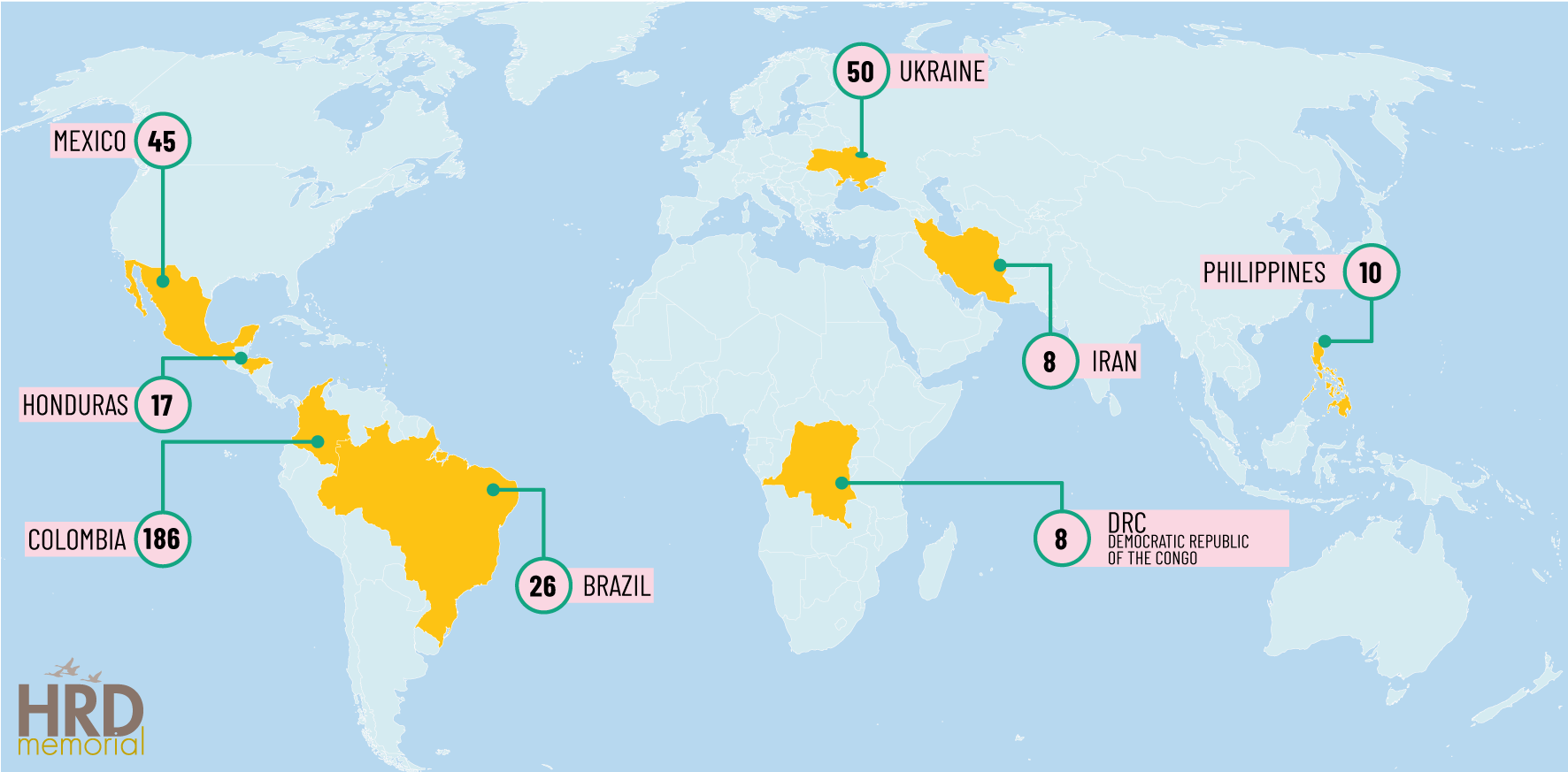
The report also names 401 HRDs killed in 26 countries in 2022 compared to 358 HRDs killed in 35 countries in 2021 – based on statistics by the HRD Memorial, a collective initiative of human rights organisations working to collect and verify data on the killings of HRDs each year.
“In a grim milestone, for the first time we saw more than 400 targeted killings of human rights defenders in 2022. While Latin America remained the deadliest region in the world for human rights defenders, we also saw a more dangerous landscape for defenders in the context of Russia’s full-scale invasion of Ukraine,” said Olive Moore, Interim Director of Front Line Defenders. ”These human rights defenders were deliberately targeted and killed because of their human rights work. Because they choose to speak out and challenge injustice, they paid for it with their lives.”
Five countries – Colombia, Ukraine, Mexico, Brazil and Honduras – accounted for over 80% of killings, according to HRD Memorial data. Colombia alone accounted for 46% of the total, with at least 186 killings documented and verified by HRD Memorial partner Somos Defensores to date. Defenders working on land, indigenous peoples’ and environmental rights were the most frequently targeted sector, accounting for almost half (48%) of the total killings.
In the context of Russia’s full-scale invasion of Ukraine, defenders engaged on humanitarian response and human rights journalists were also specifically targeted, with at least 50 documented killings by Russian military forces.
Wide array of threats
Global Analysis 2022 data is based on more than 1,500 threats and violations reported to Front Line Defenders, and is disaggregated by region, type of threat, sector of human rights work and gender.
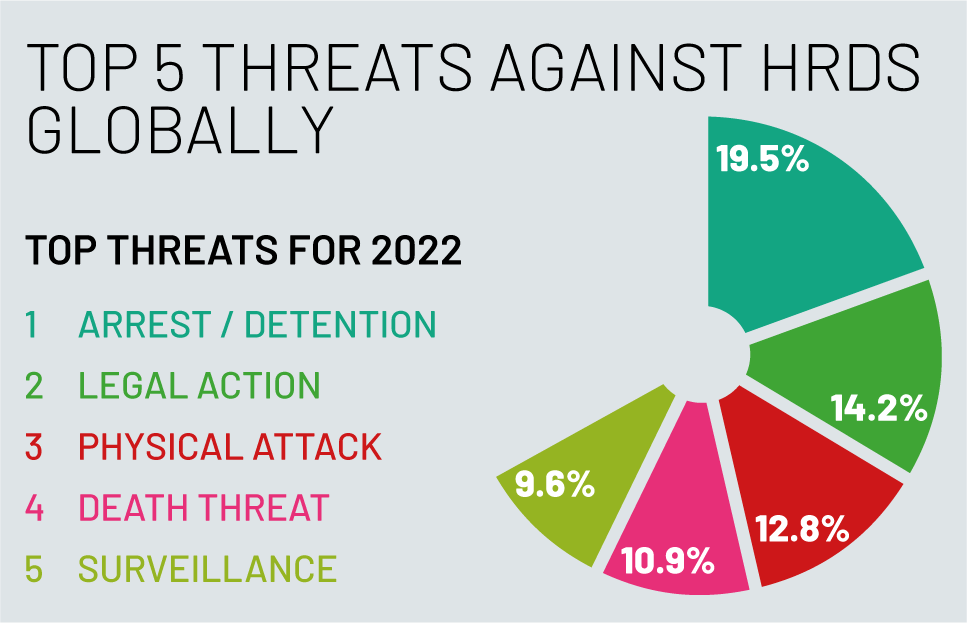
The main threats HRDs reported to Front Line Defenders in 2022 included: arrest or detention (19.5%); legal action (14.2%); physical attack (12.8%); death threats (10.9%); and surveillance (9.6%). In Asia and the Americas, death threats were the most frequent violation against defenders; in Africa it was arrest and detention; while in ECA and MENA it was legal action against HRDs.
Women HRDs (WHRDs) were frequently targeted with death threats, which accounted for the third most common violation against them. Physical violence was the most prevalent violation reported by trans and gender variant/gender nonconforming HRDs.
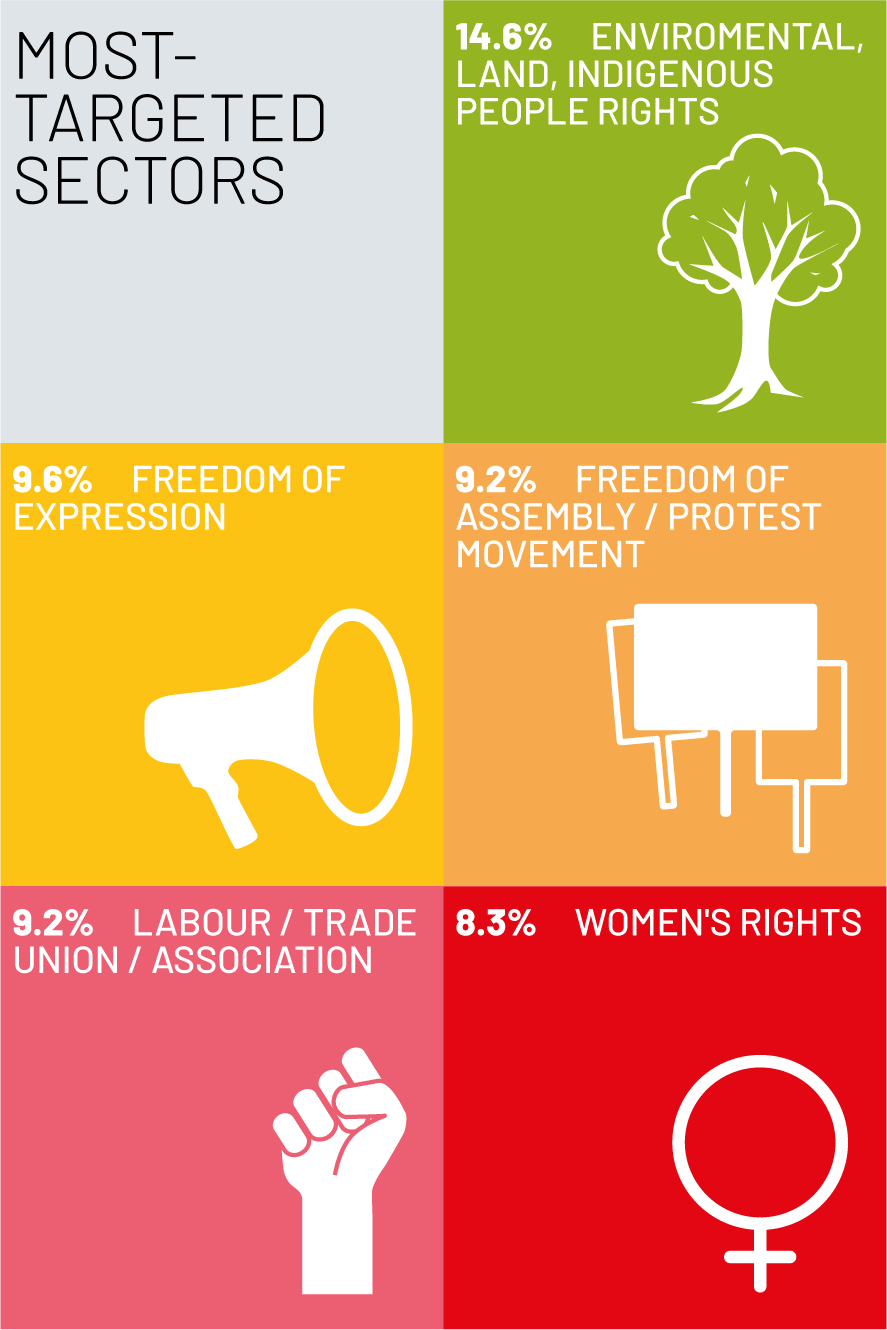
The five most targeted sectors of human rights defence were: environmental, land and indigenous peoples’ rights (11%); freedom of expression (10%); protest movement/ freedom of assembly (9%); women’s rights (7%); and impunity and access to justice (6%).
About the data on killings: Front Line Defenders manages the collection of partner-verified data-sets under the HRD Memorial umbrella. The partners in the HRD Memorial are: ACI-Participa (Honduras); Amnesty International; Comité Cerezo (Mexico); FIDH; Front Line Defenders; Global Witness; Human Rights Defenders’ Alert – India; Karapatan (the Philippines); OMCT; El Programa Somos Defensores (Colombia); Red TDT (Mexico); and UDEFEGUA (Guatemala).
About the data on other violations against HRDs: This is derived from 1,583 reported threats and violations, based on Front Line Defenders’ urgent actions and approved grants between 1 January and 31 December 2022. For more details, see the Methodology section of the report.
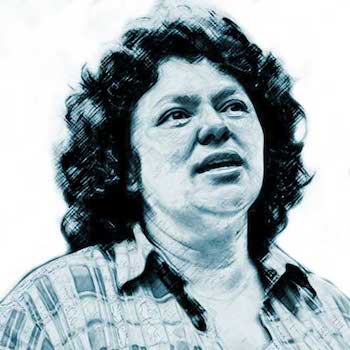
According to Common Dreams, human rights defenders on Monday 5 July 2021 welcomed the conviction of Roberto David Castillo Mejía, a Honduran businessman and former military intelligence officer, for the March 2016 assassination of Indigenous environmental activist Berta Cáceres, while calling on authorities in the Central American nation to bring everyone involved in planning the murder.
(Photo CC by Trocaire on Flickr.)
The Guardianreports that the Tegucigalpa high court found Castillo—formerly head of the dam company Desarrollos Energéticos, or DESA—guilty of collaborating in Cáceres’ murder. The court ruled that Cáceres was killed for leading the campaign to stop construction of the $50 million Agua Zarca dam, a local grassroots effort which caused delays and monetary losses for DESA.
The environmentally destructive hydroelectric project is located on the Gualcarque River, which is sacred to the Indigenous Lenca people, and was approved despite its failure to comply with Honduran and international environmental requirements.
Cáceres, who was 44 years old when she was murdered, was co-founder and coordinator of the Council of Popular and Indigenous Organizations of Honduras (COPINH), a group dedicated to the defense of the environment in Intibucá and the protection of the Lenca. In 2015 she received the prestigious Goldman Environmental Prize for leading “a grassroots campaign that successfully pressured the world’s largest dam builder to pull out of the Agua Zarca Dam” project at Río Gualcarque. See also: https://humanrightsdefenders.blog/2020/06/10/nina-lakhanis-who-killed-berta-caceres-reviewed/
COPINH hailed Monday’s verdict as “a popular victory for the Honduran people” that “means the criminal power structures failed to corrupt the justice system.”
Erika Guevara-Rosas, Americas director at Amnesty International, said in a statement that “the long-awaited prosecution of David Castillo, convicted as co-author of the murder of Berta Cáceres, is an important step towards justice and the result of her family and COPINH’s tireless efforts to secure truth, justice, and reparation. However, justice for Berta will never be truly complete until everyone who took part in the crime, including those who planned it, is brought to justice.”
“We urge the prosecutors to keep uncovering the truth,” Guevara-Rosas continued. “Until all those responsible are held accountable, other human rights defenders in Honduras will continue to lose their lives, for raising their voices and defending the most vulnerable. The Honduran authorities must put an end to impunity.”
Noting that Honduras is “the most dangerous country for defenders of land, territory, and the environment,” Guevara-Rosas admonished the Honduran government, which she said “seems to look the other way when human rights defenders are attacked instead of fulfilling its obligation to protect them.”
“Authorities must take this seriously and do whatever is necessary to keep human rights defenders safe from harm, so that a crime like the murder of Berta Cáceres is never repeated,” she added.
A 2017 report (pdf) by international legal experts concluded Cáceres’ murder was not an “isolated incident” and alleged “willful negligence by financial institutions.” The report found that the targeting of Cáceres was part of a “strategy” by DESA employees, private security firms, and public officials “to violate the right to prior, free, and informed consultations of the Lenca.”
“The strategy was to control, neutralize, and eliminate any opposition,” the report said.
Sunday March 7 2021 an initial hearing was held in the court at Trujillo, Colón, in which Marianela Solórzano and Jennifer Solórzano, women human rights defenders belonging to the Black Fraternal Organization of Honduras (OFRANEH), are on trial. Both were arrested by the Public Security Force (FUSEP) on March 3rd, and charged with damages, threats, robbery and usurpation of lands.
In the trial records they are incriminated for the offenses of land usurpation, involving other Garifuna defenders, as well. The charges against them are related to the historic process of resistance by the Garifuna people to the plunder of their lands. Private businesses and governments alike have participated in the illegal appropriation of the ancestral territory of the Garifuna people, particularly the ownership of more than seven thousand hectares of land in the Cristales and Rio Negro communities confirmed by ancestral property deeds.
Marianela is a defender of the rights of the LGBTI Garifuna community, and Jennifer, a defender of the ancestral Garifuna territories. Their arrests took place in the context of the continuous persecution and attacks against the Garifuna people organized in OFRANEH.
Historically, the communities belonging to OFRANEH have been the target of harassment, threats by armed groups, assassinations, and the disappearance of community leaders, among other highly serious rights violations. During the last ten years, these have only worsened due to the authoritarian criminal government model headed by Juan Orlando Hernández. Eight months ago, five Garifuna comrades were disappeared by armed men wearing uniforms of the Office of Police Investigations (DPI) of Honduras. As of now, their whereabouts are unknown.
National Network of Women Human Rights Defenders in Honduras, the Mesoamerican Initiative of Women Human Rights Defenders (IM-Defensoras), and many other groups and networks of women human rights defenders in Mesoamerica, as well as the FIDH call on all feminist and LGBTI social movements and the international community to stay on the alert for developments in this case and to demand a hearing with full guarantees for the rights of the criminalized Garifuna defenders.
On 2 March 2021, Mary Lawlor – the UN’s Special Rapporteur on Human Rights Defenders – wrote for Amnesty International “Five years after Berta Cáceres was murdered, states are still failing to protect human rights defenders". With the presentation of Mary Lawlor's report to the UN Human Rights Council coming up this week, the piece is worth reading in full:
She was one of hundreds of human rights defenders killed that year because of their peaceful work, and hundreds more defenders have been killed every year since. Those responsible are rarely brought to justice. Although some have been convicted of Berta Cáceres’ killing, others believed to have been involved have still not been brought to account. [see: https://humanrightsdefenders.blog/2020/06/10/nina-lakhanis-who-killed-berta-caceres-reviewed/]
It’s a familiar and continuing story, in Honduras and across the world, where those responsible for the murder of a human rights defender often enjoy impunity. This week I am presenting my latest report to the United National Human Rights Council in Geneva, and it is on the killings of human rights defenders and the threats that often precede them.
At least 281 human rights defenders were killed in 2019, with a similar number expected to be recorded for 2020. Unless radical, immediate action is taken we can expect hundreds more murders again this year.
Since 2015, at least 1,323 defenders have been killed. While Latin America is consistently the most affected region, and environmental human rights defenders like Berta Cáceres often the most targeted, it is a worldwide issue. At least 281 human rights defenders were killed in 2019, with a similar number expected to be recorded for 2020
Between 2015 to 2019, human rights defenders were killed in at least 64 countries, that’s a third of all U.N. member states. Those collecting the data agree that underreporting is a common problem. The number of defenders killed is likely significantly higher than the figures we have.
We know that on every continent, in cities and the countryside, in democracies and dictatorships, governments and other forces threatened and killed human rights defenders. Many, like Berta Cáceres, are killed in the context of large business projects.
Why do so many governments and others kill human rights defenders working peacefully for the rights of others? Partly because they can, safe in the knowledge that there is unlikely to be the political will to punish the perpetrators.
While some states, particularly those with high numbers of such killings, have established dedicated protection mechanisms to prevent and respond to risks and attacks against human rights defenders, defenders often complain that the mechanisms are under-resourced.
And in too many cases, businesses are also shirking their responsibilities to prevent attacks on defenders or are even responsible for the attacks.
These murders are not random acts of violence that come out of nowhere. Many of the killings are preceded by threats. As Amnesty International noted, Berta Cáceres’ murder “was a tragedy waiting to happen,” and she had “repeatedly denounced aggression and death threats against her. They had increased as she campaigned against the construction of a hydroelectric dam project called Agua Zarca and the impact it would have on the territory of the Lenca Indigenous people.”
And yet her government failed to protect her, as so many governments fail to protect their defenders. Since I took up this mandate in May last year I have spoken to hundreds of human rights defenders. Many have told me about their real fears of being murdered, and have shown me death threats made against them, often in public.
They tell me how some threats shouted in person, posted on social media, delivered in phone calls or text messages, or in written notes pushed under a door. Some are threatened by being included on published hit lists, receiving a message passed through an intermediary or having their houses graffitied. Others are sent pictures through the mail showing that they or their families have been under long-term surveillance, while others are told their family members will be killed. It’s not that complicated. It’s up to states to find the political will to prevent killings by responding better to threats against human rights defenders, and to hold murderers to account
I’ve been told by defenders about a coffin being delivered to the office of an NGO; a bullet being left on a dining room table in their home; edited pictures of them being posted on Twitter, showing them having been attacked with axes or knives; and an animal head being tied to the door of their organization’s office.
Those advocating for lesbian, gay, bisexual, transgender and intersex rights, and women and transgender human rights defenders, are often attacked with gendered threats, and targeted because of who they are as well as what they do. Women and LGBTI people demanding rights in a patriarchal, racist, or discriminatory contexts often suffer specific forms of attack, including sexual violence, smears and stigmatisation.
The murders of human rights defenders are not inevitable, many are signalled in advance, and yet governments fail, year after year, to provide enough resources to prevent them, and fail, year after year, to hold the murderers to account. In fact, states should not only end impunity but also publicly applaud the vital contribution that human rights make to societies.
This week I’ll again remind the U.N. that their members are failing in their moral and legal obligations to prevent the killings of human rights defenders. It’s no use for government officials to wring their hands and agree that the murder of Berta Cáceres and other defenders is a terrible problem and that someone should do something about it.
It’s not that complicated. It’s up to states to find the political will to prevent killings by responding better to threats against human rights defenders, and to hold murderers to account.
Reuters on 28 December 2020 reported that masked men armed with guns and machetes killed Felix Vasquez, a Honduran environmental rights defender, in front of his family, police said, the latest in a string of such attacks in the Central American country. [see: https://humanrightsdefenders.blog/2020/10/16/two-more-defenders-killed-in-honduras/]
“Police authorities immediately decided to initiate a corresponding investigation… we hope to have an answer soon,” police official Kevin Hernandez told journalists.
Vasquez, a member of the indigenous Lenca community which lives in the mountainous region near the border with El Salvador, had intended to run for Congress as a member of the opposition LIBRE party in 2021 elections.





 Hans Thoolen on Human Rights Defenders and their awards