The ceremony of the Martin Ennals Award 2014 is over (7 October 2014). It was again very impressive to hear and see 3 courageous Human Rights Defenders being honored. Some 450 people (my estimate) gave standing ovations to the 3 nominees whose work was shown in impressive films produced for the occasion. The film portraits are already available on the website: http://www.martinennalsaward.org where there is also a short summary of the whole evening.
Martin Ennals Award for Human Rights Defenders
Especially the film on Chinese HRD Cao Shunli is a masterpiece given that the film makers had almost no images to work with due to the modesty of the human rights defender as well as her untimely death in detention only 2 days after her nomination in March 2014.
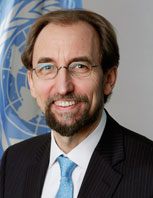
One of the nicest surprises was the address by Zeid Ra’ad Al Hussein, the United Nations High Commissioner for Human Rights at one of his first public appearances outside the UN. The High Commissioner gave a moving and almost poetic description of the sorry state of affairs left to human rights defenders to correct: He said inter alia: Read the rest of this entry »
(From left to right — Charles Harper, Estela Barnes de Carlotto, Ambassador Alberto D’Alotto and Bishop-emeritus Aldo Etchegoyen. Photo: Argentinian mission in Geneva)
A former World Council of Churches (WCC) official from Brazil, Rev. Charles Harper, has been honoured with the Order Comendador de Mayo, a high decoration of the Argentine government for his emblematic legacy of struggles for human rights in the ecumenical movement. Harper, was WCC’s director of the Human Rights Resource Office for Latin America from 1973 to 1992. He received this honour in a ceremony held on 16 September in Geneva, Switzerland. Harper, born to an American missionary father working in Brazil, joined the anti-colonial struggle through the Committee for Assistance to Evacuees (CIMADE). At CIMADE, he worked with young people and Algerian immigrants in Marseille, France, in the early 1960s. With CIMADE and later as director of the John Knox International Reformed Centre, Harper supported church leaders persecuted in Mozambique, Angola and Cape Verde. Many of those become key actors in the independence struggles of their countries. At the WCC, Harper coördinated a number of systematic international initiatives denouncing human rights violations in Latin America. He created strong networks to protect the persecuted, imprisoned and tortured people in the region.
Accompanying human rights movements in the 1970s, the WCCwas able to respond to the calls for solidarity at regional and global levels. Harper’s work at the WCC was initiated by the WCC member churches in Latin America, following a dialogue held with the WCC’s Commission on International Affairs, chaired then by the renowned jurist Dr Theo van Boven, who also received an honour from the Argentine government in 2012.
In his speech Harper pointed out the current global challenges that a new generation of human rights advocates has to deal with. “Thirty years later – today – the challenges facing the world community of nations, both as international and ecumenical family, not only persist but become more intense: The World Council of Churches, an instrument of unity and service to humanity, strives to accompany churches and groups related to them in critical situations to defend human rights and human dignity, fighting impunity, demanding punitive justice, and building just and peaceful societies.”
At the ceremony, Ambassador Alberto D’Alotto said, “Protestant churches have played an important role in defending human rights and in starting movements for human rights in my country. They helped in founding human rights organizations and sponsored their consolidation, and managed international financing much needed in the beginning…..The churches helped to find ways to overcome the information blockade imposed by the military authorities, giving international visibility to what was happening in Argentina and denouncing the military repression in international forums,” he said.
“Protecting civil society space and preventing reprisals: National and international developments and next steps” is side event that will be held on Friday, 19 September 2014 from 9.15 to 10.45 am in the Palais des Nations, Geneva, Room XXIV.
Opening remarks Olivier de Frouville, member of the UN Working Group on Enforced and Involuntary Disappearances and member-elect of the UN Human Rights Committee
Panelists:
Reine Alapini-Gansou, Special Rapporteur on Human Rights Defenders, African Commission on Human and Peoples Rights
Stephania Kulaeva, Director, Anti-Discrimination Centre Memorial, Russia
Patricia OBrien, Ambassador of Ireland to the UN
Eleanor Openshaw, Reprisals Advocacy Manager, International Service for Human Rights
Mothusi Bruce Rabasha Palai, Ambassador of Botswana to the UN TBC
Moderator: Michael Ineichen, Human Rights Council Advocacy Director, ISHR
The event will be webcast at www.ishr.ch/webcast. You can also follow the event on Twitter @ISHRGlobal, using the hashtag #ProtectCSS.
If you would like to attend but do not have UN accreditation, please email information[at]ishr.ch before 12 noon on 16 September.
Another interesting side event to take place in Geneva in the margins of the UN Human Rights Council is on the topic of The universality of human rights on Wednesday 10 September from 16h30 to 18h00, Palais des Nations, Room XXIV.
It is organised by ISHR, ARC International, Article 19 and the Association for Progressive Communications. The objective of the event is to ensure that the universality of human rights is not undermined at the national level and through initiatives at the UN Human Rights Council. Speakers:
Nadine Moawad – Association for Progressive Communications
Fulata Moyo – World Council of Churches
Sunita Kujur – Creating Resources for Empowerment in Action CREA
Andrew Smith – Article 19 moderator
For more information: Pooja Patel at: p.patel[at]ishr.ch
During the current session of the Human Rights Council there will again many side events in Geneva. I will refer to some of them not only in the hope that you may able to attend, but also to illustrate the concerns of the NGO movement:
On Tuesday 9 September from 12.00 to 13.30 (Palais des Nations, Room XXI) there will be a side-event organised jointly by Amnesty International, CIVICUS, Human Rights Watch, FIDH, ISHR and the International Bar Association. Speakers are:
Kenneth Roth, Executive Director, Human Rights Watch
Souhayr Belhassen, Honourary President, International Federation for Human Rights FIDH
Philip Luther, Middle East and North Africa Program, Amnesty International
Phillip Tahmindjis, Director, International Bar Association Human Rights Institute
The City of Geneva and the Martin Ennals Foundation have set the day of the 2014 ceremony for 7 October 2014, 6 pm, at Uni-Dufour, Geneva, during the opening day of the Human Rights Week hosted by the University of Geneva. Save this date in your agenda and register as from now online at: http://www.martinennalsaward.org/.
The laureate will be selected among the three Final Nominees of the 2014 edition:
Ms Cao Shunli (China), who lost her life on March 14th, 2014, had vigorously advocated since 2008 for access to information, freedom of speech and freedom of assembly, encouraging strengthened domestic implementation of international mechanisms.
Mr Adilur Rahman Khan (Bangladesh) has worked since the 1990’s on a wide range of humain rights issues, such as illegal detention, enforced disapearances, extra-judicial killing, and elections monitoring with his non-governmental organization, Odhikar.
Ms Alejandra Ancheita (Mexico) founder and Executive Director of ProDESC, has worked for more than 15 years with migrants, workers, and indigenous communities to protect their land and labour rights vis a vis transnational mining and energy companies.
The Jury of the Martin Ennals Award is made up of ten of the world’s leading human rights organizations: Amnesty International, Human Rights Watch, Human Rights First, International Federation for Human Rights, World Organisation Against Torture, Frontline Defenders, the International Commission of Jurists, EWDE-Germany, the International Service for Human Rights, and HURIDOCS.
The Geneva Academy of International Humanitarian Law and Human Rights, organised an expert meeting on The Right to Privacy in the Digital Age‘ (hosted by the Permanent Missions of Austria, Brazil, Germany, Liechtenstein, Mexico, Norway, and Switzerland) in Geneva on 24-25 February 2014. The right to privacy is of great practical importance to human rights defenders who are often in the firing line of (mass) surveillance. The report is short and very readable and makes an excellent long read for the weekend. To help those pressed for time, here is the Summary of conclusions: Read the rest of this entry »
The foundation “Cartooning for Peace” went to Syria-Palestinian Hani Abbas and Egyptian Doaa Eladl for their work. Former Secretary General Kofi Annan handed them the international award for press cartoonists in Geneva, as part of World Press Day. French cartoonist Plantu gave Euronews his views on the significance of using cartoons as a form of expression: “We’re trying to show the level of resistance that exists today, from the perspective of the very people that allow us to understand the word “resistance”, the cartoonists that ultimately become the foot soldiers of democracy. In other words, they’re railing against different powers, not just the power of their editors but also against political and religious power.”
From Lake Geneva, euronews correspondent Wolfgang Spindler said: “Political cartoons can be subversive, provocative and amusing – they make us smile, they give us pause for thought. But we very often forget that the cartoonists behind them sometimes have to risk their lives daily for the sake of their work.” via: http://www.euronews.com/2014/05/05/drawing-for-peace
The cartoon exhibition on the banks of Lake Geneva runs until the beginning of July and then moves to Sarajevo.
On Tuesday 27 May 2014, will take place a Conference on the human rights situation in Belarus, from 14h00 –17h00 in the International Conference Centre in Geneva (room 3)
Speakers include:
Florian Irminger, Human Rights House Foundation
Tatsiana Reviaka, Human Rights Centre “Viasna” and Belarusian Human Rights House
Aleh Hulak, Belarusian Helsinki Committee
Anna Gerasimova, Belarusian Human Rights House
Volodymyr Yavorskyy, Working group on the development of the Guidelines on Definition of Political Prisoner
Andrzej Poczobut, journalist
Nicolas Agostini, International Federation for Human Rights (FIDH)
Andrei Paluda, Human Rights Centre “Viasna”
Pavel Levinau, Belarusian Helsinki Committee
Natallia Pinchuk, wife of Belarus political prisoner Ales Bialaitski
Marina Adamovich, wife of Belarus political prisoner Mikola Statkevich
For more information contact: anna.innocenti[at]humanrightshouse.org
The meeting is cosponsored by Amnesty International, Human Rights Watch, FIDH, Civicus, Belarusian Human Rights House and the Human Rights House Foundation.


 (From left to right — Charles Harper, Estela Barnes de Carlotto, Ambassador Alberto D’Alotto and Bishop-emeritus Aldo Etchegoyen. Photo: Argentinian mission in Geneva)
 Hans Thoolen on Human Rights Defenders and their awards