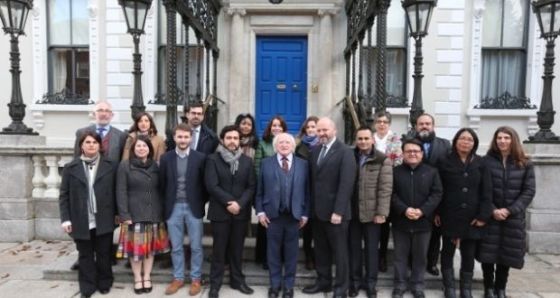
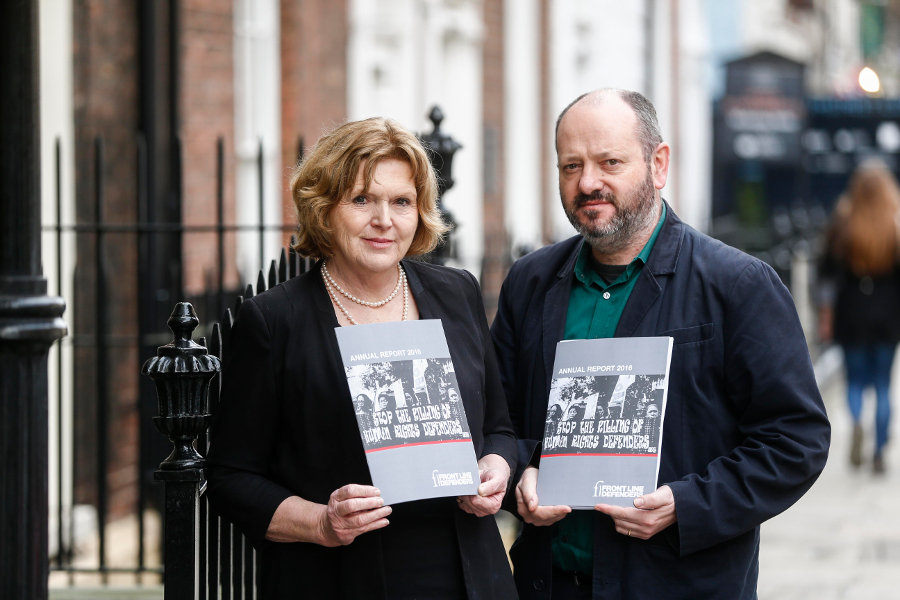
Dublin-based NGO Front Line Defenders announced on 6 October 2016 that Andrew Anderson has been appointed as the organisation’s new Executive Director. Andrew has worked for the international protection of human rights defenders for more than twenty years, and has played a key leadership role in building Front Line Defenders into an effective force fighting for those most at risk. He will begin his new role on 1 November 2016.
The Front Line Defenders Board of Trustees selected Andrew due to his extensive management, fundraising and human rights experience. In its announcement, the Board of Trustees noted that it “unanimously agreed that Andrew is the candidate with the experience and skills best placed to lead Front Line Defenders into the next stage of our development.”
The choice is a good one in my view as Andrew has 27 years experience of working for human rights at the international level and has served as Deputy Director of Front Line Defenders since March 2003. As Deputy Director, he led the development of an international civil society consortium to implement the EU human rights defenders mechanism (www.ProtectDefenders.eu), and is a member of the Advisory Board of the Centre for Applied Human Rights at the University of York. Before joining Front Line Defenders, Andrew worked for thirteen years at the International Secretariat of Amnesty International where he served as Director of the Campaigning and Crisis Response Programme and as Director of the Africa Programme. For an earlier video statement by Andrew see: https://thoolen.wordpress.com/2011/12/09/andrew-anderson-speaks-and-speaks-well-on-the-anniversary-of-un-declaration-on-hrds-youtube/.
“It is an honour and a challenge to take on this role at a time when human rights defenders are facing increasing attacks in all regions of the world,” said Andrew. “We must sustain the drive and energy which made Front Line Defenders so effective under Mary’s inspirational leadership and build on that legacy to deliver rapid and practical support for those who risk their lives to build a better future.”
Reporters Without Borders (RSF), Amnesty International, OMCT and FIDH and many others condemned a decision by an Iranian appeals court to uphold a 16-year jail sentence against journalist and human rights activist Narges Mohammadi. Under a law passed last year, she will ‘only’ serve the sentence linked to the most important charge – in this case 10 years for “forming and managing an illegal group” which pressed for an end to capital punishment. Mohammadi, 44, was the spokesperson of the Centre for Human Rights Defenders and campaigned for an end to the death penalty in Iran. 2003 Nobel peace laureate Shirin Ebadi who founded the Centre for Human Rights Defenders, said: “I condemn this sentence imposed by the Iranian judicial system as Narges’s only crime is to be a human rights defender in a country that flouts these rights“.
The chilling trend of attacking human rights defenders working on environment and land rights continues. The help keep an overview here a summary of a number of relevant items:
On 26 August 2016 Patricia Schaefer of the Center for International Environmental Law posted a blog in the NonProfitQuarterly website under the Title “International Collaboration Reports on Violence against Environmental Activists”, summarizing two recent reports (On Dangerous Ground by Global Witness and a more recent “Deadly Shade of Green” by Center for International Environmental Law (CIEL), British NGO Article 19, and Vermont Law School).
Global Witness stated that worldwide, in 2015, there were 185 individuals killed in 16 countries while defending their land, forests, and rivers against industrial encroachment. At the top of the list were Brazil (50 killings), the Philippines (33), and Colombia (26). Global Witness recounts, “Conflicts over mining were the number one cause of killings in 2015, with agribusiness, hydroelectric dams and logging also key drivers of violence. In 2015, almost 40 percent of victims were from indigenous groups.” [Global Witness’ earlier report: https://thoolen.wordpress.com/2014/04/16/environment-deadly-for-human-rights-defenders-says-global-witness/].
China‘s use of ‘video confessions’ would be almost comical if it was not so serious for the individuals concerned [see e.g. https://thoolen.wordpress.com/2016/01/21/confessions-abound-on-chinese-television-first-gui-minhai-and-now-peter-dahlin/]. Now it is the turn of Wang Yu, a well-known Chinese human rights lawyer who was released on bail after she purportedly “confessed” to some wrongdoings. Wang Yu, 45, who was arrested by mainland police in July last year on charges of political subversion [https://thoolen.wordpress.com/tag/wang-yu/], appeared in a video expressing “deep remorse” for her actions. In the televised confession, Wang is shown rebuking her profession and accusing “foreign forces” of using her law firm to smear the Chinese government.
Chan Kit-man, secretary-general of the Hong Kong-based Chinese Human Rights Lawyers Concern Group, noted that the Wang case is similar to that of another human rights lawyer, Zhao Wei, who was also set free after a videotaped confession.
The Chinese lawyer has handled several politically sensitive lawsuits, including the case of Cao Shunli, who was detained for months for staging sit-ins at the foreign ministry and later died. She also defended Ilham Tohti, a Uyghur economist who was handed a life sentence on separatism-related charges. Tohti is one of 3 final nominees for the MEA 2016. She also provided legal assistance to the families of six schoolgirls who were sexually abused by their teachers in Hainan province and to practitioners of Falun Gong, a spiritual movement banned in China.
(Wang appeared on Phoenix TV on July 31 in an interview apparently conducted at a restaurant in Tianjin. She said she is physically well after recovering from a mammary gland tumor in February and March this year. Wang said arrangements had been made for her to undergo surgery. The action made her realize the “human touch and care” of Chinese authorities.)
“In her confession released on 1 August, Wang Yu criticised fellow human rights lawyers, saying that they were motivated by money and fame and blamed overseas activists for using human rights defenders as tools to tarnish the reputation of the Chinese government. Wang Yu’s confession is the most recent in a series of televised confessions of human rights defenders which have been broadcast in an attempt to undermine human rights work in the country. At least two of those who had previously appeared in such videos later said that their confessions were scripted and that they were pressured to participate”. … Wang Yu had been held incommunicado since 9 July 2015 and her husband, Bao Longjun , remains in detention, having been seized on the same day. Their 16 year old son, Bao Zhuoxuan, is under tight surveillance at the home of his grandparents following an unsuccessful attempt to flee China last year with the help of two human rights defender friends of his parents.”
A day later a court in Tianjin Tuesday handed down a guilty verdict for Chinese rights defender Zhai Yanmin, who was given a three-year jail term with a four-year probation period after being found guilty of “state subversion.”
Mary Lawlor has only just announced her departure (see announcement published yesterday) and already an article on Colombia of 11 July 2016 shows what insights we may miss in the future. The link between the peace process and the role of human rights defenders in Colombia was referred to in earlier posts [e.g. https://thoolen.wordpress.com/2015/09/11/human-rights-defenders-squeezed-by-geo-politics-the-cases-of-colombia-iran-and-cuba/] Mary Lawlor here welcomes the agreement as historic, offering the Colombian people an opportunity to make a break with the endemic violence of the past. The direct reference to the protection of human rights defenders in the peace agreement is one more reason to celebrate. Here the piece in full:
Human Rights Defenders Critical for Post-Accord Justice in Colombia
Founding directors do not alway leave in such a well-planned way, but in the case of May Lawlor this is different. Having done a most admirable job in setting up and developing Front Line Defenders into the main ‘hub’ for information Human Rights Defenders over the last 15 years, she has now announced her departure.
The Board of Trustees now seeks an Executive Director with significant previous experience of working at a senior level for the protection of human rights defenders or equivalent experience in a human rights based activity or organization in a leadership role. The Executive Director will have strong communication, management and analytical skills. They will have an understanding of the political environment for human rights defenders and have excellent political judgement. This position will be based in Dublin but will involve frequent travel.
For more information, please contact: Claire Cronin, Cronin Partners International Search, 12 Merrion Square | claire@croninpartners.com
According to Front Line Defenders a rather curious case seems to have been construed against a human rights defender in Mongolia. The trial of human rights defender Mr Beejin Khastamur will start on 8 July 2016 at the Songinokhairkhan District Court in Ulan Bator. He was arrested on 16 March 2016 and denied bail on 22 March. He was eventually released pending trial on 31 March. Beejin Khastamur is the founder of a non-governmental organisation Delhiin Mongol Nogoon Negdel (DMNN), which advocates for the protection of environment and the rights of the nomad people of Mongolia. The organisation has exposed many violations of Mongolia’s environmental laws by foreign and domestic mining companies, in which Mongolian politicians had a stake. It has also organised numerous workshops, public gatherings and demonstrations to educate the public on environmental issues. https://www.frontlinedefenders.org/en/profile/beejin-khastamur
According to the police Beejin Khastamur allegedly attacked the driver of another car using a knife. On 6 February 2016, Beejin Khastamur was indeed involved in a car accident, during which no one was killed or injured and the material damage caused was minimal. The human rights defender was driving in Ulan Bator when a Nissan car tried to pass him on the wrong side twice and eventually hit his vehicle. Its driver got out of the car and attacked Beejin Khastamur kicking him and hitting the human rights defender in his head. Subsequently, during the forensic examination it was revealed that Beejin Khastamur sustained bruises all over his body and had a brain concussion, while the second driver had only small scratches on one of his knees. When police arrived at the scene, they concluded that the accident had been the fault of the second driver and left. However, they subsequently returned and brought Beejin Khastamur to the police station for questioning. The actions of the police have given rise to the suspicion that the accident may have been used as a pretext to target Beejin Khastamur for his human rights work.
[On 21-23 December 2015, Beejin Khastamur organised a sit-down strike protesting the illegal permit given to a Canadian and Mongolian joint company enabling it to mine gold right on Onon River. Since then he has received multiple threats. On several occasions people came to his house, banging on his door at night, cutting his electricity, puncturing his car tires, threatening his wife and children. The human rights defender also received death threats on the phone.]
An academic and two journalists who play a key role in Turkey’s human rights movement have been jailed pending investigation into spurious allegations of spreading terrorist propaganda. Human Rights Watch, Reporters without Boarder, Front Line, and the Observatory for the Protection of Human Rights Defenders (a joint program of FIDH and OMCT), among others, have raised serious concern and demanded their immediate release.
An Istanbul court on 20 June, 2016, accepted a prosecutor’s request for them to be placed in pretrial detention on suspicion of having committed terrorist offenses. They are Erol Önderoglu, who is the Turkey representative of Reporters Without Borders and a journalist with the independent news website Bianet; Professor Şebnem Korur Fincancı, an academic at Istanbul University’s forensic medicine department and head of the Human Rights Foundation of Turkey; and Ahmet Nesin, a writer and journalist.
“The decision to demand the detention of Önderoğlu, Fincancı, and Nesin is a shocking new indication that the Turkish authorities have no hesitation about targeting well-known rights defenders and journalists who have played a key role in documenting the sharp deterioration in human rights in the country,” said Hugh Williamson, HRW’s Europe and Central Asia Director. “
The three were among 44 journalists, writers, and activists who participated in a solidarity campaign for media freedom in which each of them acted as a symbolic co-editor-for-a-day at the pro-Kurdish daily Özgür Gündem in Istanbul. The government sees the newspaper as hostile to it and as a result has placed it under immense pressure.
“Jailing a world-renowned journalist and human rights defender such as Erol sends a very powerful signal of intimidation to the entire profession in Turkey. It’s a new, unbelievable low for press freedom in Turkey,”Johann Bihr, head of the Eastern Europe and Central Asia desk at RSF, told CPJ. At least 14 journalists were imprisoned in Turkey on December 1, 2015, when CPJ last conducted its annual census of journalists jailed around the world. [see also: https://thoolen.wordpress.com/2016/03/20/turkey-fair-trial-human-rights-lawyers-expression-l4l/]
While the NGO reactions are expected, more remarkable is the reaction from Russia which (in the good company of the USA, the UN and the EU) has condemned the crackdown on Turkey’s press freedom: Read the rest of this entry »