Posts Tagged ‘freedom of expression’

Today: Tiananmen Square 30 years ago was ‘correct’ but singing about it still not allowed

June 4, 2019

As many news outlets report today it is 30 years ago that China cracked down on Tiananmen Square. China tries mostly to forget about it and make others forget it about it too. Still, it recenty came out to defend it as the “correct policy”. “That incident was a political turbulence and the central government took measures to stop the turbulence which is a correct policy” Defence minister Wi Fenghe Wei told a regional security forum in Singapore. “The 30 years have proven that China has undergone major changes,” he said, adding that because of the government’s action at that time “China has enjoyed stability and development“. On the other hand Wu Qian, a spokesman for the defence ministry, decried the use of the word “suppression” to describe the crackdown.

But it does cover Chinese rock musician Li Zhi, who has been outspoken and sung songs about social issues including the Tiananmen Square crackdown, and has not been seen for three months. The South China Morning Post of 2 June has a detailed piece on what happened to this singer: His upcoming tour has been cancelled and his social media accounts taken down. Then his music was removed from all of China’s major streaming sites – as if his career had never existed at all. “Now this square is my grave,” Li sang. “Everything is just a dream.”

The disappearance of Li, the musician, has left fans searching for answers. On February 20, the official Weibo social media account for the 40-year-old’s concert tour posted a photograph of its team in front of a truck about to embark on scheduled performances in Sichuan province in China’s southwest. Just two days later, however, the account posted an image of a hand wearing what appeared to be a hospital wrist band and the words: “Very sorry.” The next post, published the same day, announced without explanation that the tour was cancelled and that ticket purchasers would shortly receive a refund. Fans flooded the comment section with wishes for a speedy recovery.

But the suggestion that a health issue was behind the cancellations was later thrown into doubt. A statement published in April by Sichuan’s culture department said it had “urgently halted” concert plans for a “well-known singer with improper conduct” who was previously slated for 23 performances – the same number of concerts which Li had scheduled in the province. It said 18,000 tickets were fully refunded.

..Li’s presence on the Chinese internet was completely erased. An April 21 central government directive ordered all websites to delete any audio or video content relating to five of Li’s songs, according to China Digital Times, an organisation that publishes leaked censorship instructions. The authenticity of the directive could not be independently verified.

“There’s pretty much a consensus” among those working in the industry that Li’s disappearance from public view is due to the sensitive anniversary, said a music industry professional who spoke on condition of anonymity because of fear of government retribution. “He did a number of songs that were considered politically risky, making references to June 4, 1989, and so he’s been out of the picture,” the industry professional said.

Li’s current whereabouts could not be confirmed. His company and record label did not respond to repeated interview requests. Li’s songs alluding to the Tiananmen Square protests – The Square, The Spring of 1990 and The Goddess, in honour of the Goddess of Democracy that students erected – were part of his earlier works. In recent years, the bespectacled singer has avoided making public political statements, focusing more on promoting his performances. In 2015, state-run China Daily newspaper published a profile of Li, describing him as a performer who easily sells out concerts. After years of working as an independent artist, he signed last autumn with Taihe Music Group, a major Chinese record label. Fans who knew Li as a largely apolitical entertainer expressed bewilderment online about his disappearance. Others made veiled references to China’s internet censorship. On Zhihu, a question-and-answer website similar to Quora, one user wrote that people posed questions every day about what might have happened to Li, but these posts always disappeared the next morning “as if nothing had happened at all”.

Another user said: “I don’t dare to say it, nor do I dare to ask.” A fan who has been sharing Li’s music on his personal account spoke on condition of anonymity because he feared his employers would punish him for discussing the subject. “Everyone knows the reason for Li Zhi’s disappearance,” the fan said. “But I’m sorry, I can’t tell you, because I follow China’s laws and also hope that Li Zhi can return.” Quoting one of Li’s lyrics, the fan added: “The world will be all right.” Fans continue to circulate videos of Li’s performances online. His complete discography has been uploaded onto file-sharing websites, with back-up links in case the original ones are shuttered. Some users shared tribute art, including a black T-shirt with the words “improper conduct”. A few years ago, in a performance in Taiwan, Li bounced around on stage, strumming his guitar and repeating a chorus in apparent tribute to the spirit of Chinese propaganda.

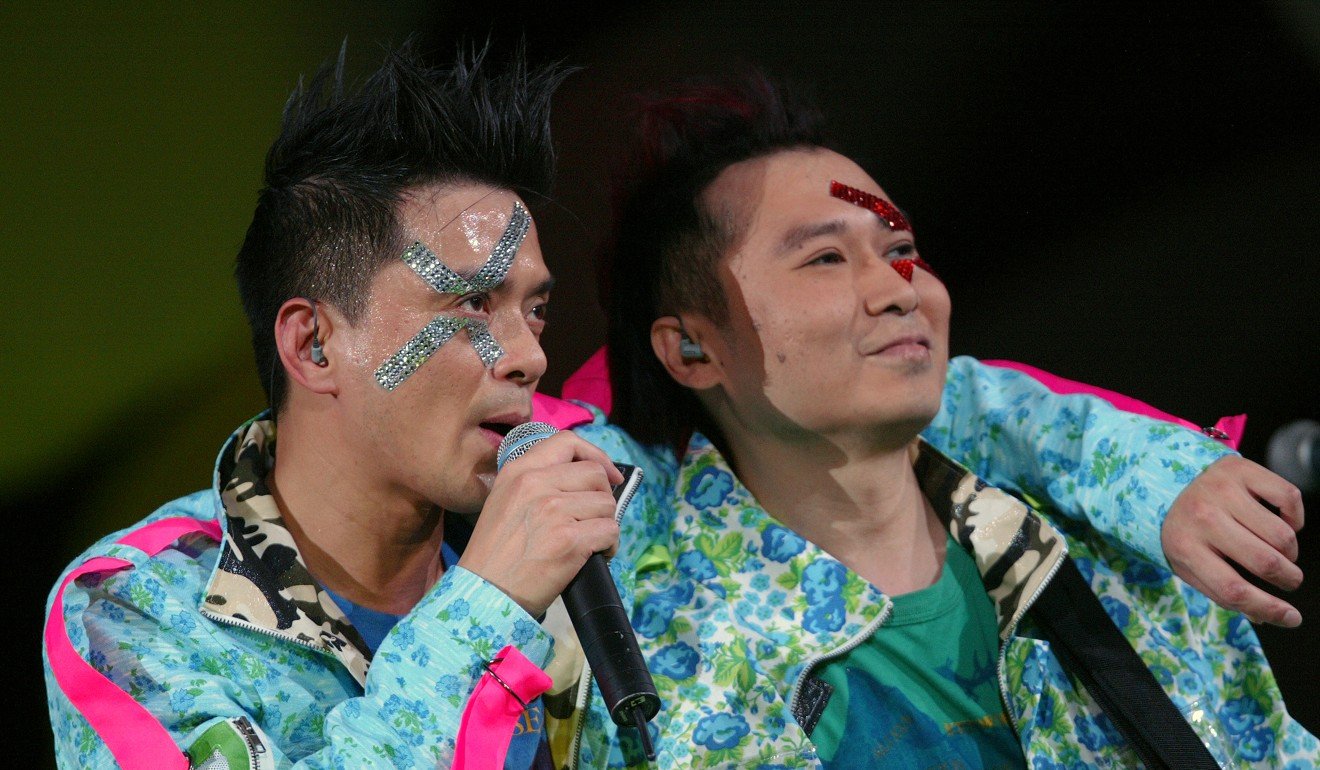
Foreign companies are not immune. Apple Music has removed from its Chinese streaming service a song by Hong Kong singer Jacky Cheung Hok-yau that references the Tiananmen crackdown. Tat Ming Pair, a Hong Kong duo, have been deleted entirely from the app. They released a song this month called Remembering is a Crime in memory of the protests.

Music by Tat Ming Pair – Anthony Wong Yiu-ming (left) and Tats Lau Yi-tat – has been deleted from the Apple Music app. Photo: K.Y. Cheng

Wikipedia also announced this month that the online encyclopaedia is no longer accessible in China. While the Chinese-language version has been blocked since 2015, most other languages could previously be viewed, Wikipedia said.

The Human Rights Foundation publised this video about China’s Million Person Muslim Prison Camps:

For the 25th anniversary see: https://humanrightsdefenders.blog/2014/06/13/25-years-tiananmen-celebrated-with-over-100-detentions/

See also: https://humanrightsdefenders.blog/2019/05/31/on-4-june-streets-around-chinese-embassy-to-be-renamed-tiananmen-square/

https://uk.news.yahoo.com/china-says-tiananmen-square-crackdown-1989-correct-policy-093500064.html

https://www.scmp.com/news/china/politics/article/3012782/outspoken-folk-rock-singer-li-zhi-disappears-china-tightens

Robert Bernstein, publisher and human rights advocate, dies at 96

May 29, 2019

Robert L. Bernstein was the publisher of Random House and founding chairman of Human Rights Watch. (Elisabeth D. Bernstein)

Standing at 6 foot 3, with freckled features and a low-key leadership style, Mr. Bernstein began his career as a junior office boy at Simon & Schuster and rose to become the president, chief executive and chairman of America’s most renowned publishing house…


Mr. Bernstein’s memoir, “Speaking Freely: My Life in Publishing and Human Rights,” was published in 2016. (Courtesy of the New Press)

For decades, he spent what few free hours he had promoting human rights, a passion that deepened in the 1970s when he visited Moscow with a delegation of American publishers. His meetings with dissidents such as Andrei Sakharov, the nuclear physicist and Nobel Peace Prize laureate, led him to create the Fund for Free Expression, a group of writers, editors and other literary figures concerned with rights abuses around the world. In the aftermath of the 1975 Helsinki Accords, he also formed Helsinki Watch to monitor the protection of basic freedoms behind the Iron Curtain. It was followed by similar organizations centered on the Americas, Africa, Asia and the Middle East, which merged in 1988 to form Human Rights Watch.

Mr. Bernstein sometimes held board meetings for the organization out of Random House’s headquarters in Manhattan and participated in its research activities firsthand. In 1985 he flew to Nicaragua and drove “to within 20 miles of the Honduran border,” according to a Times report, “to investigate charges that acts of terrorism were being waged by the contras against unarmed civilians.”

Combining his interests, Mr. Bernstein published works by dissidents around the world, including Sakharov and his wife, Yelena Bonner; Natan Sharansky, a former Soviet political prisoner; Jacobo Timerman, who was tortured by Argentina’s military government in the 1970s; and Vaclav Havel, the Czech statesman and playwright.

Mr. Bernstein shifted his focus to Human Rights Watch, which was active in 70 countries by the time he stepped down as chairman in 1998. That same year, President Bill Clinton honored him as one of the first recipients of the Eleanor Roosevelt Award for Human Rights, calling Mr. Bernstein “a pathbreaker for freedom of expression and the protection of rights at home and abroad.”..

In 2009, he took the unusual step of criticizing the organization he had founded, writing in an op-ed column for the Times that Human Rights Watch had issued reports “on the Israeli-Arab conflict that are helping those who wish to turn Israel into a pariah state.”

The group, he argued, was better served focusing on closed authoritarian states such as Iran than condemning violations of international law in Israel. (Two chairs of the organization disagreed with his reasoning, writing in a letter to the Times that “it is essential to hold Israel to the same international human rights standards as other countries.”)

https://www.washingtonpost.com/local/obituaries/robert-bernstein-random-house-publisher-and-human-rights-advocate-dies-at-96/2019/05/28/6b85f126-8153-11e9-bce7-40b4105f7ca0_story.html?noredirect=on&utm_term=.bd940d7ef530

Thai Anti-Junta Rap group awarded the Václav Havel Prize for Creative Dissent

May 27, 2019
Corrected version: Last week I announced the 3 laureates of the Václav Havel Prize for Creative Dissent [see: https://humanrightsdefenders.blog/2019/05/15/2019-laureates-of-the-vaclac-havel-prize-for-creative-dissent-announced/] and one of them is Rap Against Dictatorship, which was threatened with legal action for their 2018 hit ‘My Country’s Got’, a viral rap video lambasting Thailand’s junta and justice system. Rap Against Dictatorship said two of its rappers are flying to Norway to attend the award ceremony, which will be held at the Oslo Freedom Forum – the same event which invited junta critic and Khaosod English writer Pravit Rojanaphruk to speak in 2015. “Liberate P and Jacoboi are our representatives to receive the prize. Please keep supporting us,” the group said.

My country preaches morals but has a crime rate higher than the Eiffel Tower. My country’s parliament house is a soldiers’ playground. My country points a gun at your throat,” read some of the lyrics.

Police officials considered filing sedition charges against the rappers, to much ridicule on social media, but no legal action was taken.

http://www.khaosodenglish.com/politics/2019/05/27/anti-junta-rappers-awarded-creative-dissent-prize/


World Press Freedom Day celebrated on 3 May 2019

May 6, 2019

Friday 3 May was World Press Freedom Day. Read the rest of this entry »

NGOs urge Putin not to sign Russia’s “Sovereign Internet Bill”

April 28, 2019
Participants in an opposition rally in central Moscow protest against tightening state control over the internet in Russia, 10 March 2019
Participants in an opposition rally in central Moscow protest against tightening state control over the internet in Russia, 10 March 2019  Igor Russak/SOPA Images/LightRocket via Getty Images

On 24 April 2019 nine major human rights, media and Internet freedom NGOs, called on Russian President Vladmir Putin, not to sign the so-called “Sovereign Internet Bill” as it will lead to further limitations of already restricted Internet and media freedoms in the country.

The bill (No. 608767-7) amends the laws “On Communications” and “On Information, Information Technologies and Information Protection” and states its aim as enabling the Russian Internet to operate independently from the World Wide Web in the event of an emergency or foreign threat. On 16 April 2019, the Russian State Duma approved the bill in the third reading amid widespread domestic criticism, protests and online campaigning around the country, and on 22 April, the Federation Council, the upper house of the Russian parliament, approved it. If signed by President Vladimir Putin, the bill would enter into force on 1 November 2019.

The bill creates a system that gives the authorities the capacity to block access to parts of the Internet in Russia, potentially ranging from cutting access to particular Internet Service Providers (ISPs) through to cutting all access to the Internet throughout Russia.

The bill gives control over Internet network routing to the state regulator for Telecommunications, Information Technologies and Mass Communications, Roskomnadzor. It provides that the ISPs should connect with other ISPs, or “peer,” at Internet exchange points (IXes) approved by the authorities, and that these IXes should not allow unapproved ISPs to peer. The bill would also create a centralised system of devices capable of blocking Internet traffic. The bill requires ISPs to install the devices, which the government would provide free of charge, in their networks.

Under this system, Roskomnadzor would monitor threats to Russia’s Internet access and transmit instructions to ISPs through the special devices about countering these threats. Cross-border Internet traffic would be kept under close state control. The draft does not specify what the range of instructions would be, but they could potentially include partially or fully blocking traffic both between Russia and the rest of the World Wide Web, and within Russia. Nor does the draft explain how the new equipment will work, or what specifically it will do. It is clear, however, that blocking would result from direct interaction between the government and the ISP and that it will be extrajudicial and nontransparent. The public would not know what has been blocked and why.

The bill states that the new measures will be activated in the event of a ‘security threat’. The draft does not define security threats, and instead gives the government full discretion to decide what would constitute a security threat and what range of measures would be activated using the new system to address a threat.

The bill also states that Russian ISPs remain obligated to filter and block content in accordance with existing Russian law.

Further, the bill creates a national domain name system (DNS) – a system that acts as the address-book for the Internet by allowing anyone to look up the address of the server(s) hosting the URL of a website they are looking for. The bill would require Internet providers to start using the national DNS from 1 January 2021. Forcing ISPs to use the national system will give Russian authorities the ability to manipulate the results provided to the ISP outside the ISP’s knowledge and control. Authorities will be able to answer any user’s request for a website address with either a fake address or no address at all. This not only allows them to conduct fine-grained censorship but will also let the national DNS to redirect users to government-controlled servers in response to any DNS requests instead of to a website’s authentic servers.

These proposals are very broad, overly vague, and vest in the government unlimited and opaque discretion to define threats. They carry serious risks to the security and safety of commercial and private users and undermine the rights to freedom of expression, access to information and media freedom.

The bill contravenes standards on freedom of expression and privacy protected by the International Covenant on Civil and Political Rights (ICCPR) and the European Convention on Human Rights (ECHR), to which Russia is a party. Both treaties allow states to limit freedoms to protect national security but impose clear criteria for such limitations to be valid. The UN Special Rapporteur on freedom of expression, commenting on the ICCPR, has reiterated that these limits should be “provided by law, which is clear and accessible to everyone,” and be predictable and transparent.

Human Rights Watch, ARTICLE 19 and other undersigned organisations are extremely concerned that the changes introduced in the bill threaten human rights and freedoms in Russia. Open, secure and reliable connectivity is essential for human rights online, including the rights to freedom of expression, information, assembly, privacy and media freedom. The bill could pose a threat to the Internet’s rights-enabling features if access to the World Wide Web is wholly or partially cut off, or if arbitrary blocking and filtering of content is carried out. It would facilitate state surveillance and curb anonymity online. It also risks severely isolating people in Russia from the rest of the world, limiting access to information and constraining attempts at collective action and public protest. The Bill’s negative impact on the freedom of expression will also affect the rights of journalists and media to work freely.

The adoption of the bill should be seen in the context of other Russian legislation that severely undermines protection of freedom of expression and privacy online and fails to meet international human rights standards. These include:

. The 2016 ‘Yarovaya Law,’ which requires all communications providers and Internet operators to store metadata about their users’ communications activities, to disclose decryption keys at the security services’ request, and to use only encryption methods approved by the Russian government. It was adopted to allegedly counter ‘extremism’ but in practice, it creates a backdoor for Russia’s security agents to access Internet users’ data, traffic, and communications.

. In 2017, Federal Law 327-FZ made amendments to the ‘Lugovoi Law’ (Federal Law FZ-398, 2013) that gave the General Prosecutor or his/her deputies a right to block access to any online resource of a foreign or international NGOs designated ‘undesirable’; and, to ‘information providing methods to access’ the resources enumerated in the ‘Lugovoi Law’, i.e. including hyper-links to old announcements on public rallies not approved by local authorities.

. The recent March 2019 bills mandate blocking and penalizing websites that publish what authorities deem to be “fake news” and “insult” to authorities, state symbols, and what the legislation vaguely describes as Russian “society.”

The President of the Russian Federation should reject the bill. The Russian Government should also review other Internet related legislation, abolish the above listed laws and bring its legal framework to full compliance with international freedom of expression standards.

ARTICLE 19

Civil Rights Defenders

Committee to Protect Journalists

Human Rights Watch

International Federation for Human Rights (FIDH)

International Media Support

International Partnership for Human Rights

Norwegian Helsinki Committee

PEN International

Reporters without Borders

https://www.ifex.org/russia/2019/04/24/sovereign-internet-bill/

https://www.hrw.org/news/2019/04/24/joint-statement-russias-sovereign-internet-bill

EU Parliament ‘improves’ proposed Terrorist Content Regulation

April 18, 2019

After my earlier piece about the risks in the draft EU regulation on terrorism content [see: https://humanrightsdefenders.blog/2019/01/31/ngos-express-fear-that-new-eu-terrorist-content-draft-will-make-things-worse-for-human-rights-defenders/], I am happy to report that some NGOs have welcomed the changes now made in the latest version.

On 17 April 2019 eub2 reports that “EU Parliament deletes the worst threats to freedom of expression proposed in the Terrorist Content Regulation”: Read the rest of this entry »

Reuters journalists in Myanmar jail receive UNESCO/Guillermo Cano Press Prize

April 13, 2019

Two Reuters journalists who are currently serving seven-year prison sentences in Myanmar are to be awarded the 2019 UNESCO/Guillermo Cano Press Freedom Prize (for more on this and other media awards see: http://www.trueheroesfilms.org/thedigest/awards/unesco-guillermo-cano-world-press-freedom-prize). In the press release, president of the jury Wojciech Tochman explained the decision to honor Wa Lone and Kyaw Soe Oo, stating the choice “pays a tribute to their courage, resistance and commitment to freedom of expression,” and that the men “symbolize their country’s emergence after decades of isolation.”

Wa Lone and Kyaw Soe Oo are two journalists who had been working on stories about a military crackdown and alleged human rights violations in Rakhine state in Myanmar when they were arrested. Their investigation was published by Reuters while they were awaiting trial in February 2018, and included graphic photography and detailed accounts providing evidence that state security forces were implicated in carrying out extrajudicial killings of 10 Rohingya at the village of Inn Din. The Myanmar government has been accused of ethnic cleansing and genocide of Rohingya Muslims by the U.N. and various human rights organizations since 2016. [see also: https://humanrightsdefenders.blog/2018/11/06/50-human-rights-ngos-address-joint-letter-to-aung-san-suu-kyi-on-reuters-journalists/]

They were named as TIME’s Person of the Year last December. Earlier this month they received AI UK media awards [see: https://humanrightsdefenders.blog/2019/04/09/amnesty-uk-media-awards-sets-good-example/.]

For last year’s laureate see: https://humanrightsdefenders.blog/2018/04/20/3-may-world-press-freedom-day-awards-for-journalists/.

The award will be presented on UNESCO’s celebration of World Press Freedom Day in Addis Ababa on 2 May.

http://time.com/5568605/myanmar-journalists-jailed-unesco-press-freedom/

Mozambique: Joint Statement by NGOs Calling for the release of journalist Amade Abubacar

April 13, 2019

Maldives: Foundation launched in memory of Rilwan and Yameen

April 12, 2019

The families of abducted journalist Ahmed Rilwan and slain blogger Yameen Rasheed have launched a foundation in memory of the outspoken human rights defenders.  The foundation was announced Wednesday 10 April 2019 by their mothers at a private event held to mark Yameen’s 31st birthday. “This foundation will work to advocate for human rights, democracy, freedom of speech, tolerance, justice and the right to a dignified life,” Yameen’s mother Mariyam Shafeeq told reporters. The purpose of the foundation is to provide education and training opportunities for people who want to contribute in these areas.

Yameen, a satirist and IT professional, was stabbed to death near the stairwell of his apartment building on 23 April, 2017. He was killed by a radicalised group of young men who believed he was guilty of insulting Islam, according to police. Six suspects were charged with murder and preliminary hearings were wrapped up in October. [see: https://humanrightsdefenders.blog/2017/04/25/sunny-maldives-murder-of-human-rights-defender-and-blogger-yameen-rasheed-tip-of-the-iceberg/]

Rilwan, an outspoken blogger and journalist with the Maldives Independent, was abducted in August 2014 outside his apartment building in Hulhumalé. Two suspects were acquitted last August with the judge blaming glaring investigative and prosecutorial failures.

The missing journalist’s family said the not guilty verdict showed “at minimum state complicity and, at worst, active involvement in Rilwan’s abduction and disappearance.”

On Wednesday, the families condemned the outgoing parliament’s refusal to grant investigative powers to a presidential commission formed to investigate deaths and disappearances. “We have seen that powerful politicians and criminal gangs have continued to use state institutions and the courts to bury the truth. The fact that the bill seeking legal powers for the presidential commission investigating unresolved murders and enforced disappearances have been put on the parliament’s agenda thrice, only to be held up in parliament is clear evidence that influential persons are working to pervert justice,” the families said in a statement.

For queries about the work of the Rilwan and Yameen Foundation email rilwanyameenfoundation@gmail.com.

Foundation launched in memory of Rilwan and Yameen

Satire as a weapon: Malaysian cartoonists showed the way

April 4, 2019
Having blogged about cartoonists as human rights defenders (se e.g.https://humanrightsdefenders.blog/2016/05/19/urgent-award-winning-cartoonist-zunar-threats-malaysia-support/), it is a pleasure to refer to a long piece in CNN  written by James Griffiths on 29th March 2019: “The cartoonists who helped take down a Malaysian prime minister”. The story is enriched by many of the cartoons that landed the cartoonists in trouble.
For Malaysians, the figure pictured (below) is instantly recognizable as Rosmah Mansor, wife of disgraced former Prime Minister Najib Razak and — according to prosecutors in the US and Malaysia — a modern day Imelda Marcos who accrued luxury goods worth millions of dollars using money embezzled from the state investment fund, 1MDB.
A cartoon of former Malaysian first lady Rosmah Mansor by Zunar is seen in a gallery in Kuala Lumpur.

A cartoon of former Malaysian first lady Rosmah Mansor by Zunar is seen in a gallery in Kuala Lumpur. Credit: James Griffiths/CNN
Zunar‘s work welcomes visitors to “Democracy in Action,” a recent exhibition that would have been impossible to stage only a year ago.
Malaysian cartoonist Zulkifli Anwar Ulhaque, popularly known as Zunar, poses with handcuffs prior to a book-launch event in Kuala Lumpur on February 14, 2015.
Malaysian cartoonist Zunar, poses with handcuffs prior to a book-launch event in Kuala Lumpur on February 14, 2015. Credit: MANAN VATSYAYANA/AFP/AFP/Getty Images
..Just last year, it seemed almost certain that Zunar would end up in prison. A number of his books had been banned, and while his work was still widely shared online, the artist faced multiple charges of sedition and committing acts deemed “detrimental to parliamentary democracy.” Unknown assailants attacked him at a gallery show, police seized his works and he was banned from leaving the country. Then, in a shock election result, a coalition of opposition parties turfed Najib out of office, promising to clamp down on corruption and reverse the country’s turn toward authoritarianism. Now Zunar is watching as his the political figures who were once his nemeses and muses face decades behind bars themselves — in part because artists like him helped bring attention to their alleged corruption and disdain for the rule of law. “The medium of cartooning is (a) very powerful medium,” Zunar told CNN at his small studio in a Kuala Lumpur suburb. “Everywhere, in any country you go, (cartoonists) get killed. Cartoonists, get arrested, put in jail everywhere because of the medium.
Fellow artist Fahmi Reza, who also faced prosecution under Najib, said this is partly because of cartoons’ unique ability to poke fun at those in power. “Using satire and humor is effective because it breaks the fear barrier,” he said in a phone interview. “People had always been afraid to speak out. The culture of fear is always there; the culture of self-censorship is always there. That’s where satire and humor can be the most effective tool, it makes people less afraid.
In June 2016, Fahmi Reza was charged with two counts of violating section 233(1) of the Communications and Multimedia Act, which forbids disseminating online content deemed to annoy, abuse, threaten or harass others. Fahmi had depicted Najib as a clown with big red lips and arched, thick eyebrows. The image quickly caught on with Malaysians sick of the widespread allegations of corruption, and it soon became a common sight at anti-government protests.
A caricature of Malaysian Prime Minister by artist Fahmi Reza. The artwork almost landed Fahmi in prison.
A caricature of Malaysian Prime Minister by artist Fahmi Reza. The artwork almost landed Fahmi in prison. Credit: MOHD RASFAN/AFP/AFP/Getty Images
Like Zunar, Fahmi had a record of trouble with the authorities. ….. “One sign that whatever you’re doing is effective is when the authorities and people in power react,” he added. “If they ignore it, then there’s no impact. That’s how the whole clown thing became a symbol of protest — because of the overreaction by the authorities.
Both cartoonists’ arrests made international headlines, helping to highlight Najib’s growing authoritarianism to the outside world. Protesters also delighted in using the caricatures of Najib and Rosmah on posters and placards after it was revealed how much the artists had irritated them. As Malaysia’s opposition grew ever more determined to oust Najib — with many observers warning that 2016’s general election might be their last chance to do so — the government passed new legislation to control what people could say about it.
Activists hold up caricatures of Najib Razak and Rosmah Mansor (center). Political art became a key tool of protest in Malaysia during Najib's rule.

Activists hold up caricatures of Najib Razak and Rosmah Mansor (center). Political art became a key tool of protest in Malaysia during Najib’s rule. Credit: MOHD RASFAN/AFP/AFP/Getty Images
In early 2018, it introduced a new law to crack down on “fake news” that critics said was so broadly defined that it could easily be used to shut down and criminalize criticism of Najib.
Eventually however, the wave of dissent was too great for Najib to overcome. ….Since Najib’s downfall, charges against Zunar and Fahmi have been dropped, though the latter is still fighting to have an earlier conviction overturned. Both men said that, while they felt considerably freer under the new government, true reform has yet to be delivered.
For some other posts on cartoons, see: https://humanrightsdefenders.blog/tag/cartoons/