Posts Tagged ‘freedom of expression’

Reuters journalists in Myanmar jail receive UNESCO/Guillermo Cano Press Prize

April 13, 2019

Two Reuters journalists who are currently serving seven-year prison sentences in Myanmar are to be awarded the 2019 UNESCO/Guillermo Cano Press Freedom Prize (for more on this and other media awards see: http://www.trueheroesfilms.org/thedigest/awards/unesco-guillermo-cano-world-press-freedom-prize). In the press release, president of the jury Wojciech Tochman explained the decision to honor Wa Lone and Kyaw Soe Oo, stating the choice “pays a tribute to their courage, resistance and commitment to freedom of expression,” and that the men “symbolize their country’s emergence after decades of isolation.”

Wa Lone and Kyaw Soe Oo are two journalists who had been working on stories about a military crackdown and alleged human rights violations in Rakhine state in Myanmar when they were arrested. Their investigation was published by Reuters while they were awaiting trial in February 2018, and included graphic photography and detailed accounts providing evidence that state security forces were implicated in carrying out extrajudicial killings of 10 Rohingya at the village of Inn Din. The Myanmar government has been accused of ethnic cleansing and genocide of Rohingya Muslims by the U.N. and various human rights organizations since 2016. [see also: https://humanrightsdefenders.blog/2018/11/06/50-human-rights-ngos-address-joint-letter-to-aung-san-suu-kyi-on-reuters-journalists/]

They were named as TIME’s Person of the Year last December. Earlier this month they received AI UK media awards [see: https://humanrightsdefenders.blog/2019/04/09/amnesty-uk-media-awards-sets-good-example/.]

For last year’s laureate see: https://humanrightsdefenders.blog/2018/04/20/3-may-world-press-freedom-day-awards-for-journalists/.

The award will be presented on UNESCO’s celebration of World Press Freedom Day in Addis Ababa on 2 May.

http://time.com/5568605/myanmar-journalists-jailed-unesco-press-freedom/

Mozambique: Joint Statement by NGOs Calling for the release of journalist Amade Abubacar

April 13, 2019

Maldives: Foundation launched in memory of Rilwan and Yameen

April 12, 2019

The families of abducted journalist Ahmed Rilwan and slain blogger Yameen Rasheed have launched a foundation in memory of the outspoken human rights defenders.  The foundation was announced Wednesday 10 April 2019 by their mothers at a private event held to mark Yameen’s 31st birthday. “This foundation will work to advocate for human rights, democracy, freedom of speech, tolerance, justice and the right to a dignified life,” Yameen’s mother Mariyam Shafeeq told reporters. The purpose of the foundation is to provide education and training opportunities for people who want to contribute in these areas.

Yameen, a satirist and IT professional, was stabbed to death near the stairwell of his apartment building on 23 April, 2017. He was killed by a radicalised group of young men who believed he was guilty of insulting Islam, according to police. Six suspects were charged with murder and preliminary hearings were wrapped up in October. [see: https://humanrightsdefenders.blog/2017/04/25/sunny-maldives-murder-of-human-rights-defender-and-blogger-yameen-rasheed-tip-of-the-iceberg/]

Rilwan, an outspoken blogger and journalist with the Maldives Independent, was abducted in August 2014 outside his apartment building in Hulhumalé. Two suspects were acquitted last August with the judge blaming glaring investigative and prosecutorial failures.

The missing journalist’s family said the not guilty verdict showed “at minimum state complicity and, at worst, active involvement in Rilwan’s abduction and disappearance.”

On Wednesday, the families condemned the outgoing parliament’s refusal to grant investigative powers to a presidential commission formed to investigate deaths and disappearances. “We have seen that powerful politicians and criminal gangs have continued to use state institutions and the courts to bury the truth. The fact that the bill seeking legal powers for the presidential commission investigating unresolved murders and enforced disappearances have been put on the parliament’s agenda thrice, only to be held up in parliament is clear evidence that influential persons are working to pervert justice,” the families said in a statement.

For queries about the work of the Rilwan and Yameen Foundation email rilwanyameenfoundation@gmail.com.

Foundation launched in memory of Rilwan and Yameen

Satire as a weapon: Malaysian cartoonists showed the way

April 4, 2019
Having blogged about cartoonists as human rights defenders (se e.g.https://humanrightsdefenders.blog/2016/05/19/urgent-award-winning-cartoonist-zunar-threats-malaysia-support/), it is a pleasure to refer to a long piece in CNN  written by James Griffiths on 29th March 2019: “The cartoonists who helped take down a Malaysian prime minister”. The story is enriched by many of the cartoons that landed the cartoonists in trouble.
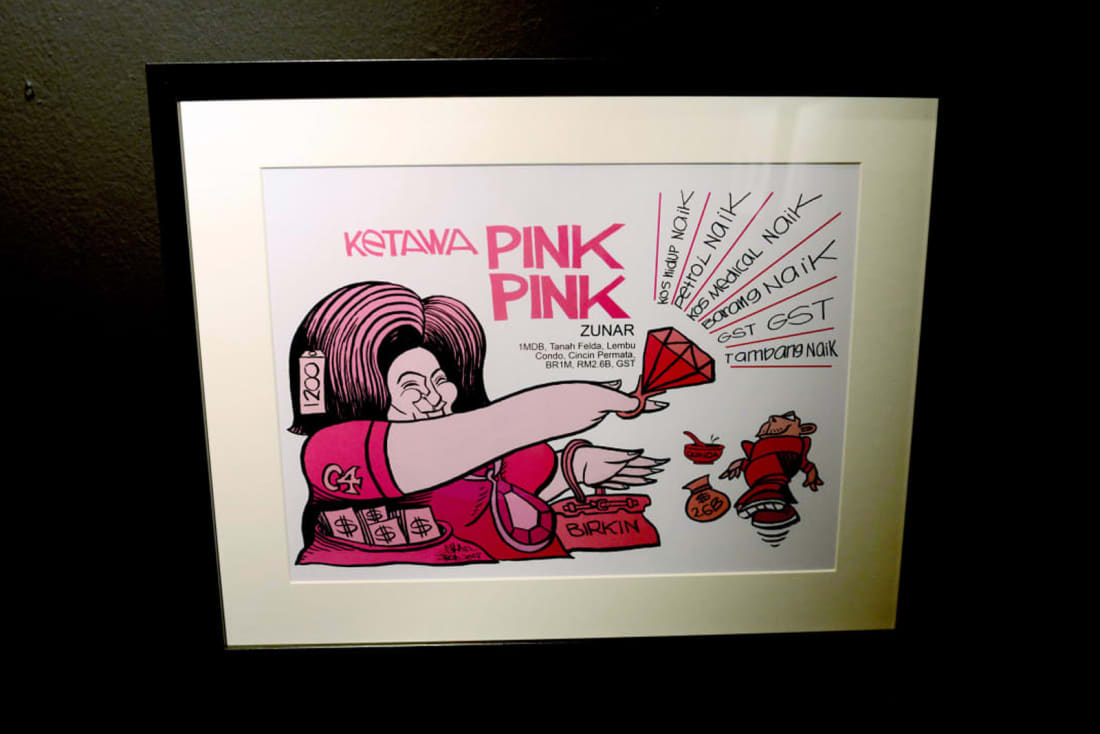
For Malaysians, the figure pictured (below) is instantly recognizable as Rosmah Mansor, wife of disgraced former Prime Minister Najib Razak and — according to prosecutors in the US and Malaysia — a modern day Imelda Marcos who accrued luxury goods worth millions of dollars using money embezzled from the state investment fund, 1MDB.
A cartoon of former Malaysian first lady Rosmah Mansor by Zunar is seen in a gallery in Kuala Lumpur.

A cartoon of former Malaysian first lady Rosmah Mansor by Zunar is seen in a gallery in Kuala Lumpur. Credit: James Griffiths/CNN
Zunar‘s work welcomes visitors to “Democracy in Action,” a recent exhibition that would have been impossible to stage only a year ago.
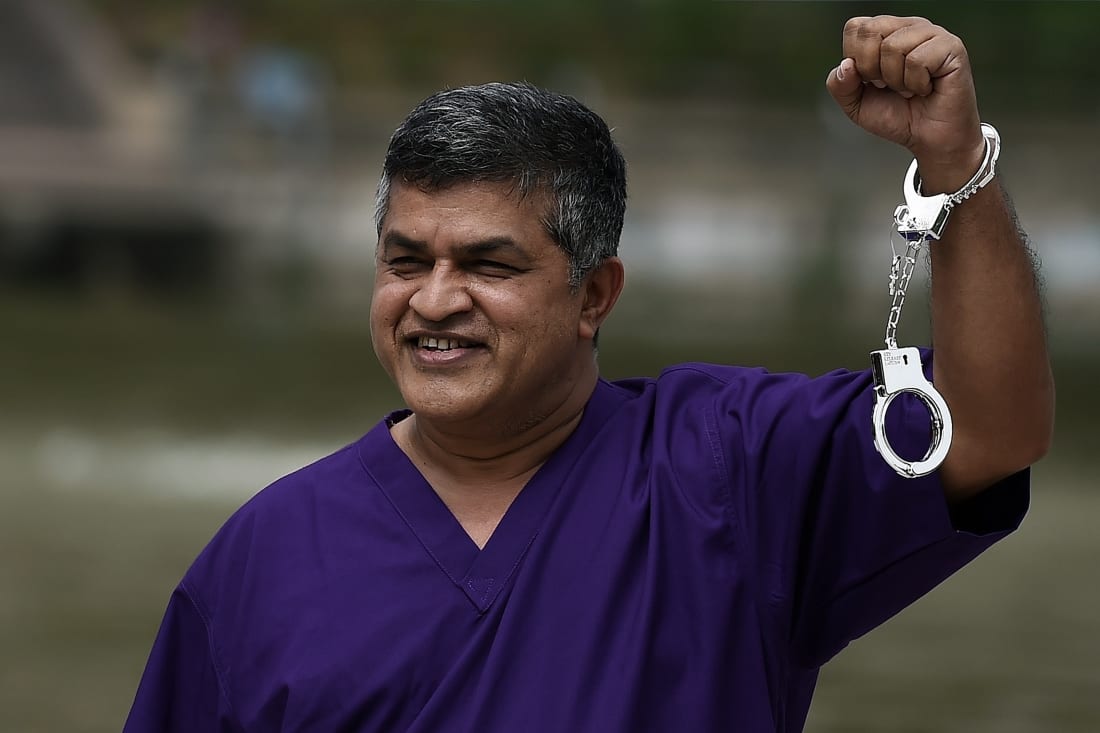
Malaysian cartoonist Zulkifli Anwar Ulhaque, popularly known as Zunar, poses with handcuffs prior to a book-launch event in Kuala Lumpur on February 14, 2015.
Malaysian cartoonist Zunar, poses with handcuffs prior to a book-launch event in Kuala Lumpur on February 14, 2015. Credit: MANAN VATSYAYANA/AFP/AFP/Getty Images
..Just last year, it seemed almost certain that Zunar would end up in prison. A number of his books had been banned, and while his work was still widely shared online, the artist faced multiple charges of sedition and committing acts deemed “detrimental to parliamentary democracy.” Unknown assailants attacked him at a gallery show, police seized his works and he was banned from leaving the country. Then, in a shock election result, a coalition of opposition parties turfed Najib out of office, promising to clamp down on corruption and reverse the country’s turn toward authoritarianism. Now Zunar is watching as his the political figures who were once his nemeses and muses face decades behind bars themselves — in part because artists like him helped bring attention to their alleged corruption and disdain for the rule of law. “The medium of cartooning is (a) very powerful medium,” Zunar told CNN at his small studio in a Kuala Lumpur suburb. “Everywhere, in any country you go, (cartoonists) get killed. Cartoonists, get arrested, put in jail everywhere because of the medium.
Fellow artist Fahmi Reza, who also faced prosecution under Najib, said this is partly because of cartoons’ unique ability to poke fun at those in power. “Using satire and humor is effective because it breaks the fear barrier,” he said in a phone interview. “People had always been afraid to speak out. The culture of fear is always there; the culture of self-censorship is always there. That’s where satire and humor can be the most effective tool, it makes people less afraid.
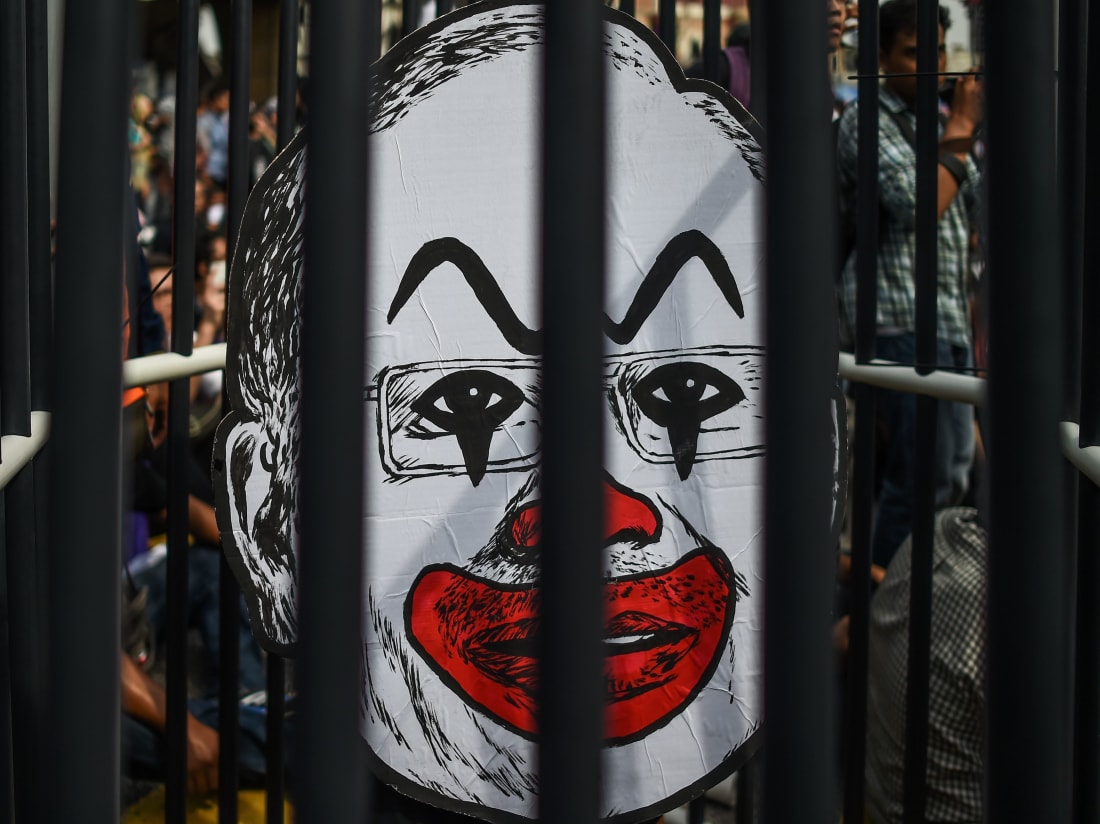
In June 2016, Fahmi Reza was charged with two counts of violating section 233(1) of the Communications and Multimedia Act, which forbids disseminating online content deemed to annoy, abuse, threaten or harass others. Fahmi had depicted Najib as a clown with big red lips and arched, thick eyebrows. The image quickly caught on with Malaysians sick of the widespread allegations of corruption, and it soon became a common sight at anti-government protests.
A caricature of Malaysian Prime Minister by artist Fahmi Reza. The artwork almost landed Fahmi in prison.
A caricature of Malaysian Prime Minister by artist Fahmi Reza. The artwork almost landed Fahmi in prison. Credit: MOHD RASFAN/AFP/AFP/Getty Images
Like Zunar, Fahmi had a record of trouble with the authorities. ….. “One sign that whatever you’re doing is effective is when the authorities and people in power react,” he added. “If they ignore it, then there’s no impact. That’s how the whole clown thing became a symbol of protest — because of the overreaction by the authorities.
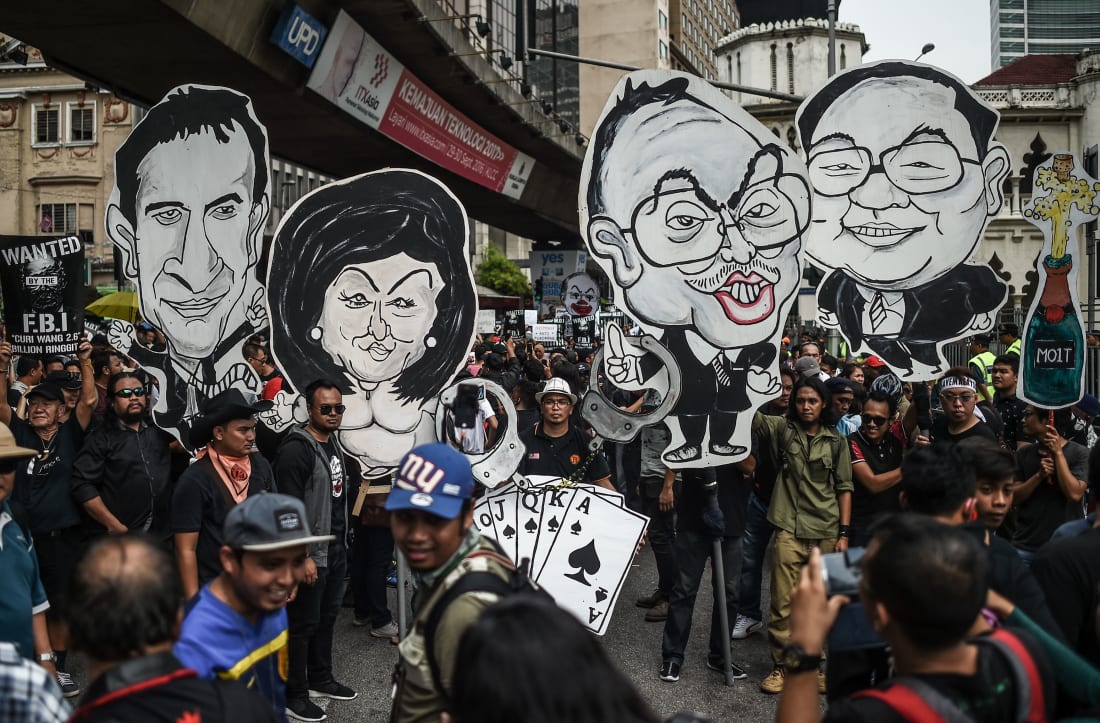
Both cartoonists’ arrests made international headlines, helping to highlight Najib’s growing authoritarianism to the outside world. Protesters also delighted in using the caricatures of Najib and Rosmah on posters and placards after it was revealed how much the artists had irritated them. As Malaysia’s opposition grew ever more determined to oust Najib — with many observers warning that 2016’s general election might be their last chance to do so — the government passed new legislation to control what people could say about it.
Activists hold up caricatures of Najib Razak and Rosmah Mansor (center). Political art became a key tool of protest in Malaysia during Najib's rule.

Activists hold up caricatures of Najib Razak and Rosmah Mansor (center). Political art became a key tool of protest in Malaysia during Najib’s rule. Credit: MOHD RASFAN/AFP/AFP/Getty Images
In early 2018, it introduced a new law to crack down on “fake news” that critics said was so broadly defined that it could easily be used to shut down and criminalize criticism of Najib.
Eventually however, the wave of dissent was too great for Najib to overcome. ….Since Najib’s downfall, charges against Zunar and Fahmi have been dropped, though the latter is still fighting to have an earlier conviction overturned. Both men said that, while they felt considerably freer under the new government, true reform has yet to be delivered.
For some other posts on cartoons, see: https://humanrightsdefenders.blog/tag/cartoons/

Turkish human rights defender Veysel Ok receives Thomas Dehler Medal

March 24, 2019

Human rights Lawyer Veysel Ok, who is also the Co-Director of the Media and Law Studies Association, will be awarded the Thomas Dehler Medal 2019 “for his work in advocating for freedom of speech and the rule of law in Turkey.”

For more on this and other awards, see: http://www.trueheroesfilms.org/thedigest/awards/thomas-dehler-medal

The medal will be awarded to Ok in a ceremony to be held in Munich on April 5. Ok will receive his medal from Sabine Leutheusser-Schnarrenberger, the former Minister of Justice of the Federal Republic of Germany. In an announcement made by the Thomas Dehler Foundation, it has been stated, “Human rights lawyer Veysel Ok fights for the rule of law in Turkey like no other. He became known in Germany above all because he represented Welt correspondent Deniz Yücel in court. He also defends many other lesser known journalists. Veysel Ok fights fearlessly and also faces consequences, now he himself has been indictment.”

About Veysel Ok

Formerly a lawyer for many journalists in Turkey, including imprisoned former Taraf Editor-in Chief Ahmet Altan and columnist Şahin Alpay, Veysel Ok currently faces “denigrating the Turkish judiciary system” charges as per the Article 301 of the Turkish Penal Code (TCK) for an interview that he gave in 2015. As part of the Media and Law Studies Association’s (MLSA) work, where he is a co-founder and currently co-director, Ok continues to defend 11 imprisoned journalists including Nedim Türfent, Ziya Ataman, Salih Turan, İdris Yılmaz and İdris Sayılgan and many other journalists and academics.

https://bianet.org/english/freedom-of-expression/206658-lawyer-veysel-ok-to-be-awarded-thomas-dehler-medal

https://ahvalnews.com/freedom-speech/german-rights-prize-turkish-lawyer-defending-journalists

The U.N. Hates Hate Speech More Than It Loves Free Speech

March 4, 2019

In a blog post in Foreign Policy of 28 February J (Executive director of Justitia, a Copenhagen based think tank) tackles the thorny issue of hate speech versus freedom of speech: “The U.N. Hates Hate Speech More Than It Loves Free Speech – The U.N. Secretary General is going soft on one of the most fundamental human rights“. It is an excellent read! Read the rest of this entry »

China’s freedom of expression subject of side event on 13 March

March 4, 2019


In November 2018, China underwent its Universal Periodic Review and received many recommendations on freedom of expression, both online and off. This side event will elevate the views of civil society actors who are committed to seeing improvements in the protection of freedom of expression in China.

13 March 2019 , 13h30-14h30, in Room XXIII, Palais des Nations, Geneva

Panelists:

  • Judith Lichtenberg, Director of Lawyers for Lawyers
  • A 1989 democracy activist
  • Uyghur PEN representative
  • Steven Butler, Asia Program Coordinator, Committee to Protect Journalists
  • Sarah M Brooks, Asia Advocate, International Service for Human Rights.

Event co-organised by:

Download the event flyer

For some of my earlier posts re China: https://humanrightsdefenders.blog/tag/china/

Join the conversation on Twitter: #ChinaUPR

https://mailchi.mp/ishr/749qlxejj6-32025?e=d1945ebb90

Human Rights Defender Jolovan Wham in Singapore sentenced – NGOs dismayed

February 24, 2019

The five undersigned human rights organisations, strongly condemn the prosecution of Singaporean human rights defender Jolovan Wham. After convicting Wham in January 2019 of “organising a public assembly without a permit,” the State Court sentenced him, on 21 February, to a fine of S$3,200 (US$2,367), or by default, 16 days in prison.  [see: https://humanrightsdefenders.blog/2018/01/05/international-commission-of-jurists-joins-criticism-of-singapore-for-harassment-of-human-rights-defender-jolovan-wham/]

World Press Freedom Index 2018 is out – colorful but disheartening

January 30, 2019

The World Press Freedom Index 2018 is out.

Published every year since 2002 by Reporters Without Borders (RSF), the World Press Freedom Index is an advocacy tool. The Index is a point of reference that is quoted by media throughout the world and is used by diplomats and international entities such as the United Nations and the World Bank.

The Index ranks 180 countries and regions according to the level of freedom available to journalists. (It is a snapshot of the media freedom situation based on an evaluation of pluralism, independence of the media, quality of legislative framework and safety of journalists in each country and region. It does not rank public policies even if governments obviously have a major impact on their country’s ranking. Nor is it an indicator of the quality of journalism in each country or region.)

Click here for more information

THE PRESS FREEDOM MAP, which is distributed in print and digital versions, offers a visual overview of the situation in each country and region in the Index. The colour categories are assigned as follows: good (white), fairly good (yellow), problematic (orange), bad (red) and very bad (black).


https://rsf.org/en/ranking

Internet shutdowns to silence opposition – what to do?

January 28, 2019

“African governments use Internet shutdowns to silence opposition more and more —what can people do?” askson EuroNews of

What would you do if your government decided to intentionally shut down your access to the Internet? Millions of people around the world have had to answer this question time and time again over the past few years, as government-mandated Internet blackouts are on the rise. Less than a month into 2019, Sudan, the Democratic Republic of Congo, Gabon and Zimbabwe have experienced government crackdowns on Internet connections.

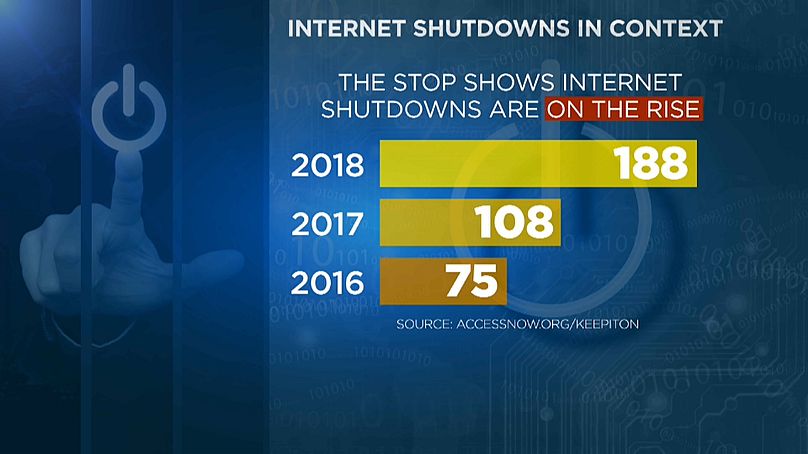
From 2016 to 2018, 371 separate cases of Internet shutdowns were documented around the world. More than half of them occurred last year alone, according to international non-profit organisation Access Now.

Authorities have used a number of reasons to justify the blackouts, including public safety, national security and stopping the dissemination of rumors and illegal content. However, advocacy groups investigating governmental tendencies to exert control over the flow of information don’t buy it. They claim it has more to do with silencing opposition movements and protests and trying to limit political instability.

They harm everyone: businesses, emergency services, journalism, human rights defenders, and demonstrators. They don’t help victims or restore order,” Access Now’s website reads.

In the past few weeks, several African governments have turned to partial or complete shutdowns in attempts to control the public discussion.

Sudan doubled down on social media amid widespread anti-government protests, with Access Now and the #KeepItOn coalition calling on network operators to fight back against state pressure — but it wasn’t the only African country to do so.

Zimbabwean authorities were quick to gag social media — including Facebook and Whatsapp — as soon as civil unrest over rising fuel prices spread in Harare and other major cities, and the DRC also ordered a full blackout following recent elections…..

From 2016 to 2018 alone, Africa witnessed 46 Internet shutdowns,…….Chad, Sierra Leone, Ethiopia, Somaliland, Algeria, Togo, Cameroon, Gambia, Uganda, Gabon, Algeria, Morocco, Lybia, Tunisia, and Algeria have all cracked down on their citizens’ access to the Internet in the past.

How did citizens react to Internet or social media shutdowns?

People always find a way”, Zimbabwean analyst Alexander Rusero told Euronews. “But it {VPN} doesn’t work for everyone”, Rusero pointed out. “Usually the ones in Harare, at the centre of the country, manage to”.

The analyst was quick to underline the issues behind similar crackdowns…”During the Internet blackout there were a lot of lies and rumors — they spread faster than you would believe. Media relies on social media, and so do critical opinion leaders. Outside those platforms, fake news manifest”.

Jean-Hubert Bondo, a journalist from the Democratic Republic of the Congo, doesn’t believe the problems end here. “Many Congolese families live off their small cybercafés. Also, we are in a country where there are not enough physical libraries. Students and researchers use the Internet to research their work at the university. Young people animate pages on Facebook and WhatsApp”, he told Euronews. “To deprive us of the Internet is to take us back to antiquity”. As for the VPNs Rusero mentioned — the most common ways to avoid Internet censorship worldwide — Bondo said that, during the latest shutdown, they failed to work. “In response to what is being perceived as a violation of human rights, Bondo reported that several Congolese civil society organisations have now lodged a complaint against the main telecommunication companies.

In Uganda, a crackdown on Twitter, Facebook, WhatsApp, YouTube, and mobile money apps in February 2016 as citizens were heading to the polls sparked a legal case that will be discussed in court in February 2019. “Shutdowns may not silence people, but they do hinder communication”, said Ugandan blogger Ruth Aine Tindyebwa….

https://www.euronews.com/2019/01/26/african-governments-use-internet-shutdowns-to-silence-opposition-more-and-more-what-can-pe

https://www.dailynews.co.zw/articles/2019/01/27/ed-justifies-internet-shutdown