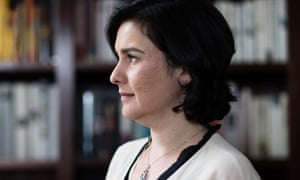
the Swedish PEN’s Tucholsky Prize was presented to jailed Swedish-Chinese publisher Gui Minhai, . EPA-EFE/Fredrik Sandberg SWEDEN OUT
New Europe reports that Sweden’s culture minister defied a Chinese threat on Friday 15 November after she had awarded a Swedish human rights prize to detained Chinese-Swedish book publisher Gui Minhai. The ceremony at Sven-Harry’s Art Museum in Stockholm, took place on 15 November 2019. The Swedish section of the International organization PEN awarded its free speech Tucholsky Prize free speech prize to the 55-year-old Gui, a Chinese-born Swedish citizen now detained in China. The Tucholsky Prize was established in 1984 and is named after German writer Kurt Tucholsky, who sought asylum to Sweden fleeing Nazi Germany in the 1930s. It has been previously awarded to writers such as Adam Zagajevski, Nuruddin Farah, Salman Rushdie, Taslima Nasrin and Svetlana Alexievich.
Gui Minhai published stories about Chinese political leaders out of a Hong Kong book shop. He disappeared while on holiday in Thailand in 2015. He then appeared on Chinese state television confessing to a fatal drink-driving accident from more than a decade earlier. He served two years in prison, was released in October 2017, and then arrested again while travelling on a train to Beijing with Swedish diplomats. [see also: https://humanrightsdefenders.blog/2016/01/21/confessions-abound-on-chinese-television-first-gui-minhai-and-now-peter-dahlin/]
“Those in power should never take the liberty to attack free artistic expression or free speech,” Swedish Culture and Democracy Minister Amanda Lindsaid during the ceremony. An empty chair symbolically represented the writer at the ceremony in Stockholm. The Chinese Ambassador to Stockholm, Guy Congyou, opposed both the award and its presentation by a Swedish government official. Gui Congyou told Radio Sweden that there would be “serious consequences” and “countermeasures” against Sweden.
More specifically, Gui Congyyou told Swedish news agency TT that any government representative attending the ceremony would be unwelcome in China. The Chinese Ambassador maintains that Gui Minhai is not a persecuted author but a criminal who has “committed serious offences in both China and Sweden.
Swedish Prime Minister Stefan Löfven made clear that his government would not back down: “We are not going to give in to this type of threat. Never. We have freedom of expression in Sweden and that’s how it is, period,” Lofven told Swedish Television. “We have made it clear to China’s representatives that we stand by our position that Gui Minhai must be released and that we have freedom of expression in Sweden,” Lind told TT. Sweden’s foreign ministry issued a statement on Friday calling on China to release Gui and made an official representation to Chinese authorities over the ambassador’s statements.
..Unfortunately, social media platforms are now a primary tool for coordinated, state-aligned actors to harass, threaten and undermine advocates. Although public shaming, death threats, defamation and disinformation are not unique to the online sphere, the nature of the internet has given them unprecedented potency. Bad actors are able to rapidly deploy their poisoned content on a vast scale. Social media companies have only just begun to recognize, let alone respond, to the problem. Meanwhile, individuals targeted through such coordinated campaigns must painstakingly flag individual pieces of content, navigate opaque corporate structures and attempt to survive the fallout. To address this crisis, companies such as Facebook, Twitter and Youtube must dramatically increase their capacity and will to engage in transparent, context-driven content moderation.
For human rights defenders, the need is urgent. .. Since 2011, the ABA Center for Human Rights (CHR) has ..noted with concern the coordination of “traditional” judicial harassment of defenders by governments, such as frivolous criminal charges or arbitrary detention, with online campaigns of intimidation. State-aligned online disinformation campaigns against individual defenders often precede or coincide with official investigations and criminal charges.
……
While social media companies generally prohibit incitement of violence and hate speech on their platforms, CHR has had to engage in additional advocacy with social media companies requesting the removal of specific pieces of content or accounts that target defenders. This extra advocacy has been required even where the content clearly violates a social media company’s terms of service and despite initial flagging by a defender. The situation is even more difficult where the threatening content is only recognizable with sufficient local and political context. The various platforms all rely on artificial intelligence, to varying degrees, to identify speech that violates their respective community standards. Yet current iterations of artificial intelligence are often unable to adequately evaluate context and intent.
Online intimidation and smear campaigns against defenders often rely on existing societal fault lines to demean and discredit advocates. In Guatemala, CHR recently documented a coordinated social media campaign to defame, harass, intimidate and incite violence against human rights defenders. Several were linked with so-called “net centers,” where users were reportedly paid to amplify hateful content across platforms. Often, the campaigns relied on “coded” language that hark back to Guatemala’s civil war and the genocide of Mayan communities by calling indigenous leaders communists, terrorists and guerrillas.
These terms appear to have largely escaped social media company scrutiny, perhaps because none is a racist slur per se. And yet, the proliferation of these online attacks, as well as the status of those putting out the content, is contributing to a worsening climate of violence and impunity for violence against defenders by specifically alluding to terms used to justify violence against indigenous communities. In 2018 alone, NPR reports that 26 indigenous defenders were murdered in Guatemala. In such a climate, the fear and intimidation felt by those targeted in such campaigns is not hyperbolic but based on their understanding of how violence can be sparked in Guatemala.
In order to address such attacks, social media companies must adopt policies that allow them to designate defenders as temporarily protected groups in countries that are characterized by state-coordinated or state-condoned persecution of activists. This is in line with international law that prohibits states from targeting individuals for serious harm based on their political opinion. To increase their ability to recognize and respond to persecution and online violence against human rights defenders, companies must continue to invest in their context-driven content moderation capacity, including complementing algorithmic monitoring with human content moderators well-versed in local dialects and historical and political context.
Context-driven content moderation should also take into account factors that increase the risk that online behavior will contribute to offline violence by identifying high-risk countries. These factors include a history of intergroup conflict and an overall increase in the number of instances of intergroup violence in the past 12 months; a major national political election in the next 12 months; and significant polarization of political parties along religious, ethnic or racial lines. Countries where these and other risk factors are present call for proactive approaches to identify problematic accounts and coded threats against defenders and marginalized communities, such as those shown in Equality Labs’ “Facebook India” report.
Companies should identify, monitor and be prepared to deplatform key accounts that are consistently putting out denigrating language and targeting human rights defenders. This must go hand in hand with the greater efforts that companies are finally beginning to take to identify coordinated, state-aligned misinformation campaigns. Focusing on the networks of users who abuse the platform, instead of looking solely at how the online abuse affects defenders’ rights online, will also enable companies to more quickly evaluate whether the status of the speaker increases the likelihood that others will take up any implicit call to violence or will be unduly influenced by disinformation.
This abuser-focused approach will also help to decrease the burden on defenders to find and flag individual pieces of content and accounts as problematic. Many of the human rights defenders with whom CHR works are giving up on flagging, a phenomenon we refer to as flagging fatigue. Many have become fatalistic about the level of online harassment they face. This is particularly alarming as advocates targeted online may develop skins so thick that they are no longer able to assess when their actual risk of physical violence has increased.
Finally, it is vital that social media companies pursue, and civil society demand, transparency in content moderation policy and decision-making, in line with the Santa Clara Principles. Put forward in 2018 by a group of academic experts, organizations and advocates committed to freedom of expression online, the principles are meant to guide companies engaged in content moderation and ensure that the enforcement of their policies is “fair, unbiased, proportional and respectful of users’ rights.” In particular, the principles call upon companies to publicly report on the number of posts and accounts taken down or suspended on a regular basis, as well as to provide adequate notice and meaningful appeal to affected users.
CHR routinely supports human rights defenders facing frivolous criminal charges related to their human rights advocacy online or whose accounts and documentation have been taken down absent any clear justification. This contributes to a growing distrust of the companies among the human rights community as apparently arbitrary decisions about content moderation are leaving advocates both over- and under-protected online.
As the U.N. special rapporteur on freedom of expression explained in his 2018 report, content moderation processes must include the ability to appeal the removal, or refusal to remove, content or accounts. Lack of transparency heightens the risk that calls to address the persecution of human rights defenders online will be subverted into justifications for censorship and restrictions on speech that is protected under international human rights law.
A common response when discussing the feasibility of context-driven content moderation is to compare it to reviewing all the grains of sand on a beach. But human rights defenders are not asking for the impossible. We are merely pointing out that some of that sand is radioactive—it glows in the dark, it is lethal, and there is a moral and legal obligation upon those that profit from the beach to deal with it.
Ginna Anderson, senior counsel, joined ABA CHR in 2012. She is responsible for supporting the center’s work to advance the rights of human rights defenders and marginalized dommunities, including lawyers and journalists at risk. She is an expert in health and human rights, media freedom, freedom of expression and fair trial rights. As deputy director of the Justice Defenders Program since 2013, she has managed strategic litigation, fact-finding missions and advocacy campaigns on behalf of human rights defenders facing retaliation for their work in every region of the world
Kamila Shamsie. Photograph: Teri Pengilley/The Guardian
Arundhati Roy, JM Coetzee and Sally Rooney are among more than 250 writers who have defended Kamila Shamsie after a German literary prize withdrew an award [named for the Jewish Nobel Prize-winning German-born poet and playwright Nelly Sachs (1891-1970)] over her support for the Boycott, Divestment, Sanctions (BDS) movement against Israel. In an open letter published today in the London Review of Books, the writers, who also include Noam Chomsky, Amit Chaudhuri, William Dalrymple,Yann Martel, Jeanette Winterson and Ben Okri, say that the Nelly Sachs prize has chosen to “punish an author for her human rights advocacy”. Michael Ondaatje, a former winner of the award, is one of the signatories to the letter. This post is based on Alison Flood in the Guardian of
The judges had initially chosen Shamsie for writing that “builds bridges between societies”, but changed their minds on learning she backed the BDS movement, saying that her “political positioning to actively participate in the cultural boycott … contrasts with the claim of the Nelly Sachs prize to proclaim and exemplify reconciliation among peoples and cultures”.
Shamsie’s supporters reply asks: “What is the meaning of a literary award that undermines the right to advocate for human rights, the principles of freedom of conscience and expression and the freedom to criticise? … Without these, art and culture become meaningless luxuries.”
The revoking of Shamsie’s award follows a motion passed in May by the German parliament that labelled the BDS movement antisemitic. But the letter writers point to a decision earlier this month in the administrative court of Cologne ruling that Bonn city council’s decision to exclude the German-Palestinian Women’s Association from a cultural festival because of its support for BDS was unjustified. The writers highlight the statement last year from more than 40 progressive Jewish organisations arguing that conflating anti-Jewish racism with opposition to Israel’s policies and system of occupation and apartheid “undermines both the Palestinian struggle for freedom, justice and equality and the global struggle against antisemitism”.
The letter also criticises the German city of Dortmund, which runs the award, for refusing to make public Shamsie’s written response to the decision.
Shamsie, winner of the UK’s Women’s prize for fiction, had called it a “matter of outrage that the BDS movement (modelled on the South African boycott) that campaigns against the government of Israel for its acts of discrimination and brutality against Palestinians should be held up as something shameful and unjust”. Asked to comment, a spokeswoman for the city of Dortmund said that the jury had decided not to give any further statements. “The council has legitimated the jury of Nelly Sachs prize to choose an awardee,” she said. “The jury is autonomous in its decision and gave reasons in the press release. There has been no council meeting after the jury’s decision, so the withdrawal has not been a topic for the council yet.”
Aimed at students aged between 16 and 18, guidelines for entrants urge them to consider “What can the world learn from the UAE’s model for tolerance?” and “How does the Year of Tolerance reflect the already established values of diversity within the UAE?”
UAE launches ‘pledge of tolerance’ despite continued crackdown on dissent
Hiba Zayadin, a Gulf Rights expert for Human Rights Watch, criticised the British government for its participation in this initiative and said it was “helping whitewash” the UAE government. “It is not just ironic to host such an initiative in one of the world’s most repressive countries, but downright irresponsible,” Zayadin told Middle East Eye. “The UAE is a country where the red lines are constantly shifting, and where journalists, academics and critics have been targeted, harassed, threatened, and jailed simply for expressing their opinions.” She added: “By launching such an initiative, the British embassy is not supporting the growth of journalism around the world so much as it is helping to whitewash a repressive regime’s near-obliteration of the space for free speech.”
Press freedom in the UAE has been a constant source of criticism for the Emirates. Reporters Without Borders (RSF) ranked the UAE at 133rd in its 2019 Press Freedom Index and described the country as the “masters of the online surveillance of journalists”.
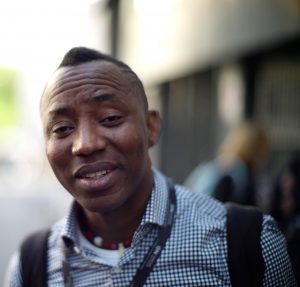
On 23 August 2019 48 NGOs issued an urgent appeal in relation to the arrest and detention of Omoyele Sowore, Nigerian journalist and human rights defender, to the UN and African human rights bodies. Joy Hyvarinen, head of advocacy at Index on Censorship said: “Index on Censorship urges the Nigerian authorities to release the prominent journalist and campaigner Omoyele Sowore immediately. The arrest and detention are a shocking violation of Mr Sowore’s human rights, which calls into question Nigeria’s willingness and ability to meet international human rights obligations.”
To the members of the Working Group and the Special Rapporteurs:
We, 48 human rights and press freedom organisations, respectfully request that you consider this urgent appeal in relation to the arrest and arbitrary detention of Nigerian journalist and human rights defender Omoyele Sowore who was arrested by the authorities following a call for peaceful protest. We request that you urgently intervene to secure the immediate release of Mr Sowore and declare his arrest and detention a gross violation of his human rights, including the right not to be arbitrarily detained as protected by Article 9(1) of the International Covenant on Civil and Political Rights (ICCPR) and Article 6 of the African Charter on Human and Peoples’ Rights (the Banjul Charter); the right to a fair trial as protected by Article 14 ICCPR and Article 7 of the Banjul Charter; the right to freedom of expression as protected by Article 19 ICCPR and Article 9 of the Banjul Charter; the right of freedom of peaceful assembly and of association as protected by Articles 21 and 22 ICCPR and Articles 10 and 11 of the Banjul Charter; and his rights as a human rights defender as outlined in the 1999 UN Declaration on Human Rights Defenders and 2017 African Commission Cotonou Declaration on strengthening and expanding the protection of all Human Rights Defenders in Africa.
Background
Mr Sowore is a prominent journalist, human rights activist and pro-democracy campaigner. He is the founder of Sahara Reporters, an online news agency based in New York City that focuses on corruption, human rights abuses and other political misconduct in Nigeria. Challenging government corruption and speaking truth to power has been the constant thread throughout Mr Sowore’s career, from the leading of student protests in the 1990’s to his recent campaign running for Presidential office in Nigeria.
Omoyele Sowore’s arrest and detention
Mr Sowore was arrested on 3 August 2019 in his hotel room during a trip to Lagos. Security agents forcefully detained Mr Sowore without informing him of any charges against him and flew him to Abuja, where he is currently being detained at the facility of the headquarters of the Nigerian State Security Service. Mr Sowore has access to food and water, but no access to the outside world: no newspapers, television or phone, and he spends most days in isolation. He was held incommunicado until 6 August, during which time Mr Sowore refused to answer any questions without consulting with his lawyer. He was allowed access to his lawyers only on 7 August, 4 days after his arrest.
Based on Section 35 of the Nigerian Constitution, Mr Sowore should have been arraigned before a court within 48 hours. As of today, Mr Sowore has not been arraigned in any court.
However, on 6 August, 3 days after his arrest, the State Security Service did seek an ex- parte order from the Federal High Court in Abuja to detain Mr Sowore under Section 27(1) of the Terrorism Act 2013, which enables the detention of anyone planning to “commit an act of violence”. The Court’s order of 8 August, made within 48 hours after the State Security Service’s request, granted the authorities permission to detain Mr Sowore for 45 days. Within 24 hours, his legal team, led by Mr Femi Falana, filed a motion to set aside the order and requested Mr Sowore’s immediate release, arguing that his detention was contrary to the Nigerian Constitution. At the time of writing, this request has not been heard by the courts and no date for hearing has been fixed. Importantly: no formal charges have been filed against Mr Sowore.
Mr Sowore’s call for a peaceful #RevolutionNow protest
The arrest of Mr Sowore appears to be the direct consequence of his call for a peaceful protest scheduled to take place on 5 August 2019, using the hashtag #RevolutionNow.
The objective of the protest was to demand that the Nigerian government end corruption and economic inequality and guarantee education to all. That the protest Mr Sowore and the Coalition for Revolution (CORE) movement he founded called for was a peaceful one is made clear at the very outset of the call for protest, issued on 27 July, which starts by setting out the “rules of engagement”:
We eschew all forms of violence. No protester should throw any object as little as stones or attack any security officials. We are aware of their intent to provoke the mass unduly by using undue tactics and sponsored agents, so as to give the protest a bad name. We encourage all Nigerians to remain calm as we are ready to fight these injustices to a logical conclusion.
A week earlier, in an interview with the Arise News channel, Mr Sowore stated that “Nigeria needs revolution, not war,” clearly distinguishing his call for substantial change from a call to violence. Mr Sowore has used the word “revolution” contextually to mean “change for the better” since 2006, when he founded Sahara Reporters. Mr Sowore then stated that he would “revolutionise” the way news is being reported in Nigeria –– something he actually did with the investigative citizen journalism the website publishes.
Despite Mr Sowore’s arrest and detention, the 5 August #RevolutionNow protests took place in Abuja, Lagos, Osun, Ondo and Cross River. Protesters met a police force that dispersed them with teargas and gunshots. Numerous protesters, including several of Sahara Reporters’ journalists, were arrested and charged with illegal assembly.
Request for urgent action
It is clear that Mr Sowore’s arrest on apparent grounds of suspicion of terrorism is unfounded. Mr Sowore did what he has done throughout his career as a journalist and human rights activist: exercise his right to freedom of expression and seek to bring about change through peaceful means, in this case a peaceful protest. The use of the emotive term “revolution” merely underlines his desire for transformative change in what he considers the shortcomings of the current government. There are strong suspicions that Mr Sowore’s arrest stems from ulterior motives than responding to any supposed criminal wrongdoing. This is further highlighted by the fact that the authorities failed to define a charge against him for the first few days after his arrest; the investigations that were subsequently instigated against him under the Terrorism Act were clearly only created to serve the purpose of silencing Mr Sowore.
As such, the arrest and detention of Mr Sowore amount to a violation of his right not to be arbitrarily detained as guaranteed under Article 9 ICCPR and Article 6 of the Banjul Charter. The fact that the charges brought against him most likely stem from his call for a peaceful demonstration and his critical stance on the Nigerian government also violates Mr Sowore’s right to free expression under Article 19 of the ICCPR and Article 9 of the Banjul Charter and his right of freedom of peaceful assembly and of association under Articles 21 and 22 ICCPR and Articles 10 and 11 of the Banjul Charter. Not properly arraigning Mr Sowore before a competent court within the time limit mandated by the Nigerian Constitution and not allowing him access to a lawyer during the initial days of his detention violates his right to a fair trial as protected by Article 14 ICCPR and Article 7 of the Banjul Charter. The foregoing also constitutes a violation of his rights as a human rights defender as defined in the 1999 UN Declaration on Human Rights Defenders and 2017 African Commission Cotonou Declaration on strengthening and expanding the protection of all Human Rights Defenders in Africa.
As a State Party to both treaties, Nigeria is under an obligation to guarantee these rights to all its citizens, as specified under Article 2(1) of the ICCPR and Article 2 of the Banjul Charter. Accordingly, we appeal to the Working Group and UN and AU Special Rapporteurs to:
intervene urgently to secure the immediate release of Mr Sowore; and
declare his arrest and continuing detention a gross violation of his human rights.
SIGNED BY: All Workers’ Convergence (AWC)
Afrika Movement for Freedom and Justice (AMFJ)
Agege Women Agenda (AWA)
ARTICLE 19 Senegal/West Africa
Centre for Constitutional Rights
Centre for Human Rights and Social Justice (CHRSJ)
Chidi Odinkalu Former Chairman, National Human Rights Commission (Nigeria) & Senior Fellow, Open Society Justice Initiative
Coalition for Revolution (CORE)
Committee for the Defence of Human Rights (CDHR)
Community Women Initiatives (CWI)
The Concerned Forum
Congress of Progressive Youths (COPY)
Democratic Youth League
Edo State Civil Society Organisation (EDOSCO)
Enough is Enough (EiE) Nigeria
Freedom of Expression Hub
Gani Fawehinmi Apostles
Gani Fawehinmi Memorial Organization (gafam.org)
Governance Advancement Initiative for Nigeria (GAIN)
Global Voices Sub-Saharan Africa
Grassroot Justice Centre
Human and Environment Development Agenda (HEDA)
Human Rights Network for Journalists-Uganda (HRNJ-UGANDA)
IAmVocal
Index on Censorship
Media Legal Defence Initiative
Media Rights Agenda
Moshood Abiola Vanguard for Democracy (MAVD)
Movement For People’s Rights
National Conscience Party (NCP), Lagos State Branch
Nigerians in Diaspora Europe, Belgium-Luxembourg (NIDOE-BeLux)
Open Society for West Africa (OSIWA), Nigeria Office
Paradigm Initiative
People’s Alternative Front (PAF)
Peoples’ Unite
Rivers State Civil Society Coalition (RIVSCO)
Rule of Law and Accountability Advocacy Centre (RULAAC)
Save Lagos Group
Socialist Vanguard Tendency (SVT)
Socio-Economic Rights and Accountability Project (SERAP)
Screenshot from video ‘Full interview Doan Trang’ uploaded on 10 May 2019 by the 88 Project on Youtube.
A new series of video interviews highlights the perspectives and struggles of human rights women in Vietnam. On 1 July 2019Don Le posted this in Global Voives:
The 88 Project, an organisation supporting freedom of expression in Vietnam, released the first video of an ongoing interview series with female activists in Vietnam. In the first interview with Pham Doan Trang, a dissident journalist and political activist, she discusses the challenges women face as bloggers and human rights activists: “In general, Vietnamese women are not respected. Not only in democracy activism but in all fields. In democracy activism, female activists are disadvantaged because they get attacked no less than male activists. They get beaten and assaulted. The work they do is no less than their male counterparts. But what they often get from other people is pity. I think it is not respect.” See also: https://humanrightsdefenders.blog/2017/11/18/overview-of-recent-campaigning-for-human-rights-defenders-in-vietnam/
Other women including social activist and blogger Tran Thi Nga, who is currently serving a nine-year prison sentence, have also been seriously injured following physical attacks, often conducted by hired men. Tran Thi Nga’s attack was documented and posted on Youtube with recordings of her being wheeled into a hospital accompanied by her two young children. According to family reports, Tran Thi Nga has been subjected to both physical and psychological harassment after her arrest, receiving death threats and beatings from a cellmate.
According to the 88 Project database, there are currently more than 200 prisoners of conscience in Vietnam with over 30 identifying as female. Bloggers and journalists are frequently arrested and charged for “activities attempting to overthrow the state” or “conducting propaganda against the state”. According to Amnesty International, the Vietnamese government has been conducting a growing crackdown on freedom of expression and peaceful activism over the past few years.
Nguyen Dang Minh Man, a photojournalist and the woman who has served the longest time in prison so far, is expected to be released at the beginning of August.
On 31 July a number of and leading international and Brazilian free speech organizations appealed for support for the staff of The InterceptBrasil, a Rio de Janeiro-based investigative news website that has been the target of a fierce campaign of harassment and intimidation since 9 June. The Intercept Brasil’s revelations about the “Operation Car Wash” corruption case triggered a wave of verbal attacks and threats against the website’s representatives. The most serious recent attacks include Brazilian President Jair Bolsonaro’s public threat on 27 July to imprison The Intercept Brasil founder and editor Glenn Greenwald. [see also: https://humanrightsdefenders.blog/2014/12/15/edward-snowden-gets-another-human-rights-award-in-berlin/]
The 26press freedom and human rights organizations and media outlets named below strongly condemn the recent wave of attacks and threats against the investigative news website The Intercept Brasil. We call on the authorities to ensure respect for the constitutionally guaranteed right of journalists to protect the confidentiality of their sources.
The attacks began on 9 June after The Intercept Brasil published the first of a series of reports revealing apparent irregularities in the “Operation Car Wash” investigation, one of the most important corruption investigations in Brazilian history. To publish these revelations, which are based on documents provided by an anonymous source, The Intercept Brasil partnered with several Brazilian media outlets including the Folha de SãoPaulo newspaper and Veja magazine.
Since then, the staff of The Intercept Brasil and in particular, its founder Glenn Greenwald, have been subjected – especially on social networks – to countless insults, slurs and death threats accompanied by false information designed to undermine the credibility of its reporting. This harassment is symbolic and symptomatic of the difficulties encountered by all media workers who investigate sensitive stories in Brazil, where the journalists are often the targets of intimidation and persecution campaigns.
Regardless of their provenance, the attempts to undermine and attack the credibility of The Intercept Brasil and its partners are viewed by the signatories of this appeal as a grave threat to the freedom to inform. Not only are they designed to deflect the public’s attention from the content of the revelations but above all, they reinforce an increasingly hostile work environment for the media and especially for investigative journalism.
We remind the authorities that the Brazilian state has a duty to guarantee the protection of journalists and to investigate the serious threats received by the journalists at The Intercept Brasil and its partners.
Freedom of the press and information are pillars of democracy. They transcend political divisions and must be protected and guaranteed at all costs.
Signatories:
Agência Pública de Jornalismo Investigativo
Amnesty International Brazil
Article 19 Brasil
Asociación de la Prensa de Madrid (APM)
Associação Brasileira de Imprensa (ABI)
Associação Brasileira de Jornalismo Investigativo (Abraji)
Associação dos Correspondentes Estrangeiros (ACE) de São Paulo
Committee to Protect Journalists (CPJ)
Federação Nacional dos Jornalistas (FENAJ)
Federación de las Asociaciones de Periodistas de España (FAPE)
Reporters Without Borders (RSF) is delighted to report that Mohamed Cheikh Ould Mohamed Mkhaitir, a Mauritian blogger who had been held for more than five and a half years and who was originally sentenced to death for apostasy, was released at dawn yesterday. When contacted by RSF after his release, Mkhaitir thanked all the organizations who have been campaigning on his behalf ever since his arrest in January 2014. He was arrested for a Facebook post criticizing the use of religion to justify discriminatory practices against the blacksmith community to which he belongs. See: https://humanrightsdefenders.blog/2019/06/24/ngos-demand-the-release-of-mohamed-cheikh-ould-mkhaitir-in-mauretania/
The death sentence he received in December 2014 on a charge of apostasy was eventually commuted to two years in prison by a Nouadhibou appeal court in November 2017. He should then have been released but many demonstrations calling for his execution had been held during his trial and the authorities continued to detain him on “security grounds”, denying him access to his family and lawyers.
“We are deeply relieved that he has finally been freed after being held for more than five and a half years in almost total isolation,” RSF secretary-general Christophe Deloire said. “For nothing more than a social network post, he was subjected to a terrible ordeal that violated a decision by his own country’s judicial system. This blogger was francophone Africa’s longest-held citizen-journalist. We thank all those who contributed to his release.”
Mkhaitir had made formal statements of repentance on Facebook and TV in the past few weeks. This was the condition that was set for his release after a meeting at the start of July between outgoing President Mohamed Ould Abdel Aziz and several religious officials. The new president, former defence minister Mohamed Ould Ghazouani, is to be sworn in on 1 August. Mkhaitir’s release was the outcome of a major international campaign to which RSF, many other NGOs and his lawyers all contributed. …. Mainly because of Mkhaitir’s arbitrary detention, Mauritania has fallen 46 places in RSF’s World Press Freedom Index since 2016 and is ranked 94th out of 180 countries in the 2019 Index. Aside from Tanzania, no other country has fallen so sharply in the same period.
The Committee to Protect Journalists on 16 July gave one of its International Press Freedom Awards 2019 to Neha Dixit, an Indian freelance reporter, who has covered politics, gender, and social justice in print, TV, and online media for more than a decade. [see: https://humanrightsdefenders.blog/2019/07/17/international-press-freedom-awards-2019/]
She began her career at Tehelka magazine and then joined the special investigation team at India Today. In 2019, Dixit spent months investigating and reporting stories that shed a light on important issues in the country, including extrajudicial killings by police. She also reported on the illegal detention of citizens under draconian laws that appeared to be motivated by political interests. In January 2019, the Office of the United Nations High Commissioner for Human Rights sent a notice to the Indian government to express its concern about the detentions. In 2018, Dixit reported on the damage to the health of poor Indians who were being used as guinea pigs by pharmaceutical companies in illegal drug trials.
In 2016, she wrote a story for Outlook magazine that accused members of a right-wing nationalist group of trafficking more than 31 girls in Assam state to other parts of India in order to inculcate them with a nationalist ideology. After the story was published, members of the ruling party filed a criminal defamation suit against Dixit and Outlook, accusing both of violating Indian law. CPJ condemned the case, which continues today, and provided Dixit with support for its legal fees. CPJ’s research has found that section 153A of India’s colonial-era penal code, under which the suit was filed, has been used to silence journalists, writers, and academics in India. Dixit was also charged with “inciting communal hatred through writing,” for which she could face a five-year prison term.
After Dixit’s exposé on extrajudicial killings by the police, she said high-ranking police officials threatened her family’s safety if she continued to report on the issue. She is frequently harassed online as a result of her reporting, especially from alleged right-wing extremists. She has been threatened with physical attacks, rape, and death, and her personal information has been exposed online. She told CPJ in May 2019 that she faces up to 300 abusive messages a day.
Dixit’s work has been published in international outlets including The New York Times, Al-Jazeera, Caravan, and The Wire. She has received numerous awards, including the European Commission’s Lorenzo Natali Media Prize in 2011, the Kurt Schork Award in International Journalism in 2014, and the 2016 Chameli Devi Jain Award for Outstanding Woman Journalist.
Digital activist Maxence Melo. (Daniel Hayduk, AFP, File)
A Tanzanian journalist awarded the International Press Freedom Award on 16 July [see https://humanrightsdefenders.blog/2019/07/17/international-press-freedom-awards-2019/] said he hoped the recognition will “lift the corner of the veil” on the plight of reporters in his homeland reported News24 on 17 July 2019. Maxence Melo, a blogger whose critical writings of President John Magufuli have landed him in hot water.
The CPJ said the co-founder of the Jamii Forums blog in 2006, was a “champion of online freedom of expression” who never flinched, even in the face of Tanzania’s strict internet laws. Melo has been in court more than 80 times, the CPJ said, and is still facing prosecution for refusing to disclose his sources in a story criticising Tanzanian authorities. His work focuses on corruption, tax evasion and human rights violations.
Melo said he hoped the award would turn the spotlight on the exceptional difficulties faced by journalists in Tanzania. “This prize lifts a corner of the veil on what is happening in our country,” said Melo, who is barred from leaving Tanzania’s financial capital and biggest city, Dar es Salaam. “Never before in our country has a government violated press freedom so much.”
“It is of course not good news that my country is making the headlines because of its laws and practices that violate freedoms of the press and expression,” Melo said. “With the announcement of this award, I think the international community will take a greater interest in what is happening in Tanzania, in the difficult environment in which the media and human rights defenders work in Tanzania.” Melo, a father of three, said he had received death threats. “It is obvious that I am afraid, afraid for my personal safety, but also for the safety of my family,” he said.
In 2015, the East African country was 75th in the world in RSF’s press freedom rankings. By 2019, it had slid to 118th.