The Irish Independent on 28 June 20143 reports that the founding director of Dublin-based Front Line Defenders will receive the Order of Chevalier of the Legion of Honour at the French embassy on Thursday 3 July. Mary Lawlor established the NGO (one of the 10 NGOs on the MEA Jury) in 2001 with a start-up donation of €2.2 million from businessman Denis O’Brien. “Francophone and francophile Ms Mary Lawlor defends the values of humanity and respect, which are shared by both France and Ireland,” said a spokesman for the embassy.
It is with great pleasure that I am able to announce that a great human rights defender from France, Louis Joinet, is honored with a colloque on the topic “Is sovereignty still the basis of international law?”. It coincides with the publication of his book: “Mes raisons d’Etat” [‘My reasons of state’ or better ‘How I saw the national interest].
Had he been fluent in English (he picked it up too late in life) he would have been probably one of the most famous human rights experts in the world. His nicknames range from “Louis le Juste” to “the Obstinate”. He played a major role within the French state apparatus as from the 1960s. One of the founders of the ‘Syndicat de la magistrature‘ in 1968 (sometimes called the ‘red judges’), he became the first director of the National Commission on Informatics and Freedoms [Commission nationale de l’informatique et des libertés]. He served five different Prime Ministers during the 1980s as advisor. It was during those days that I met him regularly to set up and run a number of Committees dealing with the military regimes in the Southern Cone of Latin America (e.g. SIJAU, SIJADEP). We travelled often to the region and on many occasions I saw returned refugees come up to Louis to embrace and thank him for the support he gave them in exile.
In the meantime during 33 years he was an expert in various UN bodies, travelling all over the world. Most pronounced was his leading role in the Sub-commission for Human Rights and the Protection of Minorities (now renamed and relegated to a research role for the new Council), where he spearheaded a great many and daring innovations, concerning many issue including disappearances, torture, international crimes and amnesty. His popularity with (certain) States suffered, but most NGOs considered him to be a hero.
Together with his late and much-beloved wife Germaine he had a less-known but rewarding social life that includes assisting young street criminals and a passion for circus and street theater. His musical talent is illustrated in the picture below from my private collection, where he is seen playing the accordion with Argentinian Leandro Despouy watching (August 1988).
The colloque in Louis honor is taking place on 27 Mars 2014, 18h30, at Université Panthéon-‐Assas, Centre Panthéon, Salle des Conseils, in the series of lectures under Professor Olivier de Frouville.
In March, Margaret Sekaggya will finish her term as the UN Special Rapporteur on Human Rights Defenders. For more than five years the Ugandan Margaret Sekaggya has served the mandate with dedication and commitment, and has played an integral role in promoting the work of and furthering protection for human rights defenders around the world.
Also it has been announced that the new Special Rapporteur will be Michel Forst , from France.
He is a lawyer by training and the Secretary General of the Commission Nationale Consultative des Droits de l’Homme de la Republique Française. From 2008 – 2013, he was the Independent Expert of the United Nations on the situation of human rights in Haiti. He was Director General of Amnesty International in France and worked in the human rights department of UNESCO. Mr. Forst is also a founding trustee of Front Line Defenders.
In short, Margaret Sekaggya did a great job – like her predecessor Hina Jilani – and the credentials of the new Rapporteur give all reason to hope that the level of knowledge and commitment will be maintained. Glad to report something good coming out of the Council!
On 26 September 2013 many countries attended the first ministerial meeting held at the United Nations on the rights of lesbian, gay, bisexual and transgender (LGBT) individuals.
(UN Photo/Amanda Voisard)
Foreign ministers attending the meeting, held on the margins of the General Assembly’s annual high-level debate, adopted a declaration pledging not just to protect LGBT rights but also to counter homophobic and transphobic attitudes. UN High Commissioner for Human Rights Navi Pillay commended
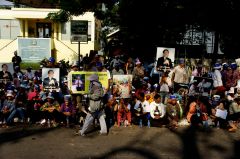
(800 people gathered in front of the Phnom Penh Court of Appeal to support Mam Sonando (c) Clothilde Le Coz)
Arrested on July 15th 2012, Beehive Radio journalist and director, Mam Sonando, was sentenced in the first instance to twenty years in prison in October 2012. He was charged with instigating villagers and peasants to protest against lands expropriation, in Kratie province. He was convicted and sentenced for “aggravating circumstances rebellion, unlawful interference in the performance of public functions, insurrection, inciting people to take arms against the state authority”. After spending already eight months in prison, his appeal started on 5 March 2013.
Stéphane Hessel, a hero of the French Resistance, diplomat and activist (what a rare combination) died on Tuesday 27 February in Paris at the age of 95. His life and works are described in detail by the mainstream press, so I only single out here his strength of conviction that made him publish at a very advanced age – in October 2010 – “Indignez-Vous!”, a short pamphlet that urged young people to revive the flame of resistance to injustice that burned in himself during World War II, this time in peaceful rebellion against what he termed the dictatorial forces of international capitalism, and to reassert the ideal that the privileged must help the less fortunate rise. Read the rest of this entry »
The ‘new’ Commissioner for Human Rights of the Council of Europe (who took office on on 24 January 2012) Nils Muižnieks stated in his end of the year message some hard truths about the position of human rights defenders in Europe.
”Defamation, threats, verbal and physical attacks, sanctions and judicial harassment are used to deter human rights activists from working with migrants.” Nils Muižnieks states that in several Council of Europe countries, the rise of xenophobic and anti-migrant discourse has “negatively impacted” on the work of human rights defenders who protect and promote the rights of migrants.“Human rights defenders are even increasingly labelled as traitors who are threatening national identity and security,” he adds. “They are often exposed to intimidation and abuse.
“The situation in Greece is particularly worrisome as migrants have become targets of unacceptable, extreme violence notably by members, including MPs, of the far right political party of Golden Dawn.“Human rights defenders defending migrants are under threat. There have been several instances of lawyers being threatened and physically attacked in Athens as they were assisting migrants in the course of asylum and other legal procedures.
“In some Council of Europe countries the work of defenders working with migrants and their rights is being criminalised. In France, legal provisions corresponding to the so-called délit de solidarité the offence of solidarity concretely result in law enforcement bodies pressuring and punishing human rights defenders providing assistance to irregular migrants. Persons standing up for the rights of migrants have been detained, prosecuted and/or fined.“ “In Belgium, similar tendencies have been identified and persons who have been demonstrating in favour of the rights of migrants have been arrested.”
At the session of the Universal Periodic Review on Bahrain in Geneva this week, a large number of countries (such as France, the UK and USA) and NGOs (such as Human Rights Watch and Frontline) confronted the government of Bahrain with its flagrant shortcomings in respecting its human rights obligations and in implementing the recommendations of its own investigation.
The Bahraini Human Rights Minister, Salah Bin Ali Mohamed Abdulrahman, in response said “radical measures and progressive steps” had been taken to overcome the “sad and unfortunate events” of March 2011. Some of the recommendations required legislative amendments and this “may take some time,” he said. The minister told the meeting Bahrain held no prisoners on charges relating to freedom of expression. “Any such charges have been withdrawn. The only cases (remaining) are criminal cases” ..and …”These cases are being looked at by the judiciary therefore the government cannot interfere”.
On 17 January 2012, the Geneva-based Alkarama group, which campaigns for human rights in Arab countries, said its executive director Mourad Dhina was arrested and detained in France at Paris-Orly airport. Alkarama spokesman Michael Romig said Dhina appeared before a French magistrate on Tuesday to hear Algeria’s extradition request on decades-old terrorism charges and was then returned to custody. This a complex case with heavy political overtones.Dhina was a former top official in the Islamic Salvation Front (le ‘FIS’), the organisation which was poised to win the Algerian elections in 1992, which then led to an army crackdown and a decade-long bloody civil war, with severe violations from both sides.
Dhina has lived in Switzerland for 20 years, but – contrary to some press statements – he was not a recognized refugee. He is a Massachusetts Institute of Technology-trained physicist who worked at CERN. He became an opponent of the Algerian government following the coup d’état of January 1992 that banned the Islamic Salvation Front (FIS), starting the Algerian Civil War. After being spokesman for the Coordination Committee of the FIS, he became head of the Executive Office of the FIS from October 2002 to October 2004, and in 2006 he discretely left the party, but more because he regarded it as ineffective than because he disapproved of its violent methods. In 2007, he co-founded Rachad , an organisation dedicated to overthrowing the Algerian government through mass nonviolent resistance. He rejects any reconciliation with the present regime. According to Le Matin de Dimanche of 15 October 2006 his position is: “There was a putsch in Algeria in 1992, so I find armed resistance legitimate. I said and I’ll say it again.”
According to a Wikipedia entry he was accused by the former French minister Charles Pasqua of having links with arms dealers, and therefore he left Saint-Genis-Pouilly, Geneva in 1993. When he was sentenced in absentia to twenty years imprisonment in his country he replied “I am honored to have been condemned by tyrants. History, one day, will prove me right”
Because the Algerian Embassy in Bern regularly asked for his extradition, Mourad stated in the same 2006 interview in le Dimanche de Dimanche: «Nous n’avons pas de documents pour voyager. Nous ne pouvons pas quitter la Suisse». In spite of this he appears to have travelled several times through French territory without having been arrested. So, why was he now arrested? And what is the likelihood of him being extradited? Clearly his vehement opposition and use of television aimed at Algeria must anger the Government but that would not be the right ground for extradition. But the timing seems to indicate that there might be such a link. If it is the old charges of terrorism, then it will depend op the strength of the evidence. In this context it is pity that Dhina’s taking distance from the FIS was not accompanied by a clear condemnation of human rights violations also by the FIS itself. Even if one qualifies the Algerian conflict as a civil war, it does not condone violation of humanitarian law by any party. Let’s see what happens!


 He is a lawyer by training and the Secretary General of the Commission Nationale Consultative des Droits de l’Homme de la Republique Française. From 2008 – 2013, he was the Independent Expert of the United Nations on the situation of human rights in Haiti. He was Director General of Amnesty International in France and worked in the human rights department of UNESCO. Mr. Forst is also a founding trustee of Front Line Defenders.
 Hans Thoolen on Human Rights Defenders and their awards