Posts Tagged ‘fellowship’

The 2026 Marianne Initiative for Human Rights Defenders open for applications

June 26, 2025
marianne-initiative-2023
Opportunities For Africans

Applications are now open for the 2026 Marianne Initiative for Human Rights Defenders. The Marianne Initiative for Human Rights Defenders aims to better help Human Rights Defenders in their fight


As part of the organization of the 9th World Congress against the Death Penalty in Paris in the summer of 2026, particular attention will be paid to applications relating to this theme. However, the other areas of human rights covered by this call for applications remain fully eligible.

You are committed to the promotion and defence of human rights in your country:

  • You are a human rights defender in the sense recognised by the United Nations, adult and of non-French nationality, regardless of your placeof residence;
  • You can provide document(s)/evidence, produced by others (recommendations, press articles, etc.), attesting to your commitment/action in favour of human rights;
  • You can justify that participation in the Marianne Initiative’s French aid programme will strengthen your capacity for human rights action in your country and internationally, and that it will enable you to create or develop existing or planned links or projects with French organisations;
  • You possess a valid passport (with a validity of at least six months) or you are willing to follow the procedures to obtain one;
  • You are not subject to any legal ban on leaving your territory;
  • You are willing to travel to France from February to June 2026.

Benefits

  • The program in France provides individual accommodation near Paris, a monthly grant to meet daily needs, a training program, individualized support and networking with human rights players for a period of 4 months (from February to June 2026). The program does not provide support beyond the 4-month period.

Application Deadline:  6th July 2025. You can apply online to be part of the 2026 class of the Marianne initiative through the link below:

Application form – Marianne Initiative for Human Rights Defenders – Class of 2026 (February-June)

Applications do not need to be sent to the Embassy, but should be submitted directly using the procedure indicated above. However, if you have any questions, you may send an email to: amelle.abdallahi@diplomatie.gouv.fr.

see also: https://humanrightsdefenders.blog/2024/06/04/the-marianne-initiative-for-human-rights-defenders/

Your application will include the documents listed in the application form. It will be in either French or English.

Visit the Official Webpage of the Marianne Initiative for Human Rights Defenders

Human Rights Defenders Protective Fellowship Programme in South Africa

April 29, 2025

The inaugural Fellowship at the University of the Western Cape is designed as a rest and respite for Human Rights Defenders (HRDs) working in stressful environments.

Our three-month, non-academic Fellowship Program provides Human Rights Defenders (HRDs) working in stressful environments a safe space to rest, recharge, reflect on their work, and take advantage of opportunities to acquire new skills and knowledge at the University of the Western Cape. HRDs often face difficulties, including fatigue, burnout, and persecution in the form of arrests, threats, and other traumatic experiences. This unique initiative is a response to the need to provide support and strengthen the capacity of HRDs to continue their work. 

While at our University, Fellows have opportunities to audit academic courses, present as guest speakers in lectures and other platforms, and attend writing and other workshops. By engaging in these various activities, Fellows share their knowledge, thereby enriching the teaching and learning experiences. The Fellows also have the space and resources to remain involved in activism in their home country or region. The Africa Hub collaborates with various actors within the UWC campus and in civil society to provide psychosocial support to its Fellows. Outside the university, they also tour and engage with South African democratic institutions and places of historical significance that symbolise human rights struggles. Other key aspects of the Fellowship are networking with civil society organisations in Cape Town and community visits for cultural exchange. 

The first cohort in 2024 had three HRDs from Mozambique, Uganda and Kenya. The Fellows’ programme is oriented towards rest and respite. The future Fellowships may have different emphases, depending on the participants’ needs and other factors. 

Selection process: The selection of fellows is based on a closed nominations system. 

Reach out at pugresearch@uwc.ac.za to add your organisation to our list of contacts for the fellowship programme call for nominations. 

https://pugresearch.org.za/africa-hub-fellowship-programme/

York Centre for Applied Human Rights offers Sam Pegram Scholarship 2025/26

March 19, 2025

CAHR announces details of the Sam Pegram Scholarship for the 2025/26 academic year

The Sam Pegram Scholarship provides one international student with full funding to pursue an LLM in International Human Rights Law and Practice offered by the York Law School and the Centre for Applied Human Rights.

  • Funding: Full tuition fee waiver, travel and visa costs, accommodation and living costs, and overseas placement. 
  • Academic year: 2025/26
  • Open to: International (including EU) students
  • Qualification level: Postgraduate taught
  • Number available: 1

This is a full scholarship that covers tuition fees, accommodation, travel and visa costs, including an overseas placement to South Africa, and a monthly living stipend for one individual student.

The scholarship is generously provided by The Sam Pegram Humanitarian Foundation in memory of Sam Pegram, a caring, kind and talented young man who tragically died in the Ethiopian Airlines’ Boeing 737 Max crash, in 2019, en route to Nairobi.

After spending two years volunteering and working for humanitarian NGOs in Jordan, Sam came to the University of York to study the LLM in International Human Rights Law and Practice. After graduating, he secured a role as a research policy assistant for the Norwegian Refugee Council in Geneva, where he was working when he died.

Sam was a wonderful presence in the classroom. He was committed, thoughtful and reflexive in his fieldwork. He was deeply committed to humanitarianism, the rights of people on the move, and social justice in a broad sense. He remains deeply missed by his friends and family here at York, in Lancashire where he was from, and around the world.

Through this scholarship, others will have the opportunity to study on this course and make a positive difference for the rights of people on the move and human rights more generally.

Eligibility 

Open to International (including EU) students only.

In order to be eligible, you must also have an offer for a place on this course: LLM International Human Rights Law and Practice

To apply, you must also:

  • have applied to study on the LLM in International Human Rights Law and Practice at the University of York on a full-time basis
  • demonstrate that you have limited financial resources and that you need the scholarship to pursue your postgraduate studies
  • demonstrate a passion for human rights, either through your previous academic studies, professional work, or volunteer activities
  • have a demonstrable specific interest in migration issues, and that you wish to pursue or consolidate a career working on issues affecting people on the move, including generally and in relation to their social exclusion
  • have some lived experience of human rights challenges or migration issues.

How to apply 

Apply online before the deadline on Saturday, 31st May 2025, 11.59pm BST

https://www.york.ac.uk/cahr/news/2025/sam-pegram-scholarship-2025/

Global Civic Space Fellowships by Amnesty

February 26, 2025

Amnesty International invites applications for an 18-month part-time fellowship to explore the global phenomenon of shrinking civic space and document grassroots resistance strategies from marginalized and overlooked voices. Fellows will analyze current trends in civic space restrictions, investigate emerging resistance and human rights movements, and convene activists to co-create a practical toolkit for defending civic space worldwide. The fellowship aims to ensure that Amnesty’s work remains innovative, grounded in lived experience, and contributes to new knowledge on resistance strategies.

Deadline for all applications: 06/03/2024

Rate: Fixed Rate of USD 25,000 for the duration of the fellowship

Location: This fellowship does not include relocation. The consultant must work from their preferred location and possess the necessary work authorization.

OBJECTIVES AND DELIVERABLES

The Fellowship project aims to:

  • Support human rights defenders, academics, and practitioners with lived experience to document and analyze grassroots resistance strategies against authoritarianism and civic space restrictions in their regions.
  • Use this research to develop concrete recommendations and practical tools that can inform Amnesty’s global civic space advocacy.
  • Produce regular short written outputs, including blog posts and opinion pieces, to be independently published.
  • Convene activists and thought leaders in the region through virtual, in-person, or hybrid meetings to share ideas, incubate new strategies, and foster collective learning.
  • Deliver a final in-depth think-piece for Amnesty International’s internal strategy and advocacy, with external publication at Amnesty’s discretion.

ESSENTIAL REQUIREMENTS

  • Fluency in written and spoken English; fluency in a relevant regional language is desirable.
  • Demonstrated experience working on civic space resistance—either formally (academia, NGOs, journalism, law, policy) or through grassroots activism.
  • Strong writing and research skills, with experience producing publications related to civic space and human rights activism.
  • No formal academic qualifications or certifications are required to apply.

To apply, please submit:

  1. A short bio (maximum one page) outlining your recent experience.
  2. Relevant case studies or descriptions of past work on civic space issues.
  3. Your proposed approach to this fellowship opportunity, including how you would structure your research and engagement.
  4. Applications must be in PDF, Word, PowerPoint or Excel format.

https://careers.amnesty.org/jobs/vacancy/global-civic-space-fellow–4033/4061/description/

Dejusticia 2025 fellowships for defenders from the Global South

December 20, 2024

Members of the 2024 cohort of our Global South Defenders program.

This opportunity allows human rights defenders from countries in the Global South who are in emergency or high-risk situations to develop their projects and participate in an academic and cultural exchange in a safe space.

There are 14 thematic areas within Dejusticia to whichyou can apply.

The fellowship will begin in the second semester of 2025.

Who is eligible to be part of the program?

We seek human rights defenders from the Global South who meet the following criteria:

  • They come from an emergency or high-risk context. This includes regions affected by armed conflict, civil unrest, or authoritarian regimes, where there is an imminent threat to the security of the grantee. This may involve situations where the grantee and/or their organization have been subjected to threats, intimidation, or populist propaganda, or where they have been excluded from funding due to government or private sector influence.
  • The grantee may be at risk of burnout and is seeking a quiet place to continue working on human rights issues, but in a different context.
  • They belong to human rights organizations in the Global South that are interested in engaging in exchanges and joint research or advocacy work with Dejusticia.
  • They aim to build lasting relationships with other fellows and with Dejusticia. This ensures that our fellowships function as acceleration hubs for connections that will make the human rights movement more cohesive and impactful.

What will fellows receive from Dejusticia?

Dejusticia will cover travel expenses (visa, tickets) and provide a monthly stipend based on the fellow’s profile and experience. Although Dejusticia will offer support at the beginning of the process, including a two-week training period on applied research and on the fellow’s specific work, it is important to note that fellows will be responsible for managing their stipend to cover housing, transportation, and food expenses.

What are the commitments of the Global South Fellow?

The fellow will allocate their time at Dejusticia as follows:

How to apply for the fellowship program?

Before January 31, 2025, please fill out the form

CF: 2024:

Dejusticia: Fellowship Program for Human Rights Defenders from the Global South

June 26, 2024

On 25 June 2024, Isabel de Brigard and Christy Crouse described this fellowship programme taking place in Bogota:

Dejusticia’s work as part of the human rights movement has always been carried out alongside individuals and partner organizations with whom we have collaborated to advance various agendas. The value of these encounters drives us to constantly seek ways to better articulate our work with leaders, activists, and professionals from different areas of the human rights movement in Colombia and different countries of the Global South. As part of this effort, the Fellowship Program for activists and human rights defenders from the Global South was born. With this program, we seek to generate South-South collaboration ties that are sustained over time and contribute both to building a more coordinated and organized civil society, as well as supporting the individual efforts of those who work for global justice on a daily basis.

What does the program entail? Dejusticia provides fellowships for cohorts of 5 to 8 human rights defenders who come to Bogota, Colombia, to live and work here for periods of 3 to 6 months. They are integrated into one of Dejusticia’s teams to work with its researchers on collaborative projects. The program offers fellows a collaborative and creative space to reflect on various relevant issues, strengthen their work in the struggle for social and environmental justice, and get inspired by new strategies, approaches and possibilities of transformative actions. 

For those who in their places of origin often face risks derived from the work they do, Dejusticia offers a quiet and safe space for research, advocacy, and fellowship with those who share their struggles. The program is a useful opportunity for exchange, in which those who come to Dejusticia can explore our tools and action-research strategies to enrich the work they do in their home countries, while Dejusticia learns from their experience and that of their organizations.  

A new kind of profile for fellows 

The program we designed at Dejusticia takes a slightly different approach. We look for human rights defenders and activists with three key characteristics: (1) people who are at risk due to threats, armed conflict, an authoritarian government, or obstruction of their work; (2) people who may be at risk of burnout from their job; and (3) people linked to a human rights organization in the global south that is interested in working with Dejusticia. 

This approach has allowed us to receive people from Brazil, India, Mexico, Nigeria, Turkey, Venezuela, among other countries. Our fellows are professionals and activists in political science, law, sociology, communications, and more, many with extensive experience, as well as people who are just beginning their careers. Welcoming each of the people who have participated in the program has been an opportunity to add hospitality to the strategies with which we seek to strengthen the human rights movement in the Global South. And in the same vein, programs like this one are a fundamental part of our efforts to strengthen the voice and presence of actors from the Global South in debates, academic production, and the setting of human rights agendas.

Cohort 2023

In the second semester of 2023 we had a cohort of fellows whose time with Dejusticia was enormously enriching. 

Jorge Lule, for example, is a political scientist and public administrator from Mexico, specializing in public security issues and conflict analysis. He has worked on issues of militarization, drug policy, serious human rights violations and international crimes. During his fellowship at Dejusticia, he collaboratively wrote an article, with a researcher of the Transitional Justice line, regarding the serious crisis of disappearances and the search for missing persons faced by both countries. This text was published in Dejusticia’s Global Blog and in the Mexican news portal Animal Político. 

Another fellow, Danielly Rodriguez, comes from Venezuela and is an activist and social documentarian. She has a long history of telling the stories of  Venezuelans, their struggle against authoritarianism and in favor of human rights. She has been working in the field of human rights for more than 11 years, especially through documentary photography. According to her, the fellowship at Dejusticia helped her understand other contexts of human rights situations, both in the countries of the other fellows and in Colombia. It also confirmed her belief that although we are separated by borders, there are situations that affect us in very similar ways.

Miracle Joseph comes from Nigeria and joined the tax justice team. With a background in geography, he specializes in economic, social and behavioral geography, focusing on the connections between government policies and social patterns. His main project at Dejusticia was an investigation that aimed to understand how corruption affects the advancement of human rights and sustainable development in Nigeria, focusing on health, education and climate change.

Finally, Fabian Hernandez is a young activist from the Colombian Caribbean region with campesino roots, linked to the peasant resistance movement in the department of Cesar. He is active in social movements, especially in the struggle for the recovery of land, water and ecosystems. Fabián strengthened his research skills and exchanged tools with Dejusticia’s Land and Peasant Rights team, which he joined during his stay. During this time he wrote a text on autonomy and peasant resistance in the Sumapaz region and organized a discussion with peasant leaders from different parts of Colombia to discuss the challenges and stakes in agroalimentary farming territories.

Having these four talented and committed people be part of our team in 2023 was a great privilege and an opportunity to learn and build valuable partnerships. By the middle of 2024 we will have a new cohort, which will continue to enable us to strengthen the knowledge, experiences, and collaborative networks essential to the work of those of us who fight for global justice.

https://www.dejusticia.org/en/fellowships-program/

https://www.dejusticia.org/en/human-rights-in-the-global-south/

The Marianne Initiative for human rights defenders

June 4, 2024

On 3 June, 2024 Ifeoma Chuks wrote about the Marianne Initiative 2025 for human rights defenders

©Sarah Steck/ Présidence de la République

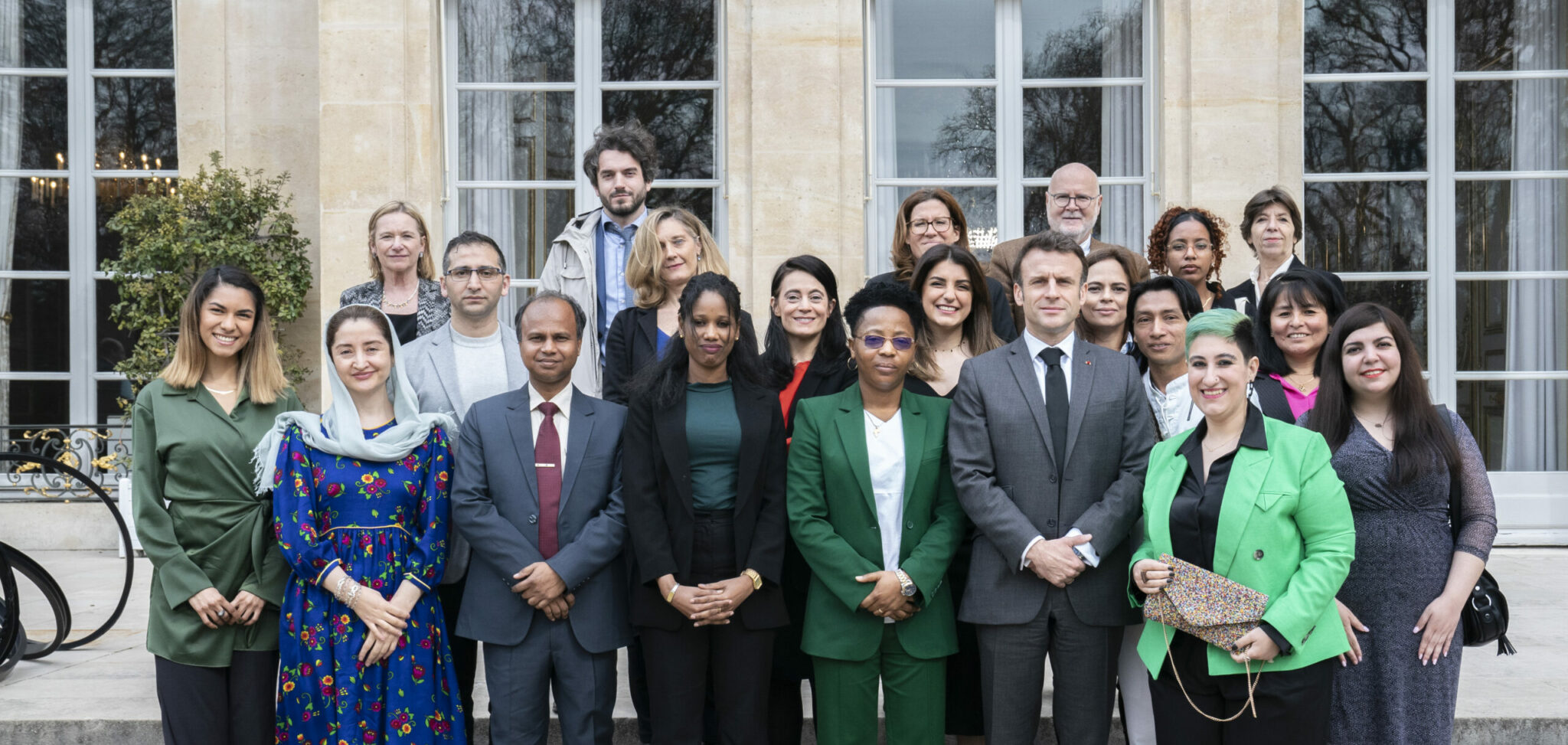
In 2021, French President Emmanuel Macron announced the launch of the Marianne Initiative for human rights defenders, aimed at better supporting them in their fight, both abroad and in France. The Marianne Association for Human Rights Defenders was created to federate the actors involved in our country (State, organisations and associations for the promotion of human rights and reception, local authorities, qualified personalities, etc.) and to carry the initiative’s support pillar in France, for the benefit of about fifteen laureates per year (reception, personalised support, networking, etc.).

After receiving the first all-female class in 2022 and a mixed class in 2023, the third class was officially launched now.

Some fifteen men and women from every continent have been welcomed to France for six months as part of the Initiative. The winners benefit from a training program designed to strengthen their skills and commitment in their home country or in France, whether in favour of civil and political rights, women’s rights, minority rights or environmental rights.

Recipients complete a comprehensive program consisting of:

  • Training in negotiation, leadership, advocacy, physical and digital security, project management, etc. ;
  • Courses from the School of International Affairs of Sciences Po Paris and French language;
  • Contact with French or international personalities involved in human rights and development issues;
  • Meetings with inspiring personalities and potential partner organizations (NGOs, foundations, institutions, etc.);
  • Conferences and cultural activities ;
  • Individual interviews to support the activist project;
  • Visits to international institutions and organizations;
  • Exchanges with members of the program’s alumni network.

The hosting programme in France provides for accommodation near Paris, the payment of a monthly grant to cover daily needs, a training programme, support, and networking with Human Rights Defenders for a period of 6 months. After the 6 months, participants no longer benefit from the grant, the accommodation and the support provided in the programme. Participation is individual and does not provide for the laureate to be accompanied by their family.

Class of 2025 runs from January-July 2025. The Application Deadline: 17th June 2024

Apply here

Visit Award Webpage for Details

https://www.afterschoolafrica.com/83981/marianne-initiative-2025-for-human-rights-defenders/

Türk tells students in Geneva: Human rights are the solution

November 22, 2023

On 21 November 2023 Volker Türk, UN High Commissioner for Human Rights spoke at the Université de Genève. [see also: https://humanrightsdefenders.blog/2022/09/15/new-high-commissioner-for-human-rights-volker-turk-the-man-for-an-impossible-job/] Here some extracts:

First: war. One quarter of humanity is living today in places affected by conflict. At the end of last year, the Peace Institute in Oslo, which works closely with my Office, found that the intensity, length and number of conflicts worldwide are at their highest levels since the Cold War: 55 conflicts, lasting on average between 8 and 11 years.

In Ukraine, in Sudan, in Ethiopia, in Myanmar and across the Sahel – to take just a few examples – the level of atrocities and suffering is devastating. The armed conflict in the Occupied Palestinian Territory and Israel, after just five weeks, has seen over 11,500 people killed, including more than 4500 children – and I want to emphasise that the Gaza Ministry of Health has not been lable to update those numbers since 15 November. The war has lit a firestorm of hate speech across the Middle East and the entire world. The level of Antisemitic and Islamophobic attacks, in real life and online, is deeply shocking….

Time and again, we look back and see that conflict could have been prevented. In the Occupied Palestinian Territory, for example, my Office has repeatedly issued reports that recommend practical, feasible steps towards de-escalation of tensions and overcoming human rights violations. Injustice; discrimination; oppression; extreme inequalities; a lack of accountability for human rights violations: these are among the factors that will sadly make violence more likely.

Before I took up my mandate as the UN’s High Commissioner for Human Rights, I worked for 30 years in situations of failed prevention. I was working with and for refugees –in places where conflict had erupted, with dramatic impact on civilians; or where long years of discrimination metastasized into ethnic cleansing; or where deprivation had become so overwhelming that people were massively compelled to flee. Now, I feel my utmost priority has to be prevention – and solutions. Because that is what human rights bring. They state clearly what every human being is entitled to – a life that is free from fear and from the deprivation of certain essential resources – and in advancing those rights, they bring solutions to the root causes of preventable suffering…

Harsh restriction of civic space is the Achilles heel – the fatal weakness – of governance. If there is one message that I deliver again and again to Ambassadors and Heads of State or Government, it is this: ensuring that people can speak freely – and critically – and that they can fully and meaningfully participate in decisions will build more effective policy…

These are all measures that help to prevent conflict. They are also among the steps that can de-escalate conflict, by resolving some of its root causes; and they contribute to making a peace that is real and which can endure, with development that is sustainable because it is inclusive.

They are also key guidelines for addressing challenges as crucial and complex as climate change, runaway pollution and the obliteration of biodiversity. Acting to limit the triple planetary crisis, and upholding our right to a clean, healthy and sustainable environment, are the defining struggles of our generation.

This spiralling damage is a human rights emergency. Worldwide, climate change is pushing millions of people into hunger. It is destroying hopes, opportunities, homes and lives. In the Sahel region, a recent report by my Office outlines the profound impact of climate change-related soil degradation and declining food production on income, health, resource competition, conflict, and displacement – a vicious cycle that now spins deeper with every planting season. Temperatures in the Sahel are rising much faster than the global average; even if the global temperature rise is kept to an unlikely 1.5 degrees, the impact on the people of the Sahel will be permanent and devastating.

Across the Sahel, we can see very clearly how climate change, conflict, poverty, discrimination and lack of accountability feed into each other – creating a vast knot of issues that strangle the lives and rights of people.  But this is the case everywhere, as the climate crisis continues to generate profound and increasing threats to human rights. The dignity and the very survival of communities, of nations – and ultimately, all of humanity – is at stake.

So, again, how do we prevent this? Where are the solutions?

Notably, of course, we need global solutions. The governments and people of the Sahel, and many other regions that are experiencing extreme harm, did not contribute significantly to climate change. 

In a few days, global climate negotiations will resume in Dubai. It is absolutely essential that they lead to decisive and equitable action to prevent the worst impacts of climate change, and to remedy the impacts that can no longer be prevented. We have to ensure that Governments, businesses and individuals prioritise the interests of humanity over their short-term, narrowly defined self-interest. The fact is, the COP talks have to date fallen far short of what is needed to stop climate change and remedy its worst impacts. The world is dangerously off-track to meet the promises made in the Paris Agreement. Recent discussions on loss and damage are an example of  this. The climate justice movement, and many of the countries most vulnerable to climate change, struggled for years  for an agreement to establish a new loss and damage fund, finally achieving this objective at COP27. But the recommendations that have been sent to COP28 for operationalization of that fund do not satisfy the demands of those most affected by climate change. 

A strong governance framework that is grounded in human rights. Environmental and social safeguards. An inclusive and participatory Board. And a fair funding mechanism. These should be viewed as essentials – not a point of contention, or of trade-offs in negotiation.

Point one: We must protect civic space.

On the climate and environmental issues that affect us all, key decisions continue to be made behind closed doors – and are often influenced by fossil fuel lobbies. Environmental human rights defenders working to protect communities and land from environmental harm are often vilified, attacked and even killed. Their rights to participation, freedom of expression, and access to information and to justice must be secured. We must ensure the free, meaningful and safe participation in all climate discussions of all those most affected by climate change, including women and Indigenous Peoples.

Point two: climate action must advance equality and equity.

Adaptation strategies and all other measures need to prioritize the situation of people most affected by climate change. Funding must go first to the people who need it most.

Point three: We need to ensure access to effective remedy, and accountability, for climate-related harm.

Point four: we need resources for a rapid and just transition that advances human rights, including the right to a healthy environment...

In every country, we also need to see full participation and consultation on environmental laws and measures – notably for those who are most at risk – and protection of people who raise concerns about environmental harm and the policies that produce them.  Bashing climate protests; designing laws that unfairly restrict activities that call the public’s attention to climate harms; and allowing attacks on activists to go unpunished: these are tactics that ultimately harm all States and all human beings. We need to fix this urgently. [see also: https://humanrightsdefenders.blog/2023/10/15/climate-human-rights-defenders-increasingly-seen-as-eco-terrorists/]

So: Conflict. Discrimination. Poverty. The suffocation of civic space. The triple planetary crisis. These are five immense challenges that threaten our rights and our world, and they fuel each other. We face the compounding effects of all of them – while also confronting a surge of new human rights challenges, notably in the digital realm, including artificial intelligence and surveillance.

……

Over the past 75 years, the Universal Declaration of Human Rights has guided tremendous progress in countries across the world. It has inspired vibrant, creative, powerful activism and solidarity, empowering people to claim their rights and to engage actively in their communities and societies.

How could such a simple text guide such profound transformation? Because “recognition of the inherent dignity and of the equal and inalienable rights of all members of the human family is the foundation of freedom, justice and peace.” Greater respect for human rights – all human rights, building on each other ­– constructs more sustainable development. More enduring peace. A safer future.

This is an extraordinarily powerful truth…

Economies and societies that are inclusive and participative; in which opportunities, resources and services are equitably shared; and where governance is accountable, deliver justice, opportunities and hope…

And it is precisely in our era of rising storms that the 75th anniversary of the Universal Declaration of Human Rights can help us navigate to safety. Its essential values, which connect all of humanity, were set out to ward off horror and destruction, and they have been tried and tested. They embody the power of unity of purpose and the potential for transformative action – both within societies, and globally.

It is absolutely critical, now – precisely in this time of terrible crisis – that we rekindle the spirit, impulse and vitality that led to the adoption of the Universal Declaration of Human Rights, so that we can rebuild trust in each other, and move forward, united.

https://www.ohchr.org/en/speeches/2023/11/our-utmost-priority-solutions-turk-tells-students

see also: https://www.opportunitiesforafricans.com/office-of-the-high-commissioner-for-human-rights-un-ohchr-minorities-fellowship-programme-2024/
Human Rights Foundation announces its first 10 Freedom Fellows

May 22, 2019

Yesterday I referred to the new look of the Human Rights Foundation [https://humanrightsdefenders.blog/2019/05/21/human-rights-foundation-uses-2019-oslo-freedom-forum-for-rebranding/], here is a substantive new proframme. On 21 May 2019 the Human Rights Foundation (HRF) announced the creation of the Freedom Fellowship, a program that awards 10 human rights defenders, social entrepreneurs and non-profit leaders from authoritarian countries around the world with the unique opportunity to increase the impact of their work. HRF is partnering with the Center for Applied Nonviolent Tactics and Strategies (CANVAS), founded by Srdja Popovic. The fellows will work with HRF staff and a team of specialists to improve leadership, movement building, fundraising, marketing, and digital security.
The first ‘class’ comprises:

  • Rania Aziz , Sudanese activist organizing professional and youth groups in the country against the dictatorship of Omar Hassan Ahmad al-Bashir. She is part of the Sudanese Professionals Association (SPA), an outlawed group of unions currently leading protests in the country.
  • Fred Bauma. Congolese human rights activist also known as “Congo’s Gandhi”. He is the leader of the pro-democracy youth group LUCHA, which advocates for nonviolent, community-level change and governmental reform in the Democratic Republic of the Congo.[ see also: https://humanrightsdefenders.blog/2015/11/30/amnesty-internationals-annual-write-for-rights-campaign-focuses-on-freedom-of-expression/]
  • Vanessa Berhe, Eritrean free-speech and democracy activist. She is the founder of One Day Seyoum, a human rights organization that campaigns for the release of jailed Eritrean journalist Seyoum Tsehaye, and raises awareness around a continued crackdown on democratic ideals in Eritrea.
  • Andrei Bystrov, lawyer, historian and democratic activist from Moscow. He is a co-founder of the December 5 Party, a pro-democracy political party that was born out of the 2011 anti-Putin protests.
  • Netiwit Chotiphatphaisal is a student activist, publisher, and author who advocates for education reform in Thailand. He founded Education for Liberation of Siam, a student group that challenges the Thai military junta’s unjust actions in the country’s education system.
  • Rodrigo Diamanti, Venezuelan human rights activist and nonviolence expert. He founded the international NGO, Un Mundo Sin Mordaza, which has coordinated creative protests against Nicolas Maduro’s dictatorship in more than 52 countries.
  • Edipcia Dubón, Nicaraguan pro-democracy and women’s rights advocate. She is the coordinator of Dialogue of Women for Democracy, a think tank that promotes open discussions about the challenges faced by women in Nicaragua.
  • Asma Khalifa, Libyan activist and researcher who has worked on human rights, women’s rights, and youth empowerment since 2011. She is the co-founder of Tamazight Women’s Movement, an organization working on gender equality and research on the indigenous women of Libya and North Africa.
  • Farida Nabourema, Togolese writer and democracy activist who began her career in activism when she was 13 years old. She co-founded the Faure Must Go movement, a hallmark of the Togolese struggle against Faure Gnassingbé’s oppressive rule.
  • Johnson Yeung, Hong Kong human rights advocate who works on freedom of assembly and expression, protection to HRDs, and capacity building to right-based CSOs. He is the chair of the board of the Hong Kong Civil Hub, which produces regular briefings on Hong Kong shrinking civic space, and builds solidarity around international rule of law and human rights communities.


In partnership with CANVAS, HRF launched the Freedom Fellowship in 2018 with a pilot opportunity for Jhanisse Vaca Daza, a civil society activist from Bolivia. During her Freedom Fellowship experience, Vaca Daza co-founded the Bolivian movement: Ríos de Pie (Standing Rivers), which has quickly gained a national following, becoming one of the leading nonviolent resistance movements in response to Evo Morales’ authoritarian regime. Vaca Daza will provide her insights from the past year as the manager for the Fellowship. “This is a truly diverse class of fellows, and they are going to learn as much from each other as from their mentors,” said Vaca Daza. “Anyone running a non-profit or civil society organization or start-up needs help and guidance with personal leadership, movement building, marketing and media strategy, fundraising, and digital security. My own experience was transformative, and I’m looking forward to bringing world-class expertise in each of these areas to 10 new Fellows.”

The Fellows will meet one another as a group for the first time at this year’s Oslo Freedom Forum, which will be held from 27-29 May in Norway. There will be special programming curated to begin their Freedom Fellowship experience starting May 25. If you would like more information about the program, please contact: jhanisse@hrf.org.

Home

Call for nominations for women human rights defenders from East Africa to learn about digital safety

January 26, 2019
The community of Safe Sisters is announcing the 3rd round of women’s digital safety fellowship program to start in March 2019. They are looking for creative, self-motivated and dependable women who want to take their digital safety skills and online activism to the next level and they invite women human rights defenders from Burundi, Djibouti, Eritrea, Ethiopia, Kenya, Rwanda, Somalia, South Sudan, Sudan, Tanzania, and Uganda to apply. The workshop is scheduled in March 2019 in Kampala, Uganda.

Two years ago, they started the work of building a community of tech-savy East African women ready to stand up and defend digital rights and digital safety while fighting online harassment in their communities. Since then 21 amazing women from Kenya, Rwanda, Burundi, Uganda, Ethiopia, Sudan, South Sudan, and Tanzania have been trained to play an important role in their communities as digital security mentors! [see also: https://humanrightsdefenders.blog/2017/05/09/defenddefenders-launched-new-security-manual-for-human-rights-defenders-in-africa/]

Participation involves 

Minimum 4 hours per week for 3 weeks before the first workshop to complete self-study assignments and exercises. Please note these exercises are mandatory for participation in the workshop; you must be available for weekly email check-ins with mentors;

You must be able to attend a one-week workshop to be scheduled in March 2019 in Kampala, Uganda. You will get an opportunity to seek small grants to carry out community digital safety activities of your own; you will work with mentors and peers as they improve their skills and work to defend your community; and Opportunity to participate in the 2nd gathering of Safe Sisters to further grow skills and reflect on practice and experience gained during project implementation

Application requirements 

Applicants must have a demonstrated interest in digital safety and security; should have experience working in the human rights and/or media field with strong links to communities who are digitally at-risk; must hold a sufficient level of English, as English will be the working language; and must complete and submit the application form.

Selection Criteria 

Priority will be given to applicants who: demonstrate experience with strong technical competencies (though this need not be formal education); have experience with tech and human rights initiatives; demonstrate an understanding of their own and their community’s digital safety challenges and needs; Propose creative project ideas; and construct clear project objectives/goals.

Applications are now open until 15th February 2019. You can apply by filling out the online application form.

For more details, visit Defend Defenders.