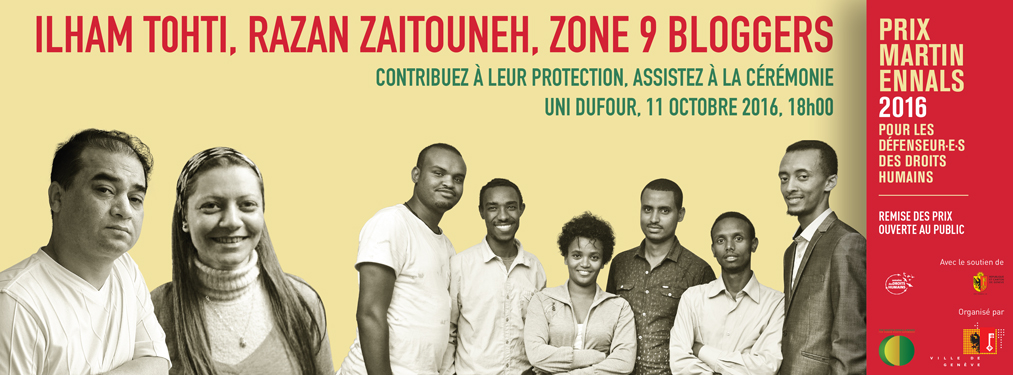
The 2016 Martin Ennals AwardCeremony, organized annually by the City of Geneva and the Martin Ennals Foundation, will this year take place on 11October, 6.00 pm, at Uni Dufour, Geneva, as thethe opening of the Human Rights Week hosted by the University of Geneva from October 11 to 14 and with the support of the Canton of Geneva.
The laureate will be selected from among three 2016 finalists:
Mr. Ilham Tohti (China) was sentenced to life imprisonment after working for two decades to foster dialogue and understanding between Uyghurs and Han Chinese.
Mrs. Razan Zaitouneh (Syria) was kidnapped after dedicating her life to defending political prisoners and documenting crimes against humanity in Syria.
Zone 9 Bloggers (Ethiopia) have been prosecuted for documenting human rights abuses in their country.
The finalists and laureate are selected by the Jury of the Martin Ennals Award, made up of ten of the world’s leading human rights organizations: Amnesty International, Human Rights Watch, Human Rights First, International Federation for Human Rights (FIDH), World Organisation Against Torture (OMCT), Frontline Defenders, the International Commission of Jurists, EWDE-Germany, the International Service for Human Rights, and HURIDOCS. The detailed programme of the ceremony will follow at the beginning of September.
Martin Ennals Award for Human Rights Defenders
For the conversation in the social media, use the hashtag: #Ennals2016.
Just now the Martin Ennals Foundation announced that the three Final Nominees of the 2016 Martin Ennals Award for Human Rights Defenders are: Read the rest of this entry »
Further to my post of today about human rights defenders in the area of economic, social and cultural rights, here the profile of such a defender, Allo Awol from Ethiopia.
Allo is a voice for human rights defenders in Ethiopia; a voice for those on the ground who resist oppressive Government policies and struggle to bring about progressive change and transformation in the face of adversity. ‘Under current circumstances, being outside Ethiopia presents both an opportunity and a responsibility to speak out against the Government’s authoritarian policies, particularly the increasing abuse of the constitutional order, the judicial system, discourses around development and counter-terrorism. I speak for the victims of human rights violations in Ethiopia, the victims of the State.’..
On 21 January 2016 a group of United Nations Rapporteurs (Maina Kiai, Special Rapporteur on the rights to freedom of peaceful assembly and of association; David Kaye, Special Rapporteur on the promotion and protection of the right to freedom of opinion and expression;Michel Forst, Special Rapporteur on the situation of human rights defenders; Christof Heyns, Special Rapporteur on extrajudicial, summary or arbitrary executions; and the Working Group on Enforced or Involuntary Disappearances) called on the Ethiopian authorities to end the ongoing crackdown on peaceful protests by the country’s security forces, who have reportedly killed more than 140 demonstrators and arrested scores more in the past nine weeks. “The sheer number of people killed and arrested suggests that the Government of Ethiopia views the citizens as a hindrance, rather than a partner,” the independent experts said, while also expressing deep concern about allegations of enforced disappearances of several protesters.
The current wave of protests began in mid-November, in opposition to the Government’s ‘Addis Ababa Integrated Development Master Plan’ to expand the capital’s municipal boundary. The ‘Master Plan’ could reportedly lead to mass evictions and the seizure of agricultural land in the Oromia region, as well as extensive deforestation. The UN experts welcomed the Government’s announcement on 12 January 2016 suspending the implementation of the ‘Master Plan’, but were concerned about continuous reports of killings, mass arrests, excessive use of force and other abuses by security forces. “The Government’s decision is a positive development, but it cannot be seen as a sincere commitment until the security forces stop their crackdown on peaceful protests,” they said. “The role of security forces should be to protect demonstrators and to facilitate peaceful assemblies, not suppress them.”
“We call on the Government to immediately release protesters who seem to have been arrested for exercising their rights to freedom of peaceful assembly and expression, to reveal the whereabouts of those reportedly disappeared and to carry out an independent, transparent investigation into the security forces’ response to the protests,” the experts said. “Impunity, on the other hand, only perpetuates distrust, violence and more oppression.”
The UN independent experts also expressed grave concern over the Ethiopian Government’s application of the Anti-Terrorism Proclamation 652/2009 to arrest and prosecute protesters, labelling them as ‘terrorists’ without substantiated evidence. This law authorises the use of unrestrained force against suspects and pre-trial detention of up to four months. “Ethiopia’s use of terrorism laws to criminalize peaceful dissent is a disturbing trend, not limited to the current wave of protests,” they experts noted. “The wanton labelling of peaceful activists as terrorists is not only a violation of international human rights law, it also contributes to an erosion of confidence in Ethiopia’s ability to fight real terrorism. This ultimately makes our world a more dangerous place.”
How the law was used recently is clear from the case of the “Zone 9” bloggers. Fortunately, on 16 October 2015 Front Line was able to report that all “Zone 9” bloggers were cleared of terrorism charges by the Federal Court in Addis Ababa. All bloggers and journalists whose terrorism charges have been dropped are members of the “Zone 9” and prominent social media activists. With the exception of Soliana Shimelis, the other human rights defenders, namely Mss Mahlet Fantahun and Edom Kassaye and Messrs Natnael Feleke, Befekadu Hailu, Atnaf Birhane, Zelalem Kibret, Abel Wabela, Tesfalem Weldyes and Asmamaw Haile Giorgis, were arrested on 25 and 26 April 2014 and remained in detention for over a year before being freed. The human rights defenders’ lawyer stated that “all the evidence presented was very weak to prove they were planning any kind of terrorism”. However, charges of inciting violence remain pending against Befekadu Hailu, who might face a ten-year imprisonment sentence if convicted. See: https://www.frontlinedefenders.org/node/29137
At the end of 2015, a violent series of attacks against HRDs took place in the sub-region. In Djibouti, Ethiopia, and South Sudan, state authorities have repeatedly attempted to silence journalists, human rights activists, and NGOs through detentions, physical attacks, and office raids. “2015 was an extremely difficult year for HRDs across the East and Horn of Africa, who are facing increasing challenges and worsening attacks in the sub-region,” said Hassan Shire, Executive Director of DefendDefenders. “DefendDefenders reiterates its commitment to support the work of HRDs and journalists in their struggle to promote human rights and civil liberties.”
In Djibouti, civic space is heavily restricted and on 21 December 2015, during a public gathering in Bouljougo, 27 people were killed and over 150 wounded by government forces, according to the Djiboutian human rights NGO Ligue Djiboutienne des Droits Humains (LDDH). The government responded to the NGO’s advocacy on the massacre with further attacks, and later on 21 December, the organisation’s General Secretary, Said Houssein Robleh, was shot by police forces in the throat and collarbone. [This was the second attack in December on Robleh. On 10 December 2015, Robleh was seriously beaten by the Djiboutian Chief of Police.] Upon leaving the hospital, Said Hossein Robleh and Omar Ali Ewado, one of the leaders of LDDH who had come to collect him, were arrested by Djiboutian authorities. Robleh was released shortly after, however Ewado was taken by the National Gendarmerie and held incommunicado for several days. After his appearance in court on 3 January, he was transferred to Gabode Central Prison without access to his family. He is being charged with public defamation for inciting hatred and spreading false news related to the 21 December massacre and the prosecution is seeking a 12-month sentence. On Sunday 17 January 2016, he was condemned to 3 months imprisonment. Additionally, police raided the offices of LDDH on 29 December, and the organisation archives and computer equipment was confiscated.
In Ethiopia, numerous HRDs and journalists have been targeted in the wake of the Oromo protests, which have resulted in the deaths of at least 140 protestors exercising their right to freedom to assembly. Getachew Shiferaw, Editor-in-Chief of Negere Ethiopia, was arrested on 25 December 2015 and is currently being held in the notorious Maekelawi Prison. The following day he appeared in court and a judge gave police permission to hold him for an additional “28 days for interrogation”. Fikadu Mirkana, news anchor at Oromia Radio and TV, was arrested on 19 December 2015 and is still being held. It has been reported to DefendDefenders that these arrests were the result of their coverage of the protests. In addition, two field investigators working for the Human Rights Council (HRCO), a leading Ethiopian human rights NGO, were arrested and questioned by police. At least one of the investigators was researching the Oromo protests and subsequent crackdown. They have both since been released.
In South Sudan, Joseph Afendy, Editor of El Tabeer, was arrested on 30 December 2015 for writing an article critical of the SPLM a week before. He was reportedly detained at National Security Service in Juba but has not had access to a lawyer or his family. It remains unclear if he is facing any charges. South Sudan is one of the most dangerous countries in the sub-region for journalists attempting to cover the brutal civil war.
The long-read for the weekend comes from Counterpunch, 13/15 February 2015 where Graham Peebles treats the horrible media situation in Ethiopia. Basing himself on a variety of UN and NGO sources – including the recent report by Human Rights Watch – he describes in detail and by name what happens to journalists and human rights defenders who try to cover reality.
The need to combat impunity for attacks against human rights defenders, together with the enactment of specific laws and policies to protect their work, have been identified as key priorities by the new UN Special Rapporteur on Human Rights Defenders, Michel Forst, in his inaugural reportto the UN General Assembly next week. This is stated by the International Service for Human Rights in Geneva.
The report, which will be presented to the General Assembly in New York in the week of 20 October, sets out a vision and priorities for the mandate over the coming three years, including a focus on groups of human rights defenders who are ‘most exposed’ or at risk, such as those working to promote economic, social and cultural rights, the rights of minorities, the rights of lesbian, gay, bisexual, transgender and intersex persons, women human rights defenders, and those working on issues of business and human rights or on accountability for past violations. According to the Special Rapporteur, each of his ‘future thematic and mission reports will contain a specific section dedicated to analysing the development of trends and particular threats facing the most exposed groups’.
The report expresses grave concern at the related issues of lack of cooperation with the mandate by some States, and the intimidation and reprisals faced by many human rights defenders in connection with their engagement with international and regional human rights mechanisms. The Special Rapporteur is ‘struck by the number and gravity of threats’ against those who cooperate with the UN, the report says, including ‘threats against the defenders themselves or their families, defamation campaigns, death threats, physical violence, abductions, hounding by law enforcement, assassinations or various forms of harassment and intimidation by the police’. In this connection, the Special Rapporteur pledges to follow-up more actively and systematically with States in relation to the investigation and remediation of alleged threats and attacks against defenders.
The need to ensure accountability and combat impunity for attacks against defenders comes through as a strong theme in the Special Rapporteur’s report, with Mr Forst identifying that ‘it is partially because of the de facto impunity enjoyed by perpetrators of reprisals against defenders that the phenomenon grows and expands’ and pledging that ‘one of the main lines of his work will be to combat the culture of impunity’. It is likely that the Special Rapporteur will dedicate a forthcoming report to this topic.[for examples see: https://thoolen.wordpress.com/tag/reprisals/]
Building on the recommendation of the previous Special Rapporteur that States enact specific laws and policies to protect human rights defenders, Mr Forst’s inaugural report identifies a need to ‘intensify efforts to convince governments to develop specific national measures, following the examples of Brazil, Colombia, Cote d’Ivoire and Mexico’ and foreshadows a future study focusing on the importance of national laws and mechanisms and ways to improve their effectiveness. He also pledges to play a significant role in the identification and dissemination of ‘good practices’ in the implementation of the Declaration of Human Rights Defenders, including through a more visible social media presence for the mandate.
On April 25, six members of the Zone Nine blogging collective were arrested in Ethiopia. They are now reported to being held at Maekelawi, a detention center in Addis Ababa. News of the arrests first broke on Twitter, where fellow bloggers and social media users voiced support for those arrested and expressed their own fears about what may be to come. Writer Bisrat Teshome, who lives in Addis Ababa, tweeted: “Terrified with the rant of EPRDF on journalists & bloggers. I almost fainted when my door was knocked at about 7pm. #Ethiopia — Bisrat Teshome (@_Bisre)“. As of this evening, no charges had been issued to the members of our group.
[Formed in 2012, the Zone Nine group has leveraged significant critiques of ruling government policy and practice through online campaigns in an effort to raise awareness about political repression in the country. Translating international news for local audiences — through partnership with Global Voices, launched Global Voices in Amharic two years ago. Have been a surveillance target of the Ethiopian government.]
[Kality prison is divided into eight different zones, the last of which — Zone Eight — is dedicated to journalists, human right activists and dissidents. Thus the name of the blog for the proverbial prison in which all Ethiopians live: Zone Nine]
The Committee to Protect Journalists [CPJ] has published its Risk List, indicating where press freedom is in decline. In determining the list, CPJ staff examined six press freedom indicators: fatalities, imprisonments, restrictive legislation, state censorship, impunity in anti-press attacks, and journalists driven into exile. Countries named to the Risk List are not necessarily the world’s worst places for journalists; such a list would include nations like North Korea and Eritrea, where free expression has long been suffocated. Instead, the Risk List identifies the 10 places where CPJ documented the most significant downward trends during 2012. Those trends included:
High murder rates and entrenched impunity in Pakistan, Somalia, and Brazil.
The use of restrictive laws to silence dissent in Ecuador, Turkey, and Russia.
The imprisonment of large numbers of journalists, typically on anti-state charges, to thwart critical reporting in Ethiopia, Turkey, Vietnam, Iran, and Syria.
An exceedingly high fatality rate in Syria, where journalists faced multiple risks from all sides in the conflict.
CPJ, which is publishing its Risk List for the first time, identified Syria and Somalia, which are racked by conflict, along with Iran, Vietnam, and Ethiopia, nations that are ruled with an authoritarian grip. But half of the nations on the Risk List– Brazil, Turkey, Pakistan, and Russia, along with Ecuador–practice some form of democracy and exert significant influence on a regional or international stage.
Threats to press freedom were not confined within the borders of these nations. Four Risk List countries sought to undermine international or regional press freedom initiatives during the year. Russia pushed for centralized control of the Internet ahead of the World Conference on International Telecommunications. Ecuador led an effort, supported by Brazil, to weaken the ability of the Inter-American Commission on Human Rights to intervene in cases of systemic or grave press freedom abuses. Brazil and Pakistan were among a handful of countries that tried to derail a U.N. plan to improve journalist security and combat impunity worldwide.
Setbacks in Brazil are particularly alarming given its status as a regional leader and home to a diverse array of news media. But a spike in journalist murders, a failure to address impunity, and a pattern of judicial censorship have put Brazil’s press freedom at risk, CPJ found. Turkey, too, has projected an image as a regional model for freedom and democracy. But while Prime Minister Recep Tayyip Erdoğan has expressed a commitment to press freedom, his administration has wielded an anti-terror law as a club to jail and intimidate journalists.
Less surprising, but no less worrisome are setbacks in Vietnam, Ethiopia, and Iran. Though Ethiopia and Vietnam have been applauded for economic strides, both countries have lagged in terms of openness and freedom of the press. Conditions worsened in 2012, as Ethiopian and Vietnamese authorities ramped up efforts to stifle dissent by imprisoning journalists on anti-state charges. Iran, ignoring international criticism of its press record, has intensified an assault on critical voices that began after the disputed 2009 presidential election.
In Syria and Somalia, where journalists faced risks from multiple sides, the death tolls have mounted. Crossfire was the leading cause of death for journalists in Syria, although at least three journalists were assassinated, CPJ research shows. Both rebels and forces loyal to President Bashar al-Assad have been implicated in acts of violence against the press. All 12 journalists killed in Somalia in 2012, the country’s bloodiest year for the press, were targeted in direct reprisal for their reporting. Both insurgents and government officials were suspected of involvement. In both countries, the ranks of young journalists, many with little training and experience, have been particularly hard hit.
In the full report below you can find capsule reports on the 10 nations named to the CPJ Risk List:
Ethiopian journalist Eskinder Nega is serving an 18-year prison sentence for “terrorism”. He was charged in 2011 after giving speeches and writing articles criticizing the government and supporting free speech. He is a Amnesty prisoner of conscience. Eskinder has long been a thorn in the side of the Ethiopian authorities. He has previously been harassed, arrested and prosecuted a number of times for his writing. Between 2006 and 2007, Eskinder and his wife Serkalem Fasil were detained and tried on treason and other charges along with 129 other journalists, opposition politicians and activists. Serkalem gave birth to their son Nafkot while in prison. In May 2013, Eskinder wrote from prison: “I will live to see the light at the end of the tunnel. It may or may not be a long wait. Whichever way events may go, I shall persevere!”


 Hans Thoolen on Human Rights Defenders and their awards