Posts Tagged ‘environmental defenders’

Amazon: indigenous peoples must have say in anti-crime and environmental policies

July 5, 2025

On 1 July 2025, Raphael Hoetmer and Sofia Jarrín in Amazon Watch report on the U.N. Permanent Forum on Indigenous Issues, staying that governments and UNODC must include Indigenous Peoples in anti-crime and environmental policies

Organized crime now dominates 70% of Amazonian municipalities across Bolivia, Brazil, Colombia, Ecuador, Peru, and Venezuela. Networks of illicit economies – or “Amazon Crime” – have diversified and expanded the territorial control and political power of criminal gangs, posing existential threats to biodiversity, ecological integrity, and Indigenous rights across the Amazon, much like in other critical ecosystems worldwide. [see also: https://humanrightsdefenders.blog/2025/02/17/colombia-and-brazil-the-worlds-deadliest-countries-for-environmental-activists/]

For Indigenous communities, these expanding criminal economies mean more than environmental degradation. They are direct assaults on their lives, health, and sovereignty. Illegal activities such as logging, mining, and coca production for international markets contaminate rivers with mercury, destroy food sources, deteriorate health, and displace communities from their ancestral lands. These burgeoning criminal markets, coupled with weak or complicit state institutions, have led Indigenous leaders to warn that criminal groups are increasingly taking over local government structures and exerting territorial control.

This deepening crisis makes the Amazon one of the most dangerous places in the world for environmental defenders. Indigenous organizations often face these threats alone, without adequate support from governments or international institutions. As Indigenous Peoples themselves underscore, these violent criminal economies kill leaders, recruit their youth, and spread fear through their communities…

This year a delegation of Amazonian Indigenous leaders delivered a clear and urgent message: organized crime and illegal economies are devastating the Amazon and threatening the survival of Indigenous Peoples. They called on the Forum to include strong recommendations urging the international community and governments to step up their efforts to support Indigenous territorial governance, protect human rights defenders, and ensure Indigenous Peoples are included in shaping policies to prevent and contain organized crime.

The Permanent Forum must formally recognize that organized crime and illegal economies such as drug trafficking and illegal mining are an existential threat to our peoples. We must be included in drafting the international protocol on environmental crimes, and protection mechanisms for Indigenous defenders must be created, along with funding for Indigenous-led economic alternatives. If these measures are not taken, ongoing military and police interventions in our territories will continue to put our lives at risk. Without dignified livelihoods, we cannot safeguard our culture or our territories.”

The Permanent Forum’s conclusions this year directly responded to these urgent appeals. Its final document, published earlier this month, presents a wide range of concerns, recommendations, and proposals related to the implementation of the United Nations Declaration on the Rights of Indigenous Peoples, with this session explicitly addressing the impacts and expansion of criminal economies.

In conclusion 87 of the document, the Forum urges governments and the United Nations Office on Drugs and Crime (UNODC) – the leading global institution on anti-crime policies – to integrate Indigenous Peoples meaningfully into the design and implementation of anti-crime and security strategies. This recommendation is particularly relevant in the ongoing process to discuss a new Protocol Against Crimes that Affect the Environment, which must include the voices of Indigenous Peoples – as the principal stewards of global biodiversity and primary victims of the violence tied to these crimes.

The Forum’s conclusions also emphasize the urgent need for the international community and governments to:

  • take necessary measures to ensure the rights, protection, and safety of Indigenous leaders and human rights defenders,
  • end impunity and prosecute those who commit violence against Indigenous Peoples,
  • acknowledge and protect Indigenous women and children from the disproportionate impacts of war and violence on their lives,
  • ensure Indigenous participation in peace negotiations and peace-building processes,
  • assess the impacts of mercury on the health, culture, and livelihoods of Indigenous Peoples under the Minamata Convention,
  • and repair the damage from toxic metals on Indigenous lands and territories, including restoring sites and water sources, with special attention to the severe impact on the health of Indigenous women and children.

New report: Human rights defenders at risk in the renewable energy transition

May 27, 2025

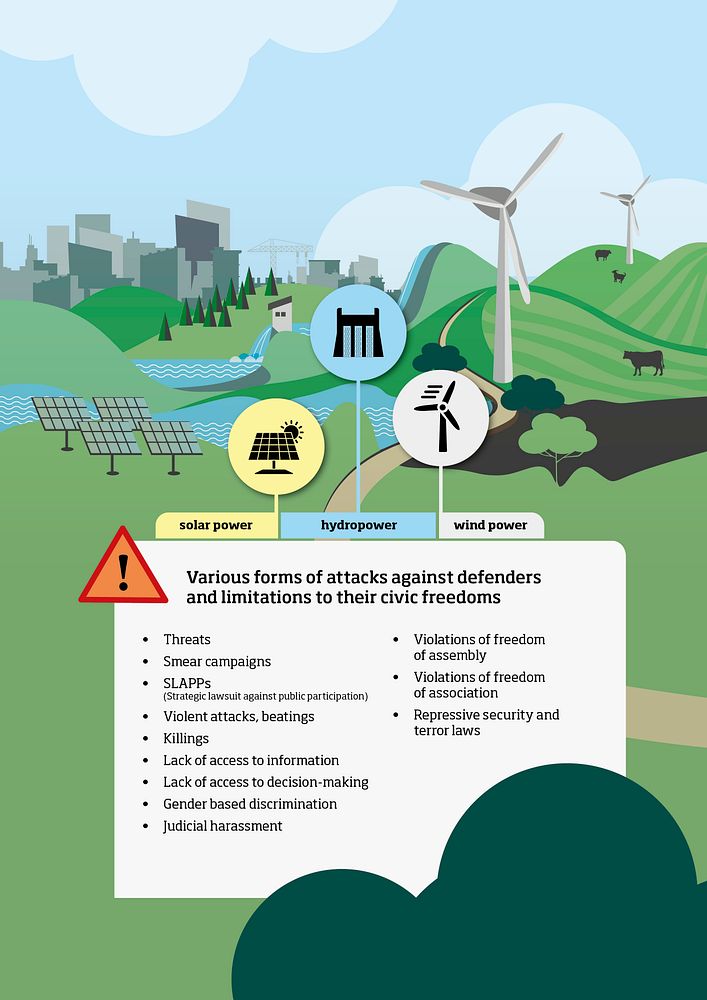
A new report by the research organization Swedwatch of 29 April 2025 highlights critical human rights risks associated with the global transition to renewable energy. The report reveals that human rights and environmental defenders face serious threats and reprisals in countries where renewable energy projects are being rapidly developed.

More than half of the world’s total prospective wind farm capacity, and more than two thirds of the prospective solar farm capacity, is estimated to take place in countries with obstructed, repressed or closed civic space.

While scaling up wind, solar, and hydropower is essential to limiting global warming to 1.5°C, this growth must not come at the expense of human rights.

We cannot build a green future on the backs of those who are silenced or displaced. The renewable energy transition must not come at the cost of human rights. Defenders are not obstacles – they are essential allies in ensuring that this is just, equitable, and sustainable, says Alice Blondel, Director Swedwatch.

Renewable energy projects require large land areas, often affecting local communities, ecosystems, and livelihoods. Swedwatch’s analysis shows that the renewable energy transition will largely take place in countries with restricted civic space and poor human rights protections, where defenders who raise concerns often face harassment, legal persecution and at times even deadly violence.

The report Renewables and Reprisals – Defenders at risk in the green energy transition in Brazil, Honduras, Mozambique, and the Philippines is based on a global mapping of such high-risk areas for defenders, where civic space is restricted and where renewable energy expansion is projected to accelerate. Additionally, the report presents four case studies from Mozambique, Honduras, Brazil, and the Philippines, where defenders and affected community members describe restrictions and reprisals of defenders linked to renewable energy projects.

The report is authored by Swedwatch with input from Terramar Institute (Instituto Terramar), Network of Women Human Rights Lawyers and Defenders (Red de Abogadas Defensoras de Derechos Humanos) and Jalaur River for the People’s Movement (JRPM).

-The report underscores the urgent need for stronger protections for defenders, transparent consultation processes, and corporate accountability. Without immediate action, the rapid expansion of renewables risk repeating the same human rights abuses seen in industries such as mining and agribusiness, rather than fostering a truly just energy transition, says Alice Blondel.

Expansion of renewables in countries with high risks for defenders
Swedwatch’s findings indicate that a large share of the expansion of renewable energy is taking place in countries where civic space is restricted, and defenders are at significant risk.

Case studies: Defenders under threat
In the four case studies, defenders from Mozambique, Honduras, Brazil and the Philippines described restrictions of basic civic freedoms and risks of verbal, legal or violent physical attacks when reporting about impacts of renewable energy projects.

Mozambique: According to interviews in the report, the planning of the Mphanda Nkuwa hydropower project has been marred by inadequate social and environmental impact assessments, lack of transparency, and suppression of civic engagement. Defenders reported threats, violation of freedom of assembly, and an overall disregard for their right to participate in decision-making processes.

Honduras: Human rights defenders have faced legal intimidation through SLAPPs (Strategic Lawsuits Against Public Participation) for their criticism of the Los Prados solar power project, according to a group of women human rights lawyers. Community members involved in protests have allegedly been surveilled and subjected to repressive actions by security forces. Defenders also reported smear campaigns in the media, further restricting their ability to voice concerns.

Brazil: In Brazil, the wind power project Bons Ventos failed to properly include impacted communities, including marginalized groups, traditional fishing, and quilombola communities, in consultations, according to interviews. Defenders decided to remain anonymous in the interviews out of fear of reprisals, citing increasing threats and violence against defenders in the past years.

The Philippines: Indigenous defenders from the Tumandok communities were allegedly threatened, harassed, and killed when the national police and the armed forces raided their communities after community leaders criticized the Jalaur River Multipurpose project, according to a CSO operating in the area. Defenders reporting on the dam project outlined persecution, surveillance and red-tagging – terror-labelling by the government accusing defenders of being communist insurgents, creating an environment of fear and impunity.

Swedwatch´s recommendations
As the world races to meet climate targets, a just transition must include the voices of those most affected by energy projects, and defenders are essential in ensuring that renewable energy projects respect human rights and the environment.

-Governments, businesses, and financial institutions must work together to ensure that human rights are protected, and that defenders can operate without fear of repression or violence. Engaging with defenders as valuable partners rather than as adversaries can help governments and businesses ensure renewable energy projects’ alignment with international human rights obligations, mitigate conflicts, and promote sustainable development, says Jessica Johansson.

Detailed recommendations to different actors can be found in the report, below the main ones are summarized:

Recommendations for governments:

  • Adopt legislation on mandatory human rights due diligence (HRDD) for companies, highlighting risks to defenders and meaningful consultation with defenders.
  • Adopt laws on company transparency laws and access to information.
  • Establish and enforce protections for defenders, ensuring they can operate without fear of retaliation, and provide effective legal remedies for those affected by violations.

Recommendations for companies and investors:

  • Strengthening their HRDD processes by integrating civic space risks and ensuring meaningful stakeholder engagement with defenders.
  • Adopt and enforce a zero-tolerance policy against reprisals targeting defenders (and affected communities).
  • Take appropriate action when business partners or third parties commit violations in relation to their business activities.


https://www.mynewsdesk.com/swedwatch/pressreleases/new-report-from-swedwatch-human-rights-defenders-at-risk-in-the-renewable-energy-transition-3382176?utm_source=rss&utm_medium=rss&utm_campaign=Alert&utm_content=pressrelease

Environmental defenders and the Escazú Agreement

April 28, 2025

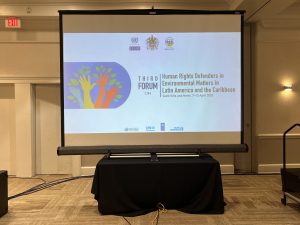
From 7-10 April, the Latin American and Caribbean Forum on Environmental Human Rights Defenders brought together environmental defenders, Indigenous Peoples, civil society, and government representatives in Basseterre, Saint Kitts and Nevis.

The Escazú Agreement is a landmark regional human rights treaty that guarantees access to environmental information, public participation and justice in Latin America and the Caribbean. Article 9 describes States’ obligation to protect human rights defenders in environmental matters and guarantee their rights, including those related to access to information, participation, and justice, as set forth in the agreement.  

As of today, 17 countries are parties to the agreement, while other key countries in the region still haven’t signed or ratified it. In February 2025, Special Procedures mandate holders sent a communication to these countries urging them to sign and ratify the agreement.  

The 2024 Action Plan adopted by the parties to the Escazú Agreement aims to implement practical protections for human rights defenders in environmental matters. It outlines capacity building and assessment, calling for urgent national action to address immediate threats and ensure the continuity of defenders’ work.

Since April 2024, individuals who believe that a State is not complying with its obligations as a party to the Escazú Agreement can send information (‘communications’) to the treaty’s Implementation and Compliance Support Committee. At a 2024 Conference of the Parties (COP) to the Agreement, States agreed to incorporate a gender perspective within the Escazú Agreement, recognising the unique risks faced by women human rights defenders in environmental matters.

This decision further requires States to consider gender-based violence and ensure women’s participation, enhancing security and effectiveness for all defenders. 

At the Forum on Environmental Human Rights Defenders, the #EscazuEnlaCorteIDH initiative was presented during the Third Forum. This initiative seeks to ensure that Escazú standards are included in the Inter-American Court’s forthcoming advisory opinion on the climate emergency.

A central piece of this effort was the amicus brief co-submitted by ISHR. 

see also: https://humanrightsdefenders.blog/tag/escazu-agreement/

https://ishr.ch/latest-updates/better-protection-and-participation-of-environmental-human-rights-defenders-through-effective-implementation-of-the-escazu-agreement

Colombia and Brazil – the world’s deadliest countries for environmental activists

February 17, 2025

Cândida Schaedler on 12 February 2025 asks whether anything can be done to protect them.

In 2023, 196 land and environmental defenders were murdered around the world – the vast majority of them in Latin America. In fact, just four countries – Brazil, Colombia, Honduras and Mexico – accounted for over 70 percent of those killings. Colombia was by far the deadliest country, with 79 murders, followed by Brazil, with 25.

We spoke with some of these brave activists to learn more about the threats they face, how they stay safe and how Colombia and Brazil are working to keep them alive.

Quilombolas
Quilombolas in the Jequitinhonha Valley in Minas Gerais, Brazil. Photo: Mídia NINJA, Flickr

“When we recognized ourselves and declared ourselves a quilombo, our peace was over”, recalls Elza,* a Brazilian Quilombola leader in her late 50s.

In December 2008, she was shot and injured in an attack that killed her brother and sister. Since then, she hasn’t left her home alone – not even for a walk in her own territory, one of the 11 urban quilombos in Porto Alegre, the capital of Rio Grande do Sul in southern Brazil.

Quilombos are Afro-Brazilian communities that were originally founded by escaped slaves in colonial times.

Today, they are officially defined as “ethno-racial groups that, by self-definition, have their own historical trajectory, maintain specific territorial relations and are presumed to have Black ancestry related to resistance against historical oppression.” Brazil has recognized quilombos in its constitution since 1988, but the process of gaining legal recognition is time-consuming and often fraught with obstacles. Elza’s community was officially designated a quilombo in 2005, but only after its residents agreed to give up half their territory. Ever since, they’ve been battling gangs and real estate speculators who want control of the same 58 hectares of land they call home.

In 2022, they once again came under attack. Armed men showed up at their door in an attempt to take over a housing project under construction in the quilombo, which had been put on hold due to a dispute with the bank financing it….

Elza and her daughter, Carolina,* live under the protection of the Brazilian government, which has a program to safeguard human rights defenders, environmentalists and communicators.

Jesus Pinilla
Jesus Pinilla leads a workshop for the Network of Young Guardians of the Atrato. Photo courtesy of Jesus Pinilla

Jesus Pinilla is a 26-year-old Afro-Colombian activist from a small community in the Chocó Department in western Colombia. He is a member of the Network of Young Guardians of the Atrato, a group composed of 36 young people defending the Atrato River – considered the mightiest river in Colombia.

Back in 2016, the Atrato was the first Colombian river to be given legal rights. Enforcing those rights are a group of 10 guardians, along with the Young Guardians, who are embroiled in a constant battle against mining companies exploiting the river’s waters.

Pinilla works as an environmental educator. He first became an environmental activist at the age of 14, but he fears that the risks often drive young people away from climate and environmental movements in Colombia.

“My community is located by the river, so we are constantly dealing with it on a daily basis,” he says. “We depend on it for our basic needs.”

Brazil military police officer
Policing is not enough to tackle the threats facing land and environmental defenders in Latin America. Photo: Agência Brasília, Flickr

“When combined with the interests of communities, the internal armed conflict becomes even more dangerous,” says Leonardo González Perafán, director of the Institute for Development and Peace Studies (Indepaz) in the capital, Bogotá.

“That’s when actions against environmental defenders and communities come into play,” he explains, adding that environmental conflicts often occur in countries with abundant mineral resources.

In most cases, communities are forced to self-organize to ensure their own safety due to the absence of the state.

“They provide self-protection through Indigenous or campesino [farmer] guards,” he explains. 

The communities have also developed communication strategies to share information with each other, as well as with the authorities and other organizations.

But as long as the armed conflict persists, it will be very difficult for the government to tackle systemic threats against environmental defenders, especially in areas where it has little authority, says Franklin Castañeda, director of human rights at Colombia’s Ministry of the Interior.

Castañeda explains that more than 15,000 people are currently protected under the National Protection Unit (UNP), which aims to ensure the safety of members of Congress, mayors, journalists, human rights defenders, community leaders and other individuals facing threats due to their work.

The majority – around 9,000 – of these people are social leaders, including environmental defenders. The UNP provides them with security measures such as bulletproof vests, private escorts, armored vehicles or other measures as deemed necessary on a case-by-case basis.

Still, Castañeda emphasizes that individual measures are a last resort. The government has also invested in prevention, such as ensuring that the military and police are not involved in illegal activities.

Despite these efforts, Castañeda concedes that there is still plenty of work to be done to address the structural drivers of conflict, such as high levels of socioeconomic inequality.

“Most of the territories where social conflicts arise are the least developed ones that the government still cannot reach.”

He says these areas will need internet access, highways and other infrastructure to improve the government’s ability to ensure safety and the rule of law.

Quilombo in southern Brazil
A quilombo in southern Brazil. Photo: Cândida Schaedler

In Brazil, the main drivers of conflict are deforestation, illegal mining, real estate speculation and the expansion of agriculture.

In response, the government is supporting 1,304 people through the Program for the Protection of Human Rights Defenders, Communicators and Environmentalists (PPDDH), linked to the Ministry of Human Rights and Citizenship. 

The program’s coordinator, Igo Martini, emphasizes the importance of listening to the communities to respond quickly to their protection needs.  Last year, it carried out 54 public consultations to devise a National Plan to address threats to these communities. But Martini also points out the need to address the root causes rather than merely deploying the police.

“If we don’t solve the underlying causes, the program will continue for another 20 or 40 years just responding to emergencies,” he warns. “A movement from the states is also necessary, not just from the federal government.”

“We need to strengthen agencies, monitoring systems and prevention systems, like the Brazilian Institute of the Environment and Renewable Natural Resources (Ibama), for example.”

The PPDDH operates in three areas: state protection, justice protection and collective protection.

While state and justice protection are offered by the police and courts respectively, collective protection involves strengthening communities and providing them with the tools to communicate with each other and report threats to the authorities to safeguard their territory.

https://thinklandscape.globallandscapesforum.org/71968/deadliest-countries-for-environmental-activists/

Vietnamese Human Rights Defender Bach Wins 2024 Baldwin Medal of Liberty

January 28, 2025

Human Rights First announced on 24 January 2025 that climate rights activist and lawyer Dang Dinh Bach, jailed in Vietnam since June 2021, is the winner of the 2024  Roger N. Baldwin Medal of Liberty. The Baldwin Medal will be presented at an event in the United States later this year to someone on Bach’s behalf, unless he is freed from prison and able to travel to receive the award in person.

For more on the Baldwin Medal and its laureates, see: https://www.trueheroesfilms.org/thedigest/awards/F23B5465-6A15-4463-9A91-14B2977D9FCE

Bach is the co-founder and former Executive Director of the Law and Policy of Sustainable Development Research Center (LPSD), a public interest law firm advising communities on cases of environmental harm, including industrial pollution, involuntary displacement due to hydropower construction, and pollution from coal plants.

Taken from his home in June 2021, he was held in pretrial detention for seven months, with limited contact with his family or his lawyers, and the LPSD was shut down by authorities following his arrest. The UN Human Rights Council’s Working Group on Arbitrary Detention has found Bach’s imprisonment to be arbitrary and in “violation of international law,” and called for his immediate release. United Nations Special Procedures experts have noted reports of his being attacked and beaten in prison.

I’d like to express honor and gratitude for this recognition of Bach’s life and work,” said Tran Phuong Thao, his wife. “The Baldwin Award represents the critical importance of human rights and rule of law in building a just and sustainable world – values my husband has fought for both outside and inside of prison. It is through solidarity and support from the international community that the movement he has helped to build continues to grow and inspire others.”Press

Special Rapporteur: harmful narratives restricting freedom of assembly

November 29, 2024

In her latest report to the UN General Assembly, the Special Rapporteur on the rights to freedom of peaceful assembly and of association , Gina Romero, underscored the effects of a growing negative rhetoric directed at civil society and activists.

The Special Rapporteur presented her report ‘Protecting the Rights to Freedom of Peaceful Assembly and of Association from Stigmatization’ in an interactive dialogue with States at the UN General Assembly’s Third Committee.

The report highlights the growing number of harmful narratives that stigmatise civil society groups and activists engaged in association and peaceful assemblies, labeling them as ‘enemies or threats to security and values.’

The Special Rapporteur highlighted an alarming trend of harmful narratives that undermine the legitimacy of peaceful activism and target human rights defenders and the public for exercising their rights to freedom of assembly and association. She discussed how activists and organisations face stigmatising labels and accusations for organising peaceful protests, forming associations, and bringing urgent issues to the attention of authorities and the international community. Her report listed specific narratives and language used in various countries to stigmatise the work of civil society organisations and activists.

Particularly vulnerable to these harmful attacks are advocates for ethnic and religious minorities, women, children, young activists, LGBTIQ+ people, environmental and Indigenous activists, and defenders of democracy, transparency, and fair elections, with trade unions and labor rights groups also being targeted frequently.

These narratives result in the restriction of human rights. While most States participating in the interactive dialogue welcomed the report, some rejected  the references to  their country in the report, including China, India, Iran, and Russia. Several States asked the Rapporteur about best practices and concrete examples to support and protect the right to peaceful assembly and association.

Gina Romero responded that States should avoid stigmatising protesters and civil society, facilitate peaceful assembly and association, and ensure any restrictions are evidence-based and meet the requirements of legality, necessity and proportionality. She also responded to criticism from China, India, Iran and Russia by emphasising the challenges faced when there are no responses from States to inquiries, denial of requests for country visits, or lack of clear information about state actions and called on states to engage more openly with her mandate. 

The Special Rapporteur also noted that harmful narratives from both State and non-State actors restrict access to freedoms of assembly and association, leading to rights violations and shrinking civic space. She called on States to detect, monitor, and counter such cases to ‘prevent undue legal restrictions and repression of these freedoms, which create a cycle of repression and stigmatization’ and implement legal and policy reforms.

https://ishr.ch/latest-updates/unga79-special-rapporteur-reports-alarming-rise-in-harmful-narratives-restricting-freedom-of-peaceful-assembly-and-association

UN General Assembly: UN expert urges recognition of vital work of defenders for 2030 Agenda

November 10, 2024

On 17 October 2024, the Special Rapporteur on the situation of human rights defenders, Mary Lawlor, presented her latest report in an interactive dialogue with United Nations member States during the 79th session of the United Nations General Assembly in the Third Committee.

In an interactive dialogue presenting her report to the Third Committee of the General Assembly, the Special Rapporteur on the situation of human rights defenders Mary Lawlor urged States to acknowledge the crucial role of human rights defenders in achieving seventeen Sustainable Development Goals (SDGs) and advancing 2030 Agenda. During the interactive dialogue, Mary Lawlor highlighted human rights defenders’ contributions to various SDGs, including zero hunger (Goal 2), good health and well-being (Goal 3), quality education (Goal 4), gender equality (Goal 5), clean water and sanitation (Goal 6) as well as affordable and clean energy (Goal 7). The report illustrates specific examples of human rights defenders’ work and contributions to each of seventeen Sustainable Development Goals.

During the dialogue, the Special Rapporteur noted that ninety percent of SDG targets are linked to human rights obligations. Given that only seventeen percent of the goals are on track, she emphasised the need for human rights defenders to be supported in their work in making the SDGs a reality. She noted that despite this crucial work of defenders in advancing the SDGs, they face severe barriers and threats including stigmatisation, criminalisation and other violations of fundamental rights.

In her concluding remarks, the Special Rapporteur emphasised that amidst global disagreements, the SDGs represent a rare consensus and urged States to support, partner with and respect HRDs working to support 2030 Agenda. Mary Lawlor in her recommendations, urged States to publicly acknowledge the essential role human rights defenders play in advancing the 2030 Agenda and called for legal frameworks that protect rather than restrict defenders and civil society in their legitimate work in achieving SDGs.

https://ishr.ch/latest-updates/unga79-un-expert-urges-recognition-of-the-vital-work-of-hrds-in-fulfilling-the-2030-agenda

See also SDG – Human Rights Data Explorer : https://sdgdata.humanrights.dk/en/node/252884

and

https://www.fidh.org/en/issues/business-human-rights-environment/human-rights-and-environmental-rights/cop-29-environmental-defenders-must-be-protected

Open Global Rights on creating pathways for environmental defenders in the trickiest places

October 26, 2024

Grassroots environmental defenders are building a variety of strategic, community-based approaches to environmental justice. Global actors can do more to support their work write Rebecca Iwerks & Ye Yinth & Otto Saki on 14 October 2024 in Open Global Rights.

Fighting for land, environmental, and climate justice is risky. Global Witness annually reminds us of the staggering number of people who are killed for defending their land—over 2,100 since 2012. And lethality is only the tip of the iceberg, one of a multitude of violent tactics that people face when they speak up for their community. [see also: https://humanrightsdefenders.blog/2024/09/18/global-witness-2023-2024-annual-report-violent-erasure-of-land-and-environmental-defenders/]

The last few years have seen encouraging steps to respond through global and regional policy. National governments have started to make specific commitments to protect environmental rights defenders, deeming it necessary to address the climate crisis. The Escazu agreement in Latin America has explicit requirements for the state protection of environmental rights defenders. [NOTE: On 16 October 2024 civil society in the Americas has issued an urgent call to accelerate the implementation of the Plan of Action on Human Rights Defenders, of the Escazú Agreement, adopted five months ago].Just this month, the UNFCCC Supervisory Body for Article 6.4 and the UN Secretary General’s Panel on Critical Energy Transition Minerals showed how global bodies can incorporate the protection of environmental rights defenders directly into climate policy. More broadly, hundreds of organizations have pooled their efforts to end retaliation against environmental defenders through the ALLIED network.

What do we do while we wait for momentum to build and for policy to translate into practice? We can draw hope from thoughtful, strategic examples of grassroots legal empowerment. Throughout the world, legal empowerment advocates—people helping individuals and groups know, use, and shape the law with the support of community paralegals—are assisting communities in registering their land, stopping corporate pollution of their water, and negotiating fair land use deals even in the most difficult places. 

Last year, we examined the experiences of environmental defenders who were able to continue their work in repressed environments, using tenets of legal empowerment to find pathways to justice in ways that reduce their risk. Here’s what we saw:

  1. Building community power.
  2. Changing paths to remedy.
  3. Building relationships with allies. …..
  4. Knowing, using, and shaping the law to respond to security concerns.

How do we super-charge support for this subtle, effective protection alternative? 

While grassroots justice advocates are continuing to seek remedies in tricky places, global actors can do more to support them. The primary shift that can support this type of innovative risk response is to provide flexible, unrestricted funding directly to grassroots justice advocates, whether through philanthropy or from pooled private sector funds that facilitate independent legal and technical support. Flexible funding allows the practitioners to shift their plans as pathways become riskier; it also allows them to invest in security equipment that may not clearly fit into a project-driven budget. Openness to different types of reporting can allow grassroots justice advocates to make decisions about what information is safest for them to reveal without concerns about financial security.

Secondly, those who influence global frameworks, such as the UN Sustainable Development Goals and the United Nations Framework Convention on Climate Change (UNFCCC), can do more to incorporate the security of environmental rights defenders into these frameworks. For example, the security of environmental rights defenders is integral to the access to justice encompassed by Sustainable Development Goal 16, and progress on that issue should be included in all SDG 16 reporting. Within the UNFCCC, the language protecting defenders from Article 6.4 Supervisory Body and the Secretary General’s Panel on Critical Energy Transition Minerals should be mirrored throughout climate policy frameworks and resourced during their implementation. 

While the actions against environmental defenders are shocking, there are significant steps the rights community can take now to support grassroots actors moving forward.

https://www.openglobalrights.org/creating-pathways-to-land-and-environmental-justice-in-the-trickiest-places/

Volker Türk: Environmental human rights defenders are champions for our future

September 30, 2024

Volker Türk, United Nations High Commissioner for Human Rights

Global CITIZENS FESTIVAL 2024

New York

Friends, New Yorkers, global citizens.

Human rights defenders are champions for our future – shining a light on repression, on injustice and on solutions to humanity’s greatest challenges.

In return, they are often smeared, intimidated, imprisoned, and worse.

According to data gathered by my Office, last year, 320 human rights defenders, journalists and trade unionists in 40 countries were killed. Many of them while protecting nature and the environment.

Across the globe, environmental human rights defenders are leading efforts to tackle a climate crisis that is growing ever more ferocious, more terrifying, and more present.

They are standing up for the marginalized, for the natural world, and for the planet.

For the human right to a clean, healthy and sustainable environment.

They deserve our gratitude and our protection.

My office is proud to support the Leaders Network for Environmental Activists and Defenders (LEAD), a new initiative focused on meaningful and safe participation of defenders in climate and environmental discussions.

But they need your support too. So I urge you to join my office.

Take action to protect civic space and help us to build a more sustainable and more equal future. 

https://www.ohchr.org/en/statements-and-speeches/2024/09/environmental-human-rights-defenders-are-champions-our-future-turk

CAFOD calls for justice as another environmental defender is killed in Honduras

September 26, 2024

Juan Lopes - Screenshot

Juan Lopes

Catholic aid agency CAFOD has called for justice, after the murder of a prominent environmentalist that CAFOD supported.

Following the news of the murder of Juan Lopez – anti-mining, environmentalist, community leader and Municipal Councillor of Tocoa, northern Honduras – who was shot dead by several men as he headed home in his car from church, Paz Redondo, CAFOD’s Country Representative for Central America said: “The assassination of Juan Lopez clearly shows once again the complicity between the authorities, international companies, and organised crime in Tocoa, and the inability of the government to protect environmental and human rights defenders in the emblematic case of the Guapinol river – despite the fact that precautionary measures had been ordered by the Interamerican Court of Human Rights – IACHR.

Juan Lopez denounced the corruption within local and central governments in Honduras during a public press conference just before he was killed.

Paz Redondo continues: “Justice needs to be more than words for the state of Honduras, a state that shows once again its fragility and inability to combat corruption within its ranks, as it continues to serve the interests of extractives and organised crime. Juan publicly denounced this corruption within local and central governments and was killed days after his and his fellow activists’ latest public press conference.”

For over a decade, the communities of Guapinol, San Pedro and other areas in the vicinity of Tocoa have been denouncing the illegal granting of mining concessions in the “Carlos Escaleras National Park” in Honduras. Their advocacy efforts were fruitful in February, when the Honduran government approved Decree 18-2024 to protect the core zone of the national park, a key achievement to safeguard the environment against mining and energy projects in the area.

The murder of Juan Lopez is not the first killing in the Guapinol case. Over 160 community members in Tocoa have been killed protecting their land and natural resources since 2010 (Amnesty, 2024). In 2023, three community leaders were killed in what the community saw as retaliation, following the release of defenders who had been criminalised. Later in the year, in October 2023, 30 members of the Municipal Committee for the Defense of Common and Public Goods of Tocoa and of the Bufete Justicia para los Pueblos, were granted precautionary measures by the Human Rights Interamerican Court (IACHR).

Juan Lopez was killed despite precautionary measures which were ordered by the IACHR last October. The community of Tocoa believes his death could have been prevented if the Honduran authorities had implemented the precautionary measures granted to Juan Lopez. CAFOD, alongside ERIC has accompanied the Guapinol community in their fight to protect the land and natural resources essential for their survival, and we will continue supporting them as they defend their environmental rights.

https://www.frontlinedefenders.org/en/case/killing-human-rights-and-environmental-defender-juan-lopez