The issuance of Interpol red notices against two Salvadoran human rights defenders currently in exile in Spain constitutes a grave misuse of the law enforcement mechanism, UN experts warned on 19 November 2025
“This move amounts to an act of transnational repression, as it extends the harassment of human rights defenders beyond borders, targeting them in a country where they are seeking safety,” the experts said.
Ivania Cruz and Rudy Joya have applied for asylum in Spain, fleeing legal harassment in El Salvador stemming from their legitimate human rights work. Both human rights defenders work for the non-governmental organisation UNIDEHC, which has been targeted by the Salvadoran authorities since February 2025 for its support to the La Floresta community, who have been facing attempts of forced eviction since 2024.
“The charges brought against Ivania Cruz and Rudy Joya in El Salvador and related arrest warrants issued by the authorities appear to be without basis and in direct connection with their legitimate human rights work for UNIDEHC to support communities under threat and denounce the actions of the Government under the state of emergency declared in 2022,” the experts said.
In May 2025, the court presiding over their case in El Salvador ordered the Interpol National Central Bureau to submit a request for the issuance of a red notice to the Interpol General Secretariat. Interpol confirmed the issuance in July 2025.
The experts pointed to Articles 2 and 3 of the Constitution of Interpol, which state that the organisation is “strictly forbidden” from undertaking “any intervention or activities of a political nature”, and that the organisation’s activities will be conducted “in the spirit of the Universal Declaration on Human Rights.”
In September 2025, Rudy Joya was summoned by police under the pretext of his asylum application in Spain. Upon presenting himself to the authorities, he was detained and presented before a Spanish specialised court. Ivania Cruz was also summoned and appeared before the same court, which ordered that both defenders sign-in at a local court every 15 days, not leave the country, surrender their passports and report any change of address.
“We call on Interpol to immediately revoke the red notices and judicial sanctions against Ivania Cruz and Rudy Joya, and on Spain to refuse to accede to the red notice and to ensure their safety by rejecting their forcible return to El Salvador,” the experts said.
The experts are in contact with Interpol and the governments of Spain and El Salvador on these concerns.
Ganna Yudkivska (Chair-Rapporteur), Matthew Gillett (Vice-Chair on Communications), Miriam Estrada Castillo (Vice-Chair on Follow-Up), Mumba Malila, and Ethan Hee-Seok Shin,Working Group on Arbitrary Detent
The Trump administration’s omission of key sections and manipulation of certain countries’ rights abuses degrade and politicize the 2025 US State Department human rights report, Human Rights Watch, Amnesty International, Human Rights First and many other NGOs concluded .
On August 12, 2025, the State Department released its “Country Reports on Human Rights Practices” covering the year 2024. The report omits several categories of rights violations that were standard in past editions, including women, LGBT people, persons with disabilities, corruption in government, and freedom of peaceful assembly. The administration has also grossly mischaracterized the human rights records of abusive governments with which it has or is currently seeking friendly relations.
By undermining the credibility of the report, the administration puts human rights defenders at risk, weakens protections for asylum seekers, and undercuts the global fight against authoritarianism.
This year’s human rights report may strictly keep with the minimum statutory requirements but does not acknowledge the reality of widespread human rights violations against whole groups of people in many locations. As a result, Congress now lacks a widely trusted, comprehensive tool from its own government to appropriately oversee US foreign policy and commit resources. Many of the sections and rights abuses that the report omits are extremely important to understanding the trends and developments of human rights globally, Human Rights Watch said.
On Israel, the State Department disregards the Israeli authorities’ mass forced displacement of Palestinians in Gaza, their use of starvation as a weapon of war, and their deliberate deprivation of water, electricity, medical aid, and other goods necessary for civilians’ survival, actions that amount to war crimes, crimes against humanity, and acts of genocide. The State Department also fails to mention vast damage and destruction to Gaza’s essential infrastructure and the majority of homes, schools, universities, and hospitals.
The report is dishonest about abuses in some third countries to which the US is deporting people, stating that the US found “no credible reports of significant human rights abuses” in El Salvador, although they cite “reports” of extrajudicial executions, enforced disappearance, and mistreatment by police. The administration has transferred to El Salvador’s prisons, despite evidence of torture and other abuses.
The State Department glosses over the Hungarian government’s escalating efforts to undermine democratic institutions and the rule of law, including severe curbs on civil society and independent media, and abuses against LGBT people and migrants. It also fails to acknowledge that Russian authorities have widely used politically motivated imprisonment as a tool in their crackdown on dissent, and its prosecutions of individuals for “extremism” for their alleged affiliation with the LGBT movement.
On 3 July 2025, the undersigned 22 organizations, expressed their deep concern over the increasing use of criminal law without due process guarantees, the harassment, the stigmatization, and the persecution by Salvadoran authorities against human rights defenders, community leaders, environmental activists, university professors, lawyers, journalists, and other voices critical of the government.
Prominent journalists, activists, and lawyers, such as former prosecutor and defenderRuth López and professor and constitutional lawyerEnrique Anaya, have been arbitrarily detained in retaliation for their work documenting and denouncing corruption, human rights violations, and attacks on the rule of law in El Salvador. Both are in prolonged pretrial detention and face spurious and unfounded charges of embezzlement and money laundering, respectively. These detentions send an intimidating message to the rest of civil society and further erode public confidence in the impartiality and independence of the Salvadoran judicial system.
The Salvadoran state has intensified its attacks on civil society and the independent press through coordinated strategies in the legal, institutional, and media spheres to silence their work. It is extremely alarming that they are being persecuted under a prolonged state of exception that suspends fundamental rights and freedoms, a measure whose objective is to control organized crime gangs.
In a context of high concentration of power, the Foreign Agents Law was enacted, imposing severe restrictions on non-governmental organizations, including onerous registration requirements, a 30 percent tax on foreign funding, and broad powers to suspend their activities based on vague allegations of political activity. Together with the hostile rhetoric from senior officials led by President Bukele, these measures aim to delegitimize independent voices and restrict the legitimate activities of civil society organizations.
The persecution of defenders such as Ruth López and Enrique Anaya reflects a broader strategy to dismantle civic oversight and the rule of law, and to criminalize criticism and the defense of human rights. Other examples of criminalization include community leaders from La Floresta and the El Bosque cooperative, among them Fidel Zavala, Alejandro Henríquez, and Ángel Pérez, who have been detained during peaceful protests over land and evictions.
It is important to note that, throughout Nayib Bukele’s administration, dozens of human rights defenders, journalists, lawyers, former public officials, members of the political opposition, and businesspeople have been forced into exile outside the country. This trend, which is worrying in itself, has significantly increased in the last month, reflecting a growing climate of repression and persecution that severely restricts civic and democratic space in El Salvador.
The repression of civic space in El Salvador is taking place within a broader context of erosion of democratic institutions and the rule of law. As a result of the state of exception, more than 85,000 people have been detained without respect for basic due process guarantees, including the presumption of innocence and access to a fair and impartial trial, and in inhumane conditions of deprivation of liberty. Local organizations have documented at least 400 deaths of people in custody since the beginning of the exception regime.
We therefore call on the Salvadoran State to:
Immediately release lawyers Ruth López and Enrique Anaya, as well as all human rights defenders and community leaders who have been arbitrarily detained for political reasons; and respect due process guarantees, including the right to a public trial, in any proceedings against them.
Refrain from using pretrial detention as a form of advance punishment against human rights defenders and others detained for political reasons, in clear violation of due process guarantees and international human rights standards.
Protect human rights defenders from reprisals, harassment, torture, and threats, and ensure accountability for abuses committed.
Restore conditions that allow freedom of expression, association, and assembly, and harmonize national laws with El Salvador’s international obligations, including by repealing the Foreign Agents Law.
End the misuse and abuse of emergency measures and, in all cases, guarantee the right to a fair trial.
We also call on the international community, including the Organization of American States and the United Nations, to:
Urge the government of El Salvador to immediately cease the instrumentalization of the criminal justice system against human rights defenders or those who express criticism of the government.
Take urgent action, through diplomatic channels, assistance, and conditional cooperation, among other means, to protect civic space, the rule of law, democracy, and human rights in El Salvador.
Abogadas y Abogados para la Justicia y los Derechos Humanos (México)
Alianza Regional por la Libre Expresión e Información
Asociación Pro Derechos Humanos -APRODEH, Perú
Center for Gender & Refugee Studies (CGRS)
Centro de Documentación en Derechos Humanos “Segundo Montes Mozo SJ” (CSMM) / Ecuador
Centro por la Justicia y el Derecho Internacional (CEJIL)
Consultora Solidaria (Mexico)
Consultoría para los Derechos Humanos y el Desplazamiento – CODHES (Colombia).
Convergencia por los Derechos Humanos (CDH), Guatemala
Comité de Familiares de Víctimas de los Sucesos de Febrero y Marzo de 1989 (COFAVIC), Venezuela.
Due Process of Law Foundation (DPLF)
Equipo de Reflexión, Investigación y Comunicación (ERIC-SJ). Honduras
Global Strategic Litigation Council for Refugee Rights
Instituto de Defensa Legal (IDL), Peru
Latin America Working Group (LAWG)
Movimiento Autónomo de Mujeres
Robert F. Kennedy Human Rights
Synergía, iniciativas para los derechos humanos
Tejiendo Redes Infancia en América Latina y el Caribe
Now finally there is some closure as reported by ANP on 4 June 2025:
In El Salvador, three suspects have been found guilty of murdering four Dutch journalists that were working for IKON in 1982. All three were handed a prison sentence of 15 years, several Salvadorian media outlets reported, including the newspaper Diario El Salvador.
After a hearing that took longer than 11 hours, the jury ruled that all the suspects were involved in the death of the journalists. The suspects are the former Minister of Defense, Guillermo Garcia (91), former director of a special police service, Francisco Antonio Moran (93), and former colonel Mario Reyes Mena (85).
Koos Koster, Jan Kuiper, Hans ter Laag, and Joop Willemsen, four journalists who worked for the now defunct broadcaster IKON, were reporting on the civil war in the country in 1982. They walked into an ambush at Chalatenango and were killed. A now-repealed amnesty law prevented the prosecution of the perpetrators for years.
Sonja ter Laag (70), the sister of Hans ter Laag, responded to the verdict. “I am very happy that the people who murdered my brother have been convicted. And that they will go to their graves as murderers. We can finally close this after 43 years.”
She added that the victim’s relatives have been living in a state of hope and desperation for the convictions for 43 years. “That costs a lot of energy, you don’t want to know. And now it is over. The people who gave the order to murder my brother, an innocent 25-year-old boy, will be punished.” Ter Laag did not mind that the elderly men would not have long to live anymore. “In any case, they will not go to their grave decorated.”
The judges imposed a lower sentence than the maximum set by the law. Instead of a prison sentence of 30 years, they imposed 15 years because of the defendants’ age and poor health.
García and Morán are being treated in a private hospital. El Salvador has requested the extradition of Reyes Mena. He currently lives in the U.S.
In El Salvador, the suspects in the murder of four Dutch journalists will finally stand trial 42 years after the fact. The former Salvadorian Minister of Defense and two army officers will appear in court, NOS reports. See
The Christian Science Monitor of 30 October 2023, tells the story of attorney Dennis Muñoz who seeks to uphold human rights in El Salvador, despite increasingly difficult and dangerous odds.
Víctor Peña/Special to The Christian Science Monitor
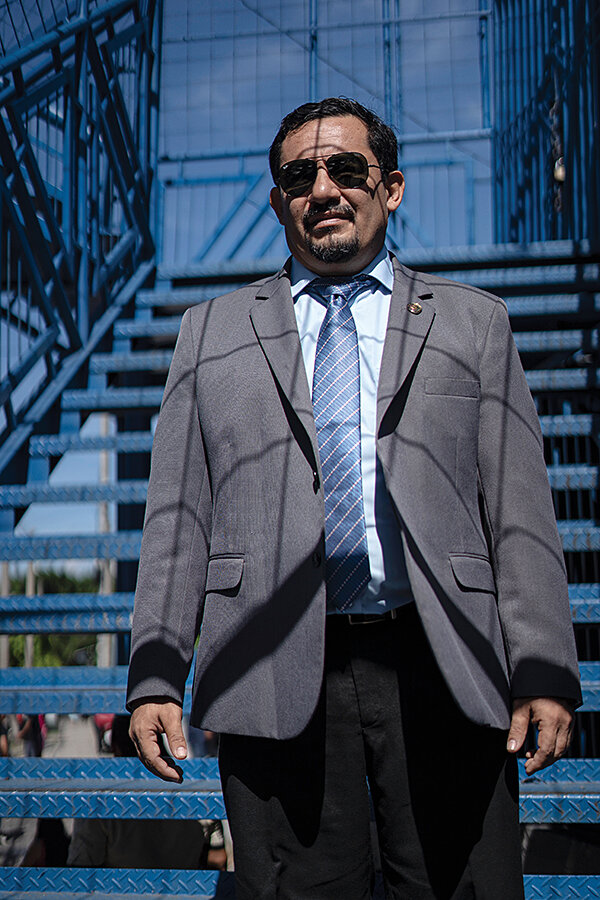
Mr. Muñoz found a way to channel his deep-seated desire for justice by becoming a lawyer in 2005. But he doesn’t work with just anyone – he goes for the tough cases of human rights abuses. He has defended multiple women who suffered miscarriages but were accused of murder in a nation where abortion is banned without exception. He has fought arbitrary arrests of environmentalists, activists, and average citizens. He could be called a defender of lost causes.
There’s no shortage of demand for Mr. Muñoz’s work in El Salvador, which has the highest incarceration rate in the world. And these days the risks of his work are almost as high as the demand for it.
In March 2022, a monthlong “state of exception” was enacted in response to extreme gang violence. The order suspended basic constitutional rights for those arrested under it. Securing a court warrant before searching private communications was no longer required, for example, and arrestees were barred from their right to a defense attorney and their right to see a judge within 72 hours.
But what started as an emergency measure has become ordinary practice. The state of exception has been extended every month for more than a year and a half now, with no end in sight. Violence has declined dramatically, but critics say the order’s extreme powers are seeping far beyond the gang-related arrests they were meant to address. Even those detained outside of the state-of- exception category are having their rights suspended.
That’s the group Mr. Muñoz focuses on. While he has taken a few state-of-exception cases, he primarily works on human rights violations, with the added burden now of his clients getting caught in the emergency order’s crosshairs. Despite death threats and intimidation, he’s not slowing down. Instead, fellow lawyers doing similarly risky work ask him to be on call if – or, perhaps more likely, when – they themselves are arrested.
… Despite quashing constitutional rights, the move has been overwhelmingly popular for providing a long-elusive sense of calm.
“A tired society, fed up with a lack of answers to the chronic problem of violence, is willing to accept short-term answers,” says Verónica Reyna, director of human rights for the Passionist Social Service, a nongovernmental organization focused on local violence prevention and support of human rights.
Gustavo Villatoro, minister of justice and public security, acknowledges that the state of exception is affecting more than gang members. Over 7,000 innocent people have been arrested, Mr. Villatoro said in August, noting that some degree of error is inevitable. But the consequences of those errors can be grave. Even if a case has nothing to do with gang activity, lawyers can be blocked from visiting their clients in detention, and court hearings can be suspended. Over 71,000 Salvadorans have been arrested under state-of-exception rules. With 6 million people in El Salvador, close to 2% of the adult population is currently behind bars. And many of them, even those not under the emergency order, lack access to a lawyer and may be tried en masse.
Margaret Satterthwaite, the United Nations special rapporteur on the independence of judges and lawyers, tweeted in May that in El Salvador, “public defenders reportedly have 3-4 minutes to present the cases of 400 to 500 detainees.” She warned that “fair trial rights must not be trampled in the name of public safety.”
In the last week of July, Salvadoran lawmakers eliminated a previous two-year limit on pretrial detentions and passed reforms to allow mass trials that could bring together 1,000 individuals in a single appearance before a judge.
“Maybe they won’t let us be lawyers anymore,” says Mr. Muñoz, “at least not private attorneys with independent criteria.”
“The reforms have disrupted the whole system and have turned innocence into an exception,” says Ursula Indacochea, program director at the Due Process of Law Foundation, based in Washington. “Presumption of innocence is disappearing because the roles have shifted. The state no longer has to prove I’m guilty, but now I’m guilty and have to prove I’m innocent,” Ms. Indacochea said in a Sept. 7 radio interview in El Salvador.
Of the 35,000 authorized lawyers registered in El Salvador, Mr. Muñoz stands out for almost exclusively taking cases of human rights violations.
“Things aren’t easy right now,” he says, describing the justice system as “made to convict.” The government is “criminalizing the job of lawyers,” he adds.
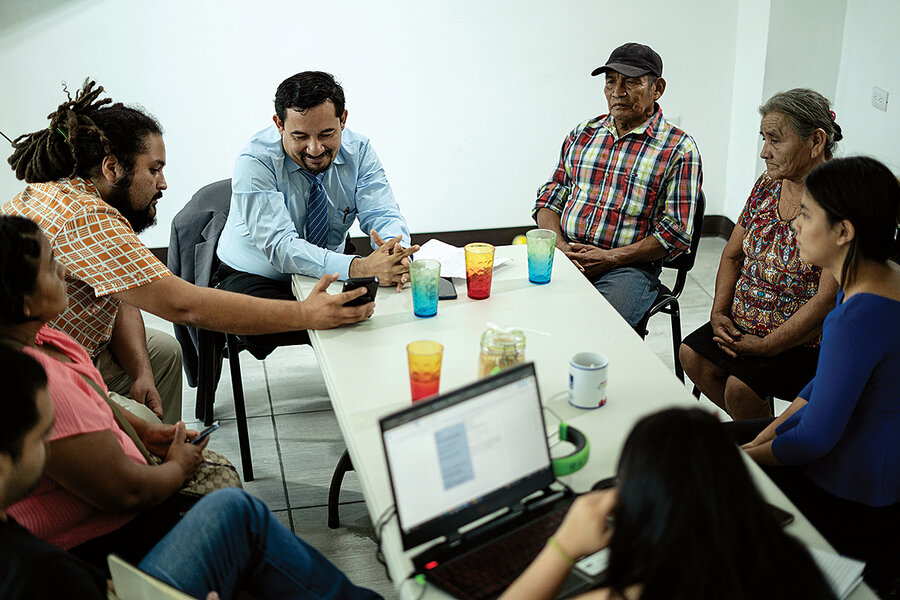
Yet Mr. Muñoz looked anything but cautious at a press conference in early July, where he was the only person wearing a suit at the San Salvador offices of the Christian Committee for Displaced People in El Salvador, a wartime human rights organization. He headed to the podium in the ample room, sparsely decorated with pictures of St. Óscar Romero, the archbishop of San Salvador murdered by right-wing death squads in 1980.
Mr. Muñoz discussed openly a forbidden topic. Five environmentalists were arrested in January over the alleged 1989 murder of a Salvadoran woman during the war. The case was under a court-issued gag order.
“It’s very serious that environmentalists are being unjustly accused, bending [what are considered] the rules of due process anywhere in the world,” Mr. Muñoz said, staring into the cameras.
His clients in this case are former guerrilla members, and two of the accused are part of the Association of Economic and Social Development Santa Marta, known as ADES. One of the country’s oldest environmental organizations, ADES was key in achieving the total ban on mining here in 2017. In a country where almost the entirety of war crimes remain unresolved and defendants in active cases are rarely imprisoned, the arrest of these men was an outlier, apparently due to their vocal criticism of the government. The U.N. called for the activists’ immediate release.
“Dare I say there are crimes being committed against these environmentalists,” Mr. Muñoz said before the media. “It’s nefarious that things like this happen in a country that calls itself democratic but really has a criminal injustice system in place.”
Víctor Peña/Special to The Christian Science Monitor
By late August, Mr. Muñoz had successfully convinced a judge to grant an order for his clients’ release. “It’s a crumb of justice, but we shouldn’t celebrate until there’s a dismissal of proceedings,” he said at a later press conference.
It’s hard to reconcile this image of seeming fearlessness with Mr. Muñoz’s request when the Monitor approached him for an interview: Could the piece leave out his last name? The question reflects a sense of fear that has built up over many years of doing this work.
Mr. Muñoz downplays receiving death threats, normalizing the culture of violence he’s lived under for most of his professional life. “They say they wish that I was extorted or killed because of the people I’ve defended,” he says about the social media threats. He thinks he’s been able to stay off the political radar by censoring his opinions. “I issue legal and technical opinions,” he explains. “Other colleagues have entered the political arena and expose themselves more to attacks.”
The arrested suspects, Defense Minister General Guillermo García and Colonel Francisco Antonio Morán, will be arraigned on Monday before a judge in Chalatenango. El Salvador has also requested the U.S. to extradite Colonel Mario Reyes Mena, another suspect in the case who is believed to be the main person responsible for the murders.
The case concerns the murder of four Dutch journalists who worked for the now-defunct public broadcaster IKON: Koos Koster, Jan Kuiper, Joop Willemsen and Hans ter Laag. They traveled to El Salvador in 1982 to report on families living in the guerrilla zone during the country’s 12-year civil war. They were ambushed and shot on March 17, 1982 by the Salvadoran army.
A 1993 UN Commission of Inquiry marked Colonel Reyes Mena as “responsible for planning the ambush and assassination,” according to Zembla. That same year, an amnesty law was passed in El Salvador, which meant that Reyes Mena could not be prosecuted in that country. The criminal investigation into the murders of the four Dutch journalists was launched in 2013 and El Salvador’s amnesty law was lifted in 2016. The result was that perpetrators of crimes during the Salvadoran Civil War can now be prosecuted.
Reyes Mena, now in his 80s, was discovered to be living in the U.S. in 2018. “The case has already been investigated, I have never been charged. You are part of a communist plan to retaliate,” Reyes Mena told Zembla journalists who confronted him about the murders.
According to Zembla, a Dutch justice is being dispatched to the Central American country to speak with the arrested suspects.
Episode 4: People who work to end violence and discrimination based on sexual orientation and gender identity (SOGI) face multiple forms of risk. They can be targeted for their actual or perceived sexual orientation or gender identity, and for being human rights defenders as well.
Karla Avelar is trans woman human rights defender from El Salvador who has been working since the 1990s to defend the rights of LGBTI persons, people with HIV and other marginalised groups. After being subjected to two and a half years in prison, where she was tortured, sexual assaulted and denied access to medical treatment, she began to work more intensely for the rights of LGBTI persons. She began by calling for appropriate provision of HIV medications and greater access to justice within El Salvador. In 2008 she founded COMCAVIS trans, El Salvador’s first organisation for trans women with HIV. In 2013, she was the first trans woman to appear before the Inter-American Commission on Human Rights. After multiple threats to her own life and that of her mother, she applied for asylum in Switzerland in 2017, where she now lives and continues her work. She was a finalist of the MEA in 2017 [see: https://humanrightsdefenders.blog/2017/05/16/trans-defenders-karla-avelars-life-is-under-constant-threat/]
Diversity in Adversity is a joint campaign by Mary Lawlor, UN Special Rapporteur on Human Rights Defenders, and Victor Madrigal-Borloz, UN Independent Expert on sexual orientation and gender identity. It will feature interviews with 10 SOGI rights defenders from all over the world; ordinary people engaged in extraordinary work. For more on this campaign, visit: https://www.ohchr.org/en/special-proc…
Devon Kearney in NPQ of 8 February 2022, reports on a worrying legislative development in El Salvador….
It has been nearly a decade since the Russian government passed its “foreign agent law,” a measure that requires nonprofit groups that engage in political activity to register with the government if they receive money from overseas. Russia justified the bill by saying it was based on a U.S. law—a statute from the lead-up to World War II that many of us came to know only after Donald Trump’s campaign manager, Paul Manafort, was accused of being an unregistered foreign agent. Putin’s message was that this was just an ordinary, even boring regulatory measure.
The sinister brilliance of the foreign agent law is twofold. First, it targets human rights NGOs’ supply lines, as it were, making it difficult to accept the funds they need to survive. In much of the world, human rights defenders rely on support from global philanthropies like the Open Society Foundations for the funding they need to operate. By the standards of Russia’s law, most would be required to register as foreign agents. Groups that take foreign money would be subject to government meddling and harassment; those that opted to do without would struggle to keep their doors open.
Second, the law accomplishes this by co-opting legitimate regulatory functions of the state to crush dissent. Setting the rules for nonprofits—along with corporations, lobbyists, and a wide range of activities that impact the public good—is something governments are supposed to do. The great innovation of Putin and the autocrats that followed him was to turn regulatory schemes into instruments of their own political dominance. By obviating the need for violence against opponents, these methods may avoid the consequences of harsher exercises of state power. They are key to creating, in the words of Hungarian semi-dictator Viktor Orbán, an “illiberal democracy,” a state where elections continue but the rights and liberties of the people are curtailed.
Under 38-year-old President Nayib Bukele, a charismatic young politician, El Salvador has taken a sharp turn toward authoritarianism. Bukele made headlines in February 2020 when he brought armed soldiers into Congress to stand behind him as he demanded funding for the military. He has since fired prosecutors and judges in order to pack the legal system with loyalists. Bukele is the latest in a growing number of modernized dictators who adopt the tactics but not the swagger of their forebears. But his style is distinctive. In the Journal of Democracy, Salvadoran political scholar Manuel Meléndez-Sánchez writes: “Bukele relies on millennial authoritarianism, a distinctive political strategy that combines traditional populist appeals, classic authoritarian behavior, and a youthful and modern personal brand built primarily via social media.”
Bukele’s authoritarian moves have raised alarms among Salvadoran civil society and around the world. The US has expressed its concern by hitting the government in the pocketbook: in May 2021, the United States Agency for International Development announced that it would pull funding from the Salvadoran police and other national agencies, instead directing the funds to civil society groups carrying out local development projects. More recently, USAID Administrator Samantha Power said the agency would commit $300 million for direct civil society funding in Central America, and promised to increase the amount of funding bypassing national governments to 50 percent within 10 years.
All of this is in keeping with Power’s stated intention to provide aid to developing nations with a local, “bottom up” approach that prioritizes small businesses over big international contractors, and local civil society groups over national governments—“[t]o engage authentically with local partners and to move toward a more locally led development approach,” as she told the Senate Foreign Relations Committee in July 2021.
But in a region where US interference has long rankled rulers and their people, the move may be seen as ham-fisted—taking aid money to support opponents of a duly-elected government brings to mind the ways in which our country funded proxy wars that killed hundreds of thousands of Salvadorans and left a bloody trail in Nicaragua and Guatemala, as well. More recently, in 2019 the Trump Administration slashed hundreds of millions of dollars in aid to the region in the hopes that by increasing financial pain it could pressure countries to take harsher measures to prevent their people from fleeing to the U.S.
With this history as a pretext, and perhaps stinging at this new reduction in aid funding, Bukele’s government struck back. On November 9, 2021, the government introduced a bill to require domestic nonprofits or social enterprises (solely commercial enterprises are exempted) to register as foreign agents if they “respond to the interests of, or are directly or indirectly funded by, a foreigner.”
“That the Legislative Assembly is even considering such a restrictive bill sends a chilling message to human rights groups and organizations fighting against impunity and corruption,” says Ricardo González Bernal, the Fund for Global Human Rights’ Program Director for Latin America. The Fund supports grassroots human rights defenders and independent journalism in El Salvador, across Central America, and throughout the world.
On 12 August 2021 Front Line Defenders came out with an unique report saying rights defenders working in sex industry face ‘targeted attacks’ around the world. The same day Sarah Johnson devoted a piece to it in the Guardian:
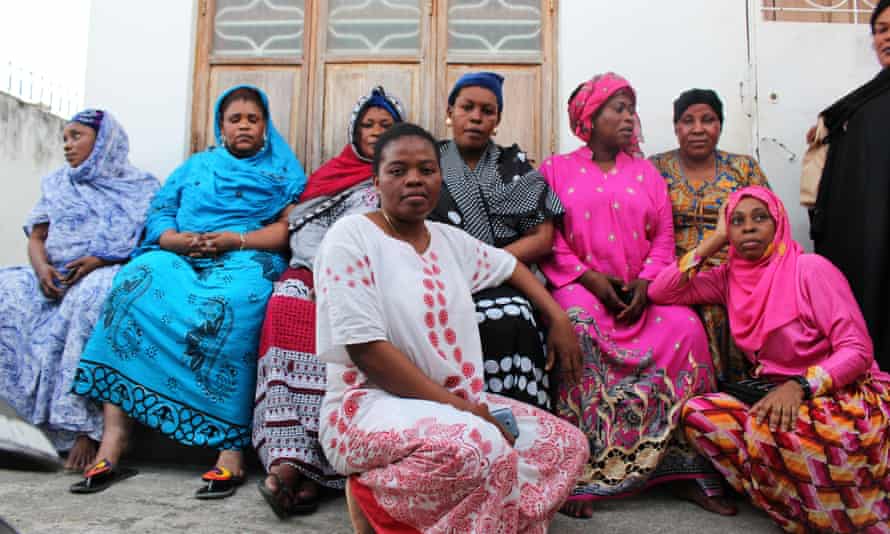
Sex worker rights defenders from Yosoa in Zanzibar, Tanzania. Yosoa do health outreach work and provide support after police, client or family violence. Photograph: Erin Kilbride/Front Line DefendersRights and freedom is supported by
Sex worker activists are among the most at risk defenders of human rights in the world, facing multiple threats and violent attacks, an extensive investigation has found.
The research, published today by human rights organisation Front Line Defenders, found that their visibility as sex workers who are advocates for their communities’ rights makes them more vulnerable to the violations routinely suffered by sex workers. In addition, they face unique, targeted abuse for their human rights work.
Drawing on the experience of 300 individuals in Tanzania, Kyrgyzstan, El Salvador and Myanmar, the report focuses oncases of sexual assault, threats from managers and clients, raids on homes and offices, physical attacks and police surveillance endured by sex workers undertaking human rights work.
The services the activists provide to fellow sex workers include: negotiating access to brothels, conducting gender rights training, offering legal and health counselling, reporting experiences of violence, and campaigning for freedom of movement and free choice of employment for those seeking to leave sex work.
Erin Kilbride, research and visibility coordinator at Front Line Defenders and lead author of the report, said: “Sex worker rights defenders take extreme personal risks to protect their communities’ rights to access justice, healthcare, housing and food, while responding to the immediate threats of police and domestic violence, discrimination, criminalisation and structural poverty.”
Often these activists were the only people able and willing to provide health education in locations in which sex was sold, the report found. They ensured treatment for sex workers who would otherwise be left with crippling injuries and life-threatening illnesses.
Activists’ role in creating community networks and defending sex workers’ right to assemble were also highlighted in the repot. “Coming together, even in private, is a radical, resistant, and dangerous act for defenders whose very identities are criminalised,” it said.
Defenders interviewed said they had been subjected to violations above and beyond what are typical for sex workers in their area. These included torture in prison, threats by name on the street, targeted abuse on social media and demands for sex in exchange for an advocacy meeting with a police commissioner. They also faced attacks from clients….
In Tanzania, sexual assaults in detention by the police have become a common occurrence for sex workers. They are often forced to perform sex acts in exchange for release. But human rights defenders have also been forced to perform sexual acts in order to secure other sex workers’ release. If they refuse, they are often tortured. One woman was given electric shocks after she refused to perform sex acts during a one-week detention related to her human rights work.
In El Salvador and other countries, physical attacks by clients and managers began after they learned about a sex worker’s activism, said the report.
In Myanmar, police followed activists to brothels to conduct raids duringhuman rights trainings. Some activists had been forced to change where they sell sex because police surveillance increased after they became known for their human rights work.Advertisement
Activists were often belittled at police stations in front of the sex workers they had tried to help. Htut, an outreach worker for Aye Myanmar Association, a network of sex workers, said: “[The police] let us in to the stations but then use rude words, take money from us, insult us, embarrass us, and made me feel bad about myself. It feels like they want to prove to the other sex workers that being an advocate is a humiliating thing.”
In Kyrgyzstan, sex workers have been paid or threatened by the police to help entrap rights defenders when they go to an area to distribute health supplies.
Despite the overwhelming evidence that sex worker activists have been under threat for their human rights work, much of it is dismissed by people ranging from the police to their own families, who assume such attacks are a result of being a sex worker.
Kilbride said: “Human rights defenders who are sex workers themselves are the best, and sometimes the only, activists and communities workers qualified and capable of accessing the most dangerous locations in which people sell sex.
“The targeted attacks they experience – ranging from sexual assault in detention to raids on their homes and offices – are indicators of how powerful their human rights work is.”

 Hans Thoolen on Human Rights Defenders and their awards