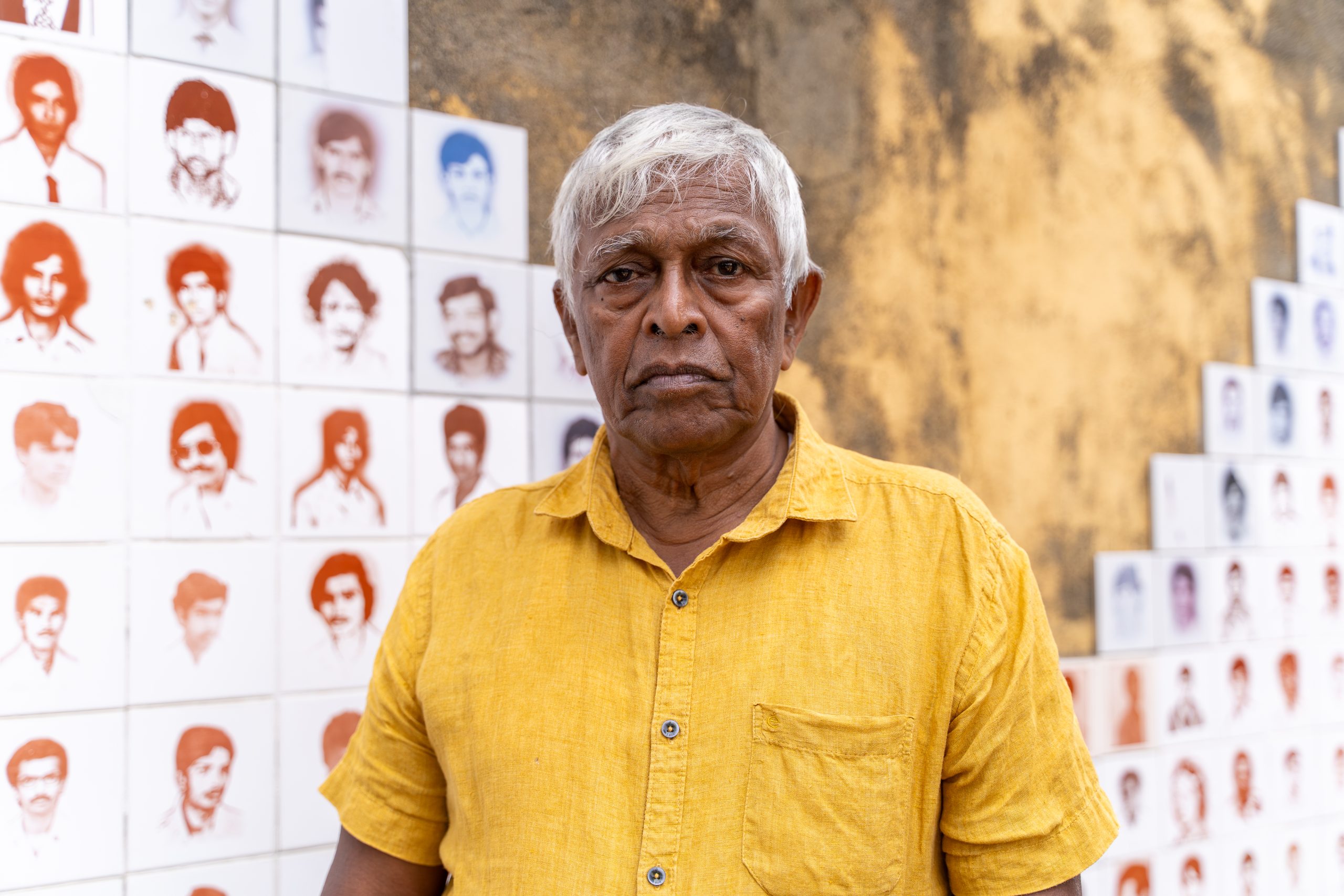
Brito Fernando in front of a monument displaying hundreds of portraits of disappeared people in Seeduwa, outside Colombo. Photo: The Living History Forum/Splendid
On 24 March 2026 it was announced that Brito Fernando from Sri Lanka has been awarded the Per Anger Prize 2026 for his work seeking truth and justice for the tens of thousands of people who have disappeared involuntarily in Sri Lanka. The Per Anger Prize is the Swedish Government’s international prize for human rights and democracy.
Brito Fernando is the founder and chair of Families of the Disappeared (FoD), which represents more than 20,000 families across Sri Lanka. Since the late 1980s, he has campaigned to establish what happened to those who vanished during periods of political violence and civil war in the country, and to secure accountability and justice.
According to the UN Working Group on Enforced or Involuntary Disappearances (WGEID), Sri Lanka has among the highest numbers of unresolved cases of enforced disappearance in the world. During various armed conflicts and the civil war in Sri Lanka, which ended in 2009, tens of thousands of people were taken by state actors, armed groups or paramilitary organisations. Most of these cases remain unresolved.
In 2004, Brito Fernando founded FoD, which today is the only organisation in Sri Lanka working across all communities on the issue of disappearances. Various ethnic and religious groups in Sri Lanka have historically been pitted against each other. Even today, violence and discrimination against minority groups remain widespread.
Through his work, Brito Fernando has brought together families from Sinhalese, Tamil and Muslim communities across much of the country in a common fight for truth, justice and accountability.
Brito Fernando’s work has entailed significant personal risk. He has been detained and arrested on several occasions, questioned over alleged links to terrorism and had his home attacked. Despite this, he and the families in FoD continue their pursuit of truth and justice.
On 15 January 2026 – the third anniversary of the enforced disappearance of Ricardo Lagunes and Antonio Díaz – UN experts demanded immediate answers about the fate and whereabouts of the two Mexican human rights defenders. “Mexican authorities must comply with the State’s international obligations, including by investigating the enforced disappearance, proactively searching for them, determining their fate and whereabouts, and holding perpetrators criminally responsible,” the experts said.
On 15 January 2023, Ricardo Lagunes, a human rights lawyer, and Antonio Díaz, an Indigenous leader, were forcibly disappeared in the state of Colima, Mexico. Their enforced disappearance occurred amid an ongoing dispute over natural resources between the Indigenous community of San Miguel de Aquila, Michoacán, and the Luxembourg-based mining company Ternium (part of the Argentine-Italian Techint Group). They were last seen after attending a community meeting to discuss collective action in response to the human rights impacts of the mining company’s operations.
“Refusing to succumb to despair after their enforced disappearance, the families of Mr Lagunes and Mr Díaz have undertaken a tireless quest for truth and justice over the past three years,” the experts said, noting that the authorities have so far not provided an effective response and that the company concerned has reportedly failed to fully cooperate with ongoing investigations and search activities.
The cases have been registered under the Committee on Enforced Disappearances’ Urgent Actions procedure and benefit from precautionary measures granted by the Inter-American Commission on Human Rights, acknowledging the serious, urgent and irreparable risk faced by the two human rights defenders.
“Enforced disappearances have a chilling effect on human rights defenders, including those advocating for land, natural resources and environment issues, as well as Indigenous leaders, and serve to silence critical voices,” the experts said, urging the Government to ensure that human rights defenders can carry out their work in a safe environment, including by strengthening the protection mechanism for human rights defenders.
In the context of resource-extraction projects, business enterprises have often reportedly sown and exacerbated community divisions, inciting violence among locals with opposing views on the projects and the use of land and natural resources. “The Government must ensure that businesses respect human rights across all their activities pursuant to the UN Guiding Principles on Business and Human Rights, including when engaging with human rights defenders and affected communities,” they said.
The experts are in touch with the Government of Mexico and the business concerned in this regard.
To illustrate how international days can influence actions by NGOs, here an example from Syria:
The International Day of the Victims of Enforced Disappearances (30 August) the Platform of Families of Missing and Enforcedly Disappeared Persons in North and East Syria organized a solidarity stand in Qamishlo.
The event took place today under the slogan, “Our doors are still open, waiting for their return,” in front of the office of the United Nations High Commissioner for Refugees (UNHCR) in Qamishlo, Jazira Canton, with participation from relatives of the missing, activists, and human rights defenders.
Participants carried banners with messages in Kurdish, Arabic, and English, including: “A mother is still waiting at the window,” “Absence is a weight heavier than iron,” “No peace and no future without knowing the fate of the missing,” “Knowing the fate is the beginning of holding perpetrators accountable,” and “Our voices will not be silenced; we will continue demanding our loved ones.”
Abbas Ali Mousa, coordinator of the Platform of Families of Missing Persons in North and East Syria, told ANHA agency that the number of families affiliated with the platform ranges between 600 and 700.
Mousa explained that the event was held in solidarity with victims of enforced disappearances and their families, reaffirming their legitimate right to know the fate of their loved ones and emphasizing the necessity of establishing truth and justice.
Ilham Ahmed, the mother of journalist Farhad Hamo, who has been missing by ISIS mercenaries for 11 years, said: “I know nothing about my son or his fate.”
Ahmed added: “Despite repeatedly appealing to human rights organizations and relevant bodies, we have received no response or clarification.” She called on human rights organizations and groups working with abductees to reveal the fate of her son and all missing persons.
Women dressed as the mothers and grandmothers of the Plaza de Mayo gather in Buenos Aires, Argentina, in March. Photograph: Rodrigo Abd/AP
On Wednesday 6 August 2025 the Guardian carried an interview with Buscarita Roa, one of the last of the Abuelas.” ..
Argentina’s 1976-83 military dictatorship tortured, killed and “disappeared” an estimated 30,000 people – political opponents, students, artists, union leaders: anyone it deemed a threat. Hundreds of babies were also taken, either imprisoned with their parents, or given to military families. The Abuelas de Plaza de Mayo have fought for almost 50 years to find these grandchildren. Buscarita Roa is one of two surviving active members.
On 28 November 1978, my 22-year-old son, José, his wife, Marta, and their baby daughter, Claudia, joined the list of those “disappeared”. A squad of Argentina’s military police stormed their home and I couldn’t find out any more. I went everywhere to look for them – police stations, courthouses, army camps, churches. I was desperate. But nobody would answer me. Every door was closed. It was a suffocating, hermetic time.
Then one day, not long after they were taken, I watched as a group of women walked in circles around the Plaza de Mayo in Buenos Aires. These mothers and grandmothers had started to gather, demanding answers about their missing relatives. I recognised one of the women. She said come with us, and I did.
We – who would become known as the Abuelas – didn’t know each other before. But we would meet every week and walk round and round the square, identifying each other with our white headscarves.
At first some of the husbands came, but we knew they risked being “disappeared” too, so then the men stayed at home and we went alone. It was still dangerous, a terrifying time, and some of the first mothers were taken themselves.
When the police ordered us to leave, and we didn’t, they charged at us on horseback. But we were younger then, so we could run.
Together we started going to the police stations and the courts, searching for answers. We cried in front of them, and they told us to go away, they didn’t want to see us. We knew the dictatorship was watching us from afar.skip past newsletter promotion
My granddaughter’s disappearance haunted my life. She was only eight months old when she was taken, and whenever I would see a little girl who looked like her, I would follow her, unable to stop until I saw her face. If there were people at my front door I would think, oh she must have come home. Other times, people would tell us they had seen a neighbour with a new baby. So we would go to their houses, trying to glimpse the child, to see if they looked like one of ours. We were doing crazy, desperate things, but it was all we had.
Many years passed before we started to receive any information. Most people didn’t believe us, and those that did thought our sons were terrorists. Still, we continued to go to Plaza de Mayo to pray for the return of our children. And when the country’s economic situation improved, we started travelling abroad to share our story too.
In 2000, I found my granddaughter, and was able to hug her again for the first time in two decades. People had come forward with their suspicions, and a judge agreed to investigate. We learned that Claudia had been taken to the clandestine detention centre “El Olimpo” with her mother, where she was kept for three days before being illegally adopted by a military family. They created a fake birth certificate, signed by a military doctor. My son and daughter-in-law were tortured and killed.
Claudia was in my heart every day that she was missing. I can’t explain what I felt when I found her. It was a pure, overwhelming joy. But I was also afraid, fearful that she would reject me. By then she was 21, and had been raised by a military family. I couldn’t invade my granddaughter’s life just like that, she needed to figure out the terrible truth and start trusting us. Slowly, over long afternoons of mate [a traditional herbal drink], we got to know each other and have built a beautiful relationship.
Belonging to the Abuelas helped me to heal. We laughed, we cried and we became friends. We were relentless too – we women have not rested once in half a century. But while some of us found our grandchildren, others only found bodies, and most of us found nothing at all. And then there is the battle of time; it is cruel and many of the Abuelas have died. There were once many of us, and now there are fewer than 10.
Estela de Carlotto, the president of the Abuelas, and I are the two last active members. But we are growing old too, and I don’t know how much further life will take us. We have found 140 of the grandchildren, with the last reunited last month, but we estimate that nearly 300 are still missing.
The ones we have found have now taken up the mantle. This is the legacy de Carlotto and I leave behind: a generation of grandchildren still looking for the others.
My lifelong work has consisted of searching for my son and daughter-in-law. I am 87 years old now, but I will never give up.
The Philippines recorded the highest number of alleged abductions involving human rights defenders (HRDs) across Asia from 2023 to 2024, according to a biennial report released on 19 July 2025 by the Asian Forum for Human Rights and Development (Forum-Asia).
The country topped the list of 24 nations with 15 documented abduction cases, surpassing Bangladesh with nine, and both Afghanistan and Pakistan with seven each. The report accounted for at least 32 Filipino victims, though it did not specify how many remain missing.
These incidents were compiled through the Asian Human Rights Defenders Portal, a publicly accessible database maintained by Forum-Asia using verified reports from civil society, media, and UN sources. Only cases with clear identification of victims and a link to their human rights work are recorded.
One cited case involved indigenous activists Job David, Peter del Monte Jr., and Alia Encela, who were reportedly abducted by military forces in Bongabong, Oriental Mindoro in September 2023. The Philippine Army denied the allegations, asserting that the three were members of the New People’s Army captured during an operation and are currently detained. However, Forum-Asia noted that the case mirrored earlier incidents where so-called “Red-tagging” was used to justify human rights violations.
Red-tagging, the practice of labeling activists as communist rebels or terrorists, has long been criticized for exposing individuals to threats, violence, and in some cases, fatal attacks.
The report also revealed that abduction is only one of many repressive methods used to target HRDs. Judicial harassment emerged as the most widespread, with 868 cases across Asia. This includes arbitrary arrests, the use of oppressive laws, and denial of fair trials.
Threats, intimidation, and censorship were also rampant, totaling 376 incidents. The Philippines accounted for 41 of these, with 18 cases of vilification—all allegedly perpetrated or backed by state actors.
Environmental, indigenous, land, and community-based defenders were among the most targeted groups, with 60 harassment cases documented in the Philippines—second only to Indonesia. The country also ranked second in attacks on labor rights defenders, tallying 16 cases.
The first World Congress on Enforced Disappearances will convene from 15 – 16 January in Geneva, marking a pivotal step in the global fight to prevent and eradicate this egregious human rights violation.
This event will bring together governments, victims, civil society organisations, and international bodies to foster dialogue and chart a collective path forward to end enforced disappearances worldwide. Over the course of the two-day event, panel discussions will be held on topics such as international responsibility for the forcibly disappeared, strengthening search procedures, and protecting victims, rights defenders, lawyers and journalists.
Details of the programme are available online. The event will take place at the Geneva International Conference Centre (CICG). Onsite registration is open at the venue.
The Working Group on Enforced or Involuntary Disappearances comprises five independent experts from all regions of the world. The Chair-Rapporteur is Ms. Gabriella Citroni (Italy); and the Vice-Chair is Ms. Grażyna Baranowska (Poland); other members are Aua Balde (Guinea-Bissau); Ms. Ana Lorena Delgadillo Perez (Mexico); and Mr. Mohammed Al-Obaidi (Iraq).
On 22 May 2024 Front Line Defenders launched its Global Analysis 2023/24 on the situation of human rights defenders (HRDs) at risk around the world, an in-depth annual publication detailing the variety of risks, threats and attacks faced by HRDs around the world.
The report also reveals statistics gathered and verified by the HRD Memorial initiative – which Front Line Defenders coordinates – documenting the killings of at least 300 HRDs in 28 countries in 2023. Almost a third of those killed (31%) were Indigenous people’s rights defenders. This brings the total documented killings of HRDs in the last decade to nearly 3,000.
“This appalling wave of attacks on human rights defenders is a direct result of an international human rights framework left in tatters and governments’ double standards when it comes to respecting human rights,” said Alan Glasgow, Executive Director of Front Line Defenders. “A quarter decade after the UN adopted a Declaration on human rights defenders, not enough progress has been made to ensure defenders are valued and protected. In this time, thousands of defenders have paid with their lives and many more face ongoing attacks and intimidation for their peaceful work. Urgent action is needed to change this.”
Wide-ranging risks to HRDs
Globally, the violation most commonly cited by HRDs was arbitrary arrest/detention (15%), followed by legal action (13%), continuing an ongoing trend of criminalisation as the most-reported risk. This was followed by death threats (10.2%), surveillance (9.8%) and physical attacks (8.5%). Trans and non gender-conforming HRDs reported slightly higher rates of physical attacks, and a much greater risk of smear campaigns. Globally, the five most targeted areas of human rights defence were: LGBTIQ+ rights (10.2%); Women’s rights (9.7%); Human rights movements (8.5%); Indigenous peoples’ rights (7.1%); and Human rights documentation (5.2%).
The statistics in the Global Analysis are derived from Front Line Defenders’ casework and approved grant applications between 1 January and 31 December 2023. The statistics are based on 1,538 reported violations in 105 countries. Front Line Defenders documents multiple violations per case or grant, as this is the reality of the situation for human rights defenders. For more details on how these and the HRD Memorial data are gathered, please refer to the Methodology section at the end of the report.
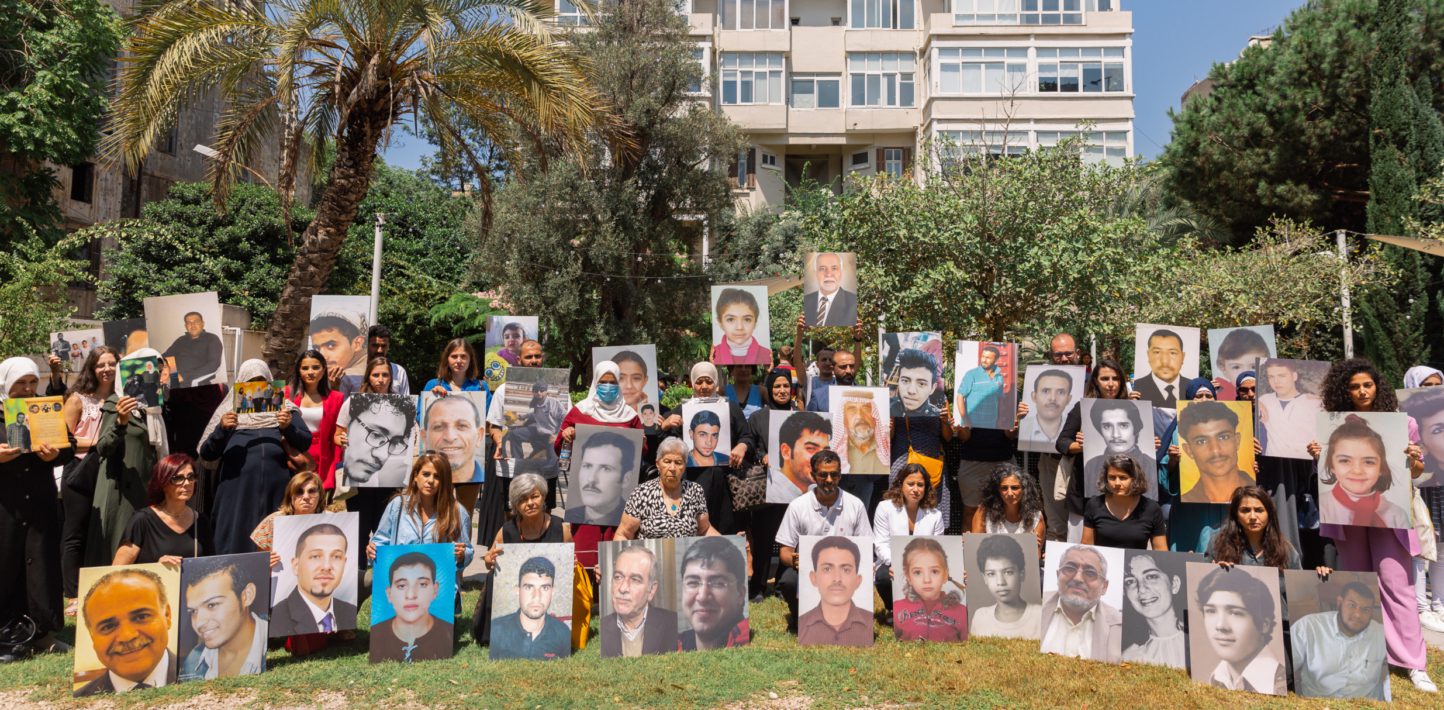
On 30 August 2023, Amnesty International reported on that Representatives of the families of people forcibly disappeared in Iraq, Lebanon, Syria and Yemen gathered in Beirut to demand that their governments uphold their rights to truth, justice and reparation, during an event organized by AI to mark the International Day of the Victims of Enforced Disappearances.
Across the Middle East, both state authorities and non-state actors, such as armed opposition groups, abduct and disappear people as a way to crush dissent, cement their power, and spread terror within societies, largely with impunity.
While most governments in the region have not yet investigated disappearances nor provided accurate numbers of those missing or disappeared, civil society organizations and UN bodies have published estimated numbers of people abducted and disappeared in each country. These numbers in Iraq, Lebanon, Syria and Yemen, when multiplied by a conservative estimate of the total years these individuals have been missing, suggest that families have spent more than a million years waiting for answers – an agonizing length of time.
“In the face of their governments’ apathy and complicity for the crime of enforced disappearances, the families of the disappeared across the Middle East have led the charge, year after year, in demanding their right to know what happened to their loved ones and to get justice and reparation – often at great personal risk,” said Aya Majzoub, Amnesty International’s Deputy Director for the Middle East and North Africa.
“Today we honour their perseverance and add our voice to theirs in calling for authorities to take real action to investigate these crimes, hold those suspected of criminal responsibility accountable and ensure these crimes are not committed again.”
Iraq
In Iraq, the UN estimates that between 250,000 to 1,000,000 individuals have been disappeared since 1968 – making it one of the countries with the highest number of disappearances in the world. Disappearances are still being carried out today at hands of militias affiliated with the government. Consecutive Iraqi governments have repeatedly failed to take meaningful steps to investigate disappearances or hold those suspected of criminal responsibility to account. Widad Shammari from Iraqi organization Al Haq Foundation for Human Rights, whose son has been missing since 2006, said: “I was a single protester until I met many others who shared my struggle, and we formed a strong coalition who fights for the truth for all the disappeared in the Arab region, not just Iraq.”
Lebanon
In Lebanon, the official estimate of those abducted or missing as a result of the 1975-1990 civil war is 17,415. Every year, on 13 April – the anniversary of the start of the Lebanese Civil War – the families of the missing and disappeared gather to mark the beginning of the conflict, repeating the mantra, “Let it be remembered, not repeated.”
The Lebanese authorities granted amnesty to the perpetrators of crimes that occurred during the civil war, but after years of campaigning, in 2018, the families of the disappeared successfully pressured the government to acknowledge the disappearances that took place. The government also passed a law that established the National Commission for the Missing and Forcibly Disappeared with a mandate to investigate individual cases, locate and exhume mass graves and enable a tracing process.
However, Wadad Halawani, whose husband was kidnapped in 1982 and who leads the Committee of the Kidnapped and Missing in Lebanon said: “Today, we raise our voice and shout out loud. The National Commission for the Missing and Forcibly Disappeared is 3 years old already. Only two years remain in its mandate. The Commission established a clear strategy for its work, but it cannot carry on without the needed financial and logistical support. The government must provide it with all the needed resources immediately.”
Syria
Since 2011, the Syrian authorities have forcibly disappeared tens of thousands of its actual or perceived opponents, including political activists, protestors, human rights defenders, journalists, lawyers, doctors, and humanitarian aid workers, as part of a widespread and systematic attack against the civilian population that amounts to crimes against humanity. Thousands have also gone missing after being detained by armed opposition groups and the so-called Islamic State. Given the Syrian government’s role in orchestrating the campaign of enforced disappearances, there has been total impunity for these crimes in Syria. The families have therefore resorted to international justice mechanisms.
In a momentous victory for the families, on 29 June 2023, the UN General Assembly voted to establish an international institution dedicated to shedding light on the fate and whereabouts of those missing and disappeared since the start of the armed conflict in Syria.
Fadwa Mahmoud from Families for Freedom, whose husband and son were disappeared in Syria in 2012 said: “We had big dreams in 2011. But we paid a very heavy price. My husband and son have been disappeared since September 2012… We faced our fears and raised our voice until it reached the United Nations …this [institution] is the product of our labour as the families of the detained…and this is its strength. We are demanding that we have an instrumental role in the institution.”
My husband and son have been disappeared since September 2012… We faced our fears and raised our voice until it reached the United Nations …this [institution] is the product of our labour as the families of the detained…and this is its strength.Fadwa Mahmoud from Families for Freedom, whose husband and son were disappeared in Syria in 2012
Yemen
In Yemen, human rights organizations have documented 1,547 cases of disappeared and missing people since 2015. All parties to the conflict, including the Huthi de facto authorities and the internationally recognized government forces, are still committing these crimes with impunity at a time when the world’s attention has turned away. Since the Human Rights Council voted in 2021 to end the mandate of the Group of Eminent Experts, following heavy lobbying from Saudi Arabia, efforts to hold all those suspected of criminal responsibility accountable in fair trials and realize victims’ rights to reparations have stalled.
The Abductees’ Mothers Association in Yemen said: “We were harassed and threatened and beaten-up during demonstrations, but we will not give up and we are determined at ensuring some progress every step of the way. We are not mothers of our own disappeared family members only; we consider ourselves mothers of every single disappeared person in the region and we will continue our fight for the truth for all of them.
On 30 August, 2022, the International Day of the Disappeared, the international community must recognize and respond to the widespread use of enforced disappearances in the People’s Republic of China, say an impressive group of NGOs (see list a the end):
Just over five years ago, on 13 August 2017, human rights lawyer Gao Zhisheng vanished for the third time. Gao, praised as the ‘Conscience of China’, had long fought for the rights of those who dared to speak out, who belonged to religious minorities, who were evicted from their homes when their land was seized, or who protested against exploitation. For that, he was in and out of prison and separated from his family for nearly a decade. For more than five years, his wife and children have had no idea of his whereabouts, nor even if he is alive. [see: https://www.trueheroesfilms.org/thedigest/laureates/33C77656-F58B-454E-B4C7-E1775C954F14]
Gao Zhisheng’s case is severe, and yet represents only the tip of the iceberg: many other activists and lawyers face a similar fate, such as Tang Jitian, disappeared in 2021, tortured, and detained in a secret location. UN experts, including the Working Group on enforced disappearance, have sounded the alarm from as early as 2011 about the use of enforced disappearances against those taking part in China’s human rights movement. It is used to silence those promoting rights and freedoms, to enable acts of torture and ill-treatment without any oversight, and to send a chilling message to any person who may dare to criticize the government.
The UN Secretary-General Antonio Guterres echoed this when he reminded the international community that enforced disappearance is a ‘method of repression, terror, and stifling dissent’. Relatives – themselves also victims of this crime– are deprived of their right to justice, and to know the truth, constituting a form of cruel and inhumane treatment for the immediate family.
But no matter how powerful a country is, no matter what security challenges (real or perceived) they may face, the experts rightfully emphasize: ‘There can never be an excuse to disappear people.’ Enforced disappearances are strictly prohibited under international law under any circumstances, and may constitute a crime against humanity when committed as part of a widespread or systematic attack against any civilian population.
The Chinese government continues to ignore calls for it to ratify the International Convention for the Protection of All Persons from Enforced Disappearance. It has disregarded requests for over nine years by the UN’s Working Group on Enforced and Involuntary Disappearances to visit the country, including its most recent on 7 January 2022. In the meantime, the number of cases of individuals disappeared presented before the Working Group soared, reaching 214 by 2021, out of which 98 remain outstanding.
It is urgent that the UN, governments, and civil society worldwide press China to end, unequivocally, all forms of enforced disappearance.
UN experts and civil society actors have documented many practices used by the Chinese authorities amounting to enforced disappearance. Some are written into Chinese law, or Chinese Communist Party guidance; others happen outside the scope of China’s own laws. Some target individuals for their actions or speech; others are wielded with the intent to terrorize a particular ethnic or religious community.
Residential Surveillance at a Designated Locations(RSDL)
‘Residential Surveillance at a Designated Location’ is allowed for in China’s Criminal Procedure Law, and authorizes holding someone in custody – prior to arrest – for up to six months in an undisclosed location. This ‘location’ is unofficial, selected at the discretion of the police, and the individual is isolated in solitary confinement without access to family, counsel or options to appeal the measure. This is especially true for those activists and dissidents accused of ‘national security crimes’. Incomplete government data admits to use of RSDL in some 23,700 instances, but civil society estimates that for the period 2013 to 2021, the real figure is closer to 85,000, with increased use over time. The practice continues despite having been condemned by UN experts as ‘a form of enforced disappearance’ that ‘may per se amount to cruel, inhuman or degrading treatment or punishment, or even torture.’ The experts’ assessment is clear: RSDL must be repealed. [see also: https://humanrightsdefenders.blog/2022/02/05/chinas-residential-surveillance-at-a-designated-location-needs-to-disappear/]
Liuzhi system
The liuzhi (留置) extralegal detention system mimics the practice of RSDL, but is used to specifically punish any public servant or Chinese Communist Party (CCP) member who allegedly ‘violates duties’ or commits ‘economic crimes,’ potentially reaching nearly 300 million victims. As with RSDL, liuzhi detentions can last up to six months, holding victims incommunicado and in solitary confinement at undisclosed locations. Yet, detentions are outside the scope of China’s laws, including the Criminal Procedure Law, as liuzhi is not part of the criminal justice system. Instead, it is run by China’s powerful extra-judicial anti-graft watchdog, the National Supervision Commission (NSC), a quasi-state body answerable only to the CCP. Legal safeguards, including the right to legal counsel, do not apply to individuals investigated under liuzhi, until and unless their case is sent for criminal prosecution. Incomplete official data acknowledges 11,000 individuals held under liuzhi; civil society estimates actual figures to surpass 57,000 disappeared victims. UN experts addressed a general allegation on this issue to China in September 2019.
Psychiatric incarceration (ankang)
Since the 1980s, China’s Ministry of Public Security has locked up individuals targeted for their political and religious beliefs in psychiatric hospitals for the criminally insane, known as ankang (安康) (‘peace and health’). Despite legal reforms, police continue to send human rights defenders for compulsory treatment without medical justification in both ankang facilities, and psychiatric hospitals for the general public. Civil society data indicates this is a regular, large-scale practice, where victims are denied contact with the outside world and often subjected to torture and ill-treatment, while families are not informed about their relatives’ forced hospitalization.
Enforced disappearance in Tibet
The Chinese authorities continue to disappear Tibetans, including religious leaders, critics and influential thinkers, subjecting them to torture and ill-treatment, and employing the threat of disappearance to instill widespread fear across Tibet. In February 2022, six UN experts raised concern over the physical well-being of Tibetan musician Lhundrup Drakpa, writer Lobsang Lhundrub, and school teacher Rinchen Kyi, arrested and disappeared ‘in connection with their cultural activities in favour of the Tibetan minority language and culture.’ In July 2021, four UN experts expressed similar concern over the enforced disappearance of Rinchen Tsultrim and Go Sherab Gyatso, pointing to a ‘worrying pattern of arbitrary and incommunicado detentions (…) against the Tibetan religious minority, some of them amounting to enforced disappearances.’
The 11th Panchen Lama, Gedhun Choekyi Nyima, one of the most important Tibetan Buddhist leaders, was disappeared in 1995 at the age of six. The Chinese government continues to ignore calls for his release, UN experts’ concerns, or the UN child rights committee’s request for access to establish his whereabouts and health.
Enforced disappearance in the Uyghur region
Beginning in 2017 in the Xinjiang Uyghur Autonomous Region (XUAR, or Uyghur Region), Uyghurs and Turkic Muslims have been detained incommunicado by Chinese government officials in internment camps, forced labor facilities, official prisons where they serve lengthy sentences, and other facilities where they are at risk of being subject to forced labor. Reports to the UN Working Group on enforced disappearances escalated dramatically, indicating a widespread and systematic practice. While the Chinese government refers to these camps as ‘vocational education and training centers’, administrative detention in the camps has no basis in Chinese, or international law.
Journalists and NGOs have reported countless testimonies of people whose family members are or were missing and believed to be detained in the XUAR, and yet who have no way to establish their family members’ whereabouts. They almost never receive official confirmation regarding their family member’s status from the Chinese authorities; efforts to gather information from Chinese consulates or embassies abroad have been largely unsuccessful. Very few detainees are allowed contact with the outside world. Even nominally ‘free’ Uyghurs living in XUAR have been effectively forbidden to speak with their family or friends abroad. Uyghurs in the country and overseas are wholly deprived of their right to truth.
We, the undersigned organizations, urge the international community as a whole to ensure sustained attention and take meaningful action to put an end to all forms of enforced disappearance in China. The authorities must release all those disappeared, ensure their relatives’ right to truth, justice, reparation, and guarantees of non-recurrence.
We stand in solidarity with all those missing, and with their loved ones, left longing for them to return alive.
On 29 August 2022, on the occasion of the International Day of Victims of Enforced Disappearances, AFAD, FIDH, Maayer Daak and Odhikar urge the government of Bangladesh to: 1) Halt all enforced disappearances and immediately return all disappeared persons to their families. 2) Set up an independent mechanism to investigate all cases of enforced disappearances. 3) Refrain from all forms of reprisals against human rights defenders, family members of the disappeared, and civil society activists, and ensure the safety and security of victims and their families. 4) Hold all perpetrators accountable. 5) Ratify the International Convention for the Protection of All Persons from Enforced Disappearance. 6) Adopt and implement domestic legislation criminalizing enforced disappearance in line with international law.
The Asian Federation Against Involuntary Disappearances (AFAD) is a federation of human rights organizations working directly on the issue of involuntary disappearances in Asia. AFAD was founded on 4 June 1998 in Manila, Philippines and was the recipient of the 2016 Asia Democracy and Human Rights Award. See: https://www.trueheroesfilms.org/thedigest/laureates/5E526725-F43B-83FB-3B7E-2B3C56D01F60 The International Federation for Human Rights (FIDH) is the world’s oldest non-governmental human rights organization. Founded in 1922, FIDH federates 192 member organizations from 117 countries. Its core mandate is to promote respect for all the rights set out in the UDHR. http://www.fidh.org Maayer Daak is a platform of the families of victims of enforced disappearances in Bangladesh with the common goal of seeking the whereabouts of their loved ones and advocating for justice. Odhikar is a human rights organisation in Bangladesh, established on October 10, 1994 by a group of human rights defenders, to monitor human rights violations and create wider awareness. It holds special consultative status with the ECOSOC of the United Nations.





 Hans Thoolen on Human Rights Defenders and their awards