..A one-day conference was organized by African Centre for Media and Information Literacy (AFRICMIL), in collaboration with Amnesty International Nigeria, to explore the nexus between whistleblowing, corruption and human rights, and in doing so highlight the essence of whistleblowing as a conveyor belt of free speech and an affirmation of individual human dignity and moral worth that requires full protection from the state or other legitimate institutions.
Its theme, ‘Amplifying Whistleblowing to reduce Corruption and protect Human Rights,’ was painstakingly decided to assert the value of whistleblowers in exposing or preventing wrongdoing, and the necessity of standing up for them for largely playing the delicate role of human rights defenders who are in most cases victimized for performing what is clearly the citizenship duty of protecting the well-being of other citizens and the wider society.
Indeed, that whistleblowing is a fundamental human right is neither theoretical nor speculative. All applicable statutes from the domestic to the international are clear on this. And Maxwell Kadiri, senior legal officer at Open Society Justice Initiative (OSJI) and human rights advocate who was the keynote speaker, made the point succinctly in his refreshingly scholarly address by delving into the origin of whistleblowing and laying out all the laws proclaiming it as a human right that deserves protection.
However, worthy of note is that in exercising the right to hold opinion and express themselves by disclosing public interest illegalities or potential danger to competent authorities, whistleblowers are also helping – directly or indirectly – to protect the right being harmed by the wrongdoing they disclose. It isn’t for nothing, therefore, that some of the most prominent whistleblowing cases globally can be traced to whistleblowers who have reported wrongdoing that amounted to human rights abuse. Just one example of such is Dr. Li Wenliang, the 34-year-old Chinese ophthalmologist who was the first to blow the whistle on the covid-19 virus and other issues related to the right to life and access to healthcare. And there are many more unsung heroes like Wenliang whose disclosures have uncovered corruption and its collateral human rights violations. Whistleblowers have largely served as human rights defenders when they expose threats to human rights that the public are not able to access.
In Nigeria, they have continued to be victims of relentless persecution simply for doing the right thing: exposing wrongdoing which serves public interest. This is one of the major reasons for the whistleblowing, corruption and human rights conference. Institutions and individuals perpetrating wrongdoing often find it difficult to admit their mistake. Instead of tackling the message, they shoot down the messenger. Not a day passes without a report of public sector workers at the federal and sub-national levels being censored or penalized for challenging authorities by reporting fraud, corruption, misconduct and other illegalities. Although section 6 of Nigeria’s whistleblowing policy provides protection for whistleblowers on the receiving end of punishment for reporting wrongdoing, no whistleblower is known to have enjoyed any protection under this provision. This is because the oversight institutions are so weak that they are not able to assert themselves to implement this provision effectively. Rather than ensure honest implementation of the policy, these institutions are often found doing the bidding of the persons reported, not able to summon the courage to hold them to account for their wrongdoing and would perpetually ignore complaints of victimized whistleblowers.
At the conference, there were at least four whistleblowers with different stomach-churning tales of workplace oppression ranging from suspension, harassment, denial of salary and other benefits, punitive posting, abusive lawsuits, outright dismissal, and threat to life. At the risk of seeming immodest, it has to be stated that AFRICMIL is overwhelmed with demands for support from whistleblowers in this category. In the face of these varied attacks, it is no surprise that citizens are showing next to no interest in engaging whistleblowing despite its famed rating as an extension of the right of freedom of expression that is linked to the principles of accountability and integrity. To prevent an individual from exercising this right is much more than a denial of fundamental human right; it is a violation of humanity….
Whistleblowing is about promoting the culture of truth, self-expression and democracy. Dr. Chido Onumah, coordinator of AFRICMIL and his counterpart at the Amnesty International Nigeria, Isa Sanusi, have agreed as much and stated their resolve to work together to preserve the freedom of expression rights of citizens as it relates to whistleblowing.
Following the decision of a judge in Guatemala City to authorize the immediate release of Virginia Laparra, former prosecutor of the Special Prosecutor’s Office against Impunity (FECI) on Tuesday, 3 January, Ana Piquer, Americas director at Amnesty International, said:
“Virginia Laparra should never have spent a day in jail. It’s great news that she can be reunited with her loved ones after nearly two years as a prisoner of conscience. Her release is a first step towards ending the terrible human rights violations she has faced in retaliation for her outstanding work as an anti-corruption prosecutor.”
“We lament, however, that Virginia Laparra remains convicted of a crime she did not commit and faces another unfounded trial, due to the regrettable use of criminalization against dozens of people who, like her, have led the fight against impunity. Amnesty International reiterates its call for the Guatemalan authorities to put an immediate end to the misuse of the criminal justice system to harass, intimidate and punish judges, prosecutors, human rights defenders and journalists”.
On 28 November 2022, Amnesty International named the former prosecutor as a prisoner of conscience, having found that her detention was solely due to her human rights work as head of FECI in Quetzaltenango, and requested her immediate and unconditional release. In May 2023, the United Nations Working Group on Arbitrary Detention declared that the detention of the former anti-corruption prosecutor was arbitrary and requested her immediate release. At the same time, the international mobilization of thousands of human rights activists on the case has not ceased.
“Amnesty International underscores the importance of international pressure in cases such as those of Virginia Laparra. Our movement in the Americas and around the world has not rested in demanding the release of the former prosecutor,” said Ana Piquer.
The unfounded criminal prosecution against Virginia Laparra took place in a context of attacks against dozens of people for their role in the investigation of high-profile cases of large-scale corruption and human rights violations. In 2022, there were 3,754 attacks against human rights defenders and at least 73 judicial workers, journalists and activists had to go into exile, according to data from Guatemala’s Human Rights Defenders Protection Unit (UDEFEGUA).
The Human Rights Council on 11 March held an interactive dialogue with the Special Rapporteur on the situation of human rights defenders. With thanks to Reliefweb, here an extract:
Mary Lawlor, Special Rapporteur on the situation of human rights defenders, said last year she had presented a report detailing the shocking scale of killings of human rights defenders across the world – in almost a third of the Member States of the United Nations. Words of support had been heard from States at her presentation, saying they would work with her to stop this scourge – to date, she had received no invitations from any States as to ways to discuss how to stop these killings, and she had received more communications on killings. Human rights defenders who worked against corruption were often attacked for exposing or researching abuse of power, graft, bribery, fraud and other related malpractices, and these attacks took many forms. Governments and business targeted anti-corruption fighters as they feared exposure. Corruption was deeply rooted in some societies and could not be rooted out overnight, but States needed to publicly recognise the work of human rights defenders, and openly combat attacks against them.
In the ensuing dialogue, speakers said the international community should work to better support human rights defenders and protect them from retaliation. Human rights defenders played a vital role all across the globe. States should end impunity for those seeking to stifle the voices of human rights defenders, and work better to protect them, amplifying their voices in the United Nations system. Human rights defenders protected and fought for the core values of the international community; they should be given an enabling environment. Corruption was, as the Special Rapporteur’s report said, a human rights issue, and national legislators were obliged to defend those investigating it. Work needed to continue to create an environment where human rights defenders and all civil society workers could operate without fear of violence and reprisals, which would further reinforce democratic and legislative institutions.
Speaking in the dialogue with the Special Rapporteur on the situation of human rights defenders were European Union, Lithuania (on behalf of a group of countries), Australia (on behalf of a group of countries), Liechtenstein, Germany, Paraguay, Philippines, Egypt, UN Women, Norway (on behalf of a group of countries), Sierra Leone, Montenegro, Slovenia, Iraq, Cuba, France, Venezuela, Luxembourg, China, Burkina Faso, India, Namibia, Marshall Islands, Lesotho, Armenia, Netherlands, Switzerland, Russian Federation, Cambodia, Indonesia, Peru, Morocco, Algeria, Togo, Ireland, Belarus and Uruguay. Tunisia, United States, Belgium, Afghanistan, Bahrain, Côte d’Ivoire, United Kingdom, Niger, Czech Republic, Albania, Botswana, Malta, Vanuatu, Italy, Georgia, Mauritania, Kazakhstan, Colombia, Republic of Moldova, Saudi Arabia, Viet Nam, Iran and Pakistan.
Also speaking were SUHAKAM, Morocco National Human Rights Institution, Helsinki Foundation for Human Rights, American Association of Jurists, Sociedade Maranhense de Direitos Humanos, International Service for Human Rights, Dominicans for Justice and Peace – Order of Preachers, World Organisation Against Torture, Oidhaco, Bureau International des Droits Humains – Action Colombie, Families of Victims of Involuntary Disappearance (FIND), Peace Brigades International, and Il Cenacolo.
Speaking in right of reply were Armenia, Israel, Lithuania, China, Indonesia, Cambodia, Cuba, Azerbaijan and Bahrain.
On 25 January 2022 important Research by Jon Vrushi and Roberto Martínez B. Kukutschka of Transparency International (which just published it 2021 Corruption Perceptions Index) shows a perhaps not surprising but undoubted link between human rights and corruption. They say: Corruption enables both human rights abuses and democratic decline. In turn, these factors lead to higher levels of corruption, setting off a vicious cycle.
…While all states have a responsibility to respect, protect and fulfil the human rights of all people, the presence of corruption can weaken a government’s ability to do so by undermining the overall functioning of the state – from the delivery of public services, to the dispensation of justice and the provision of safety for everyone.
More specifically, the duty to respect means that the state must not act in violation of human rights, for example, by using violence against peaceful demonstrators. Corruption can undermine this obligation when, for example, the government instrumentalises the police or judiciary to unfairly detain, arrest or intimidate opponents or dissidents. Corruption in law enforcement can jeopardise people’s safety and victims’ access to justice. On the one hand, corruption in law enforcement can drive human right violations such as ill-treatment or torture in the hands of officers including in detention settings or through police practices. In other cases, corruption might permeate the administration of justice including by slowing investigations into human rights violations and affecting due process.
What is more, corruption and impunity contribute to an unsafe climate for human rights defenders to operate in. Having examined the data collected by Frontline Defenders, we found that out of the 331 cases of murdered human rights defenders in 25 countries in 2020, 98 per cent of those deaths occurred in 23 countries with high levels of public sector corruption, or a CPI score below 45. Moreover, at least 20 of all cases were registered as killings of human rights defenders dealing with anti-corruption issues.
The second state obligation, to protect, means that governments should ensure that no one infringes the rights of its people. Corruption can also undermine this obligation. Organised criminal groups routinely murder journalists and human rights defenders and the state often fails to protect their safety. Similarly, private actors can rely on bribery and/or personal connections to ensure that the state turns a blind eye to human rights abuses. If the state fails to prevent a company, which has made a large campaign donation, from polluting a water source on which people depend on and puts their health at risk, the state is effectively failing in its obligation to protect.
Finally, corruption can directly undermine a government’s ability to fulfil its human rights obligations to take positive actions to guarantee the enjoyment of basic human rights. When states allow the embezzlement of public funds meant to be spent on providing healthcare or when rigged public procurement processes fail to deliver the necessary goods and services for education, states fail in their responsibility to fulfil the rights to health and education.
While all three obligations are equally important, state failure to respect human rights can lead to catastrophic consequences for democracy and the rule of law, as it can subvert fundamental rights which are critical for government accountability, such as freedom of expression, assembly and association. This, in turn, makes it harder to keep corruption in check and can lead to a vicious cycle of corruption, human rights abuses, and democratic decline.
The graph below shows how corruption and abuse of civil liberties go hand-in-hand. The civil liberties score, a dimension of the Democracy Index from the Economist Intelligence Unit, contains indicators on freedom of expression, association, assembly, personal safety and access to justice, among others. What we observe is that there is a strong and positive correlation between good governance and the respect of human rights and that very few countries have managed to establish effective control of corruption without also respecting human rights. This relationship holds even when controlling for the level of development (see Annex).
Keeping corruption out of the public eye is essential to ensure that those who participate in it face no consequences. Restricting freedoms of expression, association and assembly is thus a popular tactic to weaken societal checks on corruption, reducing the chances of being denounced for engaging in corruption and facing consequences. Simultaneously, this helps to perpetuate corrupt networks and practices. To ensure they face no legal consequences, in some cases corrupt officials also capture the judiciary and independent oversight institutions. To prevent loss of their privileges, corrupt and their cronies often resort to oppressive measures, curtailing civil liberties.
Take Nicaragua, for example, where President Daniel Ortega has ruled since 2007 and the country has experienced democratic decline, along with restrictions to fundamental freedoms and rampant corruption. Nicaragua is one of the significant decliners on the 2021 CPI, having dropped from a score of 29 in 2012 to 20 in 2021.
Nicaragua now ranks in the bottom 20 countries on the Index. At the same time, Nicaragua’s scores on V-Dem’s “Freedom of Expression”, “Freedom of Association” and “Access to Justice” indicators have dropped to record low levels. Corruption in the justice system and total capture of the courts by the executive means that human rights abuses go unchecked, providing no access to justice or remedy for victims in the country. At the same time, politically motivated corruption charges against opposition figures.
further impinge on political rights and liberties while government officials face virtually no accountability for acts of corruption. This climate of total impunity allows the government to further restrict fundamental rights, like freedom of expression, association and assembly. In some cases, they become direct attacks.
In 2019, one of the oldest newspapers in Nicaragua, El Nuevo Diario, reported that it was forced to close after authorities prevented it from obtaining newsprint and ink. Furthermore, between March and July 2020, Nicaragua’s Observatory of Aggressions on the Independent Press reported 351 attacks including unjust prosecutions, arbitrary detentions and harassment of media workers and their families. Human rights abuses continue, including bans on protests, attacks on freedom of expression, and the stigmatisation and persecution of journalists and human rights defenders.
Attacks on checks and balances as well as on civil liberties do not only occur in countries with systemic corruption and weak democratic institutions, but also in consolidated democracies. Hungary serves as a cautionary tale where following corruption and full capture of the state, the country has fallen to the lowest score in the Freedom in the World Index since the end of the communist regime in 1989. The abuse of media, civic space and the judiciary by democratic governments alleged to be involved in corruption has also been prevalent in Czechia, Slovenia and Brazil, among others.
What is more, not everyone is equally able to challenge corruption. Repressive officials or those seeking to silence anti-corruption campaigners are less likely to fear being held to account when they target individuals from marginalised groups. People from discriminated groups are therefore more exposed to potential backlashes and human rights abuses when they try to make their voices heard. The enhanced level of danger also applies to anti-corruption campaigners who champion the cause of discriminated groups, such as Transparency International’s chapter in Guatemala, which seeks to uncover and challenge acts of collusive corruption between state officials and mining companies that harm Indigenous Peoples.
Transnational corruption as enabler of human rights abuses
Various actors in the top-scoring countries are all too eager to help authoritarian and kleptocratic regimes clean their reputations – not just their money.
The case of Kazakhstan and the United Kingdom shows this corrupt backscratching at work. The heavy-handed response to protests in the country in early January made international headlines, echoing events of the Zhanaozen massacre from 10 years ago. Nursultan Nazarbayev, the country’s president at that time turned to the UK’s former prime minister Tony Blair to help him with his image. In a leaked letter Blair reportedly advised and provided Nazarbayev with talking points on how to handle critical questions about Zhanaozen. Months later, the government jailed an opposition leader for allegedly orchestrating the events. Blair continued to defend Kazakhstan’s regime on various occasions.
More international coordination is needed to ensure that foreign dictators and western enablers do not circumvent anti-money laundering and sanctions regimes.
Transnational corruption enables human rights abuses and exacerbates repression by allowing autocrats to:
Enjoy looted funds and reward cronies. Without the help of professional enablers like complicit bankers, lawyers, accountants, real-estate brokers etc, kleptocrats would not be able to enjoy their funds and pay off those who support them. In turn this means that they can stay in power by buying support and dispensing patronage to cronies.
Launder their reputation abroad. By employing western public relations firms, lobby professionals and even funding universities kleptocrats and autocrats ensure that little pressure will come to bear from the international community on their human rights abuses record.
Evade accountability. By hiding their financial transactions, autocrats make it almost impossible for law enforcement or judicial bodies, at home or abroad, to find traces of their malfeasance, ensuring they stay in power and unscathed. They can also bypass sanctions regimes, such as those aimed directly at human rights abusers through the Global Magnitsky Act or similar legislation.
In 2017, the Azerbaijani Laundromat investigations found how a network of slush funds financed Azerbaijan’s bribe-induced foreign policy and reputation. Three Spanish delegates to the Parliamentary Assembly of the Council of Europe (PACE) are suspected of benefiting from the Laundromat. In return, they allegedly watered down the human rights body’s criticism of events in Azerbaijan under the country’s repressive authoritarian regime. In 2021, authorities in Germany expanded their previous investigations into the Azerbaijani Laundromat. Another (now former) German parliamentarian is under investigation for similar reasons. Transnational corruption schemes allowed the Azerbaijani government to conduct a type of caviar diplomacy, bribing abroad and shoring up support from cronies at home.
Effects on democracy and corruption
Civil and political rights including freedom of expression, freedom of association and assembly, as well as access to justice are integral to healthy democracies. They guarantee the participation of citizens and groups in democratic and policy processes and can help keep corruption in check. The current wave of autocratisation is not primarily driven by coups and violence, but rather by efforts to undermine democracy gradually. The descent into authoritarianism usually begins with violations to people’s civil and political rights, attacks on civil and political rights, efforts to undermine the autonomy of oversight undermining election management bodies, and trying to control or directly attack the media to help disseminate the regime’s ideology while supressing criticism.
The case of Belarus, which this year fell 6 points in the CPI score this year, perfectly illustrates the limits of this top-down model and how the apparent successes in controlling corruption can quickly prove illusory where they are subject to the whims of a dictator or a regime that does not allow criticism, opposition or political competition. The country also serves as a cautionary tale for similar regimes.
While examples of successful top-down anti-corruption reforms exist in countries like China, Cuba and Singapore. These efforts are few and far apart. Furthermore, some of the most successful anti-corruption reforms that started with top-down interventions, eventually had to incorporate more bottom-up approaches to ensure their sustainability. Hence, sustainable anti-corruption strategies go hand in hand with the protection of universal human rights and fundamental freedoms.
For these reasons, in its Strategy 2030, Transparency International recognises that corruption cannot be countered without fundamental human freedoms to organise, associate, access information and speak up as well as a free and independent media.
To end the vicious cycle of corruption, human rights violations and democratic decline, people should demand that their governments:
Uphold the rights needed to hold power to account. Governments should roll back any disproportionate restrictions on freedoms of expression, association and assembly introduced since the onset of the pandemic. Ensuring justice for crimes against human rights defenders must also be an urgent priority.
Restore and strengthen institutional checks on power. Public oversight bodies such as anti-corruption agencies and supreme audit institutions need to be independent, well- resourced and empowered to detect and sanction wrongdoing. Parliaments and the courts should also be vigilant in preventing executive overreach.
Combat transnational forms of corruption. Governments in advanced economies need to fix the systemic weaknesses that allow cross-border corruption to go undetected or unsanctioned. They must close legal loopholes, regulate professional enablers of financial crime, and ensure that the corrupt and their accomplices cannot escape justice.
Uphold the right to information in government spending. As part of their COVID-19 recovery efforts, governments must make good on their pledge contained in the June 2021 UNGASS political declaration to include anti-corruption safeguards in public procurement. Maximum transparency in public spending protects lives and livelihoods.
The Berlin-based nongovernmental organisation surveys business leaders and experts to assign scores to 180 countries and territories on their perceived levels of public sector corruption. Using a scale from 0 to 100 (with 100 being very clean and 0 ranking as highly corrupt), the 10th annual report found that two-thirds of countries scored below 50. The average score was 43 out of 100. Overall, the fight against corruption is having mixed results – with some nations making gains and others falling behind. “Since 2012, 25 countries significantly improved their scores, but in the same period 23 countries significantly declined,” the report said.
It also found that despite increased momentum to end the abuse of anonymous shell companies, many high-scoring countries with relatively clean public sectors continue to enable corruption. A shell company does not have a physical location, employees, products or revenue. It is used to store money, help facilitate tax avoidance and, in some cases, deal in illegal activity such as money laundering. Some high-ranking countries such as Switzerland have been called tax havens in part due to their tolerance of shell companies.
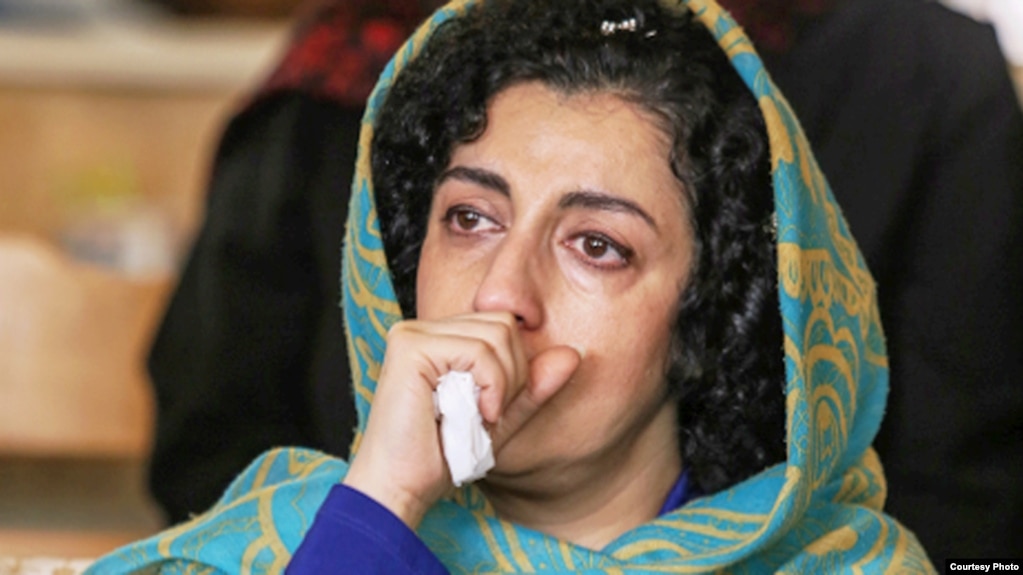
Narges Mohammadi has “serious health problems,” her brother says, but is not allowed out of prison to see a doctor.
Reporters Without Borders (RSF) has condemned the latest “absurd charge” brought against jailed Iranian journalist and human rights advocate Narges Mohammadi, who has been imprisoned since 2015. On 12 June 2020 RSF urged the UN special rapporteur on the human rights situation in Iran, Javaid Rehman, to “intervene quickly and do everything possible to obtain the release of Iran’s longest-held woman journalist.“
In a recent open letter to the Iranian judicial authorities, her brother revealed that she was now accused of “dancing in prison during the days of mourning” commemorating the seventh-century killing of Imam Hussein, a revered figure in Shi’ite Islam. Mehdi Mohammadi, now a refugee in Norway, also wrote that his sister had serious health problems but “was not allowed out of prison to see a doctor, who went to her cell.” “This persecution of Narges Mohammadi is evidence of judicial discrimination at the behest of the Intelligence Ministry and senior justice system officials,” said Reza Moini, the head of RSF’s Iran-Afghanistan desk.
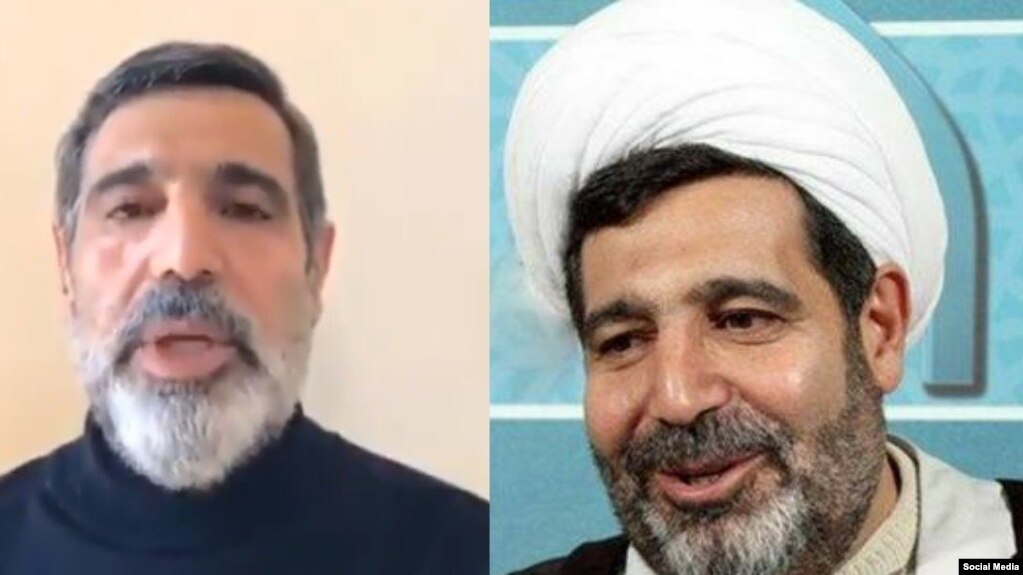
In the meantime there is also an interesting case of an Iranian judge and former prosecutor who was arrested in Romania by Interpol for rights violations (13 June 2020 Radio Farda)
Gholamreza Mansouri, Iranian judge and former prosecutor.
Iran’s Judiciary Spokesman confirmed that Interpol has detained Gholamreza Mansouri in Romania. He is accused of human rights violations by rights defenders, but he is also one of the defendants in a recent sensational corruption case in Iran who fled to Europe. Judiciary spokesman Gholam-Hossein Esmaili said Mansouri’s extradition is not possible now due to coronavirus restrictions but he will be returned to Iran and put on trial for corruption. He also told a local news network that Iran requested the arrest through the Interpol.
In a tweet on June 11, the Secretary-General of Reporters without Borders urged German authorities not to let him escape justice. Reporters without Borders (RSF) has supported the call of Iranian activists and filed a complaint with Germany’s Federal Public Prosecutor against Mansouri for the arrest and torture of at least 20 journalists in 2013….Mansouri is a highly influential prosecutor and judge notoriously famous for prosecuting journalists and putting them behind bars. In one instance in 2013 he ordered the simultaneous arrest of 20 journalists in one day.
Mansouri’s name came up as one of the recipients of bribes in the first trial session of Akbar Tabari, a former Judiciary deputy. The former judge allegedly received 500,000 euro in bribes from Tabari.
In a video published on social media on June 9, Mansouri claimed that he was abroad for treatment of a serious medical condition and could not return due to the restrictions introduced after the breakout of coronavirus. He did not reveal where he was but said he would go to an Iranian embassy to arrange for his return to defend himself against the corruption charges.
The number of environmental human rights defenders murdered across the world has doubled over the past 15 years, climbing above the number of soldiers killed in some conflict zones, research has revealed. Between 2002 and 2017, as many as 1,558 people across 50 countries were killed while defending the environment, according to a study published in the journal Nature Sustainability,“The supply chain of violence”.
That is more than double the number of U.K. and Australian armed service personnel killed while on active duty in war zones during the same period, the researchers emphasized. Since 2004, the recorded number of environmental defenders dying has risen from two per week to four per week. Most were killed due to conflict over natural resources….
“Environmental defenders currently face a wave of violence that includes threats of physical harm, intimidation and criminalization,” the authors wrote. “Deaths represent the ‘tip of the iceberg’ of the violence that environmental defenders face.”
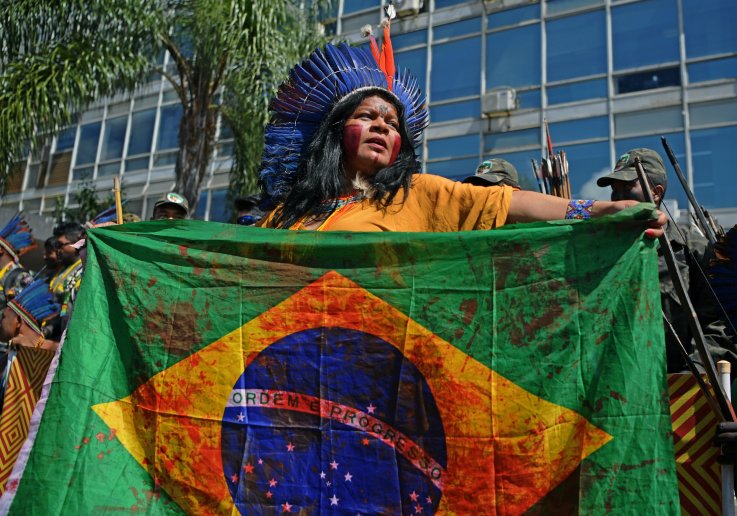
An indigenous woman holds a Brazilian national flag stained in red representing blood during a march in Brasilia on April 26, 2019, on the last day of a protest to defend indigenous land and rights. CARL DE SOUZA/AFP/Getty Images
In 2017, at least 185 activists were killed, with Indigenous peoples making up the biggest portion at around 30 percent, down from 40 percent in 2015 and 2016. At 36 percent, most deaths happened in Central America, followed by South American at 32 percent, and Asia at 31 percent. The most indigenous peoples died in the Philippines and Colombia between 2015 and 2017, with 36 and 22 deaths respectively. In 2017, 56 environmental defenders were killed in Brazil and 47 in the Philippines.
And the loved ones of victims struggle to seek justice, the authors said. Just over 10 percent of murders result lead to a conviction each year. This is likely due to corrupt police and authorities, who are sometimes involved in environmental devastation, and because murders are often carried out in remote areas. For instance, military and civil police are the main suspects after 10 land rights activists were killed in the city of Pau D’Arco, Brazil.
The researchers said the elections of populist leaders Jair Bolsonaro of Brazil and Rodrigo Duterte of the Philippines are a further cause for concern. Bolsonaro has called activists terrorists, and plans to relax gun and environmental protection laws, while the Philippines’ president “has taken a violent stance toward human rights defenders, Indigenous peoples, environmentalists, women, drug users and others,” the authors wrote.
..
Companies and consumers also have a responsibility to “investigate the sources of products, publish the results and commit to eliminating violence from supply chains,” the authors said. Co-author Dr. Nathalie Butt, a researcher fellow at the University of Queensland, Australia, School of Biological Sciences commented in a statement: “The number of reported deaths of environmental defenders has increased, as well as the number of countries where they occur.” Butt told Newsweek she was surprised that corruption was the key driver of the deaths, rather than the resources themselves. “As a lot of the resource demand is driven by international markets, consumers in countries in the Global North need to make sure they are aware of where their products come from, and how they were obtained, and demand (through pressure on supply companies) ethical and transparent supply chain processes,” she said.
Butt continued: “In many cases they [environmental defenders] are trying to protect environments that are important for everyone on the planet such as the Amazon, which is critical in terms of buffering climate change and carbon emissions.”
….Christopher Jeffords, associate professor in the department of economics at the Indiana University of Pennsylvania, told Newsweek: “These studies help shine a light on known instances of extreme violence committed against environmental defenders and thus help illuminate the notion that there are likely many cases which go unreported.” Eve Bratman, adjunct professorial lecturer at the American University Washington, D.C., School of International Service, told Newsweek: “The study tells us that the most important driving forces behind human rights abuses and the killings of environmental defenders are corruption and rule of law; when governments become more accountable, the benefits will likely be seen across the board. “In Brazil and several other countries, there is reasonable cause for concern that rates of violence will spike even higher given the dangers of today’s political climate.”
The Allard Prize for International Integrity (CAD $100,000) goes to an individual, movement or organization that has demonstrated exceptional courage and leadership in combating corruption or protecting human rights, especially through promoting transparency, accountability and the Rule of Law. For more information on this and other awards see: http://trueheroesfilms.org/thedigest/awards/allard-prize-for-international-integrity
On 26 May 2015, Nurul Izzah Anwar, Malaysian MP and daughter of imprisoned opposition leader Anwar Ibrahim, spoke at the Oslo Freedom Forum. In this video he describes how she was drawn into the opposition movement in Malaysia. She tells us about rampant government corruption, the country’s defunct judicial system, and how the government targets dissidents and attempts to limit change. Anwar explains how the lack of genuine parliamentary immunity prevents Malaysian politicians from speaking against the government. She reminds us that “Malaysia’s most wanted” are the activists that challenge the government, and expresses the hope that Malaysia’s future belongs to those seeking a more democratic and fair country.
Jamil Nasir, a graduate of Columbia University, wrote on 10 December 2014 a short piece on the link between human rights and corruption: “The corruption link”. The author concludes that “Human rights defenders should not consider themselves just as activists; similarly anti-corruption champions should also not limit themselves like that. A bridge needs to be built between human rights and anti-corruption activists.” The article follows below in full:
“The world celebrates ‘Anti-corruption Day’ and ‘Human Rights Day’ on December 9 and 10, respectively. Corruption and human rights are inextricably linked, but these linkages are not emphasised much in literature or discourse on corruption. The detrimental impact of corruption on economic growth and development is now well documented. It is a fact that corruption kills the incentive system, distorts technology choices, misallocates talent, promotes tax evasion and retards economic growth.And how does corruption impact human rights? First, it reduces the capacity of the state to protect, respect, and enforce its obligations with regard to the fundamental human rights enshrined in the social contract between the citizens and the state. For example, ‘access to justice’ and ‘security of life, property and honour’ are fundamental human rights. Can these rights be protected with a corruption-ridden judicial and police system? Our own current system is a pertinent example.Corruption in the judiciary and the police is not a secret in our country. When we talk of corruption in the judicial system, it does not mean prismatic decisions and judgements only. Granting adjournments to benefit one of the parties to a dispute is also corruption. When it comes to the police, corruption is not about flawed investigations but also non-submission of challans in the court on time. Consequently, the weaker party gets so disillusioned that it either does not pursue the case or enters into forced compromise.
Thus corruption affects fundamental rights as well as procedural rights like due process – the. right not to have undue delay in court proceedings and the right to a fair trial. Is it not corruption that has reduced the capacity of our state to enforce fundamental human rights? Have the court and police systems not become dysfunctional? Are these institutions not making the people poor rather than providing them quick justice?
This corruption lowers economic development and undermines poverty alleviation. The social contract obligates that the state should provide an environment where people can realise their full potential. Is such an environment possible without adequate resources with the state? Corruption reduces the level of revenues which consequently reduce the capacity of the state to fund basic social services. Again, Pakistan is a pertinent case. Due to corruption, tax evasion is rampant. Corruption also affects targeting of social programmes. If corrupt practices are pervasive, leakages in such programmes will usually be high. Anecdotal evidence suggests that the money allocated for various social spending and poverty alleviation programmes have not reached the intended targets. A substantial percentage of such funding was squandered away during the process of distribution. Further, targeting of the poor was riddled with nepotism and patronage.
Moreover, corruption enhances the operating costs of the government and reduces the resources available for social spending. The budget for the health and education sectors gets squeezed. It is an open secret now that the major chunk of the funds allocated for development of infrastructure like roads, schools and hospital buildings is eaten into by corruption in the form of commissions and kickbacks by the engineers, contractors and construction companies. And so corruption undermines development, deepens poverty and exacerbates other human rights violations.
Corruption can also violate human rights directly. If a corrupt judge takes a bribe to decide a case against an individual or a corrupt police officer takes a bribe not to properly investigate, that corruption directly violates human rights like the right to a fair trial. Corruption can manifest itself as the worst abuse of human dignity and rights.
One of the reports of Transparency International mentions a local public hospital in Zimbabwe whose nurses charged $5 every time the mother screamed while giving birth to a baby. This amount was charged as a penalty for raising alarm. Those women who were unable to pay the delivery fee were detained at the hospital until they had settled the debt. In this way, they were held hostage by the corruption prevalent in the hospital.
Corruption particularly targets the poor. For example, if a rickshaw driver or a street vendor pays a meagre amount of bribe (assume Rs100) to a policeman to avoid harassment, the impact on these poor chaps will be deep and severe since even Rs100 constitutes a major chunk of their daily income. It is not a big amount in absolute terms but it eats into their already tight budget. Compared with the daily income of the wage earners, the impact of this seemingly little amount can be well imagined on the household budget of the poor.
On the other hand, if a businessman pays – assume Rs100,000 – to a tax collector, he will get enormous personal benefit. But due to this collusion of the tax evader and the tax collector, millions of rupees will be dribbled through corruption. The taxes evaded due to this under the table deal, if properly collected, could be utilised for developing infrastructure, transfer payments or spent on poverty alleviation programmes.
This simple illustration shows that corruption adversely affects the poor. Second, it may also benefit the rich which is perhaps one explanation of the tolerance of the rich and the elite towards corruption in society. According to Professor Pranab Bardhan, corruption feeds on itself due to a variety of reasons. First, it is beneficial for the payer and the payee. Second, it is so entrenched that it becomes a self-fulfilling prophecy. Third, once corruption takes root in society, it is exceedingly difficult to eliminate.
It is time the discourse on corruption included the human rights perspective. A clear understanding between corruption and human rights can empower both human rights activists and those working against corruption. If linkages between corruption and rights become part of the narrative on corruption, attitudes will change. When people become more aware of the damage corruption causes to their fundamental rights, they are more likely to support campaigns against corruption. This new discourse can persuade key actors like judges, parliamentarians, lawyers, media and the public at large to take a strong stand against corruption. Connecting corruption to human rights violations means that acts of corruption can be challenged in a court of law as violation of fundamental human rights.
Weak human rights protection creates possibilities for corruption which also means that the promotion of human rights can be one of the tools against corruption. For example, promotion of the right to freedom of expression and information can go a long way in combating corruption in society. The right to information is critical in the fight against corruption.
Human rights defenders should not consider themselves just as activists; similarly anti-corruption champions should also not limit themselves like that. A bridge needs to be built between human rights and anti-corruption activists. This will be possible once the dots are connected and linkages between corruption and human rights are consciously explored for a joint struggle. Both human rights organisations and anti-corruption agencies should make a resolve to work together. The fight against corruption and the promotion of human rights are too important to be left to disjointed endeavours.”
An array of international human rights organisations have over the last weeks focused on Azerbaijan. These four reports together give a shocking picture of the kind of repression that awaits human rights defenders: Read the rest of this entry »

 Hans Thoolen on Human Rights Defenders and their awards
