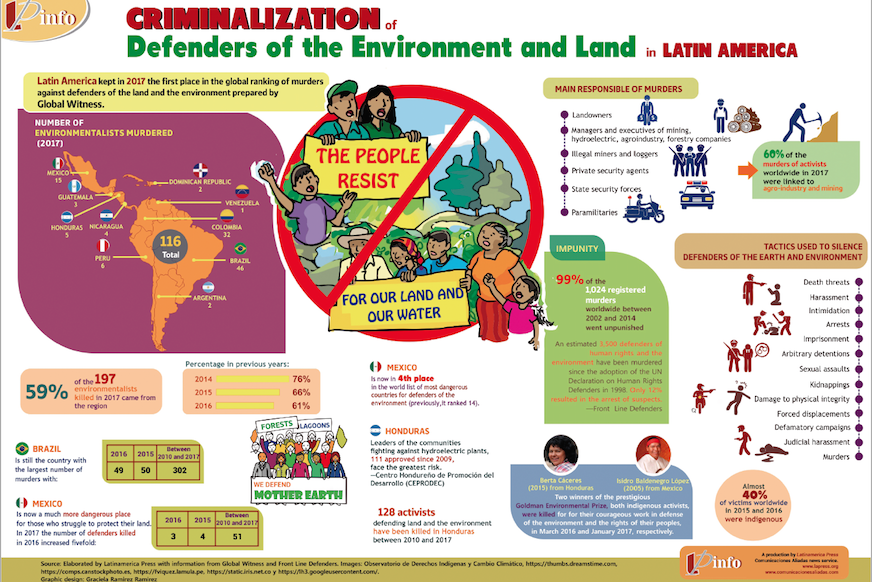
This blog has on several occasions drawn attention to reports that show that Latin America is among the deadliest places to be a human rights defender [e.g. https://humanrightsdefenders.blog/2016/01/06/latin-america-philippines-most-dangerous-places-for-human-rights-defenders/]. An infographic – published on 27 March 2018 by Latin America Press – summarises criminalization of land & environmental rights defenders in Latin America.
Posts Tagged ‘Colombia’
2018: Latin America still the graveyard for environmental human rights defenders
April 28, 2018Goldman environmental prizes in 2018 go to women human rights defenders
April 23, 2018
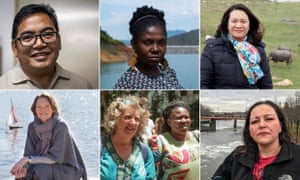
Goldman environment prize winners 2018: (clockwise from top left) Manny Calonzo, Francia Márquez, Nguy Thi Khanh, LeAnne Walters, Makoma Lekalakala and Liz McDaid, Claire Nouvian. Photograph: 2018 Goldman Environmental Prize
This year’s Goldman environmental prizes celebrate six remarkable success stories, five of them driven by women.
In Latin America, the winner is Francia Márquez, an Afro-Colombian community leader who led a 10-day, 350-mile march of 80 women from the Amazon to Bogotá that prompted the government to send troops to remove illegal miners who were polluting rivers with cyanide and mercury. [The dangers of environmental activism have been evident in the murder of two Goldman-prize recipients in the past two years: the 2015 winner Berta Cáceres and the 2005 winner Mexican activist Isidro Baldenegro López] “The first thing we need is to be more aware of the historical moment in which we find ourselves: the planet is being destroyed, it’s that simple, and if we do nothing to avoid it we will we will be part of that destruction,” Francia Márquez said. “Our time has come, we must act, we have a responsibility to future generations to leave a better world, in which taking care of life is more important than producing cumulative wealth.”
South African anti-nuclear activists Makoma Lekalakala and Liz McDaid, [see: anti-nuclear court ruling against former South African president Jacob Zuma]
Vietnamese clean-energy advocate Nguy Thi Khanh,
USA clean-water defender LeeAnne Walters, and
French marine-life champion Claire Nouvian.
Philippines anti-lead campaigner Manny Calonzo.
– see also: https://humanrightsdefenders.blog/2016/04/19/goldman-environmental-prizes-awarded-san-francisco-activists/
The three Child Rights Heroes for 2018 are announced
April 23, 2018Three Child Rights Heroes are honoured by the World’s Children’s Prize (WCP) 2018. Learn more about them by clicking their names below.
• Gabriel Mejía Montoya for his efforts over the course of more than 30 years to support Colombia’s street children, child soldiers and children in prison. Father Gabriel has suffered repeated attempts on his life because of his work.
• Rachel Lloyd for her 20-year fight against commercial sexual exploitation, CSEC, and domestic trafficking of girls and young women in the US. Rachel is a survivor of sexual and mental abuse during her childhood in England and exploitation in the sex industry in Europe.
• Valeriu Nicolae for his tireless struggle to protect the poorest and most vulnerable children in Romania’s Ferentari ghetto. Valeriu grew up in extreme poverty and was discriminated against because he was Roma.
The candidates were selected by a jury of children from 15 different countries. Rachel Lloyd has been elected Child Rights Hero by millions of young people. Gabriel Mejía Montoya from Colombia and Valeriu Nicolae from Romania get the World’s Children’s Honorary Awards.
20th anniversary: UN work on human rights defenders assessed by ISHR
April 17, 2018
UN country missions and human rights mechanisms have developed some good practice in regard to the protection of human rights defenders (HRDs) but there is still much to be done to ensure a coherent, coordinated and courageous response. ISHR submitted findings on some aspects of the UN’s work on HRDs, to the Office of the UN High Commissioner on Human Rights (OHCHR) following its call for input. At country level, ISHR – along with partners Colombian Commission of Jurists and Ligue Tunisienne for Human Rights – found positive practice by OHCHR in encouraging the State to implement the Declaration.
‘In Colombia OHCHR has contributed to a collective understanding of who defenders are and what institutional changes may be needed to counter attacks against them,’ said ISHR’s Eleanor Openshaw. ‘While in Tunisia OHCHR has developed a database to systematise the process of follow up on UN recommendations.’ In other contexts, guidelines to steer bodies and representatives in country are often vague, with no mention of the Declaration as a key UN standard.
‘UN Resident Coordinators need to have an understanding of the Declaration on HRDs so they can ensure the protection of defenders is effectively integrated into their work,’ said Openshaw. ‘There is a gap between developments in key human rights mechanisms and country responses.’
Whilst there have been some positive developments connecting different parts of the UN system – for example the new UN Environment focus on environmental defenders, developed with the Special Rapporteur on HRDs – there is a lack of an informed or coordinated response in others. This points to the need for comprehensive UN-wide policies on the protection of defenders.
‘Ensuring coherence and effectiveness throughout the UN system in regard to the protection of defenders requires a strong steer from the very top – the UN Secretary General,’ said ISHR’s Tess McEvoy. ‘We hope Mr Guterres will commit this year – the 20th anniversary of the Declaration– to providing such leadership.’ The Special Rapporteur on Human Rights Defenders, Michel Forst has spoken of attacks against defenders ‘multiplying everywhere’.
Openshaw also stated: ‘The dangers for defenders are known. The UN system has good practice to build on – and it must – to fulfil its role in encouraging and demanding States realise their obligations to defenders.’
Contacts: Eleanor Openshaw e.openshawATishr.ch; Theresa McEvoy t.mcevoyATishr.ch
http://www.ishr.ch/news/promising-patchy-un-work-human-rights-defenders
Insight into correspondence between NGOs and UK Foreign office about Colombia
January 31, 2018In his response from 17 January 2018, Minister Sir Alan Duncan wrote:
“[…] I share your concern about the increasing violence against human rights defenders in Colombia. As you mention in your letter, the UN Office of the High Commissioner for Human Rights (OHCHR) has confirmed that 73 social leaders were killed last year. It is verifying a further 11 cases. A disproportionate number of those killed are linked to disputes concerning land restitution. Some also appear to have been targeted for speaking out for the rights of local and indigenous communities. Please be assured that our Embassy in Bogota continues to monitor the situation on the ground closely.
As you know, Colombia is designated a Human Rights Priority Country by the Foreign and Commonwealth Office and protection of human rights defenders is a priority focus for our work. I regularly raise violence against human rights defenders during my meetings with Colombian Ministers and the Colombian Ambassador […]”
https://reliefweb.int/report/colombia/violence-against-human-rights-defenders-correspondence-fco
Read the letter that ABColombia sent and the full response by Minister Alan Duncan
How photographer Tom Laffay sees human rights defenders in Colombia
January 20, 2018
Cleveland Magazine talked with Laffay about the perilous work of defenders intent on protecting their native environment:
Q: In 2016, the Colombian government and the Revolutionary Armed Forces of Colombia signed a peace agreement. Since then, nearly 200 indigenous leaders, environmental activists, LBGTQ leaders and lawyers have been murdered in Columbia. Why?
A: It’s open season on human rights defenders in Columbia, who are being killed with impunity for documenting blatant oil contamination by companies using water in fuel extraction. With the rebels demobilizing, the country is open for business in areas they couldn’t be involved with before.
Q: Are you in danger for your associations with the local activists?
A: There are a lot of extremely talented and brave journalists here. I definitely take precautions and I make calculated risks. You have to really trust the people you’re with. I make sure I’m always in touch with the legal collective I work with and they always know where I’m going to be.
Q: What do you want people to take away from this exhibit?
A: These are men and women defending their communities and environment, and their rewards are arbitrary arrests, fake judicial processes and death. The landscape has become so dominated by the oil industry. … Oil extraction comes first and communities are a distant second. ..
Front Line’s 2017 report confirms worst expectation: over 300 HRDs killed
January 5, 2018At the end of last year I published the post: https://humanrightsdefenders.blog/2017/12/31/2017-a-year-to-forget-for-human-rights-defenders-but-dont-forget-the-human-rights-defenders/, and now – 3 January 2018 – Front Line Defenders has published its 2017 report which confirms this impression.

Front Line Defenders said female human rights defenders in particular are increasingly reporting “hyper-sexualised smear campaigns and defamation” which aim to limit their activism by eroding local support networks. File photograph: Getty Images
There were 312 human rights defenders killed in 27 countries last year, according to the new report. Two-thirds of those killed were activists working on issues of land, environmental and indigenous peoples’ rights, while 80 per cent of killings took place in just four countries – Brazil, Colombia, Mexico and the Philippines. Front Line Defenders said the number of killings remained “truly shocking”, while the “weak response of both national governments and the international community gives little hope that this will change in the short term”. The report outlined that in 84 per cent of killings the defender had previously received a threat.
Andrew Anderson, executive director of Front Line Defenders, said “we know that those killings, in many cases were preventable”. “When we analyse those killings, in 84 per cent, the defendant had previously received a threat, and that highlights if there had been effective action taken by the police or other authorities, there could have been something done to prevent that killing happening.” Mr Anderson added: “These are not random killings of people in crossfire – This is the targeted elimination of people who are working to defend the rights of the most vulnerable.
Front Line Defenders said female human rights defenders in particular are increasingly reporting “hyper-sexualised smear campaigns and defamation” which aim to limit their activism by eroding local support networks.
Colombia: 2017 marks one year of peace effort but human rights defenders still suffer
December 31, 2017The Bogotá Post of 24 November 2017 summarizes the situation in the following rather factual manner: “One year since the signing of the peace agreement with the FARC, and – as was to be expected – there have been a number of ups and downs in post-conflict Colombia. But while there are plenty of challenges, there are also a lot of people throughout the country working to address them.” Re the killing of activists it says: “The October protest violence in Tumaco was a reminder of the ongoing turbulence in the troubled region, which has the highest amount of coca production in the country. It highlighted both the issues surrounding forced coca eradication and the increased presence of armed groups and paramilitary activities as rival gangs compete to fill the vacuum left by the FARC. CINEP, a peace NGO, identified the presence of Clan Úsuga, Clan del Golfo, Clan Pacífico, La Empresa, Gaitanistas, Gente del Orden, Cártel de Sinaloa and Guerrillas Unidas del Pacífico in the region this year. A number of national and international NGOs have expressed serious concern about the killings of social activists and community leaders. On November 17 the UNHCR expressed growing concern about the increase in murders and threats. According to their figures, there have been 78 deaths this year and 13 suspected murders. In addition, at least 1,500 people have been displaced by threats and violence in 2017, although the report says the number may be higher because people are afraid to report abuses.
What’s being done? A landmark constitutional reform to prohibit neo-paramilitarism has been approved by congress, and recent military strikes targeting these groups have been successful in capturing some of their most influential leaders. Although steps to indict those responsible for killing social leaders have been made (54 indictments so far, according to President Santos), more long-term measures are needed. To that end, the government has established a national commission for security guarantees, but it has been slow to respond to the increasing dangers in affected regions.”
TeleSur reported on 21 December that “earlier today a community leader in Puerto Colombia, Putumayo was murdered along with his eight-year-old daughter. Pablo Oviedo was walking with his daughter and both were ambushed by a group and shot multiple times. The two were rushed to San Francisco de Asis Hospital in Puerto de Asis and declared dead.
Oviedo’s two brothers who are involved in the Human Rights Network in southern Colombia were also declared missing. The tragic death of father and daughter occurred hours after Colombian Defense Minister Luis Carlos Villegas had participated in security council meeting with the purpose of addressing the violence in the southwestern city of Mocoa. Social leaders present at the meeting wore masks to cover their faces in an attempt to avoid being swept away in the wave of violence.”
At least the UK Parliament took notice with “Early day motion 718”: ‘That this House notes with concern the increased risks faced by human rights defenders and community leaders in Colombia since the signing of the peace agreement with the FARC, and in particular the recent killings of land restitution leaders, Mario Castaño Bravo and Hernán Bedoya; is deeply disturbed that according to the United Nations High Commissioner for Refugees 78 defenders have been killed in the first 11 months of this year; further notes the vital importance of the work of human rights defenders in Colombia, and elsewhere; and calls on the Government to strengthen its efforts, bilaterally and through the EU, to protect human rights defenders and civil society leaders in Colombia, and to support and monitor the implementation of the peace agreement between the Colombian Government and the FARC.”
http://www.ohchr.org/en/NewsEvents/Pages/DisplayNews.aspx?NewsID=22215&LangID=E
and
———
https://thebogotapost.com/2017/12/04/pieces-of-peace/
Nobel Peace Prize 2016 has strong peace content
October 8, 2016The Nobel Peace Prize for 2016 is very much a traditional and clear ‘peace’ award. The news can be found in all mainstream media. So for the record, and in the words of the Norwegian Nobel Committee: “The Norwegian Nobel Committee has decided to award the Nobel Peace Prize for 2016 to Colombian President Juan Manuel Santos for his resolute efforts to bring the country’s more than 50-year-long civil war to an end…” That the referendum rejected the proposal does not diminish the serious effort made (and perhaps shows the risk of calling referendums where ‘anger’ of different kinds tends to favor any response that has a NO element in it).
For last year’s see: https://thoolen.wordpress.com/2015/10/13/more-on-the-tunisian-winners-of-the-nobel-peace-prize/