Brazil’s “Piripkura” has won the Amsterdam Human Rights Award at this year’s International Documentary Film Festival Amsterdam (IDFA). Recognition for a devastating chronicle, the award comes with a cash prize of €25,000. The jury said of the film: “With this poignant, exceptional story, the filmmakers tackle a broad series of issues that should be high up on the international human rights agenda. The filmic quality of this documentary left us no choice but to award the Amsterdam Human Rights Award to ‘Piripkura.’”The film was produced by Brazil’s Zeza Filmes with Maria Farinha Filmes and Grifa Filmes as associate producers.
“Piripkura,” is a a modern-day ethnographic documentary with distinct differences from its scholarly predecessors. Ethnographic filmmaking started with voyeuristic or educational intentions, as an attempt to show the world something it had never seen. Perhaps it says something about the modern world that these films are now made in the spirit of conservation.
[The film follows Jair Candor, an official with Brazil’s indigenous affairs agency FUNAI, as he ventures into one of the Amazon’s protected indigenous lands, Piripkura. Only three Piripkura tribe-members are still alive today, and only two in their native land. The third, Rita, was forced to flee the lands when logging companies sent in mercenaries to kill the tribespeople, and thus lift government protections of the area. Rita accompanies Candor on his initial visits to confirm the continued existence of Pakyî and Tamandua, the last remaining Piripkura, an undertaking which must be done to sustain the areas protected status. Beyond the inherent dangers of living in the Amazon; corporate farms, fires, logging companies and massive budget cuts to aid agencies are constant threats to the two men.]
Columbia University has opened 2018 prize nominations for judicial services and legal decisions supporting freedom of expression. What is a bit special about these awards is that they go to ‘court rulings” and “legal services” in the area of freedom of expression.
The Global Freedom of Expression initiative at Columbia University in New York City has opened nominations for its 2018 global prizes, which recognize judicial decisions and legal services strengthening freedom of expression through the promotion of international standards.
The initiative “seeks to advance understanding of the international and national norms and institutions that best protect the free flow of information and expression in an inter-connected global community with major common challenges to address.” It awards the Global Freedom of Expression Prizes, which began in 2014, every two years. “We believe that at a time when freedom of expression is threatened at a global level, there is a particular need to celebrate the victories in defense of this fundamental right”. Individuals and organizations, particularly jurists, academics and non-governmental organizations dedicated to freedom of expression, are invited to nominate court decisions or legal services from anywhere around the globe that “have had a recognizable impact on freedom of expression.” There will be separate prizes for “Court decision” and “Legal Service.” In the Legal Service Category, the awards will consider legal briefs, amicus briefs, academic or other publications.
Nominations will close Jan. 31, 2018 and winners will be announced March 13. Forms are available in both English and Spanish.
Members of the Awards Committee are: Lee C. Bollinger, President of Columbia University; Catalina Botero, former Special Rapporteur for Freedom of Expression of the Inter American Commission on Human Rights of the Organization of American States; Nicolas Bratza, former President of the European Court of Human Rights; Lydia Cacho, journalist, human rights defender and author; Agnes Callamard, Director of the Columbia Global Freedom of Expression initiative; Sarah Cleveland, Louis Henkin Professor of Human and Constitutional Rights and member of the UN Human Rights Committee; and Irene Khan, Director-General of the International Development Law Organization.
This blog tries to follow as much as possible what happens in the world of human rights awards which honor human rights defenders. Here is a story from Belize where an award (as in reward) is used in a different way: A reward is offered for the capture of Albert Cattouse’s killer!
Around seven-thirty on Thursday night, shots rang out in the vicinity of Dolphin Street near the rear of Roger’s Stadium. A well-known taxi driver and activist had been gunned down in cold blood. Seventy-two-year-old Albert Anthony Cattouse was driving his Lincoln Town Car when he was targeted by a gunman. The bullet caught him in the head and he died instantly inside his taxi, which came to a stop inside the drain. The activism community is up in arms because Cattouse, who was very vocal, recently participated in the high gas price protest last week (News Five’s Duane Moody reports).
The community activist group, Belize Leaders for Social Justice (BLSJ), is offering a $5,000 reward for information leading to the arrest and conviction of the person responsible for the murder of Albert Cattouse. The BLSJ issued a statement today, condemning Cattouse’s murder, noting that he was a defender of human rights. “The activism community and human rights defenders are concerned that this murder can be related to Mr. Cattouse’s outspoken condemnation for acts of corruption and the injustices levied on our citizens by the government of Belize,” the group said.
Today, 27 September 2017, Geneva-based True Heroes Films (THF) unveils it new Digest of Human Rights Awards.
In order to assist in accessing the growing number of human rights awards THF launched its unique Digest of international and regional human rights awards. The Digest of Human Rights Awards is an online searchable database hosted on True Heroes Films’ website (www.trueheroesfilms.org/thedigest). It not only allows anyone to find out information about the almost confusing number of awards, but also permits human rights defenders and their supporters to quickly find the right award for them. Users can search the awards by theme, geographical focus, whether they accept public nominations as well as other information such as the deadline for submissions. Links to the awards’ external websites are also provided.
The Awards Digest is the first phase of a larger project that foresees a Digest of Laureates(over 1900 award winners included in the Awards Digest). This second phase is still under preparation and its completion is planned for 2018, subject to funding.
The Digest is also accessible on any device including mobiles and tablets.
The Digest has been made possible with the support of Brot für die Welt and the Permanent Mission of the Kingdom of the Netherlands in Geneva and other international organizations in Geneva.
For further information contact me at thedigest[at]trueheroesfilms.org or Jo Maxwell-Scott[at]trueheroesfilms.org (mobile +41 78 842 3403).
Farah Jamil published on 10 July 2017 a blog post “The Richest Poor Man” recalling the life of the great humanitarian Abdul Sattar Edhifrom Pakistan. Leading humanitarian and the most endearing person in the country. ‘Edhi’ left us at the age of 88 last year on July 8. He had been suffering from kidney failure since 2013 and was on dialysis. Edhi dedicated his life for the welfare of the poor irrespective of their caste, class and creed and that’s what makes him an asset for the whole universe. “He was not only an asset for this country but for the whole humanity because of his selfless work”.
It was in 1974 when a formal institution by the name of Edhi Foundation was set up. …..with more than 1,800 ambulances stationed across Pakistan, the Edhi Foundation is Pakistan’s largest welfare organization. In 1997, the foundation entered the Guinness World Records as the “largest volunteer ambulance organization”. The Edhi Foundation’s slogan is: “Live and help live”.….
Edhi Sahab received many national and international awards included the Ramon Magsaysay Award for Public Service, Lenin Peace Prize, Hamdan Award for volunteers, Peace and Harmony Award (Delhi), Peace Award (Mumbai), Gandhi Peace Award (Delhi), UNESCO-Madanjeet Singh Prize.
Throughout his life, Edhi sahab set examples for the world to follow through his actions. He was a simple man with a heart of gold. He slept in a windowless room adjoining the office of his foundation furnished with just a bed, a sink and a hotplate.…..
His last words were:
–Bury me in same clothes, donate all my body parts, and make sure my clothes are distributed among others.
—Take care of the poor people of my country.
…….Edhi sahib, you indeed were the richest poor man!
Saturday, 27 May 2017 jailed UAE lawyer Mohammed al-Roken was announced as the winner of the Ludovic Trarieux Award. This award is given by the Luxembourg-instigated European Bar Human Rights Institute (IDHAE), and is named after Trarieux, who in 1898 founded France’s Human Rights League. The annual award, worth 20,000 euros, recognises lawyers who have sought to defend human rights, often at great risk to themselves. [https://humanrightsdefenders.blog/2016/06/07/detained-chinese-lawyer-wang-yu-wins-ludovic-trarieux-prize/]
The Emirates lawyer was sentenced to 10 years in jail in 2013. Mohammed al-Roken was among 69 people jailed on charges of conspiring to overthrow the government following a mass trial criticised by rights groups. A former head of the UAE Jurists’ Association, Roken, 54, was arrested in July 2012, after taking on the defence of several government opponents, including seven islamists. According to Amnesty the trial “was marred by allegations of torture which were blatantly ignored, the rights of defence were flaunted, and independent observers were banned from the court room“. For more on the Emirates and human rights: https://humanrightsdefenders.blog/tag/united-arab-emirates/
In awarding the Jury said Roken had devoted two decades to defending fundamental freedoms. The jury lamented that Roken’s trial had gone ahead behind closed doors and demanded his immediate release.
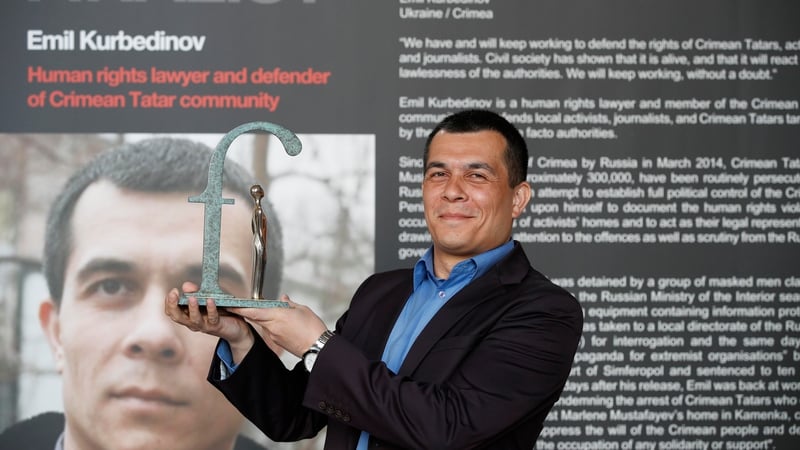
Emil Kurbedinov said ‘Winning an acquittal for my clients is almost impossible – but what I can do is show them that, despite the risks, I will not abandon them’
Emil Kurbedinov was at the ceremony in Dublin’s City Hall this morning to receive the Human Rights Defender At Risk award for 2017. According to Front Line Defenders, which has its global headquarters in Blackrock in Dublin, defending human rights activists and political prisoners in Crimea is some of the most dangerous work that any lawyer can undertake. Despite those risks, Mr Kurbedinov has spent years providing emergency legal response for the Crimean Tartar minority, which it maintains has been persecuted by Russian authorities.
In January of this year, Mr Kurbedinov was detained by representatives of Crimea’s Centre for Counteracting Extremism while on his way to represent a client whose house had been raided by police. A district court later sentenced him to ten days in detention on a charge of “propagandising for extremist organisations“.
The Executive Director, Andrew Anderson, said: “In the midst of a global crackdown on human rights defenders, the five finalists demonstrate the will to persist in the face of severe, often life-threatening risks.”
Anna Neistat, Senior Director of Research at Amnesty International, writes in the Huffington Postof 23 February 2017 about 4 Human Rights Defenders who deserve a “Lifetime Achievements” Oscar. Since it’s awards season, Amnesty International is paying tribute to four human rights heroes whose dramatic stories could – and should – be made into movies:
Itai Peace Dzamara
It’s been almost two years since Zimbabwean journalist and activist Itai Peace Dzamarawas dragged from a barbers’ chair by five armed men while he was getting a haircut. Dzamara, the leader of a pro-democracy movement called “Occupy Africa Unity Square”, had long been considered an enemy of the state by the Zimbabwean government. Just two days before his abduction he had delivered a speech at an opposition rally in Harare, calling for mass action against the deteriorating economic conditions in Zimbabwe. If this were a movie, justice would have been done long ago. Dzamara would have been returned to his wife and children, and the men who abducted him held accountable. But this isn’t Hollywood. This is Zimbabwe, where basic rights and freedoms have been trampled on throughout the long years of Robert Mugabe’s reign. As Itai Peace Dzamara and his family know, anyone who dares to speak out is a target for intimidation, harassment and arrest, and there’s no happy ending in sight. Despite a court ruling ordering state security agents to investigate Dzamara’s disappearance, there were gaps in the investigation and his whereabouts remains a mystery. [https://humanrightsdefenders.blog/2015/05/05/itai-dzamaras-disappearance-worrying-for-all-human-rights-defenders-in-zimbabwe/]
Berta Cáceres
GOLDMAN ENVIRONMENTAL FOUNDATION
Like the audience of a horror movie, the people around Berta could see that terrible danger was coming her way – but they were powerless to stop it. Honduras has the highest number of killings per capita of environmental and land activists in the world. The vast majority of these killings go unsolved and unpunished. One story that really stands out in this deadly context is that of Berta Cáceres. Berta was the leader and co-founder of an organisation that was campaigning against the construction of a hydroelectric project on the ancestral lands of indigenous communities in Honduras. In the early hours of 2 March 2016, she was murdered in her own home. Berta knew that she was putting her life in danger, but she was willing to take the risk to stand up for indigenous communities. Like the audience of a horror movie, the people around Berta could see that terrible danger was coming her way – but they were powerless to stop it. Despite the stark warning that her death served, environmental activists in Honduras say that stopping their work is not an option – no-one else will defend their communities and rights. They continue Berta’s work every day, reminding us that we should never take freedom for granted. It is essential that Berta’s assassination is solved, to show that there is a price to pay for attacking and killing environmental activists. Berta’s story ended in tragedy, but we will not stop fighting until we are sure that other activists will not meet the same fate. [https://humanrightsdefenders.blog/2016/03/07/exceptional-response-from-ngo-world-on-killing-of-berta-caceres/]
Sirikan Charoensiri
Sirikan Charoensiri, also known as “June”, is a young lawyer who has bravely stood up for human rights during a dark period of military rule in Thailand. In June 2015, she was on hand at a peaceful protest by pro-democracy student activists in Bangkok to monitor the situation and provide legal representation, if necessary. She now finds herself facing sedition charges and a potential trial in a military court alongside her clients. She also faces charges in two additional cases relating to her defence of the student activists and could be imprisoned for up to 15 years. As the Thai authorities have escalated their crackdown in the name of security, people who stand up for human rights in the country are increasingly falling foul of a government intent on silencing dissent. As June herself put it: “There is now an environment where risk is visible and imminent.” [https://humanrightsdefenders.blog/2016/12/01/international-day-of-women-human-rights-defenders-agents-of-change-under-pressure/]
Narges Mohammadi
Narges is a prisoner of conscience who should be lauded, not locked up, for her human rights work. In Iran, human rights defenders and other peaceful critics are subject to relentless harassment. Over the past year, those jailed after shockingly unfair trials before Revolutionary Courts including lawyers, bloggers, students, women’s rights activists, filmmakers and even musicians. Human rights defender Narges Mohammadi knows better than most how vengeful the Iranian authorities can be towards anyone who dissents. She is currently serving a total of 22 years in prison for speaking out against issues such as Iran’s prolific use of the death penalty and acid attacks on women. What makes her situation even worse is that she is critically ill and cannot receive proper medical care in prison. Just as cruelly, the authorities have at times denied her access to her young children, who had to leave Iran to live with their father in France after she was jailed. Narges is a prisoner of conscience who should be lauded, not locked up, for her human rights work. We will continue to fight until she is free.[https://humanrightsdefenders.blog/2014/06/12/retaliation-against-iranian-human-rights-defender-for-meeting-with-ashton/]
Itai, Berta, Sirikan and Narges are just a handful of the outstanding human rights defenders around the world who deserve recognition, but have instead been silenced by forces of cruelty, injustice and repression.
2016 Human Rights Award Laureates: Andrea James and Glenn E. Martin (United States)
The Robert F. Kennedy Human Rights Award invites nominations of human rights defenders who are leading efforts to secure dignity for all people, especially those who have demonstrated an ongoing commitment to bringing justice and human rights to the people who need them the most, despite serious personal risk or sacrifice. Robert F. Kennedy Human Rights often forges strategic partnerships with the recipients of the Award and for this reason it is important to nominate someone who could find the support of Robert F. Kennedy Human Rights useful. For last year’s award see: https://humanrightsdefenders.blog/2016/12/14/2016-rfk-human-rights-award-went-to-two-criminal-reform-advocates-in-the-usa/Read the rest of this entry »