This interesting story starts in February 2011 with a peaceful demonstration against deaths of pregnant women at the Huruma Nursing Home, a hospital serving Huruma, one of the major slums in Nairobi. Two human rights defenders, Ruth Mumbi and Ms Victoria Atieno, were accused of incitement to violence. Their case has dragged on for 2 years with at least 5 adjournments triggered by the absence at the trial of the administrator of Huruma Nursing Home, both a key witness and complainant. During the latest hearing on 21 February 2013, the administrator of Huruma Nursing Home turned up at the Court. However, this was a new administrator who replaced the person who managed the establishment at the time when the protest took place. As the judge raised questions about this change of witness, the administrator responded that the sole purpose of his presence at Makadara Law Courts was to present Huruma Nursing Home’s desire that the case be dismissed! The judge interestingly decided to allow the accused human rights defenders to express their opinion on it. On 26 February 2013 (tomorrow), Ruth Mumbi and Victoria Atieno hope to tell how they were victims of malicious prosecution and file a lawsuit to claim damages. And on top of this a great occasion to alert the public about poor health services!
The HURIDOCS network publishes a Newsletter with many items that are of importance to Human Rights Defenders. The latest issue carries e.g. interesting news on access to human rights case law from the Asian and American scene. In the future it should be possible to have on-line access to the case load of these regional systems which until now are very difficult to find. Connecting these two databases in the future will be possible, but only if they are built on common standards. Developing these is a core function of HURIDOCS as illustrated by an interview with Judith Dueck who has been involved in standard formats for almost 25 years (Judith Dueck looks back upon how it was done).One reason to refer to this article of course the youth picture of me (from 1988) they added!
To get the HURIDOCS newsletter free every 15 days subscribe via the homepage: http://www.huridocs.org/
Bukeni Waruzi – just back from a field trip to Kenya – posted an excellent piece on “Witness‘ blog on 23 February under the title “Can Cell Phones Save Kenya’s Elections?. Here some excerpts:
The December 2007 elections were marred by unprecedented violence: killings, rapes, lootings, attacks on civilians, and massive displacement. Historically peaceful, Kenya devolved into violence that caught many unprepared—including human rights activists who were unable to use video to document the magnitude of what was happening.
The InQuirer from Monrovia reports on 21 February 2013 that Search For Common Ground (SFCG) has launched a new project in Liberia. According to Oscar Bloh, Country Director of SFCG, the project is being launched in Lofa and Bong Counties, two of Liberia’s most populated counties, with the aim of encouraging the authorities to protect and promote human rights in the country. According to Bloh, now that the 14-year war has ended with a democratically elected government, the protection of human rights and access to justice should be key factors in promoting good governance in the country. The organization is working in partnership with the Independent National Human Rights Commission of Liberia, the United Nations Mission In Liberia UNMIL, the Government of Liberia (through the Ministry of Justice) and the European Union in implementing the project which targets about 80,000 citizens. He said the SFCG will work with county authorities, including the police, to engage society and stakeholders by explaining the rule of law. Giving an overview of the project, Mr. James Yarsiah, Executive Director of the partner NGO ‘Rights and Rice’ said the protection of human rights is cardinal to the national transformation in Liberia explained that the activities under the project include the training of local rights activists, providing skills for selected civil society organizations and empowerment of the citizens. The Executive Secretary of the Coalition of Human Rights Defenders, Daniel H. Allison, said over the past fifteen years Liberia has become a violator of human rights despite the election of a democratically elected government. He called on the Ellen Johnson-Sirleaf led administration to exert every effort to stop human rights violation in the country. This may not be earth-shaking news but is a nice example of the myriad of local projects that are going on.
Human Rights Watch issues a video and press release concerning a series of death threats made over the last four months to two lawyers who represent clients accused of homosexual conduct. Human Rights Watch on 13 February 2013 sent an open letter to President Paul Biya. Read the rest of this entry »
Having just today reported on the new human rights defenders network created in the Arab world, I would be amiss not to draw attention to the developments of an already existing network in Africa. On 4 February 2013 the Pan-African Human Rights Defenders Network (PAHRD-Net) officially launched from Kampala, Uganda, a 3-year programme totalling 1.8 million Euros to promote a safe legal and working environment for human rights defenders (HRDs) across Africa.
“The tireless and innovative work done at the sub-regional level to protect human rights defenders will now have a dedicated venue at the Pan-African level for mutual support and reinforcement,” said Hassan Shire Sheikh, Chairperson of PAHRD-Net and Executive Director of the East and Horn of Africa Human Rights Defenders Project (EHAHRDP). Today’s launch is the result of a process started in 1998 in Johannesburg (All-Africa Human Rights Defenders Conference) and renewed in 2009 at the follow-up meeting in Kampala.
PAHRD-Net brings together the five sub-regional human rights defenders networks in Africa (the Central African HRD Network, the East and Horn of Africa HRD Network, the North Africa HRD Network represented through the Cairo Institute for Human Rights Studies, the Southern Africa HRD Network hosted by the International Commission for Jurists, and the West African HRD Network) to meet the protection needs of human rights defenders and especially to address the needs of the five groups of most-at-risk: journalists fighting to end impunity and corruption, women human rights defenders, defenders working on issues of sexual orientation and gender identity, HRDs working under oppressive regimes or in armed/post-conflict areas, and HRDs engaging with the resource extraction industries.
Human rights defenders are individuals working alone or through organizations under the goal of promoting respect for universal human rights norms. Frequently HRDs come into conflict with the entrenched local power structures of state and non-state actors through their activism. This conflict can put in jeopardy the security of the HRD and their work and family networks. HRDs are often the victims of harassment, threats, assault, injury, and death across Africa, and many are forced into exile, a move which may effectively end their advocacy for human rights. The consolidation and growth of protection mechanisms within the sub-regions will improve the responses available to mitigate these threats and develop HRDs’ ability to manage their own security effectively.
The European Commission supports the new programme under its global fund for Democracy and Human Rights, which is to underpin the implementation of the European Union Guidelines on Human Rights Defenders
Joseph Bikanda – Coordinator, Pan African Human Rights Defenders Network: Tel +256-312-202133, +256-312-265825, or panafrica@defenddefenders.org
Rachel Nicholson – Advocacy Officer, East and Horn of Africa Human Rights Defenders Project: Tel +256-312-265-824, +256-778-921274, or advocacy@defenddefenders.org
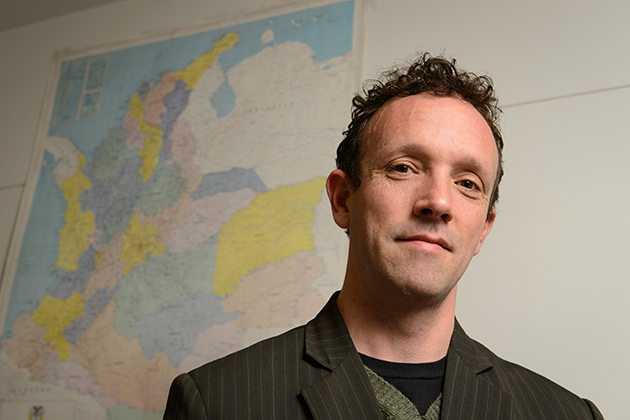
When writing about individual Human Rights Defenders the tendency is to give attention to those in the front line who are in immediate trouble. This time I want to refer to a HRD teaching at the University of Connecticut based on a blog post by Kenneth Best of 30 January 2013. It concerns Luis van Isschot, an assistant professor of history, who specializes in the study of human rights in Latin America ( photo by Peter Morenus/UConn Photo).
Conversation around the dinner table in the van Isschot home in Montreal was a bit different than in most Canadian homes. Growing up with a Spanish, Peruvian, and Dutch family heritage, Luis van Isschot listened to discussions about Latin American history and politics led by his father, a physician who treated families in a clinic based in Montreal’s Latino community…….
…His path to a doctoral degree developed from his volunteer work in Guatemala and later in Colombia, where he served as a human rights observer. It was during his time in Colombia that a friend who was a university professor and a historian told him that one of the most important books of Colombian history was written by a professor from his hometown of Montreal, Catherine Le Grand at McGill University, and that he should look her up. He did, and it led to his enrollment in the doctoral program. “She made it seem that you could be a wonderful teacher, a cutting-edge scholar, and have a balanced life of engagement in your community, and that the Ph.D. was a way of doing that,” van Isschot says. “The university is central to the community, not apart from it. That makes sense to me.”
He later became involved with MEA Laureate 2001 Peace Brigades International, a nonpartisan organization that sends international volunteers to areas of conflict to provide protective accompaniment to human rights defenders threatened by political violence in 11 nations, including in Asia, Africa, and Latin America. In addition to serving as a human rights observer in Colombia, he also traveled to the Great Lakes Region of Africa, doing research in the Democratic Republic of Congo, Rwanda, and Burundi.
“It was a really important experience for me to go somewhere where the language of human rights and social justice and the understanding of history really enriched my own understanding of what I was working on in Latin America,” he says. His experience in Colombia led him to focus his doctoral studies on human rights activities in that nation’s oil capital, Barrancabermeja, where he lived for a year. The city was the center of a major urban war between Colombian paramilitary groups and leftist guerillas. Between 1998 and 2002, in a city of 300,000 there were about 2,000 violent murders. “It was a devastating period. The relationships I made with Colombian human rights activists, teachers, and scholars convinced me that I needed to find some place to explore the issues,” he says.
His book, The Social Origins of Human Rights: Protesting Political Violence in Columbia’s Oil Capital, 1919-2010, is near completion, and scheduled to be published in early 2014. His new research project is titled “When the Courts Make History: the Impact of the Inter American Court of Human Rights in Latin America’s Conflict Zones,” and examines the historical changes set in motion by the pursuit of justice across borders.
Sudanese teacher and activist Jalila Khamis Koko, who was arrested by the National Security Service in March 2012, was released from detention after a court hearing on 20 January reports Amnesty International.
Jalila was acquitted of all charges except those related to “spreading false news”, a vague provision of the criminal code often used by the government to silence dissent. It is punishable by six months in prison, but the court released her since she had already spent nine months in pre-trial detention. “Jalila’s release is victory for justice but the nine months that she has spent in detention simply for expressing her opinions cannot be ignored,” said Audrey Gaughran, Amnesty International’s Africa program director. “The government must also ensure that she is able to return to her teaching job from which she was unfairly dismissed during the course of her detention.”
Somewhat different from the Observatory’s report on Zimbabwe I referred to in my post of 26 November 2012, this report by a broad coalition of local NGOs (listed at the end of the document) paints a more mixed picture. The report of the Zimbabwe NGO Human Rights Forum covers the period September to december 2012.
After reflecting on the deadlock in the constitution making process, the report documents the continuing harassment of civil society and political activists that characterised the period. The operating environment for NGO’s continued to be very challenging. Police arrested and ill-treated peaceful protesters, especially the Women of Zimbabwe Arise activists. Other organisations that faced raids and arrests included the Gays and Lesbians of Zimbabwe, the Counselling Services Unit and many other civil society organisations offering vital services to vulnerable Zimbabweans. Human Rights lawyers were hampered at every turn as they tried to carry out their professional duties and protect Human Rights Defenders.
Fears of the same levels of political violence that characterised the 2008 election period were re-ignited when President Mugabe announced to the UN General Assembly that there would be a constitutional referendum in November 2012 and harmonised elections in March 2013. The news was greeted with great concern. In September 2012, the Zimbabwe Election Support Network stated that it would be logistically impossible to hold a referendum in November and elections in March. They cited disputes in finalising the new constitution, continuing political intimidation and gross inaccuracies in voters’ lists that still name ‘ghost’ electors who have long been dead. The organisation called for a number of important issues to be dealt with first. These include resourcing the Zimbabwe Electoral Commission, revision of the outdated Referendum Act and effecting technical changes to the Electoral Bill as well as updating and cleaning the voter’s roll. This led to the passing into law of the Zimbabwe Human Rights Commission and the Electoral Amendment acts.
Sadly as 2012 drew to a close the Annual ZANU PF Congress rang a warning bell against NGO’s and, as if nothing had ever changed, within days, the police began wantonly raiding and arresting human rights organisations all over again.
Despite the setbacks narrated above, it is our view that Zimbabwe is in a better place today than it was 2008. All the credit is due to the Human Rights Defenders who have tirelessly worked on the ground as well as our regional and international partners and without whose input the country could have descended into lawlessness. The attainment of democracy is a process not an event and indeed Zimbabwe is currently in transition although that transition is fraught with unnecessary detours and compromises. However such compromises, disappointing as they may be in the short run, may aid the transitional process in the long run. A case in point is the limited temporal jurisdiction of the Zimbabwe Human Rights Commission and Zimbabwe’s failure to ratify the Rome Statute.
Ironically a focus on ratification of the Rome Statute for some countries in transition can impede the chances of a peaceful transition. In other words whilst Zimbabwean civil society is absolutely committed to ratification, that long-term necessity should also not derail the process of transition, and this indeed calls for a judicious balancing act. ‘In other words it was important not to allow perfection to become the enemy of the good.’
“The Cause of Progress” tells the story of the lives of three Cambodians caught up in the country’s chaotic and often violent economic progress, set against the backdrop of the shifting political, religious and familial landscapes of modern-day Cambodia. Shot over the course of three years, the film is a unique and intimate portrait of modern Cambodia. At times poignant and emotional, at others violent and chaotic, the film explores the impact of progress on modern society – from the corruption of the national religion, to the disintegration of the family, to the abusive power and kleptocracy of the ruling political elite.
What is happening in Cambodia is happening all over the developing world, from South America to Africa to Eastern Europe – land is being colonised by the developed world and the local elites, while the rightful owners are being displaced. This film addresses one of the most pressing issues of our time.
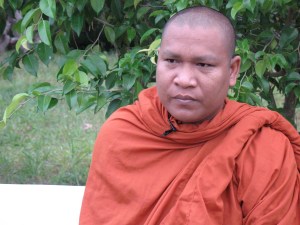
Each of the three personal narratives focuses on a different aspect of the story but forced evictions and land grabbing recur across all three. The Venerable Loun Sovath is a Human Rights Defender who uses video as part of his activist campaigning, all the while fighting against the corruption within his religious order. He is the 2012 Laureate of the MEA. Sopheap, facing eviction and waiting for a new home, is struggling to start a new business while she tries to cope with her slowly disintegrating family. And Srey Pov – at the front lines of a high profile forced eviction – comes face to face with a corrupt political elite and the sometimes difficult relationship between global institutions and the developing world.
This film will offer a unique insight into a country at a pivotal time in its development, finally shaking off the legacy of the past and the atrocities of the Khmer Rouge, Cambodia’s future direction is uncertain.
Those who want to keep up to date on future developments of this project should sign up to the film’s blog, join its facebook group, and mailing list and follow on twitter @chriskellyfilm

 One reason to refer to this article of course the youth picture of me (from 1988) they added!



 terised the period. The operating environment for NGO’s continued to be very challenging. Police arrested and ill-treated peaceful protesters, especially the Women of Zimbabwe Arise activists. Other organisations that faced raids and arrests included the Gays and Lesbians of Zimbabwe, the Counselling Services Unit and many other civil society organisations offering vital services to vulnerable Zimbabweans. Human Rights lawyers were hampered at every turn as they tried to carry out their professional duties and protect Human Rights Defenders.

 Hans Thoolen on Human Rights Defenders and their awards