Catherine Russell, the U.S. Ambassador-at-Large for Global Women’s Issues, wrote in the Huffington Post of 1 July 2015 a piece which highlights 8 stories about women taken from the State Department’s annual human rights reports, that she says would not reach the evening news but are a must. Here is her selection:
In Nepal, a mother may be denied the ability to confer her Nepali citizenship to her children if the father’s identity is unknown or he is not Nepali. This is not uncommon: 27 countries discriminate against women in their ability to pass citizenship on to their children. Too often this results in a child who is stateless, meaning he or she may not be able to access basic services like health care and education.
In Afghanistan, a survey found that 39 percent of Afghan women between the ages of 20 and 24 were married before the age of 18 — making them part of a global trend where one in three girls in the developing world is married as a child — and Afghan women who marry later in life often don’t have a choice in their marriage. These stories and statistics exist despite laws against early and forced marriage.
A story in the Nigerian report highlights the case of a college student who reported that a soldier lured her to a police station and raped her repeatedly. The soldier was reportedly “disciplined” for leaving his post, but as of December nothing else had happened.
In Burma, there is an effort underway to enact legislation that would mandate that women can’t have children more than once every three years. There are obvious questions as to how such a law would be enforced. Many are concerned that it would only be enforced in areas where many members of minority groups live.
Fortunately, the news is not all bad.
In Afghanistan, the national electoral commission’s gender unit focused on women’s political participation in the 2014 election, and increased the number of women who helped determine their country’s future.
In Brazil, the federal government operates a toll-free nationwide hotline for women to report intimate partner violence, while in India, a partnership between state government and civil society led to the launch of a crisis center for survivors of rape, dowry harassment, and domestic violence.
Another partnership — between government and civil society in Guinea — is helping to educate Guinean health workers on the dangers of female genital mutilation. The report says that more than 60 health facilities have integrated FGM/C prevention into their services thanks to this effort.
At the 2015 Oslo Freedom Forum (26 May) Australian-Afghan media entrepreneur Saad Mohseni describes how in 2006 he returned to the country of his birth, where he and his brother started by setting up set up a radio station and then a television station in postwar Afghanistan. In a fascinating performance he argues that even after decades of unrest, the country can improve its human rights situation and build a more stable future. According to Mohseni, change has not come about through government or international action alone. Instead, media has played a transformative role in rebuilding Afghanistan. Mohseni tells us about the successes of soap operas in strengthening women’s rights, as well as televised football’s role in bringing citizens together and providing role models. Mohseni believes that Afghanistan has changed significantly due to radio, internet, and television, and that media will continue to play an important role in the future.
On Wednesday 14 January, Front Line Defenders launched its 2015 Annual Report, “Human Rights Defenders, Lives in the Balance” which examines in detail the deteriorating situation for human rights defenders (HRDs) around the world in the period January – December 2014.
The report was launched at a press conference in Dublin with as keynote speaker Mary Akrami, Co-founder and Director of the Afghan Women Skills Development Centre which was the first safe house for women and children in Afghanistan.
Mary Akrami, Andrea Rocca, and Mary Lawlor from Front Line Defenders launch the report.
Over the last two years Front Line Defenders has documented a growing global backlash against human rights defenders (HRDs) which has now reached crisis point. Against this backdrop, international human rights institutions as well as governments traditionally supportive of human rights defenders appear to be incapable of forcefully and effectively opposing the shutting down of civil society space.
“This is a crucial political moment. If we are to challenge the systematic erosion of human rights standards there needs to be a more consistent and credible political response, which must give the same priority and resources to creating a safe space for HRDs as authoritarian governments give to closing it down” said Front Line Defenders Executive Director, Mary Lawlor. “There can be no human rights progress if those at the forefront of human rights work are not allowed to work”.
The report highlights:
• that over 130 HRDs were killed or died in detention in the first ten months of 2014 as reported to Front Line Defenders
• Colombia accounted for 46 of those 130 HRDs killed in 2014
• The Americas overall claimed 101 of the 130 HRDs killed in 2014
• Globally, deprivation of liberty and court proceedings were the most widely used strategies to silence and intimidate HRDs
• Repressive laws continued their viral spread across the world with the growth of cut and paste repression as governments replicate legislation
• HRDs are exposed to digital attacks.
In a 28-page report, Under Attack: Violence against health workers, patients and facilities, Human Rights Watch and the Coalition “Safeguarding Health in Conflict” highlight recent attacks in countries around the world. Major examples include the targeted killing of more than 70 polio vaccination workers in Pakistanand Nigeria; the arrests of health workers for providing care to protesters in Bahrainand Turkey; the bombing of hospitals and deaths of hundreds of patients and health workers in Syria; and attacks targeting health workers in South Sudan and Afghanistan. The report is released in advance of a meeting from 19-24 May 2014, of health ministers from around the world.
Sometimes it is good to look at how people can support human rights defenders elsewhere. Here an example from West Sussex, UK, where – using a script compiled exclusively from the first-hand accounts of Afghan women human rights defenders – Crawley’s Pitchy Breath Theatre Group voices testimony, underlining the risks to women’s freedom posed by any resurgence of the Taliban. The reading – on Monday 19 May – will be followed by an opportunity to ask questions and discuss the issues raised with Chris Usher, Amnesty International UK’s Country Co-ordinator for Afghanistan. There will also be the opportunity to take part in actions in support of Afghan women. This event forms part of Amnesty International UK’s campaign on women’s rights in Afghanistan. The local AI Group are hoping that “Even If We Lose Our Lives” can inspire the local community and contribute to more action protecting these women and the rights they are fighting fight for.
[Afghan women are too often portrayed as faceless, passive victims who are powerless to change the grave human rights abuses which regularly affect them. The script is based on the actual accounts of three women – Parween, whose teenage son was kidnapped and killed because she runs a girls’ school, Dr D, a gynaecologist whose son was injured in a bomb blast, and Manizha, who runs the largest Afghan organisation working on violence against women and girls at great personal cost.]
Human rights of womenin Afghanistan were at the forefront of the international agenda after the fall of the Taliban in 2001. Thirteen years later, nine Afghan women human rights defenders working at the front line reflect on the progress that has been made over the last years, as well as on the risks they have faced because of their work. Today, new challenges arise, as the lack of commitment at national and international level endangers past achievements and the continuation of progress in the near future. Dublin-based Frontline Defenders published the following video in 2 parts:
On 22 February 2013 Dan Smith published a post on his blog on the ‘state of States’. While not directly touching on human rights defenders, it gives in few words an excellent overview of the formation and deformation of States which provide much of the power and abuse that human rights defenders struggle against. I summarize some of the main issues here, but urge you to read the full text:
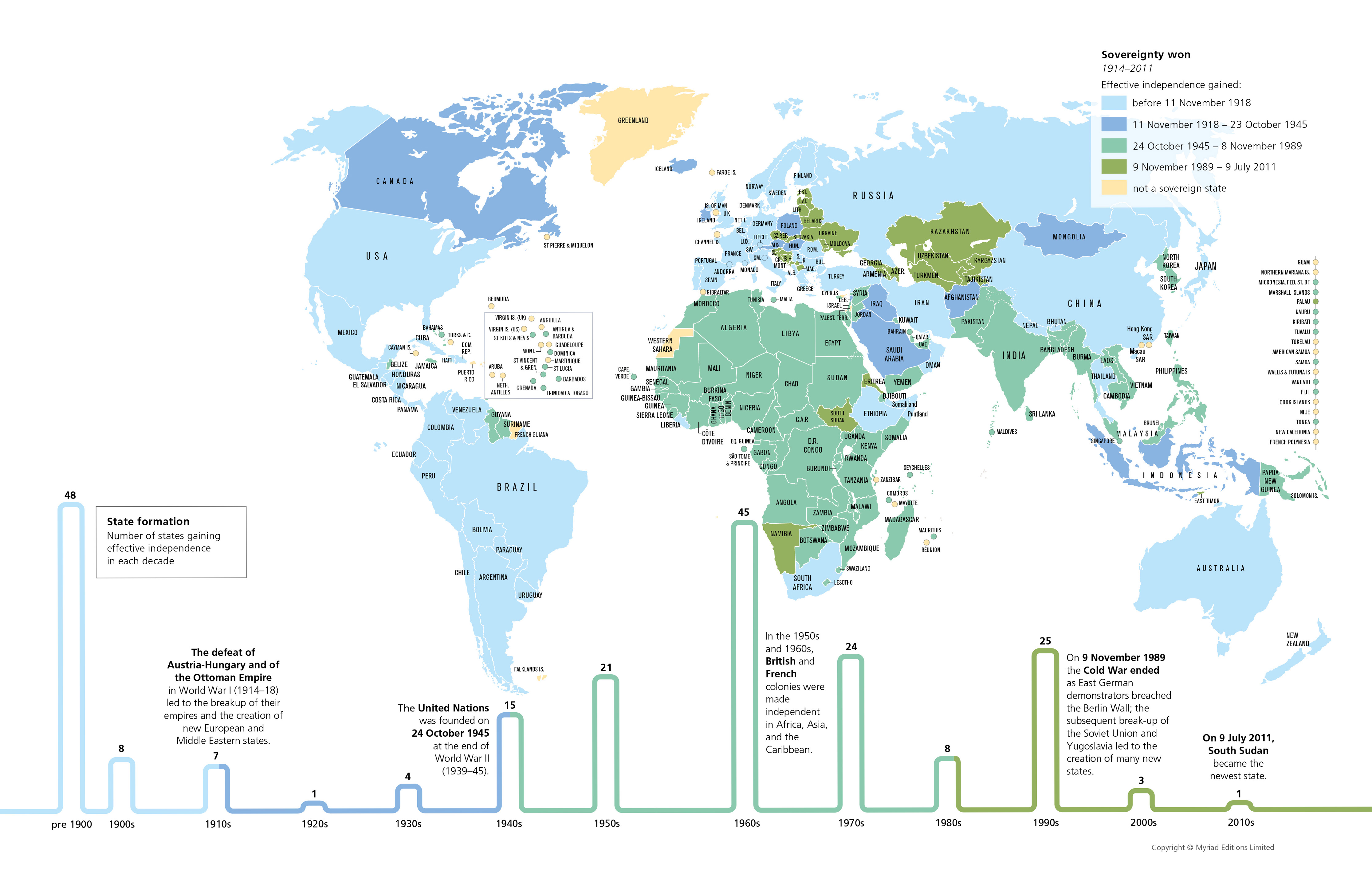
First he points out that most states are relatively new. By 1900 there were just 48 states in our modern sense of the term. In the years either side of World War I, with the break-up of the Ottoman and Habsburg Empires, there was considerable state-making. Even so, the UN was founded by just 51 states. Today, 193 states make up the UN, the newest being South Sudan in July 2011.


 Hans Thoolen on Human Rights Defenders and their awards