While uncertainty about the status of a peace accord in Afghanistan continues to feature in the main media, this opinion piece by Samira Hamidi in Khaama, Afghanistan/ of Wednesday, 26 February 2020 is most timely: “Human rights defenders strategy: From commitments to action”. Samira Hamidi is Regional Campaigner for Amnesty International’s South Asia Regional Office. She was the former Country Director for Afghan Women’s Network and has also chaired the board of AWN and Human Rights Defenders Committee.
Wherever there is injustice in Afghanistan, you will find some of the bravest people fighting against it. They are lawyers and activists supporting women who have suffered violence and discrimination. They are teachers who are supporting the right to education of girls and boys. They are journalists who advance the right to freedom of expression. They are whistleblowers who expose allegations of corruption and other abuses of government and its officials. They are all human rights defenders, as they work to contribute to the protection and promotion of human rights in the country
Human rights defenders in Afghanistan have played a crucial role in bridging the gap between the government and the people. They have been key actors in protecting and promoting human rights and strengthening the rule of law, often at great risk to themselves, their families and communities, and to the organizations and movements they represent. For decades, they have advocated humanity’s core values of equality, justice, fairness and non-discrimination. They have not only contributed to the development and progress of communities and the country but have also paid a high price for the work they do.
Despite the positive contributions they make, human rights defenders face hostility from different state and non- state actors. They have been subjected to threats, intimidation, harassment, violence and even death. The human rights defenders and women human rights defenders are questioned for their human rights work, labeled as ‘anti-religion’ and ‘anti-culture’ and are targeted for challenging injustices. There have been systematic attacks on human rights defenders in Afghanistan in the last couple of years, which notably increased in 2019.
In May last year, a female journalist and activist, Mena Mangal was shot dead in Kabul. In July, Saeed Karim Musawi a well-known human rights defender and civil society activist was shot and killed by two gunmen who were riding on a motorbike and escaped the scene in Kunduz province. … Abdul Samad Amiri, a human rights defender and head of the Ghor provincial office for Afghanistan Independent Human Rights Commission was kidnapped and killed on his way to Ghor province. In November, two prominent human rights defenders from Logar province were forcibly disappeared and then detained for exposing alleged sexual abuse against children. [see also:https://humanrightsdefenders.blog/2019/11/26/afghanistan-human-rights-defenders-targeted-but-fearless/]
These attacks on human rights defenders, and many more that are yet to be documented,…There are also examples where human rights defenders were advised to silence themselves, claiming officials are not capable enough to provide them protection. In certain cases, human rights defenders were even told to acquire weapons to protect themselves.
….Over recent months, the human rights community with the support of Amnesty International collaborated in devising a protection strategy for human rights defenders in Afghanistan. This maiden effort addresses the protection of human rights defenders, the need for investigations of threats, calls for bringing suspected perpetrators to justice and encourages collaboration between the government and international community specifically for the protection of human rights defenders.….The international community has a key role to play here as well. For years, human rights defenders have worked with these actors to provide first-hand information about violations taking place in Afghanistan. The international community has encouraged them to speak out against human rights violations and abuses and to promote human rights values. When these same human rights defenders are at risk, the international community has a responsibility to stand up for them – as the United Nations Declaration on Human Rights Defenders demands.…..As human rights defenders emphasized during the launch of the human rights defenders protection strategy, it is time for the Afghan government and the international community to put their commitments to action.
International Human Rights Day, 10 December 2019, was celebrated or observed all around the world and there is no way to report on every event. Stil to add flavour here a selection of some 14 smaller and bigger events – for more details follow the links provided (and for last year’s anthology see references at the end):
There was of course the annual statement by UN High Commissioner for Human Rights Michelle BacheletRightly, these young people are pointing out that it is their future which is at stake, and the future of all those who have not yet even been born. It is they who will have to bear the full consequences of the actions, or lack of action, by the older generations who currently run governments and businesses, the decision-makers on whom the future of individual countries, regions and the planet as whole depends…We have a duty to ensure young people’s voices are heard. The Universal Declaration of Human Rights, adopted by the UN General Assembly on 10 December 1948, was a firm commitment by States to protect the rights of everyone – and that includes making it possible for future generations to uphold human dignity, equality and rights…..Climate harms will not be halted by national borders – and reactions based on hostile nationalism, or short-term financial considerations, will not only fail: they will tear our world apart. The struggles for climate justice and human rights are not a political quarrel. This is not about left or right: it is about rights – and wrongs… We need to mobilise across the world – peacefully and powerfully – to advance a world of rights, dignity and choice for everyone. The decision-makers understood that vision very clearly in 1948. Do they understand it now? I urge world leaders to show true leadership and long-term vision and set aside narrow national political interests for the sake of everyone, including themselves and all their descendants.
Pakistan: Human Rights Defenders asked the government to make serious efforts to provide fundamental rights. Human rights, labour rights and civil society activists called upon the government to make serious efforts for the provision of fundamental human rights and freedoms, especially the freedoms of association and expression, enshrined in the Constitution of Pakistan and the Universal Declaration of Human Rights. Addressing a joint press conference at the Karachi Press Club to mark International Human Rights Day, PILER joint director Zulfiqar Shah, human rights activists Naghma Shaikh and Saeed Baloch representing the Sindh Human Rights Defenders Network said the government should ensure the restoration of the freedom of expression and the freedom to association. They demanded that the government should bring in a law to protect the rights of human rights defenders as they stood up for the voiceless people…. They also demand fully restoring the freedom of expression, as it was a constitutional right of the people to express their thought. Access to the information right must be ensured, they said.
India: Activists say NHRC urgently needs to protect human rights defenders. The National Human Rights Commission should proactively protect the rights of ‘human rights defenders’, said activists at the national convention on rights of Dalit and Adivasi rights defenders in the capital on Tuesday. Human Rights Defenders appealed to the commission to proactively intervene in cases where the works of Dalit and Adivasi organisations were being obstructed. Activists said there were a growing attack on human rights defenders in India and said the need of the hour was collective action….On Human Rights Day, the convention highlighted the importance of the work of human rights defenders. Despite the country having national human rights institutions and over 160 state human rights institutions dealing with human rights, women, children, minorities, SCs, STs, right to information, persons with disabilities, and safai-karamcharis, these institutions have often failed to protect the human rights defenders, activists said. In addition to the usual challenges, women human rights defenders face gender-specific violations, such as rape and sexual violence which are used as tools for harassment, said activists. Caste discrimination has also presented a greater danger for women rights defenders belonging to the Dalit and Adivasi communities.
Cambodia: The Khmer Times reported that very differing opinions on the status of human rights in the Kingdom became apparent as various groups marked Human Rights Day at two venues in the capital. About 400 government officials and youth group members marked the day’s 71st anniversary at the Cambodia-Korea Cooperation Centre, while about 2,000 unionists and members of the public marked the day at Freedom Park.
Keo Remy, president of the Cambodian Human Rights Committee, at the CKCC said the government has always paid attention to the rights of citizens. “Our leaders prioritise peace and stability,” Mr Remy said. “Youths can make the country chaotic because of the words democracy and human rights. That is why we focus on youths and stability.” while..
Ath Thorn, president of the Coalition of Cambodian Apparel Workers’ Democratic Union, at Freedom Park said respecting the rights of workers has decreased over the years and it is a source of concern for many. “We see that respecting workers’ rights has decreased – investors do not pay attention to workers,” Mr Thorn said. “Investors need to consider the rights of workers.” He said garment factory workers are faced with decreasing salaries, overtime work, discrimination, short-term contracts, violence and imprisonment. The Cambodian Centre for Human Rights in a statement said the government has taken action to curb issues surrounding human rights, but it has not done enough. “We call on the government to encourage the celebration of Human Rights Day in Cambodia and acknowledge the benefit human rights have on society as a whole,” it said. “We implore the government to cease all arbitrary action and targetting of human rights defenders.” The CCHR also called for the charges against two former Radio Free Asia journalists and Kem Sokha to be dropped.
Palestine: the Addameer Prisoner Support and Human Rights Association reported that Palestinians marked International Human Rights Day following a year of nonstop violence and widespread human rights violations by Israeli Occupation Forces (IOF), against the Palestinian population used, as a form of collective punishment and a method to control Palestinian society. These consistent and systematic policies by the occupation include, extrajudicial executions and issuance of discriminatory legislations, mass arrests campaigns, torture, administrative detention, and medical negligence against Palestinian political prisoners…..In 2019, the (IOF) continued its crackdown and repression of human rights defenders. Currently, Addameer faces gag orders against around 40 of the cases they represent, who are in interrogation. The gag order prohibits us from releasing any information to the public regarding their detention status, or face grave consequences.
Philippines: Groups under the Ecumenical Voice for Human Rights and Peace in the Philippines (Ecuvoice) has submitted its first wave of reports on the human rights situation in the Philippines to United Nations Commissioner on Human Rights Michelle Bachelet on Monday, Dec. 9. This is in line with Resolution 41/2 which was adopted by the UN Human Rights Council (UNHRC) in July this year. “With the intensifying transgressions on the Filipinos people’s political rights and civil liberties, we are participating in this report-making process of the UN High Commissioner for Human Rights to pursue justice and accountability,” the convenor of Ecuvoice, Edita Burgos, said.
while
the international trade union movement was using international human rights day to call attention to the alarming attacks on human and labour rights defenders in the Philippines. The government’s targeting of trade unionists has been ramped up recently with fresh waves of arrests and violence. The international trade union movement is united in calling on the government to stop the attacks. The government is targeting labour activists through a practice known as red-tagging. By falsely identifying people who speak out against the government as associated to armed militia groups, the government purposely targets them with harassment and arrests and exposes them to violence and even murder….The International Labour Organization (ILO) has resolved to send a High-Level Tripartite Mission to the Philippines to investigate the human rights situation, but despite the urgency, the government has yet to receive the Mission. The international labour movement is undertaking solidarity events across the world to demand an end to the human rights abuses and the targeting of trade unionists. The ITUC has requested to meet with the representative of the Philippines to the EU on Human Rights Day and has outlined three key demands.
Turkey. Amnesty International Turkey and MetroPOLL Strategic and Social Research Center have jointly conducted a Survey on Perception of Human Rights. The results of the survey have shown that when they hear the expression of “human rights”, 65.2 percent of the participants think of “right to life” first. While “freedom of expression” comes to the minds of 33.5 percent, the right to a fair trial ranks third with 22.1 percent. According to the survey participated by 2,651 people from 28 cities and conducted in a face-to-face manner, 82.1 percent of the society think that fundamental rights and freedoms are violated in Turkey. Of these people, 58 percent say that fundamental rights are occasionally violated and 42 percent say that they are frequently violated. 62.6 percent of the participants are of the opinion that fundamental rights and freedoms are restricted in Turkey. While 72 percent of the young participants think that fundamental rights and freedoms are restricted, this rate falls as the age of the participant gets older. For more detials see the full report.
China:Samuel Wade posted an interesting piece in China Digital Times on how the Chinese government defends if record on human rights and how others see this. Here one excerpt out of manY:
On Tuesday, International Human Rights Day, spokesperson Hua Chunying mounted a familiar defense of China’s rights record at the Ministry of Foreign Affairs’ regular press conference …and went on to note that the MoFA and State Council Information Office would host the “2019 South-South Human Rights Forum” this week “with a view to adding new dimensions and injecting impetus into exchange and cooperation in the field of human rights.” ….. At Hong Kong Free Press, the Uyghur Human Rights Project’s Omer Kanat commented on the ‘South-South Human Rights Forum’ hailed by Hua Chunying,…… Among the enablers of Xi Jinping’s repression are states with disreputable recor[ds attracted to a possible exemption from universal standards that ‘human rights with Chinese characteristics’ affords. And again, if we could freely ask the populations who reside in these states how they feel about such a concept, there would be few advocates. Therefore, on Human Rights Day, we have a responsibility to defend those who defend universal values and be clear ‘never again’ has meaning. There is injustice everywhere and we must fight it. Uyghurs are among them, for example, the imprisoned Ilham Tohti, and in exile Rebiya Kadeer, Nury Turkel, Rushan Abbas, and Gulchehra Hoja, whose families have been detained and disappeared in East Turkestan because of their advocacy. The second ‘South-South Human Rights Forum’ is opening in Shanghai for this year’s Human Rights Day. The dangerous fiction of the ‘Beijing Declaration’ that there are exceptions to the universality of rights should be firmly resisted.
Afghanistan ‘Human Rights’ should be more focused during peace talks. MENAFN (Afghanistan Times) reported that UN Special Representative for Afghanistan and head of UNAMA, Tadamichi Yamamoto, in a gathering has expressed concerns regarding the human rights achievements, saying that these gains should be saved in the ongoing negotiation with the Taliban. He called on the National Security Council to consider perseverance of human and civil rights in talks with the Taliban, adding ‘Afghanistan Independent Human Rights Commission’s role is very important in the peace process, every voice that raise should be heard and rights of the victims should be observed.‘.. Moreover, head of AIHRC, Shaharzad Akbar has called on the Taliban to legislatively recognize the values of human rights. …There are massive concerns about the violation of achievements of human rights and freedom of speech in the peace negotiation with the Taliban militants. The Taliban has back in 1990 ruled Afghanistan with the sever restriction on girls and school students. The cultural Taboos and less freedom of women are one of the other key issues that have brought sever concerns from Afghan and foreign officials.
The NGO WITNESS used the occasion to publish its ANNUAL REPORT which looks at key successes from July 2018-June 2019 (fiscal year 2019). See the video clip:
Malaysia. “What happened to Harapan’s vow to improve human rights?” asks Jasmine Choin an open letter:…’When Pakatan Harapan won a dramatic victory in the GE14 elections, they vowed to steer the country forward with human rights as one of their top priorities. However, since their win, we have seen a heavy regression in the area. The kind of regression that has gotten us worried about our present and our future as a modern, fair, and humane nation. From the Suaram 2019 report, several areas of abuse were glaring. One was the treatment of prisoners. The government has yet to abolish the Security Offences (Special Measures) Act 2012, the Prevention of Crime Act 2015 and the Dangerous Drugs (Special Preventive Measures) Act 1985……….The list of human rights abuse is getting longer and the frustration we feel with our government is reaching boiling point. Malaysia is considered a modern and democratic country, so why are we so far behind when it comes to human rights? The government should stop pandering to the religious majority and stop focusing on external matters. The rights of the rakyat are being abused.
Netherlands/Sri Lanka. The Dutch Ambassador Gonggrijp spoke at an event for Human Rights Day 2019 organized by Equal Grounds Sri Lanka saying inter alia:
…Sri Lanka has recently known a long period of conflict, during which human rights were under pressure. The reconciliation process after the end of the war has been slow. And I hear people say: what is the point of looking back, let’s move forward. To my opinion it is about recognition and human dignity. To that respect we should also recognize the progress that has been made: the Office on Missing Persons has been mandated to restore the rights of every Sri Lankan of any background, language or religion, to know what happened to their loved ones. And the work of the Sri Lanka Human Rights Commission, as an independent entity, mirrors the country’s commitment to uphold human rights and civil freedoms. The Netherlands supports this and stands ready to help Sri Lankan institutions like these with capacity building and technical expertise…..
The policy of Netherlands is aimed at 1) abolishing the criminalization of homosexuality, 2) opposing discrimination on the basis of sexual orientation and gender identity and 3) achieving wider social acceptance of gay people. In the Netherlands we have taken the first step of decriminalization a long time ago, but we are also still working on stopping discrimination and promoting acceptance. As I hope Sri Lanka will also take this first step in the near future, I also recognize that this will not solve all issues the LGBTI community is facing. It is key to inform people about the rights they have, regardless of their sexual orientation. To empower them to take responsibility, stand up or seek justice. It is also key to educate and make people from outside the community aware of the harassment and discrimination that people from the LGBTI community face. In order to also empower them to show solidarity and to take action if necessary. Every form of emancipation has been and still is a struggle. It starts with a ‘fight for your rights’. This is why this initiative of Equal Ground is so important, because – and allow me to quote again:
Mongolia / EU: Montsame reported that on the occasion of International Human Rights Day the Delegation of the European Union to Mongolia together with the Embassies of France and Italy presented European Union Human Rights Defenders’ Award (a national award!) to nine people, who are making their efforts to human rights protection…..Unfortunately, we are still observing human rights violations in many countries, especially gender and racial discrimination and discrimination in sexual orientation. Therefore, the EU Delegation to Mongolia, the Embassies of France and Italy and the Embassies of other countries are showing respect to human rights activists in Mongolia. Protection of human rights is one of main principles of the European Union, which defines its internal, and foreign policies and it is belonged to everyone. We will ever protect and encourage the people who endeavor for human rights, “ Ambassador of the European Union to Mongolia Traian Laurentiu Hristea said at the opening of the award presenting ceremony. The Ambassador also highlighted that the event will be traditionally held in the future.
MEXICO An indigenous activist who documented and denounced abuse committed by the military in Guerrero is this year’s winner of the National Human Rights Prize. Obtilia Eugenio Manuel was awarded the prize at Tuesday’s presidential press conference by National Human Rights Commission (CNDH) president Rosario Piedra Ibarra. The human rights chief said that among the military abuses that have been documented by Eugenio are the forced sterilization, sexual assault and sexual torture of indigenous women. Piedra also said the activist has received numerous threats and noted that she was abducted for four days earlier this year. ..“We don’t want one more rapist in our way,” Eugenio said, making a reference to the Chilean feminist anthem that has been performed around the world in recent weeks. Also at Tuesday’s press conference, Piedra recognized the human rights work of Margarito Díaz González and presented an award to his widow, Modesta Chávez de la Rosa. A former member of the Wirikuta security council and an advocate for environmental and indigenous rights, Díaz was murdered in Nayarit last year. Piedra recalled that the activist opposed the construction of a dam and other projects in San Luis Potosí and the development of Canadian-owned mines on sacred sites of the Huichol people.
If you are interested to compare with last year, see:
Afghanistan’s top intelligence agency must immediately release two human rights defenders it detained after they exposed alleged sexual abuse against children. Musa Mahmudi and Ehsanullah Hamidi, both well-known human rights defenders from Logar province, were arbitrarily detained by the National Directorate of Security (NDS) on 21 November 2019 when they were on their way to meet with the European Union ambassador in Kabul.
The two human rights defenders began receiving threats, including from local officials in Logar, on Facebook after they gave interviews to The Guardian and Afghanistan’s TOLO News about the existence of a paedophile ring in the area. The human rights defenders uncovered more than 100 videos of the alleged abuse. Some of the victims of abuse have been murdered, according to The Guardian. “This is the latest case where human rights defenders have been targeted by the authorities for carrying out their important work. Faced with threats from both the state and non-state actors, they are operating in some of the most hazardous conditions anywhere in the world. There is impunity for attacks on these brave defenders, who have little to no protection.”
I am the director of the Journalism and Mass Communication Unit at Balkh University. I also head a non-governmental organization that works on human rights. For 20 years, as a women’s rights activist, I have pushed to address issues that prevent women from accessing their rights, not only in Balkh but also in other neighbouring provinces such as Samangan, Jowzjan, and Faryab.
One of my achievements is the establishment of the first private university in Balkh – Taj Higher Education Institute, which offers medicine, economy and law. Similar to Kabul, Herat and Kandahar, Balkh has some developments and achievements in terms of women’s rights. However, the province is still well known for the presence of armed groups, the local mafia and warlords, who have no respect for human rights. Due to existing challenges and the weak rule of law, self-censorship is embedded in the day-to-day lives of people in Balkh.
I am no stranger to tolerating injustices, especially when it is a matter of saving my life and my family’s lives. It gets challenging especially when it involves former war commanders who are now elected representatives of the area and, who would not hesitate to exert their power to commit crimes.
I hope in future like-minded women will join hands for the women’s revolution in Afghanistan, to reclaim the rights that we are entitled to.
Day one: Khawar Amiri
I am the Head of the Literacy Department of the Directorate of Education in Khost Province and have worked for many years as a mediator for women’s issues. As most women of Khost Province are illiterate, and some districts are yet to establish schools for girls, through the Literacy Department, I have conducted courses for women and girls above the age of 14 to enable their basic reading and writing skills. As a well-known human rights defender, I have worked in solving many of women’s issues through the Committee on Elimination of Violence against Women and tribal Jirgas (councils), with help of the police.
Women in Khost are exposed to discrimination and violence. Girls’ education is till grade six, after which they are sent off to marriage or asked to stay home. Forced marriages, being sold off, physical violence, lack of access to inheritance rights are some of the issues women face on daily basis. Women don’t work in government posts in Khost, as most of the positions are held by men. Women are discouraged from applying for government positions as their posts are given to men and justified with unlawful reasons for not being appointed.
I have intervened in many cases of women being abused, sometimes solving the case with the help of local elders and at times through direct mediation. One of my biggest successes is organizing a Master’s Degree programme for women in Khost to study in India, funded by the US Embassy. Despite being threatened and attacked, I am continuing my activism.
I hope women are independent, have security, and have equal opportunities for studies, get to live a life free from violence.
You can send a solidarity message to all of the 16 WHRDs in Afghanistan, or any one of them, and let them know that they are not alone. Please email your thoughts in a personal message to AfghanDefenders@amnesty.org and AI will share them with the activists.
These are the every-day heroes going to extraordinary lengths to help forcibly displaced people in great need, who have been chosen as the regional winners of the UNHCR 2019 Nansen Refugee Award. The regional winners for Africa, the Americas, Asia, Europe and the Middle East were short-listed from more than 450 nominees.
They are:
Africa: Evariste Mfaume, the founder of NGO Solidarité des Volontaires pour l’Humanité in the Democratic Republic of the Congo, who champions the rights of Congolese people displaced by conflict and also refugees and their host communities.
Americas: Bianka Rodriguez from El Salvador, a young trans woman and executive director of NGO COMCAVIS TRANS, who advocates for the rights of forcibly displaced LGBTI people in the country.
Asia: Alberto Cairo, a physiotherapist in Afghanistan and head of the International Committee of the Red Cross orthopaedic programme, who has dedicated almost 30 years of his life to providing prosthetic limbs and helping find jobs for injured Afghans.
Europe: Humanitarian Corridors, a ground-breaking cross-border initiative established with the Italian Government in 2015 to enable particularly vulnerable refugees to start a new life in safety in Italy.
Middle East: Abeer Khreisha, a community volunteer in Jordan, known as ‘the mother of Syrians’ for her work helping refugees.
On 6 March 2019, two days before international women’s day, the Right Livelihood Award Foundation brought together 5 women Laureates from around the world to discuss ‘local realities and shared global challenges’ facing Women Human Rights Defenders. The side event, organised in parallel to the Human Rights Council’s fortieth session, was co-sponsored by CIVICUS, Human Rights House Foundation, International Network for Human Rights, and supported by the International Platform against impunity and the International Dalit Solidarity Network.
Fabiana Leibl, Sima Samar, Mozn Hassan, Helen Mack Chang, Ruth Manorama, and Charlotte Dos Santos Pruth. Photo by: Amy Au
Here are a few takeaways from the discussion:
Fabiana Leibl, Head of Protection and Advocacy at the Right Livelihood Award Foundation, opened the meeting by describing the worsening trend for women human rights defenders who are prevented from working, not only because they are advocating for human rights, but also because they are women. As the Special Rapporteur on Human Rights Defenders noted in his recent report, this trend is often fuelled by deeply rooted ideas about ‘who women are, and who they should be’. Nahla Haidar, a member of the Committee on the Elimination of Discrimination against Women, remarked that women are frequently ‘targeted with charges of counter-terrorism’, which allows their oppressors to act with impunity.
Sima Samar, Chair of the Afghanistan Independent Human Rights Commission and a leading women human rights defender in Afghanistan, emphasised that achieving parity in educating people of all genders was a key starting point. As we approach the 70th anniversary of the Universal Declaration of Human Rights, she explained, “we need female human rights defenders in order to really change the environment on the ground, and to make the environment conducive for the women to exercise their basic human rights.” She called for an end to the misuse and misappropriation of culture, tradition, and religion as justifications for male dominance. Access to paid work, reproductive services, and justice mechanisms was also identified as crucial in the struggle for gender equality. Samar received the Right Livelihood Award in 2012 “for her longstanding and courageous dedication to human rights, especially the rights of women, in one of the most complex and dangerous regions in the world.” See also: https://humanrightsdefenders.blog/2018/08/31/major-piece-by-departing-high-commissioner-in-the-economist/
Mozn Hassan, founder of Nazra for Feminist studies, is one of the defendants in the well-known NGO Foreign Funding case targeting civil society organisations in Egypt. Her career’s focus on sexual and reproductive rights adds additional restrictions to her work. In July 2018, she was charged with, among other things, establishing an entity in violation of the law and receiving foreign funding with the intention of harming national security. The charges – which are clearly politically motivated – could lead to life imprisonment. Hassan could not attend the event due to a travel ban imposed by the Egyptian government since 2016. However, via video message, she conveyed the serious dangers for human rights defenders, ranging from asset freezing to arrests, arbitrary detention and forced disappearances. On top of this, women must confront gender-specific threats from state and non-state actors. As Mozn noted, “women are facing various gender-based violence in their custodies from harassment to threats of rape.” Mozn Hassan received the Right Livelihood Award together with Nazra in 2016 “for asserting the equality and rights of women in circumstances where they are subject to ongoing violence, abuse and discrimination.” See also: https://humanrightsdefenders.blog/2017/02/02/right-livelihood-has-to-go-to-egypt-to-hand-mozn-hassan-her-2016-award/
Helen Mack Chang, who has persistently sought justice and an end to impunity in Guatemala as head of the Myrna Mack Foundation, emphasised that women often suffer multiple dimensions of discrimination. Indigenous women, for instance, “suffer double discrimination (…) when defending their land or territory against the claims of international corporations.” She noted that recent years have seen a resurgence of conservatism and of global threats to the rule of law and democracy. Corruption and impunity, she stressed, go to the heart of this challenge, in Guatemala and elsewhere. Helen Mack Chang received the Right Livelihood Award in 1992 “for her personal courage and persistence in seeking justice and an end to the impunity of political murderers.
Ruth Manorama is India’s most effective organiser of, and advocate for, Dalit women, belonging to the “scheduled castes” sometimes also called “untouchables.” She is, among other things, President of the National Alliance of Women (NAWO) and National Convenor to the National Federation of Dalit Women. Ruth called for counter-narratives to combat the negative view of human rights defenders in the media. In India, for instance, activists are routinely called “enemies of the State,” “militants,” “anti-nationals,” “traitors,” and “terrorists.” She stated: “I am a patriot. I am an Indian citizen. I must enjoy my constitutional rights. (…) Protecting human rights defenders is a state obligation.” Dalit women are particularly vulnerable to systematic sexual abuse at work, forced sexual slavery such as the Devadasi system, and forced labour. Manorama received the Right Livelihood Award in 2006 “for her commitment over decades to achieving equality for Dalit women, building effective and committed women’s organisations and working for their rights at national and international levels.” See also: https://humanrightsdefenders.blog/2016/11/07/forum-asia-25th-anniversary-event-in-geneva-on-16-november-2016/
Charlotte Dos Santos Pruth is an Advocacy and Policy Advisor at Kvinna till Kvinna, a Swedish organisation working to strengthen and promote women’s organisations in several regions of the world. She presented the findings of their recent report, “Suffocating the movement – shrinking space for women’s rights”, which identifies the main effects of shrinking civic space for women. “A strong feminist movement is the single most important factor to advance women’s rights and gender equality”, she stated, adding that women often have limited access to formal decision-making processes. “This makes defending civil society space particularly crucial”, Dos Santos Pruth continued by saying. She suggested that addressing the lack of funding for women’s organisations would be an important first step.
The speakers brought together experiences from very different cultural contexts. Nevertheless, there were important parallels in their descriptions of defending human rights on the ground. The panellists all showed that the crackdown on women human rights defenders must be viewed within the context of other global trends including growing material inequality, counter-terrorism, corporate impunity, environmental degradation, and corruption. As Sima Samar pointed out, in this worrying global landscape, international solidarity must remain an important principle. In her words: “We don’t only need women in positions of power, we need feminist women; women who don’t support male domination in order to keep their own space and position”.
“Civil Society Leaders Meet Amid Protests, Attacks on Rights” by A. D. McKenzieReprint
Under the theme, “The Power of Togetherness”, ICSW 2019 “seeks to generate deep conversations among civil society leaders, social justice advocates, development practitioners, members of the philanthropic community, diplomats and others on emerging global challenges and how civil society should be responding to these,” said Mandeep Tiwana, CIVICUS’ chief programmes officer.
“Defence of democratic values, civic space and participation, along with citizen action, will be among the topics of discussion,” he told IPS in an email interview while en route to Belgrade. “Our message to governments is that the right to peaceful protest is a basic human right enshrined in constitutional and international law. Governments have an inherent responsibility to enable the right to peaceful protest as an integral element of the defence of democracy,” he added…
“In country after country, democracy is under attack, with populist and right-wing movements gaining ground and democratic regression being witnessed even in countries historically considered bastions of democracy,” CIVICUS says.
“This year’s event in Serbia comes at a critical and opportune time for civil society and the world’s citizens to realise the power of unified, collective action to challenge a global trend that threatens our fundamental freedoms,” said Lysa John, CIVICUS’ Secretary General………
Media workers, in fact, often find themselves between a rock and a hard place, caught amongst the security forces and protestors as they try to report on turbulent events. CIVICUS said that the role of the media and their relationship with civil society will be a key topic of discussion at ICSW, alongside the focus on protecting rights campaigners.
“CIVICUS is working in several ways to stop attacks on members of the media and civil society activists targeted for exposing rights violations or speaking truth to power,” Tiwana said. “We engage with a broad range of civil society organisations that support press freedom using several approaches ranging from in-depth participatory research and analysis to raising awareness of attacks on the media, strategic coalition building, and directly engaging decision-makers at the national and international levels.”
…..Ahead of the meeting, Serbia and four other countries have been added to a global watchlist of countries that have seen an “escalation in serious threats to fundamental freedoms in recent weeks and months”, according to CIVICUS Monitor, an online platform that tracks threats to civil society across the world. Citizens of all five countries (Afghanistan, Saudi Arabia, Sudan, and Venezuela are the others) are experiencing increasing rights violations that “include killings, attacks on protesters, media restrictions and arbitrary detentions of human rights defenders”.
That there is still a lot that needs to be done in the world of sports and human rights is illustrated in the piece by Minky Worden (director of global initiatives at Human Rights Watch) in the Sydney Herald of 7 April 2019 (“Football leaders stand by as human rights abuses pile up”). Article 3 of the FIFA and AFC Statutes requires the AFC and its leaders “promote and protect
human rights”. [see also: https://humanrightsdefenders.blog/2018/12/03/fifas-second-report-on-human-rights-misses-sustainable-approach/]
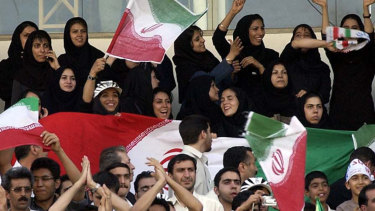
A too-rare sight … Iranian women cheer their national team in an Asian World Cup qualifying match against Bahrain in 2006. Now women resort to disguising themselves as men to enter stadiums.CREDIT:AP
..He is not the only high-level football official who may not be acting in accordance with the policy. In 2018, 20 members of Afghanistan’s women’s national team made detailed allegations to the Guardian and to FIFA of sexual and physical abuse they say they suffered at the hands of the president of the Afghan Football Federation, Keramuddin Karim, and other officials. FIFA suspended Karim for two 90-day periods and during this time he has reportedly threatened witnesses in the case. He stands accused of sexual assault, physical attacks and intimidation…. The federation general secretary, Sayed Ali Reza Aghazada of Afghanistan, was suspended, yet was also just elected to the AFC’s powerful governing body, the executive committee.
Finally, Iran’s Football Federation president, Mehdi Taj, was elevated to AFC vice-president……….On Friday, before the AFC election, Iranian women filed an unprecedented FIFA ethics complaint against Mehdi Taj, for his role in presiding over their exclusion from stadiums for years. FIFA has said clearly in its second Human Rights Advisory Board report that the stadium ban for women violates FIFA’s statutes, which say such discrimination is “punishable by suspension or expulsion”.
The AFC football leaders from Bahrain, Afghanistan and Iran are bound by the FIFA code of ethics, the FIFA statutes and the FIFA human rights policy. FIFA has made admirable progress in implementing its new policy , and could even raise the bar for other sports federations. But FIFA’s reform efforts risk derailment if the sport’s leaders in Asia refuse to uphold the new global standards. FIFA’s Gianni Infantino, up for re-election unopposed himself this year, needs to find his voice to call out football federation leaders who are undermining reforms. It is time to hold accountable those who are threatening the “beautiful game” with ugly human rights abuses.
Jessica Corbett, staff writer for Common Dreams writes on 25 March “‘Blatant Effort to Intimidate and Retaliate’: Pompeo Imposes Visa Ban on ICC Staff Probing US War Crimes“
Secretary of State Mike Pompeo announced new visa restrictions in a press briefing on Friday. (Photo: U.S. State Department)
Human rights defenders expressed outrage on Friday after Secretary of State Mike Pompeo revealed that the Trump administration is revoking or denying visas for any International Criminal Court (ICC) personnel who try to investigate or prosecute U.S. officials or key allies for potential war crimes. The move, Pompeo confirmed is a direct response to ongoing efforts by the ICC to probe allegations of war crimes and crimes against humanity tied to the war in Afghanistan. There was an immediate and almost unanimous outcry by the key human rights NGOs in the USA:
Jamil Dakwar, director of the ACLU‘s Human Rights Program (the ACLU currently represents Khaled El Masri, Suleiman Salim, and Mohamed Ben Soud, who were all detained and tortured in Afghanistan between 2003 and 2008): “This is an unprecedented attempt to skirt international accountability for well-documented war crimes that haunt our clients to this day,” Dakwar said. “It reeks of the very totalitarian practices that are characteristic of the worst human rights abusers, and is a blatant effort to intimidate and retaliate against judges, prosecutors, and advocates seeking justice for victims of serious human rights abuses.”
Richard Dicker, international justice director at Human Rights Watch,called it “an outrageous effort to bully the court and deter scrutiny of U.S. conduct.” He encouraged ICC member countries to “publicly make clear that they will remain undaunted in their support for the ICC and will not tolerate U.S. obstruction.”
Daniel Balson, advocacy director at Amnesty International USA, noted that this is just “the latest attack on international justice and international institutions by an administration hellbent on rolling back human rights protections.” Visa bans, as Balson pointed out, are “powerful tools typically reserved for the most serious of human rights abusers.” But rather than targeting global criminals, the Trump administration has set its sights on the ICC—an impartial judicial body that aims to promote accountability under international law by probing and prosecuting crimes of aggression, crimes against humanity, war crimes, and genocide.
The move is “is highly indicative of [the administration’s] culture of disregard for rights abuses,” said Balson. “Throwing roadblocks in front of the ICC’s investigation undermines justice not only for abuses committed in Afghanistan, but also for the millions of victims and survivors throughout the world who have experienced the most serious crimes under international law.”
Pompeo’s announcement came after John Bolton, President Donald Trump’s national security adviser and a longtime critic of the ICC, threatened to impose sanctions on court officials in September if they continued to pursue an investigation of potential crimes by U.S. civilians or military personnel in Afghanistan….”These visa restrictions may also be used to deter ICC efforts to pursue allied personnel, including Israelis, without allies’ consent,” Pompeo added. “Implementation of this policy has already begun.”
Press Emblem Campaign (PEC), a nongovernmental organization presented a statement on press freedom and journalist killings duringUnited Nations Human Rights Council 40th session in Geneva on 13 March 2019.
The Press Emblem Campaign (PEC) documented last year the killing of 117 journalists, an increase of 17 percent in media casualties compared to the previous year. In five countries journalists paid an unacceptable toll: Afghanistan with 17 killed, Mexico also with 17 killed, Syria with 11 killed, Yemen and India, with 8 journalists killed in each of those countries. The PEC urged the Members of the Human Rights Council to fight more firmly impunity and to bring the responsible of those crimes to justice.
The PEC is also worried by the large number of arrests among journalists in the recent turmoilin Sudan, the repression of press freedom in Nicaragua and Venezuela, the statement reads. PEC expressed itsspecial concern with the continuous judicial harassment of journalists in Turkey in the statement.
PEC was one of the organizers of the panel discussion on human rights violations in Turkey, which the Turkish government mobilized its entire diplomatic corps to prevent during 40th Regular Session of the UN Human Rights Council on 5 March. The move prompted an outcry from human rights defenders.[see: https://stockholmcf.org/erdogan-govt-fails-to-cancel-un-human-rights-council-event-on-turkey/%5D
Turkey is the biggest jailer of journalists in the world. The most recent figures documented by SCF (Stockholm Centre for Freedom) show that 211 journalists and media workers were in jail as of March 11, 2019, most in pretrial detention. Of those in prison 134 were under arrest pending trial while only 77 journalists have been convicted and are serving their time. Detention warrants are outstanding for 167 journalists who are living in exile or remain at large in Turkey. The government also closed down some 200 media outlets.
On 30 October 2016 the ISHR published this video interview with Natasha Latiff who is the founder and executive director of Strategic Advocacy for Human Rights (SAHR). Following an ISHR training for human rights defenders held in Geneva in June, she spoke to ISHR about her organisation’s work on women’s rights in Afghanistan.




 The Press Emblem Campaign (PEC) documented last year the killing of 117 journalists, an increase of 17 percent in media casualties compared to the previous year. In five countries journalists paid an unacceptable toll: Afghanistan with 17 killed, Mexico also with 17 killed, Syria with 11 killed, Yemen and India, with 8 journalists killed in each of those countries. The PEC urged the Members of the Human Rights Council to fight more firmly impunity and to bring the responsible of those crimes to justice.
