The ISHR reports that on 21 March 2019 the UN Human Rights Councilhas adopted a strong consensus resolution recognising the critical role of environmental human rights defenders in protecting vital ecosystems, addressing climate change, attaining the sustainable development goals (SDGs) and ensuring that no-one is left behind. [See also: https://humanrightsdefenders.blog/2019/01/09/front-line-defenders-says-record-number-of-activists-killed-in-2018/].
The resolution meets many of the civil society demands ISHR expressed in a joint letter along with more than 180 groups (see reference below). By formally acknowledging the important role of environmental human rights defenders, the Council highlights the legitimacy of their work, helps counter stigmatisation and can contribute to expanding their operating space. Though the resolution falls short in some key areas, its adoption by consensus is a positive step towards better protection of environmental human rights defenders. It must now be followed by implementation at the national level by all relevant stakeholders, including States, UN agencies, businesses and development finance institutions….
The resolution was led and presented by Norway, on behalf of 60 States from all regions. In particular, many Latin American States strongly supported the resolution, which is significant given the dangerous situation for defenders in many of those countries. The consensus on the protection of environmental human rights defenders is a welcome sign of unity by the international community in recognising their vital contribution to a biodiverse and healthy environment, to peace and security, and to human rights.
‘We now look to States, business enterprises and development finance institutions to take rapid and decisive steps to address the global crisis facing environmental human rights defenders’, said Michael Ineichen, Programme Director at the International Service for Human Rights. ‘This means States need to create protection mechanisms which guarantee the security of defenders. States must also ensure that businesses put in place specific policies and processes allowing for the inclusion of human rights defenders and their concerns in due diligence processes’, Ineichen said.
Expresses alarm at increasing violations against environmental defenders, including killings, gender-based violence, threats, harassment, intimidation, smear campaigns, criminalisation, judicial harassment, forced eviction and displacement. It acknowledges that violations are also committed against defenders’ families, communities, associates and lawyers;
Recognises that the protection of human rights defenders can only be achieved through an approach which promotes and celebrates their work. It also calls for root causes of violations to be addressed by strengthening democratic institutions, combating impunity and reducing economic inequalities;
Pays particular attention to women human rights defenders, by stressing the intersectional nature of violations and abuses against them and against indigenous peoples, children, persons belonging to minorities, and rural and marginalised communities;
Urges States to adopt laws guaranteeing the protection of defenders, put in place holistic protection measures for and in consultation with defenders, and ensure investigation and accountability for threats and attacks against environmental human rights defenders; and
Calls on businesses to carry out human rights due diligence and to hold meaningful and inclusive consultations with defenders, potentially affected groups and other relevant stakeholders.
While the resolution was adopted by consensus, the unity came at the price of a lack of specificity in certain areas. For instance, the resolution does not clearly recognise all of the root causes of the insecurity facing environmental human rights defenders, as documented by UN experts, nor comprehensively name the perpetrators or the most dangerous industries. It also fails to clearly spell out the human rights obligations of development finance institutions, and to detail the corresponding necessary steps to consult, respect and protect the work of environmental human rights defenders.
In two statements delivered to the 40th Session of the Human Rights Council, ISHR and Amnesty International reacted to the latest Joint Communications Report of the UN Special Procedures – independent human rights experts, appointed to monitor and report on human rights violations and to advise and assist in promoting and protecting rights. The report cites nine cases of reprisals against human rights defenders cooperating with the UN, and reveals that 95 states have not responded to letters from the UN experts concerning human rights violations.
There are two, related issues at stake here: (1) non-response to letters from the UN, and even worse (2) reprisals against human rights defenders who cooperate with the UN.
As Helen Nolan of ISHR explains, 35 States have recently failed to respond to two or more of these letters. 13 of these nations are members of the Council. ‘Repeat offenders are a particular concern,’ says Nolan. ‘India has failed to reply to a staggering 8 communications, Mexico 6, Italy 5, and Bangladesh and Nepal 4 each.’ Nolan emphasises that a failure to reply is a failure to cooperate, and welcomes the fact that the recently published report of the Annual Meeting of Special Procedures focuses on non-cooperation, including ‘more subtle forms’, such as selective cooperation with particular mandates. ‘To encourage cooperation, the Council must make non-cooperation more costly,’ says Nolan. ‘We urge the President of the Council to work closely with the Coordinating Committee of the Special Procedures to find ways to do this,‘ adds Nolan.
ISHR and Amnesty International’s second statement noted that under GA Resolution 60/251, Council members must ‘fully cooperate with the Council.’ Yet, the report cites nine cases of reprisals involving these members:
China sought to revoke the Society for Threatened Peoples’ ECOSOC status after vexatiously alleging that a person accredited by them, Dolkun Isa, participated in incitement and funding of separatism and terrorism, in retaliation for cooperation with the UN;
Egypt carried out forced evictions, and violations of the rights to physical integrity, liberty and security against individuals who cooperated with the Special Rapporteur on the right to adequate housing during her recent visit;
Iraq carried out unlawful arrest, enforced disappearance and torture against Imad Al Tamimi and intimidated and threatened Israa Al Dujaili for cooperating with the UN;
Libya arrested an individual in retaliation for taking steps to clarify the fate and whereabouts of his father, including with UN mechanisms;
The Philippines labeled defenders “terrorists” in reprisal for their engagement with the UN;
Russia surveilled, intimidated and harassed Yana Tannagasheva and her husband, for speaking out about impacts of coal mining on indigenous people in Siberia and in possible reprisal for their communication with UN mechanisms;
Turkmenistan carried out reprisals against a defender and her husband for her cooperation with the UN; and
In Yemen, forces loyal to President Hadi and the Saudi-led coalition detained human rights defenders Radhya Al-Mutawakel and Abdulrasheed Al-Faqih for cooperating with the UN.
Nishita, JhaBuzzFeed, reports on 20 March 2019 that many women who were slated to participate in the UN Commission on the Status of Women have been denied visas, especially lawyers, activists, and women who deliver reproductive health care services from African and Middle Eastern countries that fell under Donald Trump’s travel ban.
The International Service for Human Rights said it was aware of at least 41 women who have been denied visas to attend the conference this year — but this figure is said to be only “the tip of the iceberg” and likely to increase.
Women who wanted to attend CSW this year from countries like Iran, Sudan, Zimbabwe, and Syria were asked to provide supporting documents like marriage certificates, proof of property ownership, letters stating employment status, proof of finances, and even proof of birth certificates or proof showing that they have children, according to the petition.
Lyndal Rowlands, advocacy officer with the UN-accredited organization CIVICUS, told BuzzFeed News that among all the people that were denied visas, women from countries that fell under the Trump administration’s travel ban were disproportionately affected. “Last year and this year we have also heard of women from Pakistan and Nepal who were denied visas,” she said. …Most of the women applying for visas, Rowlands said, had not traveled to the US before — a deliberate decision by organizers who wanted a diverse range of women present at the United Nations, not just pundits and experts who travel all the time but women who work at the grassroots.
“It’s essential that women who are at the front lines working on women’s rights are present when their rights and the rights of the women they serve are being discussed,” she said. “Governments and UN officials that attend the conference can make better policies when they are informed by the experiences of women who face some of the biggest uphill battles when it comes to fighting for gender equality — for example, delegates who were unable to attend include lawyers and advocates who represent women who have been imprisoned for their activism, [and] women who deliver reproductive health care services.”
Morocco World News reports on 20 March 2019 that Morocco deeply regrets and denounces UN special rapporteur on the independence of judges and lawyers Diego Garcia-Sayan’s decision to cancel his official visit to the country. The Moroccan government addressed Garcia-Sayan’s statement, published Tuesday, 19 March, on the United Nations High Commissioner for Human Rights (OHCHR) website, in which he declared that he would not visit Morocco on an official trip set for March 20-26.
Garcia-Sayan said he canceled the visit because the “government of Morocco has not been able to ensure a programme of work in accordance with the needs of the mandate and the terms of reference for country visits by special procedures.” In response, the Moroccan government stated that Garcia-Sayan’s decision contradicts his earlier stand when he first began preparations for the visit on June 16, 2017, at the invitation of Morocco.
According to the government, Morocco has been keen on ensuring all the necessary “guarantees” for the success of Garcia-Sayan’s visit by including all the suggested places for him to visit to exercise his mission, contrary to what the rapporteur stated. Garcia-Sayan stated: “It is most regrettable that the suggestions of places to visit and schedule of work were not fully taken into consideration by the Government. It is an essential precondition for the exercise of the mandate of Special Rapporteur that I am able to freely determine my priorities, including places to visit.” Morocco stressed the country’s readiness to make any amendments Garcia-Sayan requested to enable him to exercise his mandate as required.
Garcia-Sayan’s visit was to examine the independence and impartiality of judges and prosecutors and the independence of lawyers.
In Resolution 30/1 adopted in 2015, Sri Lanka (which cosponsored it!) committed itself to a range of measures on human rights, accountability and reconciliation. Sri Lanka’s progress in fulfilling its commitments will be discussed on March 20, 2019, at the 40th session of the UNHRC. It is interesting to contrast two reactions:
One at the political level: On 17 March it was reported that a Sri Lankan parliamentarian – who will be a member of a delegation to be sent to the UN Human Rights Council next week – has slammed the UN High Commissioner for Human Rights report on his island, calling it “an atrocious piece of writing containing lies, half lies and highly contestable statements”. Sarath Amunugama, a senior former minister said the Sri Lankan delegation would be meeting with the UN High Commissioner for Human Rights to take up their complaints in person.
The report, released last week, said Sri Lanka had made “virtually no progress” on the investigation of war crimes, and also raised several other issues, including concerns over on-going reports of abduction, torture and sexual violence, institutional failures within the criminal justice system, ongoing harassment of human rights defenders since 2015 and the military’s continued occupation of civilian land. Amunugama though claimed the report was “methodologically incorrect” and contained “totally unwarranted statements”.
His comments come after less than a day after Sri Lanka’s ministry of foreign affairs agreed to the co-sponsoring of a roll-over UN resolution, the president Maithripala Sirisena said he wanted it stopped. Sirisena also said that the delegation he would be sending to Geneva would argue that Sri Lanka should be allowed to ‘solve its own problems’.
—–
And the other more ‘scientific’,fact-based approach of Verité Research which is engaged in a four-part series on government progress in fulfilling commitments in Resolution 30/1.
Since 2016, Verité Research has annually assessed government progress in fulfilling all 36 actionable commitments in Resolution 30/1. According to Verité’s latest assessment, the government has fulfilled 6 out of 36 commitments as at March 2019. This concerns only Part II: Rights, the Rule of Law & International Engagement
Figure 1: Government progress on Rights and Rule of Law
Rights and Rule of Law: 2/15 completed
The government made fifteen commitments on rights and the rule of law. These include reviewing, repealing and replacing the Prevention of Terrorism Act (PTA), criminalising enforced disappearance, and investigating attacks on journalists, human rights defenders, religious minorities and civil society. As at March 2019, two of the fifteen commitments in this category have been fulfilled (See figure 1).
Sri Lanka criminalised enforced disappearance by enacting the International Convention for the Protection of All Persons from Enforced Disappearance Act, No. 5 of 2018. This law also introduced new procedural safeguards for persons taken into custody, such as the right to legal counsel and to contact a family member. There has also been some progress in issuing certificates of absence. A certificate of absence is issued to relatives of missing persons and affirms the status of victims as ‘missing’. The measure offers an alternative to receiving a death certificate for missing and disappeared persons. By April 2018, the Registrar General had issued 616 certificates out of 827 applications.
There has been limited progress in investigations and prosecutions pertaining to violence against journalists and religious minorities. Some of these cases have been subject to interference from the security and political establishment, thus impeding their progress. For instance, the military is reported to have withheld key evidence relating to the 2010 disappearance of cartoonist Prageeth Ekneligoda.
Progress in preventing new attacks has also been limited. In February 2019, journalist Nadarajah Kugarajah was reportedly attacked by policemen in Kokuvil, Jaffna. There were fresh outbreaks of violence against Muslims, first in Ginthota, Galle in November 2017, and thereafter in the Ampara and Kandy districts in early 2018. In response to the 2018 violence, the government declared a state of emergency under the Public Security Ordinance (PSO). The PSO grants the president extraordinary powers during a state of emergency, such as calling out the Armed Forces and imposing a state curfew. Resolution 30/1 contains a commitment to review the PSO, but the government is yet to announce clear plans to do so.
Progress in repealing the PTA remains slow. The Counter-Terrorism Bill slated to replace the PTA is currently under further deliberations in Parliament, following a Supreme Court ruling that certain clauses in the Bill was inconsistent with the Constitution.
International Engagement: 2/3 completed
The government made three commitments on international engagement: to continue engaging the Office of the United Nations High Commissioner for Human Rights (OHCHR), to cooperate with UN special procedure mandate holders, and to implement specific recommendations made in the report of the OHCHR’s investigation on Sri Lanka (See figure 2).
Sri Lanka continues to engage the OHCHR, and has extended invitations to UN special procedure mandate holders. Visits by special rapporteurs have been made in the past four years, with more scheduled for 2019. However, there has been ‘poor progress’ in implementing the recommendations of the OHCHR Report. For example, there has been no progress in enacting new modes of criminal liability, or in criminalising war crimes, crimes against humanity, and genocide. There has also been no review of convictions under the PTA, including those secured through confessions made to police officers during custody. There has also been limited progress in releasing detainees held under the PTA.
Conclusion
Over the past year, progress was achieved in fulfilling two of the commitments under the theme rights and rule of law: criminalising enforced disappearance and issuing certificates of absence. Progress in repealing and replacing the PTA, and investigations of attacks on journalists, religious minorities, and civil society has remained ‘partial’. The government continues to engage the OHCHR, but in 2018, did not make any significant improvements in implementing the recommendations of the OHCHR Report.
UN Commission on the Status of Women opening session, March 2019. Photo: Li Muzi/Xinhua News Agency/PA Images. All rights reserved.
Several news outlets have noticed the rather ironic selection of Iran to a United Nations’ body dedicated to “gender equality and the advancement of women”. Especially as this happened on the same day as an Iranian court sentenced Nasrin Sotoudeh, a lawyer who represented women charged for protesting the mandatory wearing of the hijab [ see: https://humanrightsdefenders.blog/2019/03/12/iran-cracks-down-on-nasrin-sotoudeh-and-other-human-rights-defenders/]. No Commission on the Status of Women (CSW) member-state raised an objection or called for a recorded vote, and Iran got the post. There is perhaps not much substantive meaning in this position and other ‘contradictory appointments’ have occurred in the UN, but it remains a public relations disaster for the UN.
Anne Marie Goetz in Open Democracy of 13 March 2019 goes in more depth on what the UN’s Commission on the Status of Women (CSW) in New York can do and points our that “Never before has social protection – pensions, health insurance, social security, child benefit, parental leave – been addressed by the CSW. Achieving progress on these issues is threatened by both religious and market fundamentalisms – though a number of states including Lebanon, Namibia, and Uruguay are resisting this backlash.“…
The US, Bahrain and Malaysia have reiterated during this week’s CSW discussions that the family – not the state – is the main source of social protection for many women. This is what I’d call a ‘family fallback’ approach which, combined with cuts to public services, requires women to expand their mothering roles to pick up the slack. Some countries, including Russia and Saudi Arabia, defend this maternal focus as a national cultural preference. The US is now among those supporting this view, arguing that any proposals on women’s rights should only be applied ‘as nationally appropriate’. This allows the notion of ‘national sovereignty’ to trump global standards on gender equality.
But the US position is so extreme that Shannon Kowalski, advocacy and policy director at the International Women’s Health Coalition, told me it’s expected that “major fractures will emerge” even with its conservative friends. Few developing countries can stomach the Trump government’s drift towards abstinence as the foundation of family planning.
Moreover, the US’s refusal to participate in the 2018 Global Compact for Immigration discussions has alienated countries such as the Philippines, Mexico and Indonesia, which have proposed, for instance, that social security benefits earned by immigrant women should be portable and redeemable when they return home.
A diverse counter-movement against the current global ‘illiberal drift’ is also visible at this year’s CSW. The ‘Buenos Aires Group’, consisting of many South American states (notably Argentina, Chile and Uruguay), has emerged as a defender of LGBTIQ rights and a skeptic about privatisation of public services. This year Tunisia and Lebanon, in the Arab states group, and South Africa, Namibia, Liberia and Cape Verde in the ‘Africa Group’ of countries, are championing progressive positions on women’s rights as well. This support from the Global South vitally shows that the gender equality agenda is not just the concern of the usual suspects in the North – Canada, New Zealand, Australia, Iceland, Norway, Liechtenstein and the EU.
On 15 March 2019 the International Federation for Human Rights and its partner organizations Association of Parents of Disappeared Persons (APDP) and Jammu Kashmir Coalition of Civil Society (JKCCS) published a briefing note detailing key human rights issues of concern in Indian-administered Jammu & Kashmir. I use the term dare in the title as wading in to the issue of Jammu and Kashmir is always tricky and leads to furious reactions from governments and media.
Human rights violations began to be formally reported in Indian-administered Jammu & Kashmir in 1990 in the midst of counter-insurgency operations by the Indian Army to contain an armed struggle against Indian rule. These military operations were marked by excessive and disproportionate use of force. Since 1990, more than 70,000 people have been killed, more than 8,000 have been subjected to enforced disappearances, several thousands have been arrested and detained under repressive laws, and torture and other acts of inhuman and degrading treatment against protestors and detainees have been routinely used by Indian security forces.
ILLUSTRATION: MIR SUHAIL QADRI.
The NGOs have demanded full and unfettered access to Jammu & Kashmir to UN bodies and representatives, foreign and domestic human rights organizations, and foreign and local journalists. The groups also called for establishing a Commission of Inquiry to investigate allegations of all human rights violations perpetrated in Jammu & Kashmir, as recommended in the report by the UN Office of the High Commissioner for Human Rights (OHCHR) and the establishment of a mechanism to monitor the human rights situation in Jammu & Kashmir through diplomatic missions in New Delhi and Islamabad.
The note details “continuing crime of enforced disappearance, extrajudicial killings, torture used as punitive action, systematic impunity for grave crimes, use of arbitrary and administrative detentions to curb dissent, military operations threatening human rights, rights to freedoms of expression, freedom of association, and freedom of religion or belief being curbed, human rights defenders under threat, sexual violence used a tool of repressions, lack of safeguards continue to place children in danger,” among other crimes.
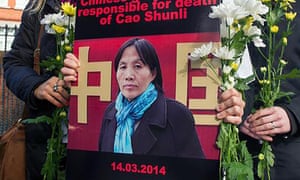
On 14 March Frances Eve (deputy director of research at Chinese Human Rights Defenders) wrote “Cao Shunli died five years ago. She stood up to China on human rights, and so must we.”
Veteran Chinese human rights activist Cao Shunli, who died in 2014 in a Beijing hospital. Photograph: Front Line Defenders
...This week is an opportunity to pay tribute to Cao Shunli, but also importantly, for the international community to speak up and remind the Chinese government of its obligations to safeguard human rights. On March 15, the UNHRC will be meeting to adopt a final report on recommendations made in November during China’s third Universal Periodic Review (UPR). ……States can use Friday’s meeting to speak out and pay tribute to Cao Shunli and all those who have died under Chinese police custody, reject China’s denials made during the UPR over its rights abuses in Xinjiang, and build momentum towards passing a resolution on the human rights situation in China……..Since the council’s creation in 2006, there has not been a single country-specific resolution directed at China despite a worsening rights situation. It’s time for the UNHRC to end its double standards and mandate an international fact-finding mission to look into the credible reports of internment camps in Xinjiang.
Many human rights defenders, like Cao, and ethnic and religious minorities have died in Chinese custody due to torture or deprivation of medical treatment. China’s only Nobel peace prize laureate Liu Xiaobo, Uighur scholar Muhammad Salih Hajim, and Tibetan monk Tenzin Delek Rinpoche all died in police custody in recent years.
Others, like detained citizen journalist Huang Qi, await such a fate without urgent intervention. Police have denied Huang, who has kidney and heart diseases, medical treatment and have repeatedly beaten him in custody. His condition has deteriorated to the point where supporters fear he may become “another Cao Shunli” and UN independent experts recently expressed concern he might die in detention.
Ten other Chinese activists, journalists, scholars, and lawyers are on a medical watchlist of political prisoners, launched after Cao’s death to draw attention to China’s practice of torture by withholding medical treatment…………..
It’s no coincidence that following a weak response internationally to the deaths of prominent human rights defenders and a widespread crackdown on civil society that the Xi government felt confident enough to establish a system of mass internment camps for ethnic Uighurs and Muslims and turn the Xinjiang region into a “no-rights zone”.
Human rights defenders and ethnic and religious minorities in China face real risks for standing up to the Chinese government. They don’t pay with lost trade deals but with their lives. The risks of speaking out in defence of human rights and fundamental freedoms in China include losing your job, your home, your family, or being disappeared, arbitrarily detained, tortured, or even killed.
Cao Shunli said before her death: “Our impact may be large, may be small, and may be nothing. But we must try. It is our duty to the dispossessed and it is the right of civil society.” States should remember her spirit and not be afraid to speak truth to power.
Press Emblem Campaign (PEC), a nongovernmental organization presented a statement on press freedom and journalist killings duringUnited Nations Human Rights Council 40th session in Geneva on 13 March 2019.
The Press Emblem Campaign (PEC) documented last year the killing of 117 journalists, an increase of 17 percent in media casualties compared to the previous year. In five countries journalists paid an unacceptable toll: Afghanistan with 17 killed, Mexico also with 17 killed, Syria with 11 killed, Yemen and India, with 8 journalists killed in each of those countries. The PEC urged the Members of the Human Rights Council to fight more firmly impunity and to bring the responsible of those crimes to justice.
The PEC is also worried by the large number of arrests among journalists in the recent turmoilin Sudan, the repression of press freedom in Nicaragua and Venezuela, the statement reads. PEC expressed itsspecial concern with the continuous judicial harassment of journalists in Turkey in the statement.
PEC was one of the organizers of the panel discussion on human rights violations in Turkey, which the Turkish government mobilized its entire diplomatic corps to prevent during 40th Regular Session of the UN Human Rights Council on 5 March. The move prompted an outcry from human rights defenders.[see: https://stockholmcf.org/erdogan-govt-fails-to-cancel-un-human-rights-council-event-on-turkey/%5D
Turkey is the biggest jailer of journalists in the world. The most recent figures documented by SCF (Stockholm Centre for Freedom) show that 211 journalists and media workers were in jail as of March 11, 2019, most in pretrial detention. Of those in prison 134 were under arrest pending trial while only 77 journalists have been convicted and are serving their time. Detention warrants are outstanding for 167 journalists who are living in exile or remain at large in Turkey. The government also closed down some 200 media outlets.
Sotoudeh was charged with spying, spreading propaganda and insulting Iran’s supreme leader. Photograph: Behrouz Mehri/AFP/Getty Images
Only yesterday I hoped that Nasrin Sotoudeh‘s invitation to the G7 would set a good precedent [https://humanrightsdefenders.blog/2019/03/11/does-g7-set-a-precedent-with-sotoudeh-for-inviting-human-rights-defenders/], now Reuters reports that she has been handed a new sentence that her husband said was 38 years in prison and 148 lashes! The news comes days after Iran appointed a hardline new head of the judiciary, Ebrahim Raisi, who is a protege of Ali Khamenei. The appointment is seen as weakening the political influence of the Iranian president, Hassan Rouhani. (NOTE: Her husband clarified later that she will be serving 10 years of the 33 he had announced on his Facebook page and in an interview with Radio Farda)
In the meantime AIreports that a series of videos shared on social media in recent weeks have shed light on the daily harassment and violent attacks women in Iran face at the hands of morality police and pro-government vigilantes seeking to enforce the country’s forced hijab(veiling) laws. The videos show members of the public or plain-clothes morality police aggressively confronting or attacking women for defying Iran’s degrading forced hijab laws, in the name of defending “public decency”. Perpetrators of such attacks appear to be getting bolder in their assaults in response to efforts by women to film the violence they face and share the videos on social media. “The video footage that has emerged in recent weeks demonstrates the shocking levels of abuse women in Iran face on a daily basis from morality police or pro-government thugs simply for daring to defy the country’s abusive forced hijab laws,” said Philip Luther of Amnesty International. Iranian women’s rights defenders have courageously filmed these incidents as part of the My Camera My Weapon campaign, which aims to raise awareness of the constant harassment and assault that women and girls face in Iran’s streets as a result of forced hijab laws.
Amnesty added:…..The charges on which Nasrin Sotoudeh was convicted include “inciting corruption and prostitution” and “openly committing a sinful act… by appearing in public without a hijab”. Some of the activities that the authorities have cited as “evidence” against her include: opposing forced hijab; removing her headscarf during prison visits; defending women who peacefully protested against forced hijab; giving media interviews about the violent arrest and detention of women protesting against forced hijab; and placing flowers at the scene where a woman protester was violently arrested.
The UN Human Rights Council also was dealing with Iran this week: Worrying patterns of intimidation, arrest, prosecution, and ill-treatment of human rights defenders, lawyers, and labour rights activists in Iran signal an increasingly severe State response to protests and strikes in the country, Javaid Rehman, the Special Rapporteur on human rights in Iran, said on 12 March 2019. “Today, the people of Iran face a myriad of challenges,” he told the Human Rights Council in Geneva. “Many have voiced their concern through protests, demonstrations, and strikes. People from diverse sections of society – from truck drivers to teachers to factory workers – across the country have protested.” “It is in this context of increased challenges that concerns are mounting about human rights, including the rights to freedom of peaceful assembly and to association in Iran,” he said, calling on the Government to release all those detained for exercising such rights. Presenting his first report to the Council, Rehman said the re-imposition of secondary sanctions by the United States of America had further increased concerns for the welfare of ordinary Iranians.
The Special Rapporteur also highlighted the alarming health situations of numerous imprisoned individuals such as human rights defender Arash Sadeghi [see also: https://humanrightsdefenders.blog/2016/09/30/iran-shameful-sentences-for-narges-mohammadi-issa-saharkhiz-arash-sadeghi-no-detente-in-human-rights/]. Rehman also highlighted the situation of prominent woman human rights lawyer Nasrin Sotoudeh who was reportedly convicted last week of charges related to her work and could face a lengthy prison sentence. Other issues raised in his report include concerns regarding the right to life and to fair trial, the situation of detained foreign and dual nationals, and the treatment of religious and ethnic minorities.
Human Rights Watch commented that the Iranian judiciary’s draconian sentence for a prominent human rights lawyer Nasrin Sotoudeh was an “appalling travesty of justice“.




 The Press Emblem Campaign (PEC) documented last year the killing of 117 journalists, an increase of 17 percent in media casualties compared to the previous year. In five countries journalists paid an unacceptable toll: Afghanistan with 17 killed, Mexico also with 17 killed, Syria with 11 killed, Yemen and India, with 8 journalists killed in each of those countries. The PEC urged the Members of the Human Rights Council to fight more firmly impunity and to bring the responsible of those crimes to justice.
 Hans Thoolen on Human Rights Defenders and their awards