On Wednesday 9 September 9am-12pm (New York time)Amnesty International and the International Service for Human Rights will hold – as usual – an online pledging event for candidate States in advance of the Human Rights Council elections that will take place this autumn for the membership term 2021-2023,. State representatives and civil society are invited to participate actively in the events and pose questions to candidate States.
The link to attend the event will be shared closer to the date.
Have a question? Follow the event on Twitter and submit questions to candidates via: @ISHRglobal #HRCpledging #HRCelections2020
Kim Seung-yeon on 16 July 2020 reported that Signe Poulsen, Seoul office chief of the U.N. Office of High Commissioner for Human Rights (OHCHR), will leave South Korea this week for a new position in the Philippines, ending her five-year term monitoring human rights situation in North Korea. As it it the end of her normal term it is not clear whether there is any link to her speaking out on the issue of balloons sent over the border. [see https://humanrightsdefenders.blog/2020/06/29/un-representative-in-south-korea-sees-balloon-actions-as-freedom-of-expression/]
“It’s been a great inspiration interacting with civil society and activists working on North Korea’s abduction issues and separated families, and people who continue to make progress in getting their voices heard,” she told Yonhap News Agency on Thursday.
Poulsen said while she has “many regrets” over the lack of progress in improving human rights in the North, the U.N. now places far more weight on the issue compared to the past and that is a big step forward.
“North Korea has not unfortunately seemed to have gotten any better since we opened the office. But the U.N. and the international community are now fully engaged on North Korea files. Firm placing of North Korea’s human rights violations in the U.N. system is important,” she said.
Leaving Seoul, she expressed hopes that inter-Korean exchanges at a humanitarian level, including reunions of separated families, will take place in a sustainable way in the long term.
“The solution is ultimately for the Korean people and not for me to say. For that to happen I strongly believe human rights must be part of all those engagement and interactions,” she said.
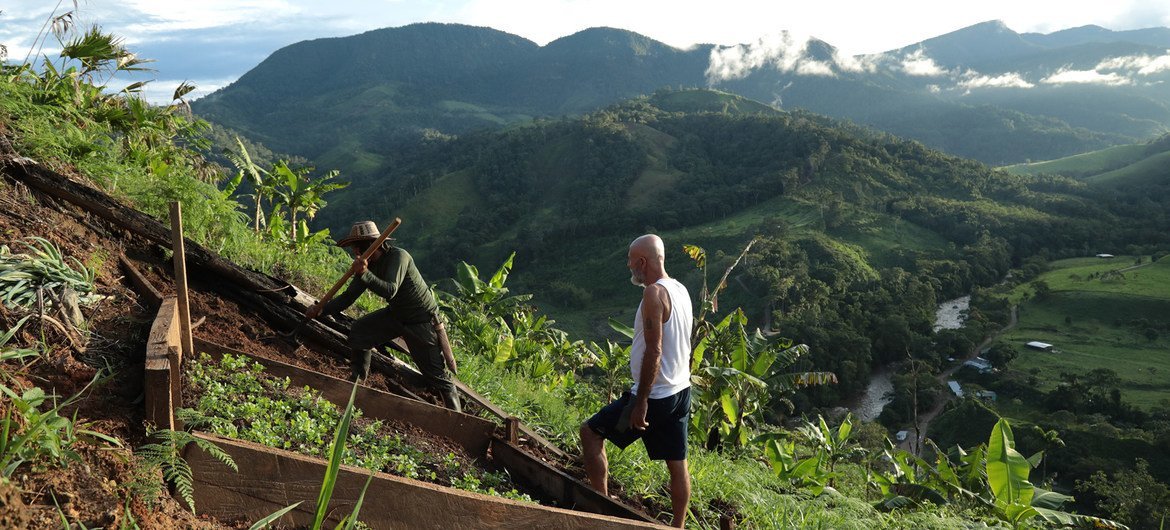
Some former combatants in Colombia, have now turned to farming following the historic 2016 Peace Agreement – UN Verification Mission in Colombia/Marcos Guevara.
On 14 July 2020 UN News made public the following assessement:
The killing of former combatants, human rights defenders and social leaders of communities devastated by decades of conflict, remains the most serious threat to peace in Colombia since the signing of a landmark peace agreement in 2016, the top UN official in the country told the Security Council on Tuesday, meeting in-person at UN Headquarters in New York, for the first time in four months.
Carlos Ruiz Massieu, Special Representative and head of the UN Verification Mission in Colombia, said authorities on 6 July arrested an individual allegedly behind the killing of Alexander Parra, a former member of the Revolutionary Armed Forces of Colombia—People’s Army, and leader of the former territorial area for training and reintegration in Mesetas, “These arrests are an example of the results that the mechanisms in the Peace Agreement can deliver”, Mr. Massieu said, and a reminder of the need to provide them with the support required to carry out their tasks. e.
Safety essential for those who laid down arms
After months of uncertainty and mounting security risks from illegal armed groups, Mr. Massieu said operations are now underway to transfer the former territorial area for training and reintegration in Ituango – where 11 former FARC-EP members and seven of their relatives were killed – to a new location in Mutatá…..
Presenting the Secretary-General’s report on the Mission, he said the COVID-19 pandemic has laid bare the vulnerable situation of roughly two-thirds of accredited former combatants who currently reside outside the former territorial areas for training and reintegration.
Offering a perspective from her own life, Clemencia Carabalí Rodallega, of the Municipal Association of Women, in Cauca, introduced herself as a survivor of a 4 May 2019 attack, which also threatened the lives of 25 other people working to defend the ethnic and territorial rights of communities in Colombia.
“Ethnocide in Colombia has not stopped,” she said. Not a day has passed since the Spanish invasion 528 years ago that a black or indigenous person has not been killed, a member of the indigenous or cimarrona guard has not been threatened, a woman has not been raped, or a human rights defender has not died by violence.
She said that since the signing of the Peace Agreement, 686 leaders and human rights defenders have been murdered, 160 of them in this year alone. She described the 2019 assassinations of a mayoral candidate from Suárez municipality and a governor of the Nasa indigenous community, along with the dismemberment, earlier this month, of a member of the Renacer Afro-Colombian Community Council, in Cañón del Micay.
“These situations have increased exponentially due to the COVID-19 pandemic”, she stressed.
She urged the President to fully implement the Comprehensive Programme of Safeguards for Women Leaders and Human Rights Defenders, and the Comprehensive Protection and Security Programme for Communities and Organizations in the Territories.
More broadly, she said the Government must comply with the entire Peace Agreement – especially its Ethnic Chapter and provisions on gender – and effectively investigate and prosecute those behind the violations.
She invited the international community to “put yourselves in our shoes” and visit the territories, accompanying Colombians in their peacebuilding initiatives, “not only through technical and economic support, but also with political commitment, as guarantors.”
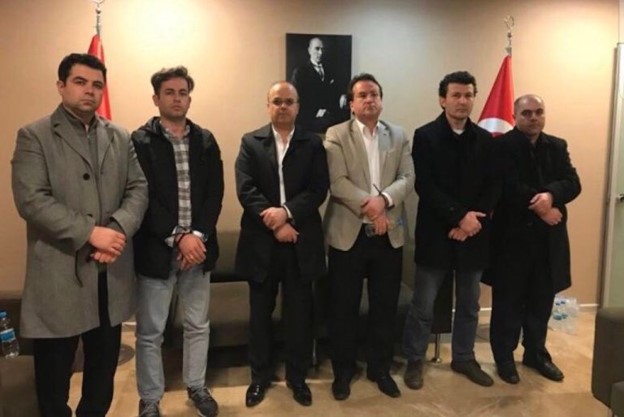
Turkish nationals who were abducted in Kosovo were kept for a time at the Turkish embassy premises.
On 9 July 9, 2020 the Nordic Monitor higlighted the shocking news that the Turkish government has signed bilateral security cooperation agreements with multiple states that were phrased ambiguously to allow for the expulsion or abduction of Turkish nationals living abroad, This is based on a joint UN letter on 5 May 2020.
Four UN rapporteurs/experts sent a joint letter to the Turkish government to express their concern about the “systematic practice of state-sponsored extraterritorial abductions and forcible return of Turkish nationals from multiple States to Turkey.”
“The Government of Turkey, in coordination with other States, is reported to have forcibly transferred over 100 Turkish nationals to Turkey, of which 40 individuals have been subjected to enforced disappearance, mostly abducted off the streets or from their homes all over the world, and in multiple instances along with their children,” the letter said.
Nordic Monitor previously reported how the content of Turkey’s security agreements has changed in parallel to the transformation of national legislation and that the new documents contained ambiguous copy-paste phrases designed to suppress government opponents outside the country.
“[The Turkish] Government has signed bilateral security co-operation agreements with multiple States allegedly containing broad and vague references to combatting terrorism and transnational crime. Sources claim that the agreements have been phrased ambiguously to allow for expulsion or abduction of anyone deemed to be a ‘security risk’ from third countries party to the agreements. There appears to be a clear link in the timing of the alleged operations – most, if not all, have been carried out within two years since the agreements entered into force. For instance, allegations are made that Turkey has signed secret agreements with several States, including Azerbaijan, Albania, Cambodia and Gabon, where several operations are reported to have taken place,” the letter stated….
Furthermore, rapporteurs, with reference to statements by Turkish officials, exposed the fact that over 100 alleged members of the Gülen movement have been abducted abroad by Turkish intelligence and brought back to Turkey as part of the Turkish government’s systematic global manhunt.
“Turkish authorities have not only acknowledged direct responsibility in perpetrating or abetting abductions and illegal transfers, but have also vowed to run more covert operations in the future. On September 21, 2018, it is alleged that Turkey’s Presidential Spokesperson stated during a press conference that the Government would continue its operations against the Hizmet Movement, similar to the one in Kosovo (March 29, 2018).”….
“We note in this respect that deprivation of nationality for the sole purpose of facilitating expulsion or removal goes against international law norms and standards. Finally, we wish to highlight that violations of international human rights obligations resulting from these agreements engage Turkey’s responsibility under international law as well as the third countries parties to the agreements” the letter said….
That Turkey takes an aggressive stand on anything that smacks like terrorism was made clear again on 7 July 2020 when Turkey’s Foreign Ministry slammed recent remarks by Sweden’s foreign minister against Turkey’s military operation in northeastern Syria while meeting via videolink with members of the PYD/YPG/PKK terrorist organization.
“Essentially this meeting was not the first in which Ann Linde came into contact with members of the terrorist organization. She previously held talks with members of the terrorist organization and participated in activities organized by people associated with the terrorist organization,” the ministry said late Thursday in a statement.
“It is a shame that so-called human rights defenders, who are becoming an instrument to the terrorist organization’s smear campaign, ignore the massacres, crimes and oppression…committed by these terrorists in Syria,” it stressed. [what the term “human rights defenders” here means is not clear] – https://www.aa.com.tr/en/turkey/turkey-slams-swedish-fm-for-meeting-with-terror-group/1905510
The admittedly Pakistan-based Geonet.tv gives a good summary of India’s disregard of concerns and objections in five letters by UN Human Rights Council (UNHRC) about human rights abuses in Jammu and Kashmir, India’s new terrorism law and the Citizenship law.
In the five letters, UNHRC experts raised pertinent questions and pointed out violations by Indian authorities of the resolutions by UN Security Council, General Assembly and UN Human Rights Council…
On July 4, 2020, United Nations Human Rights Council (UNHRC) made public 14 cases of worst possible human rights abuses in Jammu and Kashmir after the Indian government failed to respond to their concerns within the stipulated 60 days.
Four UNHRC Rapporteurs on torture, extrajudicial executions, minority issues and freedom of religion under HRC charter and mandate had written to Indian government on May 4th, 2020, to respond back on the 14 cases and countless other cases involving grave abuse of human rights in Kashmir after its annexation on Aug 5th, 2019. The UN Rapporteurs in the May 4th letter lamented that Indian government had not responded to their earlier letters on Aug 16, 2019, and February 27, 2020, on the atrocities in Kashmir. The two earlier letters questioned the restrictions in Kashmir on rights of expression and assembly and dissent following Indian annexation of Kashmir.
In another letter on May 6th, 2020, eight Rapporteurs of UNHRC and one Vice Chair of a Working Group raised serious concern on the new anti-Terrorism law passed by Indian parliament just before Indian annexation of Kashmir in July/Aug 2019. UNHRC questioned the detention of any accused for an extended period of six months under the new anti-terror law
In another letter on February 28th, 2020, eight Rapporteurs of UNHRC and one Vice Chair of a Working Group questioned the Indian Citizenship Act of December 2019 which discriminates against Muslims and bars them to get Indian citizenship whereas people from different religious beliefs who entered Indian before Dec 2014 are eligible for it. The letter also heavily criticise excessive use of force to quell protests against this Act which resulted in death of over 50 and injuries to hundreds.
In an interesting article published on 10 july 2020, Bruno Stagno Ugarte – Deputy Executive Director for Advocacy of Human Rights Warch – sees encouraging signs of a revival of the leading role of the Nordic countries when it comes to international human rights policy.
…There are encouraging signs these countries might be ready to re-engage in denouncing grave abuses and lead international efforts for country-specific scrutiny and accountability.
..If Iceland with a population of 365,000, found the bandwidth to lead on two issues simultaneously, its larger Nordic neighbors can surely match both its courage and performance.
There are reasons to be encouraged on that front. In June, Finland supported the creation of a Libya investigation by the Human Rights Council to document violations committed by all parties and preserve evidence. Denmark, currently a member of the Council, is considering addressing ongoing rights violations by Saudi Arabia. And now that Norway has been elected to a non-permanent seat on the United Nations Security Council for the 2021-22 term, we hope it will become a principled voice for human rights and lead on country-specific situations.
In the absence of leadership by larger states, it is incumbent on smaller states, individually and collectively, to ensure that multilateral tools remain relevant to address dire human rights situations. The Nordic countries have done so in the past; it is time for them to do so again.
On 9 june 2020 Agnes Callamard, the UN special rapporteur on extrajudicial, summary or arbitrary executions, urged member states to pressure Saudi Arabia to free women activists before a G20 nations summit which Riyadh will be hosting in November. At least a dozen prominent women’s rights activists were arrested in Saudi Arabia in 2018 as it lifted a ban on women driving cars, a step that many of the detainees had long campaigned for. The women were rounded up as part of a broader crackdown on dissent that extended to clerics and intellectuals.
Several of the arrested women have alleged torture and sexual assault in detention. Saudi officials deny this and said the detainees were suspected of having harmed Saudi interests and offered support to hostile elements abroad.
Some of the activists are now on trial, but few charges have been made public. Charges against at least some of the activists relate to contacts with foreign journalists, diplomats and human rights groups. Their prosecution has drawn global criticism, particularly following the 2018 murder of journalist Jamal Khashoggi by Saudi agents inside the kingdom’s Istanbul consulate. (as Rapporteur Agnes Callamard also dealt with Khashoggi’s killing: https://humanrightsdefenders.blog/2019/12/23/the-unsatisfactory-end-to-the-khashoggi-investigation/)
Earlier Amnesty International had called on Saudi Arabian authorities to immediately release women human rights activists, including those who are “being punished for daring to drive.“…. Amnesty UK has launched a “Beep for freedom” campaign in support of the persecuted women’s rights defenders. The campaign involves supporters sharing photos of themselves behind the wheel of a car or sharing the campaign’s “Beep For Freedom” car horn symbol, with an appeal to the Saudi authorities to “immediately and unconditionally” release the activists and drop all charges against them.
With thanks to Reliefweb for posting on 7 July 2020 here UNDP’s launch of a project to implement the human rights and bussines agenda.
Excerpts from the speech by Mourad Wahba (Assistant Administrator of UNDP and Director of the UNDP Regional Bureau for Arab States):
UNDP has been working on advancing the business and human rights agenda since 2016 when we started a regional programme in Asia, built around the participation and partnership of governments, businesses, Civil Society organisations, National Human Rights Institutions, trade unions and other stakeholders. Our work has been strongly aligned with the UN Working Group on Business and Human Rights, the Office of the High Commissioner on Human Rights, ILO and the OECD.
Our collaboration will now grow. Last week, UNDP launched a Global Initiative on Business and Human Rights building on our achievements in Asia, which will incrementally expand to the rest of the world.
The Global Initiative will have four main fronts:
Supporting governments in developing and implementing National Action Plans;
Strengthening access to justice for victims of business-related human rights abuses;
Advising corporations on how to address human rights risks; and
Enabling peer-learning for government officials, businesses, civil society and national human rights institutions.
We are honoured to partner with the Working Group and OHCHR, to chart the lessons learned since the adoption of the Guiding Principles and accelerate their implementation. Over the coming 12 months we will be hosting regional consultations, which will guide the development of a joint Roadmap for the Next Decade of Business and Human Rights.
Our network of five regional offices and 170 country offices will be leveraged to ensure all relevant stakeholders, including representatives of vulnerable and marginalised groups, are consulted on the way forward.
UNDP believes that the elaboration of this Roadmap should be guided by the goals set in the 2030 Agenda and the Secretary General’s Call to Action for Human Rights….
Verafiles of 6 July 2020 carries the personal impression of human rights defender Mary Aileen D. Bacalso who attended the 44th seesion of the UN Human Rights Council where the Philippines was on the agenda.
Participation to the 44th session of the UN Human Rights Council was mostly online. Inset photo on the left is UN High Commissioner of Human Rights Michelle Bachelet. Inset photo on the right is Philippine Justice Secretary Menardo Guevarra.
During the last two and a half decades, ..I would never have believed that I should see the UN session hall almost empty as it was during the 44th session of the UN Human Rights Council, which opened on 30th June 2020. Participation was online due to the COVID-19 pandemic.
The Republic of the Philippines, one of the founding members of the United Nations, was yet again subjected to international scrutiny at the outset of the 44th session. The UN High Commissioner of Human Rights said that according to her office’s report the Philippine situation is “near impunity.” This from the first female Chilean president, Michelle Bachelet, a woman who survived torture during the Pinochet dictatorship: she was referring to Philippine laws and policies directed at the drugs business and threats to national security, whose implementation has led to the killing of 248 human rights defenders – lawyers, journalists, trade unionists – between 2015 and 2019.
….Yet barely a week after the start of the UNHRC session, the bill has already been signed into law, on 3 July 2020. This draconian law, which introduces warrantless arrests among other curtailments of fundamental freedoms, is vehemently opposed by civil society….
At the 44th session, members of the European Union, part of the Western European and Other Groups, expressed profound concern about the direction of the Philippines, emphasizing the consequences for human rights of the Duterte administration’s “war on drugs” and censuring its failure to implement recommendations made during the Philippines’ Third Cycle of the Universal Periodic Review.
ASEAN on the other hand, and other members of the Asia and the Pacific Group, as well as some states in other regions such as Venezuela, Cuba and Belarus, expressed their unequivocal support for the Philippines, noting in particular its collaboration with the UNHRC, its robust NGO community and its efforts in reducing poverty. China conspicuously praised the Philippines’ progress in human rights……
Philippine non-government organizations (NGOs) condemned their country’s withdrawal from the International Criminal Court; the arrest and detention of Maria Ressa; the endless implementation of extrajudicial executions; the shutdown of the largest television network, ABS-CBN; continuing enforced disappearances and torture; the red-tagging of Sister Mary John Mananzan OSB and of a number of NGOs; the shoot-to-kill order against COVID-19 lockdown violators; and the then-imminent enactment of what is now the 2020 Anti-Terror Law.
Towing President Duterte’s line, Justice Secretary Menardo Guevarra responded that transparency and constructive cooperation characterized the country’s engagement with the UN, while the Philippine Commission on Human Rights, which Duterte tried to eliminate in 2018 by giving it a budget of PhP 1,000 ($20), asserted the vital importance of accountability. Commissioner Karen Dumpit said that the past failure to protect human rights had directly led to the current climate of impunity, and there was an obligation on the Government to pursue social justice and uphold human rights.
The Philippines prides itself as a founding member of the community of nations, though to become a model of human rights promotion and defense remains a distant hope.
Mary Aileen D. Bacalso is former secretary-general of the Asian Federation Against Involuntary Disappearances. For her work against enforced disappearances, the Argentinian Government conferred on her the Emilio F. Mignone International Human Rights Prize in 2013, and she was awarded the 2019 Franco-German Ministerial Prize for Human Rights and the Rule of Law.
“Human rights defenders reconnect us to what makes the essence of humanity” says Michel Forst, the former UN Special Rapporteur in his foreword to the updated Guidelines on security and protection for grantees by the Norwegian Human Rights Fund (NHRF).
Jalila, Mohamadou, Paulo and Lita are all human rights defenders who work in difficult areas. In forgotten places, where the State does not operate anymore or where conflicts rage on. They provide support to women victims of sexual violence; they advocate for transitional justice; they visit peaceful protesters who have been arbitrarily detained. They bring human rights to the darkest, most isolated places. They are the voices for those whose voices have been stolen. Each and every day these ordinary women and men brave countless risks to be close to those they defend. Because they defend human rights they are targeted by those who benefit from human rights violations. Each day they must reinvent themselves and their most trivial routines. Jalila turns her phone off while having discussions with other defenders; Lita makes sure she travels back home while the sun is still high; and Paulo frequently changes the passwords to his social media accounts. When traveling outside his village, Mohamadou leaves instructions for his family as preparation for the possibility of being arrested and taken to jail.
Each day these four defenders feel in their own minds and bodies what it means to defend human rights in complex settings and thousands of other human rights defenders face the same situation on the ground. They cannot depend on protection from the State or constant protection from their own communities, so they bear the heavy responsibility of protecting themselves, staying safe alone. Some are fortunate to have the support of their organizations and movements but must still practice self-protection. Sometimes this individual responsibility feels like a burden and can have lasting and severe consequences on their psychological, physical and social well-being.
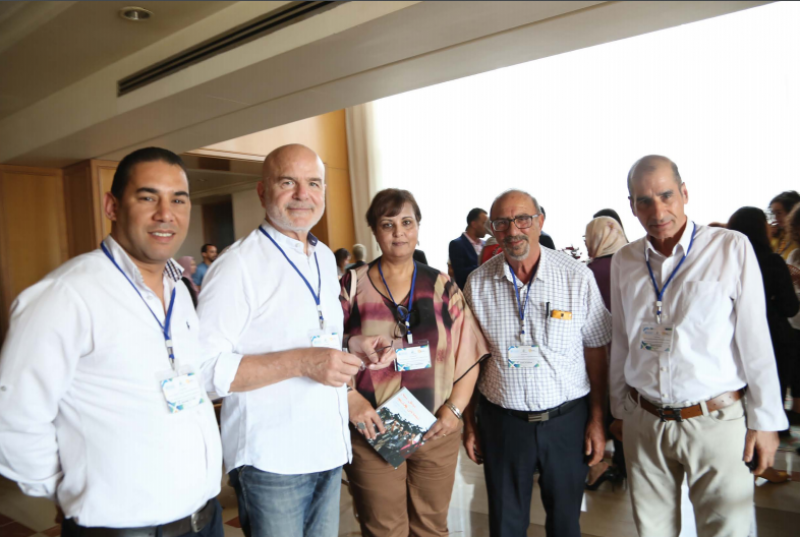
Former Special Rapporteur on the situation of HRDs, Michel Forst, with human rights defenders during a consultation on the situation in the MENA region (Photo: NHRF’s grantee partner, Gulf Centre for Human Rights).
In recent years, a number of initiatives across the globe have contributed to support defenders and to provide them with a set of concrete tools to mitigate risks. Defenders have been building solidarity networks and strategic alliances, they have developed risks analysis and digital security trainings. Women human rights defenders and indigenous communities have helped understand the necessity to develop collective and holistic approaches to security. Some States have developed laws and mechanisms to better protect defenders as a response to the current deterioration of the situation of HRDs. Over the past five years, I have heard and learnt about many good practices on protection, and I am pleased with the efforts of the NHRF to provide these guidelines as a resource to help identify and navigate these initiatives.
….Defenders often represent the last remaining hopes for those whose are left behind, who are excluded and despised by their societies. … it is imperative that we strengthen our support to these heroes. It is not only a matter of justice, it is for the sake of our common future, for our humanity. We must defend and stand and act in solidarity with these selfless, indomitable people.

 Hans Thoolen on Human Rights Defenders and their awards